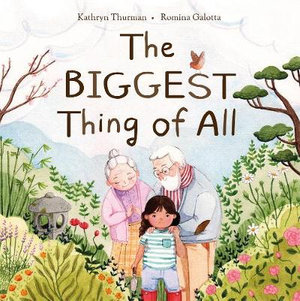
The biggest thing of all is an important story for all children, particularly those who have had experience with the death of a loved one. The book tells the story of Lily, her parents and her grandparents. They live all together and tend to the beautiful garden during the dry seasons. Grandma unfortunately becomes ill and eventually passes away, leaving Lily feeling lost and sad. When the snow clears, she sees a way to understand her feelings and celebrate grandma.
The main message used in this story is the everything is part of something bigger. The talk about one bee being part of a hive, one bird being part of a flock, and eventually one Grandma being part of their family. Lily uses this analogy to help guide her grief journey and come to an eventual place of acceptance within the loving embrace of her family.
The illustrations also help assist the message of the story, through facial expressions, images of the garden through the seasons and of Grandma's illness progression. The illustrations are watercolour which I find to be a media that suits an emotional topic well.
This story would be so helpful for younger children who are trying to navigate their grief, and for their family who are not sure how to help their children or where to start the conversation. Upside Down Books are committed to creating resources to help children navigate and understand emotionally challenging situations. They aim to provide stories and characters that children can identify with, enabling them to find a safe space for the processing of their emotions.
This is a book that I will definitely keep in my library and ensure staff are aware of its themes and whereabouts on the shelf. It is so important for children to have relevant reading materials for complex emotions as it can be difficult to have discussions when in the emotion is so raw.
Themes Grief, Family, Love, Death.
Lauren Fountain
Climate crisis for beginners by Eddie Reynolds and Andy Prentice. Illus. by El Primo Ramon
Usborne, 2021. ISBN: 9781474979863. (Age:10+)
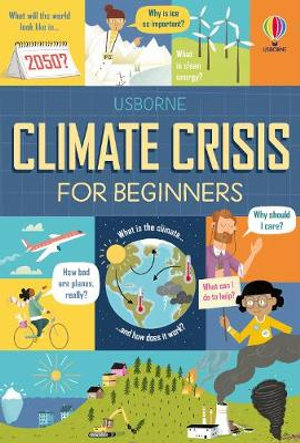
The climate crisis is real. It is already changing the world around us. How does the climate work? What are we doing to change it? What can we do differently to avoid the worst outcomes? Why do we all find change so hard? The climate crisis is a troubling and sensitive topic, especially for children, so the book includes vital tips on how to set realistic goals and not get overwhelmed by bad news.
Given the number of posts asking for suggestions for books about about sustainability that are being sent to the TL forums I belong to, this is a timely release. Using simple language and vivid illustrations to explain complex questions clearly, and make the concepts and solutions accessible to our younger students, it is another must-have addition to your collection that explores the planet and how we can make it better.
From the same series as 100 Things to Know about Saving the Planet, it has the usual Usborne integrity that talks directly to the reader to engage them and enable them to feel empowered to do something. It spans a broad range of topics and these are expanded by the pre-selected Quicklinks so the reader can follow their interests further.
It is the publication of books like this focusing on contemporary topics that compel schools to have vibrant, up-to-date non fiction collections in print format so that students have access to the information at their level at hand, rather than going down the rabbit hole of the internet.
Barbara Braxton
The day Saida arrived by Susana Gomez Redondo and Sonja Wimmer
Blue Dot, 2020. ISBN: 9781733121255. (Age:3+)
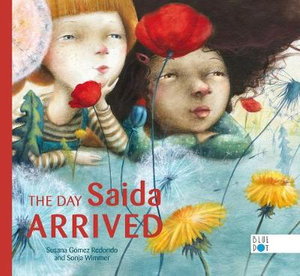
The day Saida arrived at the school she seemed to have lost her words and instead of joy and laughter there were tears and sadness. Her new classmate hunted high and low for the words but could not find them so instead, she drew a heart in chalk and Saida drew a smile. The first breakthrough!
When her dad explains that Saida probably hasn't lost her words, it was just that her words wouldn't work in this country, the little girl sets out to teach Saida the new words she needs as well as learning Saida's words. What follows is the beginning of a joyous, lifelong friendship that is so characteristic of our children when confronted with this sort of language problem. They work it out, find common ground, ignore boundaries and borders and learn together.
Having worked so often in schools where English is an additional language for so many, where students with no English at all come to get that first grounding before they go to their neighbourhood school, this story is a stunning portrayal of how kids get along regardless particularly when adults don't intervene. The playground is such a cosmopolitan learning space and whether the language is Arabic like Saida's or Tagalog or whatever, the children's natural needs overcome barriers. Enriching friendships are formed and their words that every "shape, sound and size" just mingle naturally.
With illustrations that are as joyful as the concept and the text, this is the perfect story to help students understand that being in such an alien environment can be bewildering and confusing, that there will be times when they are in Saida's shoes and their words won't work, but there is always help and hope. Because the learning between the girls works both ways, the story values Saida's Arabic as much as her new friend's English so that Saida is an equal partner in the story, offering a subtle nudge for us to consider how equally we treat our NESB students. What accommodations can and do we make for those whose words don't work in our libraries and classrooms?
Teachers' notes are available and while these are written for the US, they are readily adaptable to the Australian situation.
Barbara Braxton
Bedtime is boring by David Campbell. Illus. by Daron Parton
Scholastic, 2021. ISBN: 9781760976507. (Age:3-7 years, Tired parents) Highly recommended.
Bedtime is boring by David Campbell is a funny picture book that will resonate with both the child listening and the parent/caregiver who is reading!
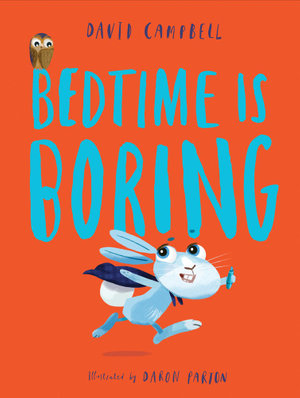
The story follows a cheeky little rabbit who doesn't want to go to bed because not only is it boring but they have so many other thing to do! Bouncing, burrowing and building are all activities that Billy the bunny believes are very important to do instead of going to bed. Throughout the story we hear many (familiar) excuses as to why he shouldn't go to bed - eventually wearing himself out and getting in to bed.
The thing I really loved about this story is how much we could relate to it! I read it to my 6 year old daughter and she thought it was a great story. In her words "The Mummy and Daddy rabbit sound just like you when I don't go to bed!". David Campbell has really succeeded in engaging both the reader and listener through this link.
The illustrator, Daron Parton, has brought the rabbit family to life in such a bright and fun way. The rabbits portray very familiar emotions and physical stances (hands on hips, eye rolls and the look of a worn down parent!) which I feel adds huge value to the story. In particular the facial expressions of the parents - every time I have read the book their faces resonate with me and link to my personal experience of bedtime with children!
Overall, a great book for young children and their eternally tired parents
Themes Bedtime, Rabbits, Parenting.
Lauren Fountain
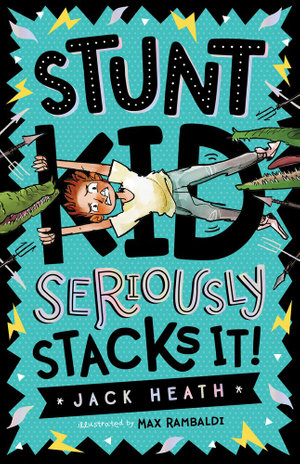
Stunt Kid seriously stacks it! by Jack Heath. Illus. By Max Rambaldi
Scholastic, 2021. ISBN: 9781760970598. (Age:8-12) Recommended for reluctant readers.
Levi is the reluctant 'star' in his father's adventure series, 'Kid Kablam’' Unfortunately, his life is at risk throughout the filming, after all he is the kid that gets 'kablammed'! This bizarre story weaves its way from one disastrous stunt to another and all the while Levi just wants to go to the Library and read. This story has hints of an extreme Wimpy Kid style combined with all other ridiculous action stories created for reluctant male readers. It is silly and preposterous and it goes into ludicrous and unbelievable territory in the bizarre town of Mount Cabbage.
Jack Heath has created many action adventure stories for older readers and his books are much enjoyed. This book is far more comedic and foolish and does not fit into the same class, however younger readers will enjoy the sheer escapism of the reluctant stunt boy. There are many examples of word play woven between the exploding scenes and the black and white illustrations are suitable quirky. This is the kind of book to get hesitant readers reading and therefore can be recommended.
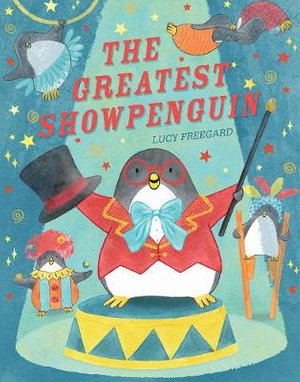
Poppy the Penguin comes from a long line of circus performers. Many skills have been passed down from penguin to penguin. However, Poppy soon decides that performing in the family circus is not for her as she prefers to feel calm and in control. But the hardest thing is not juggling, or riding a unicycle - it's telling her mum that she doesn't want to perform any more.The bravery is worth it when Poppy discovers a better role - organising and coordinating the whole show. And what a show it turns out to be!
So often, we, as parents, lead our children down the path of learning the things we like to do and expecting them to love them with a similar passion. But it can be a road fraught with danger because our children always see us as the experts and that somehow they are never going to be quite good enough, which can lead to mental health and self-esteem issues. Even though Poppy is very good as a performer and her parents are really proud of her, deep down inside she knows that the limelight is not for her and luckily she not only has the courage but also the relationship with her parents to express her unhappiness. Perhaps sharing this story might be the catalyst for our students to have similar conversations if they feel they have the need.
Freegard also brings up another element that often rears its head, particularly during class performances - that of "job snob". How often is the lead in the school play sought by the class's leading light and both child and parents celebrate their celebrity? Yet, as Poppy shows, the whole show cannot go on without those backstage workers, the support cast and everyone else who helps to make it happen. Here is a great opportunity to demonstrate that no job is better or more important than another - they are just different and without one, others will flounder. The school cannot function without all the admin staff making it easier for the teachers to do their thing.
Some big life lessons in one little book!
Barbara Braxton
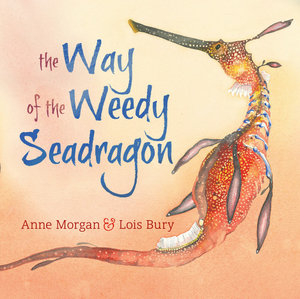
The way of the weedy seadragon by Anne Morgan. Illus. by Lois Bury
Down in the seaweed and kelp forests of Australia's southern coasts dwells a creature that looks like it has come straight from the pen of one of our children's book illustrators. With its colourful spots and bars, long snout and tail and dingly-dangly camouflage bits it revives any loss in the belief of dragons. The little weedy sea dragon (and its cousins the leafy sea dragon and the ruby seadragon from WA) are among the fascinating creatures that live in this new world of under the water and to have had the privilege of watching their graceful mating dance remains one of my most precious scuba-diving memories.
In this stunning book, not only is the reader introduced to this intriguing inhabitant of the ocean but also to the reason that these sorts of non fiction titles must remain an essential element of the school library collection. "Everything" may be "available on the Internet" but who would know to investigate weedy sea dragons if you don't know they exist? You don't know what you don't know. Alongside Bury's delicate illustrations, Anne Morgan has crafted a text as graceful as the dragons' dance and accompanied it with further information that whets the appetite and supports the development of those critical information literacy skills. As well, there are extensive teaching notes for Yr 2-6 that focus on Science, English and Media Arts,leading the reader to consider how individual characteristics help species survive and thrive. A must-have that will lead young non fiction readers into their own new world. If there are dragons in the oceans, what else might be there?
Stories about life as a member of a gang have been around for a long time – The Outsiders, even Romeo and Juliet. In some ways, this is just another one but in other ways it has its own place in the literature. Angie Thomas has set her story in the 90's, in a fictional poverty-stricken black neighbourhood in the United States, a sort of pre-quel to The Hate U Give. Drugs are rife, jobs poorly paid. Gangs and the associated violence are the narrative of the world in which the characters live. Rising above that world is almost impossible as the gangs' claims are generational and opportunities to avoid those claims are few. Maverick Carter is a young black man, still in high school, who is torn between the security of the gang life and taking the straight road. Shouldered with the sudden responsibility of a baby, he is forced to consider his future and how he is going to face things as father when the world seems to be against him.
While some of the events in this book are predictable, others take a different turn than expected. This book is about relationships, positive and negative; perceptions from differing points of view; poverty and deeply ingrained hopelessness; racism; and what it means to be an adult. Concrete Rose could be read as a complement to other books about the race divide or gang violence. It is a compelling read although at times, the vernacular does get in the way of the story.
Themes Gang violence; Poverty; Relationships; Racism.
Gaye Howe
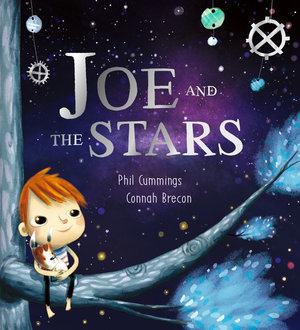
Joe and the stars by Phil Cummings and Connah Brecon
Recalling his own childhood, moving from a carefree existence on a farm to a place where he could no longer see the myriad of stars he once cherished, Phil Cummings engages the younger reader who may feel at odds with a new environment, at a loss when change is underway, underwhelmed when things look different.
For Joe, the move to the city is not a happy one. He now lives in an apartment without the endless blue sky of his early years, or the red of the endless horizon, the shelter of the huge tree next to his house and the vast night sky under which he sat with his Dad.
His new home is vastly different: a small apartment with a shoe box sized window looking onto a paved courtyard and one small tree in its centre, a city filled with noise and so much light at night that he can not see the stars.
Phil Cummings gets to the heart of his hero: recalling his own youth at a time of immense change, when things had an uncertain edge and he had to look inside himself for comfort. In this story Joe builds his own night sky, fashioning stars to hang from the bare branches of the neglected tree, waiting for the lights of the city at night to bring them to life. Doing this attracts the attention of other children and where once he was alone and unhappy, he is now accepting and befriended.
A text full of contrasts: life on the farm compared with life in the city, Grandpa's tree and the courtyard tree, its once bare branches now sporting a tiny green leaf, the farm house and the apartment, the night skies, all underline the change Joe is having to absorb. The text underscores words which add movement and sound; the 'toot, screech and beep' of the city, and 'ting tong' of the wind chime in the tree. Readers will love emphasising those words as they appear in the text, a wonderful moment for movement, noise and dance.
The luminous illustrations are full of intriguing contrasts; the endpapers are similar but different and children will love noting those differences which reflect how Joe's life has changed. The colourful double page sweep of the farm and the night sky on the title page is paralleled through the story reprising Joe's relationship with the stars while the double page spread in the city is totally different, mirroring the change in circumstances. The tiny window he now uses to view the night sky is an unsettling contrast with what he once had and children will look at that image with sympathy. But eagle eyes will be heartened when they notice shadows of his former home in the new night sky and its one small star.
And a YouTube link takes you to a song penned and sung by Phil about his childhood on the farm giving a context and companion to the book. I can hear voices singing along with the chorus and imagine lots of foot tapping while children marvel at the images the clip shows of rural Australia. A wonderful adjunct to a story of resilience and change.
Themes Resilience, Change, Stars, Night sky, Rural life, City life, Family.
Fran Knight
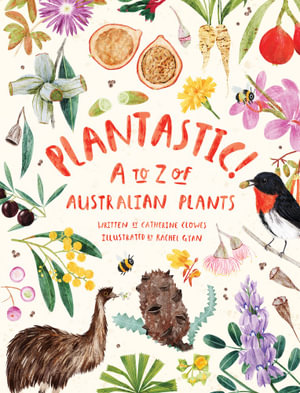
Plantastic! A to Z of Australian Plants by Catherine Clowes
While books about Australia's unique fauna abound for readers of all levels, there are fewer that focus on our unique flora and even less for younger readers who are just developing an interest in the plants the populate our landscape.
In this new publication from CSIRO, 26 of our well-known and not-so plants are in the spotlight offering an introduction to things we see daily and those that are not so common yet still readily seen in local environments. Maps pf plant ecoregions enable readers to identify what they are most likely to see where they live. Each double page spread has a similar format with some detailed information using accessible language that speaks directly to the reader ensuring challenging scientific concepts are easily understood such as the exploration of plant classification (families,genera and species) through the analogy of mixed lollies; an interesting fact that goes beyond the scientific nature of the plant; and an activity that encourages the reader to discover more about what they have just read and engage with the plant. There are beautiful biologically accurate watercolour illustrations of each plant and its parts, while the whole has all the necessary elements to encourage easy navigation and information literacy skills. Comprehensive teachers' notes are available spanning a number of the Australian Curriculum areas, including a focus on the use of the plants by indigenous people.
If we are to have our students value our bushland then they must first know what there is to value (and there are pointers about how to explore it so that both explorer and environment stay safe) and so this is a must-have for any library collection and study that has the protection of our habitat at its heart.
Barbara Braxton
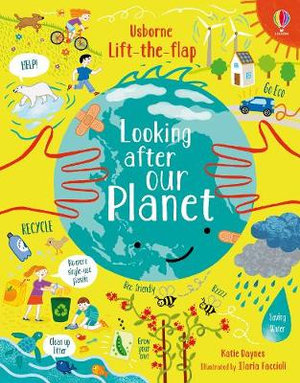
Lift-the-Flap Looking After Our Planet by Katie Daynes. Illus. by Ilaria Faccioli
The salvation of the planet and particularly, those things that individuals can do to work towards that, has certainly been the hot topic in publishing over the last year or so. And now Usborne have added to the mix with another one of their amazing lift-the-flap books.
This one gives a good overview of why we need to protect the planet, what has been causing it to deteriorate, specific issues that changes in human behaviour can address and an action plan that suggest small changes that make big differences. But don't be misled by the lift-the-flap format because this is more a book for independent readers who have some concepts about the environment and its sustainability. Although the facts are straightforward as they introduce the various concepts, plentiful and illustrated in an engaging ways, the reader still has to be mature enough to understand them.
In addition, the format offers a model for students to build their own resource. Encourage them to pose a question about a topic that interests them, seek and verify the answer and then present it in a lift-the-flap type format for others to discover. To assist with this and give greater insight into the various concepts, Usborne has provided its usual Quicklinks making this an essential resource on this topic.
Barbara Braxton
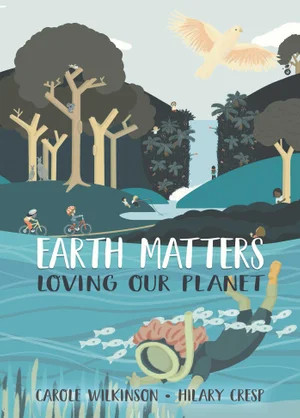
Earth matters by Carole Wilkinson. Illus. by Hilary Cresp
The brief introduction to Earth Matters talks about how over the past 50 years maximum temperatures have been creeping higher and there have been record droughts, floods and bushfires. This is a sobering thought for most adults and young people with this new release carefully explaining the history of how and why this has happened. There is an initial explanation of the difference between climate and weather which leads onto Earth's atmosphere and to global warming and greenhouse gases. Fossil fuels, renewable and non-renewable energy, extreme weather and waste are clearly discussed in an easy-to-understand and follow manner. The book cleverly offers a plan to enable students to see how they can help change the destructive path Earth is heading down as well as giving very do-able options for making better choices in the future.
This is beautifully presented book with a striking cover and end papers. The simple pastel illustrations used throughout book complement the text perfectly and give the reader images to focus on. There is a Contents page as well as a detailed Glossary and Index. This book is a very interesting and informative read and would be a welcome addition to any school or public library.
Themes Climate Change, Planet Earth, Choices.
Kathryn Beilby
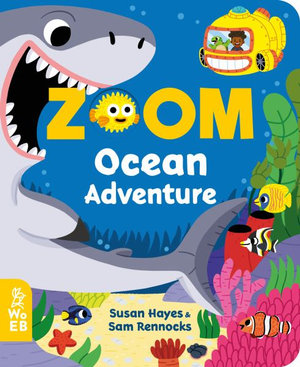
Zoom ocean adventure by Susan Hayes. Illus. by Sam Rennocks
What on Earth Books, 2020. ISBN: 9781999967994. (Age:1-5) Recommended.
Like Zoom Space adventure, the reader is taken off into an exciting world, this time the ocean, where brightly coloured marine life will be enthralling for a young reader. Noah is a young boy who dons his wetsuit, fins and snorkel and dives down deep to see some amazing creatures, like an octopus, butterfly fish and of course a Great White shark. Each page has a myriad of sea creatures to look at and some are labelled which will be a boon for beginning readers as well as an adult who may be reading this aloud. The cut-out on the page will give a glimpse of what will be on the next double page spread and children will enjoy guessing what it might be.
The illustrations are very cute and there will be 'oohs' and 'ahhs' as a page is turned and the razor sharp teeth of the hungry shark emerges. Noah escapes to his submarine and the reader is taken down into the dark water to find out what lives down there. Lots of creatures like the vampire squid and comb jelly are highlighted against a black background and then the reader spots a pirate ship and finally is taken into Antarctic waters. A pop -up of a humpback whale’s water spout shows Noah getting a ride home.
Readers will learn lots about the ocean while having fun with the idea of using your imagination to go on adventures. The strength of the board book ensures that it will last the use of little fingers and is likely to become favourite.
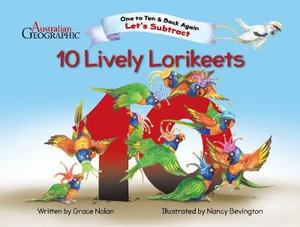
Ten lively lorikeets by Grace Nolan. Illus. by Nancy Bevington
Big Sky Publishing, 2021. ISBN: 9781922265630. (Age:4+) Recommended.
10 Lively Lorikeets is another book in a delightful series of rhyming picture books showcasing early mathematical concepts for younger readers. In this book the young reader is introduced to basic subtraction. Each double page shows beautifully illustrated lorikeets flying away to join other Australian birds. The birds included in the book are magpies, cockatoos, rosellas, kookaburras, galahs, emu chicks, wattlebirds, fairy wrens and lyrebirds.
The clever rhyming text is both simple and appealing e.g. Ten lively lorikeets chatting in a line. One chased a kookaburra then there were . . .
On each page is an easy subtraction equation presented in a horizontal format. At the end of the book are fun learning activities including counting backwards from ten to zero, an explanation of minus and take away plus some subtraction sums for the reader to try on their own.
For teachers or parents this will be a lovely book to share with young children who are just beginning their mathematical journey. The other titles in the series are 10 Naughty Numbats and 10 Bush Babies.
Themes Mathematics, Counting, Simple Subtraction, Australian Birds, Rhyme.
Kathryn Beilby
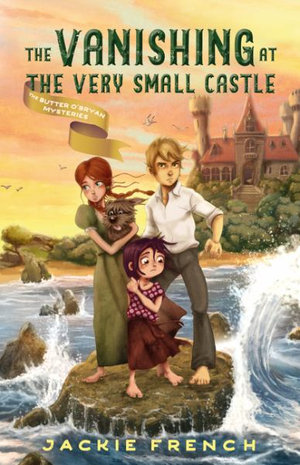
The vanishing at the very small castle by Jackie French
The Vanishing at the Very Small Castle is the second historical read in the Butter O'Bryan Mysteries.
Butter O’Bryan lives with his father and his very eccentric and entertaining Aunts: Peculiar, Cake and Elephant. Also living at the Very Small Castle are Gil, Olive and Tish, children who have lost their parents and whom Butter befriended in the first story, The Ghost of Howlers Beach. The setting of this story is once again the secluded Howlers Beach and the very impressive castle where the main characters live. For most of this story Butter's father and Gil are absent seeking treatment for Gil's polio. The remaining children are under the care of the Aunts and become involved in movie making and mystery. A disappearing leading lady, a giant of a man known as the Monster, circus acts, deception, numerous shared meals and a wartime romance all provide an entertaining and exciting read. The disappearance of Delilah Devine and the pointing of a finger of suspicion at the Monster leaves Butter, the Aunts and the Police all questioning the reality of what is really going on. Young Tish is unwavering in her support of the Monster and in the end Butter will solve the disappearance and truth will prevail.
In the Author Notes Jackie French has provided detailed information about historical aspects of the time as well as well-known and famous Australian recipes such as the pavlova and Victorian Sponge. This book would be an excellent read aloud for classes studying early Australian history.
Themes Australia, Great Depression, Film making, Adventure, Mystery, Families, Friendships, History.