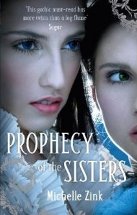
Atom, 2010. ISBN: 9781905654499 Prophecy of the sisters is the first novel in the trilogy of the
prophecy of the sisters. It is followed by Guardian of the gate
which
is then followed by The circle of fire. This compelling novel
follows
the story of twin sisters Lia and Alice Milthorpe. This story is
told from Lia's point of view.
The plot, like the rest of the book is excellent. Lia and
Alice Milthorpe find themselves in the middle of an ancient prophecy.
This prophecy has turned generations of twin sisters against each other
for centuries. What is going to happen to Lia and Alice?
This novel is set in London in 1890 with Lia just discovering
what is
going to happen to her and her twin sister's lives. The
characters in this novel change quite superbly as the story progresses,
with some characters growing wise and warm hearted while others turn
cold and don't care for anyone but themselves. Throughout the story we
meet a lot of new characters including Louisa, Sonia, James and Aunt
Virginia, just to name a few.
In
this beautifully crafted novel a lot of different themes represent
themselves. The main themes are: Family, friendship, love, loss and
death.
Over all this is a simply stunning novel and I would recommend it to
teenagers who like fantasy/mystery books.
Emily Madden (Year 9).
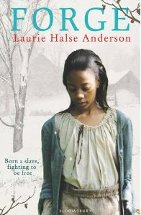
Forge by Laurie Halse Anderson
Series: Chains. Bloomsbury, 2011. ISBN 978 1408803806.
(Ages 10+) Recommended. Historical. During the American War of
Independence, one of the rallying battles, now remembered with pride,
was the Battle of the Valley Forge. The harsh winter of 1773 saw
Washington's piece meal army camped near Albany in New York State.
Deserters, Indians, freed and escaped negroes, farmers, young men
devoted to the cause, but all without proper discipline, munitions or
food and clothing, were to be brought together under the stern command
of General Nathaniel Greene. This piece of history is the backdrop to
the continuing story of Isabel and Curzon, two negro slaves readers
first met in Chains (2007).
They have now separated, and Curzon has joined the Continental Army at
its camp, seeing first hand the mess the army is in all the while
keeping a low profile in case he is recognised and recaptured. Through
his eyes the daily life of the soldiers comes thrillingly to life. We
see
them scavenging for food, their meagre portions contrasted brilliantly
with the excess of the officers. Forced to build their own wooden huts
without nails and with only a minimum of equipment, they resort to
stealing from local farmers, to augment the rice and flour they are
given.
We see the bickering and politics which divides many of the camp, and
the reality of daily life for these men, stuck in this freezing and
miserable place, waiting possibly to be killed.
The tale of Curzon and Isabel is engrossing, and the background against
which their story is told, enlightening in the extreme. The short
chapters begin with a date and a quote form one of the commanders at
the battle, and the story is then told from Curzon's perspective. The
first book in this series, Chains, told their story as slaves,
and the
third, Ashes, will be eagerly waited for.
Fran Knight
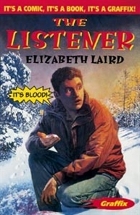
The Listener: Colour Graffix by Elizabeth Laird
Allen and Unwin, 2010. ISBN 9781408122358.
The central character in Elizabeth Laird's graphic novel, Gavin Foster,
is not happy because he is sent to his Gran's for the weekend, but,
when he arrives at Gran's house no one is there. The mystery deepens
when Gavin goes out back and sees footsteps printed in the snow. What
happens next? The Listener is a mystery and an adventure as we follow Gavin's
quest
to find his Gran. It is a fresh and original book that will be great
for middle school children. And once you start reading it you will not
be able to stop. The book draws you in from the first chapter.
Elizabeth Laird writes great book for children and young adults, titles
include, Hiding Out, The Witching Hour and On the
Run.
Tyson Brown (Year 9)
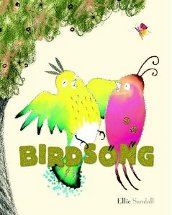
Birdsong by Ellie Sandall
Egmont, 2011. ISBN 9781405247382.
'One small bird, in a tree - kitcha, kitcha, kee, kee, kee' is
joined by a
friend 'Urrah! Urrah! Rah rah ree'. And more and more friends
come and join this wonderful bird chorus. Everything is fine until "'a
huge
bird with a mighty beak joins them with a piercing shriek'. But then
something else lands on the branch and he gets his come-uppance!
A simple theme with an old message that makes a delightful story with
heaps of potential for the classroom. Kindergarten had
enormous fun acting it out but were challenged when I asked them to
make their
bodies the orchestra - they had to make all the bird sounds but they
couldn't use
their mouths. Then we made a body band with little groups beating out
different rhythms in sequence and together. It was like singing a round
but
using our body music. Trace around your hand with thumb and pinky
outstretched on a piece of paper towelling, drop a few drops of dye so
the colours gently merge (because that's how they think Ellie Sandall
did it), add some
lines with black pencil for features, cut them out when they are dry
and you
have your own bird to add to the branch. But not until you've invented
your
own sound for it so we can have another body band and more laughs.
And when all that fun and learning about the delight of language and
stories is done, talk about the message of the story and have them
complete
their own: 'I got so ______ when __________ and I __________.' Get
them to illustrate that, if you dare, because Heidi wrote 'I got so
full when I
ate the last Easter egg that I spewed!' and Ellie wrote 'I got so mad
when
my brother teased me again that I punched him.' Ya got love 'em!
Barbara Braxton
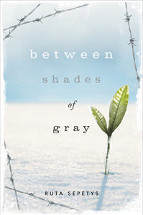
Between shades of gray, a novel by Ruta Sepetys
Penguin. 2011. ISBN 9780143205418.
(Ages 12+) Recommended. Historical fictionalised biography. I was
amazed reading this book, based on the reminiscences of the author's
family, of the extent of Stalin's purges in the days when he was
dictator in Russia. The Baltic states, Lithuania, Estonia and Latvia
came under his thrall during the years following World War 2. He
systematically absorbed these countries into Russia, taking over their
homes and cities, deporting many millions to the death camps in
Siberia, where without proper food, clothing or housing many died. It
is part of our history that is not well known, but this book shines a
light on this little known aspect of Stalin's regime.
Using her father's memories and her own research in Europe, Sepetys
added many of the stories she had heard to forge a tale of one girl's
journey across Russia to Siberia and back. Lina and her family are
bundled onto a train with carriages meant for animals, where they
survive on bread and slops, all the while worrying about their father.
Allowed one suitcase, they find life miserable. They are first held at
a village in the Arctic Circle, where they must pay rent for their
accommodation, and then they are herded back onto a train to go further
north to a slave labour camp in Siberia. Here they are forced to build
their own huts under the cold stare of the soldiers. Lack of good food
and medicine sees the younger and older members die, while all the time
the people pray for help and rescue.
Like many of the stories told about Nazi Germany and its treatment of
the Jews, so this story will add to readers' knowledge of the brutality
of one of the world's nastiest regimes, that of Stalin's Russia. The
few that survived came back to their home degraded and humiliated, only
to find that Russians now lived in their homes, and they were relegated
to refugee camps, forbidden to talk of what had happened to them. This
will be eagerly read by students wanting to know more of the world they
live in.
Fran Knight
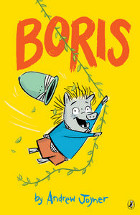
Boris by Andrew Joyner
Boris series. Penguin, 2011. ISBN 978014 3305026.
(Ages: 5-7) Warmly recommended. Boris and his parents live in an old
bus, converted to a house in Hogg Bay, but Boris dreams of travelling.
His parents once roamed the world in the old bus, and he has a world
map pinned on his bedroom wall with all the wonderful places he would
like to visit too. But only one is marked, the one place he has been,
Hogg Bay. Understanding Boris' need to travel, one day, without
warning, Mum starts up the old bus, uprooting it from its place in
their garden, driving it along the road and down the highway. Sitting
in the back with his pith helmet, Boris dreams of all the adventures
they will have, but this is cut in the bud as the bus stops in the
nearby Conservation park. Disappointed with their short drive, Boris
goes for a walk, imagining himself to be in the places he has dreamt
of, until, tired, he looks around and realises that he has been
separated from his parents and is lost. A rustle in the bushes has
Boris imagining a lion, but he is relieved when it turns out to be a
kitten. His parents reappear, and all is well, with Boris and the cat
returning home.
A charming series about Boris, will please younger readers, the
humourous illustrations underlining the tried text as Boris attempts to
be like his hero, Captain Clive. A cautionary tale, readers will love
to follow Boris' adventures, and look forward to the next in the series.
Fran Knight
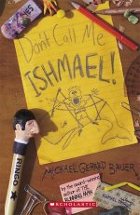
Don't call me Ishmael! (sound recording) by Michael Gerard Bauer
Read by Brendan Higgins. Louis Braille Audio, 2010. (5 hr., 30 min.).
ISBN 978 1742125282. 5 CDs. $62.00
Ishmael cringes every time his parents tell of the tale of his birth.
His mother was as large as a whale and when Ishmael slipped out so
easily, water gushing everywhere, the natural thing was to give him
such a name. But Ishmael does not want to know. So starts the wonderful
story of one boy's quest for surviving his time at school, trying hard
not to be seen, avoiding the notice of the school bullies, those who
have followed him through primary school, and are now in the same high
school.
A very funny story of life at school is told beautifully by Brendan
Higgins, his voice capturing the comic tone of the novel, and
enunciating the whole so clearly that it is a pleasure to listen.
Interspersed with small snippets of music, each chapter builds up
a picture of the school and the bullying which is tormenting some of
the cohort. Ishmael cannot help himself when seeing his class
mate, Barry Bagsley, bullying a younger boy, he steps in. This
instantly creates another victim for Barry and his mates, and when the
new kid, James Scobie joins the class, everyone can see that this boy
is ripe for their touches. Again, Ishmael cannot help but protect him
and a friendship is born. James encourages Ishmael to join the school
debating group, but assures him that he will never have to debate, just
be a helper. Of course the night comes when Ishmael must front up and
debate with hilarious consequences. As a debater he learns new words
and the power of words to defend himself against the bullies, and so
wins the eye of the girl from the opposing school.
A wonderful story well told.
Fran Knight
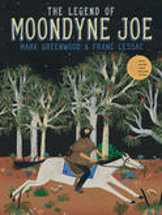
The legend of Moondyne Joe by Mark Greenwood and Frane Lessac
Walker Books, 2010. ISBN 9781921720123.
Recommended. Picture book. Historical. First published in 2002 by the
University of Western Australia Press, this book about a bushranger in
the West, has wide appeal as a story of bravery and tenacity.
Joseph Bolitho had been caught thieving in a village in Wales and so
was sent to the colony of Western Australia in 1853, where he was
expected to form part of the labour gang the colony was short of. But
this life did not appeal and so when the first opportunity presented
itself, he escaped to the bush, developing skills of survival that
would help him many more times.
This lovely picture book outlines the many times he was recaptured and
imprisoned and then escaped again, taking to the bush. Sometimes he
eluded the guards through cunning, sometimes simply taking an
opportunity as it arose, but mostly, being simply brave. Throughout the
story, glimpses of life for the new colonists are given, as the guards
in the prison are retired soldiers, brought back into service with the
promise of land. We see the isolation of those who live in the bush,
the building of a prison at Fremantle, and glimpses of the penal system
which brought so many of our predecessors to this land.
A fascinating glimpse into Australia's past about a bushranger of which
little is known in the eastern states, and fabulously illustrated by
Frane Lessac, The legend of Moondyne Joe will be readily picked
up by
students of Australian history, those who simply want a good read and
those who have a penchant for biography, simply and elegantly told.
Fran Knight
Crown of acorns by Catherine Fisher
Hodder Children's Books, 2010. ISBN 9780340970072. Crown of acorns by Catherine Fisher is an amazing story that
blends
three themes together; an eighteen year old girl called Sulis is having
trouble with her past after she's moved to a glamorous new life in a
glamorous new city. A young man in the year 1740 called Zac who happens
to be an apprentice to the brilliant, crazy, mastermind architect,
Jonathan Frost who has a dream to create the perfect city. And the
third theme is, Bladud, the king of the druids. Bladud has leprosy and
is thrown out of his kingdom to live with the wild boars and is in
search for a
cure.
It's amazing how the author Catherine Fisher twines these three
stories around each other like threads in a three colour plait.
This thrilling book is a perfect blend of excitement and mystery. It
also has the spell-binding quality that a good novel should have. In
conclusion, this story kept me interested until the very last sentence.
Sarah Filkin, Yr 9 student
The Golden Day by Ursula Dubosarsky
Allen and Unwin, 2010. ISBN 9781742374710.
(Age 13+) Recommended. Ursula Dubosarsky is a multi-award winning
author and all her skill and talent is evident in this eerie and hard
to forget novel. It is the tale of eleven little schoolgirls who are
mesmerised by their flamboyant teacher, Miss Renshaw. She loves poetry,
and on the day that Ronald Ryan is hung, takes them off to beautiful
gardens near their school to think about death. Here they meet a young
man who Miss Renshaw admires. Using his deep owl-like voice, he reads
them poetry, and easily persuades them all to go with him to explore a
cave along the shore. What happens in the cave? What are the
schoolgirls hiding?
The book is set in Sydney in 1967 and covers the period in the
schoolgirls' life to 1975. Descriptions of the all-girls school and the
teachers there are fascinating, as are the references to Ronald Ryan,
the Vietnam War and conscription. Endpapers with newspaper headlines
and exacts of events of the time also add to the setting.
Dubosarsky deftly uses this background, melding it with a chilling
psychological mystery, to build up suspense around the teacher's
disappearance. I was on the edge of my seat all the way through the
book, trying to work out what happened to their teacher. At the same
time the vivid writing fascinated me, as did the descriptions of all
the characters and the puzzle surrounding Icara's mother.
An excellent choice for a class set or literature circle, the
disturbing atmosphere and strange mystery of The Golden Day
will haunt
me for a long time. People who were fascinated by Picnic at Hanging
Rock will love this.
Pat Pledger
Wilful Eye. Tales From The Tower gathered by Isobelle Carmody and Nan McNab
Book One. Allen and Unwin, 2011. ISBN 9781742374406.
(Age 16-Adult) Recommended. An alluring cover with the names of some
of the best fantasy writers around was enough for me to put aside the
other books I was reading and delve into six fairytales. Margo Lanagan,
Rosie Borella, Isobelle Carmody, Richard Harland, Margaret Mahy and
Martine Murray all wrote compelling stories that I could not put down.
First up was Catastrophic disruption of the head by Margo
Lanagan. As
one would expect from an author of her calibre, this was a disturbing
take on Hans Christian Andersen's The tinderbox, which left me
biting
my nails and thinking about warfare. Eternity by Rosie Borella
takes a
look at The Snow Queen, but in a modern, drug-taking scene.
Margaret
Mahy's Wolf Night has a gang of Headloppers chasing her hero
and
heroine in suburban Woodlands. Richard Harland explores love and a
nasty father in Heart of the beast. I shuddered with fear,
thinking of
the plight of the prisoners in the tower in One window by
Martine
Murray. And of course, Isobelle Carmody's take on Rumpelstiltskin
was original and frightening.
There is a thought provoking foreword by Isobelle Carmody, and an
afterword is included by each of the authors, who have written about
their writing process and inspiration. These tales are not for the
young. They are frightening and challenge with their universal themes
of courage, love, war and greed.
I am a lover of re-tellings of fairy stories and I was not disappointed
in this short story collection. And it is only Volume 1! I can't wait
for Volume 2. Readers who enjoy this genre would also like books by
Shannon Hale, Laini Taylor, Robin McKinley and Juliet Marillier.
Pat Pledger
Forest born by Shannon Hale
Bloomsbury, 2010. ISBN 9781408808610.
One of several fantasy books by Shannon Hale, Forest born is
the title
revolving around Rina, the youngest child born to a gregarious widow
living in the forest. Rina is desperate to please everyone, fearing the
loss of her mother's love should she ever find out who or what the real
person within Rina is. Suppressing emotions of teenage angst such as
unworthiness and dread of rejection, the story suddenly thrusts Rina
into a position of trust and loyalty to her queen, and the queen's
close friends, each with an extraordinary power. Through more and more
difficult challenges, kidnapping and war, Rina finds she too has
talents which she must quickly command to rescue her friends from
danger. Towards the end, Rina accepts herself, enabling the book to be
used as a tool for encouraging students to look within themselves for
their own strengths, and refuse distractions that would lead them away
from their potential. Recommended for mature 12+ female readers.
Margaret Clarke
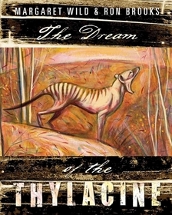
The dream of the thylacine by Margaret Wild and Ron Brooks
Allen and Unwin, 2011.
In a few spare words, brimful of emotional pull, Margaret Wild tells
the tale of the last thylacine, locked in a desolate cage in the Hobart
Zoo. It rages and howls as it paces the cage, locked away from the
bracken and bush of its wild lands, where snow falls and the creeks are
filled with shimmering fish. In 130 words, Wild recreates the home
range of the thylacine in the Tasmanian wilderness, and in between
these words tell us of its life now, shut behind wire, pacing on a
concrete floor. The words sting the reader, tugging at the heart,
bringing a lump to the throat, as we read of this animal's eventual
end, but the word 'dreaming' implies it remains part of the environment
it once roamed.
As with, Fox, Wild has collaborated with Ron Brooks, an
illustrator
with a prodigious talent and range of skills. 'Champing at the bit' to
illustrate this book, he has used a fascinating mixture of styles and
techniques, bringing in hints of John Olsen, Brett Whitely, Fred
Williams and Arthur Boyd. Mixing his breathtaking illustrations with
photos of the wood and wire of the cages is visually arresting and
impels the reader to stop and think. The end papers with their overlay
of chicken wire reinforce the caged end of this stunning animal, and
reminds us again, of Brooks' love of the outdoors.
Reading Drawn from the heart, Brook's memoir, recently
published by
Allen and Unwin, adds another layer of empathy, as we learn in his
words the depths he goes to when illustrating a book, and the works he
draws on. The dream of the thylacine heralds the importance of keeping our
environment safe and secure for all species, as every loss is a loss
for us all. Students will fall over themselves finding out more
information about the thylacine and its extinction relating this to an
environmental awareness that we all must share to prevent this
happening again.
Fran Knight
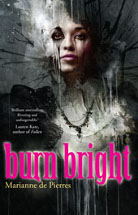
Burn bright by Marianne de Pierres
Random House Australia. ISBN 9781864719888.
(Age 13+) Retra is a seal, sealed minds and sealed community. It is for
this reason she doesn't want to go to Ixion, the island of ever night,
with no rules, constant parties and lots of pleasures, but since her
brother Joel left two years ago for Ixion her life has been unbearable.
Her family had a warden come to watch them 24/7, her father punished
her for what her brother did, her mother stopped talking and then
there's the obedience strip the warden put on her to inflict pain. So
in an attempt to find her brother, who she is absolutely determined to
find, she practices working through pain and goes against her seal
training to leave for Ixion upon the barge that only comes twice a
year. Once there the Ripers, the guardians of Ixion, tell her and all
the other new people all they need to know to keep safe and all the
places they can and can't go. During her first day in Ixion she meets
Suki from Stra'ha. Together they go around to different clubs. In one
of the many clubs they meet Kero and Krista-belle from the White Wings
one of the gangs in Ixion. But what's the voice Retra keeps hearing in
her head? And is Ixion as safe as it seems? If so why did a Riper
attack Krista-belle? And what are the night creatures Retra has seen in
the shadows? And what happens to those that get withdrawn from Ixion?
I enjoyed this book from beginning to end; it is for this reason that I
would highly recommend it to people who like adventure and mystery.
This book definitely has both.
Tahlia Kennewell (student)
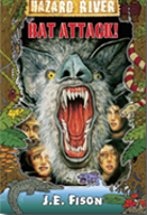
Hazard River: Bat Attack by J.E. Fison
Ford Street Publishing, 2011. ISBN 9781921665141 Hazard River: Bat Attack is a quick moving story (it lasts a day
and a
night) that I highly recommend for 9 -11 year old boys or any child who
likes an adventure. It should have even the most reluctant reader
reading - especially with some of the hilarious scenes described that
will appeal to boys! Bat Attack has an easy to read text that is told by Jack Wilde,
the
main character. His family is on holiday in Hazard River and as Jack
and his friends are getting ready for the New Year Disco, they are run
off the road by a big-eared man! The adventure and mystery begins. Who
is this man who blames kids for his bad driving?
This incident leads Jack, his brother and two other friends on an
adventure into the Australian bush and on path to saving the home of
the Australian ghost bat. The friends are attacked, steal a car, find
dynamite, get chased and eventually save the day. The good thing about
Jack's character is he is a great role model for boys. Yes, he gets up
to all sorts of mischief, boys do, but despite this he doesn't look for
recognition for saving the day, he cares for his brother (despite his
peculiar habits) and he wants to look after the environment even
if it means he loses the treasure!
Kylie Kempster