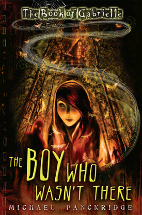
The book of Gabrielle. Book 1. Black dog books, 2011. The boy who wasn't there begins with an air of mystery and
intrigue.
Who is this girl in the hospital bed? What has happened in her life
prior to this time? Who is the boy with his own story to tell (and his
own pages to tell it)? What is the Voice in her head really saying, as
it tells her 'You are not like anyone else'?
This is the first offering in a new series from Michael Panckridge,
whom I know best for his sporting stories, and in particular The
Legends series. It is the first book in The Book of Gabrielle
series.
The second book in the series The boy without a soul is already
on its
way.
The girl in the hospital bed is Gabby (Gabrielle), seemingly an orphan.
She is fostered by Jane and Phil Calvert for 4 weeks of the January
school holidays. Gabby is a strong and adventurous character, who
doesn't hesitate to explore her new home including the treasures and
mysteries of the attic.
There are strange happenings in this house. Michael Panckridge uses
strong imagery to create the horrors of these happenings eg the
incidents in Gabby's bedroom firstly with the swarm of moths and later
with the suffocating weight on her chest; and the terror of the spiders
and cockroaches in the incident in the attic.
On occasions the narrative seems a little disconnected; it doesn't
quite gel. The reader has to work hard at connecting the incidents as
the narrative progresses. On the first reading it is difficult to know
at times which character is speaking. Some of this confusion could have
been resolved with more precise editing. It would have been a more
satisfying read, too, if the characters had been more fully explored,
particularly in regard to sudden changes in their attitude, which occur
as the story reaches its resolution.
Nevertheless, I think that children in the Middle School years will
enjoy the sense of mystery, the ghoulish incidents with the creepy
crawlies, the ghostly nature of the boy, Peter and Gabby's success in
healing old wounds.
Margaret Strickland
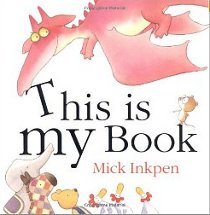
This is my book by Mick Inkpen
Hodder Children's Books, 2009. ISBN: 9780340989630.
Highly recommended. The Bookmouse has a big job ahead of him. His task
is to stop the Snapdragon from being a menace who takes parts of the
words and letters used in the story. In order to solve the problem, the
mouse follows the advice of the Blink Owl and goes into Moonwood to
visit the ghosts of the Woolywolves. Finally he outsmarts the
Snapdragon and restores order to the book.
The illustrations in this book contain Inkpen's unmistakable style, and
remind one vividly of the Kipper series. White backgrounds on most
pages allow the reader to easily concentrate on the characters and
their actions. Where the setting moves to being at night, in the
Moonwood, lilac coloured backgrounds alter the mood of the tale and add
to the suspense. From the moment Snapdragon takes a bite out of the
letter B in the word 'Book', young children would be engaged. Inkpen's
humour is evident, as the dragon later takes a bite out of the letter P
in 'STOP' and announces, 'I always eat my 'P's'.
This charming picture book could become part of spelling and language
lessons in any junior primary classroom. Children could be encouraged
to look at base words and build on them or to focus on the changes
which could be made by the removal of parts of letters as demonstrated
by Snapdragon. This is a unique picture book due the way in which the
text is integral with the illustrations as part of the story. I would
highly recommend this title.
Jo Schenkel
My sister the vampire series by Sienna Mercer
Fangtastic. Egmont, 2009. ISBN 978 114052 43704. Vampalicious. Egmont, 2009. ISBN 9781405243728. Love bites. Egmont, 2011. ISBN 9781405256958.
(Ages 10+) Starting with Switched, a book which gave the reader
two girls at a school in USA, who worked out that they were twins
separated at birth, this series has gained a popular following as the
two are so vastly different, one a vampire, and the other, well,
normal. Their adventures are very funny, involving and fast paced as
the two try to hide the truth from all around them, and attempt to
become friends.
In Fangtastic, Olivia and Ivy are getting used to the idea of
them
being twins, and learning about each other, when the nosey journalist,
Serena Starr comes snooping around. Their attempts to put her off the
scent meet with hilarious results. Vampalicious follows, where Olivia and Ivy 's secret has been
discovered. Ivy's parents do not believe that Olivia can be trusted not
to reveal their secrets and so put her through a series of tests to
prove herself.
In Love bites, the pair has gone to Transylvania to meet the
scary side
of the family, the vampires. Here Ivy is watching over her sister more
carefully than usual, because she has become entranced with a very nice
boy, but Ivy knows he is a vampire prince and it is coming close to
Valentine's Day.
All in this series are easy to read with clever pun filled dialogue,
and short snappy adventures overlaid with a large dose of humour.
Fran Knight
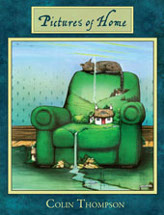
Pictures of home by Colin Thompson
Random House, 2011. ISBN 9781742750903.
Picture book. When Thompson was still establishing himself as a
children's book illustrator he had a contract with the Leeds Permanent
Building Society. His brief for five years was to produce calendars and
Christmas cards for the society with the only proviso that each picture
should have a house in it. So we now have a well known children's book
illustrator and writer, partly because of the security that regular
income gave him in his early life as an artist.
This book is a compilation of those early calendars, the pictures of
the houses he drew, tagged with comments by children from Upperby
Junior School in Carlisle. And what a collection this is. Thompson's
style is obvious to those who love his books with their detailed and
minutely drawn illustrations of life. Each of these drawings of a house
is different, giving the reader a chance to peruse the finely executed
drawings with excitement. Classrooms will have fun finding all the
things Thompson hides in his drawings, and will marvel at the nods to
various artists shown. A book to enjoy and discuss, readers will want
to tell the class about their own home and what it means to them, share
with others how like one or other these drawings are to their own home,
and draw an ideal home for themselves. The possibilities are endless
and for many teachers it will be fascinating to see children's
reactions to this book. I loved the way the houses evolved from a tree
house at the start to an industrial estate at the end and the way the
seasons revolved through the year of pages. Every time I look at it I
see something new to think about and so it will be for students.
Fran Knight
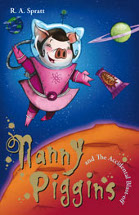
Nanny Piggins and the Accidental Blast-off by R.A. Spratt
Random House, 2011. ISBN 9781864718591.
Highly recommended for ages 8 and up. Nanny Piggins continues to care
for Derrick, Samantha and Michael, regularly breaking the rules to
which her nemesis, Nanny Anne, rigidly adheres. The children are
encouraged not to attend school regularly, hence attracting visits from
the truancy officer and even causing the demise of the replacement
officer. Life is never dull with Nanny Piggins! The children certainly
enjoy different experiences to other youngsters; including a visit to
NASA which sees them being blasted into space. Later, they watch their
nanny as she competes in the Steel Chef competition. They also
participate in other action-packed adventures, such as a visit to the
circus to see Boris, Nanny's ballet dancing brother, and stop him from
being beaten by a gang of professional wrestlers.
Mr. Brown continues to be anything but an ideal father, despite being
involved in a competition through his work to prove otherwise. His
absence and lack of interest in his children are challenged by his boss
as Mr. Brown attempts to coach the soccer team, despite his children
not being involved.
This title, the fourth book in the series, does not disappoint the
reader. Each chapter is a self-contained story, filled with humour and
adventures, to delight any reader who could only wish to have an
irrepressible nanny such as Sarah Piggins.
Jo Schenkel
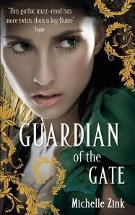
Guardian of the gate by Michelle Zink
Atom, 2010. ISBN: 9781905654536. Guardian of the gate is the stunning sequel to Prophecy of
the sisters,
the first novel in Michelle Zink's enthralling Prophecy of the
sisters
trilogy. The last book in the trilogy is Circle of fire which
is going
to be released in the middle of 2012.
This engaging novel once again follows Lia Milthorpe. We see her
journey to the enchanted Isle of Altus to find the missing pages from
the book of Chaos. These pages could tell her how to end an ancient
prophecy. This prophecy has turned generations of twin sisters against
each other for centuries. Lia knows that getting to Altus and finding
the missing pages is not going to be easy because her twin sister Alice
and The Souls are always trying to stop her. (The Souls are from a
different world known as 'The
Plane'. They are always trying to use Lia to get from their world in to
the human world).
This compelling story is once again told from Lia's point of view. We
see a
lot of the same characters including: Aunt Virginia, Louisa and Sonia.
We also see a lot of new characters including: Dimitri Markov, Aunt
Abigail, and The Sisterhood and The Brotherhood; Are the keepers of the
Book Of Chaos and the Rulers of Altus.
Throughout this superb story once again many themes present themselves
including: Friendship, Love, Loss, death and betrayal. Some surprises
are also added in to the mix.
This is an engaging novel and I would recommend it to teenagers who
like fantasy/mystery books.
Emily Madden (Student, Yr 9)
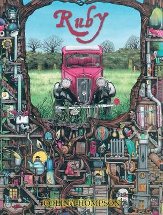
Ruby by Colin Thompson
Random House, 2011. ISBN 978 1742750897.
Picture book. The story of the Austin 7 is told alongside that of a
small family who lives in the roots of a tree. As a couple picnics by
their tree, the little people gather food from their picnic basket only
to find themselves trapped in the car when the couple leaves. The car,
an Austin 7, motors along the road to home, and here the little family
has time to search the little car with more success. They find a myriad
of things to pore over and discuss, to look at and dissect, but all the
while they are looking for the number to undo the lock of the picnic
basket in which their son, Kevin, is locked. Readers too will search
for these numbers, as they see numerous numbers in the minute drawings
on each page. The puzzle will keep them entertained as they read the
story. Along the top of each page is a history of the red Austin 7,
from its first appearing out of the factory in 1934, to it travels
through England and then overseas, to its final destination, where it
is dumped in a farmer's paddock, rained upon, nested in by chooks, only
to be found and valued once more. Then it is restored to its former
glory and put on show. The car has come full circle.
This is a warm story of the evolution of the car in people's lives, the
fashion for different car makes and the warmth of the family who now
owns it. Readers will have much to discuss and find a renewed interest
in the Austin 7.
Fran Knight
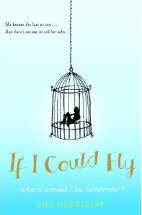
If I Could Fly by Jill Hucklesby
Egmont, 2011. ISBN: 9781405252263.
(Age: 12-15 year olds)
Calypso Summer. 'A girl with such a name is on a journey. She will have
adventures -'.
Calypso is most certainly on a journey, she is running. From what is
she running though? She does not know, but it is something terrible.
Her mind has blocked it out. For now she runs, learning to survive.
Break the system. Don't get caught. If I Could Fly is set in the future. The way our world is run
has
changed. We are controlled with regulations, rules and by the FISTS who
enforce them. The world is well controlled. Calypso and her few
friends seem to be quite normal people; in reality Calypso is the only
normal one. Her friends Furball, Dair and Alfie are not what they seem.
The plot is not completely straight forward, you don't expect some
things to happen yet other things you do. It is quite believable
although towards the end some may think not. In the final chapters it
becomes a tear jerker, written in an emotional way. There is a lot of
imagery, all of the scenes are painted in your mind. The writing
structure is of a fair but not high level that lends itself to being
best suited for 12-15 year olds and may suit girls more than boys,
though it is aimed at both genders. Could be enjoyed by older kids and
young adults because of its themes of friendship, violence at home and
choosing between to die or live. I give this book 9.5/10 stars.
Amelia Kelly (17 years old)
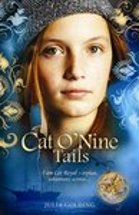
Cat Royal Books by Julia Golding
Den of thieves. Egmont, 2008. ISBN 9781405241847.
Cat o'nine tails. Egmont, 2008. ISBN 9781405241854.
(Ages 11+) Recommended. The thrilling series of novels about Cat Royal,
an orphan brought up, surprisingly, in a theatre in London's Drury
Lane, will drag in students keen on reading of other children's lives,
those having to struggle to survive in difficult times. Cat lives
through events in the late eighteenth century, a time of huge changes
across Europe and North America, and these are interestingly reflected
in this series.
The main character is a personable, intriguing young girl, capable of
surviving in harsh times. The first in the series, The Diamond of
Drury
Lane, followed by Cat among the pigeons, set the scene for
this series
of books, but the early books do not have to be read to
understand what is going on in the others.
A fourth in this entertaining series, Den of thieves, (Egmont,
2008)
has Cat residing in Paris. It is the time of the French Revolution, and
Cat is trying vainly to avoid capture and possible execution. Adventure
piles upon adventure, with Cat using all her wiles to return to London
unscathed. Cat o'nine tails has Cat aboard the HMS Courage on its way to
North
America, there to help rescue a friend who has fallen into danger. A
single woman aboard a ship is in some danger herself, and Cat must
tread carefully, avoiding the drunken sailors, many fights, and of
course the lash of the whip used to keep discipline aboard these ships.
An exciting read, students will learn much about life aboard these
ships, and the times of the French and American Revolutions, helped by
the glossary at the end of each book, outlining the meanings of many of
the words used in the text. Interestingly at the start of the book is a
list of players and a list of acts where there would be a contents
page, all adding to the underlying feel of the theatre and its
mysteries. And at the end of each is a snippet of the next book,
tantalising the reader with what will follow.
Fran Knight
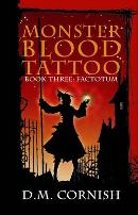
Monster Blood Tattoo Book Three: Factotum
Omnibus (Scholastic Books) 2010. ISBN 978 1862916920.
(Ages 10+) Fantasy, Highly recommended. The third and last book in this
extraordinary series, Factotum takes us into the new world of Rossamund.
He is now assistant to the monster killer, Miss Europe, and with the
two retired vigneroons, Fransitart and Craumpalin, the quartet is on
its way to Brandebrass, Miss Europe's home. He is to stay in Licurius'
old room, the box faced assistant now dead and gone. But he is still
very puzzled about his origins, and so one night after dinner, Miss
Europe sends the servants from the room and answers his questions. His
worst fears become reality. He is a rosamunderling, a boy born with
human features, but really a monster. When Fransitart's cut on his arm
becomes a cruorpunxis, a monster blood tattoo, the world will know his
secret and will be ready to denounce and kill him.
A fast paced adventure like no other, the story abounds with parallels
to that of the eighteenth century, the wonderful illustrations evoking
the time of bunderblusses and waistcoats, the time of Georgian England
and the Napoleonic Wars.
Many characters spend time with Rossamund, Rookwood, the Archduke, and
his old friends, Freckle and Cinnamon, all the while wondering just why
he is where he is, employed by Miss Europe,a well known and successful
killer of monsters, a fulgar with tattoos showing the
number of kills. Rumours abound about Rossamund's heritage, and he is
faced with a difficult choice when sent to a village the tattoo reveals
itself. His friends take him to Mister Plume's house where he is told
about the history of the war between man and monster, paralleling
everyman with one group, people or nation fighting the other.
The world of Rossamund is a treat in itself, with the words, costumes,
weaponry and gadgets Cornish has created around his hero. All are
engrossing and the explanations at the end of the book in the
Explicarium is fun to read, with its mixture of Latin, Greek, old
English and Biblical language.
Books One and Two, Foundling and Lamplighter have won accolades around
the world, were shortlisted for major prizes and won the prestigious
Aurealis Award for Young Adult Fiction in 2006 and 2008. And Factotum
the final in the series, Monster Blood Tattoo, will be no less feted.
Fran Knight
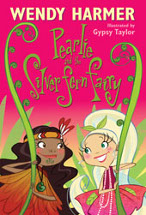
Pearlie and the Silver Fern Fairy by Wendy Harmer
Random House, 2011. ISBN: 978 174166 3792.
Highly recommended for ages 5 and up. Pearlie's adventure begins when
she arrives in New Zealand and meets Omaka, the Silver Fern Fairy. Her
task is to visit each of the animals on Omaka's list and invite them to
the party she is planning, to celebrate Grandfather Tuatara's 150th
birthday. Colin the Kiwi, Hoki the kakapo and Wanda the short-tailed
bat are all on Pearlie's list. At first, Pearlie is worried because she
has no idea what the first two creatures may look like yet she manages
to find them. Although Pearlie expects to find Wanda the bat hanging
upside down in a tree, it is not where she finds her. With all of the
invitations delivered Pearlie heads back to find Omaka. She begins to
worry that there may something dangerous waiting for her which would
also explain the differences she has noticed.
Harmer has struck a winning combination in the Pearlie series as she
aims to simultaneously educate and entertain her readers. Here, she
introduces various words and phrases from the Maori culture as well as
the animals particular to New Zealand. There is a strong conservation
theme which is highlighted at the end of the story. This title would
support any unit on endangered species or studies of other countries
and serves as an introduction to the concept of human impact on the
rainforest ecosystem. It places the responsibility of caring for nature
firmly back on the reader. Containing minimal text, this could be read
quickly to a junior class to begin conversation on any of these topics.
Thanks to Gypsy Taylor's stylised cartoon type illustrations and the
vibrant gem coloured backgrounds, children can hardly fail to be
entertained as well. Another winning title!
Jo Schenkel
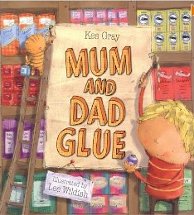
Mum and Dad Glue by Kes Gray
Hodder Children's Books, 2009. ISBN: 9780340957110.
Highly recommended ages 5 and up. When a little boy's parents seem
likely to separate he experiences the normal roller coaster of
emotions, from concern for his parents to guilt, worry and denial of
the inevitable. Consequently, he goes looking for some glue to 'mend
them' and fix their marriage. His journey leads him to the adhesive
shop owned by a kindly woman. She explains that he is not responsible
for his parents' problems and that their love for him will continue no
matter what may eventuate. He leaves feeling far more positive and
accepting of the situation.
This simple story, told entirely in rhyme, is sensitive and uplifting
and would be a great support for any child whose parents are unhappy
and contemplating divorce. Lee Wilding's illustrations contain simple
character drawings and muted colours, with each picture showing cracks
in the pavement, bed, cars and numerous items with which the boy is
surrounded. Children in this situation are regularly offered advice by
school friends, teachers and other adults. Whether or not the intention
is to show the 'glue shop lady' as a psychologist or merely a random
adult, the child is encouraged to openly discuss his feelings and hence
share the burden and seek help in the healing process.
Many classes focus on different types of families, be they blended,
extended or those which fit the traditional mould. This would be
another good text to use in resourcing such a unit as well as to assist
children whose parents seem likely to separate.
Jo Schenkel
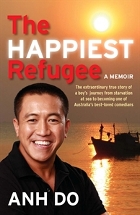
The happiest refugee, a memoir by Anh Do
Allen and Unwin, 2011. ISBN 9781742372389.
Recommended. Non Fiction. Under cover of darkness, Anh Do and his
family fled the Communist regime in Vietnam, joining many of their
extended family on a boat moored further out to sea. After a perilous
journey they reached Malaysia, where they said they would settle
anywhere. Told they were going to Australia, they collected lots of
warm clothes, in readiness for their new home near Switzerland, but
getting off the plane at Mascot Airport, soon acquainted them with the
realities of Sydney in December.
1970's saw many Vietnamese refugees enter Australia, bringing with them
the work ethic so strongly portrayed by Anh and his family. Reading
this book, I was struck again and again by their resilience,
perseverance and tenacity in having a go. Anh's parents worked in
factories, eventually renting a warehouse with many of their family.
Here they lived and worked, until buying a farm saw them raising ducks
for eggs, a niche market in the burgeoning multicultural Australia.
When this failed, the family went back to factory work, mum taking in
sewing, having the children sit for scholarship exams to get them into
a Catholic school for a sound education.
Few of us can have any idea of the bravery of these people setting out
into unknown waters, all their possessions sold, to find a new life.
But Anh's story gives the reader a sound background knowledge of one
family's story, revealing the lengths to which this particular family
went to find a new, safe home.
Throughout the book the reader is regaled with story after story of
Anh's life with his family, at school, at university, marriage and his
own family, but always, the constant echoes of the past are there.
Meeting his father again after many years of estrangement is a big part
of his adult life and is told with sincerity and candour. Having heard
many interviews and some of his sessions as a stand up comedian, many
of the stories are not new to me, but the honesty and self deprecating
humour which he uses to tell his tale, give the stories a freshness
that has a giant appeal. For students wanting an engaging autobiography
to read, or a tale of a refugee, or someone for whom success has not
come easily, then this book is inspirational.
Fran Knight
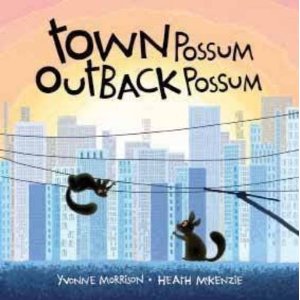
Town possum, outback possum by Yvonne Morrison and Heath Mackenzie
Little Hare Books, 2011. ISBN 9781921541476.
Picture book. Jacko the possum loves the outback, his life in the
treetops is all he wants it to be. He looks out from his eucalypt, over
the trees and hills beyond, thinking that he is in a special place. But
his reverie is interrupted by his city cousin, Jessie, come to entice
him away to visit her place. Once there, he finds that things are not
all that Jessie told him. Trying to get some food, he interrupts a
diner in a restaurant and is bundled out of there very quickly, Jessie
taking him to the bins at the back. Hitching a ride on a bus, they are
frightened by a dog snarling and snapping a their heels. Curling up to
sleep under a roof, Jacko longs for his home in his cosy tree. He is
wakened by a screeching noise, but Jessie explains that it is just some
children watching TV. All in all, Jacko cannot wait to return from his
trip to the city, and so he does, getting back to his trees, the lovely
view and a kookaburra laughing in the trees.
A charming story of finding your own place, the verse will help younger
readers recognise new words and predict what the next lines will be.
Teachers will be able to use this book for a variety of lessons, be it
poetry, conservation or simply a theme of finding a home. Apart from
being just a charming verse story to read to the class, it would make
an excellent introductory book to begin a unit of work on conservation
or Australian animals, or simply a lesson on possums. Students may look
out for possums in their area as a result of reading this story.
Fran Knight
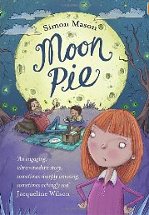
Moon Pie by Simon Mason
David Fickling Books, 2011.
(Ages 10+) Highly Recommended. Eleven year old Martha and her
five year old brother Tug are increasingly worried about Dad's strange
behaviour. Both the children miss their Mum who died a couple of
years ago and tellingly Dad refuses to talk about her. He's happy to
arrange midnight picnics and hire a stretch limo to take them to a
movie, but he often forgets to do the washing and fails to get up in
the morning to see them off to school. With the help of her
Hollywood obsessed friend, Marcus, Martha at last faces the truth that
Dad's drinking is spiralling out of control and seriously affecting his
ability to care for his family.
The children's efforts to conceal Dad's increasingly dangerous
behaviour and their attempts to help are heartbreaking, but Moon Pie
never descends into mawkish sentimentality. Martha is obstinate and
brave. She makes endless lists to try and resolve their problems, tries
to persuade Dad to take up swimming and get a job, and always does her
best to care for younger brother Tug.
With a powerful plot and strong characterisation Moon Pie is
comedic
tragedy. Mason's style is straight forward and open. He presents his
story simply with very little embroidery and that is probably the
secret of his success. The seething mass of emotion is very much
between the lines and readers will feel it without having it rammed
down their throat. I reached for the tissues more than once and
found myself wanting shake the children's father almost as often as I
wanted to hug him.
The happy ending was somewhat unexpected in so stark a story, but I was
quite relieved that Mason dipped into the realm of fairytale. After the
relentless misery and upheaval that Martha and Tug experience a
fairytale ending restores the reader's faith and confirms that this is
indeed a story for children rather than adults, although Moon Pie
is a
salutary reminder of just how much impact the behaviour of one adult
can have on their children. Altogether an excellent read which will be
snapped up by fans of Jacqueline Wilson and Cathy Cassidy.
Claire Larson