Little Hare, 2010. ISBN 9781921541605.
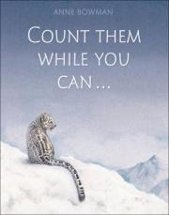
Highly recommended. Count them while you can is a superb
introduction
to endangered species
for young children and it is easy to see why it was listed as a Notable
Book for The Eve Pownall Award for Information Books for 2011.
It focuses on the mothers and babies of ten of the world's most
endangered creatures including the Californian sea otter, the
red-ruffed lemur, the kakapo and the numbat. Each creature has a
double-page spread that introduces the creature and their habitat in a
gentle counting rhyme (sung to the tune of Over in the Meadow)
and a
text box of simple but vital information that includes the threat and
current numbers, both against a backdrop of a soft, engaging
illustration of the species. Notes at the back explain how we
know if a creature is endangered and the various levels of threat that
they are under.
When our students think of extinct animals, they think of dinosaurs,
woolly mammoths and sabre-toothed tigers, but the reality is that there
are over 50 species of Australian animals and over 60 species of
Australian plants that are extinct and about 240 species of native
animals and over 1160 species of native plants may become extinct in
the near future. (Green Kids Guide to Threatened Species). Those
figures are just for Australian species - the IUCN Red List has more
alarming figures for the world generally.
With students becoming more environmentally aware all the time,
introducing them to the concept of endangered species would seem to be
a natural part of the curriculum. So often we are hampered in finding
information at the level the younger child can manage but Count them
while you can fulfils this need very well. It develops an awareness
that 'extinct' and 'endangered' are very much concepts of our time and
the fate of the dinosaurs et al awaits creatures that we know today.
Because information literacy involves creating information as well as
just using it, using the book, its information and format as a
springboard for research and a model for a simple presentation of facts
makes sound educational sense.
Barbara Braxton
Why I love Australia by Bronwyn Bancroft
Little Hare, 2010. ISBN 9781921541780.
In her speech at the launch of this book, the Governor General, Her
Excellency Ms Quentin Bryce AC, began by acknowledging 'the traditional
keepers of the land where we gather --- [and those] who work to
preserve
and shine light on our nation's ancient and contemporary cultures
through drawing, painting, print and paper, sculpture and
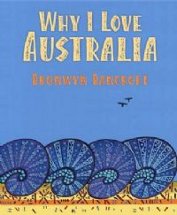
installation'. When you pick up this beautiful, illustrated journey
through Australia's awesome and unique landscapes you immediately
understand why Ms Bryce is so reverential.
As the reader travels from the ancient time of the Rainbow Serpent who
shaped the land to the 'modern city lights like a jewelled necklace
adorning an ancient landscape' via 'the soft edges of crusted salt pans
that create drawings on the land' and the 'shards of rainbow and
swaying tentacles of watery light in a coral reef' you begin to
get an inkling of the relationship that the indigenous people have with
their land. It is living and life-giving with the human spirit
intertwined and integrated in every image, just as it should be.
Every scene has a person holding a coolamon with curls of smoke rising
from it, representing the traditional smoking ceremonies that
Aboriginal people conduct to show their respect for those of other
language groups or countries and their Ancestors. In the notes at the
end Bancroft says, 'The person you can see on each page is the host to
each of the landscapes. He wishes you well as you visit his
country and make your acknowledgement to the Ancestors and Elders past
and present of each place.' Even without this explanation, the
reader has an emotional connection with this book and you find yourself
continually returning to the pages to almost inhale the trademark
colours, shapes, and patterns of the artistry. There is a depth, a
connection, an experience that even goes beyond actually visiting the
place. You can hear the 'suburban homes that chatter under a patchwork
of rooftops'; join in the 'bush cricket played on ants' nest pitches
with friends and family anytime, any town'; and feel the 'beams of
secret light and strong warrior trees of the rainforest.'
In her speech, the Governor General describes Bronwyn Bancroft as 'a
master craftswoman of vibrant, visual narratives' and 'Why I Love
Australia' is an exemplar of this. It totally encapsulates why we
all love Australia. It deserves that very rare honour of having the
Governor General launch it.
Barbara Braxton
The crossing by Mandy Hager
The blood of the lamb book 1. ISBN: 978-1869791506.
Random House New Zealand, 2009.
Coming to terms with reality is hard; dealing with that reality is
harder. The crossing is a story of well aimed rebellion. Marym otherwise
named
Nanona is one of those special characters that only come around once in
a while, you can really relate to her thoughts and feelings as they are
expressed in this novel. She grew up on a little atoll with all
the other Chosen, who were chosen because their blood doesn't clot when
mixed with Father Joshua's. They were told that they were chosen by the
Lamb to spread peace and happiness to the survivors of the Tribulation.
This is a complete and utter lie.
As Marym comes of age she begins to think outside of the box. She makes
the humiliating crossing to womanhood in full faith that she is moving
to a better place, but she soon finds out that she is dead wrong. The
Star of the Sea is nothing like she ever imagined. Rape and death are
daily companions to the servers. Marym knows that this is wrong; could
this really be the Lord's wish? She begins to question everything she
has ever known.
With the help of a kindly blind man she discovers the truth. The
Apostles of the Lamb want only blood. They use the blood to prolong
their divine lives at the cost of every 'Chosen' woman. The chosen are
as important to the Apostles as a single sheep to its Shepherd.
This book has a solid story line, one that will never grow old, but I
have to say that I wouldn't be keen on recommending this book for
anyone younger than sixteen. There are some 'scenes' that I believe are
not for the squeamish and the descriptions used could be a little
unwelcome for most teenagers.
Kayla Gaskell (Student, aged15)
Editor's note: The crossing won the Young Adult Fiction
Category in the
New
Zealand Post Children's Book Award.
The Wings of Leo Spencer by Jerome Parisse
Sid Harta Publishers, 2010. ISBN: 1921642149.
(Ages: 12 +) Fourteen year old Leo Spencer goes to bed at the beginning
of this novel after saving a lost puppy from rough surf during the day;
he wakes up and he is dead. Having realised that he is dead, and there
is nothing that he or his family could do about bringing him back to
life, Leo sets out to discover the cause of his death. In doing so, he
discovers the 'great white light' and follows this to Heaven where is
reunited with his Guardian Angel, Jezeral. Leo discovers that he had
requested that his life as 'Leo Spencer' was short because he was due
to become an Angel soon after his death. Accordingly, Leo is given his
wings and becomes a Guardian Angel himself. In Heaven Leo discovers the
House of Records in which is recorded the preeminent disaster that was
due to befall his family on earth in a tragic house fire. He notices
that has been a recent alteration and as result Leo sets out to
discover who or what changed this record and what he might need to do
to save his family. In doing so, he discovers evil beings have
infiltrated the security of the Heaven's House of Records. The Wings of Leo Spencer is a unique fantasy story loosely based
on
concepts of Heaven, death, Guardian Angels and destiny. The story is a
bit slow moving in parts when the rules of Heaven and its hierarchy are
explained but becomes more engaging as it draws towards its climax.
This book is recommended for upper primary to lower secondary students,
with some caution taken with the religious themes of God, Angels and
Heaven.
Adam Fitzgerald
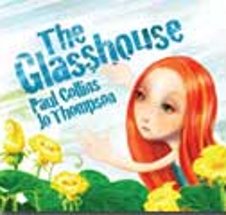
The glasshouse by Paul Collins and Jo Thompson
Ford St, 2010. ISBN 978 1921665045.
Highly recommended. This picture book is a modern parable about the
themes of obsessing with perfection; being a loner; friendship, and
being resistant to change. This is certainly a change of genre from
prolific Australian fantasy author Paul Collins, but he proves to be
multi-talented.
Clara, the central character, has bright orange hair, a freckled face
and sorrowful eyes and lives in isolation growing perfect pumpkins in
her perfect glasshouse. The vegetable growers, who initially
flocked to her door stopped doing so after she became obsessive about
keeping bugs or bad soil from the outside world out and thus made them
wear gloves and remove their shoes.
One dark haired boy kept returning and even showed Clare his pumpkin,
which she derided, saying 'It's not the perfect colour.' His
reply of, 'It's a different shade of orange, but it's still a pumpkin,'
had a moral to it. He went on to say that it must be lonely for
her in the glasshouse alone and that she should go to the market.
Eventually no buyers came to Clara's glasshouse anymore and her
pumpkins suffered and got blemishes. Clara thought more and more
about the boy and eventually went outside and picked up a stone.
The illustrations by Jo Thompson are stunning and very colourful and
this book will appeal to the very young child for this alone. The
storyline is easy to read but raises a variety of questions about how
to live one's life. Older primary students will be able to
evaluate and discuss these. More information is available
for
teachers on the Ford Street site.
Kay Haarsma (Salisbury East HS)
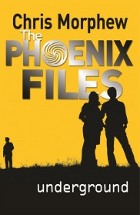
Underground by Chris Morphew
The Phoenix Files Book 4. Hardie Grant Egmont, 2011. ISBN: 978
1921502422.
Highly recommended for ages 10 and up. There are now only 49 days left
until the end of the world. With Peter strapped to a bed in an
underground laboratory, Luke and Jordan's arrival is met in a most
intriguing way. Somehow, Kara and Soren appear to have been expecting
and waiting for Luke's arrival for many years. Although Luke and his
friends believed they knew all of their enemies in Phoenix, they now
need to comprehend the role of the new additions to the list. Managing
to escape and return to the town, Luke and Jordan realise that
Shackleton's rules seem to be changing. They need to help not only
their parents but Peter. Later, the revelation of a confronting secret
makes the heroes re-assess their plans yet again, as time continues to
be a constant threat.
Morphew has created a winning series in The Phoenix Files. With its
similarities to the adult program 24, he has his protagonists racing
against the clock to save humanity. There is never a dull moment and
the suspense continues to build. The large, clear, well spaced type and
the dated, diary style entries keep one eagerly reading to see how each
episode will be resolved. With the arrival of an important new
character, Luke's growth and development as an individual are
highlighted as he takes on more responsibility for tactical planning,
working together with the various adults. Relationships within the
group and the town change and develop, also contributing to the plot.
The fact that underground has a dual focus on action and relationships,
this book should hold equal appeal to both male and female readers.
With the next books unavailable until February and September of next
year, there will be many readers eagerly waiting in suspense! This is a
fantastic series!
Jo Schenkel
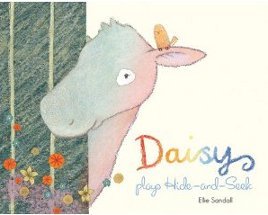
Daisy plays hide-and-seek by Ellie Sandall
Egmont, 2011. ISBN 9781405254571 (pbk).
Jake decides to have a game of hide-and-seek with Daisy, the cow.
On the surface, it would seem that Jake would always be a winner
because, really, how can you hide if you are a cow? But Daisy is
no ordinary cow. She is a strange magical colourful kind of cow
and no matter how hard Jake looks, he cannot find her. He looks in high
places and low places, muddy places and clean places, even sunny places
and spooky places but he cannot see her. He even thinks she might have
tricked him and hidden with her friends in the cow paddock! He is
so sad and is about to give up when something magical happens!
The ending is just as it should be for this age group.
This is another story from the author of Birdsong
which I reviewed in
April after Kindergarten had so much fun performing it. I'm
delighted to say that it is just as engaging. Experience has
shown me that children love to search for hidden objects in stories,
often focusing on that rather than the story itself, so that this story
which relies on them looking for Daisy is guaranteed to attract and
intrigue and help them learn about the intrinsic entertainment of
stories. There were shouts of pleasure as they tried to be the
first to find Daisy, and Jayden introduced us to the word 'camouflage',
which gave an alternative little boy some very positive kudos from his
peers. We had lots of fun thinking about where else on the farm
Daisy could hide, bringing the language of the country to the city, and
then, of course, we had to have a game of our own.
Ellie Sandall knows just how to connect with the very young through her
words and her pictures. Hopefully, there will be more titles from
her soon.
Barbara Braxton
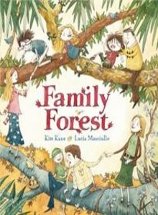
Family forest by Kim Kane and Lucia Masciullo
Hardie Grant Egmont, 2010. ISBN 9781921564703. Family forest has been nominated for the CBCA Picture Book of
the Year
Awards for 2011 and it truly fits this year's Children's Book Week
theme of 'One world, many stories.'
Its dedication to the author's 'pre-cooked' and 'home-baked' children
gives an indication of its theme of blended families, step-sisters and
brothers, step-dads and mums and all the connotations that children
find themselves living in today. Through its hilarious
illustrations, it explores what is meant by terms like 'half-sister',
and step-mum (and she's not an evil witch as the fairytales portray),
and shows that whatever its configuration, a family is just a group of
people with very special bonds built on love. The connections are more
than biological birth details. Instead of having a family tree, this
little girl is lucky enough to have a family forest!
As teachers of our time, we know that traditional topics like 'Who's in
your family?', Mother's Day and Father's Day, and 'Construct your
family
tree' have to be undertaken with a certain sensitivity because, despite
what some would want us to believe, the notion of a family being a
mother, father and their offspring is not the reality for many of our
students.' This beautiful book offers an opportunity for the
children to explore all the different structures that can constitute a
family and that their particular situation, while special, is not
unique.' It opens the door for discussions about circumstances
that might help them feel a part of the group rather than isolated from
it.' It also allows those who are in a 'traditional' environment
to understand that there are all sorts of arrangements that can be
called a family and that just because a mummy and daddy don't love each
other, it doesn't mean they don't love their children.
This is a true example of a picture book - the text and illustrations
are so closely and beautifully interwoven that neither can stand alone
as richly without the other, rather like family members.' The text
is simple, but with a strong message brought to life by the humorous
pencil and watercolour pictures.
While its initial appeal is the younger market, it is often the older
primary student who is starting to examine, compare and question what
is beyond their immediate situation and so this book has an important
place in the collection.
Barbara Braxton
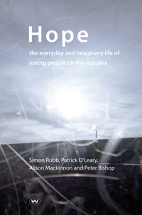
Hope: the everyday and imaginary life of young people on the margins by Simon Robb et al.
Wakefield Press, Adelaide; 2010.
This publication came about as a result of a University of Adelaide
Research Project from 2006-8 titled Doing Social Sustainability:
the
utopian image of youth on the margins in schools.
The material was collected using a variety of methodologies including
visual anthropology. Photo-elicitation was used with subjects
being given disposable cameras to record aspects of their life, so the
book has many photographs and drawings.
The book is roughly divided into three sections, with the young people
telling their stories, then teachers working in their schools give
their opinions, and finally the four researchers give summaries from
their viewpoints.
The preface talks about the complexities of hope and states 'some of
this material might confront the reader, assault our gentle
sensibilities '. The young people certainly do that with
statements such as 'I don't trust anyone,' 'I don't reckon the world is
going to be around much longer,' and 'when I think about hope I think
about dope plants.' However there are alternate
views expressed, such as 'hope is a new beginning' and 'I want a home
and an everyday life like you see in an f--- movie.'
Teachers talk of the difficulty of educating in schools in poorer
socio-economic areas, with one saying; 'You had a persona that you've
had for 20 odd years, and you've got to drop it because it doesn't work
here and it's very confronting.' The importance of relationships
for young people is a constant and the hopefulness of teaching is based
around 'relationships of openness, friendship and caring.'
This would be a useful book for new teachers to read, so as to have
some understanding of what the world looks like to students growing up
on the margins of society. The book or even just chapters
of it could also be used in personal development lessons with older
secondary students.
Kay Haarsma
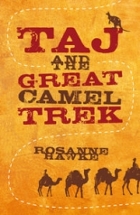
Taj and the great camel trek by Rosanne Hawke
UQP, 2011. ISBN 9780702238772.
Highly recommended. Historical. When Taj rides his camel, Mustara hard
against Tommy, the boy from the coast, in a camel race at Beltana, he
longs to win to show the men that he and his camel are ready to join
their expedition across the Australian continent to Perth. But it is
not to be, Mr Giles chooses his camels from the experienced and older
animals, but later, after Mustara brings Taj and Emmeline back after a
dust storm has obliterated their tracks, he changes his mind. So begins
the journey that will change things for Taj and his father, as well as
the finding of a land route to Perth in the new colonies.
Taj, raised by his father in the Afghan tradition, initially struggles
to find his place in the land of his birth. He must work out what lies
beyond the smiles and the words of the 7 other men on the expedition,
and accepting friendship when it is offered from people vastly
different from himself. He learns the forbearance of his father in
coming to a new country for work, only to have his wife die and who,
through songs and stories of his homeland, passes on the attitudes of
his culture needed by Taj as he matures.
Forget the dry dusty lessons about Australia's early explorers, this
story of Ernest Giles' expedition across the continent is mesmerising,
as Hawke uses Giles' journals and accounts meticulously. In her capable
hands the story, embellished only by the inclusion of the 13 year old
boy to make the tale accessible to a younger audience, comes to life. A
new generation of readers will learn of Giles' expedition as they dive
into the story of Taj and his camel, Mustara crossing Australia's
desert from Port Augusta to Perth in 1875. And what a journey they will
have!
An historical novel that stands out, Taj and the great camel trek,
informs
as
well as entertains. No long descriptions or afterwords are
necessary as Hawke includes all the detail the reader needs to know as
part of the story. We learn of the days without water, the search for
waterholes, the brushes with indigenous groups, and above all the
camels, the group becoming almost a character within the story. The
reader soaks up the facts, woven subtly into the fabric of the story,
making the whole fascinating and involving.
Fran Knight
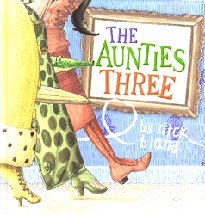
The aunties three by Nick Bland
Scholastic, 2011. ISBN 9781741697919.
(Ages 5+) Highly recommended. When the three aunties are about to come
visiting, the house is in an uproar. Things must be put away, games
disassembled, manners remembered and voices calmed down. The three
children are reminded to get the women a cup of tea, offer biscuits,
and be on their best behaviour for the visit. Of course things do not
turn out well: the cat eats one auntie's hat and so she leaves, the
second aunt sits on the broken chair and so she leaves. When the
children try and cook something for the last aunt, they are all covered
in baked beans. A funny and appealing story with a laugh on every page
will have immediate appeal to younger readers, while the twist in the
end will cause more laughter.
The illustrations are fantastic, colourful and full of fun. On each
page is a variety of things to watch out for, adding another level of
humour to an already laugh out loud story. The wallpaper, the
children's clothes, the aunties, even the fridge are triggers for a
smile.
With a large dose of whimsy, this book is an ideal read-a-loud,
inviting the children to add their voices to those of the aunts and the
children in the story.
Fran Knight
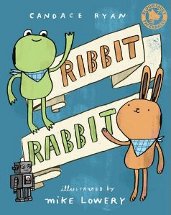
Ribbit Rabbit by Candace Ryan
Ill. by Mike Lowery. Bloomsbury, 2011. ISBN 9781408814413.
Picture book. Frog and Bunny are best friends. They do everything
together. They go swimming, eat peanut butter sandwiches and even fight
monsters. But sometimes they don't get along and they have to work out
how to stay friends.
In an original and unusual picture book, Ryan has written a
rhyming story that will appeal to boys who like mechanical toys and
robots. The repetition of the words 'Ribbit, rabbit' with variations
following it like 'Zip it, zap it' and 'Trip it, trap it' make it a fun
book to read aloud. It is a story that will make the young listener and
reader become aware of the intricate patterns of words and want to try
out new rhymes for themselves.
The ups and downs of friendship are effortlessly included in the
story as they fight over little and big things but realise what they
have to do to make up. Ryan manages to convey in very few words how
lonely it can be when you have had a fight with your best friend and
also how difficult it is to make up.
The quirky drawings by Mike Lowery are cartoon like, and Frog and Bunny
are endearing characters, their facial expressions bringing the meaning
of the text to life. The young reader is challenged to follow the
illustrations as they show what is happening to the two main characters
and are an integral part of the story.
This is an intriguing picture book that I will keep for my young
grandson.
Pat Pledger
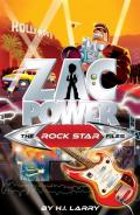
Zac Power: The Rock Star Files by H.I. Larry
Zac Power: The Fear Files by H.I. Larry
With the many titles in the Zac Power series being organised
sequentially in terms of length and level of difficulty, the concept of
including two stories within one jacket is a clever marketing strategy.
Children who have begun by tackling the smaller, individual titles
would feel a certain sense of achievement as they are seen reading
these thicker books. They still contain large double spaced font, full
page illustrations and have many small sketches interspersed
throughout. In addition, each title introduces many new tools, gadgets
and types of transportation, all of which are sure to grab the interest
of the emergent young male reader or slightly older reluctant reader.
Filled with positive messages throughout and with each story concluding
on a pragmatic note, Zac is unable to take his hero status too
seriously. Perseverance, fearlessness, independence, kindness to others
and a good work ethic could be drawn out as themes. Although these
titles could never be considered prize winning literature, they have
nonetheless won their way into the hearts of many young readers. They
are never on the shelves in our school library and serve to
successfully ease children into other more complex adventures and
science fiction stories.
The titles include:
Zac Power: The Rock Star Files Blockbuster. Hardie Grant Egmont, 2011. ISBN: 978 1921759840.
Whilst at Homework Club, Zac receives an invitation to the premiere of
a blockbuster movie. Treated like a star, Zac travels to Hollywood on
board a spectacular blimp. Complete with film stars, mansions,
computerised limousines and paparazzi, he is introduced to a strange
new world with his mission being downloaded from a hotdog! Once on the
set of a new movie, Zac meets a bunch of androids and discovers a plot
to brainwash the world's best spies. He needs to resolve this
situation, before heading home to 'write a thank you note'. Shock Music (in same volume)
Hunting for a birthday present for his mum, Zac comes across a display
of D-Pods, music players similar to iPods. His new mission is to
investigate these machines, as it appears that they have the ability to
turn their users into zombies under the control of Dr Drastic. With the
aid of the CamoSine, he is delivered to the location of for his task
and, in the process; Zac is personally introduced to Axe Grinder, his
favourite band of all times. Immediately, he begins to establish his
new persona as a Rock Star and goes on to uncover the truth behind the
D-Pods. Is it his favourite band that is to blame or is Dr Drastic
responsible?
Zac Power: The Fear Files Horror House. Hardie Grant Egmont, 2011. ISBN: 9781921759833.
When Zac receives mission information on his SpyPad, which appears to
have been intended for a BIG agent and not him, he heads into a haunted
house where he needs to uncover the truth behind the message. On this
mission he encounters a scary house complete with everything one would
expect to see in the stereotypical 'haunted house', spiders, bats,
skeletons, ghosts and more. Luckily Zac has remembered the lessons
taught to him by his old granny, parents and brother and is not afraid
of anything the house has to offer.
Thrill Ride
Zac is seemingly abducted from an Axe Grinder concert, before being
given his new mission, an 'intelligence gathering operation' in which
he must bug the conference facility at a new theme park called The
Shark Park.
Having to do so disguised as Captain Tentacles the Happy Octopus makes
his life challenging and also more embarrassing! In the course of duty,
Zac meets some characters who may or may not prove to be enemies and
uncovers a sinister plot to which he then tries to put a stop.
Jo Schenkel
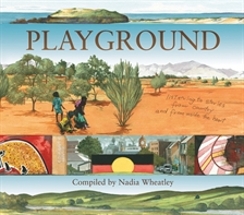
Playground complied by Nadia Wheatley
Illustration and design by Ken
Searle. Allen and Unwin, 2011. ISBN 978 1 76237 097 2.
(Ages 8+) Recommended. Picture book. Subtitled, Listening to
stories from country and from inside the
heart,
this large picture book of 85 pages plus about 10 pages of conclusion,
acknowledgments, bibliography, references to contributors and index,
make this an exceptional book to use in the classroom and library when
looking at Aboriginal culture. Each double page is an amalgam of
stories from different groups in different areas of Australia, with
superb illustrations and photographs, collected under headings which
are of huge benefit to the student. With headings such as First
lessons, Getting bush tucker, Going fishing, Learning
through
song
and
ceremony and Growing up, the range of topics covered will
cover all
eventualities in the classroom. Students that want to know how
information is passed on in a community without written language, will
be satisfied with several chapters, particularly the one entitled,
Learning through stories and pictures, which, after an introduction,
then allows the people to tell their stories. So we have Jami Lester,
growing up in the Yankunyjatra lands in western South Australia,
talking of his experiences, followed by Paddy Japaljarri Stewart from
the Walpiri lands in Central Australia, talking of the law in his
community and Olive Jackson telling us of law in her community. In this
way the book serves to show the differences between Aboriginal groups
as well as their similarities. On the three double pages of Getting
bush tucker, an introduction again gives the reader a context, then
launching into stories from different people. Darby Ross, a Walpirir
man,
describes collecting and sharing food as a child, while Hazel Brown and
her brother talk of collecting food in south west Western Australia,
and Troy and Geoffrey tell of collecting emu eggs near Walgett in New
South Wales. In this way a collection of stories details the experience
on the land of these individuals, building up a picture of Aboriginal
life.
Sharing their wisdom, both within their communities and with the wider
world, ensures that their culture lives on, and this book reveals much
to the student and interested reader, eager to learn of the Aboriginal
way of life, where the land is both their school and their playground.
A most useful resource which supports many other wonderful books, The
Papunya
book (Nadia Wheatley), Maralinga (Christobel Mattingley)
and
Our world (One Arm Point Remote School)
Fran Knight
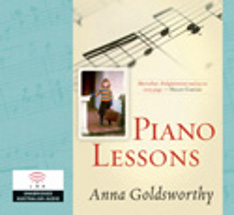
Piano lessons by Anna Goldsworthy
Black Ink Press, 2009. Louis Braille Audio, 2010. ISBN 9781742124087.
Highly recommended. Audio book. Biography. A mesmerizing insight into
the relationship between teacher and pupil is told in this audio
version of Anna Goldsworthy's award winning story Piano lessons. In
this homage to her teacher, Goldsworthy gives a candid account of her
lessons from the first day. She was advised to find another teacher
when her current teacher, a jazz musician, felt she had learnt all she
could from him. Her family was advised that their daughter should
audition for lessons with Eleanora Sivan, a woman brought up in the
strict discipline of Russian piano teaching. Taught within the European
tradition she was only one or two people away from the famous composers
of the nineteenth and early twentieth centuries, and this vast
experience was handed on to Goldsworthy.
From these accounts of her youthful lessons to when she became a
concert pianist of world repute, Anna Goldsworthy's teacher, Eleanora
Silvan, shines through. Encouraging, yet aloof, vigilant and critical,
giving a rich background to the various pieces Goldsworthy learnt, Mrs
Silvan's force of character is obvious from the start and as we listen
to this marvellous recording, her presence can be felt.
Anna Goldsworthy's compliment to the teacher is in every word, as the
woman berates her pupil for not feeling the music, or not knowing about
the composer, or not putting enough expression into a piece, or
shrugging when she makes a mistake on stage.
At first, Mrs Silvan told Anna's father that the girl would not make a
concert pianist, but Anna decided that this was to be her aim, and so
practising four hours a day became a norm. Through her years at high
school, Goldsworthy worked hard at piano as well as her classes at
school, but keeping her cleverness to herself. Only when the first of
many accolades was given to her did some of her peers realise her
talent.
With Mrs Silvan's one word, 'Not', ringing in her ears, Goldsworthy
kept hard at work, refining her piano playing, learning all about the
composers and their work, and entering competitions. Each competition
was a stepping stone and yet Mrs Sivan kept reminding her that she
should play for herself, not for a competition where other people's
opinions were more important than her own. At the end of year 12,
interviewed for The Advertiser, Goldsworthy gave glib answers to the
inane questions and was reported without thought. Mrs Sivan was
devastated and it took some strength of character for Goldsworthy to
regain the footing that she had with her teacher. The strength of the
teacher, Mrs Sivan, was equally present in the pupil. And now, that
strength, knowledge and heritage is being passed onto a new generation
of pupils through Goldsworthy's teaching and stage presence.
Beautifully read by Jane Nolan, the text is enriched by the subtlety of
her voice and the nuances of tone which underline the feelings of the
main characters. Her rendition of the voice of Mrs Sivan is remarkable,
giving a richness to her accented pronouncements and the stress on the
word, 'Not', is enough for the listener as well as the pupil to sit up
and take notice.
Fran Knight