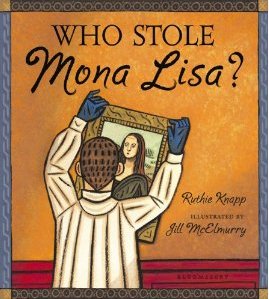
Ill. by Jill McElmurry. Bloomsbury, 2011. ISBN 978408511580.
(Ages 7+) Picture book. Warmly recommended. The story of the theft of
the Mona Lisa in 1911 is retold in this vibrant picture book in
celebration of the anniversary of its theft. Celebrate is probably the
wrong word to use when dealing with the theft of such a significant
painting, but the book serves to celebrate the painting itself and the
artist who painted it. The book also serves to remind us of the
fragility of such icons of our civilisation and their vulnerability.
The reader is invited into the gallery of the Louvre in Paris to look
at the painting and hear what the guide has to say. In this way the
reader is given a potted history of who the sitter was, something about
Leonardo da Vinci and why the painting was executed. Some of this
children may know but for younger readers, the facts are fascinating.
The story of what happened after Leonardo died is even more entrancing
as the painting made its way around Europe, ending up in Napoleon's
bedroom. He gave the painting to the Louvre and there it became world
famous with many visitors.
One visitor was Vincenzo Perugia, who firstly measured the painting
before stealing it in 1911. An Italian house painter, he claimed to
have stolen it to return it to Italy, but he painting languished under
his stove in his flat for two years before he was caught and sent to
prison.
A fascinating story told in part by the painting itself, the book will
encourage an interest in this painting, which draws huge crowds to the
Louvre every year. Readers will love to read of the theft and why
Perugia stole the painting and what happened to it while it was
missing. An astute teacher will use this book to encourage students to
look more closely at this well known painting, at the painter and take
a wider perspective of museums and art galleries, and perhaps other
famous thefts.
Fran Knight
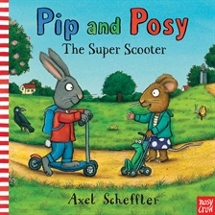
Pip and Posy: the super scooter by Axel Scheffler
Nosy Crow, 2011. ISBN 9780857630056.
Pip the rabbit was riding on his new scooter - he could go up and down
and even do tricks on it. But when his friend Posy saw it she
liked it a lot - so much that she snatched it away from Pip and off she
went, up and down and doing tricks, even though she had never been on a
scooter before. What happens next is quite predictable, as
stories should be for this age group, but Pip's response offers a
lesson about how we should treat our friends even if we are cross with
them.
I shared this with Miss Nearly 5 and she loved its simplicity which is
enhanced by the delightful illustrations of the author (who also
illustrated The Gruffalo).In fact, she was so entranced that I
overheard her retelling it to Miss 7-weeks in her bassinette.
Great for reading aloud and reading along and talking about options and
good choices. What could Posy have done instead of snatching the
scooter?What do you think Pip will do when Posy crashes?
Miss Nearly 5 has put her seal of approval (and dibs) on this one.
Barbara Braxton
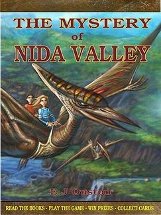
Interview with Elaine Ouston, author of The mystery of Nida Valley
Today I am hosting Elaine Ouston on her blog tour. Elaine Ouston's
latest fantasy book, The Mystery of Nida Valley,
a
tale
of
magic, time-travel and adventure for readers aged 10+ has just been
released. It is the first book in a series about a hidden valley full
of ancient animals, dinosaurs, and much more.
What authors/books did you read as a child?
As a beginning reader, I loved the fantasy of Enid Blyton's books like
The Magic Faraway Tree, but by about ten, I had switched to her
adventure stories. I read most of the series of The Famous Five,
The
Secret Seven, and anything I could get my hands on in the same ilk.
From my teens on my taste changed and I started to read fantasy. The
Lord
of
The
Rings is my all time favourite.
When did you first become interested in being a writer?
At school, I loved writing compositions (short stories) in English
class, and would send hours dreaming up interesting plots for them.
Did you consider a career in writing?
In year eight - the year we finished lower school then - I was told by
the guidance office that I had the potential to study either art or
writing - to become a graphic artist or journalist. It was a hard
decision, but I choose art and worked in the industry for over twenty
years. But I never lost my desire to write. During this time I also
studied creative writing. My writing at that time was advertising
related - advertising copy writing, newsletters, press releases
etc.
Name authors or books that have influenced or inspired your own
writing
in some way?
As I have already mentioned, J. R. R. Tolkien is my all-time favourite
author. Enid Blyton, C. S. Lewis and The Bronte sisters, follows him
closely but there are so many current novelists who also inspire me. I
am fortunate enough to have most of them as my Facebook friends. The
few I haven't yet met are Maria V. Snyder, Matthew Reilly and Tim
Winton.
If you were travelling and were told you could only take one book
with
you, what book would it be and why?
I wouldn't be able to decide - that's why I'm taking an eBook reader to
Europe with me - so I can take a whole library.
What do you hope your readers will take away from reading your books?
Except for knowledge of the megafauna, I want my readers to be totally
absorbed in the world I've created, as if they too have journeyed to
the valley. To share the laughter, tears and fears my characters feel.
To remember the courage of my protagonists as they faced danger and
take that courage into their own lives. I want them to finish reading
my book with a satisfied feeling, but with a desire to share more
adventures with my characters. I want them I want them like it so much
they recommend it to their friends. Is all that too much to hope for?
What advice could you give aspiring authors about the process of
writing and self-publishing?
I believe writing fiction is 70% imagination and 30% knowledge and
skill. However, that 30% is vital to have before you start your story.
Be sure to read anything that you can get your hands on about writing
or do some formal study. If you decide to self-publish, make sure that
you have the manuscript appraised and edited to ensure it is ready. I
had two published authors, and many friends read my story first. I
listened to their advice and re-wrote the scenes that weren't working,
then sent it off to an editor and a proof-reader before publication.
Why did you decide to offer your books as e-books?
As many children are more interested in electronic gadgets than books,
I hoped it would pick up a few more readers. I think it is the way of
the future, unfortunately.
Where can we buy your book The Mystery of Nida Valley?
Hopefully, in your local bookshop. Dennis Jones and Associates is
distributing it so if it is not in stock, just ask the store to order
it for you. Or, you can get a cheaper, signed, dedicated printed copy
from my website. eBooks in
many formats
are also available there. Payment is via PayPal.
In conjunction with this blog tour, you can go in the draw to win one
of three copies of the book. Go to
http://themysteryofnidavalley.wordpress.com
and check out the Collector
Cards page. Then answer this question: What megafauna animal
would you like to see in the flesh and why?
The competition will close at midnight on May 15th 2011. The answers
will be assigned a number, and that number will be put in a draw. The
winners will be notified by email. The winners will also be eligible to
enter the Code Cracker Game.
Pat Pledger
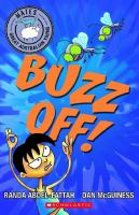
Buzz off! by Randa Abdel-Fattah
Ill. by Dan McGuiness. Series: Mates: Great Australian yarns.
Scholastic, 2011. ISBN 9781862918481.
(Ages: 8+) Warmly recommended. Lying in bed one night, trying vainly to
get to sleep, Noor finds himself unable to swat the pesky flies which
keep dive bombing him. Suddenly aware that he can hear them he is
appalled when he realises that they are targetting him because he is so
bad at killing them. He decides to take action.
It is the Eid Festival, celebrating the end of Ramadan, so food is
being prepared in earnest. The kitchen is full of food, and when they
sit down to eat, flies appear from all over the place. Getting the fly
spray, Noor overhears the flies telling each other about banana smeared
with toothpaste and garlic, and how that is far worse than any fly
spray. So Noor sets to work.
A funny story of just what the fly is useful for and showcasing the
extent of the problem, this is sure to have younger readers laughing
out loud at the flies and their antics, and Noor and his solution to
the problem.
The cute story is beautifully complimented by Dan McGuiness' zany
drawings of Noor and his family (checkout Mum with her headscarf and
cork hat!) as well as the header and footer drawings of stale food, and
his wonderful flies! This series of books does not talk down to the
student. It is to be commended that words are not simplified, meanings
are not given in a glossary and settings are given which although
unfamiliar require the student to ask questions or look something up,
which is refreshing to see.
Fran Knight
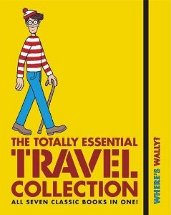
Where's Wally? The totally essential travel collection: all the classic books in one! by Martin Handford
Walker Books, 2011. ISBN 9781406333527.
Warmly recommended. For all those fans of this amazing little bloke,
this volume of Where's Wally will suit them when traveling or
not! A
fascinating collection of the Where's Wally books, all
collected
together in one volume, it will engender hours of fun on train, bus,
plane or car.
Of a size to make it fit snugly into your hand or handbag or jacket
pocket, the volume will be sought after by parents and grandparents
sending off children or friends on a trip, or to fill a Christmas
stocking, or Easter present, or anytime really, as it is infectiously
inviting to look into the pages and find Wally!
I love the historical pages, those where Wally is away with the Vikings
(I remember doing a jigsaw of this page once - unreal!) or in the
depths of a castle, or in a Roman arena, or building a temple with the
Aztecs. And more up to date, tempting the vampires, or in outer space,
or being a part of Where's Wally, the musical. It is all great
fun
finding the little bloke, but as you do, the humour on each page makes
the reader laugh out loud. If finding Wally isn't enough, then fold out
pages at the start and end of each section, of which there are seven,
list all the other things to be found on each page. Hours of fun and
laughter.
Fran Knight
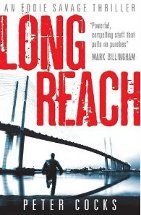
Long Reach by Peter Cocks
Walker Books, 2011. ISBN 978141632474.
(Ages 13+) Thriller. The life Eddie Savage is about to lead is every
pubescent boy's dream. When his brother is found dead Eddie finds
that his brother had another life, a shady one that dealt with the
underbelly of society. That is also the life that Eddie finds himself
lured into. The reader is never sure what this is, but is given hints
about its governmental associations.
With a very small amount of training tough but short and sweet Eddie at
seventeen, finds himself living in a luxurious safe house with a bar
and babe laid on. He is supposed to be a bit of a whizz with computers
but the reader gets very little sense of this because Cocks doesn't
want his hero to be a nerd.
Eddie has to infiltrate a criminal family through the sexy young
daughter Sophie, who has a reputation of being untouchable. The father
has a reputation of being very protective and a story does the rounds
of a former boyfriend being found dead at the bottom of a multistory
carpark. Naturally Eddie takes all in his stride and is soon welcomed
into the bosom of the family by all but Sophies brother Jason.
With short chapters, and an enticing cover, this is an easy read with a
very familiar storyline, it has blood, killings, drug use, sex and
tension, which will appeal to boys of the middle teenage years.
Fran Knight
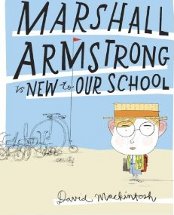
Marshall Armstrong is new to our school by David Mackintosh
HarperCollins, 2011. ISBN 9780007361410.
Picture book. Highly recommended. When new boy, Marshall Armstrong
comes to the classroom, the teacher sits him in the front with a class
member until he finds his feet. But Marshall is different. The
classmate is suspicious of his equipment laid out on the desk.
Marshall's box of pens, his ink pen, rubber bands, several rulers,
slide rule, compass and bull dog clip, contrast wildly with his
neighbour's single small pencil and folder of paper. The next page
underlines the differences even more. The classmate points out his eyes
that always look to the front, the shell like ear, freckles like bird
seed and his tidy shoelaces, all adding up, in his mind, to a huge
difference between the children in the class. These differences are
further underscored when the children go outside the classroom. Here
Marshall does not involve himself in games, and eats the oddest of
food, each in its own labelled container. The neighbour concludes that
Marshall does not fit into their school.
When the class is invited along to Marshall's place to celebrate his
birthday, the classmate predicts that everyone will have a horrible
time. But the party is different with all the class having the wildest
of times, playing hide and seek, making lemonade, playing with the
train set and opening a pinata. As a consequence the class mate changes
his mind about Marshall, saying how great he is. The next new person to
come to the class is welcomed.
A lovely story about fitting in, about welcoming people and about
acceptance of difference is beautifully told and illustrated in David
Mackintosh's distinctive style. His seemingly quick pencil sketches are
filled in with colour and vitality, while each double page spread gives
the reader a different view of what is going on. I love the double page
of Marshall's things, the collection of bits and pieces redolent of
times past, fitting in so well with the drawing of Marshall himself,
with straw hat and round glasses.
Fran Knight
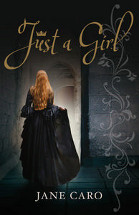
Just a Girl by Jane Caro
University of Quensland Press, 2011. ISBN 9780702238802.
(Ages 11+) Historical. Highly recommended. Elizabeth, daughter of Ann
Boleyn and Henry V111, sits in the Tower of London on the eve of her
coronation and recalls her turbulent life. Caro is able to tell her
story simply but is also able to include the reader in the terrible
intrigue and power struggles that were the hallmarks of the Tudor
dynasty.
The major players in this struggle are very familiar to an older
audience, but not so to the younger readership and Caro is able to
introduce the characters without a hint of condesention. We are able to
understand the underlying reasons behind behaviors, though they seem
outragous to us now. The desire to have an heir to safely and smoothly
continue the government and dynasty of the Tudors is uppermost in
Henry's mind and it is this which puts his children in conflict with
one another as well as their father.
Elizabeth's relationship with her father is explained in a way which
gives insight to the behaviors of both. Her relationship with her
sister Mary Tudor is as unpredictable as any of those at court who may
be in favour at one time but will find themselves in the Tower the
next. Elizabeth learns quickly not to trust anyone completely and
decides, according to Caro, that she will not marry. She is wary of the
great families who would try to use her to gain power, as they did with
her cousin Lady Jane Grey. She is also welll aware of the perils that
marriage brings. Any future husband would use her postion to gain power
for himself and establish a dynasty for his own family. Elizabeth has
also seen the dangers inherent in childbirth especially with the
example of Jane Seymour.
Elizabeth came to understand the problems that occured when the
succession to the throne was disputed or subject to regency, such as
that of her young half brother Edward V1. She could also see the
problem from the other side, where the succession was crystal clear and
gave the plotters and power seekers someone to focus their attention on.
Caro certainly leaves no question that Elizabeth was lucky to inheret
the throne. Her times in and out of favour; labelled as a bastard,
imprisoned in the Tower or Woodstock, or at court having to watch every
word and action in case it gave courtiers or the monarch reason to
doubt her loyalty, would have broken most in her position. Just a Girl
is a very readable historical fiction even though you know the
outcomes. We are given an insight into Elizabeth that provides empathy
and understanding.
Mark Knight
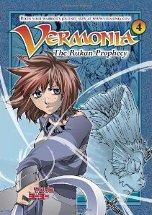
The Rukan Prophecy by YoYo (Group)
Vermonia: 4. Walker Books, 2010.
This is the 4th of a planned 10 volume manga adventure series, which
features really impressive black and white artwork. The fate of
three worlds depends on the courage of four friends, Naomi, Doug, Jim
and Mel, the Blue Star Warriors - the Battle for Vermonia continues.
In this storyline the tribes of the Turtle Realm, led by the Blue
Star warriors fight Uro's dark Yami magic in two epic battles.
The four pillars of the Turtle Realm - fire, wind, water and thunder
are attacked and Mel is imprisoned in a castle. Can they reunite with
her AND save their Realm?
The author YoYo is a Tokyo based collection of writers, artists and
gamers, which began in 2006. It would have been advantageous to have a
character summary at the beginning for new readers and page numbers for
easy return to your reading spot.
This 4th volume can just be read without the earlier volumes but the
reader will be bolting to the shop to buy no 5! Young readers
will love the associated website - www.vermonia.com, where they can get
free wallpaper, posters and music and take part in some engaging games.
Although Vermonia is action packed it is suitable for readers from 9
years to about fifteen who have good imaginations and a love of
fantasy. Manga lovers will be captivated with this book.
Kay Haarsma
Z by Michael Thomas Ford
Random House, 2010. ISBN: 9781864718225.
(Ages: 12 +) Set in 2032, Z is a novel about a teenager, Josh, who
moves from his favourite virtual video game of hunting and torching
zombies to a real life nightmare where the zombies seem too real.
The video game is based on a 'historical' event that occurred in the
2020s when a virus spread across New York and the rest of the world
causing people to become zombies. The only solution to solving this
problem was to employ armies of zombie torchers who patrolled the city
in order to catch and torch zombies. The moral and ethical problem with
this is that these zombies where formally real people and often the
relatives and friends of torchers. As a result, years later, a new
generation of teenagers have taken to the heroics of the virtual zombie
game much to the displeasure of their parents who lived through the
real dangers and memories of the zombie wars. Despite, Josh is
eventually persuaded to join an underground zombie hunting group, which
turns out to be front to pedal the mysterious drug called Z. Along the
way he experiences romance and this more common issues concerning
teenagers such as a fight with his best friend. Z moves beyond what
could an entertaining novel about hunting zombies to touch on some
deeper issues about growing-up, developing new friendship groups, peer
pressure and using drugs. For this reason, slightly older readers are
more likely appreciate these themes.
Adam Fitzgerald
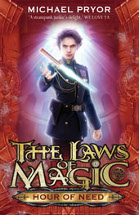
Hour of need by Michael Pryor
The Laws of Magic, book 6. Random House, 2011. ISBN: 9781741663105.
Highly recommended for ages 12 and up.
Aubrey, still bearing the label 'traitor son of Albion', is travelling
with and caring for Hugo Von Stralick, the ill ex-Holmland spy. They
have been observing the evil Dr Tremaine in his current retreat and
pondering the presence of many well known magicians, obviously being
held against their wishes. When Aubrey's first attempt to rid the world
of Tremaine goes awry, he and Hugo endeavour to get closer to the
action and are shortly reunited with Madame Zelinka, her Enlightened
Ones and George, Sophie and Caroline. From there, the action
intensifies with much use of science, magic and teamwork as the heroes
battle to save the world from total devastation.
Pryor's conclusion to this great series is filled with some suspense,
humour, insights into the machine of war and its purpose or lack
thereof. His comments regarding the role of the government are
applicable to that of any society at any time in history. He has
catered for readers of any gender. Stereotypically, many male readers
will love the descriptions of the skyfleet, battles and steampunk
creations and females will be satisfied with the development of the
various relationships throughout the series. Despite this, Pryor
creates strong female characters that are equally as capable in their
fields as their male counterparts. He leaves us with the promise of
things to come in the state of Albion. The vocabulary and more formal
style of language make this series more appropriate for the young adult
reader, as does the fact that it shows the 'coming of age' of the
protagonist, Aubrey. This is a series I am glad to have gone back to
read in its entirety, as the author has cleverly crafted not just the
tale itself but the character development has been realistic and
satisfying.
Jo Schenkel
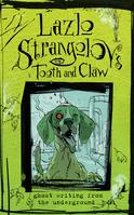
Tooth and Claw - ghost writing from the underground by Lazlo Strangolov (a.k.a Matt Whyman)
Walker Books, 2011. ISBN 9781406323450.
Recommended for middle to upper primary. 'Little Lumina loves her pet
beagle, Scud, even though he's been brought back from the grave by her
father. But stranger things than this are surfacing in the
volcanic town which is home to Dr Grubo's health clinic.'
Set in a very unusual town, this is a highly quirky story about a
devoted father and a zombie dog. Lumina lives in a spa town,
where there are hot springs and geysers of steam all around town.
Her father works at the local clinic, the place locals visit for their
health treatments, next door to the town's power station. The
earth is bubbling and unpredictable in her town, just as is her life
once her beloved beagle is brought back from the grave by her well
meaning father.
Smelly, squishy and with glowing red eyes, Scud is still as lovable as
ever to Lumina, and unfortunately for her, he is also still as
mischievous. What trouble can a zombie dog on the loose
cause? Find out as you travel with Lumina and some of her family
friends to discover the power of love, slobber and secrets.
A nicely presented book with quirky details on each page that add to
its charm. Students will enjoy the grossness of the story that is
presented with just enough gory details to make it interesting.
There are some points of predictability, but enough twists to keep you
guessing again.
Overall a fairly easy read that would appeal to many young readers, I
would recommend it to those students that like Morris Gleitzman's Toad
Rage series.
Zana Thiele
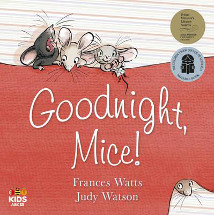
Goodnight mice! by Frances Watts
Ill. by Judy Watson. ABC Books, 2011. ISBN 978073332425.
Picture book. Mitzi, Billy, Clementine and Oliver are about to be put
to bed by their parents. All four are tired little mice and the
procedure of going to bed is spelled out as they follow the routine of
going to bed. First they kiss their grandfather good night, then climb
the stairs, have a bath, clean their teeth, put on their pyjamas, climb
into bed, have a story read to them and finally the lights are put out
and they go to sleep.
Told in rhyming four line refrains, the rhythm is easy to pick up and
so listeners can predict the next words as it is read aloud. The
straightforward story, giving a procedure before bed time, will
engender a great deal of discussion about what children do before bed
and what time they go to sleep. Teachers will be able to use the story
as an impetus to discussion in the class about routines and their
importance, about procedures and house rules. The mice are
endearing and the illustrations reflect another level of humour which
is obvious to the listener as the story is read. Children will delight
in the antics of the mice in their bedtime routine, taking time to
delay the moment, but all the while, ready to sleep.
Fran Knight
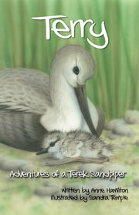
Terry, adventures of a Terek Sandpiper by Anne Hawthorn
Wombat Books, 2011. ISBN 9781921633300.
(Ages 5-7) Environmental concerns. Mixing non fiction and fiction is a
path fraught with peril, and few do it well. Although the information
presented in this book is interesting, its mix of the two genres simply
does not work, and I would have much preferred to see a solid non
fiction book with the lovely illustrations born of this venture. And of
course this would have included a map, which is sorely missing.
A story of the Terek Sandpiper is diligently told by Anne Hawthorn
making a story of its habitat, behaviours and life in learning to ply
the incredible journey it makes each year from Australia to the Arctic
Circle and back. In the first few weeks after it is born, Terry the
Terek sandpiper learns to walk and fly, catch mosquitoes, and eat to
build its strength to fly south. It flies with its group, the crowd
skimming over the Great Wall of China, spying pandas in the mountains,
across the treacherous Yellow Sea and through cyclones, until finally
reaching the Australian coast.
With engaging illustrations by Sandra Temple, this earnest book will
find a home in some classrooms where environmental awareness is under
discussion or where animals and birds and their habitats and behaviours
are being taught. The beginning of the book tells us why the book was
written and at the end is a long page of closely printed information
for the researcher. It is a mix of fiction and information book which
does not quite jell, but readers will find something to like in its
plain simple layout and the strong emphasis on information about this
mostly unknown bird in our midst.
Fran Knight
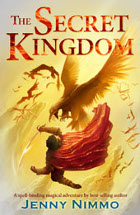
The secret kingdom by Jenny Nimmo
Random House Australia, 2011. ISBN 9781742751986. Pbk 243p
(Ages 10+) Highly recommended. Fantasy. When Timoken and his sister are
given precious gifts from their parents when the enemy is about to
slaughter the inhabitants of the castle, the pair flees. Timoken is
given a web woven from the thread of the last moon spider, which gives
him extra powers, and it is this that his enemy, the viridees, want. He
and his sister Zobayda, elude the enemy over many years, taking the
elixir to give them eternal youth. Meeting a camel whose master has
been killed, he becomes part of their family, as do the three leopard
cubs who they save. When the viridees confront Timoken and his sister
she leaps over the waterfall to her death to save her brother, and he
goes on, wary, fighting the enemy along the way, all the while
searching for a place of safety, a home.
One night a boy stumbles across him with an amazing story of slavery,
and so Timoken stops to help him, rescuing the other children and the
girl, Beri, from being sold the following day. They then go to Toledo,
where Beri is from, and here Timoken has a life and death struggle with
the new leader of the viridee, the half human, half viridee sorcerer
son of Lord Degal, killer of Timoken's parents.
Reading Nimmo's The snow spider trilogy years ago left me
breathless.
And this is is no different. Original, entertaining and highly
adventurous, the efforts of Timoken in finding a place of safety where
he and his family can live put their lives is mesmerizing, as he fights
the dreaded enemy who chase him for two hundred years.
Fran Knight