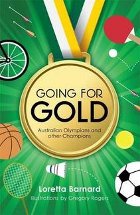
Going for gold: Australian Olympians and other champions by Loretta Barnard
Ill. by Gregory Rogers. Random House Australia. ISBN 9781742755656.
(Age: 9+) This book appears to have been published in anticipation
of
Australia's participation in the 2012 London Olympics. There are 178
pages in hard copy, and it has also been published as an ebook. Of
special note are the illustrations of Gregory Rogers - delicate,
shaded
b & w line drawings. The writing style is less notable with
occasional flippant comments, which do not add to the overall
quality
or humour of the text.
There is an attractive, uncrowded, inviting layout. Similar sports
are
logically grouped together in sections eg In the pool, Ball games,
On
the track. There are good-sized sub-headings within each sport. Page
numbers, sports and sections are clearly marked at the bottom of
each
page. The reader can explore the history of each sport, athlete
profiles, clear explanations of how each sport is played, and Did
you
know? fact and trivia boxes.
Contents (sports only), Introduction and Index (athletes only) are
included. There are lists of sports played at the Summer Olympics,
Winter Olympics and Paralympics, and also Australia's medal tallies
from each of the above.
There are some amazing stories of Australian Olympic participants eg
Snowy Baker (1908), the only Australian to have competed in 3
different
sports (swimming, diving, boxing); Shirley Strickland (1948), the
photo
of the finish line in the 200 metre final shows her in 3rd place,
but
without reference to the photo, the judges placed her 4th; and
Steven
Bradbury (2002), Winter Olympics gold medal, when he was the only
man
left standing in the final of the 1000 metre speed skating.
It is pleasing to see Louise Sauvage and Michael Milton in the
Paralympics section, but a shame that current, outstanding
Australian
paralympians, shooter Libby Kosmala and swimmer Matthew Cowdrey were
omitted. Conversely, it seems strange to include some Australian
sporting champions eg. in tennis and soccer, who did not compete in
the
Olympic Games, as this book is ostensibly about the Olympic Games.
This book is appropriate for readers of 9+ years, but will have wide
audience appeal. It is suitable for simply dipping into or for
research
purposes.
Margaret Strickland
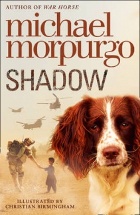
Shadow by Michael Morpurgo
HarperCollins, 2011. ISBN 9780007339617.
(Ages: 9+) Recommended. Animals in war, Refugees. The story of the
Australian Explosive Detection Dog, Sarbi, missing after combat with
the Taliban in 2008, stirred the imagination of several writers,
producing two fiction and one non fiction book about the dog and its
work in Afghanistan prior to its absence of 14 months, and
speculating about what happened in those missing months.
This most winning version of the story will garner a host of readers
as Morpurgo tells the story of Shadow, an Explosive Detection Dog
that goes missing after action with the enemy.This tale is told from
a quite different perspective than the other two, here we have the
story of a grandfather visiting his son's friend, Aman in detention
in Britain as the boy and his mother prepare to be deported back to
the country of their birth, where their family has been killed by
the Taliban, the mother imprisoned, beaten and tortured and the pair
told to leave. Talking to Aman, the grandfather unravels his tale of
finding a dog, a dog which stuck with the boy and his mother, often
protecting them when they were threatened, and finally finding its
real home quite by accident. So Shadow becomes Polly an EDD animal,
part of the unit fighting the Taliban.
The tale of the grandfather and his grandson, Matt, finding a way to
acquaint others of the plight of this now small family, makes
emotional reading, as they go from hope to despair and back again.
And this is paralleled with the story of Shadow, the dog who goes
missing, finally finding a young boy to be with, one to help and
protect as it finds its real home.
Morpurgo has written a wonderful story, full of insight and
information, as he reveals the lives of refugees fleeing a country
which now despises them, and when washed up on shores where they
hope their future lies, are met with police and imprisonment,
leading to deportation. The cruelty of detention centres is shown
through the lives of Aman and his mother, and information at the end
of the book shows that children will no longer be kept in these
centres. It is beautifully written books such as these, by award
winning authors, that keeps these issues alive in people's minds,
and gives a human face to the tragedies seen on the media.
Fran Knight
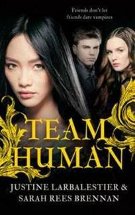
Team human by Justine Larbalestier and Sarah Rees Brennan
Allen and Unwin, 2012. ISBN 9781742378398.
(Age 13+) Recommended. Vampires. Humour. When this book came across
my desk I decided to read it immediately because I like Justine's
writing and I thought the premise that friends didn't let friends
date vampires sounded really interesting. I was not disappointed. I
loved the parody of the vampire book, the fact that the authors take
many of the ideas in the vampire genre and got me to laugh out loud
about them but then made me think about tolerating difference and
respecting others' opinions.
Mel is appalled when her best friend Cathy falls instantly in love
with Francis Duvarney, a vampire who has decided to attend their
high school. She decides that she has to save Cathy from the worst
mistake of her life and in doing so, comes across Kit, a human who
lives in a vampire shade, with his vampire cop mother and some
zombies. She is also investigating the disappearance of another
friend's father, who was supposed to have been seduced away from
home by a glamourous vampire.
With two clever authors seamlessly telling this story, the reader is
in for a real treat. Mel's tunnel vision about what is right for
Cathy, her disdain for vampires and the ties of friendship are all
told in a hilarious narrative by Mel, whose one liners and sense of
humour pervade the book. Her prejudices about vampires are tested by
Kit, a human who has lived all his life with the vampires who took
him in when he was abandoned as a baby, and who doesn't believe that
being human is better than being a vampire.
I read Team human in a couple of sittings. It was fast
paced, the humour sparkled and it was lots of fun. Teens who have
enjoyed the Twilight series will have a giggle at this send
up of the vampire genre and those who are bored with the genre will
also enjoy it. A book trailer is available.
Pat Pledger
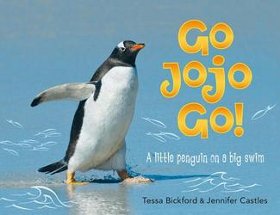
Go, Jojo, go by Tessa Bickford
Allen and Unwin, 2012. ISBN 9781 74331 017 5
(Ages 5+) Recommended. Picture book. Antarctica. A wonderful
companion picture book to Alison Lester's One small island
and Sophie Scott goes south, this book tells of a baby
penguin growing up on Macquarie Island, south of Tasmania, halfway
to Antarctica. Tessa Bickford spent two summers on Macquarie Island,
allowing her to get to know the fauna and flora, and take
photographs of the penguin chick as it developed.
The sequence of photographs show the chick growing up once out of
the egg, developing its feathers, looking all the while out to sea,
where it must eventually go. Each page depicts its surroundings, the
other animals, and the ever present sea. Some pages are a full
colour photograph, allowing the students to look more closely at
Jojo, while other pages have a number of smaller photos, showing a
sequence of events. Each page has a stimulating, fascinating
background, one which will draw readers in to look at what is
depicted.
Several pages are standouts in photography, one depicting a skua
bird about to possibly grab a penguin chick, amazing in the
closeness of the beak preparing to attack, while the double page
with four photos in a sequence showing the little animal as it takes
to the water, is one of those moments that brings the book to life.
This is a beautiful picture book, encouraging students to know more
about Antarctica, revel in the antics of these small animals and see
for themselves the place parental love and companionship has in
developing babies to a time where they leave home.
Fran Knight
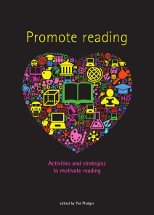
Promote Reading ed. by Pat Pledger
Pledger Publishing 2012. ISBN 9781 8766 7827 2.
Highly recommended. This book scored well from the first page: a
sub-title such as Activities and strategies to motivate reading
is of course an instant hit with teacher librarians. Anticipation
was further heightened on opening the next page, a very full and
informative Table of Contents covering a wide range of ideas and
strategies.
The Contents Page is arranged under various headings, e.g. General
ideas to promote reading, Finding the right book for the
reader, and under each heading are several articles, some with
intriguing headings such as Speed dating, Loo reviews
and Shelf talkers. The articles are quite short, most of 1-2
pages, with some a few pages longer.
Straight off I came across a recommendation for a wiki site for
summer reading for teachers, which (I probably shouldn't admit) I
didn't know about, but proved very useful and easy-to-read.
Next I looked at the Running a Reader's Cup entry, as we are
running one this year at Underdale High. This had many good ideas,
some of which we incorporated into our Book Cup, some of which we
were already doing, and some of which we considered but are doing a
little differently. Promote reading is of course a volume of
suggestions and ideas, not hard-and-fast rules, so some will be more
applicable or relevant than others. Loo reviews and Pee and reads are definitely
outside-the-square, or should I say, inside the [thunder]box,
approaches I had not previously heard or thought about. Nevertheless
their advocate makes a good case, and may well be worth trying.
Other articles are too numerous to detail, but perhaps two words
would suffice: highly recommended.
Peter Helman
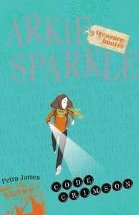
Arkie Sparkle Treasure Hunter: Code Crimson by Petra James
Pan Macmillan Australia, 2012. ISBN 978-1-7426-1110-5.
(Age: 8-11) Recommended. Arkie Sparkle is an 11 year old who with
her cousin TJ and basset hound, Cleo must try to find her kidnapped
archaeologist parents. She embarks on a treasure hunt across seven
continents, this book being on continent number 1, Egypt, with 6
other books and quests to follow.
Armed with an exciting fast form of transport and special gadgets
that include a handy time travel machine, Arkie must solve a
puzzling riddle to be able to move onto the next mission. She needs
to discover the whereabouts of a treasure from the time of the
Egyptian Pharaoh, Ramses II.
The kidnapped parents storyline at the beginning of the book seemed
repetitive of other child hero / missing parents plots but after
further reading the novel became more interesting as there were
fascinating references to real historical figures and times, which
are explained in more detail at the end of the book.
This book is aimed at 8 to 11 year olds and has enough text to be an
exciting but not overwhelmingly long story. Drawings, hieroglyphics
and extra text such as the NATO phonetic alphabet just add to the
appeal. The fact that the novel is strongly marketed as being part
of a series, combined with an unanswered mystery at the end of the
story, will encourage students to continue reading the next
seven books.
Jane Moore
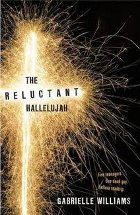
The reluctant hallelujah by Gabrielle Williams
Penguin, 2012. ISBN 9780143566847.
(Age: 14+) Highly recommended. Dodie and Coco's parents vanish from
their suburban Melbourne home just as Dodie commences preparations
for both her senior exams and her driver's test. The sisters soon
learn that their grandparents were members of the international
society of Joseph of Arimathea. Under instructions from "the Mover",
the girls aided by Enron, Taxi and the 'hunky' Jones must
"move" an historical artifact to the next safe house. Eluding both
police and the bad guys, an intense road trip to Sydney ensues.
Despite initial misgivings, Dodie becomes a strong leader. Williams'
engaging narrator describes popular culture such as Downtown Abby,
Jamie Oliver and the Brisbane Floods to produce contemporary
suspense with a dollop of speculation. Could the body sent
from Nicaragua decades earlier be that of Eva Peron? Nope, the
basement offered up the perfectly preserved body of . . . The
Messiah himself.
Jose Saramagio's, The Gospel According to Jesus Christ,
retold the story of Jesus with considerable creative license and
alternate factional histories like The Hiram Key or The
Da Vinci Code abound. However, in The Reluctant Hallelujah,
the identity of the villains is not explicitly stated so their
unknown motivations could equally be well intentioned? Nevertheless,
Williams' reluctant protagonists treat Jesus' body with due
reverence throughout the book and considering that there is no such
thing as bad publicity; this part adventure, part history, part
romance and part tragedy is delightful.
So whether you are a Christian or a Possibilitarian (Agnostic) like
David Eagleman, a neuroscientist unable to find explanations in
science for so many natural phenomena, you are bound to identify
with the coincidences (or miracles) that aid these irreverent yet
endearing teens as they become the temporary guardians of Christ's
body. No? In that case the characters and events succeed in
suspending our disbelief as well as any volume of YA Australian
literature.
Potentially controversial, selection is justified by the fact that
it is as well written as it is engaging. On one level mildly
blasphemous but on another, a novel that stimulates that singular
sense of awe and wonder, capable of turning a confirmed Atheist into
a Possibilitarian.
Deborah Robins
The Reluctant Hallelujah by Gabrielle Williams
Penguin, 2012. ISBN 9780143566847.
(Ages: 14+) In this review I am going to give away the big surprise
in the plot, so please stop reading if you don't want to know what
makes this novel controversial, and a risky choice for some school
libraries. Dodie Farnshaw is about to sit her final year
exams when her parents go missing in very mysterious circumstances.
One of her classmates, Enron, contacts her to say he can help, and
that there is a key in a sneaker belonging to her mother that will
unlock the mystery. When they investigate the basement they find the
well preserved body of Jesus in a coffin. As the baddies close in
Dodie, her sister Coco, and three assorted teenage boys take Jesus
on a road trip to save him.
The jokes around Jesus are quirky rather than offensive to me, but I
know others in my school community that would not see the humour at
all. The relationship between Dodie and her sister is believable and
appealing but the interest that Dodie shows in the character Jones
seems unrealistic, considering the peril they are in as they flee up
the coast. Williams writes well and her descriptions of the tunnels
of Melbourne, and the small towns Dodie and the other characters
find themselves in interesting, but the plot stretches credibility
to too great an extent for me.
Chris Lloyd
Unrest by Michelle Harrison
Simon Pulse, 2012. ISBN: 9780857070913
(Age: 15+) Unrest successfully combines a number of genres
into an effective narrative for teens. With male character Elliot as
narrator, hopefully male readers will pick it up despite the
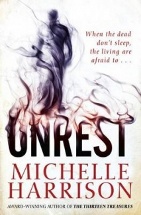
relatively strong romantic element. The cover should certainly help
draw them in, because it does a good job of portraying the creepy,
suspenseful feel of the story.
We meet Elliot at a very low point in his life. He has barely
survived a hit and run accident which left him clinically dead for
two minutes. His mother died of cancer not long before, and his
relationship with his father is distant and uncommunicative. Elliot
is experiencing out of body dreams and confronting ghosts, and he is
unable to move on with school, with relationships, or with life in
general.
After so much is explained in the first few chapters, Unrest
takes a while to settle into its stride. Elliot is introspective and
stationary - he doesn't know how to deal with what's going on, so
the book starts slowly and tentatively. However, once Elliot
realises he needs to be more pro-active, and finds a job conducting
ghost tours at an historic tourist town, the pace and action picks
up, and the book becomes hard to put down.
There are two main plot streams which initially seem unrelated:
Elliot's developing feelings for the mysterious Ophelia, and the
paranormal elements. Elliot is confronted by a number of ghosts,
either needing his help, or threatening his life. He must overcome
his fear and accept this new aspect of himself, and it takes a while
for that to happen. In the meantime, the two plots slowly and neatly
twist together. The unexpected ending should surprise some readers,
providing the necessary didn't-see-that-coming moment so important
in the thriller genre.
This is a great book, combining mystery, romance, and the
paranormal. Elliot's growth and return to life is captured
authentically as he reconciles his need to connect with his father,
the need to take risks with loving Ophelia, and the role unsettled
spirits now play in his life. The book is probably more for upper
secondary students, because the narrative offers a casual attitude
towards sex - Elliot was a 'player' and his brother Adam encourages
a dismissive treatment of girls. There is also a fairly gruelling
scene when the past lives of ghosts is discussed; the way they died
is often tragic and confronting.
Action packed and suspenseful, Unrest is recommended as a
strong option to other more light and swoony paranormal offerings.
Trisha Buckley
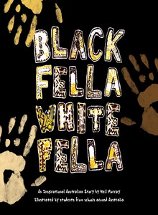
Black fella, white fella by Neil Murray
Ill. by students at various primary schools. Scholastic, 2012. ISBN
9780 9807948 9 2.
(Ages: 8+) Picture book. Aboriginal themes. Subtitled 'An Indigenous
Australian story' this colourful book is a rendering of the ballad,
Black fella, white fella, written by Neil Murray and sung by
the Papunya band, Warumpi. Written out, the ballad makes thin
reading, but is eye catching enough with its illustrations drawn by
students from schools around Australia. The endpapers show the
variety of illustrations done by these students and from which those
chosen for the book were taken.
It is an admirable ballad, written by Neil Murray after working at
Papunya for 12 months, and it promotes the idea that we are all the
same beneath our skin colour. In a classroom a copy of the band's
song would be appropriate to use alongside the book and its message,
and children could learn the song to sing at assemblies or in the
classroom. The book and song would make a strong addition to a unit
on indigenous culture and discussions around prejudice or being
equal. The illustrations will make a talking point both for studying
Indigenous culture, and looking at various types of art and how they
can produce.
Supported by Ian Thorpe's Fountain for Youth project, the book has
supportive statements by Ian Thorpe and Jeff McMullen, and a
foreword by Martin Flanagan as well as an introduction from Neil
Murray.
Fran Knight
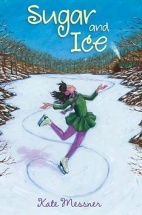
Sugar and ice by Kate Messner
Walker, 2011. ISBN 978-0-8027-2330-7.
Recommended for readers aged 10 to 13 years. Sugar and ice refers to
maple syrup collection and ice skating, two topics that most
Australian readers would know very little about. Yet the themes in
the story are universal, perseverance, self doubt, balancing
commitments with a personal life, bullying and friendship.
Middle school aged Claire Boucher is passionate about ice skating,
with most of her training occurring on a frozen cow pond on the
family farm in Mojimuk. She helps her parents with the maple syrup
collection and has a best friend she sees all the time. This all
changes when she is offered a scholarship to train at Lake Placid.
All her time is taken up by the rigorous training schedule and the
travelling time to the rink. She loses touch with her friends and
family and must adjust to the highly competitive sport of figure
skating.
Claire has a lot to learn during her time at Lake Placid and not
just about skating. She has to decide what's important in her life.
Claire is a believable character and it is very easy to be involved
in her problems and successes. I know nothing about ice skating but
was intrigued enough to look up some of her more troublesome moves
on YouTube, i.e. a double salchow. An accomplished writer can
successfully guide the reader into unknown worlds and experiences
and Kate Messner did that for me.
Jane Moore
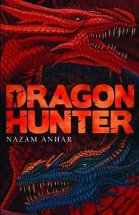
Dragon Hunter by Nazam Anhar
Scholastic Australia, 2012. ISBN 978-1-74283-030-8.
Highly recommended for readers aged 10 to 14 years old. Baran is the
reluctant hero in this story. An outsider in his own village of
Shenzing, he is of mixed parentage, with a missing father and is
shunned, teased and bullied. He has only his mother, younger sisters
and the goats he tends as his companions.
Shenzing has been dragon free for so long most people believe that
the dragon stories are only myths but dragons do return and cause
untold destruction and death. The village must call on the legendary
Dragon Warriors for protection.
In return for his help, Dragon Warrior Hajur requests a boy to train
in his ways and that boy is Baran. A new life begins for Baran,
where he must learn to accept himself, his fears and come to terms
with past experiences and the mystery of his missing father.
This is an exciting, page turning story and the dragons are
frightening in their relentless battles with humans. I am a dragon
lover and particularly fond of the dragon Danzi in Carole
Wilkinson's Dragon Keeper series. In these stories the
dragon and his keeper are the heroes and the hunters are wicked. I
have to come to terms with the role reversal in Nazam Anhar's book
and I will confess to at times secretly barracking for the dragon,
as nasty as it is.
I thoroughly enjoyed this story and hope there are sequels as I
would love to read more about these strong characters.
Fantasy and dragon lovers will enjoy this book.
Jane Moore
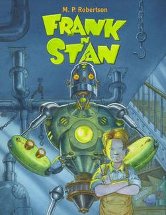
Frank n Stan by M. P. Robertson
Frances Lincoln Children's Books, 2012. ISBN 9781 84780 130 2.
(Ages: 6+)Picture book. Humour. Highly
recommended.
In reprising the story of Frankenstein, Robertson has cleverly
recycled the name of the doctor to include the young boy, Frank and
his creation, Stan, the mechanical man he builds in the basement of
his house, after his pleas for a baby brother or sister go unheeded.
He makes plans, gathers scrap material, and builds his creation.
Each page of illustrations is most detailed reflecting the effort
Frank is taking to construct Stan. Using pulleys and levers,
acetylene and a battery, Stan comes to life. At first wobbly and
losing oil form the oddest of places, Frank is ecstatic that he
finally has his baby
brother.
The family needs to get used to this odd contraption sitting at
breakfast with an oil can, wrecking the steps to Frank's upper bunk
as he climbs to bed, but this is easier when he also vacuums and
hangs out the washing. Stan and Frank have an amazing time together,
and the astute reader will notice the swelling of mum's tum, adding
a baby to the family. Stan, Frank and the baby continue the fun of
before, but Stan is increasingly left out of the games, and so,
dejected, runs away. A lovely resolution occurs in which the family
realises how much they miss Stan, and Frank tales off after him.
This is a wonderful read, full of family life, promoting the idea of
a new member coming in and the place each person has in the family.
The story speaks of inclusion and acceptance, of love and
togetherness. It promotes invention, trying new things and solving
problems. Amongst many things readers will love following the cat as
the story is told, and see the parallels to the old story of
Frankenstein, and the humour in the title.
The detail on each page, including the end papers, draws the eyes to
the plethora of information each page gives the reader. They will
love picking out the minute things portrayed, working out how each
piece goes to help build Stan. The superb illustrations beg the
reader to build a Stan of their own, so teachers and parents need to
have a box of useful equipment at the ready.
Fran Knight
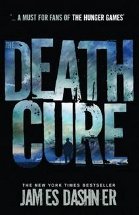
Death cure by James Dashner
Chicken House, 2012. ISBN 9781908435200.
(Ages: 13+) Recommended. Reluctant readers. When I received this,
the third in The Maze Runner series, I decided that I would
have to read the first two in the series, The Maze Runner
and The Scorch Trials, before attempting a review. I had
seen them mentioned on a number of awards, notably The Maze
Runner, as a YALSA Best Fiction for Young Adults (2011). I
wasn't disappointed. The series was so exciting and the characters
so involving that I read the series in a few days and am looking
forward to the prequel, The Kill Order. The Death Cure was a satisfying conclusion to a roller
coaster group of books. Dashner's emphasis on action ensured that I
had to keep reading quickly to find out what was going on. There
were plenty of near death fights, explosions and escapes to keep
even the most adrenalin addict glued to the page.
Dashner, too, had great settings for all his books. The Maze in the
first book was a unique and fascinating invention and I loved the
descriptions of how the boys had to run to escape monsters and how
they organised their lives in an orderly fashion in a frightening
world. The Scorch Trials had the group facing enormous
danger again as they struggled across wasteland and Death cure
saw the group grapple with the zombie like creatures who had the
Flare, a disease that slowly ate them away and made them irrational.
Thomas was the undoubted hero of the series and it was his story
that stood out. Loyal to his male friends, he protected them when he
was able. Remembering snippets of what the evil organisation, WICKED
planned, he was determined not to give in to them. The stories of
his cohort of companions, especially Teresa, Newt and Minho, added
an extra dimension to the story. Lovers of romance will be kept
going with the back story of Teresa and Brenda, but the romance is
so slight that boys won't be put off. There are also some deaths
that were unexpected and heart breaking.
Dashner's stories are thrillers that revolve around themes of
loyalty, betrayal and the eternal question: Do the ends justify the
means? In Death Cure, he makes the reader think about
science gone wild, about the ethics of handling children like lab
rat experiments and using coercion and murder to get results. These
ideas, mixed with all the suspense of the chases, made for a
thrilling read.
Both boys and girls will enjoy this series.
Pat Pledger
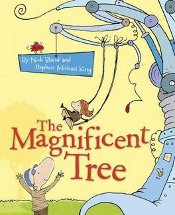
The magnificent tree by Nick Bland and Stephen Michael King
Scholastic, 2012. ISBN 9781 74283 295 1.
(Ages 5+) Recommended. Picture book. Simplicity.
Pop and Bonny are always making things for each other. Designing and
inventing is the way Pop works out things, while Bonny prefers a
more hands on, earthy way to work. Consequently, Bonny makes a
recycled paper card for her Pop, whereas Pop, wanting to fly, spends
many hours planning, designing and then making a contraption to help
him achieve that aim, with disastrous consequences.
When both notice that the birds have nowhere to perch, Bonny
suggests they need a tree and the two go about their quest for a
tree in stunningly different ways. Pop again plans and designs and
eventually builds a mechanical tree, while Bonny simply plants a
seed. Pop's finished product looks like a tree, but its mechanical
branches and discordant and pointy leaves, do not allow the birds a
quiet restful place to perch. Bonny's tree on the other hand is just
what the birds need and so they take to it without hesitation, while
Bonny finds a use for Pop's tree.
There are a number of picture books at the moment about invention
and using imagination. Frank n Stan (Robertson) and The
terrible suitcase (Emma Allen) for example intrigue the
reading audience with inventions such as the mechanical man (Frank)
in the first and the rocket ship in the latter. The magnificent
tree, is another showing imagination being used for the same
end but in entirely different ways. Pop's mechanical tree, despite
all his work, invention and design, simply does not fit the bill,
whereas Bonny's simple idea of planting a tree suits the purpose.
Reiterating this lovely story the illustrations make clear the
conservation message, reinforcing the idea that simple is best, and
strengthening the dialogue between the generations. Readers will
love Pop's stubbly chin and various hats, while watching out for
Bonny's exuberant face, and I can imagine many will clamour to make
the mechanical tree or at least a like version, at the end of the
story.
Fran Knight