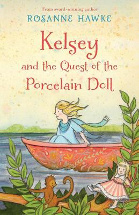
Kelsey and the Quest of the Porcelain Doll by Rosanne Hawke
University of Queensland Press, 2014. ISBN: 9780702253317.
Highly recommended for ages 7+. Kelsey is made to travel to Pakistan
with her aid worker parents after a flood. She is resentful and
wishes she could have remained at home with Nanna Rose, able to
celebrate her ninth birthday at her friend Chantelle's pool.
Instead, she finds herself in unfamiliar surroundings with people
she doesn't know and with whom she certainly doesn't want to spend
time! Gradually she is encouraged to make friends with a girl of her
own age and visit her home. As often as she can, Kelsey skypes Nanna
Rose who obliges by telling her stories about a porcelain doll and
its adventures. Over time, Kelsey learns to appreciate her new
friend Shakila and her family and their way of life and enjoys her
visits to the local school. When an accident occurs, Kelsey is able
to show her true nature. Will everything turn out for the best or
not and will Amy Jo, the porcelain doll, ever find her 'happy ever
after'?
Having begun its life as a story told by the author to her daughter
while they were living in Pakistan, the story highlights Hawke's
affinity with both the people and place of her tale. With each
chapter's focus alternating between the story of Kelsey and her
experiences and the tale of Amy Jo, the porcelain doll, this story
is accessible to younger readers but would also make a great read
aloud. The print is double spaced, there are illustrations directly
related to each chapter on its first page and blank pages between
each chapter, hence, the text is probably only around one hundred
pages in length. This all serves to make Kelsey a title which would
be perfect to use with a class. One could focus on children from
other countries, differences between families, natural disasters,
aid work and practical responses students could make in the way of
support. As stated on the blurb on the back cover, it is a
'captivating story of adversity, adventure and love.' Each of these
aspects is dealt with and could be teased out, even with young
children. I can imagine this book being paired with any of the
Sarindi titles to compare and contrast the information found in
each.
Jo Schenkel
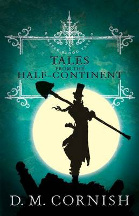
Tales from the Half-Continent by D.M. Cornish
Scholastic, 2014. ISBN: 9781742990255.
(Ages: 12-15) Recommended. Themes: Monsters, Fantasy,
Body-snatching, Detectives, Mythical creatures, Criminal
investigation.
In this novella, D. M. Cornish adds two more dark fantasy stories.
These are separate from the Monster Blood Tattoo trilogy introducing
new characters. These books are mainly for the fans as prior
knowledge of this world is assumed with the unique language, jobs
and terminology are presented without a glossary.
In The Corser's Hinge, Bunting Faukes is a grave robber or
corser and a wayfarer who has become destitute and has a debt to
repay. Fortuitously, he mets Atticus Wells a mysterious sleuth who
is on the case to find a missing young woman Viola Grey. The search
by the sleuth and his team is hazardous and involves cult
worshippers, travel across the continent, fights with monsters and
battles in some of the darker landscapes of the Half-Continent. With
much daring force they fight with the cult followers and the monster
Shilemoth.
The second story The Fuller and the Bogle is an easier read
and one which showcases life in this fantasy world. After her
father's death, Virtue Bland is sent to work as a scullery and
laundry maid in the house of her father's past employer. Hidden in
her hatcarry is her pa's olfactologue that allows Virtue to see
monsters. This story has all the elements readers expect of the
author, adventure, fantasy, fighting monsters and the detailed daily
life of the citizens of Brandenbrass.
Rhyllis Bignell
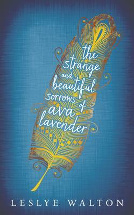
The Strange and Beautiful Sorrows of Ava Lavender by Leslye Walton
Walker Books, 2014. ISBN 9781406348088.
A debut novel, The Strange and Beautiful Sorrows of Ava Lavender
follows the lives of Ava Lavender and the two previous generations
of her family. The family begins in France, and migrates to America
in 1912, when Emilienne is eight. It is a story of the loves, losses
and obsessions of Ava, her mother Viviane Lavender, and her
grandmother Emilienne Roux.
The genre is magic realism. Ava is born with wings, ghosts are part
of the family's everyday life, and portents abound. The novel could
be one to include in a school library and might prove useful for Yr
12 English students who would like to use it as a comparative text
with other novels of the magic realism genre, or as an exploration
of the theme of love, including a number of strong examples of
unrequited love. It could also be an interesting story to discuss
independence - Ava is cloistered in the family home in order to be
protected from the world at large, with serious consequences when
she ventures forth.
The book is written in lyrical prose and would appeal to a
sophisticated reader.
Anne Veitch
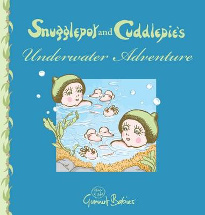
Snugglepot and Cuddlepie's Underwater Adventure by May Gibbs
Scholastic, 2014. ISBN: 9781742839288.
One hot day, when the Gumnut Babies are bored and looking for
adventure, they follow Mrs Kookaburra's advice and head to 'where
the land meets the sea.' There, whilst sheltering in an empty shell,
they meet Mr Hermit who offers to take them into the deep, blue
water. On their adventures, they become acquainted with a clownfish,
coral, and an octopus and are introduced to Little Obelia, Princess
of the Fish Folk. After being carried home on the backs of several
sea dragons, Snugglepot and Cuddlepie are left, dreaming about their
wonderful adventures.
The lovely large square format of this picture book, the watery
endpapers and the pastel toned illustrations make this book a trip
down memory lane for lovers of Gibbs' work who will be keen to share
the story with their children and grandchildren. With its simple
storyline and familiar characters, this is a charming book with a
true Australian flavour, just right for a new generation of readers.
Jo Schenkel
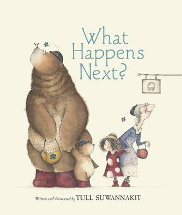
What happens next? by Tull Suwannakit
Walker Books, 2014. ISBN 9781922077561.
(Ages: 4-6) Highly recommended. Grandparents. Imagination. When
Granny takes her granddaughter, Little Ellie for a walk, she tells
her of the bear family, also going for a walk. Little Ellie asks
questions of her Granny, questioning her on the bears' habits and
practices. All the while, Little Ellie watches the bear family as
they walk behind, following their every move, and as each part of
the story continues, Little Ellie asks, 'what happens next?', a
refrain repeated on each double page. But when Granny looks behind
and sees the bear family for herself, it is her turn to ask of
Little Ellie, 'what happens next?' as she backs away from the bears,
ready to flee.
Unfazed, Little Ellie and Granny go into the woods with the bear
family where they meet a number of other animals, even an ogre, and
have a dinner of icecream, cakes and honey, before Little Ellie and
Granny go home, where the child is tucked into bed.
The transposing of ideas is wonderful, with Little Ellie imagining
the family behind her as Granny tells her the story, and then taking
shape as Granny and the girl follow the bears after Granny's initial
fear, to going to the woods and then back home. The shift from
imagination to reality occurs all through the story, encouraging the
reader to ponder over which is real and which is not. But over all
is the sense of the care and safety of the family unit.
The stunning watercolour illustrations are a treat to read and
reread. From the enticing front cover to the alluring endpapers to
the inside illustrations of the story itself, the two families are
paralleled. The hats of the two Grannies, the handbags and shoes of
each participant, the small animals that keep peeping through on
most pages, to the wonderful display in the shop, then the dinner at
the bear's house, each page is meticulous in its presentation of the
story, keeping the reader's interest. I loved the image of the two
Grannies with their noses in the air, while their offspring talked
to each other. The little images of frogs, rabbits, the birds on the
bus stop sign, the sleeping fox on the bus, the animals at dinner,
all will elicit a laugh from the audience, while the last endpaper
with the group standing together is a lovely contrast to the front
cover.
An astute teacher will use this to remind children of other stories
of bears, of other tales of ogres and stories which have an element
of 'what happens next?' as they proceed. And they could even be
encouraged to write their own.
Fran Knight
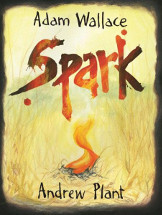
Spark by Rachael Craw
Walker Books, 2014. ISBN 9781922179623.
(Age: 15+) Recommended. Power. Genetic Modification. Violence.
Friendship. Science Fiction. A debut novel that will be the first in
a trilogy! The fact that Walker books are confident of the success
of this book, and are already advertising Book 2 and 3, suggests
that they have found a writer and a story with literary 'legs'. Spark is set in an era when genetic manipulation of humans is
now into the third generation. The Infinity Project that began the
process of modifying and manipulating human DNA has resulted in the
genesis of human lethal weapons with advanced fighting and
extra-sensory abilities. The Spark to their development is a
'civilian' who unwittingly triggers the capabilities of one of the
genetically-tweaked individuals and causes them to become their
'shield' from the lethal attack of another genetic anomaly - the
'Stray'. This conflict is the essence of the story, however the
story begins with a grieving daughter who is unaware of the
transformation she is about to undergo as the result of the stirring
of her genetic capabilities. She becomes a super-charged human in a
very short space of time and the distress in combination with her
grief has a compounding effect. Her friendship with her Spark adds a
degree of emotional anguish, because it is not uncommon for the
Shield to be unable to save her first Spark from the homicidal
attack of the Stray. A romance, which cannot be sanctioned by
Infinity, also adds a complication factor. This is a fast-paced
adventure that leaves the reader feeling the tension of the central
character.
This story is exciting and well-written, but it does require some
persistence in the early stages to understand this alternative
setting. The logic of Sparks, Strays and Shields is important, but
initially quite confusing. This has more to do with the complexity
of the concepts than the author's explanations. This will be enjoyed
by those who have enjoyed the strong, commanding female characters
in Hunger games and the Divergent series, but it is
slightly more demanding to read than the other series mentioned; not
so much a dystopian world, but a science-fiction future.
Carolyn Hull
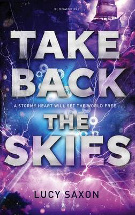
Take back the skies by Lucy Saxon
Bloomsbury, 2014. ISBN 9781408847657.
Tellus is a world where storm belts isolate countries and limits
communication between the island states. Catherine Hunter is the
privileged daughter of an Anglyan government official and as her
15th birthday approaches she decides to run away before her father
marries her off for political advantage. Her mother is bedridden but
urges her daughter to make her own decisions even though she risks
her father's wrath. Children of poorer families at this age risk
being 'collected' by the government to be trained as soldiers to
fight a war with neighbouring countries; their families never see
them again. Cat, as she now calls herself, cuts her hair and stows
away on the skyship Stormdancer disguised as a boy. She is
soon discovered but is allowed to join the crew and their rebel
cause even when she is found to be a girl. Gradually the
government's deceptions are revealed, the war is actually over and
the children are being used in diabolical experiments with the full
knowledge of Cat's father. At the same time Cat is falling in love
with fellow crew member Fox and their romance flourishes throughout
the battle to oust the government and save the children. Written
when the author was 16, this is an entertaining first novel; however
I found the imagined world a bit thin at times. Middle school
readers will enjoy the love story and action and some might like the
idea of discovering themselves and creating their own destiny rather
than being bound by their upbringing. Students who enjoyed Claire
Merle's The glimpse would like this.
Sue Speck
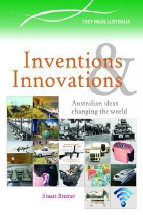
Inventions & innovations: Australian ideas changing the world by Stuart Bremer
Trocadero Publishing, 2013. ISBN 9780864271440. Inventions & innovations
is from the They made Australia collection and provides a
timeline of significant Australian inventions that have changed the
world focusing on how the ideas were conceived and the struggle to
make them reality. With the current focus on finding the black
box of Malaysian Airlines MH-370, it would be very timely to know
that this device is an Australian invention, as was the inflatable
escape slide. What is remarkable about the selection of items in the
book, is the contribution their invention and development has made
to the wellbeing of people everywhere such as spray-on skin for
burns patients and the programmable turning bed for critically
injured patients. On the other hand, are items that we take for
granted without thinking that their origins began here with
Australian thinking and research such as the work in developing much
of the technology underpinning wifi networks.
Barbara Braxton.
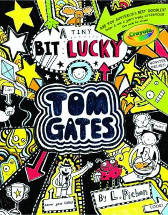
A tiny bit lucky by Liz Pichon
Tom Gates, Book 7. Scholastic, 2014. ISBN 9781743625347.
(Age: 8-11) Highly recommended. Families. School life. Art.
Friends. Music - Bands. Liz Pichon's Tom Gates series is a sure-fire
winner that continues to deliver in this seventh instalment.
Tom's dad is keen for the television to be turned off and for him to
run around outside. With the help of some string and a plastic bag
they make a kite and take it to the nearby park for a test flight.
Unfortunately June the new next door neighbor is present when things
don't go to plan. Tom's life is busy with band practice, troubles
with his sister Delia, the neighbour's cat and school dramas.
To keep himself entertained Tom takes a piece of string to school
and turns it into small scenes, of course his teacher catches him
and it is back to doodling in his books. The School Inspector's
visit causes lots of problems, the class pizza making is problematic
too, watch out for the chocolate raisins. There's so many dramas,
the Dogzombies enter the battle of the bands, a party at the
neighbours and two mini-stories included.
Tom Gates' A tiny bit lucky is filled with doodles, illustrations,
string drawings and a running commentary about school and home life.
Liz Pichon's handwriting forms the text with bubble writing,
emphasized words, block writing and words made out of patterns. This
is a great addition to the series and is great for engaging
reluctant readers. I would highly recommend it for a reading
audience from 8-11.
Rhyllis Bignell
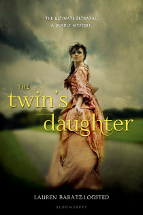
The twin's daughter by Lauren Baratz-Logsted
Bloomsbury, 2014. (First published 2010.) ISBN 9781599906614. The twin's daughter has some elements of the gothic novel.
The atmosphere is one of suspicion, a sense of foreboding, mystery
and danger. Set in Victorian London, the Sexton's home is lavish and
contains the necessary secret tunnel which joins it to the house
next door.
The opening line sets the scene for what is to follow, 'I was
thirteen the year everything changed with a single knock at the
door.' The knock on the door is quickly revealed to be Lucy's
mother's long lost identical twin sister who has been brought up in
the work-house after having being rejected by those who adopted
Lucy's mother. There then takes place a Pygmalion transformation as
Aunt Helen is welcomed into the house and lavished with those
accoutrements her own life never provided - clothes, education and
social graces. Such is the effectiveness of this change that Aunt
Helen and Lucy's mother are sometimes mistaken for each other. It is
this similarity which provides the twists and turns of the plot. The
reader is often invited to question Aunt Helen's real motives even
when Lucy embraces her. The 'unspeakable crime' which occurs halfway
through the story adds yet another twist. On another layer there is
the development of the relationship between Lucy and Kit, the boy
next door, which even less experienced readers can predict will end
in romance. The minor characters of the neighbours and the aged Aunt
Martha who come to visit add little to the story. The themes of
guilt, restitution and growing up are really only shallowly
explored. The twin's daughter has the necessary ingredients for a
gripping yarn but Baratz-Logsted fails to deliver. The characters
are two dimensional and the plot contrived, failing to effectively
create the atmosphere which would keep a reader turning the pages.
At best it can be described as 'a little bit creepy'.
Barb Rye
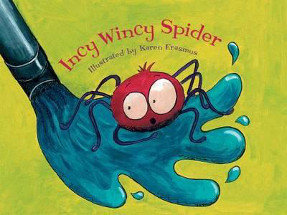
Incy wincy spider ill. by Karen Erasmus
Hachette, 2014. ISBN 9780734415493.
(Age: 3-5) Recommended. Picture book. Humour. Nursery rhyme. What a
lively and joyous little tale is presented here as the Incy Wincy we
all know being washed out of the water spout is given an airing as
he tries in vain to find a safe haven. Children will love reading of
his adventures, and be encouraged to add another refrain, telling of
Wincy's trials.
The nursery rhyme has only four lines: Incy wincy spider climbed up the water sppout
Down came the rain and washed poor Incy out
Out came the sun and dried up all the rain
And Incy Wincy spider climbed up the spout again.
There are versions with slight word changes, but the poem in this
book takes the story further as Wincy tries to find a place of
safety. Youtube has a number of presentations of this song for
children to sing along to, including one by the Wiggles, as well as
a Disney one.
This one has Wincy climbing under the house, or up a sandcastle, or
climbing into the laundry hamper or finding a warm bed which belongs
to the family dog. Each time something or someone chases him out.
The illustrations by Erasmus complete the very funny tale, by an
unnamed author, encouraging classes again to make their own Wincy
spider and poem.
Fran Knight
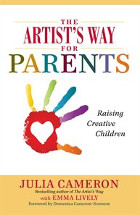
The artist's way for parents: Raising creative children by Julia Cameron with Emma Lively
Allen & Unwin, 2014. ISBN 9781743315064.
Scan the literature for quotes about the importance of the
imagination and creative thinking as an essential part of the
learning process and you will come up with thousands from people
ranging from Einstein to Jobs. Even Dr Seuss had one:
'Think left and think right and think low and think high.
Oh, the thinks you can think up if only you try.'
Following the amazing success of The artist's way published
20 years ago and still selling, Julia Cameron has now written this
guide for parents who want to enable their children to maximise this
innate part of their being. Based on her belief that 'Creativity is
a spiritual undertaking. Parenting is a spiritual undertaking' she
describes this book as 'a spiritual toolkit, a support, a guide.'
She says, 'Let us lessen our grip on the obsession with perfection,
with the 'mastery' of parenting, and allow ourselves to explore and
delight in the mystery instead.'
This is not a how-to book that provides instructions on how to teach
the child to paint, knit, model, or play a musical instrument. With
chapter titles such as Cultivating Curiosity, Cultivating
Self-Expression, Cultivating Conscious Inflow and Cultivating
Humility it has a much broader focus written in a conversational
style with anecdotes and examples that could easily be adapted to
the classroom or the home. She addresses the issue of clutter and
mess that often inhibits parents from encouraging creativity, while
at the same time encouraging the parent to examine their own likes
and compare them to those of the child, providing a mix of the
practical with the philosophical. Spattered with such exercises that
challenge thinking and encourage small changes with big impacts,
this book has a place in both your Teacher Resource and Parent
Library sections.
There are a few pages devoted to the power of reading and at their
end, she writes, 'Sharing experiences through reading, we connect
ourselves to something larger. Connecting to something larger, we
become larger ourselves.' I think that 'reading' could be
substituted with 'creativity' and encapsulate the whole theme of
this book.
Barbara Braxton
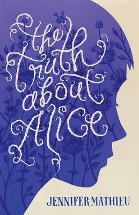
The truth about Alice by Jennifer Mathieu
Hardie Grant Egmont, 2014. ISBN 9781742979502.
(Age: 15+) Recommended. Reluctant readers. Rumours. Peer pressure.
Brandon Fitzsimmons spreads the rumour that Alice Franklin was with
two guys at the party. Alice wears tight tee-shirts and was found
kissing Brandon in the closet a couple of years before. This is just
the beginning of the rumours about Alice. When Brandon is killed in
a car crash, his best friend who was in the car with him, tells his
mother that Alice was texting Brandon and caused the accident, even
though Brandon had been drinking. From then on the rumour mill rolls
on out of control.
Told through the eyes of four teens, Mathieu brings the story of
Alice to life. Elaine, the pretty popular girl who had an on again,
off again relationship with Brandon, believes she knows all about
Alice and that the rumours have to be true. Kelsey was once Alice's
best friend, but afraid to lose her popularity with the in crowd,
leaves Alice alone and contributes in a terrible way to the stories
about Alice. Josh was Brandon's best friend and started the nasty
rumour that Alice caused Brandon's death. Kurt is the school nerd
who has had a crush on Alice for ages. He is the only one to offer
her friendship. Alice finally gets to have her say in the
final chapter and her pain and anger comes through clearly.
Mathieu captures the voices of her four protagonist, revealing their
weaknesses and their reasons for shunning Alice. She cleverly has
each person adding to the story of Alice until the reader knows and
understands Alice's personality and then hears the truth from Alice
at the end.
This is a relatively short story, with easy to read chapters. The
themes of teenage parties, boyfriends, rumour mongering and peer
pressure is sure to be popular with teens.
Pat Pledger
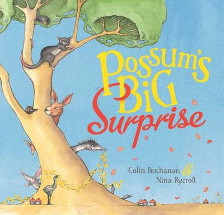
Possum's big surprise by Colin Buchanan
Ill. by Nina Rycroft. Scholastic, 2014. ISBN 9781742839271.
(Age: 3-5) Warmly recommended. Australian animals, Rhyming stories,
Birthdays. The beautiful soft water colours make this story sing.
Flossy the possum skips across the title page, then the publications
page until she is finally in the story. She is hurrying home, but is
detoured by the range of animals she meets. Each second page ends
with 'When all of a sudden', and kids will love reading this line
above all, out loud, imagining the creature that will follow.
In rhyming stanzas, the words beg to be read out loud, with
repetition adding to the suspense of turning the pages.
And Rycroft has illustrated this text with verve. Kids will adore
her animals, softly furred and placed with their trees and bushes,
wrapping things for the last page, giving a hint of what is to come.
The illustrations dance across the pages like the possum, taking
space that necessitates the text moving in different ways. Beautiful
trees hang across pages, while ants scurry to their home with their
find for the day.
The front page with animals peeking form behind the tree is
paralleled on the back cover, where we see the back view. Kids will
love the humour in the illustrations, and the fun with the words.
This is a wonderful combination of a fun filled text marrying
exquisite illustrations, making a humorous book that will appeal to
a cross section of children at home, in the library or classroom.
Fran Knight
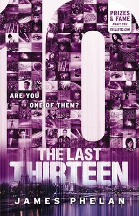
The Last Thirteen Series by James Phelan
Scholastic, 2014. The Last Thirteen: 10. ISBN: 9781742831879. The Last Thirteen: 9. ISBN: 9781742831886. The Last Thirteen: 8. ISBN: 9781742831879. The Last Thirteen: 7. ISBN 9781742631909.
(Age: 12-15) Recommended. Themes: Action, Adventure, Dreams,
Survival, Science fiction, Thriller, Good and evil,Fate, Heroes and
heroines, Prophecies.
James Phelan continues to build the suspense in these four novels in
The Last Thirteen series; through his use of fast-paced
action, plots that have unexpected twists, rogue secret agents,
futuristic technology and enthusiastic tech-savvy teenage characters
involved in life and death situations. Each book ends with a
cliffhanger and the next begins with a recap of previous events,
they need to be read sequentially from Book 13 to Book 1.
Sam's thrilling journey continues with his quest to find the chosen
dreamers, to stop the ever-increasing power of a number of enemies
and save the world. The search continues across the globe from Paris
to Brazil and on to Cuba, where Sam has to rely on his dream
memories, his skills, his stealth suit, Academy friends and on the
skills of the dreamer he must find. Clues must be followed, devious
plots foiled, kidnapped friends rescued all with little rest or
sustenance. James Phelan takes the reader on a Bourne Identity style
reading adventure.
The first book was published by Scholastic in September 2013 and the
final will be released in December 2014. There is a comprehensive website with exclusive
information, competitions, updates and book trailers. The countdown
clock shows how many minutes until the next book is released.
Recommended for readers from 12-15 years
Rhyllis Bignell