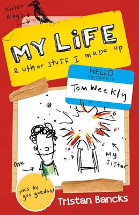
Random House Australia Children's, 2014. My Life and Other Stuff I Made Up. ISBN: 9780857983190 My Life and Other Stuff that Went Wrong. ISBN: 9780857980373.
Highly recommended for readers 9 and up. When your readers have
eaten up all the Andy Griffiths and Jeff Kinney laugh-out-louds,
these are the next choice for them. With the same kind of hilarity,
groan-making grossness, ridiculous situations and craziness, boys in
particular will revel in these books from Tristan Bancks.
Tom Weekly is the anti-hero in question and whether he is mucking
around with his best mate Jack, being victimised by his evil older
sister Tanya, in trouble with his long-suffering mother or arranging
a 'granny fight', Tom has the knack of getting himself in and out of
tricky situations with the ease associated with most ten-twelve year
old boys.
Has your nan ever wanted to climb Everest and enlisted your help in
her training preparation? Are you a dog-kisser or a non-dog-kisser?
Ever been singled out by a killer magpie? Tristan's love, as a kid,
of the weird and wacky stories by Paul Jennings is evident in his
snapshot short stories about Tom and his misadventures.
Written in a similar style to the Wimpy Kid books, with Gus
Gordon's amusing drawings interspersed with the short stories,
lists, jokes and more, these are engaging and easy to read for
reluctant readers as well as being superb quick read alouds.
Encourage your readers to visit Tristan's website for not only more
information about the author and his work but interesting
interactive fun and handy hints on writing and life.
Sue Warren
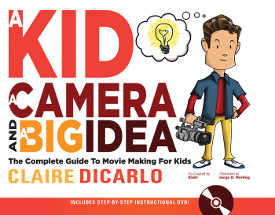
A kid a camera and a big idea: The complete guide to movie making for kids by Claire Dicarlo
Buzz Movie Makers, 2014. ISBN 9780987563408.
Movie making is no longer the realm of the big names like Baz
Luhrmann, Sir Peter Jackson and George Lucas. Technology has now put
the tools into the hands of our students and for six years Tropfest,
the world's largest short film festival, has held Trop Jr for film-makers
15 and under. Producing a video is a common assessment task in a
range of circumstances, not to mention the accessibility of YouTube!
But while having the tools and an audience are essential, having the
know-how or access to someone with the know-how to make the movie
stand above others is the critical intermediary step. This book
provides that.
Author Claire Dicarlo is both an actress and a film-maker and her
passion is to get kids to tap into their imaginations, and have the
courage to share their stories with others through film. While she
has founded Buzz Movie Makers in Melbourne and has made over 1000
short films with children, she realised that there were many who
could not access her expertise so this book is the result of trying
to reach them. It is a stand-alone step-by-step guide.
Comprising 27 chapters full of information, explanations, tips,
tricks and the stories of real kids and a DVD that puts the words
into practice so the reader can see what to do, it is the ideal
resource for the budding movie-maker, the art faculty or anyone
wanting to take their movie from 'home-movie' to professional.
Claire speaks directly to the reader as she writes, starting at the
very beginning of the process by having them consider why they want
to make the movie. What is its purpose? Is it to persuade, inform or
entertain and how do they want their audience to feel as a result of
viewing it. Is it take them to a different place or a different
time? These decisions are the foundation of any movie (or writing).
She discusses how to come up with a great idea, how to structure the
story well and how to write a script. There is even a chapter about
how to enter a movie festival and another that enables them to
ensure they comply with copyright in both production and screening.
It is much more than a technical diary. The information is in short
chunks, headings are in question format and there are photos and
illustrations throughout. Tips, examples, case studies and
worksheets for the reader to jot down their own ideas accompany each
chapter.
While Claire's target audience is kids from 9-13 and it is written
so that they can follow it independently to make their own film,
this resource has a real appeal for those like me who would love to
get students doing this, starting with a book trailer, but just
don't have the expertise because movie-making wasn't an accessible
skillset for us as we learned our teaching craft. There is a place
for this both on the general shelves as well as the Teachers'
Resources section and there would be many parents who would welcome
its suggestion as a gift for their budding film-maker.
Crowd-sourced through Pozible
(have a look to see how much putting such a project together costs)
it is an excellent result for those who invested.
Barbara Braxton
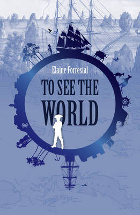
To see the world by Elaine Forrestal
National Library of Australia, 2014. ISBN: 9780642278494.
(Age: 12+) Recommended. To see and understand History it is
sometimes valuable to step inside the shoes of those who travelled
the world in the past, and to do it through enjoyable fiction.
Elaine Forrestal has told the story of the feisty Rose de Freycinet
who travelled on board her husband's French sailing vessel, the
Uranie, on the 1817-20 journey of discovery and scientific
investigation, which included a visit to Australia. Rose was an
unauthorised passenger on this French Naval journey, and her story
has an unlikely observer and narrator in To See the World - the son
of a Mauritian mother and French Government employee. The young boy,
Jose, appears in portraits from the time, being taught by Rose de
Freycinet. The journey includes the details of the drama of this
sailing journey, which includes storms, illness and death, and
shipwreck as well as the normal day-to-day life of a sailing ship.
The delight of this book is that we get a wonderful glimpse of the
world in Australia's youth, when Sydney was still a very small
settlement, and when a voyage to Australia was long and arduous. The
individuals that sailed on board this voyage are presented as
remarkable and were willing to set aside their own comforts in the
pursuit of knowledge of the world. Forrestal makes the journey of
discovery for us as readers a pleasant experience too. This book is
a great entry point for a discovery of our own history. It is
obvious that the narrative is based on Primary evidence from The
National Library's Collection and uses a transcript of Rose De
Freycinet's own journal as a source for the detail of the journey.
This in itself gives an insight for students in the value of Primary
sources to help us get an understanding of History.
I can recommend this book for Students 12+, although younger capable
students would also enjoy the book. In many respects those who have
enjoyed the historical retellings of Jackie French - Tom
Appleby: Convict Boy , Roseanne Hawke - Taj and the Great
Camel Trek, Rosemary Hayes - The Blue-eyed Aborigine,
Anthony Hill - Captain Cook's Apprentice, would also enjoy
this insight into our history, and particularly the involvement of
the French. (My only distress is that I do not know any French,
because there are a number of untranslated phrases included in the
book. With a translator App, or Google Translate at hand this
presents no problems for the digital native.)
Carolyn Hull
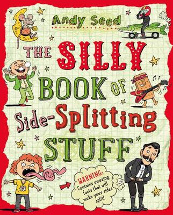
The silly book of side-splitting stuff by Andy Seed
Bloomsbury, 2014. ISBN 9781408850794.
(Ages 9+) Highly recommended. A must read collection of humorous and
interesting facts for all ages including the young at heart! Take a
walk through history with Andy Seed as he looks at the funny side of
historical facts, wacky and unbelievable inventions, nonsensical
poems, silly sports with their blundering commentators, mishaps and
glitches, the worst films titles ever, live T.V blunders and
shockers, subtitles that went bad, games that bombed, preposterous
names, silly careers as well as splendid obsolete or archaic words
to name just a few.
Find out what Hollywood has taught us, who's on the list of most
annoying people and why, the most disgusting foods from around the
world, yucky survival foods you probably won't want to try,
hilarious one liners that are still used today, ways to get yourself
out of a jam, along with the crazy laws made by the most silliest
rulers and the eccentrics of history.
Andy Seed looks at some of history's greatest accomplishments and
the things that worked, as well as the things that didn't go so
well! There is also something for those who are interested in
building their vocabulary! Find out what buildings were built in the
most unimaginable places.
If you are the type of person who likes Horrible Histories,
you'll love this book and its collection of history's funniest and
amazing people, inventions and other crazy stuff. Andy Seed has
something for everyone's fancy no matter how young at heart you are!
Christina Sapio
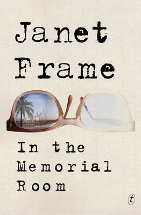
In the Memorial Room by Janet Frame
Text Publishing, 2013. ISBN 9781922147134.
(Age: Adult and mature secondary readers). Beautifully produced with
a dust-jacket in hardback format, the cover design of Janet Frame's
In the Memorial Room enigmatically evokes its title and
contents. The Cote d'Azur is reflected in one illustrated spectacle
lens, while the other lens is clouded. These hint at several
elements of this dense, extraordinary satire.
New Zealand writer, Harry Gill, has won the Watercress-Armstrong
Fellowship, an incestuous award administered by Frame's insufferable
minor characters. This award is supposed to be a living memorial to
real poet, Margaret Rose Hurndell who lived and worked in Menton,
France, where Harry is expected to work in a tomb-like room. Janet
Frame also received a Fellowship to France so we can assume that
some of Harry's appalling experiences might resemble her own. Some
of the award trustees unsubtly signal that their son, Michael,
should be the recipient of the Fellowship. He looks much more like a
writer and even has an artistic beard.
Partly due to his poor eyesight, Harry is timid and bookish; he
misses the best of things and seeks 'intentional invisibility'.
Frame's descriptions of his retreat and obliteration using imagery,
surrealism and fear-of-hyphens is impressive.
English teachers could incorporate a number of Frame's literary
techniques to create lessons or lesson breaks: metonyms, metaphors,
similes and anticlimax; speaking or writing primarily using verbs;
verbal versus written conversations in real time and deconstructed
letter writing.
Joy Lawn
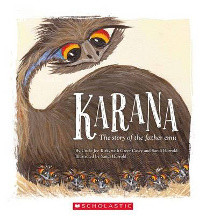
Karana, the story of the father emu by Uncle Joe Kirk, with Greer Casey and Sandi Harrold
Ill. by Sandi Harrold. Scholastic, 2014. ISBN 9781743623138.
(Age: 4-6) Australian animals, Aboriginal themes. The story of the
emu playing a definitive role in the hatching and bringing up of the
emu chicks is told in this tale by Uncle Joe Kirk a Brisbane and
Wakka Wakka elder to tell younger readers of the strength that
family has in society.
The emu builds a nest all the time watching out for the female emus
coming by. In rhyming couplets, the story is told of how the emu
sits on his eggs through heat and cold, until he finally feels
movement beneath him and the eggs hatch. He then shows them what to
eat and drink, swallowing small stones to help digestion, and
flattening their bodies on the long grass to avoid the threat posed
by eagles, snakes, dingoes and goannas. Once he has taught all he
knows for his offspring to survive, they go off by themselves, and
he builds a nest ready for the next female to come by.
A story which reinforces the role of the male within the family and
of a family teaching its young how to survive, the lessons learnt
will make a neat platform for discussion in the classroom, using an
Australian animal as the role model as well as showcasing a story
used in Aboriginal families.
Fran Knight
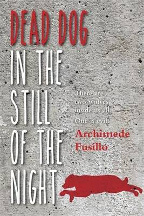
Dead dog in the still of the night by Archimede Fusillo
Ford St Publishing, 2014. ISBN 9781925000344.
(Age: 14+) Reluctant readers. As the son of Italian immigrants
growing up in Melbourne, it is no surprise that Archimede
Fusillo's work often features an Italian flavour and with more
than a nod to his own adolescence.
About his first book Sparring with Shadows Archie wrote 'I
have tried to show that boys do have emotions, are vulnerable, and
that it is acceptable to express their feelings. There is a constant
duality of feeling one way and having to appear another.'
His new book with the eerie title continues this theme and once
again focuses on a character struggling to come to terms with many
conflicting feelings. Primo is the youngest son of a family with
strong personalities, long held resentments and simmering sibling
rivalry. His domineering and womanising father is reduced to an old
man suffering dementia and in a nursing home, though still exerting
his influence on the family. Primo's mother is trying to come to
terms with her long-suffering of her husband's many infidelities,
his middle brother has become embroiled himself in an ugly
separation due to his own indiscretion and also facing the wrath of
his mistress and her drug dealing brother, his older brother wants
to sell off the old man's mechanical workshop and take possession of
his prized classic Fiat 500 and Primo is dealing with his final year
at school and a disintegrating relationship with his girlfriend,
Maddie.
The immaculately preserved scarlet Fiat becomes a focal point of the
story. 'I want to buy a car. A special one. A Bambino. Red. Red for
speed. Red for the sex.' While Primo's family might think this
statement of their father reflects upon his philandering, it becomes
apparent that this one thought had sustained him from his peasant
childhood until its fulfilment. For Primo the car represents
adulthood and independence as well as being his father's prized
possession. For older brother Santo, it is a classic cash cow - ripe
for the picking.
When Primo 'borrows' the car to impress his girlfriend and then
prangs it, he is desperate for money to repair it before anyone
finds out. Brother Adrian's peccadillo with his adultery provides an
opportunity for Primo to warn off the scorned lover, Crystal, with
the promise of payment for services rendered albeit not in the way
Adrian had envisaged. Tangled and intricate, the plot unravels with
miscommunications, wrong perceptions, hidden emotions and gritty
realistic episodes. While the media release suggest this book is
suitable for readers 10 and up, my own recommendation would be for
older boys - perhaps 14 and on. There are numerous references to
drugs, sex, violence, strong language and adult concepts. Heaven
sent for some of my own reluctant Year 10 readers.
Sue Warren
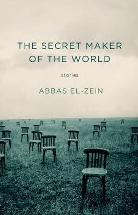
The secret maker of the world - stories by Abbas El-Zein
UQP, 2014. ISBN 9780702250071.
(Age: Yr 11-Yr 12, Adult) Recommended. I resisted this collection of
adult short stories at first and then I read several stories in
rapid succession. I found the stories elegant but did not feel
engaged. The stories while diverse featured a similar theme a man
who unknowingly awaits his fate and whose self absorption has stood
in his way of perceiving the truths around him. I found the stories
to be packed with beautiful lines but at times wished the writer had
'killed his darlings' more often.
However the memory of the stories linger and play with my mind and
two in particular have subsequently gripped my imagination. Red
carpet is the story of a corrupt politician, as he waits in
his office for his aide, mulling over his rise and rise, and
preparing for the speech that will define his success. He is unaware
that in the ten minute walk to deliver his speech his life will
unravel. The killer blow lays in the last line. Birds eye tells the story of the wise scholar who is
oblivious to the undercurrents around him and who procrastinates and
makes increasingly foolish choices as the medieval city Merv is
about to be conquered and sacked. In a preface it is explained that
this story is based on historical events and figures.
There is a vivid imagination and the stories leap across time,
cultures and continents. I feel it will enhance any collections of
short stories gathered for Years 11 and 12.
Michael Jongen
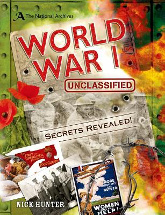
World War 1, unclassified by Nick Hunter
Bloomsbury, 2014. ISBN 9781472905253.
(Age: 9+) Warmly recommended. World War 1, Archives. Another book
produced with the authority of The National Archives in Britain,
this is a fascinating introduction to the events and times of World
War 1 and will be a boon to those looking at war, as it gives access
to a range of documents, photos, diaries, postcards and maps usually
not seen in the text books.
Looking at the contents page gives an overview of what is inside,
and it includes some topics which can prove elusive to the student.
The opening chapter shows life in the trenches, then the book harks
back to the reasons for the war occurring, each double page covered
with a meaningful brief text, photo, maps, and quotes, with a WW1
fact file containing an interesting piece of information. The
expected chapters are there, Digging in, Trench life, Beyond the
Western Front, Home front, each with a plethora of information,
followed by chapters on topics such as Treating the wounded,
Munitions factories, The war at sea, New weapons and War with words.
The last chapters, Armistice, The cost of war, and Lest we forget,
bring this whole to a sombre close.
The book concludes with a double page timeline, a double page
glossary, and then two pages of extra references and resources, with
a well stocked index at the end.
All in all a fascinating introduction to World War 1 for the younger
child, and an admirable text for the older primary student. I am
sure it will be well used in the library and classroom. I was
particularly taken with the postcard on page 15, an example of what
the men sent home. A wish or Christmas with a soldier pointing his
gun at the recipient! On the following page is a photo of a trench
system before and after bombing, and it beggars belief that people
survived in the trench. A photo too of a horse drawn ambulance on
page 29 got me thinking about transport on the battlefield, while
the photo on page 44 of a wounded man being carried off the field n
1917, brought home the difference between the land at the start and
finish of the war.
Even though I have taught this topic for decades I found this an
interesting and evocative book about a war which began one hundred
years ago.
Fran Knight
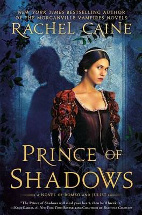
Prince of shadows by Rachel Caine
Michael Joseph, 2014. ISBN: 9781921901881.
(Age: 14+) Recommended. Such is the skill of Rachel Caine in
recreating the life and times of Verona that the reader can't help
but believe this is a true account of the back-story to Romeo
and Juliet.
In this adventure, the hero is Benvolio, the Prince of Shadows (the
greatest thief in Verona) who gives his own account of the events
that surround the well-loved Shakespearean Tragedy. Caine stays true
to the details of the play but cleverly interweaves other stories
and introduces other characters while also providing insights into
minds and hearts of the ones we know so well.
Women, in this novel, show spirit, power and intelligence, as
Benvolio states, 'In their own way the girls of noble families were
soldiers - merely armed with different weapons'. p95. Benvolio's
grandmother rules her household with an iron fist, in fact she is
referred to as 'the iron lady'. Veronica, his sister, is definitely
no blushing damsel, and is not afraid to wield her power, though not
always for good. But it is Rosaline, with her calm and sensible
approach, who gains the respect of the reader and as it transpires
that of Benvolio also.
As in the play, violence abounds in this story as the Capulets and
Montagues continue to battle out their feud on the streets of
Verona. Tybalt is still a violent and dislikeable character who even
takes out his temper on his sister, Rosaline - something neither the
reader nor Benvolio can forgive. Mercutio, at least at the
beginning, is the lovable rogue but his sexual preferences are a
portent for tragedy. Balthasar continues as the loyal and trusted
servant, who always has his master's back, whether that be in the
form of the noble Montague or the Prince of Shadows.
Caine provides an interesting twist to Mercutio's dying words, 'a
curse on both your houses' providing both an unexpected twist for
the reader and a last challenge for Benvolio. Prince of Shadows incorporates enough Shakespearean
expression, even with some reference to other plays, to add
authenticity to this satisfying tale.
Barb Rye
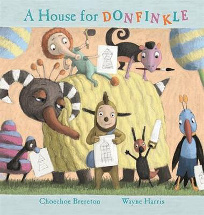
A house for Donfinkle by Choechoe Brereton
Ill. by Wayne Harris. Walker Books, 2014. ISBN 9781921720536.
(Age: 4-6) Warmly recommended. Building, Friendship, Humour. When
Donfinkle wants to build a house of his own, he goes ahead and does
it. His mud brick walls and brick porch, his wonderful uplifting
door and beech windows are just what he wants.
But then friends come along with suggestions. They do not like what
he has done and pick faults with his construction, making plans for
other things to be added or changed. Flooble whines that his roof is
too bare so to placate him, Donfinkle adds constructions to his
roof. Then of course the walls are not strong enough, according to
Flooble, so poor Donfinkle attaches string and grasses to the walls.
Along comes Goozle with different ideas, He feels that there is no
security and so Donfinkle adds thorns to his house to keep intruders
away. But the next visitor, Blooble adds some bright paint. By this
time however, the house is not anything like the house that
Donfinkle built, and so he tells his friends that he will tear down
all their additions so that it is just what he wants.
Shamefaced, his friends help him, and when all is finished come
inside for a cup of tea by the fire.
A lovely tale of friendship, of doing what you want to do, using the
offers from friends without allowing them to take over, the tale
could be well used with siblings or with classes where standing on
your own two feet is an issue amongst friends. But I am sure kids
reading it by themselves or with a friend will get the message loud
and clear and laugh out loud as well. The illustrations are superb,
Harris has playfully depicted the friends as all sorts with bits of
many different animals making up their appearances. Kids will love
looking at all the different animals shown, and work out what they
are, while reading the book out loud will enhance the music behind
the rhyming stanzas and the rhythm of the names of the friends. A
wholly satisfying read.
Fran Knight
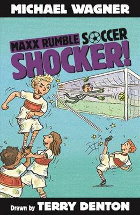
Maxx Rumble Soccer series by Michael Wagner
Ill. by Terry Denton, Black Dog Books, 2014. Shocker, bk 2. ISBN: 9781922244819. Grand Final, bk 3. ISBN: 9781922244826.
(Age: 7-9) Themes: Soccer, Sports, Competitions, Brothers. After
nine years author Michael
Wagner has finally added another sporting series to his much
loved Maxx Rumble Cricket and AFL Football books. This time Rexxy,
Maxx's younger brother is old enough to play for the Stone Valley
Saints Soccer team in a knockout competition.
True to formula the competition is fierce, devious and up to no
good. Wagner delights in choosing puns for team players, there's
Oliver Sudden, Buster Hamstring and Lou Nartick on the field for the
Outhouse Rodents. In Shocker Boofa the opposition captain
uses a deadly weapon, his beautiful sister Jennifer Boofersoon who
casts a love spell cast on poor Rexxy who is smitten and totally not
focussed on the game. As the reader knows the final minutes are key
to the Saints success and Maxx is always on hand to come up with the
last minute save. In Grand Final the Saints come face to face with the
Plankluvin Pirates the 'rottenest' team in the competition.
Unfortunately, there are only four Saints fans supporting Maxx's
team whilst the Pirates have a huge following. Tensions mount as the
crowd's noise level interferes with hearing the referee's whistle.
Another tense game is played and the reader will be delighted to
read of Maxx and his team's determination to pursue the prize.
Terry Denton's cartoons capture the key moments of the soccer games
and his humorous style of drawing adds to the enjoyment of these
books. This new series is suitable for younger readers, especially
soccer fans.
They are great middle primary class novels for readers from 7-9
years.
Rhyllis Bignell
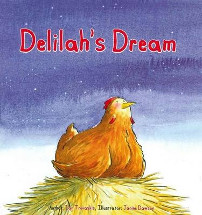
Delilah's dream by Ian Trevaskis
Ill. by Janine Dawson. New Frontier Publishing, 2009. ISBN
9781921042232.
(Age: 3-5) Recommended. Picture book. Ambition. Adventure. Chickens.
Delilah the chook has a dream, she wants to fly. She doesn't want to
be like her sisters and just scrabble around for scraps, she wants
to fly and have adventures. The other chooks scoff at her, deriding
her dreams and telling her not to be silly. While the other chooks
sleep, tucked away from Delilah, she keeps on dreaming of soaring
like an eagle, of being amongst the stars.
One day a fox is seen in the vicinity of the chook yard. The chooks
huddle together in their henhouse, their heads in the straw, not
knowing what to do. Only Delilah takes steps. She climbs across the
roof of the hen house, onto the tree and leaps across the gap
between the chook house and the farmhouse, until she gets to the
bell hanging in the verandah. She swings from side to side, waking
the farmer, and so saves the day. She has flown after all.
A fable about following your dreams, this will be a delight to read
out loud to young children. They will recognise the moral of the
tale immediately and talk of other books which have a similar theme.
Discussions will follow about their dreams and what they aim for in
their lives, be it simply where they will go after school, to what
they hope to do for a holiday to a bigger dream like that of
Delilah.
The illustrations show the hen house on the farm with its cyclone
fences, windmill and corrugated iron roof. The chooks and other
animals will delight younger readers as they see how each group
reacts to the threat of the fox, and their renewed friendship with
Delilah.
Fran Knight
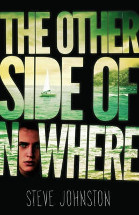
The other side of nowhere by Steve Johnston
Hardie Grant Egmont, 2014. ISBN 9781742976907.
Looking forward to a sailing cruise to an island only three hours
off an unspecified part of the Australian coast, teenager Johnno and
his younger brother Matt journey by bicycle to the town of Shell
Harbour to meet up with old friend and yacht owner Nick. Unknown to
Nick, Johnno has organised for his cousin Georgina to join them on
the venture and the awkward revelation at her arrival causes some
embarrassment for all present.
A tension between Johnno and Nick is gradually revealed, based upon
the fact that whilst the pair had been inseparable companions as
youngsters, their friendship has changed since family circumstances
led to Nick moving from the city, to live with his father on a farm.
The sailing trip had been an eagerly anticipated opportunity get
together and enjoy adolescent male fun in the form of unsupervised
boating and camping. Nick recovers the situation by accepting and
making welcome Georgina and the group soon makes way. This follows
warnings from Nick's father to make sure he heads immediately to the
island to make safe anchorage prior to possible weather changes. The
members of the group are very young and only two have sailing
experience, causing the reader to query the wisdom of allowing the
significant venture.
An unexpectedly vicious storm seizes the vessel and the crew shows
courage and ingenuity to try and save the boat yet the situation
becomes so overwhelming that they are glad to escape with their
lives. Surviving the storm was harrowing but the group's ordeal
continues on the island when they realise that no rescue is
imminent, contrary to previous expectations, and their supplies of
food and water are extremely limited.
All are hungry and exhausted and Johnno's anxiety is increasing from
self analysis following his desperate actions during the storm.
Seeking shelter, the group encounters threatening criminals and must
apply themselves in extreme situations to try and evade them.
The angst of friendships which have been altered by time, changing
circumstances and then tested by trauma, as well as fraternal
rivalry and confused romantic yearning are important influences upon
how the group deals with challenges and threats.
Rob Welsh
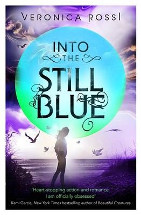
Into the still blue by Veronica Rossi
Under the never sky series, bk 3. Atom, 2014. ISBN 9781907411076.
(Age: 13+) Recommended. Dystopian. Survival. The final in Under the never sky series, following Under the never sky and Through the ever night, Into the still blue finds Perry and Aria in a desperate bid to save the Dwellers and the Outsiders by entering into the elusive Still Blue, where the Aether is calm and where they can set up a settlement free from storms and destruction. Both Perry and Aria have been tested in the first two books and it takes all their leadership skills, determination and sacrifice to fight their way to a satisfying conclusion.
An engrossing read, Into the still blue brings a very good series to a somewhat rushed but very rewarding conclusion. The growth and depth of the characters stand out. Both Perry and Aria have to make sacrifices and to think about what is best for all the survivors, even if they are at odds with each other. Roar is helped through his grief and desolation by Aria's understanding and Perry's friendship. The role of the villains, Sable and Hess, is explored more fully as the group stages an attempted rescue of Cinder and the reader begins to understand their motivations. Cinder is crucial to everyone's survival and Perry stays by his side as they try to navigate through the Aether, even though it may mean death for both of them. Soren becomes an essential part of the story and grows into a much more likeable character who is prepared to use his skills for the greater good.
The action is thrilling as Aria and Perry fight to gain access to the craft that will take them into the Still Blue. There is bloodshed, sacrifice and a touch of romance, all of which combine to make this an enthralling story as the reader breathlessly follows the group's attempt to gain safety from the Aether.
Fans of The hunger games will delight in this series, with its interesting ideas, compelling dialogue and heartbreaking moments.
Pat Pledger