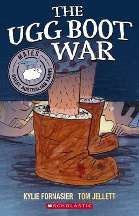
Ill. by Tom Jellett. Mates series. Omnibus, 2014. ISBN
9781862919990.
(Age: 6-9) Highly recommended. Humour, Ugg boots,
Family.
Books in the Mates series never fail to please. They are all
shorter novels with six short chapters, luminous illustrations and
larger print for the newly arrived novel reader, with some of the
possibly new words in a different font. All is engaging, interesting
and enticing.
And ugg boots, what a gem of a story. Jake is so embarrassed by his
father's determination to wear ugg boots whenever his feet are on
the ground that he makes up his mind to rid the household of them.
Then in six crisply told chapters we are taken in to Jake's attempts
at doing just that. At first he hides them but to no avail, they are
retrieved by the dog and then mum. Finally he puts them in the bin
but is then so racked by guilt that he runs after the rubbish truck
as it disappears around the next corner. All is not lost however and
a neat resolution between father and son occurs.
A double page at the end gives a brief outline of the ugg boot
history and for those who are unaware of this series, they are all
listed at the end of the book.
An engaging plot, well written and joyously illustrated, this book
will be rarely seen on the shelves. This is a series to watch out
for, I love them all.
Fran Knight
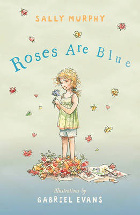
Roses are Blue by Sally Murphy
Ill. by Gabriel Evans. Walker Books, 2014. ISBN 9781922244376.
Highly recommended for 7-10 years. Themes: family, change, accident,
disability, resilience, friendship, care, compassion, empathy, hope,
school. I have not got used to my new mum.
Even though I love her
(I absolutely love her)
Sally Murphy's free verse novel is a poignant story of young Amber
Rose and her new mum who has changed dramatically after an accident.
The family has moved to a new house and new school and Aunty Fi now
lives with them as Mum's carer. Each poem is told from Amber's point
of view as she struggles with the changes at home, develops new
friendships at school and expresses her feelings and emotions
through painting. She misses her dancing, gardening, painting
mother.
Each poem is carefully crafted, every word, line and verse carries
the weight of Amber's feelings from highs to lows. With themes of
resilience, acceptance, valuing family and friendship this novel is
suitable for readers from 7 years of age. Gabriel Evans' line
drawings add to the reader's understanding of Mum's disability and
show Amber's journey.
Rhyllis Bignell
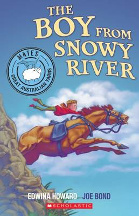
The Boy from Snowy River by Edwina Howard
Mates series. Omnibus Books, 2014. ISBN 9781862919976.
(Age: 9+) Highly recommended. Meet George Johnson of Mumblegum, a
town in the middle of nowhere, Australia. He dreams of going to Big
Spills Water World on the Gold Coast. This dream seems impossible
until his gran shows him an up and coming event at the local
festival - a horse race called The Stockman's Cup, being
raced to remember The Man from Snowy River. Gran encourages
George to enter with Bandicoot their pure mountain bred stockhorse.
Is old Bandicoot a match for the other horses? Are George and
Bandicoot brave enough to finish? The Boy from Snowy River is a great Aussie story and it is
descriptive and full of action. It is highly recommended for
independent readers aged 9+ and is great for children moving into
novels. The illustrators are bright and comical and the chapters
move quickly. The descriptive language will keep the reader engaged
and the twists in the story mean you never know what is going to
happen next.
Kylie Kempster
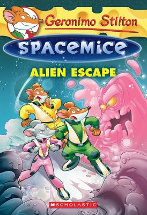
Alien Escape by Geronimo Stilton
Spacemice bk 1. Scholastic, 2014. ISBN 9780545646505.
Recommended for 7-9 years of age. Geronimo Stiltonix's new frontier
is space, he's a science fiction writer and captain of the spaceship
Mouse Star 1 through the galaxy. Along for the ride are his friends
and family Trap, Benjamin and his friend Bugsy Wugsy. His robot
assistants add to the fun, the embarrassment of Assistatrix throwing
him into the Wash-A-Mouse and antics on the flight deck.
Unfortunately, his spacecraft is in urgent need of repair, the
powerful batteries are about to explode and need an extremely rare
element tetrastellium to power them. Alien encounters, Grandfather
William's interference, a giant pink blob on the loose all make this
another exciting adventure.
This popular series is a great for helping the young reader's
confidence with all the expected font styles, sizes and colours,
cheesy puns, colourful cartoon illustrations, maps, diagrams and
character bios.
Rhyllis Bignell
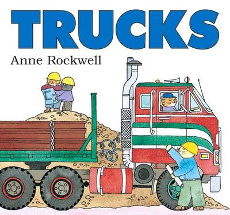
Trucks by Anne Rockwell
Bloomsbury, 2014. ISBN 9780802736420.
(Age: 5+) Trucks is a great picture book for any young boy
(or girl) who likes trucks. The text is simple and descriptive and
the pictures are colourful and fun. It is a board book which makes
it great for little hands and means it should survive any rough
play.
A great book for parents to read with their children aged 1 year +
and for more independent readers aged 6+. Children can learn what
different trucks do and how they help us. The detailed pictures will
be great for talking to children about objects in their world.
Kylie Kempster
Machine wars by Michael Pryor
Random House Australia Children's, 2014. ISBN: 9780857982766.
(Age: Upper primary, lower secondary) Recommended. Michael Pryor
imagines a world where domestic machines take over the world and
gives us an exciting and amusing tale of courage, friendship and
adventure.
Bram comes home one day and realises that all is not right. His
house explodes and his vacuum cleaner is after him with murderous
intent. Soon he is on the run sought by rampaging and vindictive
domestic bots and drones. Luckily his parents have instilled in him
that this day would come, and he knows where to go. His mission
should he accept it is to buy his scientist mother time while she
sorts out the mystery of the robot insurrection.
Accompanied by Bob, his childhood toy duck, now a piece of
artificial intelligence and his best friend Stella, Bram seeks to
avoid the killer bots and survive for three weeks while his mother
finds a solution to the crisis.
Michael Pryor has written an excellent adventure which is also very
funny. Bram and Stella are interestingly drawn characters, nerdish
and delightful. The dialogue is natural and funny, I chuckled along
for most of the story. The themes are topical in the modern
surveillance state and our reliance on technology. There is good
satire here and great one liners. Bram is an everyman hero in the
Cary Grant mould, Stella is drawn as a Hitchcock heroine and their
smarts get them through an increasingly desperate situation as the
evil bots threaten world domination.
This is a very enjoyable read and a very easy sell to upper primary
and lower secondary students. A great book for boys.
Michael Jongen
Convict girl by Chrissie Michaels
Scholastic, 2014. ISBN 9781743620151.
(Age: 10 +) The title of this story does not do it justice. Mary
Beckwith's diary of her experiences give the reader so much more
than tales of mistreatment, irons, chains, floggings and the chain
gang.
The story begins with the transportation of Mary and her mother,
after having been convicted of stealing some cloth from Ball's Linen
Drapers. Mary reflects a little on her time at Newgate Gaol which
she describes as 'a fearful place where pickpockets, food snatchers
and cutpurses and all manner of felon ended up'. Then begins their
time in the colony where they are both eventually assigned to work
for Judge Atkins: Mary as the nursemaid to the Judge's two girls and
her mother as housekeeper. The story alternates between Parramatta
and Port Jackson where Michaels creates a clear sense of the life in
those places.
But the real story begins when Mary is invited to care for the
ailing Captain Baudin, the French explorer, on his attempted
circumnavigation around the Great Southern Land. Through Mary's eyes
we sympathise with Baudin as he struggles daily with his officers,
who being scientists, often refuse to do the work required to 'keep
the ship afloat'. We further see Baudin's passion for his task of
collecting a wide range of specimens from this new strange land.
Also of note is his relationship with Matthew Flinders and their
famous meeting at Encounter Bay which would resonate with South
Australian readers.
Such is the authenticity of this story that many of the names of
people and places can easily be confirmed and, as is the case with
this reader, it created a desire to know more. The historical notes
at the end go some way to satisfy this.
Even if she says 'Lawdy' much too often Mary is a lively and often
fearless character with whom the reader can engage. She is loyal to
her friends and has a propensity for trouble both in action and in
speech which endears her even more. Convict girl has its feet firmly based in historical accuracy
and would appeal to anyone with an interest in our early beginnings.
Barb Rye
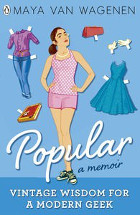
Popular: Vintage wisdom for a modern geek (a memoir) by Maya Van Wagenen
Penguin Australia, 2014. ISBN 9780141353258.
Highly recommended for the laughs and the insights for girls 12
plus. Meet Maya Van Wegenen, self-proclaimed geek and lowest of
the low on her school's social ladder. In 8th grade at
Brownsville, a US town on the border of Mexico, where drug busts,
gang violence, illegal immigrants and pregnant teens are the norm,
Maya embarked on a remarkable social experiment.
When her dad bought a quirky 1950s style guide from a thrift shop
called Betty Cornell's Teen-age Popularity Guide, he never dreamed
his daughter would take on the challenge of transforming herself
with Betty's advice.
Maya is passionate about writing, a good student who not only
respects but likes her teachers, has a loving close family and no
friends - well, just one - another social outcast. She fitted into
her largely Hispanic school population like a square peg in a
round hole and sat even more squarely on the bottom rung of the
social ladder. At the suggestion of her mother, Maya chose to take
on ex-model Betty's tips for 1950s teens and then document her
progress in a journal for the duration of her 8th grade journey.
This nonfiction book has already created such a following and been
such a sensation with other young teens that the screen rights
have been picked up and a film is being planned (Dreamworks
October 2013 news release) despite not yet being published.
As Maya works her way through Betty's chapters and follows to the
letter the instructions on dressing - pearls, white gloves,
girdles, polished shoes, make up - a little Vaseline on your eyes,
red or pink lipstick, posture - don't slouch, shoulders squared
and back straight, and more, her peers have no idea that she is
conducting a secret experiment but see a gradual transformation
from awkward shy caterpillar to happy confident butterfly.
It's certainly not every 13 year old girl who would be brave
enough to endure taunts and disbelief for an entire year but Maya
handles it all with an aplomb that is admirable and reflective.
Maya writes with candid humour, and witty insight - her style is
mature and engaging. Interspersed with Maya's own words are
snippets of Betty Cornell's wisdom, photos and some very funny
Maya-isms on the subject of popularity and its definition.
While there are possibly not many girls who would dare to follow
such an extreme 'makeover' this book has much to offer any girl
struggling to make sense of their turbulent teens. FaceBook page: Popular the Memoir News article
Sue Warren
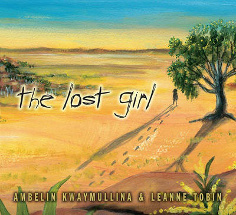
The lost girl by Ambelin Kwaymullina and Leanne Tobin
Walker Books, 2014. ISBN 9781921529634.
(Age: 7+) Warmly recommended. Aboriginal themes. Family.
Environment. This beautifully produced hard cover book has a front
cover which will draw in the reader, seeing a child walking across a
desert landscape all alone, leaving only her footprints, her long
shadow stretched out behind. Readers will immediately want to know
what happens.
The girl has lost sight of her family. She calls and no one answers,
she eats food from the trees, drinks water from the creek and
huddles under a rock ledge where the sun's rays have been trapped. A
crow calls out and she follows it finding her way back home to the
warmth and safety of her family.
They ask her what happened and she explains that it was her mother
Earth who protected her, fed her, gave her water to drink, kept her
warm, and finally led her home.
The book not only shows an Aboriginal community and their
activities, but also the environment where they live, the flora and
fauna, the plants and animals, the broad scope of the desert, the
mountains and valleys. It reflects behaviour that people must show
in the bush, finding things to keep them alive, trusting their
surroundings to keep them safe, while waiting to be found. The
relationship between family members is also shown in talking of the
range of people involved, and all would be a great starting point
for classes looking at the themes of family, particularly Aboriginal
families, or the Australian environment.
Fran Knight
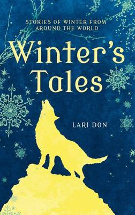
Winter's tales: Stories of winter from around the world by Lari Don
Bloomsbury, 2013. ISBN 9781408196908.
(Ages: 10+) Contains some graphic and violent content with some
supernatural themes.
A unique collection of 15 tales about winter from around the world,
told long ago, based on legends, myths and folk tales.
The Greek mythology story about 'The seeds of winter' tells of a
time when the gods were young, when there was no winter. And how the
goddess Demeter had the busy responsibility of encouraging all the
plants to grow. Demeter was married to the chief god Zeus and they
had a daughter named Persephone who grew into a beautiful young
woman, tall, slim and golden like the wheat in her mother's field.
One afternoon whilst picnicking with family and friends, everybody
had eaten so much that they decided to have a nap. However,
Persephone noticed something shining in the middle of the field.
Upon investigation she found a glorious plant covered with black
flowers with silver tips on each black petal. Being a plant she had
never seen in her mother's garden before, she thought she would pick
just one blossom to take back and show her mother.
As she tried to pick the flower her hand stuck to the plant and she
was dragged underground into the underworld with Hades and Hades
offers Persephone the black plant as a wedding bouquet.
The story continues to unfold the events leading up to the
development of the seasons and in particular winter.
The story about 'The last sun' is a Chinese myth about ten beautiful
suns, each glowing in different colours - red, blue, purple, silver,
pink, orange, lilac, green, yellow and gold. The suns danced in the
air, making the sky above the new land of China gloriously bright.
However, the heat from the tens suns made the earth below too hot.
It was too hot for rain to fall, too hot for plants to grow and too
hot for people to work so the great warrior Houyi decided to save
the plants and people by shooting down all the suns one by one.
As he shot the suns down one by one, they would explode with
thousands of spectacular sparks like fireworks. As Houyi reached for
his final arrow, the last sun dived out of the sky towards the earth
and hid in a cave. Houyi goes in search of the last sun to shoot it
down. However, this last sun is so frightened it stays in hiding and
the earth becomes very cold. The people and animals want the winter
to end. The story continues to tell the events that led up to the
development of all the seasons we enjoy today.
The story about 'The hero with hairy trousers' is a Norse Legend
about a Viking hero called Ragnar Lodbrok, literally meaning hairy
trousers. This legend tells about a Viking princess who was given a
pet dragon as a child. As this dragon grew, so did its appetite to
the point where villagers working in the field and fishing began
disappearing, filling the appetite of the hungry dragon. The dragon
was banished and built a lair in the highest point of the nearby
mountains and would fly down into the village to select his meals.
Eventually, with the people hungry and afraid, the king made a
proclamation that whoever would rid them of the dragon would win
half the kingdom and the right to ask for the princess' hand in
marriage.
The legend tells about those who bravely attempted to slay the
dragon and how eventually Ragnar Lodbrok succeeds. This story has a
lot of blood and guts to it with graphic descriptions about the
slaying of the dragon.
Christina Sapio
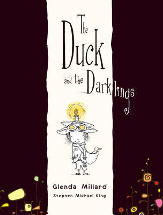
The duck and the Darklings by Glenda Millard
Ill. by Stephen Michael King. Allen & Unwin, 2014.
ISBN 9781743312612.
In a hole built with care and lit with love, deep underground in the
land of Dark, live Peterboy and his Grandpapa. In the
post-apocalyptic world, Dark was a sorry, spoiled place; a broken
and battered place and had been so for so long that everything about
a different world, a world of sunups and sundowns, yesterdays and
tomorrows had been disremembered by everyone except Grandpapa.
Peterboy and the other Darklings only venture beyond their holes and
burrows at the dead of night when they go to the finding fields to
see what they could scavenge. They know nothing of the sights and
sounds and smells that Grandpapa can recall and no one speaks about.
When Peterboy came home he would tell Grandpapa of the things he had
seen... 'There are holes in the dark, Grandpapa, and light leaks
through! It slides down the steeps, puddles in the deeps and
glimmers on the trickle'. And as he told his stories to Grandpapa he
noticed his eyes light up as Grandpapa remembered things lost and
longed for. Peterboy wanted to keep that light in Grandpapa's eyes
so when he ventured out into the night, he looked for more than
crumbs and crusts. He wished for a scrap of wonderfulness. And one
night, he found what he was looking for - Idaduck, broken and spent
but with hope beating in her downy heart. So Peterboy picked her up... and changed his life, the life of Grandpapa and the lives of
the Darklings for ever.
This is the most extraordinary book - it is a tale of hope, and
triumph and resilience; of love and friendship and family; of
connection and belonging. But what sets it apart is the most
magnificent language that Glenda Millard has used - language that is
so evocative and imaginative and expressive that you are just
absorbed into the story as it wraps around you. Every word is
perfectly chosen and paints the most amazing mind-pictures.
Accompanied by the iconic illustrations of Stephen Michael King, who
uses black and blocks of colour to depict the mood so well and
contrasts the oppressiveness of the landscape with the feelings of
futility of the Darklings who are represented in his characteristic
line-drawing style, this is the epitome of a picture book where text
and illustration are in perfect harmony.
The publisher recommends this book for 4-8 year-olds but it is for a
much broader audience than that. Apart from the context of the world
as we know it having ended and the suggestion of the resurrection of
life, older readers will gain much by examining the imagery,
atmosphere and emotion evoked by the language and how this is
interpreted by the illustrator. There are so many layers to this
book that it should prove once and for all that picture books are
for everyone.
I may just be looking at the CBC Award winner for 2015.
Barbara Braxton
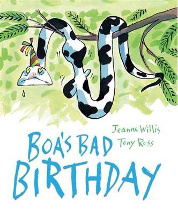
Boa's bad birthday by Jeanne Willis
Ill. by Tony Ross. Koala Books, 2014. ISBN 9781742760957.
(Age: 4-6) Animals. Snakes. Birthdays. This odd little story of a
boa waiting impatiently for the presents his friends will bring to
him, offers a rather negative perspective about friendship and
birthdays.
He is incredulous when the orangutan brings a piano as he has no
fingers with which to play. He smarts when monkey brings sunglasses
when he hasn't any ears or nose to hold them up. He is disappointed
when the jaguar brings him mittens as he has no hands, and is happy
when the sloth appears. Surely he will bring something nice. But no,
the gift is a hairbrush. And so on, until the dung beetle brings a
piece of dung which grows into a beautiful tree for the boa to sleep
in. The last pages have a twist which will intrigue younger readers,
and perhaps initiate discussions about what you do when someone
gives you an unwanted present.
I liked the illustrations, they are funny and quirky, but I found
some of the words, for example, rubbish and stink, as applied to
unwelcome presents a little sad. But if this initiates discussion
about the necessity of having the right words for the wrong present,
then it will be useful.
The illustrations of the range of animals give the reader the
opportunity of looking at animals not often seen in children's
books, and recognising that most come from South America.
Fran Knight
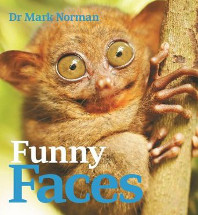
Funny faces by Dr Mark Norman
Black Dog Books, 2014. ISBN 9781922179968
(Age: 6+) Warmly recommended. Animals. Non fiction. Fourteen double
pages will attract the attentions of younger readers, as they smile,
giggle and laugh their way through the range of faces presented by
scientist Mark Norman. Introduced with a double page called
Different Faces, the reader is given a brief taste of what is to
come. Turning the page the biggest animal noses are shown, sure to
cause a ripple of mirth. The funny noses of the bat and dolphin
follow, then the large eyes of the glider and dragonfly. Each page
has a little information, enough for younger readers to see what the
animal is called, and perhaps learn a little about why they have
such distinctive attributes. The information is enough to whet their
appetites and impel them to go looking for more information or
pester a teacher or parent to take them to the zoo. Big ears, beaks
and bills follow, with a few more scary animals towards the end of
the book. The pictures of the dragonfish and walrus will cause a
hidden chuckle, while the next page shows a cicada and mosquito with
needle mouths in close up.
A double page at the end of the book gives more serious information,
while there is a brief glossary and short index. The photography is
stunning, the close-ups of the animals shown are breathtaking in
their clarity.
All is combined well to introduce, inform and entertain the younger
reader.
Fran Knight
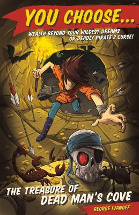
You choose (series) by George Ivanoff
Random House, 2014. The treasure of Dead Man's Cove. ISBN 9780857983831. Mayhem at Magic School. ISBN 9780857983848.
Part of the appeal of computer games is that the player has control
of what happens to the characters driven by the decisions he/she
makes about the decisions the characters make. Imagine if that power
could be in book form, propelled not by graphics and a controller
but by words, reading and understanding. Harking back to a very
popular format of about 20 years ago, where the reader chose their
own adventure by making a choice about what action to take and
therefore where to move next in the story, this series You
choose puts the power back in the reader's hands, rather than
the author's predetermined storyline. And each time the book is read
a different choice can be made and a new story created.
In The treasure of Dead Man's Cove the reader finds an old
map supposedly belonging to One-Eyed William, a fierce pirate who
was buried with his treasure. So the first decision has to be made -
to follow the clues in case it's real or hand it in to a museum
curator. In Mayhem at Magic School the reader suddenly
discovers magic powers which cause strange things to happen so a
decision has to be made about whether to visit a therapist and seek
help or keep them secret and use them? Is the outcome a place in
Magic School, a spy for the government or something else?
Written by an author who, himself, was a devotee of this sort of
format and only became an avid reader after he discovered it -
something I found happened frequently when I offered them to my
reluctant readers of both genders - this is a series that not only
combines interactivity and reading, but also enables the reader to
think about cause and effect, to consider the options, to take the
time to make a decision, and to take risks in a safe environment.
The appeal and importance of gaming within the formal education
setting is becoming the focus of a lot of research and literature
and this series provides a great foundation to actively engage and
explore options. Map the story, its choices and consequences on a
flow chart; have students add a few twists of their own and discuss
how these can have an exponential effect on the outcomes; perhaps
even venture down the Technologies strand of the Australian
Curriculum and let your budding programmers start to design the
coding. Then set a new scenario and start to explore the pathways and
fun of 'what if... ', encouraging the students to let their
imaginations go, push the boundaries, think beyond the usual as they
draw on all they've seen and experienced. Use these two books, and The
Maze of Doom and The haunting of Spook House as models
for an engaging, integrated project that draws in your writers, your
illustrators, your mathematicians, your computer experts to create
something new that accentuates the need for a team, encourages
negotiation and compromise as well as the skills of seeing things
from another perspective and looking for alternatives, and perhaps,
even, the concept of empathy.
So glad this format is back on the reading agenda of the young
readers in my life.
Barbara Braxton
Opening the windows to catch the sea breeze by Geoff Goodfellow
Wakefield Press, 2014. ISBN 9781743052952.
(Age: 15+) Recommended for mature readers. Poetry. Working-class
life. The marginalised. Mental illness. Work. Cancer. A biographical
poetry collection in blue-collar attire.
This is a delightful exploration of the beauty of simple words and
the power of poetry to patrol the parapets surrounding other worlds,
and to open the gates for us to enter. Geoff Goodfellow is earthy
and connected to the world of the working class worker. His words
bring to life the ordinary and the extraordinary as the child of a
war veteran with alcohol-infused memories. He travels as paid poet
into the workplace and speaks for the people who make big business
wealthy, and who give their health as payment for their right to a
wage. He tells his own struggles with relationships, work and jack
dancer (Cancer). He sees the world with the eyes of a wordsmith with
the opportunity to forge a different understanding from the raw
materials of humanity.
One of the powerful elements of this anthology is the detailed
explanation given at the beginning of each chapter. This places the
poetry within the historical context of the life and experience of
Goodfellow himself. This opens the reader to his world, and the
historical Adelaide that he is describing, and also gives us a
glimpse into the life of a poet, and not one that lives in the
hallowed halls of academia.
Note: For those considering this text within a school context, it
does contain some down-to-earth and colourful language (some words
of four-letter origin!), which is not surprising given its context,
but may require some care. Despite this, the opportunity of hearing
the voice of the marginalised, the 'blue-singlet' worker, the jail
inmate, the Semaphore-hostel dweller, the struggling single mother
or the public hospital patient is potent.
Carolyn Hull