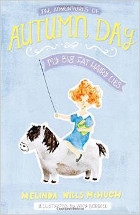
The adventures of Autumn Day: My big fat hairy lies by Melinda Wills McHugh
Ill. by Amy Borrel. Silver Wood Books, 2014. ISBN
9781781322093
(Ages 8-10) Recommended. What happens when you tell a small lie? It
grows and grows. Autumn Day is the same as any nine year old who
wants to be liked however she realizes that owning up to her
mistakes and telling the truth easier in the end.
Autumn Day just wants two things: To be best friends with Aimee and
get a pink mobile phone for her ninth birthday simply to impress the
other girls in her class. For a girl who has to endure being called
all the other seasons or, due to her hair, Carrot Top, Flame Brain
or Tomato Head, Autumn thinks this is not too much to ask for.
Unfortunately despite telling Aimee on the school bus that she had
received the pink phone she in reality received a rag doll with red
hair like hers and a jewellery box. Of course everyone wants to see
the phone and Autumn has to think up more lies to keep her friends
from knowing the truth.
Later in the day when she had to talk about her pets in front of the
class, Autumn tells them that she has 'One dog, two fish and a
pony'. The pony is a complete fabrication and means Autumn has to
maintain two lies. Life becomes more and more complicated for Autumn
until she decides it is time to come clean and admit the truth to
her friends.
The author has given Autumn an authentic voice especially as we are
privy to her innermost thoughts and feelings as she tries to justify
her lies to herself. We are just as relieved as she is when she
finally realises that she doesn't need to lie to have friends.
Sue Keane
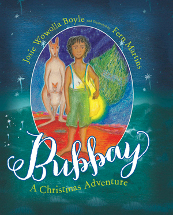
Bubbay: a Christmas Adventure by Josie Wowolla Boyle and Fern Martins
Magabala, 2012. ISBN: 9781921248726
Highly recommended for Lower/Middle Primary children. With themes
about loneliness/friendship/hope and Christmas, this is a timely
book for this time of the year. Bush magic is always special and
when it comes at Christmas time, it's even more special.
Bubbay is a little boy who lives alone in the desert, looking after
his herd of goats. The only human with whom he has contact is Mrs
Timms. He swaps goat's milk for eggs and while he is generally happy
in his own company there are times when he does get lonely so he
always enjoys his visits with Mrs Timms. This Christmas Eve is
different though. Bubbay feels sad when he thinks about everyone
else getting ready for festive celebrations in their homes and
suddenly, more than anything, he wishes he had a Christmas tree,
presents, a home and a family. Imagine his surprise when a streak of
shimmering light swoops down from the sky before him and a little
Christmas tree appears. Even more surprising is that the tree talks
to him! It tells him that if he can find five very special items for
decorations on its branches, he will have a very special Christmas!
A stone, a feather, an egg and a seed might not be too difficult to
fin but a shell? In the desert? How will he ever manage such a task?
Suddenly, the glow of his own little fire reveals old grandmother
Gubarlee appearing to the sound of tapsticks and singing. Throughout
the rest of the magical Christmas Eve Gubarlee guides Bubbay to find
each of the special decorations and they finish just in time
for sunrise. As the desert dawn floods the landscape with light,
Bubbay sees Mrs Timms approaching, her arms wide open, inviting him
to come and be her own little boy.
Truly this is a very special Christmas for both these characters,
finding comfort, company and love in each other's presence. A lovely
and gentle tale about reaching out to others in the real and the
spiritual worlds, lavishly illustrated with vibrant colours
depicting the desert and it's animal inhabitants.
Teaching notes can be found here
Sue Warren
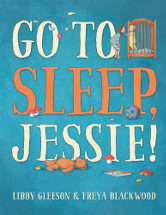
Go to sleep, Jessie! by Libby Gleeson
Ill. by Freya Blackwood. Little Hare, 2014. ISBN 9781742977805
(Age: 3+) Recommended. Sleep, Siblings, Family. The young girl
cannot sleep, because her new sister, Jessie screams when put to
bed.
She goes down to see her parents and asks their help, and Mum comes
upstairs to check on the baby. She changes her nappy, pats her on
the back and whispers a song, then creeps back downstairs. But still
Jessie screams. Dad comes upstairs and tells them a story and leaves
the music box on as he creeps back downstairs. But still Jessie
screams. The girl decides that she no longer wants Jessie in her
room, so father takes Jessie off in the car to try and get her to
sleep. The girl watches from her window, she is alone, and she
cannot sleep. A wonderful twist occurs at the end of the book when
Jessie is returned to the bedroom.
With Blackwood's engrossing illustrations redolent of family life,
of the disruption caused by a new member of the household, the
beautiful words are paralleled on every page. Freya's drawings range
from small rows of pictures to full page, with many framed images
reflecting a range of episodes within the family. The text layout
and use of white is wonderful, ensuring readers are aware that this
is deliberate, making them look more closely at the words and
pictures on each page.
Fran Knight
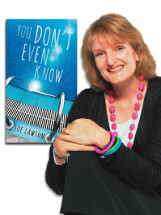
Sue Lawson, Blending reality and fiction: an interview by Fran Knight
Sue Lawson, a children's writer of some twenty books, is in Adelaide
for a month, writing and editing her latest novel.
The May Gibbs Children's Literature Trust has awarded Sue the time
away from home, a time to just write. To this end she is working on
her current novel, one set in 1965, concerning the Freedom Ride of
Aboriginal people in their demand for equality in Australia.
Having just written a non fiction about protests, to be published by
Black Dog Books early next year in the Our Stories series,
Sue has created a fictional story about the 1965 incident which will
expose the times for young adult readers. This tale she is fleshing
out during the fellowship in Adelaide as well as putting the
finishing touches to the Our Stories book.
Like several other of her books, the mixture of fact and fiction
encapsulates a time which is real for the reader. Finding Darcy
(2008)used her knowledge as a researcher of an unknown family member
to recreate a story of one young girl researching the man in the
photograph at her Gran's house, someone never spoken of. The book
not only gives the reader an involving account of a deed in
Australia's past where a Japanese prisoner of war ship was sunk by
an American submarine, killing all those on board, but gives a
riveting tale of one girl's search for her ancestor, finding herself
as she ploughs more deeply into her family's history.
Similarly Forget me not (2012) is based on the small
personal items seen at the Titanic exhibition in Melbourne in 2010.
A story is woven around some of the small objects Sue saw at this
exhibition, and while thinking that no one could write anything new
about this incident, she saw the disaster from a fresh perspective.
Other books that Sue has written include the Diva series, a group of
eight shorter novels for mid to upper primary readers about a group
of girls and their efforts to win the competition for young talent.
Friendships and fallings out, high fashion and family relationships
all figure in this well received series, published first in 2006,
and republished in 2010. And the amazing, You Don't Even Know
(2013) about a young adult critically injured after a walking under
a bus, sharing a room with a terminally ill cancer patient, is based
upon Sue's own bout with cancer and knowledge of hospital wards.
A longer article about Sue Lawson and her work has been written for
Magpies (2015), and her website
gives more information about Sue and her writing.
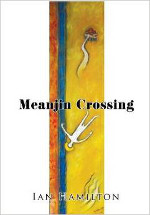
Meanjin Crossing by Ian Hamilton
Xlibris,2014. ISBN 97814909006094
(Age: Senior secondary - adult) This is a story is about the thread
that binds us to past and place. For Will, the narrator, it is a
thread back to his city's earliest white settlement. This, he
relates through the reading of his manuscript to his old friend
Mary. In it we hear the story of Jabiru, or Jacky, as the
white men call him. Initially his coming to manhood and visit to
the Bora Ring, which fascinated Will as a young boy and thence his
wandering life. He develops some friendships, in particular with
James Bolan, one of the more reasonable and compassionate early
settlers.
But this is also the story, even a memoir of Will's life. His
childhood in a place he later calls 'a hole called Brisbane' p71,
his escape to London and the eventual realisation that no matter how
long he stayed, it was a place 'he'd never be part of' p71. And like
Jabiru he eventually returns to the place of his birth.
In the present, he visits his old friend who is now suffering from
cancer and together they reminisce about a life of fun in the 60s,
which Hamilton reveals with accuracy.
That Hamilton knows his place is evident in the plethora of street
and place names which so abound in this novel and anyone who has
even just visited Brisbane will recognise many of them. But this is
integral to the thread of the story. Some places have remained:
those physical aspects which Jabiru also gazed upon and those which
belong firmly in the modern day but are a strong part of Will's
history.
Hamilton also invites the reader to reflect 'about how all our lives
are journeys and that they all come to an end' p168, but through his
narrative suggesting that perhaps there is still a part that carries
on. Meanjin Crossing clearly recreates a sense of time and place,
of innocence and experience but does not lapse into the maudlin or
self indulgent. It is just what happened.
Barb Rye
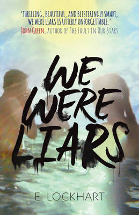
We Were Liars By Emily Lockhart
Allen & Unwin, 2014. ISBN 9781760111069
(Age: 14+) Highly recommended. This well written page turner
chronicles a distinguished family, the Sinclairs, from the point of
view of Cadence Sinclair Eastman. The 'lies', skilfully rendered
from the very first page continue through to the unexpected and
disturbing revelations in the ending.
Cadence's voice is imaginative in its very compelling turn of phrase
that can be both shocking and unexpected. It is difficult at times
to determine whether Cadence is lying, hallucinating, or mentally
unwell:
'My father put a last suitcase into the backseat of the Mercedes (he
was leaving Mummy with only the Saab) and started the engine. Then
he pulled out a hand gun and shot me in the chest. I was standing on
the lawn and I fell. The bullet hole opened wide and my heart rolled
out of my rib cage and down into a flower bed.'
Cadence unveils the joys and sorrows that befall the Sinclair family
as they pass their summers on a private island (Beechwood Island) in
Massachusetts. Cadence, Johnny, Mirren, and Gat refer to themselves
as 'the liars' and as their story develops Cadence tries to fill the
two year gap in her memory caused by an injury she cannot recall.
This work is highly recommended as not only a great read but also as
a literary text. The author has invited opportunities to discuss and
compare her novel with Wuthering Heights,King Lear,
and fairy tales involving daughters. In the novel Cadence states 'I
do not suffer fools', yet the book leaves the reader struggling to
process the consequences of a tragedy derived from a foolish act and
this will provoke a range of perspectives and opinions in the
reader.
The E. Lockhart website
provides links to support materials, a video of Emily reading the
opening to the book, and a tumblr page of images.
Linda Guthrie
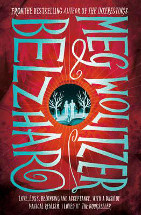
Belzhar by Meg Wolitzer
Simon and Schuster, 2014. ISBN: 9781471123764
If life was fair for Jam Gallahue she would still be living at home
with her parents and spending time with her British boyfriend, Reeve
Maxfield. But life isn't fair. Reeve is dead and Jam is sent off to
the Wooden Barn, a therapeutic boarding school. Jam is placed in
Special Topics in English where the previous students placed in this
class are miraculously stable once more. Jam and four other students
are the only people to be enrolled in this class and given journals
that they are to write in everyday. Jam must face her past and the
mysteries that are hidden there.
I found it difficult to read Belzhar and even harder to actually
keep reading except for the fact that I really wanted to know what
happen to Reeve and see if Jam would get better. I felt for Jam,
really I did, but I could not sympathise with her. I did love the
way Wolitzer wrote the relationships with the fellow students and
Jam at the boarding school and that made the book in my opinion.
Cecilia Richards
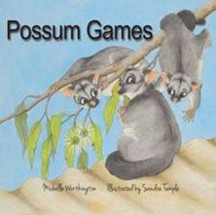
Possum Games by Michelle Worthington
Ill. by Sandra Temple. Rhiza Press, 2014. ISBN 9781925139136
(Age: Early childhood) Every night, on a rusty tin roof the possum
family hold The Possum Games. They jump, run, hop and skip, have a
tug-of-war, strap soap to their feet to slide down the roof and play
all sorts of ball games using mangoes and melons, until the stars
fade and it's time to pack away the trophies and medals till the
next night . . . What fun they have. All except Riley. He is the
youngest and the shyest and he can't keep up. The noise frightens
him and when it comes to needing a partner, he never has one. Even
in team games he isn't very good. Until one night the humans emerge
from their house bleary eyed and not in the mood for fun. Suddenly,
Riley finds what he is good at and invents a whole new game in the
process!
Miss 3 loved this story when I shared it with her. She empathised
with Riley because she knows what it's like to try to keep up with
her older sister and cousins. Even though they are very patient with
her and include her in everything, just as Riley's family includes
him, there are times when being three and little just aren't quite
enough.
The beautiful illustrations by Sandra Temple are in a style that is
realistic without being too "biological" for this audience (she is a
wildlife artist and has won a number of awards for her work) and the
expressions on the possums' faces and the humour in their actions
really bring the text to life. Every picture of Riley mirrors that
of a young child wanting to be part of the action but now quite
there yet. (You can have a sneak peek at http://www.youtube.com/watch?v=Z3IRZcftyMU)
However, apart from the charm of the story for the story's sake,
there is also an opportunity for a conversation about including
everyone in activities and introducing the concept of compassion.
How do you think Riley feels? Is it more important to win a trophy
or make sure that everyone has some fun? Can everyone be the best at
everything or do we all have things we are not-so-good at? Children
know their strengths and weaknesses and those of their siblings and
peers and they are quick to apply negative labels to others so they
can build their own self-esteem. But those labels can stick long
after they've been applied. This could be opportunity to help them
look for the positives in others so even the Rileys feel comfortable
about joining in - even if "the watermelon splatters in soft red
chunks" when they try to catch it! A great story for all those who
would like to be a teensy bit older!
Barbara Braxton
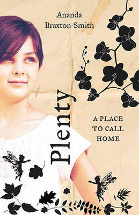
Plenty by Ananda Braxton-Smith
Black Dog Books, 2014. ISBN 9781742032429
I would highly recommend this novel for competent readers from 9 -12
years. Themes: Identity, Family life, Friendship, Dementia, Fairies,
Botany. Ten year old Maddie's life is ordered, she is the Keeper of
the Street, Queen of the back Lane and Friend to Dogs. She loves her
life, her school and has wonderful friends, including Sophie Rose,
who has been a friend since birth. Her eleventh birthday
celebrations are marred by her parents revelation they are moving to
the country. Maddie's world, her stability, her identity, her
friendships are all under threat. Written with a depth of
understanding about the feelings of homelessness, Ananda
Braxton-Smith gives Maddie's feelings of anger, isolation and
disbelief a powerful voice.
Their move to the small town of Plenty, on the slopes of Mount
Disappointment on a road called the Deviation is a difficult
adjustment for Maddie. Her Nana Mad's greenhouse and love for native
orchids helps to slowly bring Maddie's life around. Her new
friendship with Grace a Sudanese refugee helps Maddie transition as
well.
This novel is a wonderfully rich, honest portrayal of a young girl's
search for identity. Her feelings of anger, upheaval and uncertainty
as well as love and are written with real insight. Underpinning the
narrative are the gentle stories of magic, belief in fairies,
aboriginal dreaming and the stories of the formation of the
constellations. Grace's story of her acceptance of life in a
Sudanese refugee camp and Maddie's mother's story of fleeing from
the war in Cyprus add depth to the themes of identity and our place
in the world. Nana Mad's dementia and the way her family copes with
her illness are also written with a special empathy. Teacher's
notes are available.
Rhyllis Bignell
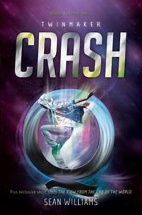
Crash by Sean Williams
Twinmaker series, bk 2. Allen & Unwin, 2014. ISBN 9781743316474
(Age: 16+) This sequel to Jump sees Clair Hill infamous - as
the girl who killed d-mat. D-mat is the technology that can create,
replicate and teleport any object (clothes, food, humans) and that
not only eliminated famine and pollution but was also permitting
self-improvement and enhancement.
Clair, a reluctant hero, is reunited with Jesse at a time where
Earth is in crisis. Clair is conflicted by seemingly incompatible
(pro- and anti-d-mat) philosophies that complicate her decisions and
demand the taking of sides.
'Once the law makers and peacekeepers started dividing people up
into different types, regardless of what they had done, couldn't
people then get away with anything just as long as they belonged to
the right type?'
Claire is caught between Peacekeepers, dupes, RADICAL (activist
group) and WHOLE (anti-d-mat terrorist group) who all have their own
agendas and are intent on capturing Q (an artificial intelligence)
to achieve their ends. Claire struggles with ethical and moral
dilemmas as the world around her erupts in violence and her life is
put at risk.
Sean Williams presents an opportunity to explore the ethical and
moral consequences of technological innovation and the use of
violence. It lends itself to comparison with other novels (such as The giver) that explore societies that have eliminated aspects of
our current society in the pursuit of a perfect and convenient life.
Crash has its own Twitter hashtag (#crashland) that readers
can follow and this sequel also attempts to present the challenges
and benefits of a world of individuals linked in instant
communication. There are no definitive answers given throughout the
story, so there is scope for genuine philosophical discussion.
While the technologies discussed in the novel are not part of our
current scientific landscape, the Baikal Superdeep Borehole and
Mesaieed (Qatar) are places mentioned in the novel that do exist.
Mesaieed will host the World Cup 2022.
The Twinmakerwebsite
allows fans of this series to learn more about the books, comment on
blogs and enter competitions.
Linda Guthrie
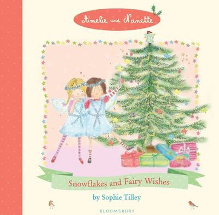
Amelie and Nanette: Snowflakes and fairy wishes by Sophie Tilley
Bloomsbury, 2014. ISBN 9781408836644
(Age: Preschool - Yr 2) Best friends Amelie and Nanette are really
looking forward to Christmas. Together they make paper chains, write
Christmas cards, wrap presents, make yummy scrummy snowflake fairy
cakes and decorate the tree. But even better than doing all those
things that mean Christmas is coming, is doing them with your best
friend. The girls are so busy that they don't notice that it is
snowing, but when they do discover it they're outside in a flash
having so much fun making the biggest snowman, jumping and rolling
around in it, throwing snowballs and making snow angels. Nanette is
so excited that she goes out without her winter woolly warms on. And
sadly, instead of making her fairy costume for the school Christmas
play, she ends up in bed with a cold, too sick to take part in
anything. But what are best friends for?
This is an enchanting story about friendship and the joy of having a
best friend. Tilley's illustrations are as gentle and subtle as the
story offering a package that all young children will relate to. Why
can't you put cardboard antlers on your dog when you're in need of a
reindeer?
This book is about what really is the true meaning of Christmas - celebrating love and friendship and being there for those who really
matter. And with other Amelie and Nanette stories coming (Sparkly
shoes and picnic parties) the girls are likely to
become favourite characters of this age group.
Barbara Braxton
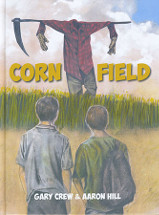
Corn field by Gary Crew
Ill. by Aaron Hill. Windy Hollow Books, 2014. ISBN 9781922081377
(Age: 10+) Recommended. Picture book for older readers. Fear.
Bravado, Mystery. Mystery is too tame a word for the events Crew
gives us in this eerie and unsettling story. Malevolence permeates
every page as the narrator bribes his friend Micky into going into
the cornfield with him. The narrator's father is a crop duster and
owns a helicopter, which Micky would love to try out. Reminders are
given about what happened to Reg Pinchly, another friend from school
who approached the field and was never the same again. And as they
move closer to the centre of the field, they spy a scarecrow with a
scythe. Spooked already, the sight of this image scares the two of
them and they try and run out of the field, with varying results.
The image of the boy on the first page sitting staring at the window
is repeated at the end, but this time the glass is shattered. Hints
abound in the story of being unbalanced, of being an object in a
glass jar, of being watched and spied upon.
The illustrations add another stunning dimension to the story: with
its cut out pieces, some images cut up and placed back together
inexpertly, of thought bubbles with no words, of images sometimes
seeming like they are seen through misty glass. All underline the
supernatural elements of the story, adding tantalising ideas which
could explain what is going on. Or maybe not. Whatever the tale,
the whole is mesmerising, enfolding the reader into a story with
hints of what it is about, forcing the reader to produce a story of
their own based on the scant evidence given. The text and
illustrations serve up a tantalising dish of maybes and what ifs to
ponder.
Fran Knight
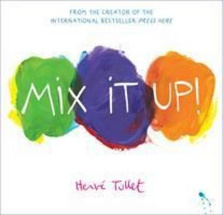
Mix it up! by Herve Tullet
Allen & Unwin, 2014. ISBN 9781760110956
(Age: 3+) Warmly recommended. Painting. Colour. Interactive does not
only apply to computers, as here is an interactive book to keep
children amused for ages. Mixing colours by pressing on each page
will enthrall, delight and inform as kids turn the pages of this
book with solid covers and shiny paper filled with colour inside.
The reader is asked to tap the first dot, and on turning the page
finds a few coloured spots have appeared. Over the next few pages
the reader is asked to tap again and more coloured spots appear.
Then a hand outline covers the spots, and the readers will not be
able to resist putting their hand on the page. Over the page again,
more coloured dots appear and the reader is asked to mix them, each
time finding a new colour appears after mixing one or two colours.
Not only is the child having fun with the pages of the book, but
they are learning how colours mix to make other colours. A fun time
will be had reading through the book, and imaginations soar as they
see the possibilities beyond the pages. Paper and paint will need to
be available at the end of reading for them to further explore what
they have leant and wish to discover.
The interactive nature of the book will enthrall younger readers,
who without knowing it will absorb the names of colours and the idea
of mixing colour to create another, and at the same time, follow
instructions, a skill which is very handy for young people to learn.
Another book by Tulet, Press here! (2010), is just as fascinating in
teaching children that books can be interactive and using this book
will again encourage them to follow instructions.
Fran Knight
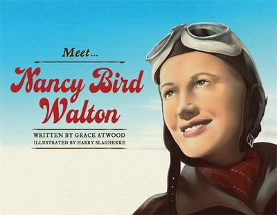
Meet Nancy Bird Walton by Grace Atwood
Ill. by Harry Slaghekke. Random House, 2014. ISBN 9780857983879.
ISBN 9780857984883 ebk.
It seems amazing that less than 40 years ago a woman wanting to be a
commercial pilot became the first sex discrimination in employment
case contested before the Australian Equal Opportunity Board, and
that it wasn't until 1980 that a female pilot took the controls of a
commercial flight in Australia, albeit as a co-pilot on a Fokker F27
from Alice Springs to Darwin. What is even more amazing is that this
was not a new scenario for this was Deborah Wardley fighting Ansett
Airlines and Reg Ansett's belief that women were not suited to be
airline pilots, not Nancy Bird Walton. Nancy Bird Walton had fought
that battle nearly 50 years before that!
Born in 1915 in Kew NSW and growing up in what is known as the
Golden Age of aviation as flying went from strength to strength from
that first 'controlled, powered and sustained heavier-than-air human
flight' in December 1903, Nancy Bird knew at a very early age that
her destiny lay in the skies. Despite her father's disapproval she
began having flying lessons at the age of 17 under legendary pilot
Charles Kingsford Smith.
'My days went by in a sort of blur. I might have only 20 minutes in
an aeroplane during the day but I went out to the aerodrome every
morning and stayed there until the fading light put a stop to flying
for the day.'
Such was her passion and determination, in 1934 she became the
youngest female pilot to have a commercial licence in the British
Commonwealth. Just a year later she flew from Melbourne to Adelaide
in record time and went on to become known as the 'Angel of the
Outback' for her work with the Far West Children's Health Scheme.
During World War II she was the Commandant of the WATC and in 1950
founded the Australian Women's Pilots' Association - thirty years
prior to Reg Ansett declaring that passengers felt safer with men;
that pilots needed strength; that the unions would object; women's
menstrual cycles would make them unsuitable; and that pregnancy and
childbirth would interrupt their careers and create extra costs for
the company.
Such an incredible life cannot be encapsulated in one 32-page
picture book, but Grace Atwood and Harry Slaghekke have combined
perfectly to create a wonderful insight into the first chapters of
Nancy's early flying career. They examine her desire to know how
planes fly and her willingness to do all the dirty mechanical jobs
because everything she did taught her something new about them.
They provide an insight into her fear as at last she is ready to fly
solo and move on through getting her licence, buying her first plane
- named Vincere meaning 'to conquer' - and her amazing flight
covering 22 000 miles around NSW with her friend Peggy McKillop in
the 'Ladies Flying Tour' to promote aircraft flying while using road
maps, a compass and landmarks to guide them.
The Meet... series is a picture book series designed to celebrate
extraordinary Australians who have shaped the country's history,
and, in my opinion, this is the best of the series so far. Perhaps
it's because Nancy Bird Walton has long been a hero of mine, but
there is so much packed into this story, including a timeline, and
the pictures are so evocative with their subtle colouring that I'm
inspired to re-read Walton's two books Born to fly and My God! It's
a woman which may be suitable for your biography collection.
As we look to introduce younger students to Australians who have had
a significant impact on our lives, those featured in the Meet...
series, and Nancy Bird Walton in particular, are very strong
candidates. These sorts of biographies in their uncomplicated yet
fact-filled format not only meet the reading needs of the
newly-independent reader but can also support those who are older
but struggling as well as whetting the appetite of others to
investigate further. In the case of this one, it would also be the
perfect springboard into examining attitudes towards women in a
men's world and how they have changed - or not!
Barbara Braxton
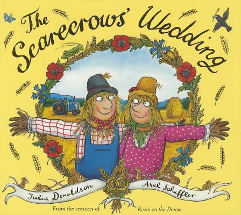
The scarecrow's wedding by Julia Donaldson
Ill. by Axel Scheffler. Scholastic, 2014. ISBN 9781407144412
(Age: 4+) Recommended. Humour. Farms. Scarecrows. Betty O'Barely and
Harry O'Hay invite you to their wedding. In rhyming stanzas with a
repeating last couplet, the tale rolls along with a rollicking pace,
a marvelous story to read aloud to small and large groups.
Harry and Betty make a list of what they will need for their
wedding. Each of the items is ticked off as one by one they are
gathered from their friends. The cows bring the bells, the geese
give their feathers for the dress, the mice find two rings in the
rubbish bin and the crab brings along a necklace of shells.
Harry goes off to find the last thing needed for their wedding, the
pink flowers. Several animals help him find them, but the snail is
so slow that Harry takes all day and night to get there. Meanwhile
the farmer makes a new scarecrow to replace Harry. Reginald Rake
spies Betty and woos her, but she remains true to Harry. When he
arrives back with the flowers they have their wedding
'The best wedding ever, the best wedding yet,
The wedding that no one will ever forget'
with all the items made and brought by their friends.
Children will love the story and its bright illustrations. They will
delight in looking for the things mentioned in the text and laugh at
the different animals represented. And along the way learn something
about hay and fire, as well as noting the play on words. The paper
cover turned inside out presents a poster of the wedding day.
Fran Knight