Every day is Malala Day by Rosemary McCarney with Plan International
Allen & Unwin, 2014. ISBN 9781760110536
(Age: 3+) Who does not recognise the name and know the story of
Malala Yousafzai, the 15 year-old Pakistani girl shot in the head by
the Taliban on October 9, 2012, for speaking out publicly about the
right of girls to have an education? Flown to England for surgery,
remarkably she survived and has gone on to campaign for the
education of girls, becoming, in 2014, the youngest person ever to
receive the Nobel Peace Prize. She was awarded the World Children's
Prize and she announced that she will donate her $50,000 prize money
to the reconstruction of UN schools bombarded by Israel in the
recent Gaza conflict. When I gave this book to a group of Year 3 and
4 students in a small rural school in New South Wales, even they
knew who Malala is and clamoured to be the one to read and review
this book. No wonder!
Written as an open-ended letter to Malala, it tells of the
inspiration she provides girls around the world to speak out for
their right to go to school - the book is dedicated to the 65
million girls who are currently in neither primary nor secondary
school. 'In many countries, bullets are not the way to silence
girls. Early marriage... poverty... discrimination...
violence... they all play a part.' As powerful as the words are,
the accompanying photos are even more so because each one shows a
girl from somewhere around the world... Peru, Niger, El Salvador,
Indonesia, Nicaragua, Nepal, each page a different country!
The book was masterminded and written by Rosemary McCarney who leads
the Plan International Canada team where she helped create the very
important 'Because I am
a girl' campaign and worked to have an International Day of
the Girl declared by the United Nations to celebrate the lives of
girls and draw attention to the particular challenges they face. The
back story to Every day is Malala Day is almost as powerful
as the book itself. July 12, 2013, the day which was Malala's 16th
birthday. was declared Malala
Day by the United Nations and 500 young people took over the
UN. They produced a short film depicting girls from all over the
world writing to Malala to tell her how important she was to them as
a symbol of hope in their lives. From this film come the photographs
that accompany the beautiful text.
On that first Malala Day, Malala addressed 1000 delegates to the UN
Youth Assembly. Parts of that speech (which went viral on social
media) are included at the end of the book, concluding with 'One
child, one teacher, one pen and one book can change the world.
Education is the only solution. Education first.'
Every child needs to know who this dedicated, inspirational young
woman is. Every child needs to know the value of their education and
how lucky they are to have access to it. Every child needs to know
that every day should be Malala Day when children know they can
raise their voices and be heard. 'One child, one teacher, one pen
and one book can change the world.' Let's start with the children in
our care.
Barbara Braxton
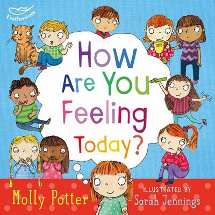
How are you feeling today? by Molly Potter
Ill. by Sarah Jennings. Bloomsbury, 2014. ISBN 9781472906090
(Ages: 4-10) Everything we do and every thought we have comes with
a feeling. Sometimes those feelings feel good and sometimes they
feel nasty. How are you feeling today attempts to assist with
discussion and deeper thought about these feelings and emotions that
we all have as human beings.
Brightly coloured pages, bold and uncomplicated text styles, simple
but effective illustrations and a very helpful special comments
pussy cat make How are you feeling today a well presented
picture book. It also has a feelings tracker at the back of the book
which is a great self-reflective research idea for any child.
The reader is immediately prompted to choose the emotion they are
feeling. You then proceed in a choose your own adventure style to
the page designated by you as your emotion. If the reader chose excited
then they would turn to page 20. On page 20 they would complete
tasks like, say 'yippee' and 'yeh' in your squeakiest voice, tell
somebody exactly why you are so excited and draw a picture of what
you think excitement looks like. How are you feeling today is a book that would be a welcome
addition to a primary school library attracting young borrowers. It
is also a book that would sit very comfortably on a shelf of a room
where students with emotional development needs regularly visit.
Students that are on the ASD spectrum would benefit from having this
book referred to in their individual learning plan so they can
identify why they feel an emotion.
This all said, I did find this book awkward and annoying to read as a
picture book. It does not flow and is not a sit down and read with
your children type book but more a book to refer to with a child who
is struggling with emotional control.
Steve Whitehead
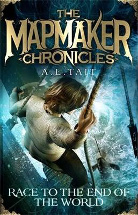
Race to the end of the world by A.L. Tait
The Mapmaker Chronicles. bk 1. Hachette, 2014. ISBN 9780734415776
(Age: 10-15) Highly recommended.
'In the meantime, though, he might as well try to enjoy the fact
that he'd be doing exactly what he loved for three months. Reading.
Writing. Learning.
How bad could it be?'
Quinn has spent the whole thirteen years of his life helping his mam
on the farm. He was the smallest and youngest of six sons, the runt.
So when he is chosen by the king to compete for one of three spots
as a mapmaker he is reluctant. Quinn thinks he is nobody and so do
most of the noble boys who have also been chosen. Especially Ira,
the biggest and richest of all the boys. Ira is positive that Quinn
will not make it and not get chosen.
And no one is more surprised than Quinn when he is chosen by the
large Deslonder to be his mapmaker.
Three teams, three maps of the world and a big prize. The race is
on...
I recommend this novel to boys, ten to fifteen as it mainly consists
of action and fights. I would also recommend this novel to people
who enjoy reading historical fiction as it is set in the time the
world was believed to be flat. It talks about the unfairness of
girls in that era and shows how girls were classed as bad luck in
certain circumstances.
A.L Tait has done a fantastic job of portraying what life would've
been like in that time and describing what the people would have
been thinking during the adventures and problems they encounter.
Jazmin Humphries, Year 7
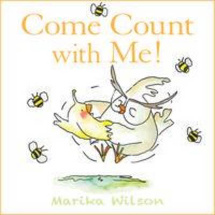
Come count with me! by Marika Wilson
Allen and Unwin, 2014. ISBN 9781743313435 Come count with me! is the first picture book produced by
Indigenous artist Marika Wilson. Published in conjunction with the
Little Big Book Club it will be a popular book to share with younger
preschoolers.
The joyous picture on the front cover of an older bird and a young
chick dancing encourages the reader to meet the characters within.
There is Nana, complete with spectacles, being encouraged to count
with her young grandchild who is so proud he can count. But when
Nana tries to count
'1,2, and 7,8, and 9?'
The chick is horrified!
'No! Nana! No!
You've got it all wrong... '
The little chick gives Nana a lesson in counting but when she still
gets it wrong, he is angry,
'Nana! Nana!
Are you listening to me?'
But becomes more sympathetic as Nana reminds him of her age.
'I'll help you,
It was hard for me too, Nana.'
He proceeds to show her the numbers one to five culminating in the
joyous picture from the cover as they dance around surrounded by
five bees.
The simple stylised birds are full of character and love with the
bright yellow of the chick and the more subdued colours of Nana
washed over the ink outline.
This is a good introduction to counting for parents to share with
their youngsters as they grasp the concept of numbers and one to one
relationships. The parents will be amused by Nana's antics as she
encourages her chick to teach her whilst he counts himself.
Sue Keane
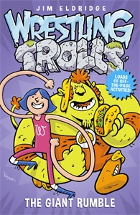
Wrestling Trolls: The Giant Rumble by Jim Eldridge
Ill. By Jan Bielecki. Hot Key Books, 2014. ISBN 9781471402630
Whilst I am not a wrestling fan, I am a fan of the idea that
students can see their suggestions, as strange and interesting as
they can be, combined into a funny story and published by a
successful author. What a great way to promote reading and writing! The Giant Rumble is the third book in the Wrestling Trolls series
but, as a story, easily stands alone. Written in collaboration with
students contributing through 'The Story Adventure' website, the wild
combination of characters and events featuring throughout add to the
fantasy.
The Wrestling Trolls team, Big Rock, The Masked Avenger and their
support team, Milo, Jack, Meenu and the horse Robin, are tricked by
the villainous Lord Veto into a Giant Rumble with his Wrestling
Orcs. Unfortunately the challenge requires both teams to provide ten
wrestlers each which is easy for Lord Veto to assemble but means the
Trolls need to go on a road trip, in their trusty caravan pulled by
Robin, to recruit more wrestlers.
A series of adventures follow as they travel around the country.
There are troll hating Billy goats and villainous wrestlers, spiders
whose bite is deadly to Trolls, piranhas, a very angry wrouse and an
army of gnomes protecting Mediterranean Brussell Sprouts that scream
on being picked.
Evil Lord Veto conspires with kings and others to keep them from
attending the Big Rumble. However with a motley collection of taco
eating, garden loving and bendy friends, not to mention the phoenix
Blaze and shy Jack who when angry transforms into the giant troll
Thud, the Trolls are just in time for the contest.
Whilst you are never quite sure what will happen next, the reader can
be confident that the Trolls will triumph against their obviously
evil, cheating opponents.
Sue Keane
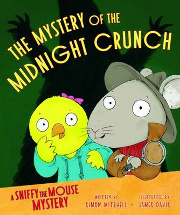
The mystery of the midnight crunch by Simon Mitchell
Ill. by James Davis. Five Mile Press, 2014. ISBN 9781743467251
(Age: 4+) Recommended. Crime. Mystery, Animals.
Mrs Hopper is convinced that she has a monster in her house. He
comes out at night, and raids the kitchen eating the food, and
leaving the room in a dreadful mess. The monster is big, green and
furry, with huge feet and a long nasty claw. And it goes crunch in
the night. She goes to Sniffy the mouse for help, after all he is a
renowned detective. He and his offsider, Cooper, go to Mrs Hopper's
house and inspect the damage, accumulating clues as they go. They
decide to hide themselves in a cupboard for the night to catch the
monster, all the while, Sniffy reassuring Cooper that there is no
such thing as monsters.
But falling asleep they are both scared when one does appear and
they run to the door, only to find Mrs Hopper coming in. She turns
on the light to reveal the 'monster'.
A goodhearted story about a monster, ridiculing the fear some
children may have about monsters, but adding a large dose of humour
to the underlying message. Sniffy is a cute little mouse full of
confidence which subsides when confronted by the monster, and his
efforts to solve the case will further entrance the reader. The
illustrations are full of life and colour, covering the whole page,
full of little things to point out and find, small points to further
amuse and intrigue. And I love the end papers, with their Hopper
style of illustration showing an empty street in a city with
streetlights lighting up small areas of the pavement. A world of
discussion is presented here about city life, and the rodents that
we share the space with. And a wonderful read aloud as well.
Fran Knight
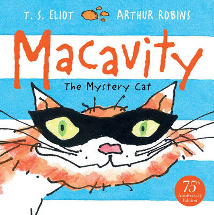
Macavity by T. S. Eliot
Ill. by Arthur Robins. Faber & Faber, 2014. ISBN 9780571312122
(Age: All) In 1939, T.S. Eliot wrote his iconic Old
Possum's book of practical cats which became the foundation
for Andrew Lloyd Webber's musical 'Cats'. Within that collection, is a
poem which begins...
'Macavity's a mystery cat
He's called the Hidden Paw.'
It's a tale that stays in your head forever and begs to be shared
with others, read aloud with its rhyme and rhythm savoured as they
roll off the tongue. So when I read this 75th anniversary edition to
a group of six-year-olds, I was not surprised that they loved it and
begged to hear it again. They didn't need to know the exact meanings
of some of the phrases to enjoy it and understand that here was a
cat of most devious tricks who is also a master of disguise and
alias-building. They used words like 'cunning' and 'mischievous' and
'naughty' to describe him showing that Arthur Robins has illustrated
it perfectly to underscore the concepts of 'a fiend in feline
shape' and 'a master of depravity'. They then delighted in sharing
their own stories of the dastardly deeds their own cats have got up
to, and what was going to be a five-minute filler when I popped it
in my bag for the day became a fun-filled thirty minute sharing
session!
Yet, at the other end of the scale, it's just as much fun for older
readers and a group of Year 6 students had great delight in
exploring the language choices and appreciating how such a complete
story with its come-to-life description can be told in just 400
words, proving that great writing transcends all age groups!
Definitely one to put in your collection and promote!
Barbara Braxton
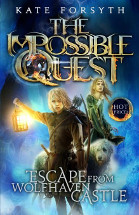
Escape from Wolfhaven Castle by Kate Forsyth
The Impossible Quest : bk 1. Scholastic Australia, 2014.
ISBN 9781743624067
(Age: 9-12) Recommended. Escape from Wolfhaven Castle is the
introductory book in this new series from Scholastic. Set in a
fantasy world of castles, lords and ladies, knights and squires not
to mention bog-men and unicorns, Kate Forsyth's opening
'Tell your lord to beware,' the wild man said, gripping Tom's arm
with a dirty hand. 'The wolves smell danger in the wind.'
immediately creates an expectation of action and drama, encouraging
the reader to ask questions and read on.
We are introduced to castle life as Tom, the cook's son, attempts to
pass the message on. When he helps win a game of mob-ball against
the squires, he incurs the wrath of Sebastian, one of the squires,
in the process. Whilst escaping Sebastian, Tom happens to meet Lady
Elanor in her tower room.
The castle folk assemble to celebrate midsummer with a feast and are
joined by Lord Mortlake, from the neighbouring Frostwick Castle, who
is keen to broker a deal Lord Wolfgang. During the evening Arwen,
the Grand Teller, also dramatically foretells of death and danger
but her warning is not acted upon except by Quinn, Arwen's
apprentice, and Tom who decide to keep watch.
Tom, Quinn, Lady Elanor, Sebastian and Tom's trusty wolfhound Fergus
are the only ones to escape Wolfhaven Castle three weeks later when
it is overrun by a mysterious leader and his army of Bog-men. Arwen
entrusts them with some strange but obviously useful gifts and the
spell which will save the castle, before they escape.
The adventure begins. All they need to do now is find a Unicorn,
Griffin, Sea Serpent and a Dragon, a seemingly impossible quest.
Whilst at times the story line and character interaction appear a
little predictable, Kate Forsyth's descriptive, easy to read style
and the continuing action within the story keeps the reader
interested. The encounter at Frostwick Castle with Lady Mortlake and
the children's escape with her final threat ringing in their wake,
leaves the reader keen to follow the story in the next book. Sue
Keane
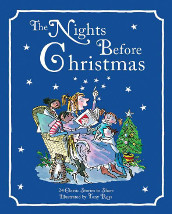
The Nights Before Christmas ill. by Tony Ross
Koala Books, 2014. ISBN 9781742761404
As December begins what better way to herald the coming of Christmas
than to share, each night, or day, a classic story of the season as
each door of the Advent calendar is opened. The Nights Before Christmas collection features a variety of
traditional stories, poems and songs as well as extracts from
newspapers and letters with a forward by illustrator Tony Ross. His
intention in assembling this collection is to remember the
preparation for, and anticipation of, Christmas Day through sharing
stories from the past, illustrated in his easily recognised style.
Beginning with Clement Moore's classic A Visit from St Nicolas,
the collection features a German folk story and Hans Christian
Anderson's Fir Tree celebrating the Christmas tree tradition, though
Professor Branestawm's Christmas Tree features a far from
traditional tree.
The King James Bible version of The Nativity reminds us of the
origin of the Christmas Story. Tolstoy's Papa Panov's Special
Christmas , Good King Wencelas and an extract from Little
Women, celebrate giving to the poor whilst an extract from
Dickens' Christmas Carol features Scrooge at his cold
hearted best. The extract from The New York Times, reporting the
Christmas truce between soldiers fighting in the trenches in
Northern France during World War One, reflects the Christmas message
of peace and goodwill.
The cold and frozen northern winter features in stories from The
Snow Queen and The Little Match Girl as is the wintery
garden created by the selfishness of The Selfish Giant.
Of course no Christmas collection can ignore the presence of Santa
who is celebrated by the quirky Letter to Suzy penned by her
father, Samuel Clements, Baum's A Kidnapped Santa Claus and
the iconic Yes Virginia, There is a Santa.
Whilst the compendium has a definite European traditional focus,
adult readers are sure to be reminded of Christmases past as they
share with the younger generation.
Sue Keane
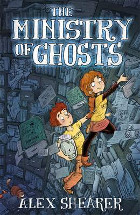
The Ministry of Ghosts by Alex Shearer
Hot Key Books, 2014. ISBN 9781471403880
Do ghosts exist? Can it be proven? The Ministry of Ghosts is on the
case . . . or is it? This is an adventure that 'creeps up on you
softly and taps you on the shoulder'.
In an obsure building, in an out of the way place called Bric-a-
Brac street, is the Ministry of Ghosts where four civil servants,
and a cat, attend to the serious business of investigating the
existence of ghosts and reporting their quarterly progress, to the
government, as they have done since 1792. Unfortunately they have
not produced any evidence of ghostly existence in all that time.
Enter Mr Beeston, from the Economies Office, unofficially known as
the Department of Cuts, bent on closing down this, in his opinion,
time and money wasting Ministry and relocating its employees to
Ministry of Sewage. With only three months to prove what they have
been unable to in over 200 years, a plan of action is put in place.
For a small wage Thruppence and Tim, students from the local primary
school are employed to search out ghosts, as it is well known that
children are more likely to be aware of their presence.
As the children investigate and learn more, they become anxious to
save the Ministry of Ghosts and its employees. Will they find a
ghost in time and if not how will they convince Mr Beeston to allow
the Ministry to continue? Or is the answer to their problem in plain
sight?
Written in the formal style of older times, reflecting the times and
values of the older characters and the formality of English
government departments, this story moves slowly but is entertaining
in its descriptions of the inner workings of the Ministry. The
introduction of the young investigators contrasts with this
formality as they bring light, life and a modern touch to the
language and to the Ministry.
Sue Keane
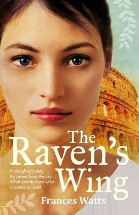
The Raven's wing by Frances Watts
Harper Collins, 2014. ISBN 9780733332913
(Age: 13+) Set in Imperial Rome under the reign of Caesar, this
story opens with Claudia, the central character and narrator being
abducted during the night before her wedding day.
Consideration and analysis of power is evident on various levels
within this story. Senators jostle for political influence by
cultivating friendships and marrying to acquire wealth and noble
attachments. Women have limited influence within the patriarchal
society beyond what respect is accorded them by their wealth and
familial connections. Slaves acquired from defeated colonies are at
the mercy of masters who purchase them like animals and as such,
they could be treated humanely, leading a tolerable existence or
they could be abused and tortured by unfeeling, brutal owners.
Claudia had been living happily with her Aunt and Uncle in a small
provincial town and was betrothed to marry a sweetheart when her
plans fell suddenly awry with the arrival of a messenger from Rome.
News is delivered that her absent and completely unfamiliar father,
a wealthy Roman Senator commands her presence and she complies,
accepting the ignominy of breaking off her engagement and enduring
the distress of leaving her beloved Aunt and Uncle.
Claudia's father had remarried to a new wife with grown children, a
son with Senatorial aspirations and two daughters, the eldest being
independently wealthy as the widow of an elderly aristocrat. Claudia
is distinctly aware that she is considered rough and uncultured,
possessing unrefined clothing and adornments, but equally from being
ignorant of the complex social intricacies and expectations in the
capital city. Whilst she is naive, Claudia is intelligent and
beautiful, and soon discovers that her situation is being
manipulated by her stepmother who desires that she marries her son,
in order to secure a noble pedigree via adoption, and wealth from
her Senatorial father. Claudia's romantic feelings for a man
betrothed to her widowed stepsister causes her angst and confusion,
as does her awareness that as a woman, she has no say in how her
future is decided whilst she is treated as a commodity in marital
plans which value the acquisition of power and influence over love
and happiness. An unexpected death sees Claudia trying to unravel a
mystery whilst having to tread carefully as she determines who
deserves her trust and affection.
13+ readers who have a specific interest in Ancient Rome may enjoy
this historical mystery.
Rob Welsh
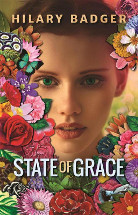
State of Grace by Hilary Badger
Hardie Grant Egmont, 2014. ISBN: 9781760120382
Recommended. Wren lives in utopia. Her world is perfect. The trees
laden with fruit and the water in the lagoon is crystal clear. Wren
and her friends live in paradise, what more could they want? Wren
starts having strange and somewhat disturbing visions and all she
wants is them to stop. Flashes of another world and people that she
doesn't know but it all seems familiar. Beautiful and mysterious
Blaze knows something about the flashes that Wren is having. What
are the lies that are hidden in these flashes and what will Wren
uncover. Is the truth easier to face than being blissfully ignorant?
A captivating read. Instead of the dystopia we have a utopia and it
was great to have something different from the many books I have
read based on dystopia and utopia. Badger explained this new
utopia extremely well and it was easy to follow the storyline. I was
immersed in this story and was lost in it. The characters are
complex and fascinating, their relationships with one another was
interesting to read.
Cecilia Richards
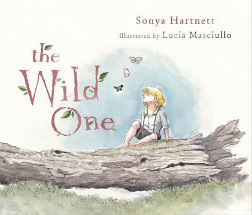
The Wild One by Sonya Hartnett
Ill. by Lucia Masciullo. Penguin/Viking, 2014. ISBN 9780670076970
(Age: F-12) Charlie met the wild one when he was young. His kite got
stuck in the branches of the tree and there, sitting on the bough
beside it is a barefoot, slightly dishevelled little boy - looking
remarkably like Charlie himself. All day they did things that little
boys liked to do running, jumping, splashing, playing in the water,
rolling in the mud, hanging from trees and scattering the leaves of
autumn. At the end of the day, it was time for Charlie to collect
his kite and he was surprised to find that his new friend didn't
have to go home. 'Here is where I live,' he said.
Whenever he could, Charlie visited the wild one and played and
explored the wonders of nature. They caught tadpoles and saw the
tiny legs; they watched caterpillars spin cocoons and spiders
weaving webs; and they hooted to the mopoke who stared at them
through feather goggles. But such an idyllic life cannot last and
Charlie had to go to school to learn mathematics and history and
science. Every now and then Charlie visited the wild one and he had
not been forgotten but as life intervened the visits became fewer
and fewer, until one, day, with his own son in his arms, he cannot
find him at all. Is he lost forever?
This is a most gentle story of a boy who finds another side to
himself, but loses it as life intervenes but as the sun rises and
falls and the moon circles the earth, he discovers it again in time
to share it. Beautifully illustrated by Lucia Masciullo - this is
the third partnership between the pair - it celebrates the joys of
childhood and shows that the magic never quite leaves us, even if we
cover it with layers of adult life. The passage of time and the
cycle of life are inexorable but deep down we never lose the wonder
of our earliest days, and the need to replicate it for our children
and our grandchildren.
Like all excellent picture books, this appeals to so many ages. It's
perfect for helping the very young understand that time passes and
things change, yet at the other end of the scale it would also be a
perfect addition to a more abstract, conceptual theme of belonging
or journeys or discovery. The more you read it, the more you
discover.
Barbara Braxton
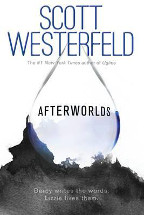
Afterworlds by Scott Westerfeld
Penguin, 2014. ISBN: 9780143572046
I tore through Afterworlds faster than any novel I've read
in the last six months. It was irresistible and I could hardly bear
to put it down. This novel takes every writer's dream and shows them
how it could play out . . .
Darcy is an eighteen year old that has just finished high school
and, with it, her very first novel,Afterworlds. On a spur of
the moment decision she sends her book to an agent and lands herself
in writer's paradise with a two book contract and a year for
re-writes. The publishers love her novel and they pay her an
enormous advance which she uses to make the biggest leap-of-faith
decision of her life: moving to New York to become a full-time
writer. Darcy quickly blows her budget and looses herself among the
fame of the authors she meets. While Darcy explores her new life as
a writer in New York, her protagonist Lizzy, tells her story on the
pages in between. Lizzy is the only survivor of a terrorist attack
in a Dallas airport, in the attack she crossed over to the flipside
where the good and the evil of death lurk. Meanwhile Darcy finally
gives herself in to the inevitability of rewrites and struggles to
find the happy ending for Lizzy and her lover Ramaraj (a Hindu death
god) as the publishers demand. While she struggles, Lizzy uses her
new found psychopomp abilities to investigate the murder of her
mother's childhood friend, Mindy, whose ghost had been haunting her
mother ever since Mindy's death. As Darcy's writing nears the end so
does Lizzy's investigation; with the final three chapters Darcy
opens her ears and does her best to type out an ending which is true
to her characters and their story.
Highly engaging, Westerfeld uses his novel to tell a fantastical
dual story which any aspiring writer would love. He talks about the
relationship between a writer and his/her novel and much of what was
written will resonate familiarity with any writer. It is the perfect
novel for writerly discussion and tips when other writers are
scarce.
Kayla Gaskell, age eighteen.
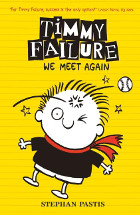
Timmy Failure: We Meet Again by Stephan Pastis
Walker Books, 2014. ISBN 9781406356748
(Ages 6 -12) Recommended. His name is Failure, Timmy Failure. He
doesn't drive a fancy car or travel by limousine; he gets around on
his mother's Roomba. (Robotic vacuum that roams across his mother's
carpet in a pattern Timmy is yet to understand)
Timmy is the founder, president and the CEO of Failure Inc. a
detective agency which is on the verge of global domination, global
riches and global fame. He claims openly that the agency has solved
most of the world's crimes. He also has his own polar bear who
sleeps 20 hours a day and declares hibernation if you attempt to
complain.
From an uneducated eye the incredible accomplishments that Timmy has
achieved must look like everything goes his way. This is however not
true. Timmy is constantly being met by roadblocks in life like the
academic probation that his horrible Principal has put him on.
Considering the small crime of throwing a tree stump through the
principal's window Timmy believes he is being singled out and
unfortunately Timmy's lawyer (also a polar bear) can't save him.
The coveted Miracle Report is the key to everything, including a
good grade. It's dirty business. It's best you know nothing. But one
thing is for sure: Timmy Failure will be triumphant again!
A naive adult (must be an adult) could be forgiven for thinking that
this is just a Captain Underpants book with a new cover and focus.
Its absurdity and ridiculousness is very similar. The main
characters in both series also bare similarities. It evoke laughter
through situations that often leave an adult saying 'what the', but
a child in fits of laughter.
Any school library should invest in the Timmy Failure
series. It will be continuously borrowed. The series is funny,
ridiculous and a great option for children who loved the Captain
Underpants style but need a new story in their life.
Steve Whitehead