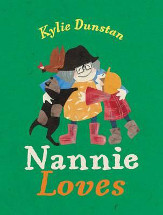
Working Title Press, 2016. ISBN 9781921504839
(Ages: 2-6) Family. Grandparents. Farm life. The story starts with
an illustration of a child posting a letter addressed to her Nan,
while the text reads 'Nannie lives on a farm'. From there, the
illustrations show us the child's family visiting the farm and
exploring it with Nannie, while the text on each page tells us
something about Nannie and her farm. In this way, the text and the
illustrations each add something different to the story and provide
plenty of material for discussion with children. Each page ends with
'Nannie loves her dog/garden/family/me'. The text is simple, but
children will love it because they get to join in with the repeated
'Nannie loves...' on each page.
The collage and pencil illustrations, in earthy, natural colours are
simply wonderful. They are bright and joyful and perfectly show the
wonder and excitement the children have for the farm. Nannie's
enthusiasm and love for the farm also shines through as she shows
them around and does her jobs.
This is a great story for sharing and enjoying. It will also be
fantastic for demonstrating mixed media illustrations and as
inspiration for classroom art. The chooks on the endpapers are
particularly fabulous, as are all the illustrations within.
Nicole Nelson
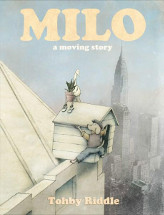
Milo: A moving story by Tohby Riddle
Allen and Unwin, 2016. ISBN 9781760111632
(Age: 6+) Recommended. Friendship. Forgiveness. Tohby Riddle has
created a visually interesting tale of friendship with quirky
twists. The central character, Milo, is a dog with a couple of
friends (with odd names!) A simple falling-out of friendship and an
unusual storm event puts Milo into a position of danger. He
eventually is able to return to offer an apology.
The illustrations within Riddle's book are muted in tone, but full
of detail so are worth inspecting more closely. Young children may
not instantly warm to the style, but an adult could spend some time
pointing out the eccentric detail. I think this book could create
discussion. The New York setting and references plus illustrations
of other famous locales may lead to an exploration beyond the plot
for older readers (or the adults who read it to the younger
generation).
Carolyn Hull
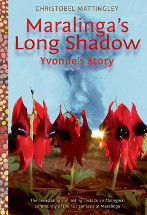
Maralinga's long shadow, Yvonne's story by Christobel Mattingley
Allen and Unwin, 2016. ISBN 9781760290177
(Age: 11 - Adult) Highly recommended. Aboriginal peoples. Nuclear
weapons. Biography. Non-fiction. Maralinga's long shadow
continues the themes explored by Christobel Mattingley in
collaboration with the Anangu people in Maralinga,
the Anangu story (2009) and Survival in our own land
(1988).
This latest book is Yvonne Edward's story, a story that reflects the
experience of too many Aboriginal people, turned off their
traditional land and their children taken away. Yvonne's
recollections expose the further horror of the Maralinga nuclear
bomb tests carried out by the British government from 1953 to 1957.
As Yvonne says so powerfully it was her grandparents' home that was
bombed. 'That was their home where the bomb went off', sending up a
radioactive cloud and contaminating the land. Subsequent generations
of Yvonne's family suffered the consequences. Her husband was one of
the Aboriginal men sent in to clean up the site without the
protective clothing worn by the white men. Her family and others
travelled through the area unaware of the dangers to their health.
Devastatingly, her husband and two sons died of cancer and her
grandson was born with a stomach defect. Yvonne herself died before
she could finally work on the story she wanted people to know about.
But Mattingley had collected enough notes from their long
conversations to be able to bring the book to fruition. It is an
important story to tell.
Learning about this terrible history through the lived experience of
Yvonne's family makes it so much more potent, and very sad.
Mattingley uses simple though often poetic language to tell the
story, often using the words of Yvonne herself. Coloured photographs
of the people and country make it very real and personal. This
story, and Yvonne's beautiful paintings reproduced in the book,
creates a wonderful legacy of a strong and courageous woman, proud
in her culture, and determined to be heard.
Helen Eddy
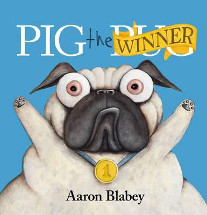
Pig the winner by Aaron Blabey
Scholastic, 2016. ISBN 9781760154288
(Age: 4+) Highly recommended. Cheating, Winning, Good sportsmanship.
Pig the pug loves to win. But he will do anything to come first, as
Trevor finds out. If he doesn't win by putting his foot out to trip
Trevor in a race, then he throws a tantrum so fierce that Trevor
gives in telling him he has won. The long suffering Trevor can only
look on as Pig goes to great lengths to overcome his partner, but
one fateful day, Pig suggests that they see who can eat their food
the fastest. Trevor decides that this is not for him and declines
the invitation to compete, but this does not faze Pig. He wolfs down
all the food he can find, his treats, his biscuits, his bowl of dog
food, but incredibly in his haste, he finds that he has eaten his
bowl.
Good old Trevor knows just what to do, grabbing the dog form behind
and giving him a squeeze to force the bowl out. In doing so the bowl
ricochets off the ceiling and pushes Pig into the rubbish bin. A
much embarrassed Pig then becomes a much nicer dog to be with and
plays with Trevor much more fairly, well, most of the time.
This delightful picture book, told in rhyming stanzas will be a hit
with younger children who will predict what words will come next
when it is read to them, enjoy sharing stanzas with their friends
when reading together or discuss the implications of cheating when
talking about sports. With so much press devoted to the scandals
involving today's sportsmen and women, this is a timely book to
introduce the theme with younger children at a level they can
understand and laugh about. Blabey's illustrations are always
delightful, and this book furthers the adventures of Pig the pug,
and Pig the fibber, all subtly teaching some home truths to the
readers.
Fran Knight
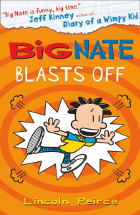
Big Nate blasts off by Lincoln Peirce
Harper Collins, 2016. ISBN 9780008135331
(Age: 8-13) Recommended. Themes: Bullying; Cartooning; Friendship;
Growing up; School drama; Humour. This is a book that Diary of a
Wimpy Kid devotees will also love. Big Nate is an ordinary kid
who deals with a dad who makes dreadful lunches, a fellow classmate
that intends harm, a connection with a girl that is hinting at
romance and the normal ups and downs of school life with his
friends. He shares his life with style - cartooning style! He has a
quirky view of the world that he translates into wonderfully
entertaining caricatures and cartoon strips. The big event of the
book is an Ultimate Frisbee tournament against a rival school that
needs to overcome the romance dilemmas, the bullying and detentions
in order to overturn a 37 year losing streak!
This is not the first book with Big Nate, so look for other titles
in the series, and it can be recommended for a school library
collection (even though teachers are the target of many of Nate's
jokes!) The book will not stay long on the shelves in the Library.
Recommended as a fun book for reluctant readers aged 8-13; but all
younger readers will enjoy the humour and the cartoons.
Carolyn Hull
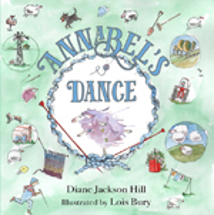
Annabel's Dance by Diane Jackson Hill
Ill. by Lois Bury. Wombat Books, 2016. ISBN 9781925139358
Picture book. High in the mountains lived a mob of sheep - ordinary
sheep with wool the colour of whipped cream growing in neat tight
crinkles. With them lived Annabel who was the colour of a mud puddle
and whose wool was straight and spiky. She couldn't just stand and
nibble grass all day - her legs went every which way, she flipped
head over heels, she was always wriggling and jiggling. She was
picky with her food because the grass prickled her tongue; she hid
at shearing time because the loud noises hurt her ears. No matter
how hard she tried, Annabel just didn't fit into the mob and they
shuffled her to the outside.
;"Hazy mazy, oops a daisy, wriggle your ears but don't go crazy,"
she'd tell herself whenever she felt alone or was trying to be
brave.
;Because she hid every time it was shearing time, for six years her
wool grew and grew and grew. But even though it kept her warm and
protected her from bumps, she couldn't see or hear very well.
Annabel is super-sensitive to the world around her and even when
Farmer Shanks tries to help her, she can't cope and makes a dash for
the mountainside.
But he is determined and calls in extra help, gives her headphones
to block out the sound of the shearing machine and even puts a
bucket of strawberry clover nearby so she can imagine herself still
out on the mountainside.
Annabel is like those students we have who are somewhere on the
autism spectrum, whose sensitivities are so heightened they can't
cope with being touched or hearing loud noises, yet all they would
like to do is be part of the mob. To belong. But instead of their
differences being accepted and their needs catered for, they are
shunned and left to themselves until eventually there is a
catastrophe.
This is a humourous but poignant story that can be read on its
surface level as being about an eccentric sheep or it can be
explored more deeply to talk about how we, as people, are all unique
each with our special needs and preferences. But some differences
are not through choice and we need to be more tolerant and more
inclusive, make allowances and reach out to help those who are
struggling or marginalised through no fault of their own - just as
Farmer Shanks did. There are many Annabels in our classrooms as
there are many more children on the spectrum than those who qualify
for special assistance so, as teachers, we need to vary our
practices, help the child develop physical or mental strategies to
cope, and inform the other students so they understand what is
happening. Indeed, under federal legislation, we are obligated to do
so but the crux of this book is that it puts us in Annabel's world
in a way few others stories do and gives some insight into a world
that is too noisy and smelly and busy for some.
Barbara Braxton
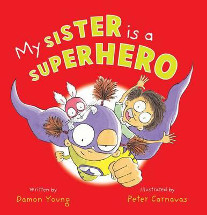
My sister is a superhero by Damon Young
Ill. by Peter Carnavas. UQP, 2016. ISBN 9780702253928
(Age: 4+) Highly recommended. Sisters. Family. Bedtime. In wonderful
rhyming couplets, the story of the little girl and her amazing
sister will resonate with the readers as the story affirms the close
bond between sisters. Each line opens with something that other
sisters do,
'Some sisters roll in carts, under jacaranda trees
Some sisters ride their sleds over waterfalls that freeze
Some sisters glide on scooters next to lanes of tooting cars'
ending with 'But my sister... '
and children will hoot with laughter at seeing the things sisters do
and what the superhero sister does, calling out the rhyming word in
the last line. The sisters at the start of each line do fairly
ordinary things compared with the superhero, but children will love
to recognise things they do together.
What a wonderful affirmation of family life, of siblings, of one
sister looking out for the other, reading and telling stories to her
at bedtime. Carnavas' illustrations reflect a variety of funny
situations engaging the reader readily with their humour,
complimenting the words on each page. Children will love searching
out what happens in each illustration and seeking out the superhero
and her sister and the things they do together. This is a wonderful
addition to the other two by Young and Carnavas, beginning with the
hilarious, My gran is a Ninja, and following with My pop
is a pirate, both characters making a reappearance in this
book, along with a curious hen.
I do like the endpapers with the superhero and her sidekick in
superhero poses. Another reason to like this book so much.
Fran Knight
Wonderment in death by J. D. Robb
In death bk 41.5. e-book. Piatkus, 2016. ISBN 9780751554106
(Age: Adult) Recommended. Mystery. Thriller. Novella. New York,
2061. When Darlene Fitzwilliams kills her brother and then jumps
from a tall building, it could be taken for a murder/suicide but Eve
Dallas' friends insist that Darlene would never have murdered her
brother. When Eve discovers that Darlene has been visiting psychics
and someone with a penchant for Lewis Carroll's Alice in
Wonderland has been messing with Darlene's mind, the hunt is
on for the motive and the murderer.
This is a quick read, in novella form, so there is not much
character development, but readers who are familar with Eve, Roarke,
Peabody and colleagues won't mind that as they will know and
understand very well how the main characters operate.
The plot and action however is exciting and different. Robb manages
to keep the reader in suspense for the duration of the novella, and
the references to Alice in Wonderland add a certain
whimsical touch to the plot. Eve and Peabody find clues to the type
of people that Darlene had been visiting in the months before her
death and quickly make sense of the crazy man whom she's been
visiting.
This is certainly one for fans of the series - fast paced and
engrossing - it is a very entertaining read.
Pat Pledger
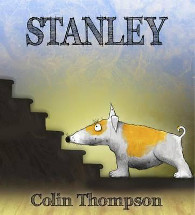
Stanley by Colin Thompson
ABC Books, 2016. ISBN 9780733332852
(Age: 4+) Warmly recommended. Dogs. Prejudice. Family. Readers will
recognise their own dog from the start of this very funny tale of
not judging a book by its cover, or in this case, a dog by its
appearance. Stanley is not a star turn as dogs go, he is built as if
from old weathered bricks, but loves four things: his owner, Gerald,
his food, his bed and his red ball. Gerald takes him to the park
where he can run after his ball, but one day it is taken by another
dog, a small fluffy dog that will not let it go.
The next day, a man, his daughter and their dog appear on the
doorstep offering back the now battered red ball with a new ball as
its replacement. Coming in for a cup of tea and biscuits, friendship
blossoms between Gerald's mother and the man, and even Gerald and
his daughter, and surprisingly Stanley and the small fluffy dog.
Each dreams that night of who they have met and after many visits
and many cups of tea and biscuits, the house becomes a home for all
of them, a new family.
This is a delightful story of finding love again, of creating a home
after a period of loneliness. Small hints are given about Gerald and
his mother; there is no Dad, Mum is alone, Gerald has no brothers
and sisters. And the man and his daughter standing on their doorstep
with their dog, seems just the answer they are looking for as
relationships develop over tea and biscuits.
Thompson's illustrations are admirable, with the cheeky looks on
Stanley's face to the little hidden motifs within each picture, the
pages will attract all readers to think about what they are seeing
as they read the text. I particularly loved the thumbnail sketch of
Gerald with his paper thin frame and deep eyes, his inability to
look the girl in the eyes, reflected in the book he is reading. I
laughed out loud at many things but this took my breath away as it
described so many boys who find relationships difficult. They will
recognise themselves and see that things will get better.
Fran Knight
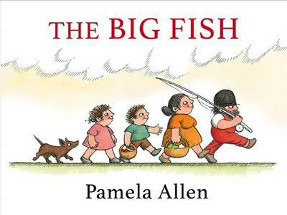
The big fish by Pamela Allen
Penguin, 2016. ISBN 9780670078974
Once upon a time a little old man, a little old woman, a small boy
and a small girl went to spend the day by the river. The little old
man took out his fishing line, put some bait on his hook, and cast
it into the river because, like everyone who goes fishing, his dream
was to catch a really big fish.
I wish, I wish,
Oh, how I wish
I could catch a big fish!
It's not long before there is a tug on his line, so strong that he
nearly falls in and he has to call on the little old woman to help
him. But even together they are not strong enough so the little old
woman calls to the small boy. Will the old man and his family land
the catch - and just what is on the end of the line anyway?
This is a delightful story reminiscent of the traditional tale of
The enormous turnip and with its repetitive refrain and cumulative
language it has a rhythm that will draw the young listener in so
that soon they will be engaging with the language as well as the
story. And with a few simple necklace-type signs to designate their
roles, they will be clamouring to be involved in a re-enactment of
it immersing themselves even more so that it becomes a treasure
trove of riches for drama and a language study.
Students will love to tell their own tales of going fishing and the
tips and tricks they can pass on to their friends. They could make a
class map of favourite fishing spots - river, lake, sea, waterhole -
and investigate the sorts of fish that inhabit them that they might
catch. The class expert could explain the parts of a fishing rod and
the different types of lures that are used and why, as well as
explaining the procedure of getting a fishing line ready for use or
what to do with their catch once they have landed it. Speculating
and illustrating what is on the end of the old man's line offers
huge scope for the imagination and because the author doesn't
disclose what it is, no one can be wrong so the smug chorus of 'I
was right!' that usually accompanies predictive questions is
avoided.
There is a range of 'the mechanics of language' that could be
explored from understanding the word 'tug' and how the author shows
its meaning through its repetition to examining the various fonts
and how they add to both the meaning and the reading of the story.
Even the use of speech bubbles and exclamation marks and the
cumulative language structure can be discussed to help develop their
understanding of book language and the conventions used to make it
more like speech, thus enhancing their own reading through their
'inner voice'. Throughout, Allen uses words like 'tug', 'pull' and
'haul' so there could be an introduction to the concept of synonyms
and a challenge to find as many words that could be used to replace
'got' as possible.
The story also lends itself to the mathematics of size, order and
position particularly through the illustrations and the
re-enactment, offering lots of opportunities for the students to be
physically involved as they position themselves according to height
or age or gender.
Pamela Allen is one of the mainstay authors of literature for the
very young and she never fails to deliver the most wonderful stories
that are perfectly illustrated so that the marriage between text and
illustration is seamless. Even our very early readers can tell
themselves this story without having to have heard it let alone read
it for themselves. Miss Just-Turned-Five is going to love sharing
this with Grandad, an ardent but not always successful fisherman, as
they snuggle up for their bedtime story soon.
Barbara Braxton
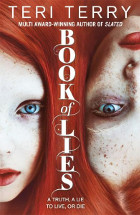
Book of lies by Teri Terry
Orchard, 2016. ISBN 9781408334287
(Age: 15+) Witchcraft. Truth and Lies. Supernatural/Horror.
Although the reviewers quoted on the endpapers about Terry's
writing, provide hints that this might be a dystopian narrative, it
is probably more a dark journey into the world of the supernatural.
If this was made into a film it would be scary! Terry writes in such
a way that the gentle journey into fear happens slowly, and the
ordinary although sad beginning slowly twists the reader into the
tangled web of lies. Just as a web-captured insect does not envisage
the ultimate end, the reader too is drawn into an ultimately
difficult conclusion.
The well-written and compelling story begins with the death of a
mother in horrific circumstances, and the discovery by her estranged
daughters Quinn and Piper, that they are identical twins, separated
deliberately to save them from the family secret that haunts them.
The reason for their separation is the essence of the story, and
what draws them together. But it is also what makes this a chilling
and unsettling journey into a family that has been separated by lies
and by the sinister magic of their ancestors. The core of identity
for the twins, and their ability to deceive others around them adds
to the tension of the tale, told through the individual voices of
the girls. A shared love interest adds a layer of complication as
does the setting for part of the narrative in the foreboding wild of
the Dartmoor moors. But ultimately this is a story where evil and
lies invade a family to create a sense of dread.
Recommendation only for those aged 15+ who can cope with the torment
and tension of the supernatural horror story. Well-written and
difficult to put down (even for someone who does not like this
genre!)
Carolyn Hull
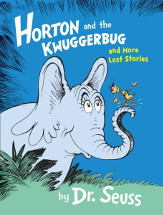
Horton and the kwuggerbug and more lost stories by Dr Seuss (aka Theodor Seuss Geisel)
Harper Collins, 2016. ISBN 9780008131272
Dr Seuss. Rhyme. Originally published in magazines in 1950's
this collection of lesser known Dr Seuss stories will be enjoyed by
his fans. They contain the usual whimsy and fun, with simple rhyming
patterns, and his created words. Dr Seuss manages to hide some more
serious ideas underneath the nonsense, for those prepared to look.
This is definitely worth adding to a Seuss collection. Horton
appears and is tricked by a pesky bug; a school child explains the
reason for his late arrival at school; a policeman on the beat saves
the community from disaster and the Grinch proves that he is a
little sneaky, but a good salesman.
Carolyn Hull
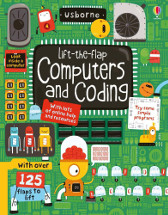
Lift-the-flap computers and coding by Rosie Dickins
Ill. by Shaw Nielsen. Usborne, 2015. ISBN 9781409591511
Among the stated outcomes of the Digital Technologies strand of the Australian Curriculum for students
in Foundation to Year 2 are the ability to 'recognise and explore
digital systems (hardware and software components) for a purpose'
and 'follow, describe and represent a sequence of steps and
decisions (algorithms) needed to solve simple problems'. So
right from their first years of formal schooling, our students are
expected to be able to understand the parts of a computer, use
software and begin to manipulate the devices to meet their needs.
This book with its myriad of flaps to lift and explore is perfect
for introducing this age group to what computers are and how they
work. Starting with 'What's a computer?' and an explanation of what
coding is, it moves on to show how computers think, including lots
of interactive activities that encourage the reader to participate
and thus gain a better understanding of the focus topic. For
example, the binary code is explained and then the reader is
challenged to convert decimal numbers to binary with the answers
under the flaps. Pictures via pixels are explained and so are
colours. There's even a treasure map to help Pixel the Pirate hunt
for treasure while teaching about writing instructions and flow
charts. The flaps reveal answers, explanations and things to think
about ensuring that the reader is actively engaged in their
learning.
The more I delved into this book the more I went back to my early
days of learning to program a turtle using Logo and even earlier
still to when we bought books with the coding for games in them and
we put these into our basic computers which ran on audio tapes! This
book encourages kids to explore and use Scratch which is so
highly recommended by my computer guru colleagues and just continues
on with so much info and fun that I'm surprised it hasn't been
written before!
But even if you buy multiple copies of this for your students, you
should also consider buying it for those teachers who feel daunted
by the requirements of the curriculum because apart from helping
them understand the technical aspects of computers and coding, it
offers a myriad of ideas for supporting the learning within the
classroom using activities that don't require a device. You might
also like to scour your TR section for all those books about
encouraging logical thinking and problem solving that were so common
a few years ago because they are all grist to the mill, and also
return to the basics of the information literacy process of
What am I being asked to do?
What do I already know?
What more do I need to find out?
Where can I find that information?
So even if writing a million-dollar-making app is beyond the reach
of many nevertheless they will have had lots of scaffolding and
experience in thinking logically, posing and answering questions and
solving problems - which all the futurists says are the essential
foundation skills for the future.
Barbara Braxton
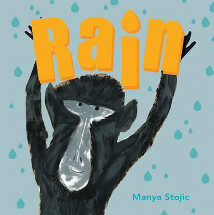
Rain by Manja Stojic
Pavilion, 2016. ISBN 9781843653059
Picture book. On the African savannah the animals are waiting for
the rains as the soil cracks from the hot, dry, unending sun.
Porcupine can smell the rain; Zebra can see the lightning and Baboon
can hear the thunder. Rhino feels the first drops and then Lion can
taste it. It rains and rains and rains but even after it stops it
continues to bring comfort to the animals. Until the whole cycle
starts again.
As the vegetation of south-east Australia withers beneath an
unrelenting heatwave and that of central regions blooms under record
rains, this is a most timely story to share with young readers
learning about the cycle of weather and its impact on the
environment. Using simple, cumulative language and big, bold type
and pictures that encourage young listeners to join in, it
introduces them to a climate that might be very different from that
which they experience as well as encouraging them to think about how
we are as dependent on rain as those on the African savannah. By
focusing on how the animals use their senses to predict the rain, it
also offers an opportunity to explore how animals more common to
them use their senses - such as a dog's dependence on smell - as
well as how humans use theirs.
In her debut book for children, Stojic has used colour very well to
contrast the dry, cracked, sunburnt landscape with that after the
rains have fallen. For those where rain brings such a change to the
landscape, this could encourage some interesting before/after
artwork from children with the focus on colour and hot and cool
tones. For those who are ready, there could also be a focus on
adjectives as Stojic has carefully chosen her words to depict that
which can't be shown in pictures. The relationship between text and
pictures is such that even youngest readers would be able to 'read'
it for themselves.
What seems a simple book on the surface has a depth that makes it
more than a one-off read-aloud.
Barbara Braxton
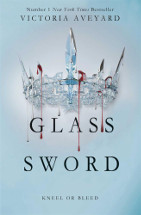
Glass sword by Victoria Aveyard
Red Queen bk 2. Orion, 2016. ISBN 9781409159353
(Age: 13+) Recommended. Glass Sword picks up directly where
the gripping Red Queen left off. Mare is unique; with red
blood like the common folk of her home, and powers to rival the
silvers who rule them. With the discovery of the other 'new bloods'
(people with red blood and silver abilities) and Mare's escape from
the palace and the newly crowned and vindictive, King Maven, Mare
sets off on her journey to find the other 'New bloods'; the people
like her. The question is; will she be able to find them, or will
Maven beat her to it?
Aveyard has created a gripping and complex storyline, shrouded in
death, heartbreak and a cruel view of humanity. The novel starts off
slowly, but quickly builds into a fast paced and suspenseful
storyline. Mare Barrow, the main protagonist, struggles throughout
the novel with the betrayal of Maven and her inability to feel as if
she belongs, neither to reds nor silvers. Glass Sword shows
an almost completely different character in Mare than what she was
in Red Queen and she was not particularly likeable
throughout this sequel. Mare came across quite frustratingly cold
and bleak to the reader when compared with her fire and passion in
the first novel. This did in return have the positive outcome of
making her feel a lot more real as it was easy to see that Mare was
struggling to deal with certain aspects of her life, as any real
person would in her position.
Overall, Glass Sword is a particularly compelling and
gripping novel, and would give rise to discussions surrounding the
nature of humanity and many impending world issues.
Georgia Cunningham (Student)