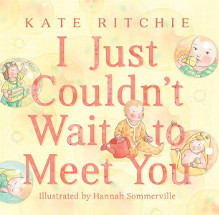
Ill. by Hannah Sommerville. Random House Australia, 2016. ISBN
9780857989703
(Ages: 3-7) Family. Babies. Love. Kate Ritchie, of 'Home and away'
fame, began work on this as a letter to her infant daughter. It
talks directly to the reader, reminiscing on what it was like
waiting for her baby to be born ('Would you grow up big and strong?
What would be your favourite toy?') before reflecting on life with
her baby ('and although you challenge me, I know we will be okay').
The sex of the baby, through the use of neutral colours and careful
wording, is unidentified. This means that all young children will be
able to relate to the baby in the story.
The text rhymes and flows quite well. The verse only occasionally
seems clunky - particularly the last page ('I am so lucky that I met
you. I just couldn't wait to meet you!'), or not reflective of how a
parent actually speaks to a child ('Each day my glad heart sings').
Otherwise, it is tender, reassuring and well phrased ('So
I'll be here to watch you grow, and guide you on your way').
Hannah Sommerville has done a wonderful job illustrating this with
warm, earthy tones and rounded, comforting lines that add to the
welcoming, caring feel of the story. The front endpapers have
illustrations of things that might be stuck in a baby scrapbook:
ultrasound photos, lists of names, baby shower invitations and belly
photographs and the back endpapers show artefacts and photographs of
the new baby's milestones: first smile, footprint, lock of hair,
first painting, etc. These will provide talking points for parents
and children as they discuss these things within their own family
context (What would I have been called if I was a boy/girl? When did
I first smile?). It might even prompt the pulling out of their baby
book or photo album.
This book, to be shared between parents and children, could be used
to reinforce how special and loved a child is, particularly if a new
sibling has or is joining the family. It will also be reassuring and
touching for new parents and seems to be written as much for them as
for children.
Nicole Nelson
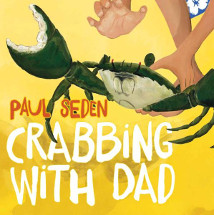
Crabbing with Dad by Paul Seden
Magabala Books, 2016. ISBN 9781925360158
(Age: 3+) Highly recommended. Aboriginal themes, Family
relationships, Crabbing, Fathers. The simple act of doing something
with Dad is shown in this delightful new book from Magabala Books.
The universal story of families working together is infectious and
all children, indigenous and non indigenous will enjoy the trip to
the creek to catch a crab. The warmth of the family outing, the
closeness between Dad and his children, the inclusion of the fellows
fishing on the beach, the addition of a cousin, all make the day a
marvellous success.
Sam and his brother, Mahli, put on their life jackets and speed off
with Dad along the creek to their secret spot. They throw over their
crab pots (judiciously we are told the laws about crab netting in
Australia at the start of the book) and watch the fish swimming
beneath them. When the pot is pulled from the bottom of the creek
they have caught the biggest crab ever and need to do things to it
to stop it from nipping their fingers. We are shown aspects of
culture through this story, and the respect shown to the fish in the
creek, as well as respecting the laws of the land: lifejackets,
sunscreen, safety on the water and wearing hats. And I particularly
like the illustration on the front cover: young readers will quiver
with excitement at the thought of being nipped by those large claws
looming out at them and eagerly turn the pages to find out what the
boys do on their day with Dad.
This lovely story, richly showing a day out with Dad that all kids
can read and admire, underlines the importance of the father in all
our societies giving a man's perspective to young boys growing up.
The way the excellent Paul Seden has told this seemingly simple
story stressing the role of men, as well as giving a procedural
account of going crabbing, makes the reader look for more. Supported
by luminous illustrations, I hope that Paul Seden has many more
stories up his sleeve to share with us all. A Darwin based author
illustrator, Seden's work first appeared with Kick with my left
foot (Allen and Unwin, 2014).
Fran Knight
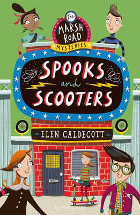
Spooks and scooters by Elen Caldecott
The Marsh Road Mysteries bk 3. Bloomsbury, 2016. ISBN
9781408852736
(Age: 9+) Recommended. Themes: Mystery; Adventure; Industrial
espionage. The Marsh Road Mysteries revolve around a group
of English friends who seem to keep finding mysteries that need
their combined talents to help solve the problems that adults are
incapable of unravelling. In this adventure, Flora and Sylvie, who
are twins with very different personality traits, attempt to rescue
their father from disaster when his business becomes the target of
intellectual theft and industrial espionage. The consequences will
be catastrophic for his business prospects and he is at risk of
losing everything. The twin's parents are separated and the girl's
father has a new girlfriend who has not yet won Sylvie's affection.
She too becomes embroiled in the mystery. Is she the thief? The
twins' other friends assist them to outwit the bumbling Personal
Investigator that has been hired by the business, and together they
use their talents to piece the puzzle together.
This is a crime mystery for young readers and will satisfy the needs
of those young readers who like mystery and intrigue. The child
characters use their talents and brain power, and young readers will
enjoy the way they problem solve (and bend the rules) to enable them
to pursue their investigations. Caldecott manages to write in such a
way that a young reader will not feel patronised. Perfect for a
school library collection, it can be recommended to young capable
readers and older readers who like an intriguing tale.
Carolyn Hull
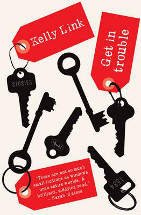
Get in trouble by Kelly Link
Text, 2015. ISBN 9781922182630
(Age: 16+) Recommended. Short stories. 'Be bold, be bold. But not
too bold - lest that your heart's blood should run cold.'
This book is an Indies Choice Book of the Year Finalist for 2016.
You will need to be bold to encounter the nine short stories
included here for the reader to enjoy. The writing is captivating
and the stories are weird, engrossing, surprising and at times
alarming or disturbing.
These stories encompass a range of characters that include: a young
girl, a middle-aged movie star, a spoiled birthday girl, astronauts,
evil twins, bootleggers, The Wizard of Oz and superheroes.
Some of the stories require the reader to really slow down and
collect all the clues in the writing for there to be real
understanding and appreciation of the intricacies in the telling.
The stories unfold in a dreamlike stream of consciousness where the
connections seem logical in that space and time but, at the end of
the story, the reader marvels at the creativity and imagination that
created the journey to an unexpected destination. The Summer People is a compelling first story in this
collection. It has teenage Fran caring for the 'summer people'.
These people are holiday makers that visit for the summer. There are
also 'summer people' to look after and they are always at home. This
story is a cautionary tale of the dangers of making agreements with
fairies.
While these are short stories, they are for sophisticated readers
able to suspend belief and enjoy the ride.
Linda Guthrie
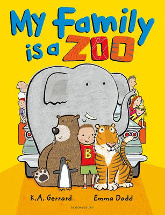
My family is a zoo by K A Gerard
Ill. by Emma Dodd. Bloomsbury, 2016. ISBN 9781408869406
(Age: 4+) Recommended. Humour. Zoos. Families. Birth. Verse. The
family is going on a journey. Dad's elephant is packed into the car,
after all he has had him since he was three, then the story teller's
big brown bear, sister's whale, and big brother's dinosaur. Each
person gets into the car with their animal, and the reader will read
the story told in a four line stanza telling of the new arrival in
the car. By now the readers will be intrigued about just how these
people and their animals are fitting into the car, and the humorous
illustrations by Emma Dodd, show the car getting very full. A
seemingly few simple strokes of her pen give priceless expressions
on each of the family members as well as the animals, as they stop
again for uncle and his penguin, the cousin and her kangaroo, aunt
and her monkey. Adding a dog and his pet as well as a pair of polar
bears means the car is absolutely stuffed full. There is truly not
enough room for a pin. But the surprise ending means room will have
to be found for the extra passengers.
Young readers will love reading this out loud, looking at the bright
breezy illustrations, working out just where everyone will fit in
the station wagon, and be amazed at the surprise at the end.
Discussion will follow about zoos and the animals that are there,
why the family owns all these animals, if indeed they are real
animals, and where to go to from here with their extra luggage.
A great way to talk about happy involved families, owning a pet and
the responsibilities involved, and the introduction of a new sibling
or two to an already full family.
Fran Knight
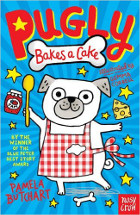
Pugly bakes a cake by Pamela Butchart
Ill. by Gemma Correll. Nosy Crow, 2016. ISBN 9780857635990
(Age: Yr 1 - Yr 4) I guess we all know that pugs are pretty cute
(and pretty fashionable) right now. If I hadn't got a toy poodle
myself I probably would have got a pug - although my eccentric
teaching colleague who had a wardrobe of outfits for hers and
attended all the 'pug parties' in Brisbane at one time did kind of
put me off a little.
Moving right along, newly independent readers are going to love this
book. It's a HOOT! Last night I read this aloud straight through to
The Divine Miss M who is having a sleepover and she thought it was
great! She was able to predict and infer as I read which was pretty
impressive as well.
Pugly and his rival Clem (Clementine) the cat are rivals for the
undivided attention of their owner Maddy who is eight years old.
Being a pug (no offence to pug owners), Pugly is not the sharpest
knife in the drawer and Clem can very easily put it over him.
Especially as Pugly's only ally is Clive the fish - and Pugly
doesn't speak or understand fish-bubble. Inspired Pugly decides he
is going to the first dog to ever bake a cake and thus win paws down
'The Great British Bake Off', be on TV and meet the Queen (as you do
when you're famous). This plan will seal his status as Maddy's
favourite pet he is sure. However, with Clem 'advising' him chaos
reigns in the kitchen and elsewhere, as Pugly heeds all Clem's
ideas, goes mental at the Evil Squirrel outside on the fence and
more.
This is a laugh a minute book and not only proved a terrific read
aloud (took about half an hour or so) but perfect for those readers
beginning their individual reading journeys. Lots of capitalised
words and extra large fonts give them the opportunity to incorporate
tone and expression into reading as well. Get onto this one - it
will be a great favourite with Year 1 to around Year 4 for sure!
Sue Warren
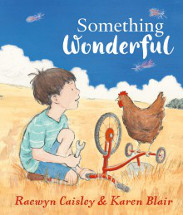
Something wonderful by Raewyn Caisley
Ill. by Karen Blair. Viking, 2016. ISBN 9780670078455
Sam lives in the country - way out in the country where the air is
fresh and clean and he and his dog have room to run and chase
feathers, climb trees, spin around on the Hills Hoist and build
things from all sorts of old stuff lying around. Pulling things
apart and putting them back together is what he loves best - so much
so that he sometimes forgets his chores like feeding the chooks,
collecting the eggs and making sure the goat is in its paddock. This
frustrates his dad who thinks he should be more focused, but his mum
understands and knows that his distractedness means a brain is very
busy at work. For all that he seems to be playing, Sam is learning,
learning, learning.
One day while chasing a shadow across the paddocks it starts to rain
and after momentarily stopping to think whether a raindrop is round,
Sam makes a dash for shelter in the shed. And in the shed are all
the bits and pieces that Sam needs to make something wonderful.
Raewyn Caisley and Karen Blair have once again combined to create
something wonderful, their first since the delightful Hello from
Nowhere. The book is dedicated to the real-life Sam who now
'works at a famous university in Europe, where he is trying to work
out what is in-between the smallest things' and demonstrates that
his mum was right - all that pulling apart and putting together, the
curiosity, the wondering of it all was just the lead up to what he
is doing now.
So even though not all tinkerers will end up at 'a famous
university' those makerspaces we offer in city libraries could just
be the breeding ground for a new Sam as they play and plan and
dream. Just as Sam learns about pulling and pushing and pulleys (in
the most hilarious way ever) so too could one of our students albeit
it in a more artificial situation.
Karen Blair's illustrations are superb - you can feel the wind in
your face and breathe the fresh country air, sense dad's frustration
and Sam's sense of wonder - they are as wonderful as that which Sam
creates. The final textless page and endpapers are divine!
Threaded throughout the joy in this story (which shines through like
a mother's love) is a powerful message about the importance of play
and discovery. THIS is what childhood is about - not academic
competition and grades and being ICT savvy. Academic things should
just be the means to an end - the vehicle on which children can make
their own discoveries as they explore and explain and not only make
sense of their world but make it better.
A very serious contender for my favourite book for a while.
Barbara Braxton
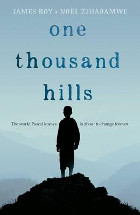
One thousand hills by James Roy and Noel Zihabamwe
Omnibus Books, 2016. ISBN 9781742990750
(Age: 15- Adult) Themes: Genocide; Historical events - Rwanda;
Innocence; Discrimination; Children in a time of conflict; Refugees;
Family. Knowing the ultimate outcome of the Rwandan Genocide in 1994
creates an underlying tension throughout the reading of this book.
This narrative is essentially a counselling session - but it is also
a horrible and slowly unfolding catastrophe. The young man, Pascal,
retells his experience to a school counsellor in explanation for an
incident that he was involved in at school. Slowly and painfully he
reveals the events of his life at the time of the genocide and his
survival after the incredible unspeakable tragedy. Should it remain
unspoken? Or does speaking it out loud release the tension or bring
it to mind again? For the reader, it is important to know how tragic
this experience was for the people involved, and the innocent voice
of the young Pascal, as his 10 year old self, creates added anguish.
The boy comes from a mixed tribe family (both Hutu and Tutsi) and
small snippets of the civil unrest filter to him through scattered
threads of conversation until the events of the massacre impact
violently into his normally gentle and religious family. The author
slowly takes us on the journey from the tender and normal family
life of the Rwandan family, with its normal sibling rivalries and
chores, to the final explosive scenes of betrayal and genocide. In a
manner similar to The Boy in Striped Pyjamas by John Boyne,
the innocent voice of the central character magnifies the horror of
the atrocities inflicted.
This is an extremely moving, but atrocious story. And it is an
account of the reality of experience for co-author Noel Zihabamwe.
This is a compelling narrative, but I would be loath to put this
into the hands of a reader too young to understand this part of
history or one who is vulnerable to violence or is traumatised by
news accounts of bloody conflict. The added horror of the
involvement of some from the church in assisting in the tragedy will
also be difficult for some readers. How humans can be so cruel to
one another and lose sight of their common humanity is a huge
unspoken question from the young Pascal. Even though this is written
in a simple and 'youthful' style it is suited for mature readers
aged 15+ and adult readers.
Carolyn Hull
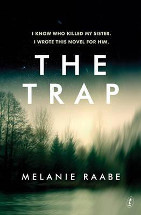
The Trap by Melanie Raabe
Trans. by Imogen Taylor. Text, 2016. ISBN 9781925240870
(Age: Secondary+) Melanie Raabe is a young German writer of
screenplays, scripts and blogs. This, her first novel, is a thriller
for which the film rights have already been secured. The main
character, Linda, is a successful author who has lived in seclusion
since the murder of her sister Anna. Linda found her sister's body
and details of the scene are unforgettable, the sight of her
sister's bleeding body, the sound of the Beatle's song 'Love me do'
repeating incessantly on the CD player and most significantly, the
glimpse she has of the killer fleeing from the room. The police at
the time were sceptical at best and disbelieving at worse about her
evidence. Unable to face the world she writes and remembers and is
alienated from even her parents, until she sees again the face of
the murderer on television. He is a well-respected journalist and
Linda recoils from approaching the police. She feels they would be
unlikely to believe her, and an interrogation would alert him to
suspicion. She decides to find proof herself.
She writes a book, a thriller, in which the victim and the murder
parallel her sister's murder. She undergoes desensitisation training
to help her face her fears. She consults an expert on interrogation
techniques. She wires her house with cameras and recording systems.
She invites the news outlet that employs her suspect, Lenzen, to
send him to interview her. She chooses a day when her staff are not
at work and has a caterer provide food. The interview begins; Lenzen
is an attractive and clever man, who she senses is aware of her
suspicions. She gains the upper hand, she thinks, after a number of
mind games and tries to force a confession by pointing a gun at him.
However, she thinks she can hear the Beatles song 'Love me do'
repeating and becomes confused. Is she going mad? Lenzen protests
his innocence and takes the gun. He persuades her that she was the
killer herself, and that was what the police had always suspected.
Linda remembers childhood antagonisms and interprets her parents'
cool behaviour as being based on suspicion. She has always been a
story teller; has she invented her sighting of the murderer to
provide herself with a cover? Lenzen seems to be off the hook until
Linda has a chance meeting which causes her to again reassess, and
to take further risky action which leads to a resolution and a
life-affirming renewal.
The novel is tightly and simply written with believable characters,
though slightly drawn, and a suspenseful and unpredictable plot.
Though a thriller the story concerns the psychological reactions to
events rather than the violence of events and so has more depth than
many crime novels. It is suitable for secondary readers.
Jenny Hamilton
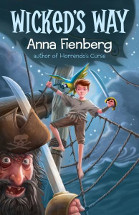
Wicked's Way by Anna Fienberg
Allen and Unwin, 2016. ISBN: 9781743319901
(Age: 9-12) Highly recommended. Themes: Pirates; Love; Choices;
Magic; Adventure; Transformation; Good and Evil. A young boy, Will,
raised in a loving island home with his mother, learns tightrope
walking and believes that one day he will be a circus star.
Unfortunately his mother disappears, and although briefly he
discovers that life goes on with new opportunities and a new friend
despite his loss, eventually disaster strikes and he is stolen by
pirates. The gentle Will is broken by the harshness of the
tyrannical pirate captain, and renamed Wicked. The life on board a
pirate ship is not pleasant, and the relationships that are formed
are difficult. Wicked slowly becomes a shadow of his former self,
and his desire to rediscover his mother and his friend slowly become
a distant hope. A mutiny and some poor choices eventually lead
Wicked to a solitary island existence with a talking parrot who
shares pithy sayings and adages, and then there is an unfortunate
re-encounter with someone who could not be trusted. This ultimately
leads Wicked to rediscover himself and to be reshaped back into the
trusting and open-hearted person from his past.
This is a story of restoration (and redemption) and the
transformation from gentle Will to Wicked and back again is an
interesting journey told within the medium of a Pirate adventure
with a small dose of magical influence. With the reappearance of
Horrendo from Fienberg's Horrendo's Curse there is also a
rediscovery of the power of the friendly and amiable Horrendo.
Highly Recommended. This tale would make a great read-aloud story
within a school context for ages 9-12. There is much to discuss
about Will's emotional journey and Horrendo's influence. The
metaphor of the tightrope journey - just place one foot in front of
the other, and stay focused on the prize; plus the wisdom of a
parrot could lead to many discussions.
Carolyn Hull
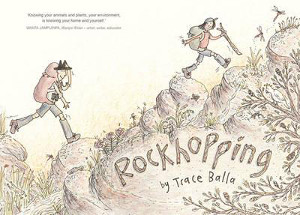
Rockhopping by Trace Balla
Allen and Unwin, 2016. ISBN 9781760112349
(Age: 8+) Recommended. Themes: Bushwalking; Natural environment;
Exploration. This is the companion text to the book Rivertime
and in this book Clancy and Uncle Egg explore the Grampians and look
for the source of the River. They pack for a walking trek through
the Grampians region, trekking up craggy rocks and through the
delight of the natural environment. The long arduous walk carrying
heavy packs and a dangerous cliff top near-accident does not dampen
their enthusiasm for the way the natural environment reveals itself
to those who have time to look. Balla's Cartoon style, graphic novel
includes a wealth of small captioned details that give the reader an
insight into the variety of life within the environment and some of
the historical perspectives of the region, including its Aboriginal
history and view of the world. Clancy demonstrates incredible
resilience as he overcomes difficulty, but he also discerns the joy
of discovery as the world unfolds before him.
Balla's beautiful and simple illustrations are enchanting. The
narrative is also delightful, telling of the journey, but also
revealing the wonderful relationship between Clancy and his uncle
and the simple pleasures of being outdoors.
Carolyn Hull
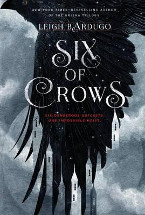
Six of Crows by Leigh Bardugo
Six of Crows bk 1. Henry Holt, 2015. ISBN 9781627792127
(Age: 14+) Highly recommended. Fantasy. Heists. Goodreads Choice
Award Nominee for Young Adult Fantasy and Science Fiction (2015),
YALSA's Best Books for Young Adults (2016). Kaz Brekker has been
offered the chance to pull off the heist of a life time and he
gathers around him five dangerous specialists, most from the Dregs,
thieves of Kerch's underworld. There is Inej the Wraith, who can
silently scale walls, Nina the girl who has betrayed her friend
Matthias and is desperate to get him out of gaol, Jesper the gambler
who cannot resist wagers and the rich runaway Wylan who hates his
father. Led by Kaz, a superb thief and strategist, they are aiming
to invade the Ice Palace in a seemingly impossible quest.
For those who enjoyed the Grisha series, Six of crows
is the first book in another series set this time in Ketterdam,
which is in a fantasy land similar to the Netherlands. Bardugo's
world building is immaculate - her vivid descriptions make it easy
to smell and see the slums, the canals the docks and the cold lands
that the six traverse.
Then there is her outstanding character building. Each of the six
main characters, who tell their own stories in separate chapters,
have distinct voices and often heart-rending tales about their
backgrounds that gradually emerge as the story unfolds. They are all
compelling people with separate skills and together they must begin
to trust each other and form an effective team to get the job done.
There are subtle hints of romance, but this is not what stands out,
rather the complexity of the personalities and their pasts is what
holds the reader's interest.
Fans of Leigh Bardugo will really enjoy this, but readers new to
this author and indeed, the fantasy genre, will find a fascinating
world, irresistible action and feisty characters to entertain them.
Pat Pledger
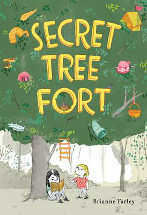
Secret Tree Fort by Brianne Farley
Walker Books, 2016. ISBN 9781406367232
(Age: 5+) Recommended for a library collection. Themes: Sisters;
Imagination; Reconciliation. Two sisters need to go outside. One, a
book-loving reader, settles under a tree with her book. The other
wants her sister to play with her. The ignored sister creates an
imaginary Secret Fort to entice her sister to join her and play. The
developing imagined detail is peculiar and grows with features as
her imagination explores the ways to connect with her sister.
However an argument bubbles to the surface. Eventually there
is a compromise to explore Fort-building together and this draws the
two sisters into a closer connection. This reconciliation after
conflict makes this a useful book to discuss differences and solving
problems. The illustrations are simple in style, but there is
sufficient detail to engage a younger reader.
Although the book incorporates colourful detail, the tonal quality
is somewhat muted.
Carolyn Hull
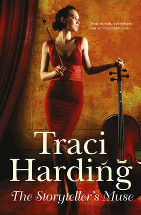
The Storyteller's Muse by Traci Harding
Harper Collins, 2016. ISBN 9780732299415
(Age: Senior secondary) Ageing author Penelope Whitman needs to
write a story which she has been incubating for a long time but is
frustrated by her failing faculties. Peter, a nurse in the aged-care
home where she lives is a frustrated author and she asks him to help
her write the story she dictates. The thread then alternates between
the story and the writing process until the author dies leaving the
narrative unfinished. A third story is introduced, Peter's own
creation, based on historical research thrown up by Penelope's
unfinished novel. Interspersed are strange supernatural incidents
identified as the 'muse' or spirit that can be dangerous as well as
creative. The chapter headings list the components of the writing
process and there is some insight into what it takes to develop as a
successfully published author although the luck and support budding
writer Peter receives is a bit beyond belief.
Traci Harding is known for her stories in the fantasy genre and this
convoluted tale may be of interest to her readers to understand how
she writes. There is a sex scene which may preclude the book from
some school libraries but senior students with writing aspirations
may like it as will Traci
Harding fans. It could be read with Rainbow Rowell's Fangirl,
also a story about a writer.
Sue Speck
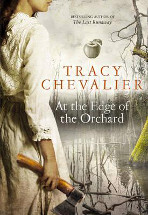
At the edge of the orchard by Tracy Chevalier
HarperCollins, 2016. ISBN 9780008135294
(Age: 15+) Highly recommended. Pioneer life in the US. Farmers.
Apple growing. Family life. It is 1838. Deep in the Black Swamp of
Ohio, James and Sadie Goodenough try to scrabble out a living,
cutting down trees and attempting to grow the 50 apple trees that
they need to claim their holding. James loves the apples, especially
the sweet apple brought from his home in Connecticut, but Sadie is
addicted to the applejack they make. Robert one of their sons, loves
the apples too and watches out for his overworked sister, Martha.
When disaster strikes, Robert leaves the farm and roams across the
country, working on ranches and trying his hand at gold mining in
California. When he meets William Lobb, a naturalist who collects
seeds, he begins to work for him, but when his past catches up with
him, he has to decide whether he will continue on his solitary way
or make a home.
This a stunning book, meticulously researched, and the background of
apple growing and the appearance of the folk hero Johnny Appleseed
is fascinating. Pioneer life is described in all its brutality, the
loneliness, isolation, back breaking work, infant mortality and
alcohol addiction running counter with the family dramas as James
and Sadie battle it out about whether the apple trees should be
'eaters' or 'spitters' to make applejack. The hardships that the
family face are overwhelming and it is easy to imagine Sadie giving
into the enticement of applejack.
Chevalier uses the different voices of her characters to tell the
story. The reader learns about James' affection for the apples, his
jealousy of Johnny Appleseed and his trust in two of his children,
Robert and Martha. Sadie's narrative is less educated and more
strident, and it is easy to see the lonely, difficult woman in her
words. When Robert strikes out alone, it is his yearly letters to
his family that bring alive his character and his narratives are so
striking giving the reader information about the settlement of the
US, the gold rushes and the fever that overtook the miners, and the
hardship that women faced. The descriptions of the redwood and giant
sequoia groves, the efforts of William Lobb to collect saplings and
seeds to send back to England and the growing effect of tourism are
rivetting. Martha's letters are heart rending and really make a huge
impact about the reality of frontier life for young girls and women.
Notes are at the back of the book about the research Chevalier
carried out and add to the reader's knowledge of some of the real
life characters, Johnny Appleseed, William Lobb and others.
This book was a joy to read - the prose was vivid, the history
fascinating and the family dynamics engrossing.
Pat Pledger