Five Mile Press, 2016. ISBN 9781760402921
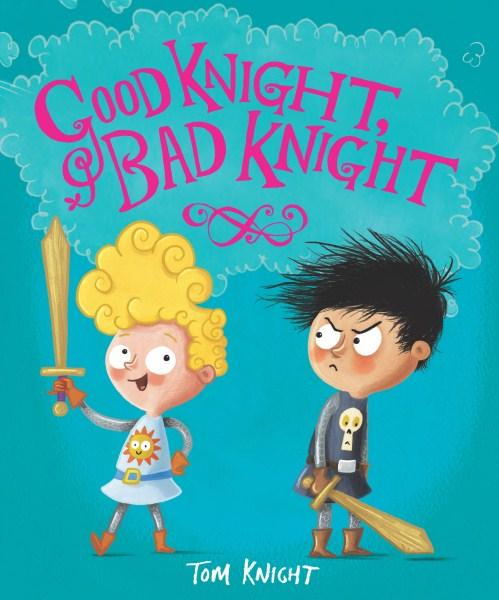
(Age: 4+) Recommended. Knights, Friendship, Dragons, Humour. Bad
Knight is not enjoying his Knight school: he is failing at
everything. He has really strict teachers and finds the work very
hard, so much so that the other kids laugh at him. He is building a
catapult in school while others are making nesting boxes, but he is
waiting for his cousin to arrive. Good Knight will be a friend. But
Good Knight turns out to be just as good as Bad Knight is bad. He
can talk to his mother about cooking, is terrific at swordsmanship,
goes into the haunted forest with aplomb, and has even mastered
tapestry making. During his visit he comes top of the class while
his cousin lingers at the bottom rung. The teacher plans a
tournament with the pair playing each other, with rather predictable
results, that is until a dragon arrives and target Good Knight. But
cousin Bad knows just what to do, luring the dragon away so that he
can use his invention to the satisfaction of everyone, except of
course, the dragon.
A funny read, children will learn lots of information about medieval
times as well as courage and friendship. The humorous illustrations
will further entreat the readers as they read through the book, and
they will pore over the endpapers with their intricate drawings
designed to tickle everyone's funny bone.
Fran Knight
This is a circle by Chrissie Krebs
Random House Australia, 2016. ISBN 9780857988058
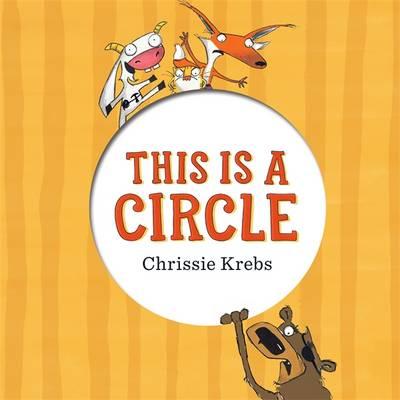
(Ages: 2-5) Rhyme. The back cover says 'This is the cover that wraps
around the book. Inside is funnier - just take a look'. That says it
all really - it is unashamedly silly! Don't be fooled by the title,
this is not a 'name the shape' book. It's a fun rhyme with a great
flow, featuring 1990s cartoon-style illustrations with lots of block
colours and crazy looking animals with big teeth and bulging
eyeballs. The cat is a little reminiscent of Leigh Hobbs's Old Tom.
The story is about a wild-looking one-eyed bear, a tap-dancing goat,
a song-singing cat and a pant-wearing fox and the fun they have with
a ball, a box, a scarf, a hat, a car and a boat. For example, 'The
goat climbs the box while wearing the hat, which frightens the fox
and angers the cat.' Needless to say it all gets a bit crazy and the
end of the book sees them& stuck on top of the box with no way
to get down.
The main subject and object words of the book (bear, cat, goat, fox,
ball, box, hat, scarf, car, boat) are repeated often and are in a
larger text size which shows the reader where to add emphasis,
inserts fun into the act of reading and makes for enjoyable
listening. The textural front cover, with a circle cut out in the
hardcover, will appeal to young children.
This is a rollicking, fun ride that children will want to hear
repeatedly and will love to join in reading. It has the potential to
encourage early literacy development because of the use of simple,
phonetic words and to promote conceptual understanding of rhyme.
Nicole Nelson
The Love Pug by Jennifer Sattler
Chick 'n' Pug series. Bloomsbury, 2015. ISBN 9781619636729
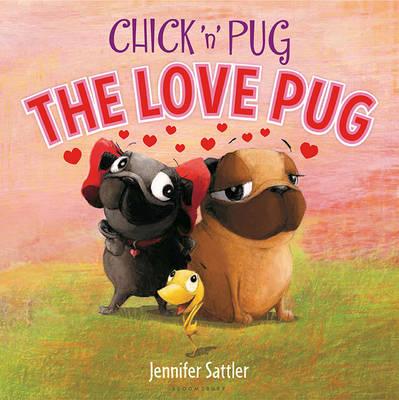
(Age: 4+) Chick and Pug are best friends, they enjoy playing and
spending time together. Unfortunately a pretty young pug called
Daisy appears and she falls for the very handsome Wonder Pug. Chick
welcomes their new friend, and shares stories of Pug's heroic deeds.
Images of Pug in a superhero cape flying through to air to rescue
poor Chick accompany the easy to read text. Pug is not impressed,
all he is interested in is taking a nap. The little yellow bird hops
into action supporting Daisy in her quest for love.
Jennifer Sattler's bright illustrations bring the characters to life
- Daisy saves Pug from the buzzing bee and Chick's expressive
actions and a range of emotions as she assists her new friend.
A fun story to read aloud to a young audience.
Rhyllis Bignell
A soldier, a dog and a boy by Libby Hathorn
Ill. by Phil Lesnie. Lothian Children's Books, 2016. ISBN
9780734416377
(Age: 7+) Recommended. Animals in war. Children in war. War. Dogs.
Refugees. Fighting at the Somme in Northern France during World War
One, a young Australian soldier spies a stray dog, and adopts it,
promising it will eat grandly: bully beef bourguignon. He tries to
do some tricks with the animal, but the sad-face dog does not
understand him. They walk on together, the young man wanting to adopt
him as his company's mascot. In the background the luminous
illustrations reveal aspects of the war in which the young man and
his fellow Anzacs are involved. Eventually a young boy approaches
them and he tells the soldier that the dog is his. He is able to get
the dog to do the tricks the soldier tried, but when the soldier
suggests the boy go to an orphanage he realises that he must sleep
rough, the dog by his side, as the orphanage will not allow a dog.
The soldier asks the boy if he can have the dog, but the boy
refuses. The soldier then gives the boy money for the two of them
and bids them farewell. As we see the soldier moving off through the
field of red poppies, the boy chases after him, exhorting him to
take the dog back to Australia. So the soldier walks off with the
dog wrapped around his shoulders. But this is not the end. The end
of the story will make readers think hard about what happened to the
other children like this one, what happened to the animals involved
in war, as well as the story of a young boy smuggled back to
Australia, which actually happened.
Hathorn's research into her own family's history at Gallipoli gave
rise to this story, and the illustrations by Lesnie give an
incredible back drop to the tale. Readers will gain some insight
into the effect of war on the landscape, as well as the populace and
feel some of the privations felt by the soldiers through the
illustrations. The names given to the dogs by the two will engage
the attention of the reader, and they will be able to think about
some of the words associated with World War One.
This is an interesting and thought-provoking addition to the
collection of picture books about Australia's participation in war
which have appeared in the last few years and will be a wonderful
inclusion for any library, classroom or home.
Fran Knight
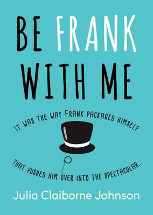
Be Frank with me by Julia Claiborne Johnson
Corvus, 2016. ISBN 9781782399179
(Age: Adult - Discerning secondary students) As you know, I don't
seem to get around to reading grown up books often but there was
something about the blurb for this one that begged me to read and
review it.
Thank you thank you Allen and Unwin for allowing me the unmitigated
pleasure of doing so! Charming, funny, poignant, realistic and with
a cast of unforgettable characters, this has been an absolute joy
for my night time reading of the past week.
The reclusive and reputedly eccentric author M.M. Banning has been
shamefully victimised by a fraud which has left her penniless. Her
literary fame which rests on a single perfect novel now studied in
schools all over America burns as brightly as ever but the funds
have dwindled desperately.
Banning's publisher, Isaac Vargas, despatches his most able young
assistant Alice Whitley from New York to the East Coast to monitor
Banning's progress with a promised new novel. Despite having not
published a word since 'The pitcher', Banning's contract for
this new book is her financial salvation but the progress is not
without obstacles. Alice's mission is not just to deliver reports on
the book's progress but to 'manage' both Banning's domestic life and
her nine year old son, Frank. If M. M. Banning is considered
eccentric then her son Frank has not only inherited her genetic
makeup but taken oddity to a whole new level.
A nine year old boy addicted to old movies, with a remarkable
intelligence and a wealth of trivia hoarded away in his brain, Frank
dresses in a range of outfits that transform him from a mini Teddy
Roosevelt to a Clarence Darrow with equal ease and completely lacks
any awareness of social mores. Needless to say, this does not stand
him in good stead with other fourth-graders and indeed, many adults
are taken aback by Frank's rather unnerving personality.
Alice's initial surprise as this strange household assaults her
senses gradually turns to an unconditional acceptance of Frank and
she becomes to a huge extent a surrogate parent for him.
Throw into this mix, the devastatingly attractive Xander whose
presence throws Frank into paroxysms of joy, has a soothing effect
on Mimi (M.M.) and thoroughly unnerves Alice.
This book has so much to offer the reader in terms of pure joy but
has also a great deal to say about our acceptance of others, and
society's definition of 'normal'.
You will not be disappointed if you look out for this one. While
primarily aimed at an adult audience there is nothing in this that
would prohibit being a delightful addition to a secondary library
for discerning readers.
Sue Warren
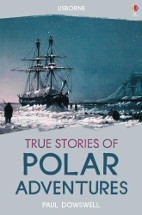
True stories of polar adventures by Paul Dowswell
Usborne, 2015. ISBN 9781474903820
(Age: Upper middle primary) One of the first places on this planet
little children get to know about is the North Pole, that legendary,
mythical home of Father Christmas, aka Santa Claus. Marked by a red
and white striped pole and inhabited by the man himself and his
wife, industrious elves and magical reindeer, it is a place of
mystery, intrigue and imagination. It is hard to believe that just
over a century ago that that was exactly the aura that shrouded this
place as expedition after expedition tried to uncover its secrets
for over 500 years. Perhaps that is why it was designated as Santa's
home - it was so remote and unattainable that no one would ever
discover the truth. From Sir Edward Willoughby's unsuccessful
attempt to find the northeast passage in 1553 until the
still-disputed claims of Frederick Cook and Robert Peary in 1908 it,
with its southern equivalent, was considered to be the Holy Grail of
exploration.
This book, written for middle-upper primary readers, contains the
stories of some of the most intrepid Arctic and Antarctic explorers
- those who succeeded and those who didn't; those who went for the
adventure and those who went for other reasons - and introduces a
new generation to the hardships, trials and tribulations of what
such a short time ago was the last bastion of exploration before the
age of flight and radio let alone satellites and GPS.
Included are the stories of Roald Amundsen, the first to the South
Pole and who beat my own personal hero Sir Robert Falcon Scott by
five weeks, but whose story is often over-shadowed by that of
Scott's because of the circumstances surrounding the deaths of Scott
and his companions. As I re-read the stories of the conquerors of
the south, once again I realised the impact that their journeys have
had on my own life all these years later as my mother was determined
to visit Scott's Hut (and did so in 1968 as the first female
journalist to go south) and Scott's story The worst journey in
the world by Apsley Cherry-Garrard was as familiar to me as
The famous five!
Illustrated with maps of the various expeditions but sadly no
photos, True stories of polar adventures could serve as just
the introduction to the exploration of these unique, hostile lands
and spark an interest in what it is that drives people to put their
life on the line to go where none has gone before and to delve
deeper into these tales of 'hardihood, endurance and courage'. This
is but a taster of an extraordinary smorgasbord of adventure stories
linked by the most hostile environments on the planet.
Barbara Braxton
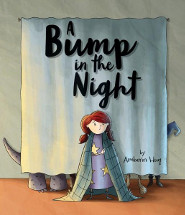
A bump in the night by Amberin Huq
Five Mile Press 2016. ISBN 9781760068820
(Age: 4+) Recommended. Bravery. Bedtime. Fear. Imagination. 'Things
that go bump in the night' is an old adage which is turned to good
use here as the young girl confronts what she believes to be outside
her bedroom door. She hears bumps, noises and knockings and assumes
something very bad is going on. She thinks of pirates with cutlasses
drawn, of giants and angry gnomes, but knows that these do not
exist. She tells herself so, albeit with a question mark at the end
of her sentence, but still determines to open her bedroom door and
confront what is there.
Readers will love the recognition of fear that sometimes dogs their
bedtimes, will laugh out loud at the things she dreams up to explain
the noise, and stand with her as she opens that door, even though
they stay behind her.
On opening that door, she finds a monster, but not your usual type
of monster. This gentle giant lives under the bed and loves to eat.
Mr Snuffles turfs out the other monsters that hide in her room,
settling down under her bed once again.
She has confronted her fear and found it to be baseless, well,
almost! What an interesting way to introduce the idea of feeling
safe, of not putting up with things that make you unhappy, but
checking them out and putting them behind you. Some classes will
have great discussions after reading this book, and will take the
opportunity to talk about safety issues, but most will take it as a
very funny read about 'things that go bump in the night'.
Fran Knight
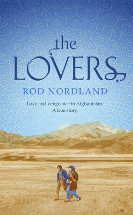
The lovers by Rod Nordland
Hodder and Stoughton, 2016. ISBN 9781473607002
(Age: 15+) Highly recommended. Journalist Rod Nordland's biography
about the Afghan lovers Zakia and Ali is an engrossing tale about
survival against all odds. The forbidden lovers' lives are changed
forever by Ali's foolhardy declaration of love.
Like many Afghan woman, Zakia lived a sheltered life under the
watchful eyes of her father, brothers, and male cousins. For Afghan
pride however, they were not watchful enough. Zakia falls in love
with the Hazara boy next door. The couple's courtship begins with
just a handful of words in stolen moments but soon it progresses to
scandalous secret phone calls and night-time visits in which Ali
stands outsider Zakia's window, risking discovery just for the
chance to talk with her. People just don't marry for love in
Afghanistan, let alone marrying across ethnic groups (he was hazara
and she was tajik). Before long Ali asked Zakia to marry him,
despite their opposing ethnic groups - they would have to elope, a
concept that was dangerous and would put both of them at risk of
honour killings. Once the couple had run off together Zaman, Zakia's
father, and his sons and nephews left their farm to hunt the couple
down. Zakia had dishonoured her father and her family. The only way
to regain that honour was for them to kill her. Zakia and Ali spent
the next few years of their lives running from Zakia's family. Their
plight received international attention with Rod Nordland's articles
posing them as the Afghan Romeo and Juliette, not only did he write
their stories for the New York Times, but he became the go-between
for foreign assistance for the couple. He played an important role
in their survival and continued international interest.
This novel is an eye-opener to the cultural differences between
Afghanistan and the western world. It is certainly a testament to
the luck of women living in a westernised world that they can voice
their opinions, study, work, fall in love, and leave their house
unattended without fear. Highly recommended for young people, in
particular girls aged fifteen and up.
Kayla Gaskell (University student)
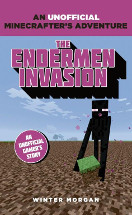
The Endermen Invasion: An Unofficial Minecrafter's Adventure by Winter Morgan
Bloomsbury Publishing, 2015. ISBN: 9781408869666
Themes: Games; Minecraft; Adventure. Imagine a popular computer game
that inspires the text for an adventure . . . .collecting of
treasure and 'building' while retaining the uncertainty and
randomness of attack and defence within that game, and you have The
Endermen Invasion. Young Minecraft devotees may enjoy this
opportunity to read a game scenario, but the narrative lacks
character development and the plot complications rely on knowledge
of Minecraft strategies and game play. The fantasy element involves
fighting ender dragons, and three-headed withers while competing in
a 'building competition' which is under attack, while remembering
the need to restore energy levels by collecting mushroom stew by
milking 'Mooshrooms' to ensure energy supplies. This will be
understood by game aficionados and just seem bizarre to any who have
managed to miss the Minecraft world.
Not highly recommended for its literary quality, but if you have a
reluctant reader who loves to play Minecraft, you might be able to
entice them to read this book. Its quality is in 'getting them
reading'.
Carolyn Hull
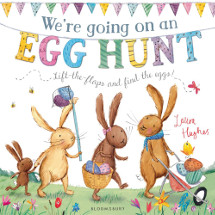
We're going on an egg hunt by Laura Hughes
Bloomsbury, 2016. ISBN: 9781408873861
(Age: 2+) Recommended. Paperback with flaps to lift. Themes: Easter,
Poetry, Rhymes. We're going on an egg hunt.
We're going to find them all.
We're REALLY excited.
Hooray for Easter Day!
Laura Hughes's lively Easter picture book is based on the
traditional rhyme 'We're going on a bear hunt.' Four young rabbits
start out with their wheelbarrow on the search for ten hidden eggs.
The farm setting provides plenty of tricky obstacles, through the
sheep enclosure, in the chicken coop, passed the busy bee hives,
even at the duck pond there are eggs to collect. The eggs are hidden
under logs, flowers, bulrushes and even the milk churn. Each
brightly coloured egg is collected in the wheelbarrow, their
baskets, buckets and a butterfly net, until they find the biggest
egg of all. Hiding behind this flap is a surprise - the big bad
wolf. The bunnies hurry and scurry back through the ducks, bees,
chicks and lambs dropping some Easter eggs along the way. Of course,
they arrive safely back at their house just in time to enjoy the
chocolatey treat. Even Mr. Wolf enjoys Easter, munching on the eggs
dropped in haste.
This engaging story is just right for sharing with youngsters this
is an exciting read-aloud story, with counting, familiar things to
find and animals to name. The pastel, watercolour wash backgrounds,
rustic settings and charming animal characters make this an
entertaining picture book.
Rhyllis Bignell
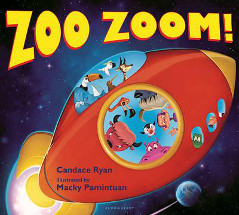
Zoo Zoom by Candace Ryan
Ill. by Macky Pamintuan. Bloomsbury, 2015. ISBN 9781619633575
(Age: 3+) The animals are off in a rocket to the moon, the monkey,
puffin, cockatoo, even the buffalo are ready for a big adventure.
The rhyming text questions which tasks need to be undertaken to
launch the rocket - using the keys, gear and dials. As the animals
are strapped in, even the kiwi, the hippo notices the sleeping rhino
has caused a major problem.
Manny Pamintuan's vibrant and lively computer generated scenes
filled with the more unusual zoo animals carry the story.
Rhyllis Bignell
The sidekicks by Will Kostakis
Penguin, 2016. ISBN 9780143309031
(Age: 14+) Highly recommended. Death, School, Same sex
relationships, Friendship. When Isaac is killed, his three friends,
Ryan, Miles and Harley find that with him gone, their relationship
has no substance. They were Isaac's sidekicks and each must now work
out their future without him. This riveting book is divided into
three as each of the boys explains what Isaac and the group means to
them.
The first section narrated by Ryan, shows the school machinery being
put into place; grief counsellors called in, the school counsellor
hovering, staff ready for the students' reactions, the principal
handling the year eleven cohort at an assembly after Isaac's death.
Excruciatingly real, the observation of the teachers including
Ryan's mother, a staff member at the Catholic College Ryan attends
is mesmerising.
But Ryan is bereft for another reason that no one else knows. Isaac
was the one person who knows he is gay, the one he could rely upon
to talk to, to discuss his latest love.
But after the assembly, Miles takes Ryan to Isaac's locker, asking
him to get a bolt cutter. Opening the locker, Ryan sees that the red
purse Miles desperately wants is full of fifty dollar notes. Money
Isaac and Miles made by selling essays: another secret.
The first part, Swimmer, leaves the reader with a mass of
questions around Isaac's death and Ryan's hesitant steps to coming
out. Time moves slowly in the second part, Rebel, told by
Harley as we are taken into his world, one that is surmounted with
the footage he has taken of his three companions, footage which Ryan
watches, looking for hints about what he may have revealed about
himself and the Isaac he didn't know. But through his conversations
we see more of what happened to Isaac before he died, and see Harley
run away to his father's house out of the city leaving behind the
many questions he may be asked. He supplied the drugs that night and
when Isaac's mother asks him to gather some of the friends together
to talk to her, he is very much afraid.
Miles is the focus of the third section, Nerd, as he
continues the questions about how close he was to Isaac. He is
peeved that the article in the newspaper did not mention him, and
talks of Isaac as the film maker in the group. Miles retrieves the
footage of the film made in the pervious year by the four, and
rewinds the out takes, looking for clues about their relationship.
This is a very involved story, the plot line developing around the
three sections from the three points of view makes fantastic reading
as questions are posed and then partly answered as we read. All the
time Isaac's voice looms large, and the reader sees all their
stories dovetail together satisfactorily as they all realise how
much they mean to each other, as each has done something for the
other, something only a friend would do.
This is a masterful tale of coming of age with three young men at
once horrified at their friend's death but also searching for who
they are. The design of the plot and the up to the minute language
are sure to appeal to a young adult audience.
Fran Knight
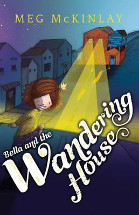
Bella and the wandering house by Meg McKinlay
Ill. by Nicholas Schafer. Fremantle Press, 2015. ISBN 9781925162301
(Age: 8+) Highly recommended. Humour, Moving house, Grandparents.
Bella steps off her verandah one morning just as she has always
done, but this morning, unlike every other morning, she steps onto
her mother's violets. The path is not in its usual place. Curious.
She speaks to her grandfather about it and in his sea salt wisdom
tells her to watch the stars as they will always tell her where she
is. Each day she wakes and the house has moved again, not only a few
paces further along but once to a lake, then to a dam.
Bella comes to see the legs the house grows in its attempts to find
a suitable resting place, and when her parents tell her the house
will be cut in half and transported back to where they came from,
she develops an idea. After all her grandfather was a boatbuilder
and has put a porthole in her bedroom window made from the last boat
he built, complete with the board with the name of his last boat, so
she realises what the house is looking for. All ends happily and
Bella has learnt a lot about her grandfather, his boats, the
difference between a house and a home, and living where you need to
live.
This is a delightful story for all ages, full of wisdom and humour
and displaying a delightful relationship between a girl and her
grandfather. And all is wonderful illustrated giving a Magic
Pudding effect to the house and its running away legs.
Fran Knight
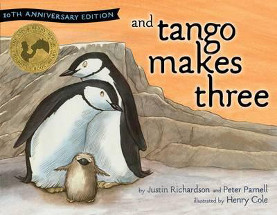
And Tango makes three by Justin Richardson and Peter Parnell
Ill. by Henry Cole. Simon and Schuster, 2015. ISBN 9781481448840
(Age: 3 - adult) Highly recommended. Animals, Chinstrap penguins,
Family, New York. This tenth anniversary edition deserves a place in
every library. The true story of two male penguins in the Central
Park Zoo in New York is enough to bring tears to the eyes in its
affirmation of what makes a family and what constitutes love.
The two penguins did everything together after meeting in 1998, so
much so that when the female penguins formed partnerships with the
males and made nests of stones ready for their eggs, Roy and Silo
did too. They even found a stone to put in their nest to sit on and
hatch like all the others. But it did not hatch.
The keeper, Mr Gramzay noticed that another pair had laid two eggs,
and knowing that they were never able to raise more than one chick,
moved one egg to the nest of Roy and Silo. They did everything the
other penguins did: they sat on the egg, moving it to keep it warm,
they slept on the egg, changing places when they needed to, until
finally the egg hatched. And it was named Tango.
The trio became a most loved family amongst the penguin colony at
Central Park Zoo, Silo and Roy teaching their chick to dive and
swim, snuggle into their warmth at night and sing for its food.
This life affirming book confirms the place of family and the love
that brings two together to make a family. Children need to see
their own family make up in the books they read, and this goes a
long way towards redressing the dearth of such books in the past.
An afterword of this anniversary edition tells us of the history of
this book since it was first published. It makes salutary reading
that in this age of Western freedoms, authorities seek to restrict
some voices. The work of the parents in Singapore in stopping this
book being pulped is wonderful and needs greater publicity,
happening so recently (2014) A post script from the two authors
telling us that they now have a daughter is a joyous end to a
wonderful read.
Fran Knight
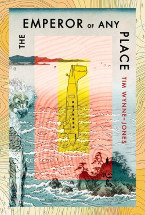
The emperor of any place by Tim Wynne-Jones
Candlewick, 2015. ISBN 9780763669737
(Age: Older teens) During the Second World War, Oshiro, a wounded
Japanese soldier finds himself on a small and remote Pacific island,
after having escaped by raft from the Island of Tinian where U.S.
forces were crushing all resistance. Gradually he recovers and lives
a peaceful existence, living off the land and utilising a range of
supplies from debris washed ashore following battles at sea.
The soldier's simple quest to survive the war and return alive to
his beloved new wife is threatened when he discovers a recently
crashed American transport aircraft loaded with rifles and
ammunition, in the island's interior. Evidence reveals that one of
the crew has survived in a seriously injured state but has escaped
to an unknown hiding place. Fearing discovery by the enemy soldier,
Oshiro carefully searches the island for him and a series of bizarre
events lead to his capturing Derwood, the American. Language
difficulties limit the pair's communication but in time, both come
to understand that it is simply impossible for Oshiro to confine
Derwood as a prisoner and the pair live an agreeable and cooperative
existence on the island, posing no threat to one another and
further, coming to depend on each other for survival.
Fifty years later, Evan, a Canadian teenager is distraught when his
father, whom he loves dearly, dies unexpectedly from a heart attack.
Evan's ninety year old Grandfather arrives to tend to his son's and
Evan's legal affairs. Evan has never met Griff, a Marine veteran
from World War II and fears him, based upon warnings and tales from
his own father who fled from Griff and ceased all contact with him
as soon as he was old enough.
At this time, Evan discovers a manuscript detailing the wartime
experiences of Oshiro and Derwood among his father's effects and
learns that Griff (somehow a part of the events), is doing his best
to suppress publication of the story. Despite his age, Griff
intimidates Evan who struggles with his rigid military ways and
threatening behaviour.
The mystery of what happened to Oshiro and Derwood, and their
connection with Griff is gradually uncovered by Evan and enables an
intriguing plot to develop. Much of the wartime narrative however
involves supernatural beings which play a significant role in the
events on the island. Aside from the notion of ghosts representing
souls yet to be born into the physical world, the supernatural
elements seemed out of place and I couldn't help thinking that the
tale suffered for their inclusion.
Rob Welsh
Editor's note: This book was on YALSA's 2016
Best Fiction for Young Adults, is one of School
Library Journal's Best Books 2015, and is on Horn
Books Fanfare list.