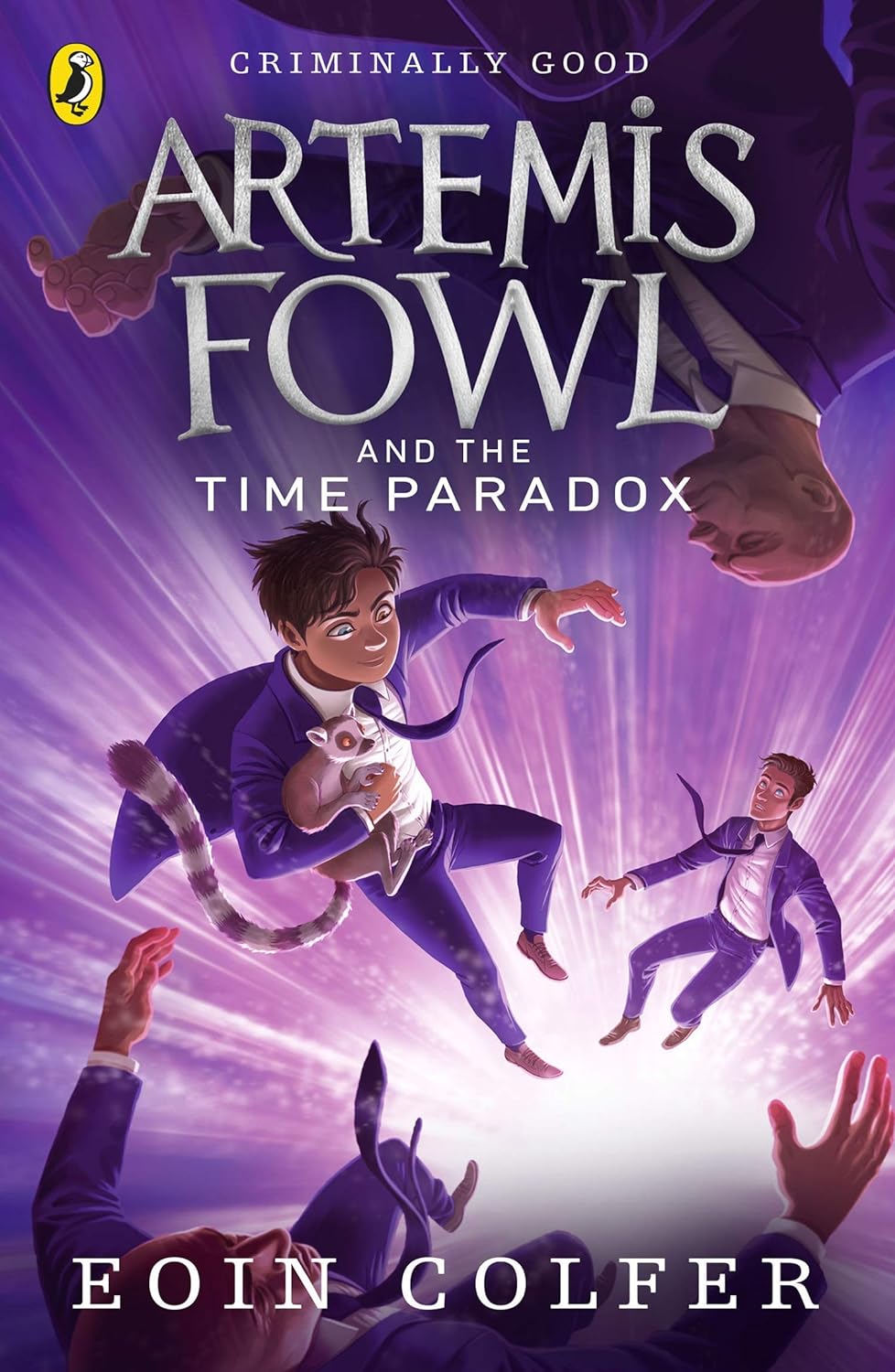
Can this wonderful series get any better? It certainly can! This is one of the best Artemis Fowl books yet. It is a fabulous adventure, cram packed with humour and thrills, danger and breathtaking near-misses. From his brothers calling him a simple-toon to him meeting his younger self (who tries to outwit him) the one liners just never stop. Mulch's exploding bum-flaps make an unwelcome appearance, and Holly becomes a teenager. There is a kiss, but you'll have to read the book to find out who's involved! And the story? Well, Artemis and friends travel back in time to try and save Artemis' mum from what seems to be an old fairy virus. The cure lies in the brain of an extinct animal, the final one having being sold by Artemis Fowl when he was ten. However, travelling back in time can cause HUGE problems! Not only do you have to ensure you don't change the future, but you have to make sure you don't accidentally bring one of your old arch enemies back with you. The end of this book is just right and leaves you with an intense feeling of satisfaction. Aahh! Nikki Heath
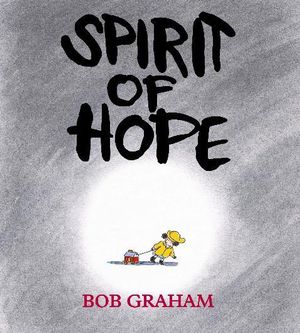
Spirit of hope by Bob Graham
Lothian, 2008. (Age 5-7) Recommended. This is an uplifting book that warms the heart. The Fairweather family, a loving group, is always optimistic and cheerful. Dad works at the local factory and six days a week comes home to be welcomed with lots of attention from his large family. On the seventh day the family heads off to the docks for a picnic and one day they see a large ship, The spirit of hope, which has come from a faraway port. Then devastating news arrives: they have to move out of their house because it is going to be demolished to make room for a matchstick factory. All the Fairweather's friends gather around and help them search for a new home, but it seems hopeless until Mary's toy inspires them with a brilliant idea. This delightful story is beautifully complemented by the illustrations, which bring the family, all their different characteristics, their love for each other and their surroundings alive in a most satisfying way. Colour is used really effectively to pinpoint the emotions of joy and spirit of hope of the family and the despair that occurs when all seems lost. Observant readers will notice Mary's toy and may guess the solution to the family's problems, while others will be pulled along by the descriptions of the fun loving family and their activities and will have fun looking back on the pictures.
This would be a good book to read aloud and the themes of love, family life, using your imagination and ingenuity could result in interesting class discussions. Pat Pledger
Princess Ben by Catherine Gilbert Murdock
Pan, 2008
(Age 12+) A change of pace from the author of Dairy Queen and its
sequel, The off season, Princess Ben is a fairy tale with a difference.
When her mother is assassinated and her father and his brother the King
disappear, Princess Benevolence is forced by Queen Sophia to acquire
some of the characteristics befitting a princess. Used to running wild
and having her own way, Ben uses every skill she has to hinder the
queen's attempts to make her lose weight and groom her to rule the
kingdom. When she is locked into a tower she discovers a passage that
leads to an enchanted room and spends her nights learning spells and
how to manipulate a magic broom. However her magical skills are
inadequate and she is flung out into the world to fend for herself.
When war looms she is forced to re-examine what she needs to do to look
after her country.
This coming of age story has the reader empathising with Ben, who has
been used to being the centre of her parents' world. Alone and unloved,
she is determined not to turn into the sort of girl who is only
interested in attracting the right type of suitor. Her courage and
determination to become her own person keeps the reader engrossed as
she thwarts Queen Sophia, pursues her magic skills and survives as a
prisoner in the king of Drachensbett's army. The romance strand with
Florian, the Prince of Drachensbett, is less satisfying to romance
lovers, but fits in well with Ben's feisty character.
This would be an easy to read and enjoyable introduction to the genre
of fairy tales retold and could lead to the exploration of more
in-depth stories like those told by Robin McKinley.
Pat Pledger
One beastly beast by Garth Nix
Allen and Unwin, 2008.
(Ages 9+) Subtitled, Two aliens, three inventors, four fantastic
tales,
this book of short fantasy tales will intrigue and delight the avid
Garth Nix/fantasy reader. Nix has always had a different view of the
world, and his fantasy writing is amongst the best. For older readers,
The Old Kingdom series is magnificent, and for middle school
readers,
The Keys to the Kingdom is just riveting. This book is for
middle
primary students and takes an askance look at some things we take as
written.
The first story, Blackbread the pirate, takes the term video
piracy
literally, as a boy, Peter, on his way to return his family's DVDs to
the video shop, is raided by pirates, Video pirates! The rats
steal his videos and scurry down the sewers, followed by the Navy rats,
resplendent in their blue and gold uniforms. When they ask Peter to
join them, he cannot, being somewhat too large, but an Alice in
Wonderland moment occurs, and Peter is transformed to the size of a
rat.
This funny story is followed by The Princess and the Beastly Beast,
Bill the Inventor and Serena and the Sea Serpent. All
great fun and
sure to please the middle to upper primary student, with illustrations
by Sholto Walker.
Fran Knight
Issues of our time edited by Helen Sykes
Future Leaders,
2008.
ISBN: 9780980332018
This book is for upper secondary students and has articles and essays
by leading thinkers on issues such as climate change, reconciliation,
sexuality, affordable housing, higher education and bioethics. It also
has 9 fiction and 9 non fiction essays selected from work
submitted for the Future Leaders Writers' Prize in 2007, from year 12
students all over Australia.
The essays by eminent thinkers such as Larissa Behrendt, Michael Kirby,
Fiona Stanley and Julian Disney are lucid, comprehensive and very
informative, but only Michael Kirby on Sexuality has an accessible,
personable and inspiring style. The student non fiction section with
articles on climate change, racism, depression, choosing a baby's sex ,
nuclear energy and violence are more original in style, vivid and
readable. The essay on climate change was an opening address to a
conference in 2019 and graphically painted the future we could face if
we continue to ignore global warming. The book is worth getting just
for these essays and is available
for free.
The 9 fiction essays grapple deeply with topics as diverse as Uluru,
homelessness, grief and memory, being and madness. The poetry of
Jessica Bloom in Godot Alone is brilliant. Alec McKinnon
displays
compassion in the beautifully written The Oak Tree when the
newspaper
boy once again hears the old lady's story of her husband's death in
World War 1. Ruby Rousell finds a positive in wearing a back brace for
scoliosis.
Lend a copy to your year 12 English teacher: they will find something
there to share with their students.
It's reassuring that there are students who can write and think like
this. One hopes there are many more like them.
Kevyna Gardner
The world's bellybutton by Tanya Landman
Walker Books 2007.
(Age 7+) William Popidopolis sometimes wishes he had an ordinary name
like Smith, but his Greek connection proves very exciting when, while
holidaying in Greece, he is approached by a large swan who engages him
in conversation. The swan turns out to be Zeus, the king of the gods
and he persuades William to help him in a race against time to retie
the knot that secures the world. With a trip to the Underworld and a
chance encounter with his distant ancestor Odysseus, William, who is
slightly lacking in the confidence department, discovers reserves he
never knew he had. Coming up with an ingenious plan to defeat the
Gorgons and retie the knot, William embarks on the adventure of a
lifetime.
This is a fast paced short novel which will engage newly fluent readers
and would also be suitable to read aloud. Chapters are short, and
usually finish on a cliff-hanger, action outweighs description and the
plot is straightforward and exciting. William is a likeable character
and children will identify with his anxieties and uncertainties and
delight in his success in conquering his fears and saving the world.
Ideal for confident readers, both boys and girls aged 7 plus.
Claire Larson
By Royal Command by Charlie Higson
Puffin Books, 2008.
I've been looking forward to this book for some time, as Hurricane
Gold
was my favourite book yet, and raced through it in around 90 minutes!
James is supposed to be relaxing and staying out of trouble for a
while. However, he joins up with the school ski trip and his stamina
and survival skills are tested virtually straight away. After a few
lessons on the slopes, James manages to save the life of a VERY
annoying and drunk boy. He's also sure he is being watched. On his
return to Eton, he befriends the new maid, who invites him to a meal in
the park. Whilst there, he meets her friend, the school gardener.
Unbeknownst to James, he is gathering materials to blow up the school
whilst the King is visiting!
James saves the day. However, the pressure becomes too much for him,
and he decides to run away (I won't say why - you'll have to read the
book!) However, as always with James Bond, things are never as simple
as they seem.
With the re-appearance of a long 'dead' villain, the murder plot and
his brushes with Royalty, I certainly was not disappointed with this
book. Roll on the next!
Nikki Heath
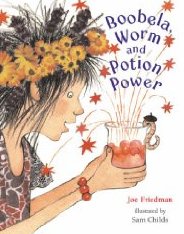
Boobela, Worm and the potion power by Joe Friedman
Illus. by Sam
Childs. Orion Children's Books, 2008. ISBN 978184255 5415
(Age 7+) This large sized paperback, full of colour and energetic
illustrations, tells the tale of Boobela, a child giant, adrift from
her parents, and her friend Worm, who sits on her shoulders and offers
advice. There are four stories in this volume, the third in the series,
aimed at linking reading between picture books and novels.
The first story, The argument, sees a rift between Boobela and
Worm, as
she struts off down the street without her friend on her shoulder. She
needs to explain to the other children she meets that she and Worm have
had a fight, and she realises how silly she has been. When
tragedy occurs and Boobela needs help, Worm appears and all is right.
The four stories are easy to read, have large print and tell a small
intimate story in the lives of the two protagonists.
While a battle rages about putting a recommended age on
every book published, it is fascinating to see how this will affect
book publishing. This book has a recommended
age of 4+ on its publicity sheet. But it is far more than a picture
book, and more involved. This book has 108 pages with
about 100 words on each page, which in my way of thinking makes it a
book aimed at 7+.
Fran Knight
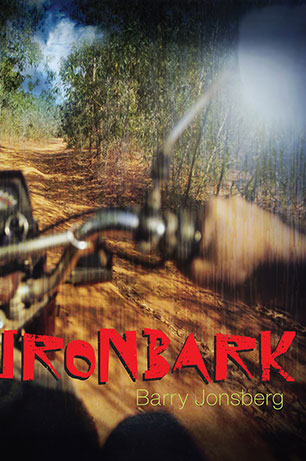
Ironbark by Barry Jonsberg
Allen and Unwin, 2008. ISBN 9781741149555
(Age 14+) Imagine what would happen when a 16 year old boy, suffering
from a major problem, Intermittent Explosive Disorder, goes to live
with his grandfather in remote Tasmania? After he has been taken to
court for violence in a shopping centre the unnamed protagonist is sent
away by his wealthy father, who has paid extravagantly to have his
son's violence judged as an illness and not hooliganism. He records how
he feels and what happens in his journal.
Jonsberg brings alive the character of the boy, with his foul language,
his bouts of dangerous anger, and his extreme views of his
grandfather's shack and its lack of modern amenities. His relationship
with his girlfriend, his ability to cook and his growing self-awareness
are revealed through his writing. The reader also gains a thought
provoking glimpse of the grandfather, who gradually reveals a sense of
humour and understanding of his grandson's extreme anger. The local
policeman, Richie, is loved by the locals for his wood chopping
prowess, but he threatens and bullies the boy who has to report to him.
An explosion is just waiting to happen!
The author uses humour to effectively depict the generation gap and
there is plenty of action, especially the motorbike riding and illicit
car driving that the boy indulges in. There are some puzzling touches
of what may be the supernatural with a strange text message telling the
boy how to find his way home from the mountain when he is lost and
unexplained incidents at the end of the novel, which left me
puzzled. However the ending is positive and boys will love the action
and humour.
Pat Pledger
The pencil by Allan Ahlberg and Bruce Ingman
Walker Books, 2008. ISBN 9781406309621
(Age 4+) Recommended. A highly imaginative picture book, this is the
story of a solitary pencil that decides to do something about its
loneliness. First it draws a picture of a boy, who wants a dog, so it
draws that and then a cat to complete the picture. After a madcap race
through the town they all want something to eat, so the little pencil
must find a way to colour their food. It draws a paintbrush and
together they have a wonderful time creating a whole world. However
some of the people aren't too happy about how they look, so the pencil
creates an eraser, which plays havoc on the drawings. What solution can
the clever little pencil come up with?
The pencil is a quirky tale of adventure with a touch of danger and
lots of funny incidents to keep the reader happy. The delightful
illustrations move from black and white to gorgeous colour and provide
humourous little touches that are a delight to find.
This would be a good book to read aloud and to encourage listeners to
use their imagination. The reader must turn a page before the
resolution of each dilemma that the pencil is faced with, so they have
time to decide what could happen next and to come up with solutions of
their own. They would also have fun drawing and making up their own
names for all the characters the pencil creates.
Pat Pledger
I'm still awake, still! by Elizabeth Honey and Sue Johnson
Allen and
Unwin, 2008. ISBN 9781741753219
(Age 2-6) Highly recommended. An enchanting bedtime story complete with
a CD with lovely songs to accompany the text, this is a must for
preschoolers or Kindergarten children. Fiddy is a little boy who can't
get to sleep, even though his mother sings him a wonderful song,
'Goodnight my little darling, goodnight my little one'. Then Parlo
tells him to dream up something wondrous and sing about it in his head.
He makes up a song about his rainbow pyjamas, but this doesn't work.
Neither does his 'Goodnight Gumboots' song or the advice from the
possum, other Australian animals and a bear. Finally Nonno points out
the planets and Fiddy drifts away into sleep.
As well as being a wonderful bedtime story, with lustrous watercolour
illustrations, the accompanying CD is an excellent addition to the
book. Elizabeth Honey reads the story and the beautiful songs, each
memorable and lyrical, will be great to use with the text. Having the
words for the songs on the endpapers of the book is very handy.
Listening to the story and songs will be a delight for children and the
book will have multiple uses for a library or classroom. It could be
used in music classes and children could also explore animal homes and
sleep patterns as well as using their imagination. Teachers'
notes are
also available.
Pat Pledger
Dreaming again ed. by Jack Dann
Harper Voyager, 2008. ISBN
978073228625 5
This collection of 35 new short stories celebrates Australian fantasy
and science fiction authors. There are some wonderful authors to read:
Garth Nix, Sara Douglas, Isobelle Carmody and Terry Dowling, to name a
few. Not every story will be interesting to all readers because this
collection touches on all aspects of the genre, but there are stories
to satisfy every reader of the genre.
I particularly enjoy those tales that are set in the present day
reality but with a twist. Many of those in this edition seem to involve
the undead. I appreciated the afterword from the authors who were able
to give an insight into their stories' origins and evolution.
Kim Westwood's Nightship gives a view of a possible future, one
that I
can relate to because it isn't a high tech future, but a future
returning to a more violent and almost feudal past, with an
environmental twist. Terry Dowling's Fooly has an interesting
twist as a ghost story, while Angela Slatter's The Jacaranda Wife
is a
story that combines Aboriginal myth with the surreal. It mirrors the
ambitions of humanity for beauty, perfection and greed and shows the
impossibility of ever succeeding in gaining it.
The constant past by Sean McMillan is one of those unsettling
tales of
a misplaced person who is seeking to right a perceived wrong of the
past. Kim Wilkins has given the Hansel and Gretel story a tweak, but
has kept the essentials the same - selfishness, poverty and
inhumanity. Sara Douglass' The way to the exit, ropes you in
and is
able to use the development of the Underground in London as the basis
for her fantasy. What a great way to use information that is there and
give it a twist. I really enjoyed this one.
Others that caught my attention were Simon Brown's The Empire,
Jenny
Blackford's Troll's night out (an unexpected gem) as was Smoking,
waiting for the dawn by Jason Nahrung (a very Aussie zombie story)
Jason Fischer's Undead camels ate their flesh could be read in
conjunction with Jason's because of its Australian flavour and
wonderful sense of humour. The lost property room by Trudi
Canavan is a
classic of its type, a wonderfully ordinary story that takes you in an
unexpected direction. Paradise Designed by Janeen Webb was a
glorious
reconstruction of the biblical Adam and Eve story and a lovely satire
on Intelligent Design.
I've only skimmed the surface of this treasury of incredible fantasy,
but I've been very satisfied with the wonderful variety and quality of
writing. What a treat.
Mark Knight
Lu-Lu's wish by Matt Zurbo and Ben De Quadros-Wander
Lothian. 2008.
ISBN 978-0-7344-1017-7
(Age 5-8) Poor Lu-Lu! She is surrounded by people who can do special
things. She desperately wants 'to be able to make something' and when
she finds a rock in the creek she decides that it will be her wishing
rock. But it doesn't matter how hard she wishes she can't paint like
Tahli, perform like the circus kids or play the saxophone. But there is
one special thing that she can do.
This is a lovely, warm story that focuses on the intense desire that
Lu-Lu has to be special at something. Children will identify with the
feeling, but will be able to see quite clearly that Lu-Lu is wishing
for things that can only be achieved by having unique talents and
spending hours practising. However her wishing stone gives her
something amazing.
The vivid illustrations from Ben De Quadros-Wander are very appealing.
Lu-Lu is a wide-eyed little girl who tugs at your heart strings and the
other characters in the story are brought alive, each with their own
unique characteristics. The interesting detail in the drawings is sure
to intrigue the curious reader. Reading aloud Lu-Lu's Wish
would
provide lots of opportunity for class discussion of what makes each
person special.
Pat Pledger
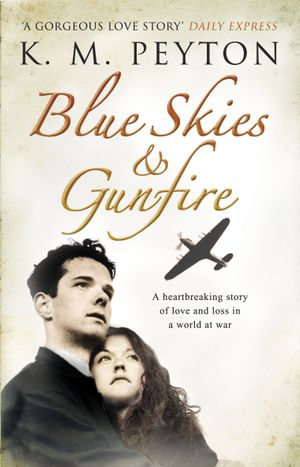
Blue Skies & Gunfire by K. M. Peyton
Josie is just about to go off to Art College when war breaks out. Her family decides to send her to stay with family in the country to keep her safe during the Blitz. This means leaving her whole life, including her boyfriend, behind, and going to live with her aunt, uncle and cousin who she barely knows. Josie finds that away from home, she has more freedom! She finds work in a pub, makes new friends and paints in her spare time. She meets Jumbo, one of the brothers from the 'Big House' where her cousin Maureen cleans, whilst painting by the lake, and begin to go out together. Jumbo lost a leg in the war but is determined that he will recover, learn to walk again, and return to the Air Force to fight. When his older brother Chris is sent to the air force base nearby, Josie falls in love with him instead. The brothers compete for her affection, with the victor disappearing suddenly, presumed dead. This is a wonderful book, which gives the reader an insight into the complexity and brutality of war. The behaviour and attitude of the young pilots is extraordinarily matter of fact, with them living each day as it comes, never knowing if they will be around for the next. A wonderful, thought provoking book, with an unexpected 'twist' at the end. Nikki Heath
Bloodline by Katy Moran
Walker Books, 2008. ISBN 9781406309386
(Age 11+) Recommended. It is a time of great peril in Dark Age Britain,
as the Wolf Clan's king has died and the Mercians are striving to take
as much land as they can. When Essa is abandoned by his father, Cai the
bard, at a Wolf Clan settlement, he is alone and desolate. He grows up
in the marsh village between the two warring kingdoms, learning to use
his sword, the Silver Serpent, and coming to terms with his ability to
see through the eyes of his goshawk and influence animals. Cai has
always believed in being 'bound to no man' but Essa finds himself in
the middle of the conflict, with a desperate part to play.
Beautifully detailed and abounding with action, Bloodline is an
engrossing historical story. Essa is a spirited boy and his journey
across Britain, meeting different tribes and kings is fascinating and
at time heart wrenching. The reader warms to his strong and thoughtful
character. His boyish anger at his father and his deep resentment about
being left behind without even a final farewell, his love for Lark, the
tomboy, and his rivalry with the village boys, make him come alive.
Other characters are equally well developed. Hild, the village
headwoman, is capable and strong, and Wulf the Mercian prince is a
match for Essa as they flee Ad Gefrin.
A subtle fantasy strand of communication with animals runs through
Bloodline but is not intrusive and gives an added dimension to the
story as it seems to fit so well into a time when Britain is moving
from pagan ways to Christianity.
This a finely wrought tale with well paced action and an engrossing
hero. It will appeal to lovers of adventure and historical novels.
Pat Pledger