Woolshed Press, 2008 ISBN 978
74166324 2
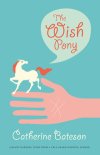
(Ages 10-13) When the older neighbour comes in to look after Ruby when
her mother has to go to hospital, Ruby is defensive and put out. Things
have not gone well. Her best friend, Sarah, has abandoned her for the
new girl in the class, Mum is always ill with her pregnancy, Dad is
wrapped up with his wife and Ruby feels left out. Magda from across the
road smells and asks strange questions, but soon the two become firm
friends, Ruby finding in Magda the friendship which has deserted her at
school.
Magda gives Ruby her wish pony, and the little figurine takes on a life
of its own on Ruby's dressing table, where it hears Ruby crying and
hears her wishes. Gradually Ruby's life turns around, her baby brother
is born, somewhat premature, her parents begin to listen to her, she
takes on more responsibility, and she makes new friends. All simple,
but each in itself is a huge stepping stone for Ruby as she works out
what is important in her life. And as she develops, so the importance
of Magda declines.
A stunning story about loss, growing up and friendship, The wish
pony
had me on the verge of tears, wishing along with the figurine, that
Ruby would find her feet in her muddled world. All of the children in
the story are subject to change, change in their circumstances, change
in their school friends, change in their homes, and each has to cope
with those changes, and luckily for some, Magda is there to help them
along.
Bateson's writing is always impeccable, finding the right series of
words to describe what is happening and the characters' feelings. In
this book, she gives a voice to children whose lives are not going
along smoothly, and helps them see that things will right
themselves.
Fran Knight
Stravaganza: City of secrets by Mary Hoffman
Bloomsbury 2008.
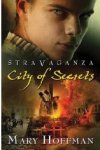
(Age 14+) Recommended. What would 17 year old Matt do with a book
voucher for his
birthday, especially when he is dyslexic and books are the last things
that he is interested in? He persuades an antique dealer to swap the
voucher for an old book and discovers that it is a magical talisman
which transports him back in time to Padvia, in 16th century Talia, a
country very like Italy. To his amazement he finds that he is a
'Stravagante', someone who can travel between time and worlds with the
help of his talisman book. He has an important task to fulfil with
Luciano and Arianna and other member of the Stravaganzi.
This is a rivetting adventure full of intrigue, fabulous characters and
treachery from the di Chimici. In Matt's new world he gains self
confidence as he finds that reading is not a problem and he even works
a printing press, making forbidden books. The story goes back and forth
from the modern world to Padvia and each strand is equally rivetting.
In the modern world Matt has to come to grips with his relationship
with his girlfriend Ayesha, which is threatened by his poor self
esteem, while managing a normal life of going to school, learning to
drive a car and being a family member.
I had not read the previous three books in the Stravaganza sequence,
City of masks, City of stars, and City of flowers
and certainly this
book would have been the richer for knowing more about the characters.
However I found that I couldn't put it down and that Mary Hoffman had
sufficient background information about the different people and events
for the plot to flow along in an exciting way.
Pat Pledger
Gang-o-kids by Hazel Edwards
Omotivo, Victoria, 2008. ISBN 978064648847 9
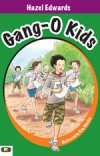
Ages: 7-10 A new book published by Omotivo, the Orienteering Services
of Australia, this contains stories by Hazel Edwards published two
decades ago, about kids in an orienteering club.
The Bunyip Orienteering Club meets most weekends going on bush walks,
bush runs and mystery hikes to practice and refine their skills. The
group consists of Jamie, Tina, Emma, Mario and Kate and each story
favours one or other of the group.
Hazel Edward's polished writing brings out the differences in these
disparate kids in a few sentences and their personalities are further
developed through the stories. This book contains four stories telling
of their adventures while orienteering. The first story, Cunning
Running has Mario having to solve a mystery to join the group. As Tina
and Emma are twins, the group devises a mystery where the girls trade
places to put off Mario. As with the other three stories, this one
promotes good skills when orienteering, and displays the sorts of
skills used in this sport.
Aimed at middle primary kids, the book is a good introduction to the
sport, and with four short stories will find a place in classrooms.
Fran Knight
The night we made the flag : A Eureka story by Carole Wilkinson
Black Dog Books, ISBN 2008978 174203007 4
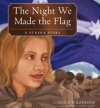
(Age: 9-13) Carole Wilkinson uses the information about the Eureka flag
to tell the story of its making. Three women spend the night before the
Eureka Stockade, December 3, 1854, to sew a flag that the men would
raise high above their hastily built fortification on Bakery Hill.
Wilkinson's story takes elements of many stories passed down through
generations about who made the flag and put these together with what is
known about the flag to make a satisfying tale of the secretive nature
of the task. The telling takes the reader into the tent where the women
work all night, fetching supplies from other women, using donated
materials and finally using a daughter's precious petticoat for the
stars. Carefully, Wilkinson builds up the watchfulness shown by the
women, their caution at their task, their ever present concern that
they will be discovered.
More information about the making of the flag is given at the back of
the picture book, and information can be gleaned from http://www.balgal.com/ (the website
for the Ballarat Fine Art Gallery where students can view the flag).
Fran Knight
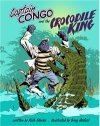
Captain Congo and the Crocodile King by Ruth Starke and Greg Holfeld
Working Title Press, 2008. ISBN 97818762889 4 Hb.
(Age 9-15) A graphic novel for all ages, Captain Congo is written in
the style of many comics that I read as a child, full of adventure set
in a tropical land, with awesome recognizable heroes and just as
recognizable deliciously bad baddies. Visual jokes abound.
From the moment Captain Congo and his side kick, Pug, step on board the
ship, Juba Queen, destined for Addis Ababa in Abyssinia, the readers
are in for a treat. An anthropologist searching for the treasure of the
Queen of Sheba has gone missing and his retrieval is in the hands of
Captain Congo and Pug. From scorpions hidden in their bunks on board
ship, to their dinner being poisoned, to the crocodile which harries
them, the whole book is full of fun and adventure.
When Captain Congo and Pug find Professor Perky, he is about to be
thrown into the river to appease the crocodiles which are taking away
villagers. Captain Congo saves the day and as the villagers believe it
is Perky who has saved them from the crocodiles, he is made a king. It
is now up to Captain Congo to find the treasure.
A great read for middle primary to lower secondary, this graphic novel
is sure to please, and like all good books, will have kids wanting more.
Fran Knight
Lightning Strikes Series
Walker Books, 2008.
(2 titles: The Meteorite kid and Egghead)
(Age 9-12) Two more stories in this series aimed at lower reading
ability kids in upper primary and early secondary school will be
instant hits. The first, Egghead by Clare Scott, tells of Paddy
and his
friend Jackal. As part of their schoolwork, their teacher, Mr Farnham
gives each of them an egg to look after for a week, during which they
must make observations for their experiment. The boys are not
impressed. They were expecting a much bolder experiment, something
loud, fizzy or smelly.
The second, The Meteorite Kid by Carol
Faulkner has a girl catching a ball at a baseball final, but what she
ends up with in her hands is totally unexpected. Both stories are
grounded in reality, will have wide appeal through their humour, and
are short with minimum description and lots of dialogue and action.
Just the thing for kids looking for a thin book.
Fran Knight
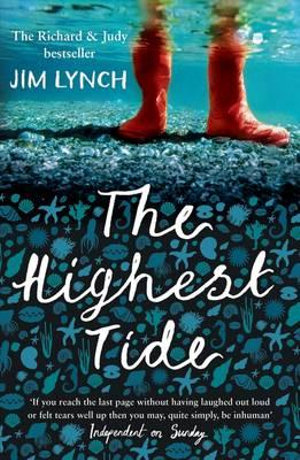
The highest tide by Jim Lynch
(Ages 13+) When Miles finds a giant squid on the coast near where he lives in Puget Sound, Washington State, he is on one of his night time wanders in his kayak, alone with the sea and its creatures that he loves, away from the strife at home. When a few nights later he finds a ragfish, things move to overwhelm him. His close friend, Professor Kramer recognizes the finds as amazing, but the newspapers dub Miles almost a freak in their hunt for a front page newsbyte.
His friend and neighbour, Florence, lives alone and drawing towards the end of her life, is most concerned about going to a nursing home as she predicts what will happen in the bay. His school friend, Phelps is the same age but obsessed with sex, and on their walks out on the flats, talks non stop to Miles about his fantasies. But Miles is constrained by his love for Angie, his former babysitter, and next door neighbour, and he cannot help but feel protective towards her as she makes poor decisions about her life.
All of the characters and events swarm towards the defining tide, the highest tide for fifty years in the sound, which brings out journalists, scientists, cult members and those wanting a miracle, all wading together in the water, as Florence dies, Miles' mother promises to return, and the community takes stock of the water and its life in front of them. Miles' summer is a defining one, he grows up, sees his friends and family with clear eyes and through his love of the work of Rachel Carson, sees his place in the scheme of things, 'for all at last return to the sea ... the beginning and the end'.
This is a book which is rarely found in adolescent literature. Through the story of Miles, the reader is given an immense amount of detail about the life, condition and future of the sea, through the happenings at Puget Sound. Without being overwhelmed with information we are initiated into the wonders of the bay, given scientific data, see for ourselves where the bay and so the world is heading. The overlay of Rachel Carson's work gives the novel a sub text that is hard to ignore, and all the while we are part of a young boy's early adolescence, with its insecurities and longings, and need for family.
I loved this book, and was amazed to read that it is Jim Lynch's first novel. The story will appeal to reflective readers in early to middle secondary school, particularly those absorbed by environmental issues, and that should be everyone. Fran Knight
The cow that laid an egg by Andy Cutbill and Russell Ayto
Harper
Collins, 2008.
(Age 3-7) When Marjorie the cow feels left out because she has no
special skills, the chickens decide to help. The other cows can do
splendid things, handstands and riding bikes, but Marjorie feels very
ordinary. But when she wakes the next morning with an egg underneath,
she shrieks her news all over the barnyard. The other cows are
naturally suspicious and are convinced that the egg does not belong to
her, but when it hatches; its first word belies that assumption.
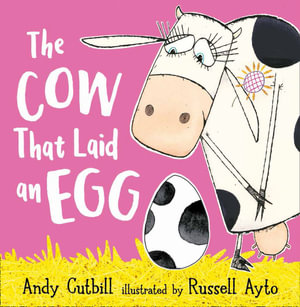
The illustrations are superb. Marjorie is the loveliest cow I have seen
in a picture book, with her downcast eyes and ears, and big black spots
which are repeated on the end papers. The other animals are all
differentiated with drawings that accentuate their differences. The
chickens are simply drawn, with a circle and stripes and appendages,
but each chicken looks different because the illustrator has changed
around the shape and place of the appendages. It sounds simple but it
looks just great. And I loved the other cows, with their menacing looks
and overbearing attitudes.
A disarming book about feeling special and belonging, The cow that laid
an egg will find a home in every library where kids love laugh out loud
books. Children will adore the off beat story with the farmyard of
animals vying for attention. They will readily identify with Marjorie,
longing to be special and looking for the skills to make her so.
Children will recognize that need to be different in some way and have
a skill that no one else has, but at the same time, be part of the
group. Marjorie the cow is a perfect vehicle to talk to
students about
what makes them special.
Fran Knight
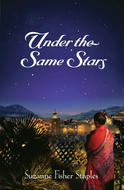
Under the Same Stars by Suzanne Fisher Staples
Walker Books, 2007.
(Age 14+) In this powerful and superbly written sequel to Daughter
of the Wind, set in Pakistan, Suzanne Fisher Staples writes openly
about the Muslim culture and women's roles in a society bound strictly
to traditional expectations.
Shabanu is the youngest, and the favourite, of four wives of Rahim, an
older man of power and prestige. His other wives are jealous of
Shabanu's position in the household and she must be ever watchful of
her young daughter and herself. She spends time in Rahim's town
house which provides some escape from the cruelty of the other wives
but it is here that she encounters the love of a young man already
betrothed. Also, her dear friend Zabo has been promised in
marriage to Rahim's simple but only son, Ahmed. Tragedy occurs as
the two girls become entangled in these binding family ties.
Recalling themes in Romeo and Juliet, this modern tragedy is an
absorbing and emotive read, showing how powerless an individual can be
when up against the demands of a strict society.
Staples worked for many years in Pakistan as an international
correspondent: she brings to this story a wonderful sense of place and
time. The rural landscape provides a haven for Shabuna as she
battles the complexities of city life; it offers true family support,
safety and cultural wisdom though at the expense of a modern education
for her daughter.
This novel extends our understanding of a complex society and reveals
how the fight for individual freedom can be dangerous even in modern
times. Under the Same Stars is endorsed by Amnesty
International.
Julie Wells
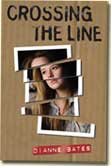
Crossing the line by Dianne Bates
Ford St Publishing, 2008. ISBN
9781876462703
(Age 14+) When Sophie moves into a share house, it is a new start. She
still attends sessions with her psychiatrist, Noel, is checked up by
the social worker, Jan, and monitored by her case worker, Marie.
But Jan goes overseas, and when things begin to stress her at school
and at home, she resorts to her old coping method, cutting herself.
Time in a psychiatric hospital leads her to Helen, her psychiatrist
while an inpatient. But Sophie transfers her affections to Helen, and
cannot stay away from her, once she returns to her usual life. Once
back in her share house, Sophie finds it hard to communicate with her
old friends, sleeping a lot, having daydreams while they are talking to
her, becoming argumentative when they try to help. Eventually she cuts
herself again, after a final rejection from Helen, who she is now
stalking. Her flatmates find her and she is patched up once again. It
is through the support of her friends that she finally realises that
there is life after self harm.
An intriguing look at the motivation of one young person, Crossing
the
line will have broad appeal to middle secondary readers who have
heard
about self harm and want to know more. The background is very real, the
hospital and sessions with case workers and doctors, frightening as
they present a reality not known to many, but the times she spends with
her friends is a little hard to believe as I cannot imagine many young
people being so sympathetic or understanding. This complex novel will
bring information and enlightenment to those who want to know, but it
also tells the story of one young woman for whom life has dealt a poor
hand. How she copes with all that is thrown at her makes for engrossing
reading.
Fran Knight
Triskellion by Will Peterson
Walker Books, 2008
(Age 11+) Surprisingly Will Peterson is the pseudonym of Mark
Billingham and Peter Cocks, both writers for television in
England. They have collaborated on a number of projects and
decided to write a trilogy for children, which took inspiration from
their interests in history, science fiction and crime. Triskellion is
the first title in the mystery series.
At the time of a difficult divorce in America, twins Rachel and Adam
are sent to England by their mother to stay with their
grandmother. A mysterious force seems to have taken over the
village and the children cannot feel at home here. They share a
heightened sense of foreboding for the place and are soon caught up in
strange happenings. When a television crew comes to the village
to investigate a Bronze Age archaeological find, the children, along
with the help of a strange outsider, discover a hidden but sinister
secret which shrouds the village and seems connected in some way to
their mother's family.
Imaginatively told, Triskellion is an action packed story with
plenty
of interesting, though often volatile, characters.There is a
dream-like quality to Gabriel the young boy who seems to belong to
another world. Other characters seem possessed and driven to
violence. Unexplained phenomena haunt some mysterious places.
As with many such adventures the young protagonists seem too often left
to their own devices, but this makes for a great read!
Julie Wells
The (not quite) perfect boyfriend by Lili Wilkinson
Allen and
Unwin 2008. ISBN 9781741753462 (Girlfriend Fiction)
One of the new series called Girlfriend Fiction, this story revolves
around Midge whose best friend, Tahni never seems to have any trouble
getting a boyfriend. Midge on the other hand is unattached and has
always been so. To avoid another bout of nagging by Tahni, Midge
creates a boyfriend, a boy she met during the holidays who has returned
to England. All is well until Ben turns up as a new boy at school,
straight from England and very close to Midge's description.
The compound of errors and mistakes arising from this blunder, cause a
whole heap of trouble for all concerned, with Midge finding out that
Ben, despite realizing what has happened and doing the right thing by
Midge, is not what he seems, and Tahni taking umbrage at her
suggestions about the other new boy, George. All is resolved in the end
of course, but not before a few lessons are learned all round. Lili
Wilkinson writes in up to date language using all the technical know
how of this generation, which makes the read most satisfying for anyone
under 15 or so. And I loved her stress on grammar and spelling, with
each chapter heading introducing a new word underscored by the text.
Lili Wilkinson has a voice that is most appealing and presents issues
common in our schools, saving face, looking beyond what is presented,
and being yourself.
Fran Knight
True Green Kids by Jim McKay and Jenny Bonnin
ABC Books, 2008.
(All ages) There are a few of these books hitting the market at the
moment,
showing kids how they can do the most simple things to recycle, be
healthy, conserve energy and implement a green way of living in their
own home. Some books stress recycling, others, things to do at school,
while some preach a wider view. This book is a little different in that
it uses colour, fun things to do, hints and information to make the
whole area of helping to save the planet, a fun thing to do.
The subtitle, 100 ways to save the planet, says it all. From
using less
water to brush your teeth, to
green ways of having a dog, to checking a can for a recycling logo, all
the hints are basic, fundamental and easy. The book is divided into 10
chapters, starting with In your room, to a last chapter on True
green
facts. In your room, for example, picks out a number of
ways kids can
make better use of their space - putting electrical appliances into
sleep mode when not being used, adding an extra blanket instead of
using a room heater, adding plants, recycling instead of throwing out.
Another chapter, With friends, presents some things kids can do: write
to politicians, set up a swap club, read information about global
warming, while the last chapter, True green facts, explains
very
briefly, some of the terms that kids hear over and over, greenhouse,
global warming and so on. This chapter is followed by a section with a
quiz that kids can do to see how efficient they are, 4 pages of web
addresses, 2 pages of glossary and information about Clean Up Australia
Day as well as Adventure Ecology, a group devoted to inspiring planet
friendly attitudes amongst the young.
A copy in your school library and classroom would not go amiss, adding
as it does to the range of books on offer to kids wanting to do
something about the state of the world. It is a positive, inspiring
little book of recommendations, which will simply take a change of
attitude and the way we have always done things, none of which are
costly.
Fran Knight
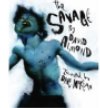
The savage by David Almond
Ill. by Dave McKean. Walker, 2008.
(Age 9+) Highly recommended. Once again David Almond has created an
outstanding book which will challenge and provoke his readers. Blue
Baker's dad has died and his school counsellor tells him to write down
his thoughts and feelings. Instead he writes a strange and compelling
story about a savage who lives under the ruined chapel in Burgess Wood.
The savage can't talk, hunts rabbits, and has old kitchen knives as
weapons. He pays a visit to Stokoe's farm and brandishes an axe as he
rides a pig. In the dead of night he creeps into the bedroom of the
bully Hopper and it is then that Blue has to come to grips with his
inner savage.
The way Almond shows how Blue deals with grief is heartbreakingly
honest. It examines through Blue's story how angry he is at his
father's death and how he works through his anguish by writing about a
savage, gradually coming to a stage where he comes to terms with his
sorrow and can look with hope to the future.
Dave McKean's dark blue and green ink illustrations are a perfect
collaboration with the story and depict an eerie savage complete with
knife and a fox skin around his belt. His drawings of Blue and his
little sister Jess show the tender side of Blue as he begins to heal.
This is a wonderful book that explores the boundary between fantasy and
reality, the violence that children can harbour, love between family
members and the healing power of writing.
Pat Pledger
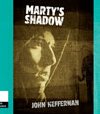
Marty's shadow by John Heffernan
(Age 13+) Recommended. This is a finely wrought tale about 16 year old Marty, a loner, resentful and riddled with doubts and terrifying memories. Marty has the care of his young brother Jack, as the boys' father is often working away. Left to their own devices by a largely uncaring and neglectful father since their mother had left, the two boys look after each other. Marty however, increasingly finds that his life is unbearable as he fights to remember whether his dreams about what has happened at the old quarry are real or imagined. The voices of the solid and well-developed characters make this an unforgettable story. Marty's angst and his descent into shadows come to life as he battles with eerie memories from the past. Jack, youthful and less damaged by his mother's departure, comes across as an optimistic and very likeable young boy. The angry and grim man who is Marty's father grips the imagination and leaves the listener in fear for the boys.
Heffernan skillfully introduces his refugee family in the story giving Nariah a central role in befriending Marty and helping him to realise that his love of trees and skill with plants is worthwhile. Pat Pledger