Corgi Books,
2010.
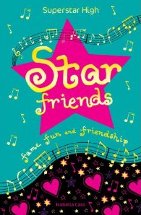
(Age: 9 +) Star
Friends is two novels packaged into one, each fizzing
with fame, fun and friendship at a London theatre school nicknamed
Superstar
High. Doubtless the series will gain a cult following as it's perfect
for girls
who live and breathe theatre arts.
Cat, Holly and
Belle meet on their first day at The Garrick School of Performing Arts
and
instantly become firm friends. This is Mallory Towers for the 21st
century and Cass is well versed in the lingo. Story lines are 'stoked
to the
max', and everything from boys to Shakespeare is described as mega,
massive,
cool and awesome.
All the girls are
hugely attractive and between demi-plies, voice coaching
and advanced acting, they devote a vast amount of time to chasing
eligible boys,
who are variously green eyed, floppy fringed and lopsidedly grinning.
There is
an avalanche of Jimmy Choo, Versace and Bobby Brown with not one
'issue' on the
fame filled horizon. The closest we get to a dastardly plot is someone
shrinking
your cashmere Armani poncho by putting it on boil wash.
It's all very
predictable but Cass does preach the importance of school work, hard
graft and
team work. (The token enemy, Bianca gets her comeuppance when the
gorgeous Jack
dumps her after the shrinking cashmere poncho incident). There is
nothing
inappropriate, but equally there is little substance and an awful lot
of
marshmallow. However, we all enjoy a bit of chick lit so point this in
the
direction of starry eyed ten year olds. They'll love you for it.
Claire Larson
The vegetable ark by Kim Kane
Ill. by Sue deGennaro. Allen and Unwin, 2010. ISBN 9781741759969.
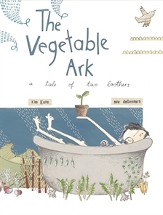
Picture book. Sub titled, 'A tale of two brothers', the front cover
will give children and adults some clues as to what the story may be
about. The word 'ark' is evocative of Noah and the ark, and this story
may be drawn from some students before reading the book. Weather
patterns on the endpapers also gives clues, and opening up, the first
page tells us of the two brothers, one Noah and the other, Neil. Each
boy has different skills and interests; Noah is competitive and keen on
business ventures, while Neil is more interested in his vegetable
garden. But when the call comes to build an ark, Noah fills his ark
with animals, the better to corner the meat market when the flood is
over, while Neil sees that before meat comes vegetables and so makes
his own boat and fills it with seeds and seedlings.
The story ends with Neil being the one to find land and plant his
seedlings, while Noah is still sending out his dove to find a sign of
land. The quirky rivalry between the brothers can be construed as the
rivalry between carnivores and vegetarians, while the whole is a
delightfully modern retelling of Noah and the ark. Readers will love to
talk about their own experiences with sibling rivalry, using Noah and
Neil as a template for discussion.
The illustrations by Sue deGennaro are infectiously funny. Neil's long
limbs seem to spread out over the page, while Noah's short squat body
initially takes up more room, then fades from the scene. Images of
gardening and water litter every page, and will entice young eyes to
find them.
Fran Knight
Herbert the Brave Sea Dog by Robyn Belton
Walker Books, 2010. ISBN 9781921529206
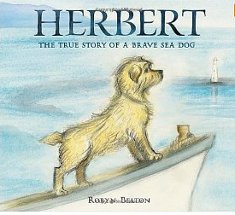
(Age 5+) Highly recommended. With his young owner, Tim, a small
sea-loving dog named Herbert lived in Nelson, New Zealand. When Tim's
father headed off to sea with his friends, Herbert leapt aboard the
boat leaving the boy and his mother to drive and meet them at a cottage
in the Marlborough Sounds. En route, a storm appeared at sea causing
Herbert to lose his balance and fall into the ocean. Not until the boat
had safely navigated through French Pass did the men realise the dog
was missing. Unable to turn around, they continued their journey and
shared the news with a distraught Tim. The following day, the young boy
accompanied a local fisherman out to retrace his father's journey.
Miraculously Herbert was discovered, exhausted but alive, following his
thirty hour ordeal in the ocean.
This heart-warming story is based on fact, incorporating maps, excerpts
of letters from well wishers, newspaper clippings and memorabilia about
the event as part of the endpapers. The text is not excessive for young
readers and the water colour illustrations capture the mood of the
story extremely well. Although based on events which occurred some
twenty years ago, this is a timeless tale. With highly accessible
themes of family, friendship, perseverance and courage, this book would
be highly recommended for readers from junior primary to considerably
older pet lovers.
Jo Schenkel
Going bovine by Libba Bray
Allen and Unwin, 2010. ISBN 9781742372907.
(Age 15+) Highly recommended. Winner of the prestigious US Michael L
Printz
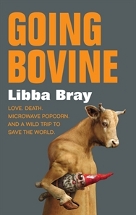
Award Libba Bray's Going Bovine is the wonderful story of
Cameron
Smith, a misfit sixteen-year-old. He leads a boring teenage life,
working at the Buddha Burger and slacking his way through school, never
trying to compete with his perfect sister. When he starts to get sick
he is diagnosed with Mad Cow Disease and told he is going to die.
Dulcie, an angel dressed in punk clothes, appears and assures him that
there is a cure if he's willing to go after it. From then on, Cameron
goes on a mad road trip with Gonzo, a hypochondriac dwarf and Balder, a
Norse god disguised as a garden gnome.
Libba Bray has written a complicated story where the reader has to make
decisions all the time about whether Cameron is hallucinating or is
really on a road trip. Interspersed are comments on physics and
philosophy, life and love. This is not a book for the faint hearted. It
is 478 pages long, full of weird memories, comments about the world and
lots of self-discovery for Cameron. Bray brings it to a very satisfying
ending with her brilliant writing.
The complex ideas, satire and commentary on materialism as well as
references to drugs and some strong language make this a book for the
older teen, especially those who like strange and wacky stories like
The hitchhiker's guide to the galaxy by Douglas Adams.
Pat Pledger
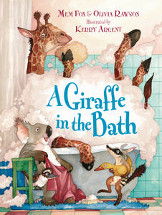
A giraffe in the bath by Mem Fox and Olivia Rawson
Ill. by Kerry Argent. Puffin, 2010. ISBN 9780670072132.
(Age 2+) Highly recommended. What imaginations Mem Fox and Olivia
Rawson have! They have come up with some wonderful ideas that might
make you laugh. Not only is there a giraffe in a bath, there is a sheep
in the shower, a frog in the flour, and an emu on the swings.
Children will delight in the ridiculous suggestions and will have lots
of fun coming up with their own ideas for making people laugh. Lots of
rhyme and alliteration make the text a great read aloud and emerging
readers will enjoy working out the words, which are beautifully
supported by the colourful pictures.
What made this book outstanding for me were the illustrations by Kerry
Argent. They are utterly fantastic and just so funny. The roo on the
loo and the crocodile with style made me laugh out loud.
This book is certainly a keeper with its hilarious ideas and
delightful illustrations. It is a must for grandparents and for
libraries.
Pat Pledger
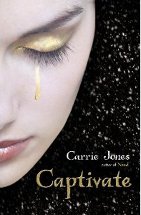
Captivate by Carrie Jones
Bloomsbury, 2010. ISBN 9781408807415.
(Age 14+) Captivate is the second book in the series following Need,
which
should
be read first to gain an understanding of the characters
and what has happened. After imprisoning the pixies and their King,
Zara and her friends find that this is not a satisfactory solution.
More pixies are arriving, lured by the opportunity to take over the
King's realm and rule his followers. Zara is confronted by a new King,
Astley, who declares that there are both good and bad pixies. He
believes that he is good and that Zara is destined to be his Queen.
Another dark King appears and suddenly everything that Zara loves is at
risk.
Jones spends a lot of time in the book working up the romance between
Zara and Nick with some minor romantic moments with Devyn and Issy.
Although there are some amusing moments in the relationship, I found it
a bit cloying. However this is important background for the action and
decisions that Zara has to make about whether she will become a pixie
queen. She has to decide whether she can trust the newly arrived King,
Astley, who I found to be rather a shadowy character. I would have
liked more in-depth characterisation here, as it was unclear whether he
is a worthy King for Zara or even a new love interest. An extra minor
character, Cassidy, adds some tension to the group dynamics.
Jones tosses in some Norse mythology, this time looking at a Valkyrie
who takes away dying warriors to Valhalla, the kingdom of Odin. I found
this addition to the faerie mythology a bit strange but it is necessary
to the plot. This time the author prefaces her chapter headings with
hints on how to deal with pixies. These Pixie tips are often amusing
and add a lighthearted touch to the tense action and strained
relationships. The humour is a welcome addition to this type of story.
This is another light, easy to read paranormal book, which teenagers
will enjoy. There is a cliffhanger ending that ensures that the third
in the series will be picked up. Teens who like this story may like to
move onto Marianne Curley's The named, which is well written
and has
lots of action.
Pat Pledger
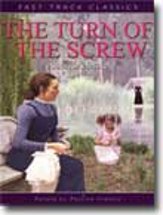
The turn of the screw by Henry James. Retold by Pauline Frances
Fast Track Classics. Evans Publishing, 2009.
(Age 12-16) Recommended reading level 9-12. Pitched at Primary level
readers, this novella seeks to re-tell the ghost story of the same
title written by Henry James. This is not a story that is suited to
reworking as an abridged children's version as it is complex and
demands that the reader analyse the characters and events beyond the
textual narrative. Readers will want to know what is going on and why
things are happening. Most will not be capable of questioning the
faculties of the characters, pondering alternative motives or
appreciating the psychological manipulation that occurs within the
story. There is nothing improper for children in the text, however the
ambiguous nature of the recount and necessity for the reader to
interpret the events and decide for themselves what is happening make
it unsuitable for most children. The situation of a governess caring
for two young children in a large manor house, with only the company of
a housekeeper to help her deal with mysterious happenings may be
foreign and unappealing to children. This is because the setting is
simplistic, yet the events that unfold are extremely complex.
Contemporary readers will be confused by the absence of ghost story
elements that are familiar to them. Modern children may also be
completely bored by the twee conversational language and the unnamed
central character's ridiculously hysterical reactions to events which
are fairly benign compared with most plots. Being seemingly at odds
with existing engaging literature for young children, I considered that
the story may be intended as motivational material for reluctant or
struggling lower secondary readers. Despite being a classic tale, which
demands a more mature examination, it could still be considered
insulting to this audience because the frequent pictures are juvenile.
Few disinclined readers would be interested by the language, setting
and lack of clarity within this book and I find it hard to recommend.
Rob Welsh
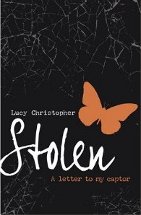
Stolen by Lucy Christopher
Chicken House, 2009. ISBN 978-1906427139.
(Age 14+) Highly recommended. Sixteen year old Gemma is drugged and
stolen from the Bangkok Airport and taken to a remote area in the Sandy
Desert in outback Australia. In a letter to her captor, Gemma outlines
everything that has happened to her. The vivid descriptions of the
desert, the isolation and her fears and feelings for Ty, the young
attractive man who has kidnapped her, make for compulsive reading.
Christopher has set up two memorable characters in Gemma and Ty. Gemma
is spoilt and middle class. Ty is a well built, artistic young man, the
opposite of the stereotype of a kidnapper who is obsessed with a young
girl. As Gemma's ordeal continues, the author brilliantly outlines her
growth as a person and her determination to get free, while reflecting
on the dependency that grows between captor and victim. The reader also
begins to understand the awful pressure that Ty has been under all his
life, his mother's desertion, his father's fall into despair, and his
experiences as a lonely boy in the bush. The realisation that Ty's
obsession has begun many years before when Gemma was a very young girl
is very unsettling.
I loved this book, and thought that it would make a worthy Year 11 or
Year 12 study. There are many themes to explore: obsession, love,
dependency, and the desert as a prison as well as Stockholm syndrome,
when a hostage begins to have positive feelings towards the
captor, and which is explored in depth by Gemma especially in the
dramatic conclusion of the story. Unlike in the novel, Living dead
girl, by Elizabeth Scott, Christopher doesn't describe the sexual
feelings that Ty may have and the aftermath of the abduction is left to
the reader to imagine. Stolen is certainly worthy of its nomination for the Cilip Carnegie
Medal 2010 and CBCA Older Readers shortlist 2010.
Pat Pledger
Spirals series by various authors
Evans, 2009.
(Age 6+) This series is brightly illustrated and contains
32 pages of easy to read text ranging from 300 to 500 words. The
illustrations complement the words, giving clues for the young reader
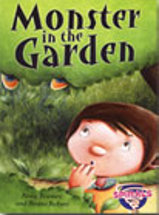
to follow. I enjoyed all the stories. Monster in the Garden by Anne Rooney ISBN: 978023753 8897.
When Patrick hears Patrick hears 'Mieuw, Mieuw!' when he is playing in
the garden he is convinced that it is a monster. With lots of clues
that a young reader can follow to work out what the monster is, this
book was an interesting introduction to mystery stories. George and the dragonfly by Andy Blackford. ISBN 9780237538842.
George is tired of his pet hamster and decides that there are more
interesting animals around for a pet. A dragonfly shows him all the
fascinating things he can find in his own garden. Catchy dialogue with
internal rhymes will make this good to read aloud. Tuva by Mick Gowar and Tone Eriksen. ISBN: 9780237538859.
This is the story of Tuva, the sledge dog, who pulls sledges through
blizzards and ice, even fighting off a polar bear. A verse story with
four lines to each stanza, tells the story of Tuva from the time he was
a puppy to his old age. The rhythm is good and this would make an easy
and interesting first reader. Wait a Minute, Ruby! by Mary Chapman. ISBN: 9780237538880.
Everyone is too busy for Ruby so she packs her bag and decides to leave
home. Amusing illustrations that complement the short text make for an
easy read for the newly independent reader. The King of Kites by Judith Heneghan. ISBN: 9780237538866.
When Anil's mother uses up all the material and sequins for her sewing,
Anil is devastated because he has promised 12 kites for the wedding.
What can he do? Set in an Indian village this is a lovely tale of
co-operation. Just Custard by Joe Hackett. ISBN: 978023753
8873.
Why will Duncan only eat custard? Any child who has been jealous of a
younger sibling and felt ignored will identify with this tale about the
baby who dominates the household. Bright illustrations complement the
text of this amusing story.
Pat Pledger
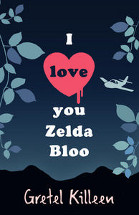
I love you Zelda Bloo by Gretel Killeen
Penguin, 2010. ISBN 9780143011606.
This is a story about a helicopter crash. The story begins in the back
of the crashed helicopter, with the heroine of the story, Zelda,
struggling for her life and her mother and the pilot dead.
Zelda has a conversation with an imaginary person in the corner to
explain how she has ended up in a crashed helicopter. She has an older
brother and sister and her Dad directs movies. Zelda's parents divorced
when she was 5 after her Dad ran off with one of his movie stars.
'Essentially since Dad divorced her all those years ago, Mum had been
like a walking broken heart'. (pg 34)
After reading an article in the National Geographic, her mother decides
she wants to make a documentary about child soldiers and takes
Zelda
with her to the mountains to interview the child soldiers. After
days of haggling with the pilot, Zelda and her mother set off in
the helicopter to find the child soldiers; Zelda dressed in gold
stilettos, a daffodil hat and
a bikini. The helicopter crashes. The pilot dies and Zelda half pushes
him out of
the plane. Her mother dies too. She finds a gun in her Mum's back pack
which she accidentally shoots and the animals hovering round the
wrecked helicopter run away. Then a boy appears. 'He was a boy as in
'not yet a man'. (pg 107)
Zelda pulls out the original National Geographic article from her Mum's
backpack and decides from the likeness of the photo in the article that
the boy is 'Saro Ecka, leader of the fearsome child warriors'. (pg108)
Zelda then thinks about killing herself when she finds a gun in the
helicopter. She does manage to shoot and injure Saro with the gun but
then she realises that she needs Saro to stay alive until they get
rescued.
The story ends where it began in the back of the helicopter. Zelda
dreams that she jumps out of the helicopter and runs away with Saro.
Zelda's responses to the situation could be seen as humorous probably
depending on the reader's age. Some may find this story gruesome.
Jenny Brisbane
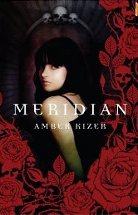
Meridian by Amber Kizer
Random House, 2010. ISBN 978 1864718782.
(Age 14+) Recommended. As her mother pulls her out of the car's way,
Meridian watches in
horror as it ploughs into the others who have just got down from the
bus. She feels their dying pain in a way she has never felt before. She
is pulled away and thrown into the packed car, her mother sending her
off with her father and the promise that she will see her again, if not
in this world then the next. Dropped at the bus station, she opens the
hidden letter, explaining some of what is going on. Like her mother,
she is a Fenestra, an angel, a secret they have kept from her, and so
she must get to her Aunt's house as quickly as possible, trusting no
one, keeping herself safe because turning 16 means that she is now a
window for a soul to escape the body as it dies and goes to heaven.
Meridian is overwhelmed. Everyday at her Aunt's house she learns
something new about herself and her role. Living there is Tens, a
gruff, uncommunicative young man, but gradually Meridian gets used to
him and his ways as she learns he is there to protect her. Overlaid
with her developing powers and experiences, Meridian learns about the
new gospel church which has infiltrated the town, turning away all
those who do not conform. These people target Auntie and then
Tens and Meridian in their quest for power over the whole community.
People, who once went to Aunty for help, now turn away in the street
and their house and car, along with the dog, become targeted by forces
unknown.
A scary, supernatural/fantasy story, Meridian has all the
elements of a
good read wrapped up in one. The angel story develops enticingly,
involving some of the centuries old beliefs about angels and adding
another layer of fantasy; the love story is inviting, leading the
reader along the path of whether they will become a couple or not; the
story of the dying Auntie holds the reader to attention as the story of
her husband is teased out. Added to that is the story of the cult which
has taken over the town and may or may not be the opponents of the
Fenestra, ready to kill Meridian whose powers are developing all the
time. An engrossing read for secondary students.
Fran Knight
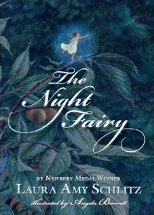
The night fairy by Laura Amy Schlitz
Candlewick Press, 2010. ISBN 9780763636746.
(Age: Primary) Well recommended. This is a charming story in every way:
from the story line to the delicate paintings, the dust jacket, the end
papers and the smooth pages. This is a quality fairy story.
The author says 'As a child I adored fairies and fairy tales'. She was
motivated by the girls who came looking for books about fairies. '
They adore the prettiness of fairies, the miniature-ness, but they are
also nature lovers and lovers of adventure' p119.
These comments by the author sum up the book well! Flory a
night fairy, no bigger than an acorn, loses her wings and finds living
very precarious. She meets many creatures who become part of her
journey to survive and to understand life. Skuggle, a squirrel
becomes her first friend along with the gentle human, 'giantess'.
Flory's greatest challenge comes when the humming bird, which Florey
wants to serve her all the time, is caught in the spider's nest. Then
she learns about nature, love and being a good friend. The
illustrations are soft, dainty and beautiful.
Sue Nosworthy
Library of Doom series by Michael Dahl
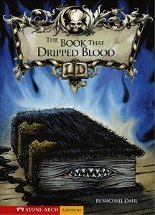
Raintree, 2010. The book that dripped blood. ISBN: 978 1406212822.
When a young man sells an exotic, fur covered book bearing exotic
golden hinges and titled 'Claws' to an old shopkeeper, a chain of
events is set in motion. The book is quickly passed from one person to
the next with pain and suffering ensuing. The Librarian magically
emerges from the pages of a paperback novel just as The Collector
arrives. Will he manage to find a solution to the problem before the
book is able to wreak any further havoc?
Containing only five chapters, few sentences on each page, a liberal
sprinkling of illustrations and with only 32 pages of text in the body
of the story, this would appear to be aimed at the older reluctant
reader. It is gruesome enough to hold a certain amount of appeal for
even secondary students to whom reading does not come easily. With the
simple vocabulary and various words highlighted by underlining or
almost having become part of a rebus or pictogram, the story is
relatively accessible. With a glossary, discussion questions and
writing prompts, this could be well utilised by classroom teachers
working with special needs students, as part of their literacy program.
In certain primary schools, the place of this series in the collection
may well be deemed as contentious by some parents! Although sharing
some similarities with the Harry Potter books, this would probably fit
best in a section designated for older readers in primary schools.
Jo Schenkel
Other titles include: The beast beneath the stairs. ISBN 9781406212815.
After much travelling the Librarian returns to his library to find that
his collection of deadly books is missing. Poison pages. ISBN 9781406212846.
After reading a few pages of a strange book, a young woman finds
herself trapped in a book. The eye in the graveyard. ISBN 9781406212839.
The Librarian risks being buried in a weird tower, if he cannot work
out a legendary secret. Cave of the bookworms. ISBN 9781406212877.
A young boy rescues the Librarian from a terrible bookworm that has
captured him. The creeping bookends. ISBN 97814062128.
A young boy is accidentally locked inside the library. Ravenous
lizard-like bookends start to devour the books.
Escape from the pop-up prison. ISBN 978140212617.
Can the Librarian stop the evil criminals being freed from a pop-up
book?
The smashing scroll. ISBN 978140621853.
The Spellbinder has a scroll contained in a silo. Will it smash the
earth?
Pat Pledger
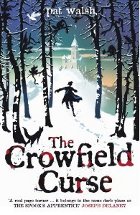
The Crowfield curse by Pat Walsh
Scholastic, 2010. ISBN 9781906427153.
10+ Fantasy. Highly recommended. Gathering wood in the forest is part
of William's work living at Crowfield Abbey as a servant after his
family's death in a fire. But he hears a voice full of pain and looking
around finds a small animal, a hob, about the size of a cat, but it can
talk. His leg is caught in an illegal trap, and William frees him,
taking him back to the Abbey to Brother Snail, the healer. Both keep
knowledge of the hob to themselves, but things in the Abbey are on edge
as the Abbot is dying and two guests, an unusual event, are about to
come and stay. Seeing to the guests William realises that one, Master
Bone, is a leper, and his carer Shadlok, a cold man with piercing
eyes, asks him detailed questions, bordering on things William knows
but does not wish to tell. Sent to the woods to let the pigs forage,
William is startled by the appearance of Shadlok who claims to have
saved him from the fay in the forest, and asks him more questions.
Many years before an angel had been killed protecting a hob, and now
Master Bone and Shadlok want to find the grave to dig up and use the
bones to cure the leprosy. William is torn. There are forces in the
forest which seem to know all about him and what he is about to do but
Shadlok has placed a spell on Brother Snail, placing him in a coma
forcing William to do his bidding. Retrieving the angel from its grave
does not have the results William expects.
A masterful story, The Crowfield Curse had me putting the book
aside,
partly because of its tension, but also because I did not want the
story to end. The cold, isolated abbey, with its handful of thin,
wasted men, keeping close the reasons for the curse, is an apt place
for a dead angel to lie buried. The curse winds its way into the
reader's consciousness, giving reason for the angel being there,
showing why the monks are so bitter, and why they keep a feather in the
sacristy cupboard. But William is warned that he is in danger, so
leaving the way for a sequel. I can't wait.
Fran Knight
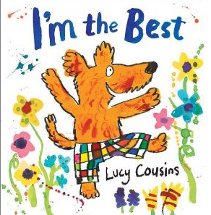
I'm the best by Lucy Cousins
Walker Books, 2010. ISBN 9781406323689.
(Age 3-6) Recommended. Lucy Cousins, an award-winning author, has
produced another of her brightly coloured books this time with a
thought provoking theme. Dog is certain that he is best at everything.
He boasts that he can run faster than Mole, and dig holes better than
Goose. He is bigger than Ladybird and can swim better than Donkey. All
his friends feel sad and inadequate but then they realise that they can
do some things better than Dog, who is suitably chastened. However
being the good friends that they are the reassure Dog that he is the
best at being a best friend and having beautiful fluffy ears.
The illustrations are lively, vivid and almost like those a child would
draw. Dog is gorgeously attired in checkered pants, and his animal
friends each have a beautiful piece of clothing on. The expressions on
the faces of the animals are exquisite and really fit the personalities
of the animals. Dog is just so proud of himself! Background details are
wonderful splashes of bright watercolours, each quite fascinating to
examine. With bold black print, the text is very short and easy to read
for new readers.
At the back of the book Lucy Cousins outlines how she had the idea for
the book after winning a tennis competition and telling her family and
friends about it. She perfectly describes the impact that boasting has
on friends, but doesn't pull any punches with the last proud word that
Dog has.
An ideal book for young reader that will give them an insight into the
power of friendship and how careless boasting can affect the emotional
well-being of friends.
Pat Pledger