Pan, 2010. ISBN 978 0 330 42579 7.
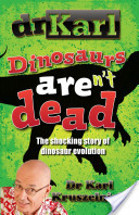
(Ages 10+) Warmly recommended. Non Fiction. Humour. Subtitled, The
shocking
story of dinosaur evolution, the well
known scientist, Dr Karl, who takes great pains to put complex
issues
into the hands of children via his natty books, is at it again. In
this
one sets out to show what the dinosaurs were, when they lived and
why
they were wiped out, (or so everyone thinks).
Enough facts are given to warm the cockles of any dinosaur
aficionado.
With the book divided into 12 easily accessible chapters, having
chapter headings such as The discovery of dinosaurs, Why did
dinosaurs
win? and What killed most of the dinosaurs, the chapters bristle
with
tempting facts and information. Different fonts, bold headings and
lists are used effectively to gain the reader's attention and one
drawing has a giraffe drawn alongside the dinosaur for comparison
which will help the reader recognise the size of some of these
creatures.
His enormously popular website outlines much of the science he talks
about and a list of his other books, a blog and information about Dr
Karl are given at this website.
Fran Knight
The Scorpio Races by Maggie Stiefvater
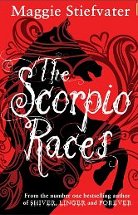
Scholastic, 2013. ISBN 9780545224918. (Age 13+) Recommended. Every year the Scorpio Races are run on the beach of Skamouth, but the horses are not ordinary thoroughbreds, instead they are capaill usice, wild water horses that are desperate to return to the ocean and are likely to attack and eat their riders. Sean Kendrick knows and loves the water horses, especially Corr, the blood red stallion that he has won on four times previously. Puck Connolly is a newcomer to the races. Desperate to save her family home, she is determined to try and win on her little mare, Dove, even though she faces opposition from the men who ride in the races. When Sean sees Puck on the beach, he is drawn to her and together they prepare for the race of their lives. After a slow start, the book builds up momentum and I became immersed in the story of the water horses. Stiefvater built up her small island world, with its mythical capaill usice, in such a matter of fact way that I found myself believing that there could be a place off Ireland or Scotland perhaps, where there really are cannibalistic water horses and people crazy enough to risk their lives riding them in races. The lives of the people living there are also described in depth. The longing of some of young, like Gabe, Puck's brother, to get to the mainland and the strength of the pull of island roots for Puck and Sean who know they could never leave adds interest to the story. Puck (or Kate as she was christened) is a brave girl. She is prepared to take on the men and refuses to let them intimidate her. However she is open to advice and actively seeks it out in her quest to save her family home. Sean is a strong silent character and the low key, simmering romance will satisfy those who enjoy a love story. However it is the excitement of the race, the suspense and fear that someone will be killed by the water horses and the sheer thrill of the gallops along the cliffs that truly captivated me. People who love horses will enjoy this change of pace from the author who wrote the Shiver series about werewolves. Pat Pledger
Little Mates Series by Susannah McFarlane and Lachlan Creagh
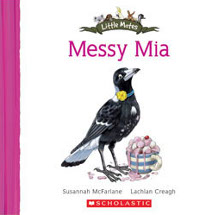
Scholastic, 2011. Messy Mia ISBN 978-1-74283-047-6. Nervous Nina ISBN 978-1-74283-048-3.
If you love alliteration then this series is for you. Each book
takes a letter from the alphabet and an Aussie animal and joins them
together to make a story based on the focus letter, for example 'm'
in Messy Mia ( a magpie),
'She melts mini meringues in the microwave and mixes melon and
marshmallow milkshakes.'
These books are only small, about 14 centimetres square. The colour
illustrations comically highlight the actions.
Although the author has tried to make a small story using this
alliteration technique, they are more a series of events based on a
beginning letter. These books would be more for preschool / JP
children but there are some challenging words to discuss i.e. in Nervous
Nina are 'nauseous' and 'nonplussed'.
Scholastic describes the series as 26 books based on friendship, for
ages 3-8 years.
Jane Moore
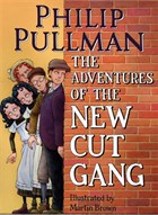
The Adventures of the New Cut Gang by Philip Pullman
Random House, 2011. (David Fickling Books). ISBN 9780857560223.
Whenever I think of Philip Pullman it is impossible not to remember
His Dark Materials series, especially the most well known, Northern
Lights, so I had completely the wrong idea about The
Adventures of the New Cut Gang. These are light hearted funny
tales about a gang of six children in late Victorian England, who
spend a lot of their time on the streets of London's east end,
thinking up adventures and solving mysteries.
Philip Pullman commented on his website that he was going to write
six stories about the gang but only two have developed at this stage
and he considers them the most favourite of all his work. Thunderbolt's Waxwork describes how the children first play
detective, trying to track down the culprit behind a spate of
counterfeit coins being spread in their community. Gang member
Thunderbolt is upset because his Dad has been arrested, so the
children want to find the person behind the crime and get his Dad
released from prison. The scene in the store when the children
convince an adult friend to be a store dummy is laugh out loud
humour. The Gas-Fitter's Ball has the gang tracking down the burglar
who has stolen the Gas-Fitters' silver trophies. The gang want to
beat the police in solving the crime. Benny's use of disguise is
another hilarious scene.
It's hard not to love the very different mixture of gang members.
Benny is the leader and we get to hear his outlandish plans and
dreams. Thunderbolt the thinker, has a great relationship with his
Dad, hot headed Bridie, whose heart is in the right place and her
little brother Sharky Bob, with horrifying eating habits. The
Peretti twins may look angelic but no one ever wants to get on their
bad side.
There is use of English slang and idioms that may take a while for
Australian readers to get used to but it is well worth the effort.
This would be a great read for 10 to 13 year olds.
Jane Moore
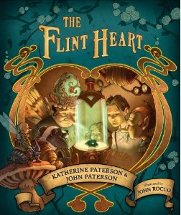
The Flint Heart by Katherine Paterson and John Paterson
Candlewick Press, 2011. ISBN: 9780763647124.
Recommended for ages 8-12. Some five thousand years ago, a young
warrior named Phutt desired to have a harder heart, so he visited
Fum, the maker of charms to seek an amulet which would make him
stronger. Despite the warnings from Fum that such a charm would
simultaneously lose him the affections of the people and lead to
war, Phutt was determined to go ahead. In order to make Phutt less
eager, Fum tried to make the cost prohibitive. Nonetheless, the
charm was created and continued to cause problems to both its owner
and his community until such time as it was buried along with Phutt
on his death. There it stayed for the next five thousand years. Its
later discovery again brought a host of problems to each of the
characters who found it. Amongst those whose lives it touched were
Billy Jago, the person who eventually unearthed the amulet, Charles
and Unity, two of his children, and later an imp and a badger. It is
only with the help of a walking, talking hot-water bottle from
Germany and the King of Fairyland that all is put to rights.
With the original fantasy written by Eden Philpott in 1910, this
title has been skillfully updated by the Patersons and illustrated
by John Rocco. The large, double-spaced font makes reading quick and
easy, even for younger primary school readers. Glossy paper,
illustrated chapter banners and full page colour illustrations make
this an even more appealing fairy tale, one I devoured in a single
brief sitting.
Jo Schenkel
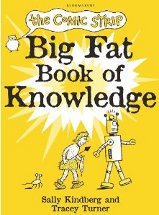
The Comic Strip Big Fat Book of Knowledge by Sally Kindberg and Tracy Turner
Bloomsbury, 2011. ISBN 9781408808245.
Good for all ages and full of awesome and fantastic facts about the
world that we live in and the galaxies around us, this book has a
basic outline of the complete history of the world, the entire
history of space, and Greek myths all with pictures. It is an
interesting, funny and great book, that makes learning about all
this stuff really fun. It's good for all ages and I would highly
recommend reading it.
As well as being a good book that makes you laugh it's one that the
whole family will like. I know my family and I have all enjoyed
reading this book and I hope that anyone else that reads it (and you
should) likes it as well.
Tahlia Kennewell (student)
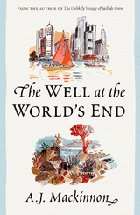
The well at the world's end by A. J. Mackinnon
Louis Braille Audio, 2010. Read by the author, A. J. Mckinnon, 12
hours (10 CDs.)
Black Inc., 2010.
(Ages: 12+)Humour. Travel. A traveller taking prodigious
risks with his adventures, Mackinnon first drew me into his world
when a few years ago, I listened to an audio tape of his sometimes
perilous journey from Cheshire to the Black Sea in a small boat (The
unlikely voyage of Jack de Crow). He navigated rivers and
canals, backwaters and open sea to avoid using anything but his
little boat. With all his worldly goods stowed away he traversed sea
and county, country and continent. I held my breath as he traversed
the English Channel, and was amazed that he made it as far as he
did. This time, he has determined to get back to Ireland from
Australia, without resorting to a plane. And he does. It takes a lot
longer than he had hoped, he meets some improbable people along the
way and has amazing luck. For an armchair traveller the story told
on these CDs is stunning.
Each leg of his journey involves a story or two told with humour and
innocent delight. He is always taken aback at people's generosity,
whether it be in the highlands of Thailand as he crosses the border
into Laos, or the guards on the border with China, a place he is
told not to go, or yacht owners in New Zealand offering him a berth
on their race to Indonesia. But at times he seems so naive, missing
Aden when the ship he is on, forgets he is on board, or being part
of a ceremony in Laos where a daughter is brought smiling shyly to
him, or travelling with a married couple on their small boat, their crumbling relationship obvious to all but the author.
But all is told with good humour and is a rivetting set of cds to
listen to while driving or walking. Some good natured stretching of
the storyline helps maintain the interest, and the story surrounding
the well at the world's end, purporting to bring long life, begins
and ends this easy to listen to story. And a tale read on the cds by
the author, adds an authority that is hard to resist, especially
when Mackinnon is a drama teacher, and readily slips into the
personalities of those he met.
Fran Knight
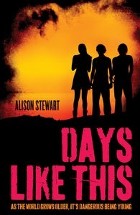
Days like this by Alison Stewart
Penguin, 2011. ISBN 9780 14 320654 5.
(Ages 14+) Recommended. Dystopian thriller. From the cover blurb,
'As the world grows older, its dangerous being young', the reader
knows
that they are in for a treat, a look at a possible future where to
be
young means that your essence is required by the old to keep alive.
I loved the trilogy by Gemma Malley called The Declaration,
where adults had to sign a form vowing never to have children, the
population having access to so many pills and potions that they
remained alive well past the three score and ten, but this novel
takes
the whole concept further. Teens are taken for their essence, it is
sucked out of them in a factory which is beyond belief, until their
wasted bodies disposed of.
Lily and her brother Daniel are aware that their ever young parents'
attitude to them is changing, and hacking into the computer after
Daniel is taken away, Lily finds out some of what is happening to
children like her once they enter their teen years. She attempts to
escape before she too is taken, but she has not been allowed outside
for so long she has difficulty finding her way across the Wall. But
others like her are there to help her, and together the people on
the
other side, attempt to free those of their age incarcerated in the
facility where they are sucked dry.
The view of a decimated Australia, torn apart by climate change,
dictatorship and rebellion is absorbing as the teens find their way
back to a deluged Sydney, across the Wall into the exclusive suburbs
where the wealthy and the vain live protected by security guards.
A heart in the mouth read, this will appeal to all those people
fascinated by the plethora of dystopian novels which abound at the
moment, containing comment on our times and an absorbing thriller to
boot.
Fran Knight
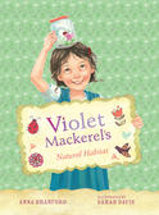
Violet Mackerel's Natural Habitat by Anna Branford
Walker Books, 2011. ISBN: 9781921529191.
Recommended for ages 6 and above. At the end of a shopping trip,
Violet becomes bored as her mother and a neighbour stop to chat over
cups of tea! When she spies a sparrow in the shopping centre, Violet
comes up with the 'Theory of Helping Small Things'. On the way home,
her mother introduces her to the term Natural Habitat. This leads to
Violet making some suggestions to her big sister, Nicola, about
possible topics for her natural science project. Despite Nicola's
disinterest, Violet finds a ladybird and makes a new habitat for it
in a glass jar. While their mother is at the market the next day,
things go wrong with the ladybird, and the two girls work together
to create a very successful science project for Nicola. During the
next trip to the shopping centre, Violet happily acts on her most
recent theory to assist the swallow she had previously met.
Branford has created a delightful, winning character in Violet
Mackerel. She is a kind, considerate child, always keen to do her
best to help others with her lateral thinking and different ideas.
For emergent readers or for teachers of junior primary classes to
read aloud, this series provides some simple plots which are easy
for young children to relate to and act as introductions to various
topics. This would be perfect to read as part of a unit on life
cycles and habitats and the activities at the back of each book are
easy and appealing for young readers.
Jo Schenkel
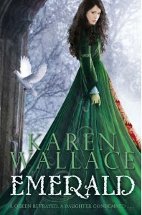
Emerald by Karen Wallace
Simon and Schuster, 2011. ISBN 9781416917168.
Recommended. 'I'd rather marry a hog than Lord Suckley . . . " and
with
this striking exclamation made by Emerald, Karen Wallace's
historical fiction begins. Set in a distinct and well-illustrated
Elizabethan setting, Emerald features an unlikely heroine who,
despite
being perceived as insignificant by others, proves herself strong
and
independent in the face of adversity.
Hardship seems all that Emerald knew as a child; with a mother
completely devoid of love whose deceit creates great scandal, and a
father who desperately compensates for this . . . only to
unexpectedly die trying. Upon the terms of their father's suspicious
death wish, Emerald of only eight years and her older brother are
abruptly forced to live with a distant uncle, aunt and conniving
cousin, regardless of the availability of their own mother. Despite
this, the comfort and sworn support of her brother holds the failing
seams of Emerald's life together until, one day, he is sent to sea
and
the stitches unravel one by one with only Molly, her pet bear, as a
companion.
Several years later, a letter from Emerald's 'she-devil' mother
arrives
ordering her matrimony to the despicable and disgusting Lord
Suckley.
Her race to escape this horrible fate introduces conflict and the
exposure of shocking secrets, until she finds herself tangled in a
fragile web of lies that threatens to collapse at any second.
Cleverly written, Emerald is a fast-paced and unpredictable novel in
which the heroine fights to conquer an outstanding number of
issues . . . betrayal, deceit, assassination, romance and
cruelty
to animals; this book covers it all!
Emilia Corbo (student)
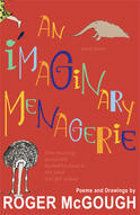
An Imaginary Menagerie: Poems and drawings by Roger McGough
Frances Lincoln Children's Books, 2011. ISBN 9781847801661.
(Ages: 5 to 7 years) Here is a fun collection of poems written
originally by Roger McGough in 1988. He has added some lively and
very humorous line drawings to accompany most of the poems for this
2011 edition. The contents page lists the 72 poems, which have
mainly one-word titles addressing each of the letters of the
alphabet. Most titles name animals known to us, but McGough adds
some, which stretch the imagination. The 'c' entries are
Camel, Canary, Catapillow, Chimp, Conger Eel. Playing with words and
familiar situations, McGough's collection is great fun to read out
loud and invites some poetry writing of our own. At times I
found some poems to be rather distant from the Australian
experience, though he does include gems from 'Oz'; some seem also to
show their age in terms of expressions and wordplay. In
summary it is wonderful to read a poetry collection that is
accessible to the young reader, and there will inevitably be some
instantaneous hits!
Julie Wells
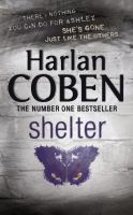
Shelter: a Mickey Bolitar novel by Harlan Coben
Indigo, 2011. ISBN 9781780621180.
(Age 12+) Recommended. Crime thriller. Harlan Coben, a
bestselling crime author for adults, has started a crime series for
young adults. It features Mickey Bolitar, a teenager who has been
forced to live with his Uncle Myron after he witnessed the death of
his father, and whose mother can't cope and is sent to rehab. He
finds his new high school difficult but makes some unusual friends
and when his girlfriend, Ashley, disappears without a word, he is
determined to find out what has happened to her. He also comes
across the strange Bat Lady, a local recluse who states that his
father is not dead.
In his quest he uncovers a sinister underworld and is forced to
confront some mysteries about her and his family.
Mickey is an attractive main character, who has led an unusual life
travelling the world with his parents. He is good at
basketball, loyal to his friends and not afraid to take risks going
to a seedy nightclub in New Jersey and taking on dangerous
criminals.
There is action galore as Mickey and his sidekicks, Spoon and Ema,
both of whom are social outcasts, start to investigate what has
happened to Ashley and why there are strange people lurking around
the neighbourhood. The suspense and mystery kept me reading
this book in one sitting, and even though I did find the ending a
bit abrupt, I don't doubt that it will entice the reader to grab the
next in the series when it is published.
Coben's foray into young adolescent fiction is an entertaining and
successful one and should appeal to teens, both as an introduction
to the crime genre and as an exciting read. I would suspect that
fans of this book will go looking for the adult series that features
Mickey's Uncle Myron.
Pat Pledger
Return to the Hundred Acre Wood (in which Winnie-the-Pooh enjoys further adventures with Christopher Robin and friends) by David Benedictus and Mark Burgess
Inspired by A.A. Milne and E. H. Shepard. Egmont, 2011. ISBN
9781405247443.
It is more than 80 years since A. A. Milne introduced us to
Winnie-the-Pooh, Piglet, Eeyore, Tigger and the other residents of
the Hundred Acre Wood and gave us a family favourite that has
survived generations (and Disneyfication). Although Benedictus wrote
some of these stories nearly 20 years ago, they could not be
published because Disney owned the rights but now, with the sequel
rights reverting to the trustees of Milne's estate, we can once
again enjoy the traditional Pooh complete with illustrations in the
style of E. H. Shepard.
In this book we share the delight of Christopher Robin's return,
marvel at Owl's wisdom and are introduced to the game of cricket -
very timely! We are also introduced to a new character, Lottie the
Otter who fits into the landscape and the stories perfectly. Like
the original, each story is perfect for reading aloud or reading
alone and the illustrations are just delightful. If you are a Pooh
fan, like me, you will love this. Pop it in your own Christmas
stocking!
Barbara Braxton
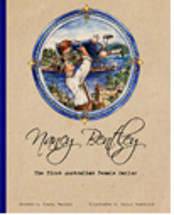
Nancy Bentley: The First Australian Female Sailor by Tracy Hawkins
New Frontier, 2011. ISBN: 9781921042768.
Born in 1914, six year old Nancy was living with her large family in
a small cottage in Port Arthur. Living near the harbour, Nancy and
her siblings had much freedom to go and play outside without
parental supervision. One day, as she followed her brother and
sister home to tea, Nancy was bitten by a poisonous whip snake. With
the doctor being too far away to safely reach, her father, Frank,
instead rowed her out to a ship moored in the harbour. Immediately,
she was seen by the ship's surgeon who declared her too ill to move.
Captain Cayley then faced a dilemma. In the year 1920, females were
not allowed on board naval ships so he made the decision to enlist
her as 'Mascot Bentley 000001'. As she regained her health, Nancy
was taken for a special outing with the members of the crew and,
shortly thereafter, returned home.
This brief snippet of Australian history is simply written and
accompanied by Jacqui Grantford's realistic water colour
illustrations. The text and art work meld together to provide a
snapshot of Australia in the early days. The inclusion of a black
and white photograph and an original document add to the title to
give children a brief lesson in history in a book which could be
used to discuss women's rights and the history of the Australian
navy.
Jo Schenkel
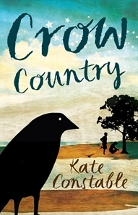
Crow country by Kate Constable
Allen and Unwin, 2011. ISBN 9781742373959.
(Ages 12+) Highly recommended. Crime, racism. When a valley
near the town of Boort in northern Victoria was flooded to make a
dam, secrets were buried under the water, but now, with 10 years of
drought, things have been uncovered. The secret is revealed by the
crows of the area to newcomer, Sadie, lately moved to Boort with her
mother, who remembers the place from her holidays as a child. But
Sadie finds the crows talk to her, they direct her feet to the place
where the secret lies buried, and when they are about, she time
slips, returning to the 1930's when her great grandparents owned a
shop in the town's main street. Here she learns of the three mates
who fought together on the Western Front during WW1, vowing to keep
together when they return home. But one is black, and the resultant
racism leads to his death.
The landowner, Mortlock wants to inundate his land, but Jimmy knows
the land to be special to the local people and so objects. Sadie, in
a different time, sees what happens and how her family is involved.
The crows tell her that only she can discover and reveal this secret
to give it peace.
This is an amazingly complex story, not only are there brushes
with problems of rural Australia, drought, use of water, lack of
jobs, the slow demise of rural communities, but Constable has
included racism in a way that provokes thought and discussion. The
theme of racism is an integral part of the whole, neither overstated
or muted but a distinctive and major element of the story.
Sadie's relationship with the Aboriginal boy, Walter, and the
resultant racism aimed at her, is masterfully told, as is the
relationship of her mother and her old flame. The racism that
existed three generations before might have been buried but has
never gone away. Alongside this stunning story, we see Sadie's
developing maturity, of making her own way in the world, of making
up her own mind in the narrow confines of a small country town.
This is an evocative story of modern Australia, linked with the
past. WW1, the depression of the 1930's, land rights and the
treatment of Aboriginal people, particularly those who fought for
Australia and returned home unheralded, all mix to make a story well
worth the read, both as a class text and a book to read for
leisure. Teacher
notes are available on Allen and Unwin's
website.
Fran Knight