Walker Books, 2012. ISBN 9781921720758.
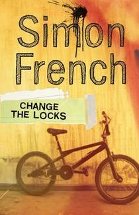
(Age: 12+) Recommended. Eleven year old Steven lives a precarious
life in a rural town with his mother and baby brother. Money is
tight and now that their car has been stolen, his mother is
especially distracted. In fact, his mother hasn't had much time for
anything or anybody since Darryl left. Steven is glad that Darryl
has gone but also worries that he might come back. It seems that
Steven always has something to worry about.
Disturbing memories from early childhood keep intruding into
Steven's consciousness. His mother refuses to talk about the past
other than to say that they lived in the city. Steven thinks she is
hiding something, but why? A chance discovery provides some clues
but there are still more questions than answers. He wants to talk to
his mum but how can he do this without adding to her worries?
Steven is a very sensitive boy. He looks after his little brother
when his mother seems incapable of doing so. He envies the home life
of his friend Patrick and his warm and accepting parents. He likes
living where he does but is fearful of the school bully and running
into the undesirable friends of Darryl.
This book is a sensitive insight into the mind of a young boy reared
in challenging and unsettling circumstances. Written by award
winning author, Simon French, it was first published in 1991
however, its relevance remains constant. It has great potential to
facilitate awareness of broader social issues such as teenage
pregnancy and homelessness. Read aloud, it could be a great stimulus
for class discussion.
Tina Cain
A matter of magic by Patricia C. Wrede
Tom Doherty Associates Book, 2010. ISBN 9780765326324.
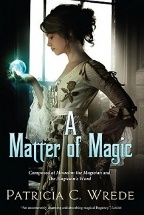
(Age 12+) Recommended. This volume contains two of Patricia C.
Wrede's books, Mairelon the Magician and The Magician's
Ward. Set in Regency England, they are full of mystery and
suspense, and will appeal to readers who enjoyed Ruby in the
smoke by Philip Pullman and stories by Georgette Heyer.
Kim is a young girl alone on the streets, masquerading as a boy to
protect herself from predators. She breaks into Mairelon the
magician's tent to steal an orb that is supposed to be magic and
when discovered, finds that her whole life is changed. She becomes
Mairelon's apprentice and begins a series of adventures following a
trail of thieves and murderers, while she struggles to learn how to
read and to behave like a lady. The second story continues her story
with an emphasis on her maintaining her style and integrity while
giving the appearance of a lady.
Wrede's combination of fantasy and comedy make for an entertaining
read. Her use of thieves' cant like 'nabbing culls' and bad grammar
like 'aint' add humour to the predicaments that Kim gets herself
into as she learns how she can operate in a different world to the
stews that she was born into. Kim is a feisty girl who doesn't
compromise her values even when faced with the opportunity to have
an easy married life with a rich man.
I really enjoyed these two stories. They were fun and easy to read
and I will certainly be finding more of Patricia C. Wrede's book to
read.
Pat Pledger
A confusion of princes by Garth Nix
Allen and Unwin, 2012. ISBN 9781 74375 861 0
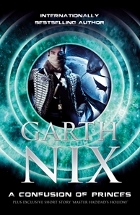
(Ages: 10+) Recommended. Fantasy. Science Fiction. Prince
Khemri is born to rule. The Empire chose him when he was an infant
and removed him from his parents to be enhanced, indulged and kept
in isolation and ignorance of the truth of the politics of the
Empire. Though he didn't know it at first Khemri is one of millions
of princes all jostling for power and position.
The Empire is an unequal world. Scientific advances have made them
the leaders in 'Mektek', 'Bitek' and 'Psitek'. Although some of
their rivals have some of these advancements the Empire seems to be
the only civilisation with all the advanced technologies. Princes
are enhanced. Their minds are developed with educational and
developmental programming and their DNA is changed and improved and
even their bones and muscles tweaked to strengthen and quicken
reflexes.
Khemri's life changes dramatically when he is 17 and he is brought
into contact with the real world, to take his place as a prince of
the Empire. It's not quite as he has imagined it! Not only does he
not take command of anything immediately there are other princes
trying to assassinate him. Fortunately his Master of Assassins is
experienced and skilled and is able to bring him safely to his
investiture.
Life in the Empire seems at first to be chaotic but as time unfolds
and Khemri's options are given he comes to realise that all is
mapped out and little is left to chance. He joins the Navy and from
then is given a series of tests and finds he really has but one path
to follow: that given by the Empire or failure and death.
His greatest test comes when he is dropped into a world where he is
stripped of his princely assets of both mind and body. He no longer
has the strength, agility, sight and mind control he has been used
to and it also seems that he has also begun to feel emotions of
ordinary humans. He begins to wonder if the life of a prince is
really the life he wants for himself. Khemri also begins to have
doubts about the political correctness of the Empire and the
Emperor, even though he has been selected as a candidate to become
Emperor.
Garth Nix has created a world where a huge central government has
control through its creation of princes. The populations of many of
the dominated worlds are unaware, as are perhaps many of the princes
themselves of how manipulated they all are, and how expendable. A
parable on our world at the moment? Where the subtleties of
information control and flow are in the hands of a few?
For trailers and an interview with the author, go to Allen and
Unwin's website .
Mark Knight
Fallen in love by Kate Lauren
Random House, 2012. ISBN 9780857531643.
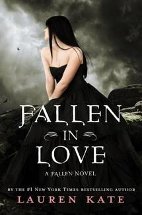
(Ages: 14+) This very short novel has 4 separate love stories
featuring Miles, Shelby, Roland, Ariane, Daniel and Luce from the
popular Fallen series, The stories are set around St Valentine's Day
in medieval England, and are connected through the collective wish
of four of the characters for Daniel and Luce to have a romantic
night together.
Miles and Shelby act on their long time attraction in their story,
while Roland secretly visits the mortal woman that he abandoned
years before in his tale. Ariane's love affair with Tess ends badly
when she is forced by Tess to choose between following Lucifer or
the Fallen Angels. The last story is that of Daniel and Luce and how
they are brought together by their friends on Valentine's Day.
Readers who have not read other books in the series will find much
of the book confusing, as there are limited explanations about why
characters are in their particular situations. This book fits
between the fourth and fifth book in the Fallen series and
would be enjoyed by fans of the other books.
Chris Lloyd
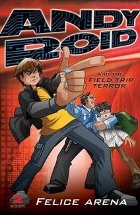
Andy Roid and the field trip terror by Felice Arena
Book 2. Puffin Books, 2012.ISBN 9780143306047.
(Ages: 7-10) Andy is 'half boy, half machine'. A bit like a younger
version of the Six Million Dollar Man, if you're my generation and
can remember the show!
This title is number 2 in the series. I had not read the first book
but fortunately a prologue gives the reader all the necessary
information. Andy survived a horrific truck accident but in order to
save his life, Andy's parents, who happen to be robotic specialists,
rebuilt him to include great strength, speed and amazing apps.
Andy has to live undercover now to be protected from the evil Dr
Baffi, so book number 2 deals with Andy's first days at his new
school. There is the friendly, nerdy kid who is constantly picked on
by the school bully Hunter and another mysterious new student, Judd
who is super cool and has amazing abilities himself.
Andy cannot display his super powers without exposing his true
identity but a school visit to a local bank changes everything and
Andy has to make a decision between saving lives and protecting his
secret.
An action packed book that will be enjoyed by boys 7 to 10+. The
book covers have dynamic artwork that will appeal. There are 5 books
available in this series at present (April 2012).
A promotional book trailer is available.
Jane Moore
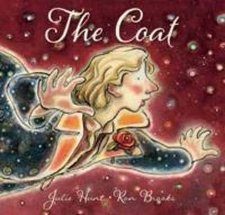
The coat by Julie Hunt
Ill. by Ron Brooks. Allen and Unwin, 2012. ISBN 978 1 74114 605 9.
(Ages: 6+) Warmly recommended. Picture book. Fable. The fable of a
scarecrow giving up his coat to a man wandering along the highway,
is told in imaginative tightly constructed prose by Julie Hunt.
Against a sepia background, the vagrant, a lonely and dejected man,
comes to life when the coat takes him upwards, over the trees and
houses, the villages and towns until he gets to a city. Here he
finds his voice, and taking a piano accordion from the wall, begins
to play and sing to the assembled people at the inn. His music fills
the room, moving the patrons to sing and dance, turning them into
acrobats, twisting and diving in the air above them, as colour
returns to his life.
When he comes to leave he does so with thunderous applause, unable
to give a response to the question of when he will return.
But the joy given to the people will live on, just as the man and
his new coat bring music and joy to other such communities along
their path. The coat, which felt it was a waste stuffed with straw
in the field of strawberries, has a new life, as does the
disappointed young man who puts it on.
There is a lot to like in this story as the coat takes on a life of
its own in trying to avoid being disregarded, while the man can see
how important the coat was once, gracing the shoulders of someone
with distinction. The man fills the coat, changing from a small,
insignificant man to one whose qualities shine for all to see. On
many levels it is a story of fulfilling one's potential, of taking
risks, of making the most of a moment, of taking opportunities as
they present themselves. Adages crowd in to be discussed and
pondered, 'Clothes maketh the man', 'Seize the day', 'Opportunity
knocks but once', to name a few.
And the illustrations, by Ron Brooks, are just marvellous. I had art
books all over the floor as I tried to match some of the styles he
uses to an artist or period of art history. All students will love
finding similar books in their library to compare with the sweeping,
intricate, sepia and colourful illustrations presented by Brooks,
with Chagall and Brueghel coming immediately to mind.
I can imagine hours of discussions proceeding from this book, once
the beautiful linked script has been deciphered by the students.
Fran Knight
10 Futures by Michael Pryor
Woolshed Press, 2012. ISBN 9781742753768.
This remarkable collection of 10 short stories imagines the future
in each of the next ten decades. The central protagonists in each
story, teenage friends Tara and Sam, grapple with a wide variety of
scenarios. In most of the stories one or other of them is faced with
a moral dilemma or agonizing choice. In 2020, a plague has destroyed
most of civilization and finds the two deliberating on whether to
let possibly infected friends into their rural fortress. In 2030
when a Total Financial Collapse leaves a small primitive
agricultural community struggling to survive, Tara lies to rid the
group of a 'free-loader' but then discovers her action has horrific,
unexpected consequences.
Other scenarios include machines to test genetic compatibility in
2040, severe rationing in the face of an alien invasion and rampant
over-population in 2060, and a religious dictatorship in 2070; here,
Sam has to choose between his boss and Tara. In 2080 Seniors, dubbed
Silvers, have the numbers and the power and don't hesitate to use it
corruptly. A 'human' AI machine features in 2100, and in 2120 a
hospital sells clones and bodies in a 'spare parts' surgery racket.
Clearly these are all grim and confronting situations, written to
provoke thought and discussion, rather than create optimism about
our future. The 10 stories are not in chronological order which
would indicate they are to be dipped into rather than read
cumulatively. Well written, they draw on the themes of Orwell's 1984
and Animal Farm as well as themes of personal
responsibility, state power and control, corruption, loyalty and
betrayal, human compatibility, and the price of freedom and
survival. Unforgettable, they would be a valuable addition for any
Senior English or Ethics classroom discussion.
Kevyna Gardner
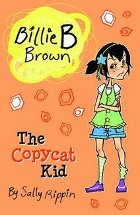
Billie B Brown: The Copycat Kid by Sally Rippin
Hardie Grant Egmont, 2012. ISBN 978 1742971414.
(Ages 6-9) What does the B in Billie B Brown stand for? This time
(it changes in each story) it stands for buddy, as Billie has been
asked by her teacher to be a buddy for Mika, a new student from
Japan.
At first Billie is very excited and proud to be Mika's new friend
but gradually as Mika copies Billie's clothing, artwork and is
better than her at soccer, Billie gets angry and the friendship
breaks down.
This book is a great choice for children who are becoming more
independent readers and would like to read small novels or 'chapter'
books. The font is large and the book only has 42 pages which are
interspersed by black and white drawings.
There are many books in this series and these stories have great
appeal for girls in years 1-4. Children might like to check out a
great website about the
books that also contains quizzes, colouring in and games.
Jane Moore
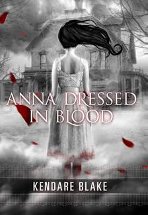
Anna dressed in blood by Kendare Blake
Tom Doherty Associates Books, 2011. ISBN 9780765328656.
(Age: 14+) Recommended. With a raft of awards (Cybils Award Nominee
for Fantasy and Science Fiction (Young Adult) (2011), YALSA 2012
Quick Picks for Reluctant Young Readers (2012), and YALSA 2012 Best
Fiction for Young Adults (2012)) Anna dressed in blood is an
ideal book to get teens reading. Cas Lowood kills the dead. He is a
ghost hunter like his father before him. When his father is cruelly
murdered, he inherits his strange athame, and goes around the
countryside with his mother, a white witch, looking for ghosts to
lay to rest. Arriving in a new town, searching for the ghost called
Anna dressed in blood, Cas finds a ghost, dripping blood, who spares
his life even though she has killed countless others.
I enjoyed reading this ghost story, which is written in the first
person in the voice of Cas. Cas is a wonderful narrator, who gives
the reader an in-depth insight into what he is feeling about the
ghost hunting that he has to do and the loneliness he experiences as
he and his mother move from town to town. He has no time to make
friends and to be a normal teenage boy. When he enrolls at Sir
Winston Churchill Collegiate and Vocational high school, he finds
that he can't shake either Carmel or Thomas, who are determine to
befriend him and help him in his quest. Both of his friends grow and
begin to value themselves by the end of the story.
There are many exciting and gruesome scenes, which will be enjoyed
by those who like some bloodthirsty action in their reading.
Suspense is built up throughout the book, culminating in a thrilling
ending that left me wanting more.
Cas's feelings for Anna are pivotal for making the story
interesting. As a reader I became fascinated by the relationship
between the two, which seems to be doomed. However there is another
book in the pipeline, so it will be interesting to see where this
talented author goes with the sequel.
Recommended for reluctant readers and those who enjoy a well written
paranormal ghost story.
Pat Pledger
Olympic Spotlight Posters
Carel
Press. Australian version distributed in Australia by LinksPlus,
2012.
Set of 37 posters in pdf form A4 and A3 size with optional
Powerpoint presentation and jpeg images.
These posters are clearly presented with bright colours and eye
catching images. Easy to read font, titles are bold and draw
attention. The topics are very wide and varied, covering all aspects
of the Olympic Games experience. A useful set of posters to spark
interest and further exploration on the chosen topics . . . there is
just enough information to make them interesting, and still more to
discover.
The optional Powerpoint and jpeg files would be a handy addition to
displays and lessons. The Powerpoint presentation is in a widescreen
format, and I would use it as a digital display during the Olympics
on my IWB. It is in a format that you can customise to suit your
needs - for example I would add some background music and set an
automatic slide transition for display purpose. Many posters have
dates and I would envisage using the jpegs to create smaller cards
to do a timeline activity with students.
Overall a clearly designed set of interesting facts, available in
multiple formats for various uses.
Zana Thiele
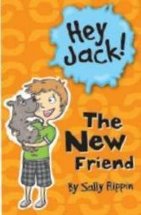
The new friend by Sally Rippin
Hey Jack! (Series). Hardie Grant Egmont, 2012. ISBN 978 1742961 39 1
The worry monsters by Sally Rippin
Hey Jack! (Series). Hardie Grant Egmont, 2012. ISBN 978
174297140 7
(Ages: 6+) Warmly recommended. In The new friend, Jack
mooches around home trying to play by himself, but is finding it
hard going. His friend Billie is away, so he and his Dad go and play
soccer on the field nearby for a while. Returning home, Jack finds a
small friendly dog following him. He takes it home, his father
telling him that it will only be staying one night as they must find
its owner. They put down blankets for the dog in the laundry and
feed him, Jack finding a name for him which suits the little animal.
The next day they set out in their attempts to find the rightful
home of the little dog, and in doing so resolve the problem of the
little dog, Jack's loneliness and the problem of the shop owner down
the street.
The second, The worry monsters, concerns Jack forgetting his
spelling homework and worrying about what will happen at school when
the spelling test occurs. Again, a subtle story promoting positive
skills, good family communication and common sense, the story line
is easily recognisable by the readers, and its resolution one they
will also comprehend.
Neatly resolved stories, these will make a great read for younger
readers who have newly arrived at chapter books. They will be a good
addition to the library and being a series, a box of these will be
well used. They will also serve well as readers in the reader box in
the classroom, a far better proposition than many of the watered
down, uninteresting sets of readers promoted by publishers to busy
teachers. These little books are well written, have a neatly
resolved storyline, sound characters and a wonderful style and range
of vocabulary to further extend younger readers.
Fran Knight
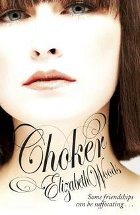
Choker by Elizabeth Woods
Simon and Schuster, 2012. ISBN 9780857072863.
(Age: 13+) Recommended. 'Sixteen-year-old Cara Lange has been a
loner ever since she moved away from her best and only friend, Zoe,
years ago. Mostly she spends her time watching Ethan Gray from a
distance, wishing he would finally notice her, and avoiding the
popular girls who call her "Choker" after a humiliating incident in
the cafeteria. Then one day Cara comes home to find Zoe waiting for
her. Zoe's on the run from problems at home, and Cara agrees to help
her hide. With her best friend back, Cara's life changes overnight.
Zoe gives her a new look and new confidence, and next thing she
knows, she's getting invited to parties and flirting with Ethan.
However just as quickly as Cara's life came together, it starts to
unravel. A girl goes missing in her town, and everyone is a suspect,
including Ethan. Worse still, Zoe starts behaving strangely, and
Cara begins to wonder what exactly her friend does all day when
she's at school. You're supposed to trust your best friend no matter
what, but what if she turns into a total stranger?' Blurb.
Behind a flashy cover, this book contained far more excitement then
I expected it to have. Choker by Elizabeth Woods is a
teenage novel, which draws a perfect picture of a typical high
school, where Cara, a loner and also the main character, spends day
after day avoiding the popular girls and watching Ethan Gray from a
distance, wishing he would finally notice her. Frankly, the
storyline promised to be very unoriginal, yet something about this
book told me that things weren't exactly spot-on and unchanging in
Cara's life, especially after her best friend Zoe returned and an
unexpected death of Sydney Powers, her arch-enemy at school, had
occurred. Choker, which is a steady paced novel, never promised or even
given a slightest hint that it would take this shocking twist
somewhere in the middle and undertake something as epic as the end.
Elizabeth Woods detailed every single sentence, motivating the
reader to go on with the book. Details of the characters were also
very accurate, forming a decent idea of what they were like.
This book is definitely worth reading, since the style of the
writing and a shocking ending leave you wondering about it for days.
People will either love or hate this book, depending on their
favourite genres. Overall I would say that good endings make good
books, and Choker is definitely one of those novels.
I recommend this book.
Nika Aroutiounian
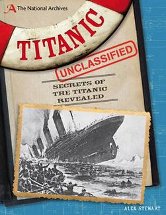
Titanic unclassified : secrets of the Titanic revealed by Alex Stewart
A and C Black, 2012. ISBN 9781408160527.
Written for the 100 year anniversary of the Titanic sinking, this
book tells the story of the disaster using photographs, copies of
historical documents and pictures of artifacts to support the text.
The history of trans-Atlantic travel is outlined and the rivalry
between competing shipping lines explained to enable younger readers
to appreciate the enormity of the vessel and the magnificence of its
design.
Excellent diagrams illustrate the vessel's layout and facsimiles of
shipboard documents such as menus and telegrams lend a sense of
reality to readers who will be aware of the legendary event but
might be unable to identify with it through the mist of time.
Titanic's design and construction, with obvious reference to the
fabled 'watertight' compartments and inadequate life boats is
covered in some detail, as is her launch and sea trials. Stewart
also explains the vast gulf between the fabulously rich passengers
undertaking the passage for amusement and the cultivation of their
image amongst peers as opposed to the desperately poor migrants
seeking a more satisfactory life in the United States.
The series of events which culminated in the sinking are explained
and the sense of confusion, shock and chaos is conveyed in language
which is not overly technical or complex. Some content which has
been analysed and interpreted in different ways during the last
century is presented somewhat simplistically from one perspective,
however the account is generally reasonable and balanced.
The author has sourced some of his documentary and photographic
evidence from the British National Archives and the inclusion of the
word 'unclassified' both in the title and stamped over many
documentary facsimiles implies that this is previously withheld
information. This is not the case and whilst this book is very good
and will be a much valued and well used addition to library
collections, there is little to distinguish it from the many similar
publications which present the usual elements, using the same few
surviving photographs.
Rob Welsh
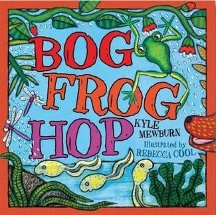
Bog frog hop by Kyle Mewburn
Ill. by Rebecca Cool. Little Hare, 2012. ISBN 978 921714 58 0.
Warmly recommended. Picture book. Rhyming story. The black outlined
illustrations frame each page as the words are read, either aloud to
a group or by oneself, drawing the eye into the picture of ten
pollywogs swimming about in the soggy bog. All around the soggy,
mossy bog is their home while they wait to become frogs. As each
pollywog grows its legs and jumps out onto the mossy log, so the
rhyme tells us that there are now nine pollywogs left. Each double
page spread tells us of the next pollywog to become a frog and leave
its compatriots, until the last page where there are no pollywogs
left. A scruffy dog watches the proceedings eager to be part of it.
The action sees the focus of each page move from the pond where the
pollywogs are living, to the mossy log where finally ten frogs
reside. The bold illustrations will entice the reader into counting
the number of pollywogs and frogs, searching for other creatures
that live in the bog, reading aloud some of the splendid words used
in the rhyme. The sounds of the bog are in bold print, splash, glip,
drip, drop, woof, croak and so on, each word redolent of sounds
heard and readers will love to sound them out and practice saying
them as the book is read. The old Middle English word, 'pollywog',
meaning tadpole, will amuse and delight readers, and make a neat
starting point to talk about language, or the environment, or
rhyming stories. Some classes may be lucky enough to have access to
tadpoles and frogs so giving the book an extra resonance.
Fran Knight
Losing it by Julia Lawrinson
Penguin Australia, 2012. ISBN: 9780143205654.
(Ages: 16+) After writing two historical YA novels (Bye, Beautiful,
2006 and The Push, 2008), Lawrinson has returned to a contemporary
setting, and a lighter tone. Although, in choosing to write about
four girls challenging each other to lost her virginity, Lawrinson
has not shied away from contentious subject matter.
Bree, Zoe, Mala and Abby have been best friends, and the school's
resident Geek Girls since they won scholarships to the prestigious
local Anglican school. Now, starting Year 12, bonding over a bottle
of vodka, the girls take up a dare by Bree to try to lose their
virgin status before schoolies week.
The narrative is structured into four parts, with the girls each
chronicling her own story. We start with Zoe, move onto Abby, then
Mala, finishing with Bree. The girls all think they know each other
well, but secrets and layers and fears are revealed and the girls
emerge as individual, distinct and flawed. There are moments of
awkward fumblings in a Ford Yaris, and an embarrassing encounter
with a migrant grandma, which although are familiar and somewhat
predictable, are described with precision and clarity, and are
basically very, very funny. The sex scenes are not graphic, but nor
do they occur off-stage, so parents and educators need to be aware
of this fact.
Despite the seemingly heavy issue, Lawrinson handles it with a deft
and humorous touch, allowing her messages to come through with
warmth and affection as opposed to melodrama and angst. She neither
judges or condones the girls' behaviours or choices; instead she
asks readers to realise that everyone has baggage and there is no
one way, or right way to connect with another person intimately. The
ending is perhaps too neatly and quickly resolved, but
speaking for myself, I was satisfied to see the girls stronger and
more confident, and most of all, happy.
Trish Buckley