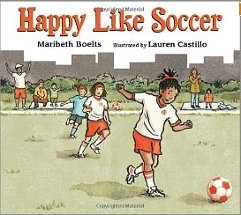
Ill. by Lauren Castillo, Candlewick Press, 2012. ISBN 978 0 7636
4616 5.
(Ages: 6+) Warmly recommended. Picture book. Sierra knows that
soccer is the thing which makes her the happiest of all, but it is
also sad, as her aunt cannot be there to see her play. Each Saturday
she is picked up by the coach and driven to the pitch many miles
away. She would love her aunt to be there. When their match is
delayed by rain, she has an idea and asks the coach if they can play
in the vacant allotment next door allowing her aunt to watch. He
readily agrees and so Sierra has all her happiest times together at
last.
A lovely story extolling the virtues of family and resolution, this
story with its bold, seemingly simple drawing style will appeal to
many children. All of those who love soccer will be absorbed while
those who live in the city and know the problems of getting a spare
space to play in will also read it with pleasure. There are many
subtle things about this book which will appeal to the younger
reader. The family in this story is not the classic family, the two
sharing a bedroom in their little house, one of a group of small
terraced houses, and the vacant allotment next door, is not the most
ideal place to play soccer. Portraying a child not normally seen in
picture books is encouraging and the neat resolution of her problem,
one that can be discussed and emulated.
Fran Knight
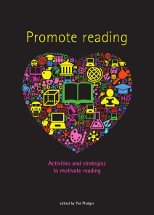
Promote Reading: activities and strategies to motivate reading edited by Pat Pledger
Pledger Consulting, 2012. ISBN 978 1 876678 27 2.
Highly recommended. Promote Reading is an invaluable resource for
teacher-librarians, librarians and teachers alike, in the National
Year of Reading. The variety of strategies outlined and their
interactive nature are just two of the highlights within this
collection of ideas.
I was particularly taken with the ideas involving digital technology
such as QR Codes, Wordle, Pinterest and Glogging and I am looking
forward to introducing these to my students. Links are given to
print and digital resources while the content throughout is fresh
and relevant with reference to the Australian Curriculum and
emerging technologies.
The ideas suggested within this resource can be undertaken in either
a short time frame such as within a lesson (Wordle, Shelf talkers
and the Graffiti wall) or can be incorporated over time into a unit
of work (Literature Circle: Year 5 Australian Colonies, Book Clubs
and the Book Week passport). They are appealing to even the most
reluctant reader and staff are provided with inviting, practical and
creative strategies to assist them in promoting reading to students
from R to 12.
This resource is very much like an inviting pool on a hot summer's
day - you are encouraged to dip into it again and again.
Tara Burton
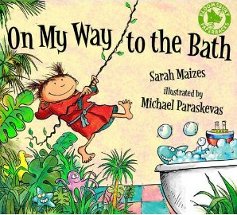
On my way to the bath by Sarah Maizes
Ill. by Michael Paraskevas. Bloomsbury, 2012. ISBN 9781408825884.
(Ages: 6+) Recommended. Picture book. Humour. What a treat, Mum
calls for Livi to come and have her bath, but Livi has too many
other things to do between her toy strewn bedroom and the bathroom.
There are statues to build, somersaults to practice, music to dance
to, her guinea pigs to talk to, a jungle to explore while all the
time mum's voice is becoming more insistent, as her speech bubble
gets bigger and bigger, using all the words that many children hear
over and over again. The repetition of the opening phrase on each
page, 'On my way to the bath', will encourage children to join in,
and the story of all the things which occupy Livi's attention will
be familiar.
The illustrations, in bright, bold colours will delight younger
readers as they spy all the things included on the page. Livi's cute
face smiles out from the front cover inviting children to open the
book, and her antics will ensure that they will read to the
end. The interaction with her family is lovely, underlined by the
drawings of the baby and sister, and long suffering mother, while
the images of the adventures she has on the way to the bath will
encourage interest and discussion.
Fran Knight
Wired up series by various authors
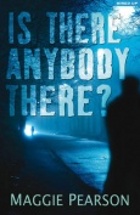
A and C Black, 2012. Begging letter by Judi Waite. ISBN 9781 40814264 6. Is there anybody there? by Maggie Pearson. ISBN 978 1 4081
4261 5.
(Age: 11+) Recommended. High interest, low literacy. Two strangely
different stories in this wonderful Wired Up series of books
from England, will be readily picked up by students wanting a quick
read. Those with a lower literacy ability but wanting something a
bit grittier than those usually published in 60 or so pages with
wide margins and larger print, will love all of this series. Begging letter has Connie sending a letter to the Universe.
The love of her life has a steady girlfriend, Megan and so she begs
the Universe for Josh to drop Megan and go out with her, but when
she sees Megan the next day with her beautiful hair cut off and Josh
asks her out, she begins to wish her wish to be undone.
A different take on the adage, be careful what you wish for. Is there anybody there? revolves around a seance, where
several teens use a pack of lettered cards to call on a dead person.
They give him a name, age and job during WW2, and are very scared
when the person becomes real. At first they all blame each other,
but when one is knocked off his bike, and one continuously draws the
face of the man called Tom, things become seriously creepy.
This is certainly a scary story and one which could be used as a
model for writing in the classroom.
Fran Knight
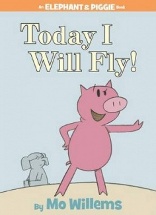
Today I will fly by Mo Willems
Walker Books, 2012 (2007). ISBN 978 1 4063 1467 6
(Ages 4-5) Picture book, Virtues. With the look of a reader, this
story in the Elephant and Piggie series is a simple tale of trying
your hardest to do something even though everyone tells you that you
cannot do it. Piggie wants to fly but Elephant tells him that he
will not fly. He tries different schemes to be able to fly,
enlisting the help of others. He never gives up and at the end of
the story repeats the refrain, tomorrow I will fly.
The book has simple line drawings and no background giving it the
appearance of a cheaply produced reader. Its contents are
encouraging, with repetition, 2 main drawings that repeat on each
page, of the elephant and pig, and a simple single theme of keeping
on trying no matter what. In a class where virtues are being
actively taught, or at home where the parents want to talk about
doing your best, then this will have a place.
Fran Knight
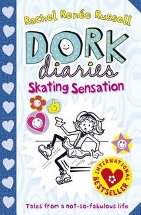
Dork Diaries, Skating Sensation by Rachel Renee Russell
Simon and Schuster, 2012. ISBN 978-0-85707-119-4.
(Age 8-11) Recommended. SQUEEE!!! Nikki is back writing in diary
number 5 about her skating experience or rather lack of skating
experience. Nikki agrees to help her skating BFF's Chloe and Zoey
participate in a ice skating performance to raise money for the
charity, Fuzzy Friends. This charity has special meaning for Nikki
as her secret heart throb Brandon is closely involved with the
organisation.
The main problem is that she has no skating experience and
must perform in front of a large audience. Will it end happily? This
is just one of many problems for Nikki who has an annoying younger
sister, embarrassing parents and the attention of the stuck up
school nasty MacKenzie who constantly plots her dorky downfall.
This is a girl's version of Wimpy Kid, full of diary entries
on lined pages and sketches of all the dorky action. Strangely the
drawings have an unusual habit of showing Nikki and friends with
normal arms and legs but at times these are drawn in black with
white mitten hands and white feet. Not sure what that's about.
There are lots of OMG! ARRRGH!!! and smiley faces scattered
throughout the text. Nikki does love her exclamation marks.
This is a very American text with a white Christmas and skating as
the theme but Nikki's feelings and experiences will be understood by
Australian pre teen and young teen girls.
I know this has appeal for many students, who enjoy this chatty,
diary format told from the viewpoint of the good kid who gets a
rough deal but ultimately wins in the end . . . and yes there is
another diary coming soon.
Recommended for 8-12 year olds
Jane Moore
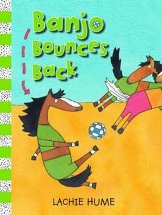
Banjo bounces back by Lachie Hume
Scholastic, 2012. ISBN 978 1 86291 846 7
Picture book, Ages 4-6, Team work
Banjo loves Hoofball, and plays with his friends on Saturday in
their team called the Winnies. He loves practicing his techniques
with his friend, Bella. But one day while jumping up high to get the
ball, he falls and hurts his ankle. The doctor, Dr Gray, orders him
to stay at home and rest for 6 weeks, and during that time, Banjo
lies about playing Haystation and eating lots of molasses.
When he comes to play again, he is no longer a star, as he has put
on weight and his neglect of practice sees him lacking his usual
skills. He becomes more despondent and takes to his bed, doing the
same things he was doing before, playing Haystation and eating
molasses. He shuns his best friend, Bella, but on hearing that she
is in hospital, comes out of his shell and visits her. She is
worried that she will miss the finals, and Banjo decides to get fit
enough to help her regain her place in the team. Together they work
hard at playing with the team once again.
A neatly resolved story of team work and working together to achieve
a goal, this brightly illustrated book will have wide appeal with
junior primary classes where these themes are under discussion. And
the humour in the language used, bringing in horsey words will not
be missed by the very young.
Fran Knight
Karrawirra Parri: walking the Torrens from source to sea by Mike Ladd
Photographs by Cathy Brooks. Wakefield Press, 2012. ISBN 978 1 74305
019 5.
(Ages: 12+) Recommended. Non Fiction. Environment. This handsomely
produced handbook of walking along the River Torrens from its Mount
Pleasant beginnings, through the hills and suburbs of Adelaide on to
its outlet at Henley Beach will beckon even the moot casual reader
to don their sneakers and take a stroll.
Each page builds an image in both words and pictures of a water
course moulded and changed by its surroundings as new settlements
were added with Adelaide growing beyond the first campsites of the
European settlers in 1836. Ladd strolls through early settlements,
marked now only by a hearth, or stone wall, following the water
course as it becomes a larger stream and then a river. Smetana's
Moldau kept coming to my mind as I walked with him, reading out loud
the snatches of verse by Wordsworth, Brooks and others, as well as
Ladd's haiku interspersing the engrossing commentary.
With only an outline map at the beginning of the book, showing the
river through the various Hills communities and suburbs, I needed to
grab a more detailed map which showed where access to these
beautiful spots was available. But this is a small quibble in
reading this absorbing travel book which gave some wonderful tidbits
of information. The history behind the name of Dernancourt, for
example, or the lists of introduced vegetation, native birds and
flowers, the story of the body in the Torrens in 1908.
With the upper reaches being in part through private land, his
meeting the Linear Park at Athelstone, meant an easier walk along
the areas begun in 1979 to preserve the banks of the river and its
wetlands, aiming for flood mitigation. The 35 kilometre stretch to
Henley Beach is a wonderful resource, and I can remember the angst
when it was first proposed.
First written as a series of article for The Adelaide Review,
Wakefield Press has published the complete set in what will
certainly delight the armchair traveller, and be a guide to those
who want to set out and stride it for themselves.
For students looking at the environment of Adelaide, then this is a
stunner as a wide perspective of the river is given, drawing in a
myriad of detail: the Aboriginal people both in the hills and on the
plains (Peramngk and Kaurna) the naming of the suburbs, the dams,
weirs and reservoirs, the flora and fauna, the poetry and small
details. I was surprised at how many times the black and red markers
were mentioned, and a catalogue of deaths along the river, or the
overgrown patches of introduced weeds and the kindness of strangers.
Not an academic tome, but a richly detailed story of one man's walk
through an area we all know about, but do not really know.
Fran Knight
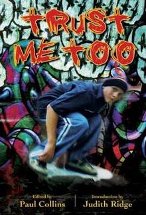
Trust me too edited by Paul Collins
Introduction by Judith Ridge. Ford St Publishing 2011. ISBN 978
19121665585.
(Ages 11+) Recommended. Short story collection. With writers like
Phillip Gwynne, Jack Heath, Deborah Abela, Janeen Brian and many
more (nearly 60!) contributing stories to this large compendium of
stories, there cannot be any reader who is not covered. Spoilt for
choice, I had trouble dipping into the book, with such a wonderful
array of well know and new authors to choose from. So I began at the
beginning and ploughed my way through, laughing at some, stifling a
tear at others, amused at some, and scared by others, perhaps
skipping and skimming a few that did not grab me at once, but then
returning to try again when I finished the book. What a treat it all
was. From the sublime pictures by Shaun Tan, to the short poems by
Leigh Hobbs and Christine Bodgers, and writings by David Miller,
Gary Crew and Simon Higgins, as well as the longer story by Isobelle
Carmody, each is quite different from the other. Old favourites,
Hazel Edwards, Justin D'Ath, Archimede Fusillo, rub shoulders with
newcomers, names I had not heard of but will watch out for.
Standouts were Phillip Gwynne's tale, Led Zep, aligning the
older and younger generations, Kirsty Murray's The night swimmer,
with its eerie overtones, and Meredith Costain's poem, Shoegitti,
giving an explanation to why those shoes appear on electricity
lines.
This is the second book produced by Paul Collins (the first, being Trust
me) which will fill a niche in upper primary and lower
secondary schools where a neat group of short stories is required,
but also will be picked up by those who want an array of stories to
read, dipping into the depth of a group of authors before tackling
their novels.
Fran Knight
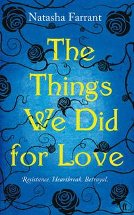
The things we did for love by Natasha Farrant
Faber and Faber, 2012. ISBN 9780571278176.
(Age: 14+) Highly recommended. As World War II rages through Europe,
in a small French village of Samaroux Arianne and Luc fall
passionately in love. However, it doesn't take long for the German
forces to close around their little disregarded town. Luc is
unexpectedly summoned into the dangerous world of Resistance, where
he is eager to atone for his family's troubled past. Arianne
is prepared for anything in order to keep Luc safe at any cost. But
there is someone else to whom Arianne is dear. Who also loves her
and would stop at nothing to get rid of the opposition. The things we did for love by Natasha Farrant is a
devastating story of first love and war, heartbreak and betrayal.
This book will never be forgotten.
It is a book that attracts people with its simple, yet fascinating
cover which features a few black roses scattered on a deep blue
background. Such image already gives the readers an idea that this
novel would be of a serious kind. Natasha Farrant's powerful writing
perfectly explains the conditions of what a life is like during war.
Main characters, such as Arianne and Luc struggle to keep each other
safe, ready to sacrifice anything in order to protect one another.
Their personalities are introduced in a fabulous way, starting with
what their childhood was like, ending with their current behaviour.
Characters develop throughout this amazing novel, which makes it
particularly interesting to read.
Although it is a book about war, the beginning wasn't really cruel
or vicious. Introduction was more of a general story about a long
forgotten village in France. It was a peaceful town, not involved in
the war. Nevertheless I didn't expect the ending to be so violent
when the town was taken by the Germans. The conclusion to this novel
was rich with descriptions and really enthralling. It was impressive
what a war could do to people and how it erased every bit of humane
approach from the German intruders.
Overall I would say that this was a remarkable book. It was written
with great attention to the actual history of the French Resistance.
However I must say that I was entirely astonished when I realized
that this book was based on actual facts. As Natasha Farrant said,
'My book is a story, my characters fiction.'
I highly recommend this book.
Nika Aroutiounian (Student)
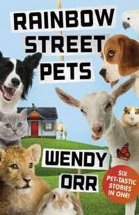
Rainbow Street pets by Wendy Orr
Allen and Unwin, 2012. ISBN 978-174237-908-1.
(Age 8-11) Recommended. Pet stories are very popular with children
and this is an excellent collection of six stories in one book.
Each chapter features an animal and tells how they became involved
in the Rainbow Street Animal Shelter. The stories vary from a lost
dog, an unwanted lion cub and a stolen horse. Of course they are not
only stories of the animals but of the people who are involved with
them, the separated owners, the animal shelter workers and the
eventual new homes the animals find.
Children who want a pet of their own will identify with the longing
of the children in this novel, but Wendy Orr demonstrates that
although a pet brings love and companionship there are
responsibilities as well, such as grooming, cleaning, exercising and
training.
These heart warming stories often connect to each other, with
characters appearing in more than one chapter. Each story has a
happy ending and there is an obvious concern for the welfare of the
animals. Photographs of the animals feature inside the book in
black and white as well as in colour on the bright and appealing
front cover.
This is a fairly large novel for its intended reader with over 350
pages but as the book is broken up into the individual stories I
feel it is not overwhelming and children will want to read every
animal's story and even reread it again!
Recommended for children, 8 to 11 years.
Jane Moore
Messy by Heather Cocks and Jessica Morgan
Allen and Unwin, 2012. ISBN: 9781742379760.
(Age 13+) Recommended. This is a surprisingly funny and entertaining
novel. The blurb might suggest that it is simply going to be Gossip
Girls meets 90210 but in fact, it is far more engaging and
insightful than this would imply. This is largely due to the cynical
edge of the main character, Max. At the opening of the story she is
a self-confessed misfit at her Mum's prestigious school: she is
scornful of most of her wealthy classmates who she judges to be
superficial and self-absorbed. None more so than pretty blonde
Brooke Berlin, daughter of action hero (and diet obsessed) Brick
Berlin.
So it is somewhat surprising that Max should lower her standards and
agree to ghost-write Brooke's new blog, which is intended to raise
Brooke's celebrity profile. However, Max loves to write and she has
a dream of attending NYU over summer to participate in a writing
course. Such a dream requires money and unfortunately for Max,
Brooke is offering plenty.
The blog entries on Open Brooke are one of the highlights of the
book, which is to be expected as the writers are famous for their
own celebrity fashion blog. Max writes sharply and perceptively
about the world of celebrities and show-business and the results are
highly amusing and entertaining.
Although this is the second book featuring some of these characters,
the reader does not need to have read Spoiledin order to enjoy
Messy. As is to be expected in a teen novel about Hollywood there
are plenty of pop references to TV shows, films, celebrities and
modern music. Whilst this novel is firmly set in its LA environment,
this is a scene that will be familiar to many Aussie teens. And, of
course, there is just the right amount of romantic entanglement to
keep teen readers satisfied.
All in all, Messy is an entertaining novel which is sure to appeal
to teen girls.
Deborah Marshall
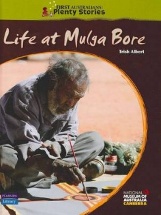
First Australians: Plenty Stories (series) by Trish Albert
National Museum of Australia, 2009. Life at Mulga Bore. Indigenous sporting heroes.
24/32pp, col ill.
First Australians: Plenty stories is a series of books showing what
it means to be an Aboriginal or Toorres Strait Island person in
Australia today. Through different modes of storytelling, we are
given some of their history and culture through stories, snapshots
of people, photographs and a fact file. Each book is colourful, easy
to read with large print and wide margins, with a brief but useful
index, contents page and glossary. For classes looking for two most
accessible books to give their students when researching Aboriginal
life today, then these would be most useful.
I was only sent these two, but looking at the National Museum of
Australia website, you can see that there are many more. 2 packs are
made for primary students with 9 books and teacher notes in each. A
teacher resource book and a poster pack can be bought as well. All
can be ordered online from the National Museum of Australia.
The first, Indigenous sporting greats, has Nicky Winmar on the cover
in what is now a famous photo of him showing his skin to people who
were racially abusing him. Inside the book are outlines of a range
of Aboriginal and Torres Strait Island sports people, Jerry Jerome,
Eddie Gilbert, Sir Doug Nicholls, Evonne Cawley, Cathy Freeman,
Michael Long, as well as the front cover person, Nicky Winmar. Each
double page gives a potted history of that person, with a small fact
file and several photos. Each is informative and tells of the
struggles that person had to achieve what they did.The introduction,
Against the odds, frames the stories, showing that these people did
in fact achieve against the odds, and the final section poses the
question about sport being a place where all players can respect one
another. Life at Mulga Bore is part of the upper primary set group of books
and has 32 pages, with many more illustrations and information.
Mulga Bore is a small community north of Alice Springs, and is home
to seven related families of the Anmatyerr group of people. One of
their number, Lindsay Bird Mpetyane is a painter, and through the
book, we are shown him painting Bush Plum Dreaming. Through this
painting we see and hear about his lifestyle, his painting methods,
his background and how the community survives. It is a bird's eye
view of the strength of a small community and its central figures,
and will enrich primary students' understanding of the lives of some
Aboriginal people today.
Fran Knight
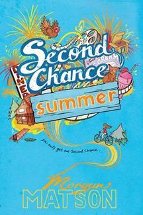
Second Chance Summer by Morgan Matson
Simon and Schuster, 2012.ISBN: 9781416990673.
(Age: 14+) Highly recommended. Second Chance Summer is Matson's
second book. Her first, Amy and Roger's Epic Detour, dealt with
serious issues in a mostly light-hearted way. This time she offers a
much more serious look at a topic that seems to be trending in YA
books this year: the cancer novel.
Much like John Green's lauded novel, The Fault in Our Stars,
Second Chance Summer steers away from sentimentality and cliche, and
the conclusion is devastating and confronting. However, instead of
the teenagers being the victims, in this book it is a parent who is
suffering.
The main character, Taylor's father, is diagnosed with pancreatic
cancer and given a poor prognosis. On the back of this news, the
family relocate to their lake house for the summer, a place they
have not visited for five years. Returning there is doubly traumatic
for Taylor. Clearly she must accept her father's chances, and on top
of that, the lake house is where she first fell in love. Henry
Crosby of course is now her next door neighbour, and for various
reasons it is awkward and confusing for both of them.
Matson doesn't rush this story. She doesn't skimp on details. While
the family crisis is dealt with in the present, Taylor's personal
dramas are provided through flashback as readers are slowly given
the reasons for the awkwardness between her and Henry. While these
are fairly predictable and minor, it is easy to understand why
Taylor behaved as she did. And their journey back to each other is
believable and enjoyable.
Dad's story, however, provides much of the heart of the novel. He
wants this chance to reconnect with his children, and there are some
very moving scenes as he tries to leave his family without too much
sadness and trauma. These serious issues-based YA novels are always
well received by mature readers, especially girls seeking something
akin to the books of Jodie Piccoult. Themes include grief and loss,
family relationships, death and dying, and friendship and romance.
Trish Buckley
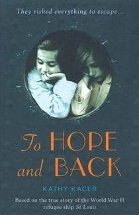
To Hope and Back by Kathy Kacer
Allen and Unwin, 2012. ISBN: 9 781743 310632.
Recommended. To Hope and Back is truly the kind of book that
will keep you up at night, the novel, a powerful biography
recounting the journey of two young people and their families aboard
the St Louis, tells a compelling tale about the black and
white world of Jews during the Holocaust. Free of many of the gory
truths of the time this gripping novel is sure to horrify and
provoke sympathy in any man woman or child.
Sol and Lisa know that they are lucky. Germany is being thrown into
chaos and even at their young ages Sol and Lisa are well aware of
the anti-semantic views of the German Government. Years of caution
bought their families the time that they needed to scrape together
enough to afford a ticket out of the soon to be war-torn country.
Boarders of the St Louis believe that they are leaving
Europe for good and travelling to the safety of Cuba and then on to
America and Captain Gustav Schroeder is determined that they should
never return to Germany to face the inevitable Death Camps. But when
politics gets in the way of bringing the St Louis into
harbour can the captain succeed in saving his crew?
These true historical events recounted through the life affirming
stories of Sol and Lisa are sure to bring even the hardest hearted
person to the verge of tears. Kathy Kacer has captured the sense of
hopelessness aboard the St Louis and brought it again to
life through the power of the written word. I would happily
recommend this novel to be read by anyone interested in history and
urge teachers to keep in mind that it would be a brilliant point of
reference to be used in class regarding the events of the Holocaust.
Kayla Gaskell, (Student,age 16)