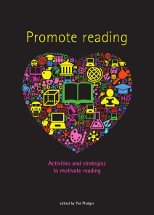
Pledger Consulting, 2012. ISBN 9781876678272.
Highly recommended. This is a must-have book for all school
libraries, both primary and secondary. It provides a terrific blend
of practical and theoretical approaches which can be used in the
library and in classrooms to promote reading. Helpful hints for
displays and book reviews are provided as well as a range of
activities. Some of these activities are easy to organise (such as a
graffiti wall) whilst others may take longer to prepare but would be
equally engaging (such as book spine poetry and book speed dating).
Some could be used all year round whilst others pertain to special
events (such as Book Week). There are several suggestions for
collaboration between library staff and classroom teachers (such as
Literature circles or Readers Cup events). The inclusion of
strategies that make use of free Web 2 tools (such as QR codes,
Wordle and Glogster) is particularly welcome as such tools are not
only attractive to students but also beneficial to the library
budget. Fortunately, source material, samples of work and relevant
links to websites are provided throughout, which makes this an
extremely useful text for library teams.
Contributors to this text come from a number of Australian states,
from private and public school sectors and from both primary and
secondary schools, so a range of experience and relevance is
ensured. Longer articles provide a solid theoretical basis for the
promotion of reading and the attached bibliographies provide a
wealth of opportunity for further study, or may be useful for
library advocacy. Two fascinating articles are based on action
research projects which focus on boys and reading. Whilst both
projects were based in American schools this does not detract from
their relevance to Australian school libraries, rather it indicates
the universal nature of some reading issues.
The contents page is organised in a logical and clear manner and the
index is equally useful. All in all, this book is not only a
wonderful resource for those working within school libraries it is
also a testament to the creativity and knowledge to be found within
the library profession.
Deborah Marshall
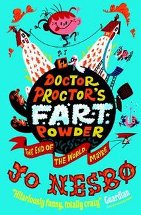
Doctor Proctor's fart powder: The end of the world Maybe by Jo Nesbo
Simon and Schuster, 2012. ISBN 978-0-85707-389-1.
(Age 8-11) Recommended. This is the third book in the Doctor
Proctor Fart Powder series and any title that contains the
word fart will have an appeal to the younger audience. Jo Nesbo is
certainly having fun writing these stories, a far cry from his dark
murders.
Doctor Proctor has invented a fart powder which when swallowed can
give the consumer a rocket type lift off which comes in handy when
you need to escape or arrive somewhere very fast. The diminutive red
headed Nilly and trombone playing Lisa are the Doctor's friends.
They work as a team trying to solve the puzzle of the invasion of
the fearful moon chameleons, creatures that can take on any shape
and love to eat humans.
The story is set in Oslo, Norway and contains lots of local
references and funny word play such as the Norovision Choral
Throwdown, (Eurovision) BABA (ABBA) and De Beetels (The Beatles).
I'm not sure children will understand all of these but it won't
affect their enjoyment of the book.
It is a long read, 458 pages and I lost interest well before the end
of the story but I am not the intended audience.
The books have bright and eye-catching covers and will appeal to
children 8 to 11 years old who have reading stamina.
Jane Moore
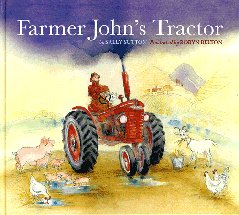
Farmer John's tractor by Sally Sutton
Illustrated by Robyn Belton. Walker Books Australia. ISBN:
9781921150944.
Farmer John's tractor lies locked in the shed, rusty yet trusty, and
orangey red . . .
So begins a story with beautiful cadence, touching simplicity,
gorgeously soft illustrations, and a powerful, yet subtle message.
It's winter, and the rains come, filling the river and blocking the
drains. The banks burst, and the river is in flood. Mum, Dad and the
girls are trying to cross the river, and they become stranded.
Various vehicles try and come to the rescue - the jeep comes, but
rolls on its side. The tow truck comes, but gets stuck in the muck.
The girls are frightened, the water is rising, and STILL, Farmer
John's tractor lies locked in the shed.
The fire engine comes, and proves just as useless - the little girls
are now standing on the roof of the car, where they start to shake
and quake and sob - just when it seems like all is lost, aid comes
from an unlikely corner, and all is well again.
I read this book to a reluctant four year old. It was a joy to watch
his face as I read - he was really drawn in to the plot of the
story, and the suspense was palpable. The illustrations are
magnificent, and really support the story.
A beautiful book, with a wonderful message - sometimes the quiet,
unassuming, and unlikely hero is the one that saves the day.
Freya Lucas
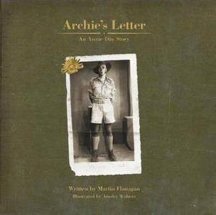
Archie's letter by Martin Flanagan
Ill. by Ainsley Walters. Scholastic, 2012 ISBN 978 0 9807948 7 8.
(Ages 10+) Warmly recommended. War. There is a huge range of books
about Australians at war coming out, probably being printed in time
for the 100th Anzac Day in 1915. Many are about the Anzacs and the
beginning of the legend, some about other theatres of war, telling
stories from personal perspectives and a few are about animals in
war.
This book relates to the Prisoners on War held by the Japanese after
the Fall of Singapore in 1942. Many men were transported to camps
and some sent to Burma where they slaved over the building of the
Burma Railway to enable Japan to service their troops. Thousands
died along this line, many were Asian slave labour but 2,500 were
Australian troops. This book attempts to reveal some of what the men
suffered, first in the POW camps, where Weary Dunlop was the medical
officer, then onto the Burma Railway and finally in a POW camp in
Japan.
Martin Flanagan's father, Archie, wrote a poem about his experiences
in the Middle East and this is reproduced along with strong
illustrations depicting the scenes described and photographs of the
Flanagan family.
This little book gives a personal face to the stories student have
heard about Changi, Weary Dunlop, Burma Railway and POW camps. Its
brief outline of where Archie went allows students to see where many
Australians fought and died close to Australia, defending this
country against the southern drive by the Japanese.
This book will be a useful supplement to student reading about the
war, giving a personal perspective which will draw the students in.
Archie's letter at the end of the book will be especially poignant
to the readers.
Fran Knight
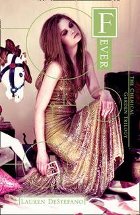
Fever by Lauren DeStefano
The Chemical Garden Trilogy, Book 2. Simon and Schuster.
ISBN: 9781442409071.
(Age: Older teens) Fever starts very strongly, following
immediately on from Wither. Rhine and Gabriel are on the
run, and must rely on their wits to avoid being recaptured.
DeStafano's dystopian world is depicted in two contrasting
landscapes: inside buildings, tents, and structures where there is a
clear sense of being trapped, with threats of violence and worse,
and outside, which is described in beautiful lyrical language
portraying nature and freedom. There seems not to be anything in
between.
Unfortunately, as the story progresses, the plot loses focus. A
predictable pattern follows in which the two lovers are captured,
exploited and drugged, and attempt escape (with the help of
sympathetic minor characters who for reasons of their own, put their
lives at risk). Then there is further capture, separation, and more
drugs and experimentation. Interestingly, the first person, present
tense narrative doesn't allow readers to connect with Rhine. She
remains distant and cold, but considering she is often drugged and
partly unconscious, this isn't surprising.
Rhine's desire to find her brother Rowan was a dominant feature of
the first book, however in this one, he's almost completely
forgotten. Gabriel, the love interest, doesn't seem to have any
distinct personality traits apart from being totally in love with
Rhine. The evil character, Vaughan, is menacing, and Lyndon still
seems weak and clueless.
Although once again the novel ends in a cliff-hanger, the lead-up is
mostly low key. There are some revelations, but it's not
heart-thumping stuff. Overall this book was disappointing. While
Gideon and Rhine are in captivity they are fed drugs and made to
'perform' for voyeurs, however the majority of the action is only
hinted at. It's definitely for older teens. Themes include dystopian
futures, diseases, love, and family.
Trisha Buckley
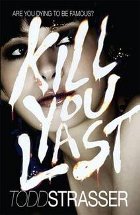
Kill you last by Todd Strasser
Thrillogy series. Walker, 2012. ISBN 9781406329940.
(Age 14+) Recommended. Crime. Mystery. Thriller. Reluctant readers.
A finalist in the 2012 Edgar awards, this book got me out of the
dystopian doldrums and into a fast moving, engrossing mystery.
Shelby's father is a photographer who takes shots of teens who want
to be models. When three teenagers go missing and the only link
between them is the fact that her father took their photos, Shelby
investigates to help clear her father. With the help of Roman, her
best friend, and Whit a journalist student at a nearby college, she
starts to uncover secrets, secrets that she would prefer not to
know.
This is an action packed novel. Strasser builds up the tension as
Shelby begins to get e-mails asking her if she knew the truth about
her father and finally one that that threatens to kill her last. As
Shelby gets closer to the truth she believes that she can't trust
anyone, not even her best friend. She is also uncertain about Whit
and whether he is interested in her or in following his journalistic
instincts and getting a scoop. There are plenty of red herrings
scattered throughout the book and it was not until the final pages
that I guessed who the murderer was.
One of Shelby's big fears about whether or not her father murdered
the missing girls is the fact that she knows her father is sleazy.
He makes inappropriate remarks about her friends and their bodies
and loves to photograph young girls. There is a subtle message in
the background to girls to be sure not to be taken in by
photographers and handsome boys who say that they can give you a
beautiful portfolio of photos to help you make it as a model.
Having her father under suspicion for murder forces Shelby to grow
up and face reality. She tells her story in the first person and I
grew to like her determination to find out the truth and willingness
to acknowledge that wrongdoing must be punished even if she loves
the person who is doing it.
Teens will love the technology, the text messages, use of Blackberry
and iPads and anonymous e-mails that help to create a scary mood in
the book. There are two other books in the Thrillogy series, Wish
you were dead and Blood on my hands. Judging by Kill
you last, which was quick read, with short chapters and plenty
of action, this series would appeal to reluctant readers.
Pat Pledger
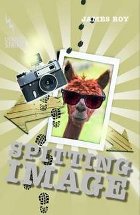
Spitting image by James Roy
Lightning Strikes series. Walker Books, 2012. ISBN 9781921977497.
(Age: 11+) Recommended. High interest, low literacy. When
Charlie and his sister, Helen are taken to the zoo for the day, they
are most disappointed to find the zoo is a farm zoo, chosen mainly
for their baby sister, not them. Dragging themselves around the farm
looking at the sheep, the pigs, the alpacas and the milking
demonstration is not quite what they bargained for. Helen takes many
photos and decides to climb up on the alpaca's railing to get a
better photo, so falling into its enclosure. The farmer tells them
off, opening the gate for her, but she jumps the fence instead.
Later, they see the alpaca out of its enclosure and try to help
round it up to take it back home, lest they get into any more
trouble with the farmer. There follows a very funny adventure trying
to get the animal to do as they want, with an annoying younger child
with a camera trailing them, and discovering there is more than one
alpaca out of its enclosure.
All is neatly resolved however, and the reader will be doubly
intrigued with the information gently included in the story. Another
superior story within the Lightning Strikes series for those with
less able literacy levels and those wanting a quick read, with a
good story and well rounded characters.
Fran Knight
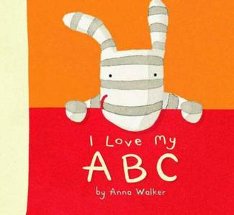
I love my ABC and I love my 123 by Anna Walker
Scholastic, 2012.
ISBN: 9781742831510 (I love my ABC)
ISBN: 9781742831527 (I love my 123)
These sturdy board books make the perfect introduction to the world
of Ollie, the zebra, who is the hero of many books by Anna Walker.
These simple books, with vibrant colours and cheerful illustrations,
are a lovely way to introduce literacy and numeracy to the under
2's.
In I love my ABC, Walker presents Ollie walking through the
pages, with each page featuring both upper and lower case letters,
and Ollie interacting with something beginning with that letter. The
selections are simple and predictable, with the usual minor quibbles
of some of the letters not lining up with their phonemic friends (i
for ice cream, x for xylophone). The text encourages interaction
between the reader and the readee - identifying pictures and naming
letters and sounds.
In I love my 123, Walker again uses Ollie to introduce
concepts of 1 to 1 correspondence. Ollie walks from 1 to 10, with
each page featuring the allocated number of objects, the numeral,
and the text for the noun group. The white pages really allow the
rich colours to soar, and the grey text supports this.
At the end of the story, Ollie is shown frollicking in the garden,
with all the objects from the story, which is a lovely touch.
Babies and toddlers will delight in Ollie's adventures, and learning
to count is a bonus!
Freya Lucas
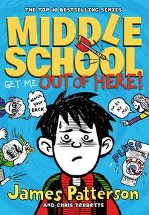
Middle School: Get me out of here by James Patterson
Young Arrow, 2012. ISBN 978-0-099-56753-0.
Suitable for 9 to 12 year olds. What to read after the Wimpy Kid
stories? Well here's another choice. This is James Patterson's
second novel about Rafe Khatchadorian, the first being the New York
best seller Middle Years, The Worst Years of My Life.
Due to unfortunate circumstances, Rafe with his mother and sister
have to move the big city and share cramped accommodation in his
grandmother's flat. Good luck comes when the talented Rafe is able
to attend art school and finds himself a new friend. Bad luck comes
when he is threatened and harassed by new bullies.
Rafe seems to be in total angst about his life and often 'talks' to
his deceased brother Leo who gives him advice and helps him to
devise Operation Get a Life, concentrating on new experiences, not
all of them helpful. He also discovers information about his missing
Dad and a relative of his fathers.
So there is a lot happening in Rafe's life and at times he makes
some poor decisions. Maybe it is because I am an adult and an
educator but I felt uncomfortable with the way the bullying was
handled. I can't recall Rafe getting any support or confiding in any
adults at school or at home about some very serious bullying
including cyber bullying on the school website and vandalism of his
property at school. In fact he becomes involved in pay back which of
course doesn't work out well. Perhaps that's the lesson.
The book is packed full of Rafe's black and white illustrations.
There is a book
trailer to advertise the book
James Patterson is a very successful writer for both children and
adults and is passionate about reading and has a web site
Jane Moore
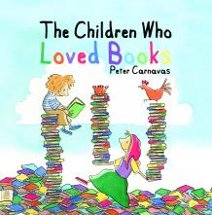
The children who loved books by Peter Carnavas
New Frontier, 2012. ISBN 9781921928161.
(Age: Pre-school-6) Recommended. Angus and Lucy love books. They
have so many of them that the caravan they live in becomes much too
crowded and the books have to go. But they don't have a
television or a car and without the books there was a lot of space
between the family members. Then one day they discovered Lucy's
library book and reading it brought the family closer together. And
when they found the library they knew they had everything they would
ever need.
Peter Carnavas has the happy knack of writing uplifting stories that
warm the heart and leave the reader feeling happy. Lucy and
Angas' family is portrayed as poor, living in a caravan and
having few material goods, a relatively rare occurrence in picture
books. However Carnavas beautifully shows that it is not possessions
that are the most important things in the world, rather it is the
closeness of family life, and that reading can make a family happy.
His signature soft water colours bring the life of the family alive.
There are little touches of humour like the chickens perching on top
of the caravan or pecking at the ground and a little ginger and
black striped cat on most of the pages. The drawings of the people are
memorable, with uplifted noses and distinct personalities.
This is a wonderful book that celebrates reading and the importance
of libraries.
Pat Pledger
The Phoenix Files: Fallout by Chris Morphew
Hardie Grant Egmont, 2012. ISBN: 9781921502439.
Recommended. This is the fifth book in The Phoenix Files
series and like its predecessors, the action is fast paced and
almost unabated. The clock continues to count down at an alarming
rate and as the story begins, there are only 14 days left. What is
intriguing about this series (and this book) is that the clock is
now ticking on more than one level: it is not just signalling the
end of the world, it is also ticking down towards the birth of
Jordan's brother or sister as well as Luke's likely murder. So the
anxiety levels have been significantly raised for both the central
characters and the readers.
The main focus of concern is still the future of Phoenix, and the
wider world, with the imminent release of Tabitha. But there remains
the daily problem of survival especially whilst living at such close
quarters in an underground shelter. As Jordan and Luke are all too
aware, just because everyone in the shelter shares a common enemy,
this does not mean their motives, or the actions they are willing to
use, are similarly shared. There is a constant undercurrent of
distrust among those living in the underground forces, a constant
fear of betrayal.
Perhaps one of the minor disappointments of the novel is that the
focus on action and intrigue leaves little time for exploration of
some of the moral dilemmas which are raised in the book, in
particular the fine line between justice and revenge. This means
that sometimes the characters seem just a little too one
dimensional.
However, few readers will be disappointed in the writer's ability to
spin an exciting story: just as one mystery is resolved in the story
another arises, so the reader is constantly being tantalised anew.
Morphew's sense of pace and his ability to provide a cliff-hanger
ending is to be celebrated because it has certainly produced an
exciting series and this instalment is no exception.
Deborah Marshall
Run, Jimmy, run by Malachy Doyle
Wired series. A and C Black, 2012. ISBN 978 14081 12592.
(Age: 11+) Recommended. High interest, low literacy. Jimmy steals
some money from his father's wallet and packs his rucksack to run
away. He has not thought any further ahead than that, wanting to
escape school and the bully, Daz. But on the train, he turns around
to find that Daz is on the same train. When the conductor comes to
take his ticket, Daz sidles up and takes Jimmy's, telling the
conductor that it is his, forcing Jimmy to pay again. When the train
comes into the station, Jimmy runs like hell, trying to escape the
bully, and several chapters show his efforts at shaking the boy off.
An involving short story, all readers will have some experience of
the fear that another person can engender, and feel for Jimmy as he
finds a safe place to be.
As with the other books in the Wired and Wired up series, these have
wide margins and larger print, designed to attract the child for
whom reading is a chore or difficult. The stories are all high
action, involving and well told, drawing the non reader into the
plot quickly and effectively. A quick read or one for lower literacy
readers, these fill a niche alongside Lightning Strikes.
Fran Knight
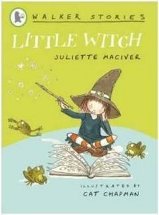
Little witch by Juliette MacIver
Ill. by Cat Chapman. Walker Books, 2012. ISBN 978 1 921720 48 8.
(Ages: 7+) Warmly recommended. Short stories. Three short
stories about the Little Witch are included in this attractively
produced, small hand sized book. Little Witch is not too keen about
her new baby sitter, but mum said that she is OK, and not to listen
to stories that others have told her. But her visit brings a whole
range of delights for the little girl, and she wants her to come
again, despite mum now realising that perhaps her daughter was
right.
In the next story we see Little Witch being cross with her mother
for serving up the same old cereal for breakfast, Toothflakes. She
wants the exotic lemon and slime ice cream like her friend Billy is
given to eat and mayhem ensues as she tries to get her way.
The third in this easy to hold book has 'wixed up merds' as its theme,
which is sure to have the readers trying their own as they read of
Little Witch's exploits in causing problem for her father.
All three stories will be cause for mirth amongst the middle primary
readers and the attractive drawings of the little girl and her
adventures by Cat Chapman will add to the merriment.
Fran Knight
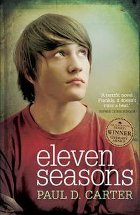
Eleven seasons by Paul D. Carter
Allen and Unwin, 2012, 9781742379715.
(Ages: 14-18) Recommended. This year's Vogel Prize winner, awarded
annually to an unpublished novel by a writer under 35, is a
coming-of-age story. The reader follows the progress of Jason Dalton
through late childhood, adolescence and early adulthood across
eleven seasons of Australian Rules football. In Year 7 the
fatherless Jason is sustained by football; trips to the AFL games
with his friend, his collection of football cards, his obsession
with his team, Hawthorn, help him through the lonely hours in his
apartment. His mother is loving but works double shifts in the hope
of buying a house, so she is either at work or sleeping. Jason does
his list of chores and goes to bed alone in the apartment every
night. At school he is a poor student, dreamy and unfocused, his
teachers say, and it is true that he is not interested in school. He
is passionate about building his footy skills; he keeps a record of
his solo practice sessions; marks, kicks, push-ups, passes are all
recorded. His mother eventually allows him to join a club although
she is clearly against him playing. He bonds with the club, the
coaches and players, and is recognized as having talent and courage.
He survives school but more importantly for him he flourishes in the
football world, which in time includes after game drinking and
marijuana. After thousands of workouts and training sessions he is
selected for the Hawthorn Under-Nineteens. His team wins the
Premiership, but this is the night when his mother tells him that
his father, a promising football hero, had raped her and that,
pregnant, she had to leave her home town. Devastated, Jason leaves
Melbourne and football. He wastes several years on the Gold Coast
where drugs and alcohol become too important. When he returns he has
to accept his history, learn how to relate positively to others,
particularly women, and to rebuild his relationship with his mother.
He plays football again, at the District level for money, finds work
in bars and once more becomes part of after game partying until he
witnesses a gang rape. He decides to travel to his mother's home
town to find his father or least settle some questions. The
character of Jason is well-established and believable; he is subject
to the temptations of teenage boys and often succumbs to them, yet
his mother's early care leaves its mark. The football games,
including Hawthorn Premiership wins in the 1990s are described in
detail, more interesting to some than others, but this is the kind
of obsessive detail that fans would perhaps relate to. The writer's
voice is sure and the language appropriate. Boys, and girls, who
love football will probably love this if they can sit down long
enough to read it. Recommended for middle level and senior readers.
Jenny Hamilton
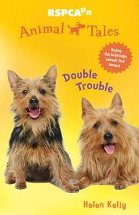
Animal tales: Double trouble by Helen Kelly
Random House Australia, 2012. ISBN 978-1-74275-330.
(Age: 7-10) Recommended. Two sweet and apparently well behaved
terriers look adoringly from the attractive front cover of this book
but the title Double Trouble indicates that this doggy
brother and sister are not as well behaved as they look.
Ben and his friend Cassie agree to look after the dogs, Tommy and
Tallulah while their elderly owner spends a few days in hospital.
Eating a school project, charging at another dog and running off in
the park are some of the antics that keep Ben and Cassie occupied
with the troublesome twosome.
This is a story about everyday children and the trials and
tribulations of caring for pets. Both children demonstrate kindness
towards the dogs even in stressful circumstances. Double Trouble is book number 3 in a series endorsed by the
RSPCA, with information about the organisation at the back of the
novel. Relating directly to this story, is the RSPCA's service of
looking after animals of older people who need to go to hospital.
With only 80+ pages of larger text, this series is aimed at children
who are 7 to 10 years old. It's not high action but will be
appealing to animal lovers.
Jane Moore