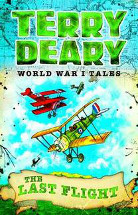
Bloomsbury, 2013 The last flight ISBN 9781408191682 The war game ISBN 9781408191743
(Age: 8+) Recommended. Historical fiction. World War One. Early
chapter book.
In the series, World War 1 tales, Terry Deary offers stories
that are not well known to his readers.
In The last flight, letters from Alfred to his sister back
home outline his extraordinary luck at not being sent to the
trenches during World War One. He was able to volunteer his
photography skills when the men were being photographed and so from
there moved into the Air Force where he and a pilot were sent to
photograph enemy lines before the push against the German Army in
1917.
The letters reveal a great deal of information about life for a
young man in the army at this time, and much of this would be new to
the age group reading this easy to absorb series of books. At just
60 pages, with large print, some informative illustrations, wide
margins and information added at the back about some of the things
mentioned in the text, this series of books will be readily picked
up by the target audience. In the back is an outline of the others
in Deary's series, Viking tales, Pirate tales and Victorian
tales. As yet there are only two in the current series about
war.
The second, The war game, outlines the story of Christmas
Eve in 1914, when Germans and British soldiers came together to
spend the evening together, playing a football match. Told through
the eyes of two men, Charlie and Alfred, the readers will absorb the
boredom of life in the trenches at the time, the orders given by
those above in rank, and the humanity of the ordinary soldiers and
their wanting to be safe at home. Bloomsbury's
website lists several more in this series.
Fran Knight
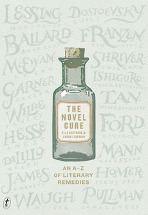
The novel cure: An A-Z of literary remedies by Ella Berthoud and Susan Elberkin
Text, 2013. ISBN 9781922079350.
This book is written in praise of literature as a cure for physical
and psychological ailments. It is organised under 'ailments', which
are arranged alphabetically and include topics both serious and
comical. The authors claim that Abandonment, their first condition,
can be remediated if not cured by reading Kent Haruf's Plainsong,
which shows how characters with losses have their needs filled by
surprising contributions from their community. The last condition,
Zestlessness, it is suggested can be cured by reading Doctorow's Ragtime,
an energetic capturing of life in New York in the early twentieth
century. Some of the discussions inbetween deal with equally serious
subjects, Insomnia, Happiness, Hatred, while others are
tongue-in-cheek, for example Itchy teeth (apparently a condition
described in Saul Bellow's Henderson the rain king and which
needs to be consulted for the cure) and Idiot, feeling like an (read
Dostoyevsky's The idiot!). The headings are beautifully
organised, with cross-references that work, and concludes with an
index of authors and titles. There are also lists of recommended
reading , under the heading of 'The ten best...' These include
recommendations for audio books, novellas, 'big fat tomes', for
'drowning out snoring', for 'reading on the loo', and for each
decade from the teenage years to the over one hundreds. The
recommendations are widely based, and include classics, little known
works of the twentieth century and very up-to-date publications.
Dickens is here, Austen too, and Cervantes, and so are Suzanne
Collins, John Green, Mark Dunn and Sam Lipsyte. The writing is
lively and entertaining, and following up the cross-referencing is
enjoyable. The discussions of the texts and sometimes the ailments
are usually insightful, though classics teachers would disagree with
the characterisation of Odysseus as having 'itchy feet'. This is an
energetic and entertaining approach to reading for adults, but is
appropriate for senior students and should be very useful for
teacher-librarians and teachers of literature. It is also great fun
too for a casual browse.
Jenny Hamilton
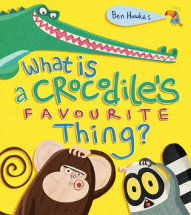
What is a crocodile's favourite thing? by Ben Hawkes
Jonathan Cape, 2013. ISBN 9781780080222.
One of the world's greatest unanswered questions - until now.
What IS a crocodile's favourite thing? Is it a racing car that
looks like a sausage or maybe riding a tricycle made of jelly on the
moon? No - it's ...!
Children will have a lot of fun with this book, not only making up
crazy-daisy scenarios that might be the answer but also interpreting
them in art! But beware of the twist in the tale.
This is another one of those quirky picture books that just look
like a lot of fun on the surface, but which, in the hands of a
creative teacher, can lead to a lot of literacy and language
learning.
Barbara Braxton
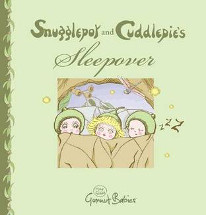
Snugglepot and Cuddlepie's sleepover by May Gibbs and Mark McLeod
Scholastic, 2013. ISBN 9781742830216.
(Age: 4+) Recommended. Picture book. May Gibbs. A beautiful
present, this hardcover picture book with May Gibbs' illustrations
adorning every page will entice younger readers to further explore
this classic Australian author and illustrator. One of three
commissioned by Scholastic with copyright holders, the Northcott
Society and Cerebral Palsy Alliance, part of the proceeds
gained from the books will assist in their work.
The story centres around the two friends inviting others over for a
sleepover. Snugglepot and Cuddlepie invite Obelia, Ragged Blossom
and Mrs Koala's children to join them.
But someone has forgotten to invite Mrs Kookaburra, partly because
her six very noisy offspring would not be good to have at a
sleepover. Cuddlepie is put into a position where he must invite
them, and of course, the predicted outcome happens. Ragged Blossom
goes to find Snugglepot and Cuddlepie to tell the baby kookaburras a
story in the hope that this will help them sleep, but cannot find the
two friends anywhere. A delightful story with May Gibbs' beautiful
illustrations will take her work to a new generation.
Fran Knight
Marcy Series 2 by Susan Halliday
Ford Street, 2013. Quiz champs ISBN 9781921665721 (pbk.) Thirteen dolphins ISBN 9781921665738 (pbk.) Lost dogs ISBN 9781921665745 (pbk.) Award winners ISBN 9781921665752 (pbk.) Netball challenge ISBN 9781921665714 (pbk.)
Box Set ISBN 9781921665882.
In order to appeal more to girls, Susan Halliday has written a
parallel series to the Toocool series by Phil Kettle, with
Marcy as the main character.
Containing the same structure as the Toocool series, each
again concludes with some factual information, a glossary and some
jokes and is based on the same characters. Written in narrative
format, these titles are easy to read and Marcy sets some great
examples to her readers. She cares about others and is always
willing to help. Her positive, helpful nature and self image means
that there is no challenge to which she won't rise. From rescuing
dolphins to finding homes for lost dogs, each title is easy to read
and contains a touch of humour often based on the ever present
rivalry between girls and boys at the ages of these characters.
Halliday includes some phrases which are somewhat old fashioned and
allows Marcy to find the meanings of the words, along with the
reader. With the new Australian curriculum, these titles could be
used as read alouds or in literature circles with younger children
and changing language could be discussed as an offshoot of these
books, as could the positive messages included therein.
Jo Schenkel
Meet Captain Cook by Rae Murdie
Ill. by Chris Nixon. Random House, 2013. ISBN 9780857980175.
In this, the third in this series of picture books introducing our
younger readers to those who have contributed so much to Australia,
we meet Captain James Cook. While it might be said that there
couldn't possibly be room for yet another book about Cook on the
shelves, this one has the younger reader, the one for whom the name
Cook is still unknown, in mind. Succinctly dealing with his
younger life, the story picks up with the beginning of the journey
which was to lay the foundation for Australia's future and tells the
story that we all know.
Fitting neatly into the history strand of the Australian National
Curriculum for Years 3-4 this is a text written at a level for this
audience, its picture book format adding to its appeal. It is
accompanied by a timeline which continues on to later travels as
well as easy-to-interpret maps on the endpapers. Written in a way
that draws the reader into a story rather than just a series of
facts and figures, this is a perfect introduction to the topic that
teaches as it tells.
Others in this excellent series focus on Ned Kelly and Mary
MacKillop, with a new title about Antarctic explorer Douglas Mawson
due for publication early 2014.
Barbara Braxton
The screaming staircase by Jonathan Stroud
Doubleday, 2013. ISBN 9780857532022.
(Age: 11+) Highly recommended. Supernatural, Humour, Adventure. The
first in a new series, Lockwood and Co., this is a world in the here
and now where things have got out of hand and ghosts have appeared.
Their arrival has meant wholesale changes to society; curfews, fear
of the dark, and the rise of ghost hunters with their guidelines and
marketing strategies. Into this mix comes a new firm of rather
disorganised ghost hunters, Lockwood and Co., young and eager but
spied on with suspicion by the older more well known firms, lest
they fail and so undermine the other companies, or succeed and take
their customers.
The company's newest member, Lucy, recently dismissed from her post
as psychic investigator at another firm is keen to do well, partly
so she can live but also to dispel the stories about her that
threaten her livelihood. She joins Anthony Lockwood and his
employee, George, who takes an instant dislike to Lucy, trying
everything he can to undermine and humiliate her. So the stage is
set for tension to rub between the three as they endeavour to solve
people's ghostly problems. Their first big case however, results in
the burning down of a house, and the subsequent suing for
compensation sees them take on an investigation which could result
in their deaths. With the creepiest house to stay in for the night,
a ghastly employer and a plethora of horrors awaiting them, the trio
sets in for the night which could see their fortunes made or their
lives cut short.
An auspicious start to a hair-raising adventure into the
supernatural world, this series will have a legion of avid
followers. There are plenty of strings to follow: just who is
Anthony and why does he have this enormous house to himself? where
has George come from? and just what is behind Lucy's abilities?
Fran Knight
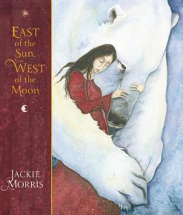
East of the sun, west of the moon by Jackie Morris
Frances Lincoln Children's Books, 2013. ISBN 9781847802941.
(Age: 11+) Warmly recommended. Fairy tale retelling, Fantasy,
Princes, Freedom. With the fairy tale of Beauty and the beast
hovering in the background, this beautifully told story is more than
a retelling, as the author adds layers of setting and
characterisation, plot and motive to the original tale.
A large white bear asks the girl to go with him. There is no
question that she will go, she has always known it, but her mother
is distraught. She loves being with the bear, is amazed at the
palace where he lives, and what he does for her, to the point of
giving her a treasured photo of her family, lost when they fled
their country.
But each night she is aware that someone creeps into her bed, lying
beside her leaving in the morning. She longs to see who it is but
the matches will not strike. When she misses her family, the bear
takes her home for a month and a day, but warns her not to be alone
with her mother.
On returning, mother has given her new matches and so one night she
strikes one, enabling her to see the person who lies in her bed. His
shocking story is revealed, and by striking the match she has
destined him to marry the ogre's daughter, never to return.
She then sets out to search for him, to right the wrong she has made
and in her search finds true love.
The retelling of the story is languid and poetic, descriptions are matched
by the mythical water colour illustrations as they drape across the
pages, adding to the pleasure girls will have on reading this tale.
The small size is appealing and handy to hold, adding to the
pleasure of the read.
Fran Knight
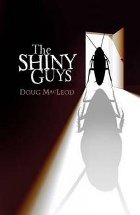
The shiny guys by Doug Macleod
Penguin, 2012. ISBN 9780143565307. The shiny guys is a bold, abrasive and surprisingly funny
novel, akin to Ken Kesey's One flew over the cuckoo's nest
in terms of subject matter, and worthy of similar praise.
The story concerns a 15-year old boy who has been admitted to an
asylum during the 1980s, a time when the treatment of mental health
patients was still radical but beginning to be questioned.
From the first page, each word seems hand picked, like a
meticulously compiled string of sentences. Despite the strength of
the writing, each word has an irresistible urgency and secrecy, as
though betraying too much of it to another would be breaking some
intimate vow.
Doug Macleod presents teenagers with a genuinely smart, genuinely
funny and genuinely hard-hitting piece of collage writing. He
combines normal contemporary prose with letters, transcribed
conversations and other styles. This format is wildly eclectic and
effective, allowing for the disjointed characters and dialogue to be
presented in a way that serves rather than stifles their quirks.
The mixed-up writing almost recalls Beat Generation poetry,
whimsical and dark, equally edgy and translucent. The shiny guys is a strong, nostalgic and never accusatory
literary nod towards the treacherous mental health system of times
gone by, but more importantly the fragile health in question of
young people. It poignantly recollects and highlights the
institutional damage inflicted on those who are already damaged.
An intelligent read recommended for teenagers looking for something
with bite, but enough heart to balance the dark.
Henry Vaughan (Student)
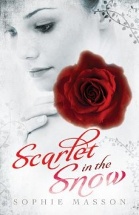
Scarlet in the snow by Sophie Masson
Random House, 2013. ISBN 9781742758152.
(Age 12+) Highly recommended. There seems to be a real fashion for
updating fairy tales in recent times. Of course, over the years
there have been many retellings of traditional tales, but this
latest foray seems to be concentrated in presenting new versions in
more adult formats vis-a-vis cinematic offerings such as Snow
White and the huntsman or Mirror mirror or books such
as Moonlight and ashes (also by Sophie Masson).
Sophie Masson presents a new styling of the old 'beauty and the
beast' traditional tale (La belle et la bete), first
published in 1740, and gives it a new and engaging twist that will
be sure to captivate the girls looking for something with rather
more substance than the general pulp fiction in the romance genre.
Carefully employing many of the original elements of the story - a
once rich family reduced to poverty, the enchanted forest, a
mysterious mansion occupied by an apparently invisible owner, tables
laden with magical food, and most importantly a beautiful rose
plucked innocently without any malice - Masson weaves a complex but
beautiful rendering of the story breathing real life into the
characters and their circumstances.
Tragedy, revenge, intrigue and love triumphant are crafted into an
unravelling of the story in which Masson has combined selected
motifs of the many hundreds of versions of the original tale. Taking
her setting from Russia and drawing most heavily on the version
retold in that country, the author has created highly believable and
very human characters in Natasha, Ivan and even Old Bony. There is a
definite tone of steampunk in the later settings/incidents in the
book which this reader found highly engaging.
With
teaching notes available from the publisher this would make a
terrific book for lower secondary students engaged in shared reading
or a book group. Highly recommended for able readers 12 and up -
especially girls.
Sue Warren
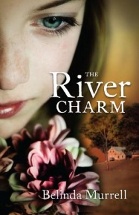
The river charm by Belinda Murrell
Random House 2013. ISBN 9781742757124. pbk., 320pp., RRP $A15.95
(Age: 10-14) Historical fiction, written well, can provide a greater
insight into the life and times of a particular period better than
any website, textbook or other non-fiction resource. Historical
fiction, written well and woven around actual people, places and
events can bring the past to life and enable students to really
appreciate the contrasts between life in a particular timespan and
their own enabling them to reflect on not only the changes that have
occurred, but, often, why they have. Such is The river charm
by Belinda Murrell.
Based on the author's own family tree which includes Charlotte
Barton (Atkinson) the author of the first children's book to be
published in Australia A mother's offering to her children, by a
lady, long resident in New South Wales, this story tells of
the challenges facing Charlotte's family in the 1840s. Set initially
in the NSW Southern Highlands where many of the landmarks mentioned
still exist (the Hume Highway crosses the Medway Rivulet at the
Three Legs O'Man Bridge) Charlotte and her children live in a
glorious mansion wanting for nothing, presumably well-catered for by
the legacy of her first husband and the children's father. However,
being a single female, even a widowed one, was not acceptable in
those times and so Charlotte's destiny is in the hands of the
executors of James Atkinson's will. A series of events, disclosed
later in the story, leads her to marry local George Barton, a
mistake she lives to regret for the rest of her life.
Barton is a violent drunk determined to spend and drink his way
through his new-found riches, and so Charlotte gathers the children
and they flee in fear for their lives to a remote outstation (near
the Cambewarra Mountain). Life here allows the reader to appreciate
the courage and resilience of those who settled such remote areas,
particularly women, such as being two days ride from a doctor who
decides the cure for Louisa's croup is to bleed her using leeches,
giving her a potion which makes her vomit and then rubbing caustic
soda on her neck so that it burns and blisters the skin!
Circumstances take them to Sydney to live, but too poor to live in
town, they rent a cottage in a nearby fishing village called Double
Bay. However, worse than being a single female, is being a married
one who chooses to leave her husband despite his being known as an
angry drunkard, and so their situation worsens and Charlotte
continues to be involved in a battle with the executors, the lawyers
and courts. It is an intriguing tale that will enable the reader to
appreciate the journey that women have travelled and endured.
Told to Charlotte's modern-day descendants by Aunt Jessamine with
whom they are holidaying, and seamlessly slipping between the
generation gap drawn together by a pebble from a river on a charm
bracelet, this is a title that should be on the library's shelves.
Even though the key character is Charlotte's eldest daughter, also
Charlotte, we are introduced to Louisa,
the youngest, who went on to become a leading naturalist of her
time, evidence of her mother's belief that education was as critical
for girls as boys and her total commitment to this.
This book would make a valuable resource to support the History
strand of the Australian National Curriculum (there are teachers'
notes ) but above all, it is just a strong, engaging read
written with the sensitivity and respect that characterise the
author's works.
Barbara Braxton
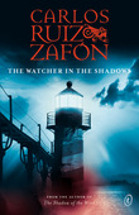
The watcher in the shadows by Carlos Ruiz Zafon
Text, 2013. ISBN 9781921922527
(Age: 13+) Recommended. Thriller. Automaton. Widow Simone takes work
at a rambling mansion at Blue Bay near Mont-St-Michel in northern
France. She has recently lost her husband so work as a housekeeper
to Lazarus Jann, a retired and reclusive toymaker, is fortuitous.
Her children, however, in walking to the mansion on their first
visit find some of the automatons, in the garden and the house,
unsettling. A letter from an unknown person opens the book,
and this we find is one of many such letters, written but never
sent. So begins a tightly plotted, complex and highly unsettling
thriller.
We hear more about Lazarus as Simone's children, Irene and Dorian,
become part of his small community, and about his seriously ill wife.
While his servant Hannah befriends Irene, she soon finds
that Hannah's cousin, the unusual Ismael, more interesting, even
though his thoughts are only of the sea.
When Ismael and Irene go to the sea cave, Ismael tells her the tale
of the frowned woman, and finding her diary, Irene is enthralled,
reading of the shadow which emerged years ago, the spectre forming a
backdrop to what then happens. With Hannah found dead, the two have
a mystery to solve, but find it is very close to home. Lazarus Jann
takes Simone from her bed to his factory where a doppelganger, a
replica of Simone is being made.
This is a breathtaking read, full of shadows, with the characters'
names adding deeper levels of meaning to an already rich and
enthralling tale. The built angel is one of the scariest inventions
I have read of, and will amaze the readers just as it did me.
Fran Knight
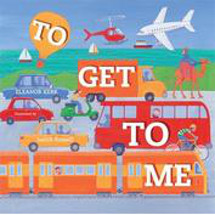
To get to me by Eleanor Kerr and Judith Rossell
Random House, July 2013. ISBN 9781742758831. RRP $19.95.
(Age: 5+) Recommended for younger readers. This delightful new picture book
combines very popular themes which teachers of young children will
no doubt find very appealing and useful. Peter invites his
friend Ahmed to join him on a trip to the zoo. Judith Rossell's
colourful illustrations reveal to the reader that Ahmed quite
clearly does not live in Australia. Peter's explanation to his
friend of how 'to get to me' is accompanied by a very attractive
world map, complete with iconic landmarks and fauna.
Using a variety of modes of transport Ahmed travels right around the
world to Sydney to meet Peter at Taronga Zoo. On his way Ahmed
passes scenery which cleverly incorporates small sections of
newspaper text in the illustrations - changing from Arabic script to
English. The text is simple and includes onomatopoeic
'transport' words which young children will delight in as it winds
up and down hills, through tunnels, and across the sky and the sea.
As a springboard to discussing intercultural relationships or
accompanying a unit focussed on methods of transport, this will be a
valuable addition to any school library.
Sue Warren
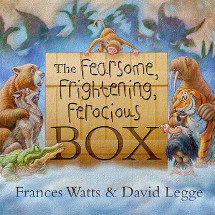
The fearsome, frightening, ferocious box by Frances Watts and David Legge
ABC Books, 2013. ISBN 9780733328916.
(Age: 4+) Warmly recommended. Picture book. Humour. Poetry. A box
falls from a truck and is left on the roadside, where a variety of
animals comes and inspects the box, saying that they would look
inside. But as each animal comes by, bragging that they will not be
frightened, they are. First a monkey looks inside and hears the
thing inside moan and tell a little tale of its life. The following
double page shows the area in which it lives, and the reader is
invited to search for the six things hidden on the two pages. Then a
crocodile happens along and he hears the thing inside groan with a
similar poem over the page inviting the reader to find the six
things hidden this time in an arctic landscape. And on it goes, each
animal being scared off by the thing inside and the reader invited
to find six things in a different environment, until finally the lid
of the box is lifted.
A fun involving story with things for the reader to do on each page
will entertain those who pick up the book. Legge has successfully
shown each animal in distress as it peers inside and the
environments shown with their hidden animals will entice younger
readers to be involved.
Fran Knight
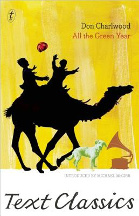
All the Green Year by Don Charlwood
Text Classics, 2012. ISBN 9781922079428.
(Age: Junior - mid secondary) All the Green Year by Don
Charlwood, along with Sydney Bridge Upside Down by David
Ballantyne are two of the titles from the Text Classics series for
adults which will find a YA readership, particularly in English
classrooms. All the Green Year was studied by 13 to 15 year
olds for two decades. It may not generate quite as much interest in
the twenty-first century but its episodic structure makes it ideal
for close study of one or more of the events in protagonist,
Charlie's adolescence.
The book is set in 1929 in a fictionalised small town on Port
Phillip Bay on Melbourne's fringe. The waterside setting and early
Depression era atmosphere and tone resemble The December Boys
by Michael Noonan. The boys in All the Green Year are not
visiting orphans, however. Seemingly reared as much by place as
their parents, their relationships with fathers and men are fraught;
beatings are commonplace and sternness easily escalates into
violence. Charlie and, particularly, Johnno are the targets of
teacher, Mr Moloney's have to flee in Charlie's boat from the
repercussions. The gripping last quarter of the novel (beginning on
page 203) could even be read as a novella.
As the Introduction states, this story is an evocation of Australian
childhood and an exploration of boyhood, especially of male
friendship. It is also important because of its insight into a slice
of Australia that should not be forgotten. Teacher
Notes are available.
Joy Lawn