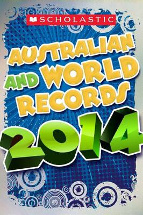
Australian and world records 2014 by Jennifer Corr Morse
Scholastic, 2013. ISBN 9781743622094.
(Age: 8+) Australian and world records is a companion volume
to Scholastic's annual Book of World Records. The global
publisher's decision to produce a title with an Australian focus
enables children to learn about records that may not be recognised
internationally but will open their eyes to aspects of life in their
own country.
The first quarter of the book is devoted to Australian records. Both
this section and the international section that follows, have a
significant emphasis on sporting achievements. The remaining topics
are money, pop culture and nature. While the mix may not satisfy
readers accustomed to the broader range of similar titles, many
children will enjoy this pared-down version because of its
user-friendly format. With few exceptions, there is only one entry
to a page. Large photographs, informative text and graphs of top
record holders in each category, may encourage readers to
investigate the information instead of skipping from picture to
picture. Alliteration and word play in the headings helps to make
this title a rewarding reading experience. Some of the records, such
as those for the largest animals, have remained unchanged for
understandable reasons, but others have been updated to the year of
publication. The font is relatively small but clear and while there
is no index, the brief table of contents is serviceable.
Jennifer Corr Morse and her Australian co-authors have created more
than a collection of superlatives with pictures. Australian and
World Records 2014 is an interesting and occasionally
thought-provoking book, that is tailor-made for young readers who
are keen to extend their general knowledge and curious about the
world in which they live.
Elizabeth Bor
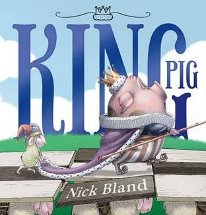
King Pig by Nick Bland
Scholastic Press, 2013. ISBN 9781742834955.
King Pig thinks he is just that - an autocratic leader who can get
the sheep to do anything they want. But while he could make them do
such things as strap boards on their backs so he has a ramp into his
sheep-free palace or pull down the branch of the apple tree so he
could pick the fruit, and scrub his castle he just couldn't make
them like him. No matter how loudly he shouted, they didn't listen
properly; no matter how hard he tried to get their attention, the
more they ignored him. Viewing himself in the mirror one day, he
decided that a fancier set of clothes might be the answer. So he
invited them into his castle and there they set to work.
To discover whether this works and if there is any way this arrogant
pig can make friends, you need to read this brilliant book by one of
Australia's most popular authors. And you need to read the pictures
as well as the words because the two not only work perfectly in
harmony to tell the surface story, but they also tell a story of
their own about power and bullying, making friends, arrogance and
humility, do clothes maketh the man? - all great discussion starters
that will help children reflect on the sorts of qualities that are
shared and valued by friends.
Nick Bland has that unique gift of being able to tell a tale within
a tale without being overtly didactic. The story can stand alone as
entertainment without delving deeper and his appealing illustrations
inject humour that tickle the fancy of even the youngest audience.
With a growing body of work to his name, Nick is becoming a
well-known name amongst our younger readers and new stories are
greeted with delight and appeal across the board because of the
levels at which each can be read.
Barbara Braxton
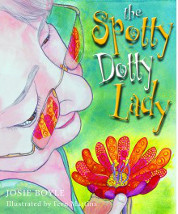
The spotty dotty lady by Josie Boyle
Ill. by Fern Martins. Magabala Books, 2014. ISBN 9781922142108.
(Age: 5+) Recommended. Loneliness, Aboriginal themes. A lady
living alone has no friends beside her flowers and plants in the
garden. One day she notices a different plant growing amongst those
she knows and watches it as it grows. The spotty bud grows quickly,
until one day it flowers with big, wonderful, spotty, dotty flowers.
So taken with these that she decides to paint her kitchenware with
spots, and she keeps on going until her whole kitchen is a maze of
coloured dots and spots. And she does not stop there. She soon
covers her whole house with spots and dots, causing a small
sensation in the street.
The postie tells the neighbours and they tell their friends, so soon
everyone in the street is outside her house. They soon begin to
bring things for her to paint, and after that of course, they stay
for a cup of tea. Soon the Spotty, Dotty Lady has many friends and
when they hold a party at her place it becomes the happiest street
in town.
A lovely tale of friendship developing out of the environment,
reinforces the relationship between the natural world and people, an
enduring theme amongst Aboriginal stories. But this modern tale has
significance for us all.
Fran Knight
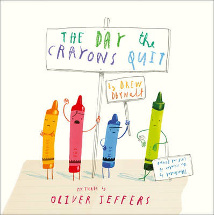
The day the crayons quit by Drew Daywalt
Ill. by Oliver Jeffers. HarperCollins Children's Books, 2013. ISBN
9780007513758.
One day, in class, Duncan went to take out his crayons and found a
stack of letters with his name on them. Each letter was from a
different-coloured crayon explaining why they didn't want to work
anymore. Red feels overworked, constantly colouring in fire engines,
apples and strawberries, even working in the holidays colouring
Santas and Valentine hearts. Black is bored with just being used for
outlines and craves things such as black beach balls while poor
peach has had all the paper peeled off and is too embarrassed to
leave the box! So Duncan decides to do something about it . . .and ends
up making all the crayons happy! The Day the Crayons Quit has consistently appeared on all the
best-reads and must-haves lists that appeared at the end of 2013 and
with good reason. It is delightfully original and has many layers to
it, with each audience being able to take something from it at their
level, whether it be 'What other things could Duncan colour purple?'
to investigating whether it's OK to have an orange whale. I'm very
much reminded of Flowers are
Red by Harry Chapin. There are lessons to be learned
about stereotyping - something we strive to make students aware of
but modern literature doesn't readily allow it because authors
strive to avoid it! You could also use it to explore emotions and
feelings and how we can tactfully express that things are making us
unhappy. So just as the crayons express why they are unhappy,
perhaps this could be a model for each child to express why they are
happy. Because this book has received such acclaim, there are many
suggestions for how it might be used online accessible by a search.
Each letter is written 'by' a crayon using a font that might make
this story difficult for the emerging reader to read alone, but it
is a perfect read-aloud for many ages! Jeffers' illustrations have
an authenticity about them - they look like they have been drawn and
coloured by young children and the credits suggest that there has
been significant input, either physical or intellectual, from them.
And this provides another level to the book - my experience is that
children start to believe that their drawings are not worthy because
they don't have the realism they see around them or the
professionalism of book illustrators, so seeing pictures that look
just like theirs in such a popular book validates their efforts and
hopefully encourages them to keep drawing.
I borrowed this book from my public library because I wanted to see
what the fuss was about, but it is now on my to-buy list so I can
share it with Miss Nearly 3 and Miss 7 because it will appeal to
both. That's the greatest accolade I can offer.
Barbara Braxton
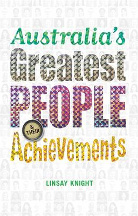
Australia's Greatest People & their Achievements by Linsay Knight
Random House Australia Children's, 2013. ISBN 9780857980205.
Recommended for Middle/Upper Primary. Here is one of those very
useful books which can earn a place on the library shelves or for an
award prize with equal ease.
Very attractively packaged and with loads of information on people
from both historical and contemporary times, it's a perfect book for
dipping into or for students to find the first 'kick off' for a
biographical research project.
As well as both brief and fuller informational text, quotes, break
out boxes and quick fact pages are interspersed throughout. Broken
up into sections from Pioneering Australians to the Arts to Science
to Social Justice and more, this covers a wide range of both well
known Australian achievers as well as those not so well known -
something I found particularly interesting.
Along with the companion book Australia's Greatest Inventions
& Innovations, this comprehensive text would be a very
useful addition to primary school libraries in particular.
Sue Warren
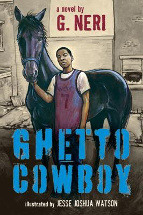
Ghetto Cowboy by G. Neri
Ill. by Jesse Joshua Watson. Candlewick Press, 2013. ISBN
9780763664534.
(Age: 10+) Recommended. When Cole's mother decides that she can no
longer deal with him, she leaves him in the mean streets of
Philadelphia with the father that he has never met. To his horror,
there is a horse in the house, and a stable full of horses nearby.
He never dreamt that there were black cowboys. Soon he is mucking
out the stables rather than skipping school and getting into
trouble. When the City decides that the stables should be shut down,
Cole knows that it is time to fight back and save his father's way
of life.
This clever and moving story comes from the 2011 Coretta Scott King
Author Award Honor winner, whose ability to write a compassionate
look at a young boy and his father getting to know each other for
the first time is inspirational. It has been inspired by the real
life urban black horsemen of North Philadelphia and the
Brooklyn-Queens area, and a picture from Life magazine and
information at the back of the book give added information.
Although the background is intriguing, it is the portrayal of father
and son getting together, that is at the heart of the story. Cole is
on the verge of getting into bad company and truanting from school
when his mother decides she can't cope with him anymore. Cole's
father has kept the stables going believing that looking after
horses will keep the local kids away from danger but has no idea
about how to act like a father. Together they get to know each other
and their fight against the closure of the stables brings them
together.
The setting and the real life background of the ghetto cowboys makes
this an exceptionally interesting book to read and I really enjoyed
Cole's journey as he began to know his father. It would make a great
read aloud and provides a fascinating alternative for those who
enjoy books about horses.
Pat Pledger
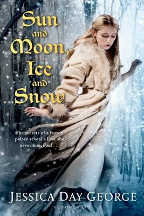
Sun and Moon, Ice and Snow by Jessica Day George
Bloomsbury, 2013. ISBN 9781619631847.
(Age 10+) Recommended. Based on the legend East of the sun, west
of the moon, the Lass, who doesn't have a name, agrees to go
away with a great white bear to his castle when he promises her
family treasure to make them rich. But of course the bear is not
what he appears to be and his castle is made of ice. She is
determined to find out what is happening when servants begin to
disappear and sets out on a gruelling journey to rescue the bear
when he disappears.
Jessica Day George has chosen to expand the fairy story, keeping
faithfully to its origins, but giving it a very likeable heroine who
grabs the reader's attention right from the beginning. Any reader
could easily identify with the young girl whose mother has refused
to name her and whose sad older brother, returned from mysterious
adventures at sea, seems to be her only friend. When she frees a
white reindeer trapped in the woods, it rewards her with a name and
the ability to hear what animals are saying. The Lass cares deeply
for her family and cannot refuse the large white bear's request to
stay with him for a year in his castle. She is an intrepid girl
whose naive curiosity leads to dire consequences, but also gives her
the inspiration to find a solution to the spell that has been cast
on the bear.
The bitter cold and the isolation of their home in woods, often deep
in snow, is beautifully described. The grim poverty of her family
and the desperate straits that they find themselves in provide a
fitting background to the story. The addition of the heart broken
brother Hans Peter and his link to the ice castle is a fascinating
one and gives an extra dimension to the story.
This is a well written, timeless tale that is sure to please readers
who enjoy retellings of fairy tales.
Pat Pledger
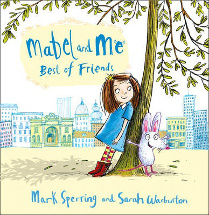
Mabel and me: best of friends by Mark Sperring and Sarah Warburton
HarperCollins, 2013. ISBN 9780007468362.
(Age: 4+) Recommended. Picture book, Friendship. When her friend,
the mouse tells Mabel that she is her best of friends, Mabel asks
the simple question Why? Stuck for an answer, the pair is
interrupted by a French photographer asking to take their
photographs. He asks Mabel if he can take her photo as well as the
little creature with her. Mouse thinks he is talking to her and
calling Mabel a little creature and so is cross on her behalf,
saying that they will go to the photo booth instead. There their
feet are seen by a passing ballerina who tells Mabel that her feet
are just right for learning to dance, but not the hairy feet of her
companion. Mouse again takes umbrage and thinks the ballerina is
referring to Mabel's feet and storms off. The confusion is resolved
when Mabel explains what has really been meant by the two, but the
mouse is stunned that now she knows why she likes Mabel. Its because
of the crazy things she says.
Surrounded by whimsical illustrations, the story moves along with a
variety of fonts and font sizes, a large pallet of colour and
fascinating buildings and interiors. Every page is stacked with
humour, be it in the illustrations, the background or the words. A
lovely treat for discussions on friendship and working together,
this book will be well used in the classroom and home, the front
cover inviting a reader to pick it up. For an adult presenting the
notion of irony with children, this is a most suitable example.
Fran Knight
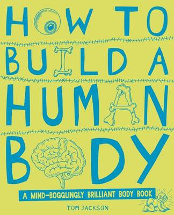
How to build a human body: a mind-bogglingly brilliant body book by Tom Jackson
Scholastic, 2013. ISBN: 9781407137377.
Highly recommended for readers from 9 - 90. Subjects: Biology, Body
Systems, Scientists, Anatomy, Science Experiments. Tom Jackson's
conversational style of writing introduces the reader to all the
major body organs and systems in a fun and dynamic way. There are
simple experiments included to help gain insight into the way our
body works, try the tendon test or make an extra stomach.
Each double page spread has a bold bright coloured background with
easy to read information, layered text boxes, interpretive diagrams
and fun photos. The information is written in a personable style
whilst engaging and informing the reader. The titles are catchy -
Take a Breath, Pee Procedure, On the Nerves and Invaders Attack are
some examples.
The reader can also learn about scientists who had a key role in
discovering the functions of these body systems. In 1840 Justus von
Liebig a German scientist discovered the importance of nitrogen as a
plant nutrient.
As the reader explores this book they can absorb information on the
anatomy and biology of the human body in a fun and fascinating way.
The glossary is transformed into Cool Words and there are additional
websites and books included in the Find Out More section.
Tom Jackson is an experienced scientific writer who has written more
than eighty books and once again he excels in bringing How to build
a human body: a mind-bogglingly brilliant body book to life.
This book is highly recommended for readers from 9 - 90, there's
something here for everyone. This is an excellent teaching tool for
Science and Health and Personal Development.
Rhyllis Bignell
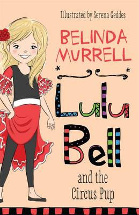
Lulu Bell and the Circus Pup by Belinda Murrell
Ill. by Serena Geddes. Random House Australia Children's, 2014.
ISBN: 9780857981998.
(Age: 7-9) Recommended. Themes: Family Life, Circuses. The circus is
coming to town with performing dogs, clowns, jugglers and prancing
horses.
After Gymnastics where Lulu Bell and Rosie practice their
cartwheels, Mum takes the family home the long way through Lagoon
Park. They are excited to discover the red and white circus tent
setting up nearby. As they watch the horses are being unloaded and
watch a young girl walking a collection of dogs. As Lulu and her
family walk past, they see the young girl Stella crying because
Spangles the performing dog is missing. After finding Spangles,
Stella rewards Lulu by teaching her some circus tricks. Lulu loves
spending time with Stella and her Mum in the circus ring and in
their little caravan. After Dad helps Goldie the camel giving birth
to twin babies, the Bell family are given VIP tickets to the circus.
There's a special surprise in store when Lulu joins in the
performance.
This is another enjoyable addition to the Lulu Bell series by
Belinda Murrell. She has created a fun, relatable family whose every
day activities turn into adventures. Serena Geddes' black and white
illustrations add character to the stories. This series is a great
class read-aloud and I would recommend them for readers from 7-9
years.
Rhyllis Bignell
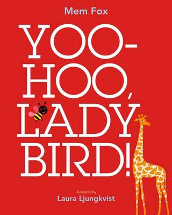
Yoo-hoo, Ladybird by Mem Fox
Ill. by Laura Ljungkvist. Penguin Viking, 2013. ISBN 9780670077304.
'Ladybird loves to hide. Yoo-hoo, Ladybird! Where are you?' And so
begins another Mem Fox classic, which she describes as a Where's
Wally for the very young. For Ladybird, one of those
teeny-tiny red, with-black-spots creatures that just fascinate
little people, has a wonderful time with her friends and is not easy
to spot unless you have very keen eyes! But, it's OK if you don't
find her because there's a close-up on the next page to help you.
What is there that's new to say about Mem Fox and her ability to
write deceptively simple books that just appeal to generation after
generation? Possum Magic had its 30th anniversary in 2013
and now Miss Nearly 3 won't sleep without hearing Where is the
Green Sheep? first. And here is another winner!
In Mem's words, it is 'a typical Mem Fox book for the very young
with simple language, predictably wrapped in rhyme and neatly tied
with rhythm and repetition'. Even though it is only 133 words, it
took two years to write because it took that long for 'every one of
those 133 words fell into place, the syllables sang the right tune,
the commas settled into their correct position, and the page-turns
worked like the puzzle they were meant to be.' (You can read more of
what Mem says on her website.)
The illustrations which are absolutely integral to a book of this
nature are utterly charming and Ljungkvist has done a perfect job of
making the puzzle tricky - but not too tricky - hiding Ladybird in
plain sight in familiar places amongst toys and objects that will
appeal, but which will also create a lot of discussion! Would you
really find an octopus in your bath? As well as hiding Ladybird, she
has cleverly included lots of other repetitive elements in the
pictures so this can become a hide-and-seek on a grand scale!
If you were to construct a Who's Who in Children's literature,
Australian or otherwise, particularly of those who are the leaders
of perfect picture books for under-8s, Mem Fox would be at the
pinnacle. In my opinion, she is a national treasure and needs to be
in every child's life and library.
Barbara Braxton
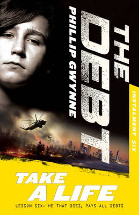
The Debt series by Phillip Gwynne
Allen & Unwin, 2013.
Instalment 1: Catch the Zolt. ISBN 9781742378442.
Instalment 2: Turn off the Lights. ISBN 9781742378435.
Instalment 3: Bring back Cerberus. ISBN 9781742378596.
Instalment 4: Fetch the Treasure Hunter. ISBN 9781742378602.
Instalment 5: Yamashita's Gold. ISBN 9781742378619.
Instalment 6: Take a Life. ISBN 9781742378626.
Since his blasting onto the writing scene with the award-winning Deadly
Unna (1999: Book of the Year - Older Readers) Phillip Gwynne
has proven his ability as an outstanding writer, particularly for
the YA market. In this new series, he sends the reader on a
thrilling ride with all the verve and adrenalin rush of series such
as Conspiracy 365 (Gabrielle Lord) and Alex Rider
(Anthony Horowitz).
Dominic (Dom) Silvagni, is a reasonably typical Gold Coast teenager
- albeit from a very privileged but outwardly normal family. Their
home in the elite gated community of Halcyon Grove is a show piece
and Dom, along with his parents, older sister Miranda and younger
brother Toby lack for nothing. His much loved paternal grandfather
Gus, is close at hand and is Dom's coach - both of them with a
passion for middle distance running - despite Gus' having lost a leg
in a 'shark attack' at a young age. He has also grown up almost next
door to the love of his life, Imogen, who sadly has lost her father
and been left with her slightly unhinged mother.
Dom's regular schoolboy existence at the top notch Gold Coast Boys
Grammar comes unstuck on the night of his fifteenth birthday when
his father, David, and grandfather Gus initiate him into the
Silvagni family inheritance - an ancient debt owed to the
'Ndrangheta' - a Mafia-style organisation from the old country. Each
male child from the Silvagni is required to pay back the debt in six
instalments - or lose a 'pound of flesh'. With each successfully
completed instalment the inner thigh of each Silvagni male is
branded until the mark of repayment is whole. With growing horror
Dom realises that his grandfather's missing leg was not the result
of a shark attack, witnessed by his incomplete branding . . .
becoming acutely aware that this is no joke, but a very dangerous
and deadly serious undertaking.
When presented with the opportunity to review the final Instalment
bk 6, I commented that I had not read the full series - and
fortunately, I was lucky enough to do so. This is definitely a
series to be read in sequence, as we follow Dom's heart-racing
exploits and watch him develop skills, acquire both allies and
enemies and despite all odds, complete seemingly impossible tasks.
Throughout, the reader becomes aware, as does Dom himself, that
there is much more to this deadly challenge than just the Herculean
assignments set. What really happened to Imogen's missing politician
father? Why does Dom's own father insist he has never been to Italy,
nor speaks 'wog' yet is overheard talking fluent Calabrese? Why does
his Californian mother have cosy chats with Roberto, the gardener?
How is it possible that the same taxi driver keeps turning up just
when he has need?
Loaded with all the thrills and spills that will particularly appeal
to teenage boys - fast cars, private jets, an unending number of
useful smartphone apps, heroic action, daring rescues plus more -
and with a knock out ending, this will enthrall readers from 12
years up.
The Debt website
A SMH
interview with Phillip Gwynne about the series.
Instalment 6 Book
Trailer
Sue Warren
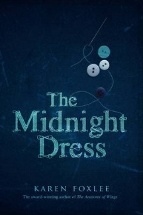
The Midnight Dress by Karen Foxlee
University of Queensland Press, 2013. ISBN 9780702249648.
(Age: 15+) Highly recommended. Rose Lovell has moved from town to
town with her alcoholic father and wonders if life will be different
tin the small sugarcane town where they live in a caravan. When she
meets pretty and popular Pearl Kelly, she feels that she might have
a friend at last. Pearl persuades her to go into the Harvest Parade
and for this she needs a special dress. She finds Edie Baker, a
strange dressmaker who helps her make a dress of midnight blue and
who introduces her to the mountain and the bush nearby. Then
everything changes when a teenage girl disappears.
Foxlee writes in a compelling manner keeping up the suspense until
the very last page. Her plotting is complex and clever. From the
first page the reader knows that someone has gone missing but is
uncertain about who it is. The story progresses on two levels: one
chapter written in italics, tells about the disappearance of the
girl, the next is told from Rose's point of view as she comes to
term with life in the insular country town and befriends Edie the
eccentric dressmaker. Rose doesn't have an easy life, her father's
moods are up and down and she finds it difficult to fit in. The
themes of love and anger, of fitting in and making friends are woven
between the mystery of the girl's disappearance.
This is a haunting, beautiful and literary story told on many
levels. There is the friendship between Rose and Pearl who is
searching for her long lost Russian father. The odd bookseller who
is teased by Pearl and Rose's relationship with her father and the
young boy who admires her are fully developed. Edie's story is
heart-breaking as well.
The language is lyrical. The descriptions of the Australian bush,
the tall trees, rocky waterfall and sweeping beaches bring this
Queensland area to life and provide an atmospheric background to the
story.
This is a complex, haunting story and I look forward to reading more
from this author.
Pat Pledger
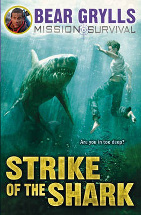
Strike of the Shark by Bear Grylls
Mission Survival bk 6. Doubleday, 2013. ISBN: 9781782950028. Strike of the Shark is the sixth book in Bear Grylls' Mission
Survival Series. It stars Beck Granger, a 14 year old boy
whose parents took him travelling all over the world from a young
age, exposing him to various tribes and cultures from which he
learned an array of survival skills. Prior to this book his parents
had both been killed leaving Beck an orphan under the custody of his
uncle. His many exploits, even since the death of his parents, have
given him some level of world renown as a survival expert.
In this book, Beck travels from Florida out into the waters of the
Bermuda triangle on a cruise ship that is sabotaged, leaving him and
four others stranded in the middle of the ocean. The five come face
to face with shipwreck, isolation, lack of water, shark attack and
the battle between good and evil. The survival themes are strong,
with basic and useful survival tips incorporated into the narrative.
The protagonist (though somewhat extremely larger than life) is a
likable boy with strong moral principles. The plot, especially as
part of a series, is rather far-fetched and the main character
certainly has an unrealistic level of life experience, but the story
should be fairly engaging for a young audience.
The language and structure is simple, though certainly lacks
sophistication and is not particularly well written. It gets off to
a bit of a slow start, though the plot does have several twists and
turns.
The main function of this book would be to capture the interest of
young people who are perhaps not avid readers. In my opinion the
survival tips they have integrated are the novel's best feature.
They encourage children and teens to respect the environment around
them and not take unnecessary risks, but equip them with some basic
principles for how to deal with unforseen circumstances. The
novel promotes values of respect, conservation, understanding of
humanity, morality and determination. It is a worthwhile addition to
a school library, though would likely not be useful as a class text.
Sarah Rose
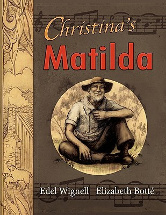
Christina's Matilda by Edel Wignell and Elizabeth Botte
IP Kidz, 2011. hbk ISBN 9781921479878. ebk ISBN 9781921479885.
This fascinating title by Edel Wignell focusses on the story behind
the story of our unofficial anthem, Waltzing Matilda. As
Wignell asks, why is Paterson's role in the creation of this song so
well-known when that of Christina Macpherson is almost unknown, even
though it is just as vital? Wignell then tells us the story of
Macpherson beginning with an encounter with bushranger Daniel 'Mad'
Morgan at the family home of Peechelbar in Victoria, her childhood
in a large wealthy Melbourne household, and her eventual meeting
with A.B. 'Banjo' Paterson at the home of her brother on a station
on the Diamantina River about 128km from Winton, Queensland.
Evenings were a time for entertainment - Paterson sharing his poetry
and Macpherson playing the piano, including a tune called Craigielee that
she had heard at the Warrnambool Races some time before and which
had stuck in her mind. Paterson was well aware of the plight of many
shearers displaced by the Great Shearers' Strike in 1894 and the
stories accompanying the hardships they endured, and it wasn't long
before he penned the words of Waltzing Matilda to fit the
tune. Wignell then traces the story of the song through to its place
in the Australian identity today, including the work of Richard
Magoffin who relentlessly tracked the song's origins, eventually
being able to identify Christina's contribution in 1983.
The story is accompanied by a variety of illustrations including
paintings and drawings, maps, photos, posters and programs, letters
and sheet music, each adding to the authenticity of the story and
providing insight into the times that inspired the lyrics and the
history of the song. Perhaps the most interesting is a facsimile of
an extract from a letter from Christina which explains how the song
came to be. Each sepia page is bordered with exquisite line drawings
by Elizabeth Botte which enrich and enhance the story.
While it is written in a style and language accessible to a newly
independent reader, its use of primary sources to support the text
would be a great way to introduce the importance of these sorts of
sources to support research and provide evidence, an integral
element of the historical skills strands of the Australian History
Curriculum for Year 7.
This is a resource that needs to be on library shelves and a story
that needs to be known by everyone old enough to sing the song!
Barbara Braxton