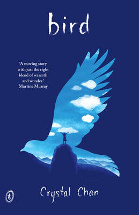
Bird by Crystal Chan
Text Publishing 2014. ISBN 9781922147707.
(Ages: 11+) The narrator is 12 year-old Jewel who lives with her
parents and grandfather in a small town in Iowa, USA. Her older
brother, who she never knew, jumped off a cliff at the age of five,
thinking he could fly. This tragedy haunts the family, leading them
to pursue an unhealthy belief in the power of magic, curses and
spirits, which is further explained by the Jamaican/Mexican family
background and the rather isolated community in which they live.
I enjoyed the young girl's narrative voice and was convinced of her
heart-felt loss of a brother, along with her frustration at how her
parents cannot give her the affection and reassurances she needs.
When she meets Eugene, who initially betrays her friendship, but
wins her over as a kindred spirit and as someone who she can share
her secrets with, the opposition from her family is overbearing and
drives her to the edge.
This is Chan's first book and is full of interesting ideas about
families, friendships, small towns and the safety of secret places.
The nature and power of magic, which surrounds the lives of this
family, is rather unsettling and, at times, Jewel's language is
oversentimental, but Bird is thought provoking and a
worthwhile read.
Julie Wells
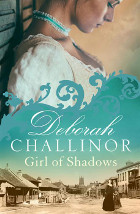
Girl Of Shadows by Deborah Challinor
Harper Collins, 2013. ISBN: 9780732292997.
(Age: Adult) This is an adult novel and unsuitable for senior high
school students as it contains an abundance of vulgar language and
adult themes.
Set in convict Australia over the period of 1830-1831 this novel
follows the story of three convict girls working in assigned
positions in Sydney Town to pay of their debts earned from felonies
committed in London. Much better off in Australia the girls have
their fair share of difficulties to overcome including the constant
fear of being identified as the murderers of Gabriel Keegan, a cruel
man who arguably deserved the end he found. The majority of the
story focuses on Sarah Morgan and her position as a maid in the
Green household and her endeavour to continue her stolen
contribution to 'The Charlotte Fund' in order to support their dead
friend's daughter in the Female Factory. Despite being unable to
legally hold employment as convicts, both Friday Woolfe and Harriet
Clarke also contribute through Friday's considerable talents as a
prostitute and Harriet's skill in artistry for the local tattooist.
Sarah is miserable in her placement with the Green's, Mrs. Green is
a hard women and a vindictive mistress. The girls decide to frighten
Mrs. Green while Mr. Green is absent, using the women's
superstitions to create a fear which would be maddening.
The second in a trilogy this novel is one of the best historical
fiction novels that I have read so far, unfortunately it is aimed at
an adult audience. Over-run with brilliant detail and well developed
characters this third-person piece is truly spellbinding and I would
highly recommend this to mature aged lovers of historical fiction.
Kayla Gaskell
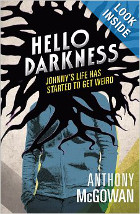
Hello Darkness by Anthony McGowan
Walker Books, 2013. ISBN 9781406337846.
(Age: 12+) Anthony McGowan is well known for previous books, Henry
Tumour and The Knife That Killed Me; both of which
have won awards in Britain. I visited his website and discovered an
interesting film clip where he is interviewed about the gang culture
in Britain, knives, schools, and parenthood. He talks about school
being a scary place in a world where the gap between the rich and
poor widens. Young people come together for safety and a bit of
security. Hello Darkness is a story about Johnny Middleton,
an outsider, excluded from all the school factions, and at the mercy
of aggressive teachers. Everyone knows that he has returned to
school after suffering a recent nervous breakdown. He becomes
entangled in a killing spree where all the school pets are killed,
and he is determined to prove his innocence and reveal the killer.
From the first page on I was immersed in life at the school;
intrigued, amazed and amused. The humour is wonderful, especially
when Johnny exaggerates circumstances, embellishing at every
opportunity. However Johnny's plight is often heartbreaking and the
reader hopes he finds the culprit soon. The language is fast-paced,
making this story very readable. There is however a niggling
uncertainty as we read. Some things are farfetched and the comedy
darkens and Johnny seems to experience a slipping sense of reality.
In fact the reader is never quite sure how much of what Johnny is
seeing or doing is actually happening. This is what makes the book
enjoyable: all is not clear and it is interesting to try to work
things out.
Julie Wells
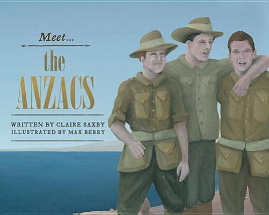
Meet the Anzacs by Claire Saxby
Ill. by Max Berry. Meet series. Random House, Australia,
2014. ISBN 9780857981929.
Recommended. The Meet series of picture books appear to be
a response to the addition of History to the Australian curriculum
recognising the contributions of significant historical individuals.
This title instead focuses on that group of young men who helped
shape the Anzac legend.
The text gives us a sense of the excitement and motivations of the
volunteers as they gather from all over the country to join up and
begin basic training. We sense the pride of the families and general
excitement of the men as they set sail and the sense of a holiday
atmosphere on the ships despite a training schedule as they head not
for Europe, as expected, but Egypt. We then experience the growing
impatience of the troops as they continue training in desert camps,
shadowed by the pyramids, and developing as a combined Australian
and New Zealand force, finally setting sail again for Gallipoli. The
story ends with the men squeezed into the landing boats heading for
the beaches and the final sobering sentence; 'War was like nothing they could have imagined '.
Max Berry has used muted colours in his painted illustrations
depicting a range of perspectives from crowds cheering, broad
landscapes to the legs of soldiers marching off to war. The soldiers
are depicted at a distance so they are representative of all and any
of the many ages, cultures and backgrounds that made up the original
Anzacs.
Whilst there is a plethora of books being produced in anticipation
of the 100 years Commemoration beginning this year, this title will
be welcome in schools and homes as an explanation of the mood of the
country and the soldiers prior to the reality of World War 1.
Sue Keane
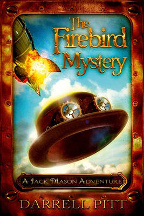
The Firebird Mystery: A Jack Mason Adventure by Darrell Pitt
Penguin, 2014. ISBN 9781922147752.
Highly recommended for readers from 11 years of age. Themes:
Steampunk Fiction, Detectives, Orphans, London - England - History,
Adventure stories, Detectives, Technology - fiction, Mysteries.
Darrell Pitt's exciting new Steampunk series introduces young orphan
Jack Mason to the reader. Filled with derring-do deeds, determined
detective work and dastardly villains this exciting fast-paced
adventure is set in an alternative London world.After the
unfortunate death of Jack's acrobat parents, he's sent to live at
Sunnyside Orphanage a dismal place where he's taunted by bullies.
Jack's life changes dramatically when he is rescued and taken to
live with an eccentric detective Ignatius Doyle. The next week of
his life is filled with danger as they take on the case of finding
Scarlet Bell's missing father and saving the world from the evil
clutches of Professor M.
The novel is rich in imagery with familiar London sights, historical
events and figures interwoven with futuristic technological
inventions. Huge steam airships fill the skies, metrotowers stretch
skyward and giant megastructures covered with terrafirma two hundred
times stronger than steel fill the landscape.
Jack and Scarlet show real emotions and their skills are much needed
by the eccentric Mr. Doyle to help solve these mysteries. Darryl
Pitt has drawn from Arthur Conan Doyle's character Sherlock Holmes,
Jules Verne and added villains from history to make this a rich and
rewarding novel. Scarlet Bell is a strong relatable character, an
advocate of women's rights and the Suffragette movement. Detective
Doyle's character adds to humour especially when he reminisces about
previous cases involving three bizarre elements - a spanner, rubber
plant and exploding nun!
This is a wonderful introductory novel, there are seven more to
come! Highly recommended for readers from 11 years of age. Great
class novel with links to History, Geography, Technology and
Science.
Rhyllis Bignell
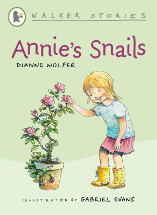
Annie's snails by Dianne Wolfer
Ill. by Gabriel Evans. Walker Stories series, Walker Books Australia,
2014. ISBN 9781921720635.
(Age: 5+) Recommended, Snails, Gardens. Annie is looking around the
garden to find some snails. She loves them and wants to collect some
to be her pets. She plays snail trails with her younger brother,
leaving a trail of debris for him to follow, while she hides under
the washing basket, masquerading as the snail shell. She looks and
looks for some snails: all in the right places, dad's tomato bush,
Mum's garden hat, near the water tap. There are none. But after a
shower of rain she looks in their hiding places again and there they
are. Collecting six snails she keeps them in a bucket, painting a
letter for their name on their shell.
Over the next day she learns about being a thoughtful pet owner and
whether the pets are best left to their own devices, in their own
environment.
The line illustrations add another level of humour to the story as
we see Annie and her brother playing, and laugh at Annie's style of
stance, imitating her mother's, and particularly, the imaginative
use of the garden when the children are searching for the snails, as
well as the words made by the snails.
This is a lovely tale of looking after pets, of learning about
snails, of learning to enjoy the garden, of even learning a few
letters and putting them together to make words. All in all a
delightful first chapter book for younger readers, with three
chapters, and published in clear large print, easy for younger
readers to try their hands at.
Fran Knight
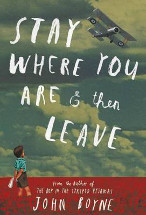
Stay where you are and then leave by John Boyne
Doubleday, 2013. ISBN 9780857532947.
(Age: 11+) Highly recommended. War, Home front, Shell shock. The day
Alfie turns five is the day war starts in Europe. Alfie will never
forget it and even though his family and a few neighbours celebrate
that night, he will not celebrate another birthday for many years.
Even worse, despite his father promising to stay with them, he joins
up and leaves, mum having to become a nurse to earn some money, and
then when that proves not to be enough, Alfie borrows their
neighbour's precious shoeshine kit and sets himself up at King's
Cross Station. Despite asking questions of his mother, he cannot
learn anything about his father's whereabouts, and then his letters
stop.
He shines the shoes of many men passing through on their way to
work, but one day a doctor drops his folder, and helping him pick
all the papers, Alfies spies his father's name, and the hospital
where he is staying.
He determines to go and help him get back home. Here he finds an
utterly changed man and convinced that he will do better at home,
surrounded by those who love him, determines to help him get there.
Behind the story of Alfie and his family, we see World War One and
its impact on those at home, their privation, their efforts to make
ends meet, the suspicion amongst people who have been neighbours for
years, the impact of a white feather, the arrival of military police
at the door.
Through Alfie's nine year old eyes, we are privy to the cruelty of
war and its imposition on millions of people, and the questions that
remain unanswered. Alfie and his family are part of the street where
their friends live and the impact of the war is felt by all as Boyne
cleverly shows the ranges of effects on a variety of people. We see
those for whom war is a fight to be fought, women sending their
husbands off, while others want them to remain home. There are the
older men who see it as a glorious thing, the conscientious objector
who refuses to kill, those who beat him up for his views while
others nurse the ones who return with shell shock, an unknown
disease, one thought to be another word for cowardice.
This multi-layered story reminds the readers that war is made up of
ordinary people, and it is their lives which are disrupted and
overturned by policies made by others far removed. I was struck by
the way that Boyne, author of The boy in the striped pyjamas, covered so many other facets to war, the growing
independence of women, the call for Suffrage, the development of
psychiatric nursing, rationing, the impact of war on the rail and so
on, all making a fascinating background to a thoroughly involving
story.
Fran Knight
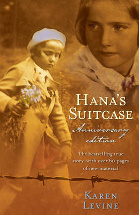
Hana's suitcase by Karen Levine
Allen & Unwin, 2014. ISBN 9781742317679.
(Age:10+) Recommended. War, Holocaust, Japan. As director of the
Holocaust Museum in Tokyo, Fumika Ishioka wanted to have something
tangible to present to the children who visited. She asked far and
wide and only Auschwitz sent a box of things, including a suitcase
with a girl's name printed on the top. This started the children
visiting the centre, to ask questions, and so a small group of
children along with Fumiko, investigated further. When in Prague she
went to the Holocaust Museum and there found that the child had been
killed at Auschwitz but she had a brother. This then led to further
letters and enquiries, and finally the man was found and came to
Tokyo to see the museum and talk to the children.
Told in alternate chapters, readers will easily assimilate the
information about Hana and her family and what happened to them,
alongside the story of Fumiko and her search. Each story compliments
the other as we are breathless in wanting to know how each journey
unfolds. One is very sad with Hana being killed in a camp, while the
other brings her back to life as her brother is found and Hana's
dream of becoming a teacher comes true.
The impact of this tale is powerful, its seemingly simple story of
reuniting a man with his sister's suitcase is the basis for talk
about where they were and why, how one survived and not the other,
what happened to the rest of their family, and what happens today in
remembering the horror of those times.
The original book is here presented with additions, telling what has
happened since, and with additional chapters about Hana's brother,
the letters received at the museum from children allover the world,
the quilts, the displays, exhibitions and awards received by the
original book. All add to the original story and will warm the
readers that the story has lived on.
Fran Knight
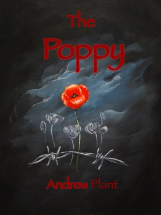
The poppy by Andrew Plant
Ford St, 2014. ISBN 9781925000313.
(Age: 9+) Recommended. World War One, Villers-Bretonneux, Diggers,
Picture book. The first of many such books to be published in 2014
and 2015, for the one hundred years anniversary of the beginning of
World War One, and one hundred years since the first Anzac Day in
1915, this will be put alongside Sally Murphy's Do not forget
Australia (Walker Books) and The promise, written by
Derek Guille (Scholastic).
Picture books about our involvement in war have appeared
consistently in the past several years, so there are plenty to chose
from when stocking the library or putting on a display for one or
other of the memorial days during the year. The poppy recognises the commitment and effort made by the
Australian, New Zealand and Canadian troops on April 24 1918, in
holding back a German advance on the little French town of
Villers-Bretonneux. Their courage and sacrifice is recognised by the
town, and this book recalls the night many gave their lives. The
children of the town chase after a poppy floating over the Rue du
Victoria, the Victoria School with Do Not Forget Australia sign in
every classroom. Beginning at the war cemetery outside the town, the
route of the children and the poppy shows the readers just how
Villers-Bretonneux remembers Australia and what was done on that
day.
The bold illustrations outlined in black, stare out of the pages, as
the children run along, freely because of the efforts made by these
men. Several pages are standouts for me; the beginning and end pages
reflect each other in giving a view from high over the hills around
the town, the middle pages recall war with threatening clouds coming
over the horizon rather than showing images of war, and the town
itself is shown with its Australian references. As a tool in a class
where war is being discussed, or freedom, or remembrance, this can
be added to the fine array of books already published.
Fran Knight
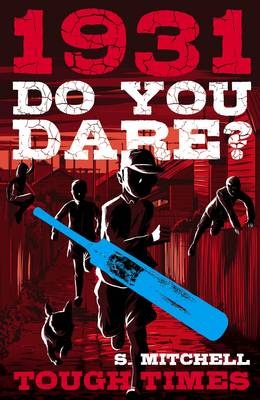
Tough times: 1931: do you dare? by S. Mitchell
Do you dare? series. Puffin, 2014. ISBN 9780143308010.
1931 is a scramble through the mean streets of Melbourne's Fitzroy
as seen through the eyes of Max, aged about eleven. It is two years
into the Great Depression and unemployment is hitting Australia's
working-class families hard. When the book opens, Max's father is
still in work as a boot maker, although on reduced hours of two or
three days a week. With three children and the family pet, Fungus
('a constant irritation underfoot') to feed, and the mortgage to
pay, money is tight. Tom's love for his parents and siblings,
especially his four year old brother Petey, are a highlight of the
book. Tom's best friends from the Daredevils gang are Samson, whose
Dad died in the Spanish Flu outbreak and who is really poor, and
Frank, one of six children at a time when families were much larger
than they are today. The book appears to be written to engage boys
in reading and in history and will probably succeed at both,
especially with a vein of backyard 'dunny' humour and bare bums
(Fungus bites the seat out of the pants of Razor, the local hoodlum)
to sustain them. Girls may find it harder to relate to the
adventures, though the only female gang member, Joan, is a
thoroughly modern miss and the most daring devil of them all.
The figure who underpins the second part of the book is 'Mac', a
benevolent, white-suited gentleman who intervenes on Tom's behalf
just as it seems inevitable that his family must be torn apart. Mac
is 'Australia's Willy Wonka' - in real life, Sir MacPherson
Robertson, founder of Robertson's chocolate factory. In his early
life, MacPherson Robertson experienced greater privation than any of
the characters in the book and in later life he was a genuine
philanthropist. Students can extend their learning to
the life and legacy of this great Australian. South Australian
children can compare his efforts to counter the worst aspects of the
Depression with Sir Edward Hayward's decision in 1933 to initiate
the Christmas Pageant to raise the spirits of the people of
Adelaide. Other Australian 'icons' such as Phar Lap and six-o-clock
closing also provide opportunities to explore the social conventions
of the era.
South Australian teachers may be familiar with Max Colwell's book
Half Days and Patched Pants and play of the same name. Several
scenes in Tough times: 1931: do you dare? would also be very suitable to act out.
Even better, in keeping with the era, students could record and
present the scenes as a weekly radio show.
I would recommend Tough times: 1931: do you dare? to teachers wanting a springboard
into important local and global changes in our society that occurred
within the memory of older family members of the students of today.
Francine Smith
Butter by Erin Jade Lange
Faber, 2013. ISBN 9780571294404.
(Age: 14+) Highly recommended. Obesity. Bullying. Suicide. YALSA
2013 Teens' Top Ten titles, Telegraph's Top 10 YA books 2013. Butter
is a lonely, extremely overweight boy who is ignored at school.
Although he is a very talented saxophone player, Butter refuses to
join the school band and efforts to control his weight have failed.
Desperate for recognition, he sets up a website, ButterLastMeal.com,
where he announces that he will eat himself to death on New Year's
Eve. To his surprise, some of his classmates become morbidly
interested in his plan, betting on what he will eat for his last
meal and closing off access to the website to only people who can be
trusted not to report what is going on.
This is a riveting read; I was totally engrossed as Butter describes
how he got his nickname, his mother's futile fluttering about his
eating, while enabling it, his father's seemingly indifference to
his son and his heart-breaking anonymous online correspondence with
Anna, one of the popular girls at school. Lange vividly describes
Butter's feelings as he suddenly becomes popular with the in crowd
at school. They invite him to go bowling, to parties and to sit with
them in the canteen. Their perverse interest in his impending
suicide and their attempts to ensure that news of it doesn't reach
the authorities are all overlooked by Butter as for the first time
he feels that he belongs.
This story delves into the heart and mind of a young man whose
obesity governs everything that he does. The reader learns about his
feelings, his struggles and his overwhelming need to belong. The
bullying, both physical and online is told in a straight forward
manner, and none of the characters are black or white, all have
flaws and strengths. As a reader I was kept on the edge of my seat
as I wondered how Butter would cope when his deadline approached.
This is a book that is a worthy addition to a library, not only
because of its themes of obesity and bullying, but because of the
way that it grabs the reader's attention.
Pat Pledger
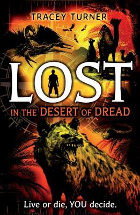
Lost series by Tracey Turner
A & C Black, 2014. Lost in the Desert of Dread. ISBN: 9781472907493. Lost in the Jungle of Doom. ISBN: 9781408194652.
(Age 10+) Themes: Survival, Deserts, Rainforests. The Lost Series by
Tracy Turner focuses on survival in four of the most difficult
environments in the world. Similar in style to the Choose Your Own
Adventure series, the reader is given vital clues to help them
navigate the dangers and then after reading the scenario choices a
choice is made.
In The Desert of Dread careful choices need to be made to survive
the extremes of temperature, scorpions, hungry animals and
dehydration. Factual pages help the reader understand why their
choices lead to their demise. Topics covered include scorpions,
Spotted Hyenas, salt deficiency, using your watch as a compass,
sandstorms and sand cats.
The Jungle of Doom explores the frightening dangers of crash landing
in the middle of the Amazon Rainforest. Careful reading of the
survival tips is needed before the reader starts their journey. The
need for water, fire and shelter is vital. Dealing with the
predators, vampire bats, jaguars, electric eels and snakes is just
part of the journey. With so many dead ends the reader can start
again to plot their jungle escape.
These books are factual fiction and more suited to readers from ten
and up as they deal with survival and death in harsh environments.
Rhyllis Bignell
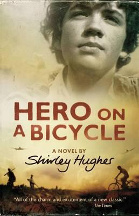
Hero on a bicycle by Shirley Hughes
Walker Books, 2013. ISBN 9781406336115.
(Age: 11+) Recommended. War. Resistance. While his English mother
and his sister, Constanza lie awake at night waiting for him to come
home, Paolo cycles into Florence from their home, avoiding the many
pitfalls that lie in wait for unsuspecting travelers during the last
year of World War Two. His own father has joined the partisans in
the hills, his family is looked upon with suspicion because their
mother is English and their few friends have deserted them.
The war background is described in some detail, as the family goes
about its business, waiting for the war to end, hoping their father
comes back alive and well. But one night when two men intercept
Paolo telling him to pass on a message to his mother, things change
dramatically. Pressured into harbouring POW's, the family finds they
are involved more deeply than they want to be, and it is Paolo and
his bicycle that run the greatest risk.
Taking them into the city the following day, they walk into a trap
and one is captured the other returned to the cellar. With Joe
hidden, the family risks all, and tension fills the air when the
Gestapo comes by ready to search their property.
This is an exciting read of a family pushed to helping the
resistance during World War Two. With a fully described background
and the fact that it is based upon a family that Hughes knew, the
situation will enthrall the readers.
Fran Knight
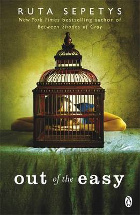
Out of the Easy by Ruta Sepetys
Penguin, 2013. ISBN: 9780141347332.
(Age: 15+) Ruta Sepety's second novel takes us to the French quarter
of 1950's New Orleans. Amidst the crime and corruption, we meet
Josie Moraine, the daughter of a prostitute, who has grown up no
stranger to brothel life, but who dreams of more. Josie's dream is
to get out of New Orleans and attend college, and she also holds on
to the hope that somewhere out there she has a father from whom she
may have inherited some good, to balance out her mother's bad.
Sepety's has developed strong characters, whose depth and sense of
loyalty paint a strong picture of community within the ghetto of
post-war New Orleans. The protagonist, Josie, does seem somewhat
larger than life in her ability to remain largely unmarred by the
world in which she lives, and the brothel madam is held up as both a
heroine and benefactress. While the novel did seem a bit too clean
cut for the environment around which it revolved, it was full of
fascinating characters and interesting details of community life
within this part of the city. Out of the Easy is an engaging novel that is easy to read but
doesn't dumb down the language. It has been elegantly written,
though I did feel that the plot, while containing several elements
of intrigue, did not have as stronger resolutions as I would have
liked.
This is a novel driven largely by character and setting, and both
work well to weave a story that left me wanting more. I commend
Sepetys for her efforts and would read other books by her.
Certainly not a novel for younger readers, though sexual references
are not explicit.
Sarah Rose
Editor's note: Out of the Easy has been nominated for or won
many awards,
including YALSA Top 10 Fiction for Young Adults.
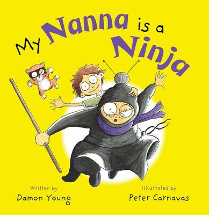
My Nanna is a Ninja by Damon Young
Ill. by Peter Carnavas. UQP, 2014. ISBN 9780702250095.
(Age: 4+) Recommended. Humour, Family relationships, Love. Some
nannas dress in punk, some in blue, but this one dresses in black,
setting the scene for this funny tale of difference. Each page gives
a familiar scenario for a nanna, how they dress, what they do in
their spare time, how they eat, what they do on holiday. Many go
swimming or ski or ride but this one practices somersaulting all day
long. Some eat with chopsticks, or teaspoons or forks, but this one
uses her shiny swords. Finally, it shows how each nanna puts the
loved child to bed. Some read a story, some stroke the weary head,
saying 'I love you', some yawn loudly, some yodel, but this nanna's
kisses can't be heard, but the child knows that she has been there.
Beautiful watercolour illustrations accompany the story of
difference, and show the nanna in all of her glory, being part of
the child's life even though she does not do all the things the
other nannas do. Kids will laugh out loud as each nanna is shown,
then on turning the page they find out what the Ninja nanna does. I
love the endpapers with the repeated illustrations of the Ninja
nanna and the fact that it grew out of reading stories at his
child's kindergarten and noticing that the grans were all the same.
This is a tale full of the love of life, despite how you look or
act, despite what others do and expect of you. The love and
companionship between a child and his grandmother is all that
matters, not what they wear or do. In a classroom, this picture book
could promote equality and sharing, discussions about difference,
and the meaning of family.
Fran Knight