UQP, April 2014. ISBN 9780702250101.
(Age: 4+) Recommended. Friendship. Loss. Grief. Gardens. With
changing seasons, a young boy and his pet rabbit celebrate the loss
of a friend who played and worked in the garden with him. He trawls
through his memories of their time together, how they'd watch the
garden when it rained, sitting on the back step with a hot drink, or
search for signs of new growth or watch for the new shoots and
changes in the garden, or swim through the leaves.
The quietly absorbing story follows the seasons as they change, and
each change brings the refrain, 'I wish that you were here.' It will
be clear to all readers, young and old, that someone has left, gone
away or died, so each reader will bring their own personal loss to
this story and find as does this little boy, that memories hold that
person still in their heart.
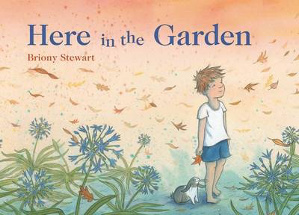
The soft water colour illustrations suit the story well, giving a
luminous glow to the garden as sweeps of muted colour cover the
pages. Some are filled with closely observed drawings of plants and
flowers, while others show leaves or wind sweeping across the page,
but each has one small boy and his rabbit, looking wistfully at the
garden he and his friend helped to develop. This is a charming story
of loss and memories.
Fran Knight
Two wolves by Tristan Bancks
Random House Australia, 2014. ISBN 9780857982032.
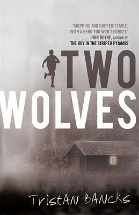
(Age: 10+) Highly recommended. From the outset Bancks draws his
characters and setting so finely that we are aware immediately of
relevant details. Ben Silver is a young boy with a penchant for all
things police and loves making his own stop-motion police movies
with a battered old video camera. In a home environment clearly not
at the upper end of the social scale, Ben is in his room making his
latest epic, and minding his little sister Olive when the police
come knocking at the front door looking for his parents. When Ben
tells the police that his parents are still at work at their car
wrecking yard, they leave without explanation, leaving Ben wondering
what is happening. Just as he picks up the phone to call his
parents, they arrive with a screech of tyres and frantically whisk
both children with a few possessions into the car, claiming they are
going on a 'holiday'.
The ensuing action which often becomes dark and disturbing as these
errant parents attempt to cover up a $7.2 million bank bungle in
their favour awakens Ben to the failings of both mother and father -
and also brings out his strongly protective care of little Olive.
When Ben and Olive are abandoned by both parents, he uses all his
instincts to bring them both safely through frightening and
dangerous experiences alone in the bush, until finally managing to
get them both back to civilisation and their grandmother.
An old man tells his grandson that there is a battle raging inside
him, inside all of us. A terrible battle between two wolves.
One wolf is bad - pride, jealousy, greed. The other wolf is good -
kindness, hope, truth.
The child asks, 'Who will win?'
The grandfather answers simply, 'The one you feed.'
A rite of passage novel that will capture readers, particularly
boys, aged 10 and up, I highly recommend this and believe it would
be a gripping 'read aloud' which would lead to many conversations
around ethics and values.
Two Wolves book
trailer .
Teacher's notes available here.
Sue Warren
Little Meerkat by Aleesah Darlison
Ill. by Shannon Melville. Wombat Books, 2014. ISBN 9781921632822.
'Little Meerkat did not like cuddles. 'Cuddles are for babies.
I am not a baby. I am a heroic hunter'.' Little Meerkat did
not like staying at home when the others went to search for food and
nor did he like slinking through the grass when the others stood in
their distinctive stance. In fact, Little Meerkat didn't like
anything that baby meerkats did and even though his family members
had very good reasons for him to hold paws, paddle at the edge of
the lake and get dry afterwards he did it very grudgingly.
Until a snake decides he will make a ssplendidly delicousss ssnake
ssnack . . .
Using an internationally recognised animal as the main character to
ensure children from all backgrounds, cultures and countries can
connect with and learn from Little Meerkat's story, Aleesah Darlison
has created this delightful tale for young children who want to be
older than they are - 'threenagers' is the word that has been used
for Miss 1 and Miss 2 lately. Inspired by their older siblings they
believe they can do anything, oblivious to danger or consequences
until they are stuck at the top of the monkey bars, or, in this
case, a snake comes along. It really is a story that spans
borders and boundaries.
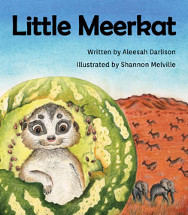
There is something about meerkats that automatically endear them to
us and Shannon Melville has captured this in her illustrations
perfectly. Little Meerkat as the tribal warrior, as the
stealthy scout, as the swimming champion add humour but more
importantly they enable the reader to empathise with Little Meerkat
and perhaps see themselves in him. Will it stop Miss 2 from
wanting to be Miss 7, or Miss 1 wanting to be Miss 9? Probably
not - but it offers a great reason to dissuade them from being too
risky. 'Remember what happened to Little Meerkat?' may become
a regular refrain in this house!
Barbara Braxton
Max by Marc Martin
Viking, 2014. ISBN 9780670077434.
(Age: 4+) Warmly recommended. Friendship, Change. Max the seagull,
and Bob the fish and chip man are friends. Each day Max sits on a
stool within the shop, welcoming customers, eating the occasional
chip, and keeping Bob company. They have been friends for a while,
and each night when the shop is closed, they go to the jetty to
fish. Things are ideal, there are a few other shops along the jetty,
a cake shop and bakery amongst others, with a fun fair and roller
coaster behind. But one day Bob looks sad, and in the background,
cranes can be seen on the sky line. Change is imminent. Over the
page several of the shops are boarded up, and an advertisement for a
new mall can be seen. Nothing will cheer Bob, and one day Max flies
in to discover Bob has gone. He waits for a while, and then flies
high in the sky, over the city, looking for his friend. He is
attracted by a familiar smell, and diving low comes across a fish
and chip shop just like the old one, with Bob serving customers.
They are together once again.
A charming story of friendship, of loss, of the pain of separation
but the joy of coming together gain, all wrapped up in a tale of a
seagull. But behind the tale is also the story of change, the
changing landscape of the city looms early, but the friendship
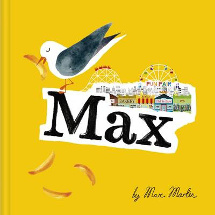
between Bob and Max remains firm. The fascinating illustrations
reflect a variety of techniques, and show a city from a seagull's
perspective. I love the Google map view of the city, the seagull
trawling across the skyline looking for Bob, then zooming in for the
closer shot of the shop then the man.
Fran Knight
Chasing Shadows by Corinne Fenton
Ill. by Hannah Somerville. Ford Street, 2014. hbk. ISBN
9781925000153. pbk. ISBN 9781925000146
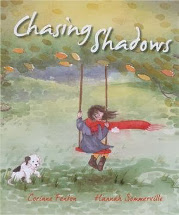
'On a yellow morning when the sun is new and shadows long a puppy
comes to live at Beth's house. For Beth it is too soon.' No
matter what puppy pranks and antics Patches gets up to, Beth is not
interested. She sits and stares seeing nothing; endlessly
winds a string of beads around her fingers; occasionally
weeps. Time passes and Beth remains deep in her grief and
depression following the death of her mother. She sees only shadows
and memories. It is clearly more than normal sadness and while she
is in almost every picture, she is not there in emotion. It's
as if she, herself, is a shadow. But slowly, slowly, she becomes
aware of Patches until one spring day Patches is a little too
curious and is bitten by a snake. And Beth has something to
cuddle and love again. No more shadows.
This is a most sensitive book on a sensitive subject - childhood
depression brought about by death and grief. The text is
gentle and poetic - instead of 'Dad took Patches out for a wee', the
author has crafted 'An outside visit night-time tumble wide eyes
watching bat ears fly' - and it all adds to the atmosphere of the
story. The illustrations from first-time illustrator Hannah
Somerville are just exquisite, their soft lines and muted tones
echoing Beth's mood and taking over perfectly so there is no text
needed. The story tells itself. Each is overlaid with shadows
until the large page which is full of light and colour and happiness
and love.
Throughout the story there is a strong thread of love - Beth's love
for her mother, the father's love for Beth even though he, too must
be grieving, Patches' love for both father and daughter as well as
life, and eventually Beth's love for Patches. It is a
heart-warming story at the same time as it is heart-wrenching, for
as much as there is said in the evocative word choices, there is
just as much unsaid that has just as powerful a presence in the
story.
The publisher's recommendation for this book is 10+ and it is
featured in the Older Readers reviews in Magpies but I believe it
can work for all ages. At its simplest level, it can just be a story
about a puppy winning over a little girl's heart and she takes a
while to love him perhaps because she's a little afraid of puppies
or because it's too soon after the death of another one; at the
other end it could be used to support a child through a similar
experience as Beth, validating their grieving process and offering
some hope that they will pass through it. It can be a conversation
starter with a child, a group or a class as, sadly, we know too many
children with depression these days and this could be the beginning
of the understanding and acceptance and support that will show the
way out of the shadows. However it is used, it is an important
addition to the library's collection.
Barbara Braxton
Tank Boys by Stephen Dando Collins
Random House, 2014. ISBN 9780857981301.
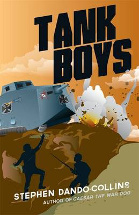
Set in the dying days of World War 1 in the battlefields of
Villers-Bretonneux, France, Tank Boys is the story of three
young lads - Frankie Pickles and Taz Dutton from Australia and
Richard Rix from Germany - and how the events of April 1918 bring
them inexorably together. All three of them, either by fate or by
choice, have found themselves on the front line instead of still
being in school. Frankie deliberately lied about his age so he could
join 'the big adventure'; Taz feels guilty about staying home after
his two brothers have already sacrificed their lives, and Richard is
there because his grandfather didn't bother to fix an error on
official documents. But regardless of their reasons each is called
on to do what would be thought unthinkable for today's 16 year-olds
and each is forever change because of that. It's a story of
friendship and relationships built on respect and understanding
through common experiences.
A skilfully woven mixture of fact and fiction, of characters and
real people, this story tells of the first ever tank-versus-tank
battle and how the mighty Mephisto, the massive German panzer A7V
tank, has come to be on display at the Queensland Museum in
Brisbane. Told from both sides of the events, it tells of life in
the trenches, the deadly perils of bombardments and mustard gas and
constant shelling for Frankie and Taz, and it tells of life in an
elite tank division for Richard. Starting out as separate chapters
but becoming closer and closer as their fates seem destined to meet
until all three are literally on the same page, this was an
engrossing account of a battle that we are only just starting to
learn and teach about in schools, showing that World War I was about
more than the events at Gallipoli in 1915. It is realistic but not
gory and it's quite possible to empathise with all three boys. It
personalises the cold facts of the history texts.
Written by the author of Caesar the War Dog and made more compelling
by the evidence that the events really did take place, this is a
book that will particularly engage boys from Year 4 and beyond,
especially as the events of World War I are brought more and more
into focus as the centenary commemorations become more widespread as
the early days of August draw closer. If I were on class, I'd
earmark as my read-aloud novel for that time.
Barbara Braxton
The Sky Dreamer by Anne Morgan and Celine Eimann
IP Kidz, 2011. Hbk. ISBN 9781921479977. Ebk ISBN 9781921479984.
Since his sister died, Liam has been living in a grey world, sitting
watching the wintry sky for hours wondering if Cassie was out there,
somewhere. Even the prospect of his birthday the next day does not
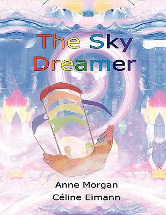
enthuse him. But that night, Liam hears a voice calling and there,
outside his window is a sailing boat tethered to an old silver ghost
gum. Aboard is Cassie, warm and happy, and inviting him to join her.
'Climb aboard the Sky Dreamer', she calls.
When he does, she picks up needle and thread and begins to sew
Liam's birthday present, but before she reveals what it is Liam must
learn to sail the Sky Dreamer. Liam encounters some difficulties
doing this, each time begging his sister for help, but she keeps
sewing, and Liam has to learn to do it for himself sailing on and on
and on until, at last, a comet with a tail as long as a year, lights
his way home. Just as the sun rises, the Sky Dreamer vanishes and
Liam tumbles out clutching his present from Cassie . . .
This is a most sensitive, alluring book about a child dealing with
death. Written following the death of the author's daughter, it
acknowledges that grief is a long journey which may be shared but
which is travelled alone. It can be stormy and seemingly endless but
there is eventually acceptance and comfort and a way forward.
The beautiful, delicate pictures mirror the mood of the story
perfectly - monochrome in Liam's dark days and the introduction of
colour when Cassie appears in the Sky Dreamer hints at a glimmer of
hope and happiness. The chaos and colour of the storms reflect
Liam's thinking and feelings, but as they merge into gentler colours
and less frenetic images the reader gets a sense of growing peace
and calm.
Too often our students travel their own version of Luke's journey -
this is a book that might help them navigate it more easily, showing
them that whatever feelings they have are OK and that they are not
alone. That, in itself, might offer comfort.
Barbara Braxton
As I Grew Older by Ian Abdulla
Working Title Press, 2014. ISBN 9781921504693.
Highly recommended. Picture book. As I Grew Older
(first published in 1993 and recently republished in paperback by
Working Title Press) is a moving pictorial introduction to the life
of an Aboriginal family living along the River Murray during the
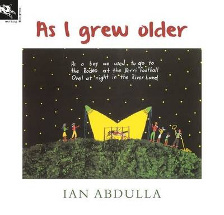
1950s and 60s. Ian Abdulla's wonderful paintings and simple text
descriptions record both the everyday activities and also special
events that were keenly anticipated all year, such as the night
rodeo held on Berri oval. The enchanting illustration of the rodeo,
my favourite in the book, has two cones of light illuminating a
daring bare-back rider and watched by an enthusiastic audience, both
brown and white skinned. Twinkling stars in a cloudless sky form a
backdrop to all. Other favourite childhood activities that are
lovingly recorded here are playing 'chicken' on the ferry going to
school, and cowboys and Indians, played using the materials to hand:
the jaw-bone of a sheep in place of a gun and a gum tree branch for
a horse.
But it is the River Murray that is the real star of this book.
Patiently winding its way through across the pages, the river
provides sustenance for the Abdulla family, giving them food,
income, shelter and entertainment through times that were hard for
everyone - but especially hard for Aboriginal people. There is a
strong sense that this family is completely at home on and in the
river and with the flora and fauna on its banks. The end-page of the
book helpfully provides a map of the district between
Kingston-on-Murray and Berri that helps to trace the Abdulla
family's movements as they catch fish, collect swans' eggs, and pick
grapes to make a living. The map also pinpoints the location of the
Gerard Mission, where Ian Abdulla is today buried alongside family
members. As I Grew Older does not directly talk about the policies
towards Aboriginal people at the time Abdulla was growing up in the
Riverland, but much can be inferred from the family's need to draw
so heavily on the resources of the river. As I Grow Older is
as quietly instructive for an adult audience as for children.
Teachers can use this book to consider changes that occurred in the
Riverland area in the century after white settlement and the extent
to which the Ngarrendjeri people were able to maintain their
connections with land and river. It is wonderful that the
republishing of this important book affords an opportunity to
introduce this important South Australian artist to a new
generation.
Francine Smith
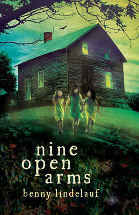
Nine open arms by Benny Lindelauf
Allen & Unwin, 2014. ISBN 9781743315859.
Fing and her siblings have a father who dreams incessantly but fails
miserably in every enterprise he undertakes. Perpetually struggling
to make ends meet, this austere Dutch family constantly has to move
home and their arrival at a strangely positioned, poorly maintained
house opens the narrative.
The children's Grandmother assumed the maternal role on the passing
of the mother and when occasion dictates, she tells a family tale,
accompanied by photographs from her special crocodile skin bag.
Stories within stories are a feature of this quirky novel and the
reader is soon captivated, wanting to understand the family's
history and that of connected village characters from previous
generations.
Being a translation, language and cultural features give this novel
a very different feel, yet this improves rather than hinders the
story which reveals the fears, difficulties and pain felt by family
members, as well as the shared love, protection and support.
Cleverly intertwined with the depiction of this family's present
circumstances and revelations about its past is the little known
story of Nienevee, a Romany traveller and Charlie, a furniture maker
in the town. In spite of brutal intolerance to the travelling folk
displayed by the town's inhabitants, the pair slowly develop a
romance over many years and this contributes a significant element
to the plot development.
Boldly drawn characters appear in this tale and they ring true,
showing kindness, tolerance and understanding towards the fragile
members of the family and wider community whilst demonstrating
perfectly normal human frailties at other times. When delicate
individuals respond unexpectedly, one can't stop reading to learn
how this micro community fares. This story celebrates its quirky
differences and at times tears the heart before making it brim with
warmth. Complex consideration of what constitutes "home" and
associated notions of security, belonging and memory are presented.
The opening explains that the year is 1937 and the location is on
the border with Germany. Interestingly, whilst this promotes a sense
of foreboding, it does not feature at all in the story. What it does
however is leave the reader ruminating upon the welfare of the
family following the invasion.
Rob Welsh
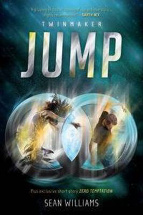
Jump by Sean Williams
Allen & Unwin, 2013. ISBN 9781743315866.
Clair lives in a world revolutionised by d-mat, a global teleport
system that allows people to transport themselves instantaneously
around the world. A coded note promises improvement - the chance to
change your body any way you want, making it stronger, taller, more
beautiful. Clair thinks it's too good to be true, but her best
friend, Libby, is determined to give it a try.
Clair's world is amazing; technology has completely revolutionised
the planet. By using d-mat you can travel around the world in a
heartbeat. Only Abstainers don't use it. They distrust and
disbelieve that any good will come from using it but, no one listens
to them as they are perceived as crazy and dangerous by the common
people. Jump didn't really engage me as it might other readers. It
felt boring and slow when I like things fast and intense. To
thoroughly enjoy this book I had to put myself in someone else's
shoes. I then started to really appreciate what Sean has done. The
book was engaging and shows a high level of romance. It also shows
the difference between the privileged and the poor. I would
recommend this book to those who love romance but would like a bit
of action in their lives.
Reece Barnett (Yr 9 Student)
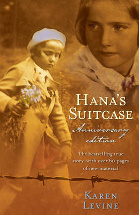
Hana's Suitcase by Karen Levine
(Anniversary Edition)Allen & Unwin 2014. ISBN 9781743317679.
When an anonymous Japanese donor decided that Japanese children
should learn more about the Holocaust in an effort to contribute to
global peace and understanding, it is unlikely that they had any
idea of the impact of their philanthropy. The foundation of the
Tokyo Holocaust Education Resource Centre set off a chain of events
which spans three continents, seventy years and continues to educate
and enlighten well beyond Tokyo, or even Japan.
The focal piece of that museum is a very ordinary brown suitcase
which sits in a glass case but which is taken out for the visiting
children to wonder at. For even though it is empty, it has a
remarkable story to tell. Painted on the outside are the words,
'Hana Brady. May 16, 1931, Waisenkind'. Words that spark questions
like 'Who was Hana Brady?' 'Where did she come from?' 'Where was she
going?' 'How did she become an orphan?' 'How did this suitcase get
to Tokyo?' 'Why is it so important?' Hana's Suitcase provides the answers to those questions and
more, and gives a little girl, who wanted to be a teacher, not only
a voice but the ability to teach children the world over, an
accomplishment beyond her wildest dreams. It is the story of how the
director of the museum, Fumiko Ishioka, felt that she would need
actual objects from the Holocaust if she was to reach and teach
Japanese children about it in a way that would engage them. For
months she wrote letters to everywhere she thought might be able to
offer her something until, at last, she was rewarded with a parcel
from the Auschwitz Museum which contained a child's sock and shoe, a
child's sweater, a can of Zyklon B poisonous gas and a suitcase.
Inspired, she started a quest to find out who owned the suitcase, a
quest which eventually leads her to Hana's brother, George who had
survived and was living in Canada. This book is the story of that
quest, interwoven with Hana's story and photos because the family
photo album was the one thing that George had managed to save and
preserve over the years. It is that story which touches and teaches
so powerfully.
While it is realistic and sad, it is written with a light hand that
realises that its audience does not want to be frightened or
terrified by explicit details - but, nevertheless, it paints a
picture of racism, marginalisation and segregation and what happens
when it is taken to the extreme. It is written in a way that those
who read it and recognise its events in their own lives -
particularly the marginalisation of being different - and respond to
it in that way.
In this anniversary edition, as well as the original story we learn
about its impact on the author, George Brady, Fumiko Ishioka and
children around the world during the years since its original
publication. It has been published in 45 countries, produced as a
play, crafted into several television documentaries, inspired
quilts, drawings, writings . . . George continues a website which has so much
more than a book can contain. Hana is truly a teacher.
A search for Hana's Suitcase will bring up a host of ideas
of how it can be used within the curriculum (Australian publisher
Allen & Unwin have teachers'
notes ) and across the years so even though it is very
suitable for a primary school library (I'm very comfortable giving
it to Miss 9 to read), it also has a place in secondary supporting
the history curriculum. An essential acquisition.
Barbara Braxton
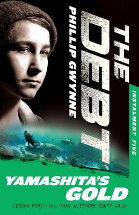
The debt: Yamashita's gold by Phillip Gwynne
Allen & Unwin, 2013. ISBN 9781742378619.
(Age: 13-18) Highly recommended. 'The Debt was the worst
thing to have come into my life. It had almost killed me about a
dozen times in a dozen different ways. But here I was wanting,
willing, it to contact me. To give me the next instalment.'
Dominic receives a mysterious note in Latin. He then goes on a
difficult and a quest of intelligence just trying to find who sent
the note. He then goes on to find the treasure and the have someone
take it from him. But the question is who does that person turn out
to be?
This book had me from the start. All the way from when he was
yelling at his treadmill to finding the gold and even to the end
when a shocking secret is revealed. I really like books and believe
me I've read some bad books but The debt, Yamashita's gold
is not boring. It is thrilling, breath taking, jaw dropping and in
some ways motivating.
I have not read the previous books but I already want all of them.
This book made several references to the previous books so I could
already guess the plot of them that doesn't stop me from wanting to
read them though!
In my opinion Phillip Gwynne has done an extremely outstanding job
in this book and I am sure in the previous and future books as well.
I rate the book 9/10 and I recommend it to 13-18 year olds.
Reece Barnett (Student)
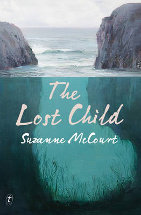
The Lost Child by Suzanne McCourt
Text Publishing, 2014. ISBN 9781922147783.
(Age: Senior secondary - Adult) Five year old Sylvie, growing up in
a small coastal town south of the Coorong in the 50's, has a lot to
contend with. The family is breaking up, her distant father is
violent when drunk and her mentally fragile mother copes by
obsessively cleaning. The good times are when her older brother Dunc
and his friend Pardie let Sylvie join them fishing, collecting birds
eggs or just reading superhero comics. Over the next ten years the
family situation gets worse; her parents divorce, her home is burnt
down and Dunc mysteriously goes missing. Sylvie endures trauma,
bullying, rejection and self-blame yet she largely manages to
channel her energy into positives like creative photography and
excelling at school. She is a survivor. The landscape framed between
the lagoon and the sea is a constant to draw strength from and as
she negotiates puberty some of the pain from the past is resolved.
This story will resonate with older South Australians familiar with
the South East issues around draining the landscape and cray fishing
and with events like the Queen's visit and oil exploration but as
the narrative seeks to document the slow development of a child from
first awareness to independence it can sometimes lose impetus.
Connected with Hartnett's Thursday's Child or Dettman's Henry's
Daughter it could be useful for senior students looking for
texts about family trauma or small town issues.
Sue Speck
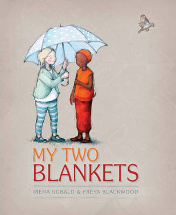
My Two Blankets by Irena Kobald
Ill. by Freya Blackwood. Little Hare, 2014. ISBN 978921714764.
Picture book. In the beginning she was a very happy little girl in
her home village - so happy, her aunty called her Cartwheel. But
then came the war and she finds herself in a new country where
everything, even the wind, feels strange. But strangest of all was
the language. Nobody spoke like she did - 'it was like standing
under a waterfall of strange sounds. The waterfall was cold. It made
me feel alone. I felt like I wasn't me any more.'
So, at home, she wrapped herself in a blanket of familiar words and
sounds and memories - a blanket that was warm and soft and covered
her all over, letting her feel safe. Until one day she goes to a
park and a girl smiles at her and waves . . . and a new blanket is
woven, one that is different but which becomes just as familiar and
comfortable so she has the luxury of choosing the one she wants at
the time.
This is a poignant story deliberately set in Any Place, Anywhere
because its message is not confined by boundaries or borders. It's a
universal story of anyone who has experienced change, even those for
whom the change is to a different circumstance not setting and while
the language may be familiar, it is different. We don't need to know
the girl's name, where she came from or went to - this is a story to
fit the globe.
Illustrated by the amazing Freya Blackwood, you can read about how
she interpreted the concepts into what are the perfect
accompaniments to this story on her blog
.
If you are looking for titles which fit such themes as Belonging,
Identity, Refugees and particularly the Australian Curriculum
cross-curriculum priority Intercultural Understanding, this would be
a perfect addition.
Barbara Braxton
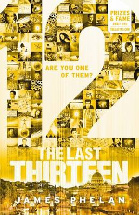
12 by James Phelen
The Last Thirteen Book 2. Scholastic, 2013. ISBN
9781742831855.
When we last saw Sam he was mano-a-mano with Solaris. Both Solaris
and the Enterprise, you will remember, are battling the Agency for
world domination - or worse. In Chapter one, Solaris turns out to be
an Enterprise Agent in disguise, leaving Sam to continue his search
for the Last Thirteen dreamers. In a parallel story arc, Alex has
been captured and is being groomed to work for the Enterprise. The
Star of Egypt, prompts Xavier to fly Sam to Egypt for more answers
before Sam's dreams find him socializing with an Italian pop star in
Rome - No 12. Together Gabriella and Sam escape Solaris only to end
Book 2 on another cliffhanger. 12 - The Last Thirteen is a fast read for tweens, teens, boys
and reluctant readers who will always choose action and dialogue to
escape the realities and restrictions of adolescence.
Deborah Robins
Editor's note: 11 (ISBN 9781742831862) and 10 (ISBN
9781742831879 ) have also been published.