Little, Brown & Company, 2014. ISBN 9780316085274. Recommended
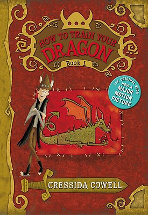
for children aged 8-12. To become a Viking hero it was a tradition
of the Hooligan Tribe to undertake the dreaded Dragon Initiation
Programme. Failure meant banishment from the tribe forever.
The unremarkable Hiccup, the son of Viking Chieftain Stoic the Vast,
and a member of the Hairy Hooligans, must capture a sleeping baby
dragon from the cave in Wild Dragon Cliff, preferably without
awakening the mass, take it back to the village and train it to obey
and catch fish for him. No easy task.
Hiccup and his little dragon, Toothless, are scorned and bullied by
other members of the gang. He has great difficulty training his
reluctant dragon, but patience pays off and Toothless eventually
proves to be very heroic when most needed.
All the characters have unbecoming names such as Snotlout, Thuggery,
Baggybum and Gobber, who is a six-and-a-half foot giant with a mad
glint in his one working eye and a beard like exploding fireworks.
The teenage Hooligans and their counterparts, the Meatheads,
initially clash in fierce rivalry. A dreadful crisis threatens the
entire village and the 'Big Drums' summon the two teams of boys, who
must work together to overcome two humungous dragons, causing
spectacular havoc.
Brave Hiccup, the only person who can converse with dragons, devises
a remarkably clever plan and endures a mindboggling experience with
Green Death and, with Toothless helping, struggles to outwit the
monsters, to avert a catastrophe.
Joan Kerr-Smith.
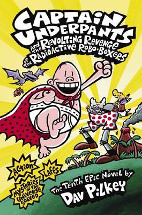
Captain Underpants and the revolting revenge of the radioactive robo-boxers by Dav Pilkey
Scholastic Australia, 2014. ISBN 9781743621806
(Ages: 9+) Laugh out loud humour with FLIP-O-RAMA that allows you to
animate the action.
Captain Underpants returns in his epic tenth novel with Mr Krupp who
turns into Captain Underpants with the click of a finger. In this
novel George, Harold, Sulu and Crackers embark on an adventure to
figure out a way to undo the time-travelling hijinks of Tippy
Tinkletrousers that prevented George and Harold from creating
Captain Underpants in the first place!
Tippy Tinkletrousers was in big trouble because he had zapped
himself back in time five years, and accidentally scared four
bullies from the school. This thoughtless mistake set in motion a
series of events that ultimately got Mr Krupp fired. Since there was
no Mr Krupp, there was no Captain Underpants. Since there was no
Captain Underpants, there was nobody to save the world from the
terrible devastation caused by the villains from the first three
epic novels.
To fix this problem Tinkletrousers decides he has to go back in time
to stop himself from scaring those four bullies. After several
seconds of made for television style of special effects, Tippy found
himself transported to the awful night of the terrifying
thunderstorm. He knew at any moment the four bullies would come
running from the school and tear across the football field. Then
they would come face to face with a slightly younger version of
Tippy who was the only one who could stop it all from happening.
Tippy, George, Harold, Sulu and Crackers constantly travel through
different times, including the caveman era where Tippy
Tinkletrousers gets pummelled in many different ways. By page
210 of the book, the author tells when and how our universe began,
what causes this to happen, what is this theory called, how did the
dinosaurs become extinct, what caused the last major ice age and who
made the world's first cave drawing. Unfortunately, this information
is not useful for any practical benefits.
Page 212 contains the 'I'm smarter than you' song which is bound to
make you giggle in true Underpants style.
The novel ends with the explosion back when nothing existed, when
Sulu, Crackers and Tippy cause the whole universe to form. While all
the action was happening, before Crackers left, she leaves three
purple and orange speckled eggs.
Could this be the beginning of another Captain Underpants adventure?
Stay tuned to find out.
Christina Sapio.
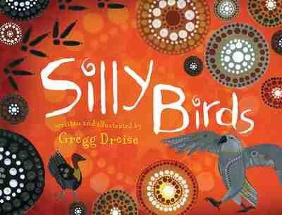
Silly birds written and illustrated by Gregg Dreise
Magabala Books, 2014. ISBN 9781922142993.
(Age: 5-7) Picture book. Moral tale. Aboriginal themes. Birds. The
story of an animal which defies its elders is one that permeates
through all cultures, and here is presented with an Aboriginal base,
as the eagle, a magnificent bird, wastes its time defying its elders
and consorting with the turkeys on the ground.
Maliyan the eagle has loving parents, and they make sure that he
listens to what they tell him. He doesn't want to be a wombah
thigaraa, a silly bird. But then he meets Wagun, a silly bird, and
together the pair talk all the time, not listening to their elders.
Wagun speaks only of his own accomplishments. Maliyan's parents
despair, their son is not taking care of their environment and
eating the food meant for all. They tell him how they feel and he
begins to feel badly about what he has done. He realsies that his
abilities are not in talking like the turkey, but watching and
listening, and he flies into the sky to do just that, while the
turkey stays on the ground. To this day the eagle remains in the sky
ever watchful, while the turkey remains scratching on the ground
having lost the ability to fly.
This is a wonderful tale of respecting the elders, of making the
most of your own abilities, of not being swayed by the easy path, of
not being taken in by your peers.
The story reflects the saying 'its hard to soar like an eagle when
you are surrounded by turkeys', often heard from Gregg's Uncle Reg
Knox as well as the elders in his community in South West Queensland
where the Kamilaroi people live. A lovely retelling of an old story
which could be used in a class where cautionary tales are under
discussion, or Aboriginal stories being read.
Fran Knight.
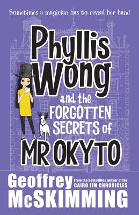
Phyllis Wong and the forgotten secrets of Mr Okyto by Geoffrey McSkimming
Allen & Unwin, 2012. ISBN 9781742378213.
Meet Phyllis Wong, great-granddaughter of the famous Wallace Wong
(that great 1930s conjuror of stage and screen fame) herself a
cannily adept magician. Phyllis lives in the beautiful Art Deco
apartment block built by her fantastical forebear along with her
Dad, Harvey, and a very smart fox terrier called Daisy. Her best
friend Clement is an able foil and sometimes inept assistant for her
adventures and the cast is rounded out by other inhabitants of the
Wallace Wong building, all of them rather unmistakeable and somewhat
eccentric.
This first adventure begins with the distressed Mrs Lowerblast,
proprietor of Lowerblast's Antiques & Collectables Emporium
(ground level Wallace Wong building) being terribly upset to
discover the theft of a precious piece of Australiana pottery. As
things heat up a valuable diamond necklace also disappears, closely
followed by a rare Picasso, without so much as the slightest hint of
a human culprit being involved. Could it possibly be... well,
ghosts? How can a valuable necklace - securely protected - just
vanish into thin air as if by magic? Ahh, as if by magic! - Phyllis
Wong brings all her unusual powers of observation and thinking into
play and combined with her expert knowledge of sleight-of-hand
manages to reveal a very nasty criminal, helping out her friend and
neighbour Chief Inspector Inglis.
McSkimming's skill with bringing characters to life on the page, his
quirkiness with language and his ability to create a rollicking
mystery laced with humour and cleverness never fails to impress.
Phyllis Wong lives in a very modern world, with all the gadgetry
young readers are used to yet the story still retains the essential
flavour of older style adventure-mysteries with their endless
appeal, where good always triumphs over evil. The city in which she
lives is skilfully anonymous enabling any reader to project
themselves into the thick of the action with ease. Phyllis is a
strong character, being smart, resourceful and mature, with a fierce
loyalty to her friends of all ages. With plenty to engage both boy
and girl readers these will be sure-fire hits with children aged
around upper primary to lower secondary.
Watch the book
trailer and trailer with
the author.
Sue Warren.
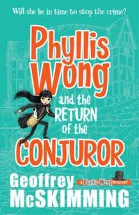
Phyllis Wong and the return of the conjuror by Geoffrey McSkimming
Allen & Unwin, 2014. ISBN 9781743318379
The second of the Phyllis Wong mysteries sees Phyllis,
Clement and Chief Inspector Inglis caught up in a baffling case of
rare Shakespearean manuscripts, which are suddenly appearing in
auctions. How can it be that such rare items as the First Folios of
Shakespeare almost flood the market, when so few of them have
survived the centuries since they were first published?
Of course, if one could travel back in time and buy them firsthand
and bring them back to the present day that would make perfect
sense. But that is impossible - or is it?
Phyllis is astounded to meet her famous great-grandfather Wallace
Wong when he travels through time and reappears in his old basement
of magical wonders, now Phyllis' own workshop. Wallace shares with
Phyllis the secret of 'transitting' through strange Pockets in time
and space, a skill he developed through his dedicated study of
science, inspired by Einstein's theories, as well as his own
application of the mysteries of magic. This certainly explains
Wallace's strange disappearance in the middle of his act in
Venezuela, back in 1936. And - importantly, explains how the nasty
Mistress Colley is obtaining Shakespearean First Folios to sell for
enormous profits. Not exactly illegal, if somewhat unethical but
when it becomes apparent that Mistress Colley intends to steal
original manuscripts written by the Bard, it's time for the
resourceful Miss Wong to step in.
Phyllis, Clement and Chief Inspector Inglis know the only way to
foil the plans of the loathsome Mistress Colley is to transit back
to The Globe and thwart her illicit designs. As one might imagine,
there is bemusement - and amusement - all round for obvious reasons
when strangers appear and try to warn William Shakespeare. However,
as with all satisfying adventure-mysteries, the action rolls on and
the villain is stymied.
Another real page-turner (I read it in one sitting!), this second
volume of Phyllis Wong certainly has me anticipating the next
instalment.
Be sure not to miss out, put these on your shopping list - they are
guaranteed to 'vanish' off the shelves rapidly!
Watch the book
trailer and trailer with
the author.
Check out Phyllis'
FaceBook page as well.
Sue Warren.
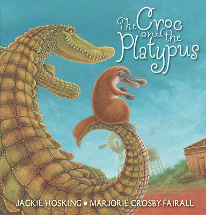
The Croc and the Platypus by Jackie Hosking
Ill. by Marjorie Crosby-Fairall. Walker Books, 2014. ISBN
9781922077608.
(Age: 5-8) Recommended. Australian animals, Verse, Australian
environment. With the same rhythm as The Owl and the Pussycat,
this rollicking read aloud verse story showcases the Australian
outback. Instead of a 'pea green boat' we have a 'rusty Holden ute',
and included in the tale are a didgeridoo, the Nullarbor Plain,
Uluru, sheep and a shearing shed, fleece, lamingtons and the
Southern Cross. The damper in the hamper bounces away in the back of
the ute, while they drive over the ochre plains to their
destination. Many of these words are in a glossary at the back for
those not in the know.
The illustrations reflects the story as the pair drives across
Australia, going through desert and softly grassed land to the
shearing shed and finally to Uluru. All the way, Croc plays his
didgeridoo, lounging in the front seat of the ute as Platypus
drives.
The easy rollicking rhyme will entreat readers and listeners alike,
and read aloud in a group or by themselves adds another layer of
interest. Some adults may look up The Owl and
the Pussycat, to compare with this adding another level
of interest to the younger readers.
As a vehicle to introduce Australian words to a class, this will
offer a starting point that will engender interest and engagement.
Fran Knight
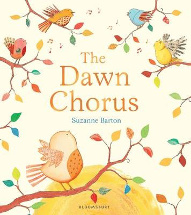
The dawn chorus by Suzanne Barton
Bloomsbury, 2014. ISBN 9781408839218.
(Age: 3-5) Warmly recommended. Birds. Music. Dawn. The swirling
lines of music on the endpapers take the readers into the story, as
they follow the tale of the music which accompanies the rising of
the sun each morning.
When Peep wakes one morning he can hear the most wonderful singing
and goes from one animal to another asking who is making this
beautiful sound. No one can help, the owl hooting that it isn't him,
the mouse squeaking that it isn't her, but the frog thinks that it
comes from over there. Looking up, Peep notices that there are many
birds in the tree above his head, singing together. When he asks
what is happening, they tell him that they are the dawn chorus,
singing in the day. Peep asks if he can join in, and is told to come
back in the morning to audition. After practising all night, he
returns in the morning, only to find that he is too late. But the
next morning he sleeps in as well, and finds that he can sing well
at night, because he is a nightingale, a bird that sings at night,
not the morning.
A lovely story of doing what you are meant to do, of finding your
own niche in the world. The dawn chorus is beautifully illustrated
with soft watercolour images that float across the page. Younger
readers will thrill to the story read out loud, following Peep's
attempts to find where he belongs, going from one animal to another
to follow the music that he hears, knowing that music is his life.
Fran Knight
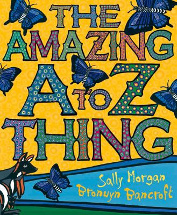
The Amazing A to Z Thing by Sally Morgan
Ill. by Bronwyn Bancroft. Little Hare, 2014. ISBN 9781921894190.
(Age: Pre-school - Yr 2) Anteater had something amazing to show her
friends, so she invited Bilby to have a look. 'It will make you gasp
in astonishment'. She said. But Bilby was too busy resting. 'Show
Chuditch,' he said. So Anteater did, telling Chuditch that she has
something that will make her squeal with happiness. But Chuditch was
too busy smiling at herself in the water. 'Show Dingo,' she said.
And so it goes on with Anteater visiting all the animals of the
alphabet, each time appealing to a different emotion but always
getting the same response. Everyone was too busy until Anteater
decided to look at it herself and began to gasp and giggle and hoot
and laugh and shout and dance.
This book is a masterful merging of two extraordinary talents - the
storytelling of Sally Morgan who takes the concept of an alphabet
book to a whole new level and the artistry of Bronwyn Bancroft whose
traditional indigenous illustrations add such colour and character.
The very best picture books are those that have many layers and
which, even though they might have an apparent target audience, have
the capacity to be used across the ages. This book is one of those.
As well as reinforcing the letters and order of the alphabet, and
exploring the gamut of emotions, not the least of which is
perseverance, the reader is also introduced to a host of Australian
creatures, familiar and not-so. Who knew that a chuditch was a quoll
from Western Australia or that Velvet Worms existed when Australia
was part of Gondwana and they're not really worms at all? And there
are another 24 creatures to investigate. And that's just the text.
Bancroft's use of colour and pattern, shape and line provide a whole
new tangent to explore.
Anteater may have an amazing thing - but this is an amazing book.
Barbara Braxton
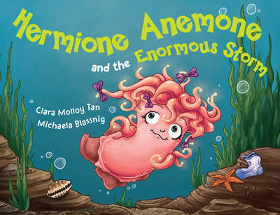
Hermione Anemone and the enormous storm by Ciara Molloy Tan
Ill. by Michaela Blassnig. Lothian Children's Books, 2014, ISBN
9780734415479.
(Age: Pre-school) The underwater adventure begins with Hermione
sitting alone in her rock pool and the reader has the sense that she
is lonely. A sudden storm begins as a frightening experience for her
as she observes people scattering and realises that her little pool
is about to take a battering. However what occurs opens up a new
world of friendship and fun and mussels, clams, seahorses and a wide
variety of sea creatures are delivered to the pool by the storm. The
end result is a fun filled party where Hermione discovers the joy of
making and having friends.
The rhyme and rhythm of the story lends itself to reading aloud and
the use of unusual words like 'kerfuffle' enriches the language.
Michaela Blassnig's illustrations, which are strong and full of
colour, add to the sense of fun and adventure. This book will be
enjoyed by pre-school children.
Karen Mutton
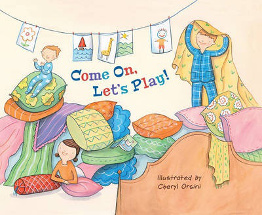
Come on, let's play illustrated by Cheryl Orsini
Lothian Children's Books, 2014, ISBN 9780734415509.
A day without school lends itself to many adventures at home with
the family. From the very start to the very end the children
engage with their parents turning many everyday home based
activities into adventures. Beginning with morning snuggles in
bed, the making of breakfast, building of forts, games of hide and
seek, the story develops until story time and bed as the whole
family enjoys a day full of home made fun and adventure.
The book celebrates the creative ability of children to turn simple
things into exciting adventures while Cheryl Orsini's illustrations
add an extra dimension to the story and contribute beautifully to
the book, which will appeal to very young children.
Karen Mutton
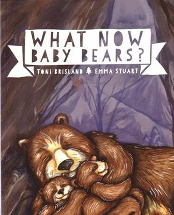
What now baby bears? by Toni Brisland
Ill. by Emma Stuart. Little Steps, 2013.
All through spring, summer and autumn the baby bears frolic and
played in their beautiful, unspoiled environment. They ate
dandelions, and nuts and crowberries; they snoozed; they caught fish
and did what baby bears are supposed to do. In late autumn when the
trees swayed in the creek and the smell of snow was in the air, the
bears just knew it was time to find a den and sleep throughout the
winter. As the snows fell, they slept and slept and slept.
But when they woke, something strange had happened to their world.
There were houses and humans and a busy road ran through the forest.
So much of what they had known had gone, including the other baby
animals and the eagles. There was just one flower in sight - on the
other side of the busy road and disaster strikes when Mother Bear
crosses the road to fetch it. What will happen to the baby bears
now? What Now Baby Bears? is Toni Brisland's first picture book
although she has more in the pipeline as well as two novels about a
Sherlock Holmes-like cat called DemiChat . Illustrator,
Emma Stuart has accompanied the text with delightful illustrations
which bring the bears to life and which characterise that cuteness
and cheekiness we associate with baby bears.
This story would be a great introduction to a unit about the impact
that humans have on the landscape and the flora and fauna within it.
Living where I do, the sight of fatally wounded wildlife on the side
of the highway is too common and if not for the efforts of
organisations like LAOKO the
toll would be higher. So even though this story is set in Canada,
inspired by the author's visit to a sanctuary for orphaned bears in
Vancouver, it has immediate relevance and would fit well within the
sustainability strand of the Australian Curriculum. While the
students' have little sway with politicians and town planners,
nevertheless there are always things that can be done through the
local wildlife organisations which could lead to a deeper
understanding of this critical environmental issue. What Now Baby Bears? got a two-thumbs-up from the class I
shared it with, as well as a lot of discussion which was initially
less confronting because its characters were not the Australian
wildlife they saw every day. But it wasn't long before they made the
connections and started to consider the real story behind the baby
wombats that they see being cared for in the library from time to
time. Then they were keener than ever to create posters to try to
educate motorists as the annual ski season draws near and the danger
to our creatures increases.
Barbara Braxton
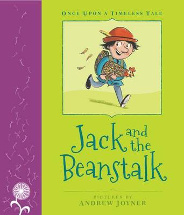
Once Upon A Timeless Tale series
Little Hare, 2014. Jack and the Beanstalk retold by Margrete Lamond with Russell
Thomson. Illustrated by Andrew Joyner. ISBN 9781742975245. Goldilocks and the Three Bears Retold by Margrete Lamond with
Russell Thomson. Illustrated by Anna Walker. ISBN 9781921894923. The Princess and the Pea Retold by Margrete Lamond.
Illustrated by Mitch Vane. ISBN 9781921894930. The Ugly Duckling Retold by Margrete Lamond. Illustrated by
Jonathan Bentley.
(All ages) These are indeed timeless tales, those traditional
stories that are handed down from generation to generation and which
we expect our students come to school already knowing (although that
is often a misconception). These are the original pre-Disney version
of these stories told way back when, retold by Margrete Lamond and
beautifully illustrated by some of the best illustrators for
children, bringing them right into the world of the 21st century
child and a new generation.
While there may be a perception that fairytales such as these are
the domain of the preschooler and very young readers, they actually
have a place on the shelves of every library, primary and secondary.
Firstly, they are a part of our oral culture and there is an
expectation that when you mention a particular story, the students
will know enough of the core story to bring it to mind. So this can
be compared to other cultures whose history has been passed down
orally.
Secondly, the original purpose of such stories was a didactic one -
each had a lesson or a moral to be learned by the younger generation
without putting them physically at risk - so students can not only
examine what that lesson is, but also compare it to the traditional
stories of other cultures to investigate if similar, universal
truths were a common theme.
Thirdly, most of them are now hundreds of years old so what is it
about these stories that mean they have endured over time, place and
space? Even though they have been retold, re-interpreted and
repackaged into a variety of formats, why does the core and essence
remain intact? Why are they told again and again and again and
children's eyes light up when you pick up a familiar one to read to
them? Which of today's stories will survive the test of time? Even
though The Very Hungry Caterpillar is now 45, Corduroy
is now 40, and Hairy Maclary, Hush and Grandma Poss
are all 30-something, do they have whatever it is it takes to notch
up centenaries and bicentenaries?
Finally, for now, these books lend themselves to helping students
understand that critical information literacy skill of
interpretation. Because there are so many versions available it is
easy to collect enough of them to provide the variety required to
examine how both the story and the illustrations have been
interpreted. What has been added, deleted, or changed to give the
story a particular purpose or slant? How would the story change if
it were told by another character? Which parts of the story have the
illustrators chosen to depict and how are their pictures of the same
thing, such as the giant, similar or different? What common
knowledge do we share even though no one has ever seen a giant and
is there evidence of stereotyping?
This series would make an affordable addition to the library's
collection so students can start to delve into the deeper questions.
Barbara Braxton
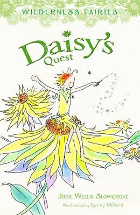
Wilderness fairies series by Jodie Wells-Slowgrove
Penguin, 2014. Daisy's Quest. ISBN 9780143307464. Daisy's New Wings. ISBN 9780143307471.
(Age: K-3)
Across a meandering river
In a forest tall and green
Live the magical Wilderness Fairies
And their wise Fairy Queen.
Guided by their Callings
The Wilderness Fairies strive
To use their magic wisely
And help the forest thrive.
But one impatient fairy
Has lessons yet to learn
Her Calling to discover
And fairy wings to earn.
And so begins the saga of Daisy, the star of this new
Australian-based fairy series written by teacher librarian Jodie
Wells and illustrated by Kerry Millard. In Daisy's Quest she
is anxious to earn her fairy wings, something granted only be the
Fairy Queen. Although she has her magic wand, presented to her on
her fifth birthday, having wings would make such a difference and
she is anxious to begin the quest that will earn them. Daisy is
delighted that her time has come and, accompanied by her best friend
Vu, a very rare chrysomelid beetle only 5mm long who exists on
hackberry leaves, she embarks on a series of tasks encapsulated in
cryptic clues and which test her life and limb. And if she is to
earn her wings she must reach the Fairy Queen by moonrise, which it
seems she will do until not only she meets Holly but also runs out
of magic . . . Daisy's New Wings follows her adventures as
she learns how to fly but she is very impatient.
The stories are filled with beautiful descriptions that bring the
fairyland of the imagination to life, but its Australian bush
setting gives it a resonance that really appeal, particularly to
Miss 7 who walks through a real fairy garden in that sort of setting
every time she goes to her cubby house. Drawing on the recognisable
native flora and fauna, which are then explained in detail at the
end of each story, really help the young reader believe that there
really is a miniature magical world that exists away from the clumsy
feet and loud noise of humans. Riches for the imagination, indeed!
(And even more reason for Grandma to keep finding fairies and other
little creatures to pop into the hidey-holes of the trees and hang
from branches and prop against the hollow logs.)
Written with a light hand, these stories have an undercurrent of
being persistent, responsible, resilient, patient, co-operative -
all those traits that their target audience are starting to develop
as they become more independent. There are at least two more in this
series to come - Daisy's Secret and Daisy takes Charge
and Miss 7 is eagerly awaiting them . . . in the meantime, when
she's not out looking for Daisy, Vu, Maggie, Pea and Nellie, she
will have to be content with the website learning
about the forest dwellers, colouring in the pictures by Kerry
Millard and creating one of her own to send in to share.
Barbara Braxton
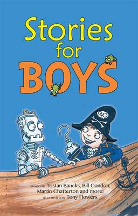
Stories for boys, and Stories for girls
Stories for boys. Random House, 2013. ISBN 9780857980885. Ebook ISBN 9780857980861.
Stories for Girls by various authors
Random House, 2013. ISBN 9780857980861. Ebook ISBN 9780857980878.
(Age: Yr 2-4) Much as some dislike to tag a story according to its
appeal to one gender or another, we still have to acknowledge that
children, especially those just beginning their independent reading
journeys and learning what they like do have significant differences
based on their gender. So these two collections are wonderful
vehicles for helping those students start to map their voyage. Each
comprises short discrete stories just perfect for a one-session read
- or those reading-in-the-gaps times that we need to encourage so
that reading becomes an all-day event, not just an in-school one.
The read-aloud hat (the subject of a new blog post for 500 Hats) is
a critical one so teachers and teacher librarians will savour these
selections for those in-between times when a short read-aloud is
just what is required.
With each story being written by one of Australia's leading authors
for this age group such as Jacqueline Harvey, Claire Saxby, Tristan
Bancks, Bill Condon and a host of others there is an opportunity to
lead the reader from the favourite short story to the novels and
series by that author. The variety of stories - some adventure, come
funny, some serious - could also be a starting point for exploring
particular topics or genres. The boys' collection has stories about
ghosts, pirates, superheroes and monsters, while the girls can enjoy
stories fairies, ponies and a giraffe who tries to learn ballet and
finds she is all gangles and little grace.
Both of these titles would be great additions to that display of
perfect books to curl up and read and shut out the world.
Barbara Braxton
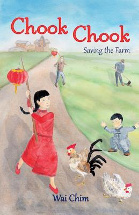
Chook Chook: Saving the Farm by Wai Chim
UQP, 2014. ISBN 9780702253164.
(Age: 9-11) Highly recommended. Chook Chook: Saving the Farm is the
third in Wai Chim's series dealing with the life of young Mei in a
rural Chinese village. The story opens with beautiful descriptions
of the colours, food and excitement as the family prepares for the
celebration of New Year, giving insight into the Chinese cultural
traditions that are an important part of Mei's life and contribute
to her sense of belonging.
While Mei has settled comfortably into her new life, coming to terms
with her mother's remarriage, her stepfather and stepbrother living
in her home and her beloved brother's departure to the city her life
is thrown into upheaval again by the demands and impact of a rapidly
developing society. The story leads the reader through the
tumultuous emotions experienced by Mei as she refuses to ignore the
injustice she feels at the treatment, by authority, of her village
and the family farm.
Mei continues as a feisty proactive character who is both
resourceful and intelligent. She refuses to be beaten down by
powerful government officials who do not understand the importance
of her traditional village and life style to the people who belong
there. Mei is challenged and confused by her brother Guo's
ambivalence towards the traditional farming methods used by Mei's
family as he is introduced to modern farming methods through his
study. He is also exposed to the ridicule and put downs of city
folks who sneer at those who live in rural communities.
Mei works with both friends and family to find a way to protect both
her village and family farm. A successful solution is found and
again Mei's pet chickens, Little and Lo contribute to the solution,
but not quite in the way Mei expected.
These books have been avidly read by students' aged 9 - 11 years, a
number of whom are excited by the release of the new story.
Karen Mutton