Hardie Grant Egmont, 2014. ISBN 9781760120160.
Recommended for middle years readers. Nowhere boys, which has been
serialised for television, tells the story of four very different
boys in Year 10 who become friends in difficult circumstances. Felix
is a punk songwriter, Andy an Asian science nerd, Jake a bully with
a disadvantaged background and Sam the all-round popular sports
hero. When the four are thrust together on a school excursion it
seems unlikely that there will be a productive outcome. However,
Felix, who feels responsible for his brother's paralysis and hopes
to invoke the help of supernatural powers to reverse the past,
manipulates the situation so that he can make contact with forces in
the forest. The boys become lost and do attract the attention of
otherworldly powers. When they make their way home they find that
they are 'nowhere'. They either do not exist or have been replaced.
Their parents do not recognise them, their homes have changed, even
their girlfriends have moved on. Tired, hungry and unhappy they are
forced to look after themselves, while trying to find out exactly
what has happened. When Felix borrows a spell from Phoebe, the owner
of the local magic shop, their troubles worsen when the supernatural
powers are antagonised even more. The boys are attacked by swarms of
bees, then crows and finally dogs. Specific humans seem to respond
to them manically, and it becomes clear that a demon has become
disturbed and is attempting to destroy them. Felix realizes that a
talisman borrowed from Phoebe can protect them if all four are
present. Each of the four represents either earth, fire, water or
air, and all four elements are needed. The boys realise that,
despite their differences, they do need each other, and they develop
a grudging respect for all their different talents. They are
restored to their former lives with the help of the talisman, but
there are clearly more adventures to follow as the temporarily
defeated demon reappears in a new form on the last page. The story
is quite simply written though the plot has a number of
complexities. The characters are believable, even though each of the
boys represents a 'type' and the minor characters are also
stereotypes. It is recommended for middle years readers.
Jenny Hamilton
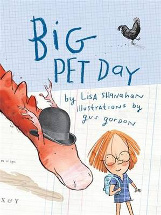
Big pet day by Lisa Shanahan
Ill. by Gus Gordon. Lothian, 2014. ISBN 9780734412416.
(Age: 5+) Recommended. School. Animals.
Each of the children in the class brings their pet to school for Pet
Day. They are all excited, especially knowing that their principal,
Mr Fisher will come in and judge whose pet is the best.
Mrs Dalton is a little flustered when Glen's ferret escapes his box,
and is a little perturbed when Jodie's horse does a poo just outside
the classroom door. After all, she is trying to keep the classroom
neat and tidy for Mr Fisher's visit.
Lily has brought along her dragon, and each behaviour shown by the
other pets is one that her dragon does not do, as she delights in
telling the class. But Courtney always has the last word, telling
them all that dragons do not exist. As the day wears on, the
illustrations show Mrs Dalton becoming more and more flustered,
cleaning up the horse poo, trying to keep the ferret in its cage,
stopping the children feeding the puppy red cordial at recess time.
When they assemble back in the classroom, a nice calming activity of
drawing their animal occurs while after lunch the children line up
with their animals for Mr Fisher's scrutiny.
Of course, chaos reigns and it is up to Lily and her dragon to save
the day, a lovely resolution to a delightful story which will
intrigue and engage younger readers. All the fun of being at school
with your peers is shown, with a hint of some of the snide remarks
made by one of the children. School is presented so clearly, the
frazzled teacher having to use all of her skills to make the day
successful for everyone, the principal strolling in at the end,
unaware of the chaos that has reigned during the day, the little
cameo sketches of the classmates: all is charming, heartwarming and
very real.
The wonderful illustrations by Gordon enhance the story, showing a
group of kids having fun with their Pet Day. He has used a range of
media to create his illustrations for the book, including line
drawing, crayon, cut-outs and watercolour. All is engrossing as I
loved looking at all the detail on each page, working out how each
page was done, as I am sure younger readers will as well.
Fran Knight
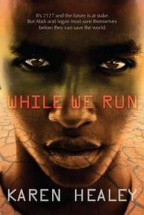
While we run by Karen Healey
When we wake Bk 2. Allen & Unwin, 2014. ISBN 9781743435458.
(Age 14+) Highly recommended. Science fiction. Dystopian. Following
When we wake, this story looks at what life was like for Abdi Taalib
and Tegan Oglietti, the girl who had died in 2027, frozen and then
brought back to life, a 100 years later. The Government has a
cryonics project that is experimenting with young refugees and the
pair are forced to be the public voice for Project Ark. Forced
apart and closely supervised by their cruel handlers, Diane and Lat,
Abdi and Tegan's feelings for each other are manipulated and each is
tortured to ensure that the other complies with their demands.
While When we wake was told in Tegan's voice, this is narrated by
Abdi, a young man who had won a music scholarship to Australia. The
reader is pulled through the awful plight of the pair as their
handlers torture them to ensure that they comply with the
Government's publicity demands. They can only see each other on a TV
screen and have no way of knowing if either has completely given
into the Government's belief system. Healey pulls no punches here,
the torture is explicit and it is all too believable that a
political party would resort to torture to ensure that they get what
they want.
Healey brings a diverse set of characters to the stage, ranging from
the evil Diane who sexually abuses Abdi to Lat, who threatens to
rape Tegan, but who is painted as less evil than Diane. Abdi and
Tegan's friends, Bethari and Joph, feature again in this book each
bringing their own unique personalities and skills to the movement
to stop Project Ark.
The themes of the ethics of regeneration of frozen children, the
plight of refugees, of destruction of the planet and the hope of a
new life are all dealt with in a thought provoking way that make
this an outstanding book for teens (and adults). There is plenty to
think about and the cleverly constructed plot, exciting sequencing
and fabulous character studies make it a stand out read.
Pat Pledger
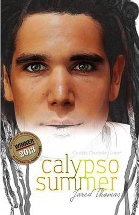
Calypso Summer by Jared Thomas
Magabala Books, 2014. ISBN 9781922142122.
(Ages: Mature senior secondary students) Kyle Summer is a young
Nukunu man who lives near Henley Beach in Adelaide. He's known to
all as Calypso because of his dreadlocks, love of Bob Marley
and reggae music and the West Indies cricket team. His Rasta persona
masks his own insecurities. After leaving school and failing to get
his dream job in a sports store, he is at a loss and spends a lot of
time smoking dope and not much else. Then things start to look up,
he ends up with a job in a health food store and really has a knack
for it, gets on well with his boss and starts to turn his life
around. He moves out of home and into a little flat and feels
proudly independent. The blight on this is a cousin, Run, moving in
to bludge. When his boss suggests getting some native bush
remedies to sell as products in the store, Calypso's mother directs
him to his mob in the Southern Flinders Ranges and this urban Indigenous
man begins to develop an affinity with his country and culture.
Ensuing troubles with some less than welcoming cousins, and the
deadbeat Run, who is thieving and dealing dope, result in some major
drama for
Calypso, but the support of his new girlfriend, a smart Ngadjuri girl
who happens to share his passion for cricket, and the newly found
family circle, prove the right medicine for his woes.
Winning the State Library of Queensland award in 2013 Black &
Write competition, Jared Thomas has tried to provide a realistic
view of the struggle for young Indigenous people and their conflicts with
cultures.
Personally I found the novel a bit hard-going at times and found it
difficult to connect with the characters or be sympathetic. I have
Koori and Murri family and friends, have spent years teaching Indigenous
kids, young adults, and adults, and worked in Indigenous units and
while lots of these friends use the word 'deadly' their vocabulary does also
embrace other adjectives. There was a point when I thought if
I read the word 'deadly' one more time I might just scream.
The novel seemed rather heavy-handed in its heaping upon the reader
every conceivable Indigenous issue.
That being said, I believe that young people would relate to it and
non-Indigenous readers would gain some understanding of the
challenges facing Indigenous culture.
The novel is marketed as YA but I would suggest that it is only
suitable for mature senior students. The frequent profanity and
emphasis on drug usage would make me hesitate about making it
generally available.
Sue Warren
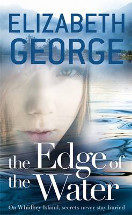
The edge of the water by Elizabeth George
The edge of nowhere bk 2. Hodder & Stoughton, 2014. ISBN
9781444720013.
(Age: 14+) Mystery. Thriller. Supernatural. The sequel to The edge
of nowhere finds Becca hiding from her stepfather in a location in
the woods which Seth her close friend has helped her find. She has
to keep the hideaway secret from everyone she knows, including
Derric the Ugandan orphan with whom she had formed a close
relationship. Meantime strange things are happening on Whidbey
Island, centred around a coal black seal named Nera that returns to
the same place each year and a mute girl who has appeared on the
island.
George has put together an intriguing mix of realistic crime and the
supernatural in this gripping thriller. The first chapter, Cilla's
World, introduces the reader to the strange girl, Cilla who reports:
'I don't speak. I only walk and point and observe. I get along by
doing what I am told. But I fear things that other children don't
fear' pg 3.
As would be expected from such an experienced author, George
immediately gains the reader's attention and fear for the fate of
the abandoned Cilla, and this suspense is kept up right to the final
denouement in the closing chapters with the reader desperate to know
the fate of the girl and the black seal.
The character development of several adults in the story and the
clever dialogue all combine to make a well-rounded whole. Jen
MacDaniels, introduced briefly in The edge of nowhere, a girl
who hates Becca because she destroyed her friendship with Derric, is
a main protagonist in this story. George brings to life the poverty
that Jen faces every day, and her intense desire to make it into the
All Island Girls Soccer team and a chance to leave the island.
Teenage sexuality is a minor theme and is handled very well. Jen's
relationship with Squat Cooper makes her think about her sexuality
while the character of Derric too is developed as he works through
his feelings for Courtney, the very popular teen.
While the mystery of the seal is resolved neatly, it is the
combination of mysteries and secrets of many of the characters, both
teen and adult, an environmental thread and the issues that face
teens all the time that made this a very satisfying book to read.
Pat Pledger
Edward and the great discovery by Rebecca McRitchie and Celeste Hulme
New Frontier, 2014. ISBN 9781925059007.
(Age: 6+) Recommended. Dinosaurs. Archaeology, Dodo.
All Edward wants to do is make a big discovery. After all his
parents and grandparents have all made discoveries in their lives as
archaeologists, and he expects to follow in their footsteps. But try
as he might, digging holes in the garden, he does not find anything
of significance. But one night he digs up an egg. He loves his egg.
He wraps it up and cuddles it in bed, and eventually it hatches. It
is a bird, but not like any bird he has seen. He examines it closely
and realises that its wings are not quite right. He is despondent,
he feels his discovery is broken.
He goes to his favourite place, a museum of ancient things and there
finds himself in a room devoted to birds. He spies a dodo, and
reading about it shows him that his bird is special. He has indeed
made a great discovery, one which warrants his photo on the family
wall.
For a class being introduced to a unit of work on archaeology and
dinosaurs this is a wonderful opener. The back endpaper jumps out at
the reader with images of all the things that Edward needs to ply his
trade. Kids will thrill at the work Edward does in digging up his
garden, and will watch eagerly as he finds out what his bird really
is. Adults will be able to discuss the demise of the dodo and easily
open the discussion about what we have done to kill off so many
species around the world, and discuss just how the dodo evolved and
why it was so precarious when it came to be threatened. This
beautifully illustrated book will lead the class in a whole range of
discussions and research into topics such as science and
environment. The illustrations are fascinating, with a myriad of
things to look for in the background, all redolent of the nineteenth
century when archaeology was world news.
Fran Knight
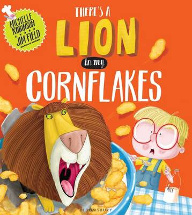
There's a lion in my cornflakes by Michelle Robinson
Ill. Jim Field. Bloomsbury, 2014. ISBN 9781408845608.
(Age: Preschool-Yr 2)This book starts in a most unusual way - a
warning to ignore any messages the reader might see about collecting
cereal packet coupons! And the warning is based on experience
because after making umpteen trips to the supermarket and spending a
whole year's pocket money, and even though it meant they had to eat
cornflakes for breakfast lunch and tea until there were no
cornflakes left, Eric and his brother Dan finally had enough coupons
to qualify for the lion on the packet. Oh, the things they could do
with a free lion... if it ever arrived! They waited and waited and
waited and even though it seemed everyone else had received theirs,
by Sunday they were still waiting.
Come Monday, it looks like their waiting is over - but it is just
the start of the problem!
Told from Eric's point of view, this is a very funny story that
really amplifies the meaning of 'Be careful what you wish for.' Who
knew that something as innocent as collecting coupons and cards
could have such an outcome! Accompanied by illustrations that are as
wacky as the text, this went from a first-read to a favourite with
Miss 8 and Miss 3 (who are avid collectors of supermarket cards)
literally overnight! They loved the punchline at the end, and then
went into hoots of laughter when we turned the page and saw what was
happening!! Miss 8, who is now such an avid reader that she will
even read the cornflakes packet, asked me if I had any other stories
by the same author so we checked out the website and now
have some on order!
Barbara Braxton
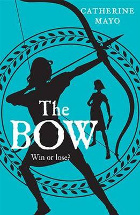
The Bow by Catherine Mayo
Walker Books, 2014. ISBN: 9781925081015.
(Age: Year 8+) Recommended. Themes: Ancient Greece; Historical Epic
drama; Adventure. Catherine Mayo has allied Ancient Greece with its
Gods and heroes to a story of conflict, family honour and drama that
is compelling even for readers that know nothing of the Ancient
Greek realm. The main character Odysseus faces many challenges as he
attempts to recover the family wealth from under the nose of a
powerful potential thief and then protect it in order to return it
to his father, Laertes the King of Ithaka. The young man proves to
be a worthy and honourable son, and his coming to maturity in this
adventure is epic.
Young readers who have discovered the ancient world from reading
Rick Riordan's Percy Jackson adventures, and those who have
loved the John Flanagan Ranger's Apprentice and Brotherband
series will equally enjoy this story. The quest and adventure,
combined with the physical combat required in the face of threats to
life and friends makes this an exciting read. (And there is even a
little romance included for female readers!)
(Note: Includes violence and references to attempted rape, and
female servants sexually abused, but in the context of the
historical Ancient world.)
Carolyn Hull
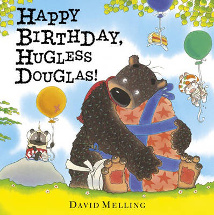
Happy birthday Hugless Douglas by David Melling
Hachette, 2014. ISBN 9781444913262.
(Age: 4+) Recommended. Birthdays, Twins. Hugless Douglas is really
looking forward to his birthday and his birthday party. He is given
a heap of presents by his many friends, and is eager to open them
when his twin cousins appear with the biggest present he has seen.
Felix and Mash rush inside and open all the presents they can find,
leaving Douglas to feel left out. He likes opening presents but they
open them before he is able to get to them. Their present is
unwrapped fiercely revealing a doctor's trolley.
With his favourite day taken over by the noisy twins, Douglas goes
outside to play on his new pogo stick, but falls off. His friends
race inside and grab the doctor's trolley, telling Douglas that they
will fix him up.
Thus follows a fabulous time when the friends wrap as many bandages
around Douglas as they can, and finding enough to wrap the others as
well.
So the whole day ends in fun with everyone working together to make
Douglas better again and eating all the cake offered. For Douglas
what was the worst day turns out to be the best day.
This is a beautifully illustrated book about birthdays and
friendships, about finding that a day is turning out all wrong, but
becomes much brighter as things move on. A lovely tale to read to
children when things perhaps have not turned out as they hoped, or
simply a lovely story to read out loud.
Fran Knight
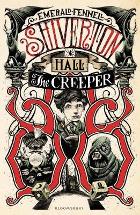
Shiverton Hall : the creeper by Emerald Fennel
Bloomsbury, 2014. ISBN 9781408827796.
The creepy and mysterious Shiverton Hall is a school with a
reputation for being involved in horrific events over hundreds of
years. The school and the surrounds of the aptly named village of
Grimstone provide the setting for suspense and horror stories,
sometimes involving the kidnapping and disappearance of children
which took place at different times over a long history. Related by
various characters, the grisly and frightening tales at first seem
disconnected but the reader soon appreciates that they are
significant in the development of the plot involving central
character Arthur Bannister and some close school friends. Events
from an earlier novel Shiverton Hall in the series involving
Arthur are referred to on several occasions by the author, yet no
recapping or summary is provided for those unfamiliar with the
preceding book. Readers may be dissatisfied and even confused
because those events would seem to have been terrifying with a
shocking outcome. This is pivotal to Arthur's thoughts and
behaviours in this novel when he leaves his family to resume
boarding and study at Shiverton, despite being warned about doing so
by a hideously scarred, burned man.
The start of the school term sees the assigning of community service
roles for students, which lead to amusing adventures and the arrival
of the flamboyant Inigo Cornwall, a new teacher who is also a famed
celebrity in the art world. His appalling classroom technique and
complete disinterest in education prompts the reader to ponder his
role in the school community. This novel comprises several mysteries
which of course are revealed in the conclusion and the various
frightening tales are drawn together. Some descriptions from the
horror stories and the concept of child abduction may be confronting
for younger primary students.
Rob Welsh
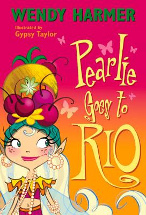
Pearlie goes to Rio by Wendy Harmer
Ill. by Gypsy Taylor. Random House Australia Children's, 2014. ISBN:
9780857982162.
(Age: 6+) Highly recommended for newly independent readers,
especially girls, from age 6 upwards. Hurly Burly! Pearlie is just
in time for the World Cup! I think any of us who have seen our
younger girls squabbling like parrots over the Pearlie books will
know that this newest one will be a welcome addition to any library
shelf.
Pearlie catches a magic ladybeetle ride to Rio where she meets a new
friend, Morena the Tijuca Forest fairy, and is completely enthralled
with the exotic wildlife like colourful birds and lizards that walk
on water. But it's the amazingly beautiful caterpillars that really
impress her and she is more than happy to take care of feeding them,
and guarding them while they metamorphose inside their chrysalises.
After all, when they emerge it will be time for the giant
celebration of the Butterfly Carnival.
Narrowly escaping a scary mishap with a naughty bird, Pearlie and
Morena are ready to samba the night away at the most wonderful event
ever.
Miss Small is a real Pearlie devotee and she, as well as many
others, will eat this up with a relish.
Round off your class's interest in the World Cup celebrations in
Brazil by sharing Pearlie's Rio experience with them - they will
love it!
Sue Warren
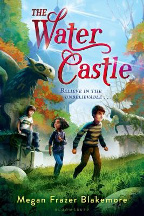
The Water Castle by Megan Frazer Blakemore
Bloomsbury, 2014. ISBN: 9780802735935.
(Ages: 11+) Contains some graphic and violent content with some
supernatural themes. A story about a young boy named Ephraim
Appledore-Smith who is related to the scientist Orlando Smith.
Orlando Smith had been searching for the Fountain of Youth his whole
life. Ephraim Appledore moved to Appledore Mansion in Crystal
Springs with his family after his father had a stroke. At first
Ephraim didn't want to move to the Appledore Mansion because he was
happy living where he was. He allowed his siblings and mother's
enthusiasm to convince him that it would be a great move.
Previously, there were three main families that lived in Crystal
Springs. The Appledores, The Darlings and the Wylies. The Appledores
were explorers and scientists who owned Ephraim's ancestral home,
the Appledore Mansion and it is believed that the Fountain of Youth
is hidden somewhere in its grounds.
The Appledores and the Wiley families are long-time rivals in the
search of the fountain of youth. The Wileys believe that they have
been searching for this fountain longer than the Appledores's and it
is this belief that creates bitterness between these two families.
Ephraim becomes friends with his neighbour's daughter Mallory, who
at first dislikes him. This changes when Ephraim's class does a
project on an explorer. Ephraim and Mallory chose two different
explorers who each claimed they had found the North Pole first.
After many discussions, both Mallory and Ephraim agreed to do a
joint project on how each explorer believed they were the first to
discover the North Pole. In the midst of this, Will Wylie has taken
a disliking to Ephraim because of the ongoing feud between the
Appledores and Wylies.
Eventually, Ephraim befriends Will and they work together with
Mallory to uncover an old science lab with notes that indicate that
the Fountain of Youth is held within the grounds on Appledore
Mansion. This discovery leads the trio on an epic adventure in their
quest to find the fountain of youth, which is believed to cure any
form of illness and slow down the aging process if it is continually
consumed. Ephraim is determined to find the Fountain of Youth to
cure the effects of his father's stroke. Eventually they find some
half-filled bottles of water hidden in a secret hiding place in the
stairs of a secret lab. Ephraim is desperate to find out if this is
the water from the Fountain of Youth. However, Ephraim is faced with
the decision to sample the water in the bottles and perhaps remain a
twelve year old boy forever or to abandon their discovery in hope
his father's condition will improve on his own.
This adventure forms a strong and unlikely friendship between these
three children of feuding families. The story ends with Will
recovering in hospital from a piece of wood stuck in Will's thigh
caused by an unsuspected trap in the lab, with Mallory preparing for
a trip to Alaska with her mother and Ephraim waving to his father
who miraculously recovered from his stroke leaving the question -
was it this water that cured Ephraim's father or did he heal on his
own?
Christina Sapio
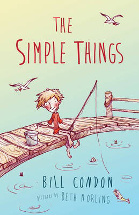
The simple things by Bill Condon
Allen & Unwin, 2014 ISBN 9781743317242.
(Age: 9+) Highly recommended. Family, Rural life. Going to visit an
aunt many miles from the city is not what Steve wants to do, but his
parents are concerned about her health and have not seen her for
nine years. On arrival, he is told they will be there for the whole
holidays, three weeks, and she is a caustic, strange old woman who
does not mince her words.
At first he is taken aback when he offers a hug, her response not
being what he expects, but then the two begin to see each other in a
different light, as he plays jokes on her, banging the door of the
outside loo when she is in there, and finding her talk about family
history of interest.
Their lives become closer as he realises that she is lonely, that
she is frail, but will not admit it. He tries to patch up her soured
friendship with her next door neighbour, Norm Smith, now undergoing
chemotherapy, and goes with Norm and his granddaughter fishing.
This is a charming story of an unusual young boy learning to accept
his aunt for what she is, seeing her as others see her, but also
looking underneath. Condon writes sympathetically of this woman and
her family, and of the life she leads in the country town, and of
her relationship with her neighbours and various other community
members. Her growing delight with her nephew endears the reader to
this cranky old woman, as the whole story becomes one about a
developing friendship between two disparate and sometimes difficult
people, with Lola finally revealing something of her past.
Fran Knight
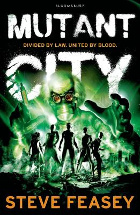
Mutant city by Steve Feasey
Bloomsbury, 2014. ISBN 9781408843031.
(Ages: 13-15) Highly recommended. I really enjoyed this book which I
read in three sittings and I highly recommend as an attractive read
for reluctant boy readers particularly in years nine and ten. The
subject matter, dystopian society and mutants with powers, and its
bright embossed cover and the attention paid to the blurb will
attract many readers. It is a fast paced plot driven story packed
with adventure and adrenalin.
Five very young children are rescued from an experimental science
facility and hidden away in safe houses. Thirteen years later they
each telepathically receive a message to go to Mutant city. In
particular we follow Rush as authorities aware of his existence raid
his farmhouse. He escapes but realises he will have to cross the
wastelands in order to avoid the troops. He also realises that he
has an important mission to accomplish while on his journey.
Meanwhile Tia from her privileged position in the inner citadel
seeks to go into Mutant city in order to expose the unfairness of
life in the ghettos. She meets Jax, a strange mutant who is
seemingly the leader of a resistant mutant group, he persuades her
that she needs to get him and his friends into the citadel.
There is a strong cast of male and female characters, and if there
is one strong lesson from this story it is that a united team can
achieve more than individuals standing on their own. Steve Feasey
also pictures two societies living side by side which to my mind
suggests a sense of the slums outside some of the great cities such
as Rio de Janeiro and Mumbai and the inequality.
Even though set in the future after war, the themes really are about
prejudice and rights and thus can be useful in helping to explore
broader themes.
This is also a strongly marketed book using social media which may
useful in selling the novel to readers. The book sets itself up for
the inevitable sequel mutant uprising.
Michael Jongen.
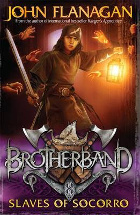
Slaves of Socorro by John Flanagan
Brotherband series. Random House Australia, 2014. ISBN
9781742759340.
(Age: 11+) Highly Recommended. Conflict. Adventure. Sailing.
Heroism. Quests. Slaves of Socorro is the fourth book of the
Brotherband series, and it is again a very engaging adventure
involving a young sea-faring band of young heroic men (and one girl)
who are involved in quests that use their superior sailing skills
and their variety of fighting talents. In this book the team are
engaged to rescue a group of slaves that have been captured for the
slave market by a renegade crew from their home country of Skandia.
The setting is the fantasy creation of the author, but the
comparisons to adventures of the Vikings can easily be made.
Having previously only read the first book from this series, I was
concerned that the gap in the continuity would cause issues in my
enjoyment of this book, but the author gives enough background
detail to link what has happened before to what the characters face
in this book. In fact, the book could be read independently from any
other of the series, but I would not recommend this as some of the
character development would be lost. Flanagan has definitely written
a book that male and female readers will love, as the excitement,
adventure, hand-to-hand combat and characterisation makes for an
exciting and enjoyable read. The humorous relationships and
bickering between the Brotherband members adds an element of
lightness to the quest. The sailing skills that are utilised also
open up a new world of expertise to the reader.
Flanagan writes books that young male readers will immediately
enjoy, and will be waiting for the next book in the series
impatiently! This series, along with the Ranger's apprentice
series, would be high on the reading preferences for upper primary
and early secondary readers.
Note: There is violent conflict, but there are aspects of morality
associated with what constitutes right action in the face of
'war-like' activity.
Carolyn Hull.