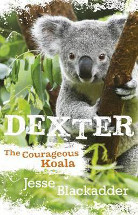
HarperCollins, 2015. ISBN 9780733331787
(Age: 10+) Highly recommended. When Ashley's plans for a new puppy
fall through, she is devastated. Fortunately, her Aunt Micky invites
her for a visit. Micky cares for abandoned and orphaned wildlife. A
great way for a young girl to forget her troubles. While we are
reading about Ashley, we also learn about a baby koala called Dexter
and his mother.
Ashley and Dexter's lives are about to become entwined as a storm
blows through town. The roads are closed due to all the rain. How
will they get the baby koala to a vet?
This Australian story is highly recommended for girls aged 10+. The
two perspectives create an engaging story and it's descriptive
language allows the reader to create images. The story moves quickly
and keeps the reader engaged. Dexter would be a great class novel,
linking Geography and English.
Kylie Kempster
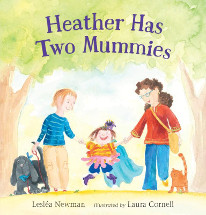
Heather has two mummies by Leslea Newman
Ill. by Laura Connell. Walker Books, 2015. ISBN 9781406359404
(Age: 6+) Recommended. Families, Same sex families. First published
in 1989, this book was considered the first lesbian themed picture
book published for children, so it is interesting to see how it
holds up, twenty five years later. The American Library Association
ranked it eleventh in the list of challenged books so it will be
fascinating to see if it is still seen in such a light. Newman wrote
it as a response to friends saying that there were no picture books
which showed their situation that they could read with their kids,
and in producing this book, she laid the groundwork to open people's
eyes that the mum, dad and two kids stereotypical family is simply
not the reality.
Heather loves the number two. She has two arms, two legs, two pets
and two parents Mama Jane and Mama Kate. On her first day at school,
the children talk about their families, and Heather begins to wonder
if she is the only one who does not have a father, as the other
children talk about what their fathers do. Ms Molly asks the class
to draw their families, and when they pin them up, they see that
each family is different. Some of the class live with stepfathers,
some just with a mother, some just with their father, some with
grandparents, some have two adults and one child, some have more
than one child. Each family is different and each family is special
to that child. The book underlines the fact that no two families are
the same, each is different in its own way.
Newman subtly presents a theme that is underrepresented in
children's books and this beautiful production will readily find a
place in school libraries and bookshelves everywhere.
The soft watercolour illustrations perfectly match the tone of the
book, showing children and families in their wondrous variety. Yes
the book certainly holds up and is a welcome addition to the range
of classics being reprinted by Walker books. For a full list of
their reprinted books go here.
Fran Knight
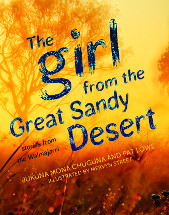
The Girl from the Great Sandy Desert by Jukuna Mona Chuguna and Pat Lowe
Ill. by Mervyn Street, Magabala Books, 2015. ISBN
9781922142054
(Age: 7-12 year) Recommended. The Girl from the Sandy Desert
is a delightful introduction to the life of traditional Walmajarri
people living in north-west Australia at a time when European
settlement was only just beginning to have an impact on their lives.
The personal stories combined with explanatory panels assist in
understanding the cultural history and land usage of these original
inhabitants and act as a valuable resource for areas of the
Humanities curriculum.
Through these stories collected by Pat Lowe over the latter years of
Jukuna's life we learn about the everyday life of Mana, her
siblings, cousins, mothers and dogs as they eke out a living in the
harsh conditions of the Sandy Desert. These are the experiences of a
child born under a tree and growing up within her extended family
structure before marriage and moving into station life.
Stories of the daily battle for that precious commodity water, from
the need to always have water available especially on longer
journeys to the danger of paying in waterholes are a told with
gentle humour and honesty. Hunting and gathering food and using all
the available resources the desert has to offer, from goannas and
snakes to fruits and nuts, and stories centred on cultural
obligations and family relationships are included.
Cultural insights and explanations are provided alongside the
stories giving authentic information and assisting deeper
understanding of these original inhabitants and their way of life.
The black and white illustrations by Mervyn Street assist with a
visual representation of aspects of each story. Walmajarri glossary
and pronunciation guides have been added at the end to help
understanding and round out the book.
Sue Keane
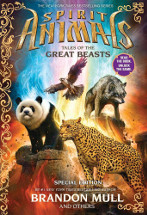
Spirit Animals: Tales of the Great Beasts by Brandon Mull and others
Scholastic, 2014. ISBN 9781743628812
(Age: 7-12 years) Recommended. Tales of the Great Beasts is
a special addition to the Spirit Animals series and acts as
a prequel to the popular series. For those who are unfamiliar with
the story this book could act as an introduction to the animals
which feature so prominently, or round out the back story for those
who have followed the series from the beginning.
Written as a series of short stories by a variety of authors we are
first introduced to the villains of the piece, young King Feliandor
of Stetriol who in his quest to become as popular as his parents is
convinced by the Great Ape, Kovo, to drink the Bile in a quest to
conquer all of Erdas. King Fel bonds with a crocodile and becomes
the Reptile King. The appearance of Gerathon the giant Snake rounds
out the evil trio, though it is clear that Fel has little control
over the situation.
The next series of stories introduce the Great Beasts who come to be
known as the Four Fallen. The stories recount how Jhi, the panda,
Uraza,the leopard Briggan the wolf and Essix the falcon, join forces
with young warriors to save Erdas in the first war which sees the
rise of The Greencloaks who band together to defeat the Conquerors.
Essix observes the battle from above having tried to convince the
other Great Beasts to join the fight before finally succumbing to
her injuries after engaging with Kovo and Gerathon. Reborn as a
Spirit Animal the stage is set for the first book of the series.
Whilst there is some violence in the battle scenes, the emphasis in
all stories is on developing relationships and teamwork as brave
youngsters face their fears and join forces to fight for their
families and way of life.
Sue Keane
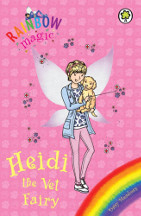
Heidi the Vet Fairy by Daisy Meadows
Orchard Books, 2015. ISBN 9781408336472
(Age: (9+) Highly recommended for fans of the series. Heidi the Vet
Fairy is another book in the popular series Rainbow Magic where
different fairies are in charge of looking after different humans.
In this story, we meet Heidi the Vet Fairy who looks after the vets
on Earth. We also meet regular characters Rachel and Kirsty. The
girls have had adventures with fairies before so are not surprised
when a fairy turns up at the vet surgery they are helping out at.
All of the fairy's magical equipment is missing. The girls help
Heidi find it all while chasing Jack Frost's mischievous goblins.
What do they want with the magical equipment? What is Jack Frost up
to?
Divided into three stories, Heidi the Vet Fairy leads its readers
through an exciting adventure.
Kylie Kempster
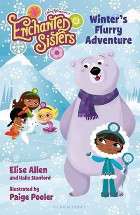
Winter's flurry adventure by Elise Allen and Halle Stanford
Ill. by Paige Pooler. Bloomsbury, 2014. ISBN 9781619632677 The Enchanted Sisters series is a natural extension for
readers who have or are still enjoying the Rainbow Fairy
books. Coming from the Jim Henson Company one expects to see an
animated version anytime. This is the second offering about the four
Sparkle sisters, Summer, Autumn, Winter and Spring and their
adventures.
Winter and her best friend Flurry, a polar bear are playing together
in the snow when Flurry discovers a baby Artic fox obviously
separated from its family by the previous night's blizzard. Whilst
winter makes a fuss of the cute little creature, Flurry leaves in a
fit of jealousy, and Winter and the baby fox set out to find him
with the help of her sisters.
Unfortunately they discover Flurry has dug so deeply into the snow
that he has broken through to the Barrens, home of Bluster Tempest
and his Weeds. Determined to bring Flurry home the sisters continue
on only to discover Flurry enjoying a party with Quake and
Thunderbolt, two of the Weeds.
With the encouragement of his new friends Flurry rejects Winter's
advances and stays with the Weeds. He eventually discovers that his
new friends are not as kind as they could be and when they all
arrive in Sparkledom it is to destroy Winter's home not just a
social call.
The meaning of friendship mixed with adventure and a little magic
will enchant and entertain young readers. The badly behaved Weeds
could be an attraction for boys but I feel this series will be
favoured by girls.
Sue Keane
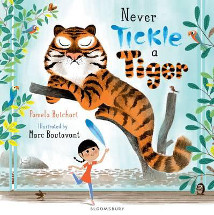
Never tickle a tiger by Pamela Butchart
Ill. by Marc Boutavant. Bloomsbury, 2015. ISBN 9781408839034
(Ages: 3+) Highly recommended. Energetic Izzy is always on the move,
always shuffling and jiggling, squirming and twitching, wriggling
and fiddling. She fiddles at home, she knots Grandma's knitting, and
as for parties she brings in the jelly jiggling on her head. When
Miss Potterhurst her class teacher bravely takes her students to the
zoo, she warns Izzy to behave. Does young Izzy listen? Of course
not, she runs from one animal exhibit to another, stroking the snake
behind the glass, bothering the bear and tapping the giant
tortoises' shells. Her teacher warns lively Izzy 'And never tickle a
tiger!'
She slips away after lunch, skips past the aviary, acquires a
feather from a surprised parrot and yes we know just what Izzy does!
She causes chaos as a catastrophic chain of events occurs.
French illustrator Marc Boutavant's vibrant, computer drawn
illustrations bring Izzy to life. Her energy, personality and
adventurous nature is evident as she shimmies, bounces, wriggles and
skips from scene to scene. The gatefold pages are an exciting
explosion of animal pandemonium, so take time to share both the
alliterative text and discover all the creatures. Engage with their
wide eyes, surprised faces and funny interactions, observe as the
crocodile snaps at the skunk, who then pongs the panda and ever so
quickly there's uproar at the zoo. Never tickle a tiger is a wonderful read-aloud story for a
young reader, and a kindergarten or junior class. Just right for an
introduction to action verbs as well.
Rhyllis Bignell
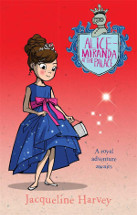
Alice-Miranda at the palace by Jacqueline Harvey
Alice-Miranda bk 11. Random House Australia, 2015. ISBN
9780857982728
(Age: 8-11) Highly recommended. Mischief and mayhem, parties and
plots, spies and surprises are all wonderfully woven threads in the
latest and much anticipated Alice-Miranda novel.
Queen Georgiana's celebrating her silver jubilee at Evesbury Palace
and Alice-Miranda's family and friends are all invited. The prologue
introduces the intrigue, a mysterious man in a bowler hat receives a
folder with instructions to kidnap someone close to the queen.
Meanwhile, after the last assembly of the term, annoying Caprice
overhears Jacinta, Millie and Alice-Miranda discussing their palace
holiday plans. Caprice tags along with her mother Venetia Baldini, a
famous chef catering for the Queen's celebrations.
Mysterious rhyming messages foretelling the kidnapping are being
handled by agents from SPLOD - the Secret Protection League of
Defence. When Head Agent Marjorie Plunkett and Chief of Staff
Thornton Thripp finally inform the Queen of the plot, she decides to
keep the girls safe at the palace for the whole week.
Meanwhile, mystery surrounds a cottage in the woods where a
reclusive lady and her protective raven live. Edgar and Louis, the
queen's grandsons are also up to something secretive in the old
hunting tower. Alice-Miranda, Millie, Jacinta and Sloane enjoy the
fun and festivities, minding the babies, playing games and dressing
up for the special dinner party.
Jacqueline Harvey has delivered another fabulous Alice-Miranda
adventure filled to the brim with all the exciting elements that her
readers love.
Read about the series on the author's website.
Rhyllis Bignell
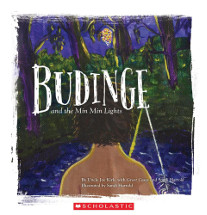
Budinge and the Min Min lights by Uncle Joe Kirk with Greer Casey and Sandi Harrold
Ill. by Sandi Harrold. Scholastic, 2015. ISBN 9781743628577
(Age: Preschool and primary) Recommended. Aboriginal themes. Min
Min lights. The Min Min lights is a recurring
theme in many stories and tales told of the Outback and is sometimes
seen as a harbinger of something sinister in Aboriginal culture.
In this one, Budinge fishes at the waterhole each evening, but one
night is frightened by a light he sees in the trees. His grandmother
has told him that if he did not behave then the light would take him
away.
He runs from the light, but as he runs the light divides into two,
then it grows even bigger. He runs through the bush, becoming more
scared even hiding behind some of the bushes. He runs for home, runs
up the verandah and through the door, gets under the mosquito net
and pulls the blankets up around his chin. And then he finds what
has been following him. This is a delightful story of an Aboriginal
boy learning about his environment and the rules which are part of
his growing up. We learn about his fishing at the waterhole, the
bush that surrounds him, the mosquito net he uses at night, the
house in which he and his grandmother live. But most of all we learn
about the story of the Min Min light, how it is used as a cautionary
tale by Aboriginal people and classes will be able to learn more
about this light using the Internet.
The illustrations, presented in a naive style, suit the innocence of
the lad scurrying through the bush at night to escape his perceived
fate. The strong colours crowd in on him, the bright green of the
bushes frame his face, the multi colours of the Min Min light stand
out against the duller colours of the background, and the blanket
makes a welcome soothing colour for the boy when he reaches the
safety of his bedroom.
It is wonderful to see a new range of Aboriginal stories for kids to
read, whether they be at home, in a library or in class. All
Australian children will learn more about the culture that has
been here for thousands of years, students will increase their
awareness of other stories they have not heard, and stories such as
this can be included in the curriculum for all to share. This is the
second story by Uncle Joe Kirk of the Wallu Wakku people in
Brisbane, with Karara, the story of the father emu published
by Scholastic in 2014.
Fran Knight
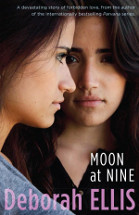
Moon at nine by Deborah Ellis
Allen & Unwin, 2015. ISBN 9781760111977
(Age: 14+) Recommended. Same sex relationships, Iran, Historical
novel, Prison. Fifteen year old Farrin goes to an elite school in
Tehran, one her mother also attended as a young woman, but she is
ambitious and smart and does not want to be part of the afternoon
tea group her mother attends with her friends. It is 1988, and the
country is at war with Iraq, which supported by the USA, is trying
to take over the country now that the Shah has been deposed and the
Ayatollah Homeini is in power. But her parents are not happy with
this situation.
At school, Farrin must always be aware of keeping her secrets,
especially when one of the school monitors, Pargol dislikes her and
taunts her. But one day Farrin meets another girl in the school,
Sadira, one to whom she can confide her secrets and as their
relationship matures they fall in love.
This is an engrossing story of two young woman in a country where
they have no voice, where they are told that their relationship will
bring disgrace upon their families, and their parents advised to get
them married as soon as possible. It is Pargol who has seen them and
she tells the school principal what she saw. Already another in
their peer group has been taken away to prison by the Revolutionary
Guard for distributing pamphlets about women's rights, so they know
what can happen to them.
They fight to communicate with each other, eventually deciding to
escape, but the Revolutionary Guard arrests them both. In prison,
Farrin is almost hanged but her father's driver whisks her away, but
as she finds out she is in a position just as precarious.
Ellis crafts a taut, moving story, taking us into the minds of two
gay girls with no support whatsoever in a country where being gay
means being executed. Based on a true story told to Ellis several
years ago, this tale will widen her fan base. Ellis is the award
winning author of the Parvana series of books, amongst many
others telling of young people surviving in appalling situations.
The background revealing the utter chaos as opposing forces vie for
power after one power base has disintegrated, reflects what is
happening in many countries around the world. No more so than when a
right wing group takes control, seizing all power within their own
hands and using fear, torture and execution as a means of
maintaining that power.
Fran Knight
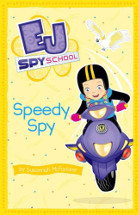
Speedy Spy by Susannah McFarlane
EJ Spy School. Scholastic Australia, 2015. ISBN 9781921931987
Recommended for readers from 6-8. Susannah McFarlane's series EJ
Spy School is a wonderful introduction to chapter books for
younger readers. They show a young Emma Jacks training to be a SHINE
agent. Speed is the key to this adventure, the SHINE spy school is
testing her skills and abilities, there are mazes for her to solve,
tests to pass, all timed by the agency.
Every Emma Jacks' adventures begin with a message on her special spy
watch, then she rushes off to the girls' toilets at school. In the
last cubicle on the right, connects her watch to a special button
under the toilet roll holder and is whooshed down the tunnel to the
spy school. She learns how to ride a special scooter and reach the
pet shop just before a Shadow agent appears. Emma learns the meaning
of the phrases - get your skates on and just in time!
This enjoyable series helps build confidence in the young reader
with age-appropriate words, interesting themes, short sentences and
chapters.
Suitable for beginner and newly confident chapter book readers.
Rhyllis Bignell
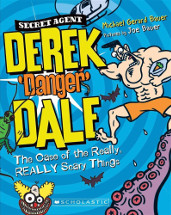
The case of the really, really scary things by Michael Gerard Bauer
Secret Agent Derek 'Danger' Dale bk 2. Ill. by Joe Bauer. Omnibus,
2015. ISBN 9781742990668
Recommended for readers from 8-10 years. Secret Agent Derek 'Danger'
Dale returns in another action-packed adventure. His task is to
outwit Dr McEvilness and the dastardly villains at Exclusively Evil
and stop them wreaking havoc with their fear inducing machine - the
FANGLE. Secret Agent Derek 'Danger' Dale is an over-the-top comic
spy with his strong physique, surfboard style hairdo, exaggerated
facial features and of course - buff body, he's always shirtless.
Derek's vacation at the Sun Seekers Resort is interrupted by the
Head of Secret Agents R Definitely NOT Us, after only twenty-seven
minutes as he's needed back at Headquarters. Before he leaves, Derek
uses his amazing skills and initiative to rescue a bunch of young
swimmers from the clutches of an escaped Giant Squid, using only a
lane rope, sunscreen, dead fish and a giant bucket of ice cream.
Back home, his mission is to find out who has stolen an ancient
Agorian statuette from the museum. The guards' conflicting reports
state that the thief was either an eight-metre tall giant cockroach
or an ugly, slimy toad. Derek's unique super spy skills are needed
to save the day.
This new Secret Agent Derek 'Danger' Dale story is filled with
crazy-named humorous characters, funny puns, diabolical plots,
unexpected situations and action-a plenty. Gerard Michael Bauer's
amusing story is uniquely paired with his son Joe's cartoon strips
running vertically on each page.
Rhyllis Bignell
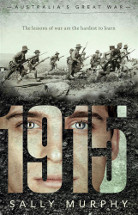
1915 by Sally Murphy
Scholastic, 2015. ISBN 9781743622483
(Age: 11+) Highly recommended. War, World War One, Gallipoli, CEW
Bean, Series: Australia's Great War. The second in the series, Australia's
Great War presents the reader with Stan, a young teacher from
rural Western Australia at Gallipoli in 1915. His battalion lands on
that shore ready to take the fortifications and march to
Constantinople, but the Turkish Army lies in wait. Through his eyes,
and those of his sister who writes to him, his diary entries, poems
and his letters back home, we see the gravity of the situation they
find themselves in. Each of his friends is drawn carefully ensuring
the readers bond with the people involved and care about their
stories. CJ, Bluey, Miles, then Art and Molly, all contribute to the
tale of the months spent at Gallipoli, and will increase the
readers' knowledge about that place.
Murphy's detailed background, the trenches, the Turkish army,
Simpson and his donkey, the wounded and the dead, even Keith
Murdoch, gives an authenticity to the tale which will encourage
students to continue reading.
Through his sister's letters, we are shown life back in Australia,
as a neighbour's son is taken to Rottnest Island to be interred
because he has a German name, or some of the boys in the town, even
sixteen year olds receiving white feathers, or the knitting circles,
as well as the constant discussion surrounding the casualty lists in
the newspapers. At first these lists are small, but as the campaign
continues they become longer to the dismay of those back home and
the realisation both to Stan and his sister of the misinformation
given.
Stan is hit by shrapnel and does nothing about it because so many
others have wounds that are more significant, but in doing this he
becomes quite ill. His friend, CJ takes him to the beach for help,
but shrapnel hits them both, killing CJ. In hospital in Cairo he
meets nurse Molly, and so another part of the story develops.
The novel covers some familiar territory but in having Stan as the
narrator, Murphy has introduced a character with whom students can
engage. He is innocent enough to have discussions which will
interest those who read this book, and his observations will make
them think about the priorities of war. Several incidents stand out
for me. One is when Miles is killed, trying to help a wounded
Turkish soldier, and the other when a truce is declared to bury the
dead. Both make the readers aware of the conflicted nature of being
in war, and the random encounters with CEW Bean are a neat
touch, grounding the story in the reality of a journalist's
observations, one whom students can research further. And Bean's
observations, given from a wider perspective than Stan's, make Stan
rethink some of the things he holds dear.
This is an eminently readable contribution to the array of books
being published at the moment to acquaint our younger readers with
Australia's involvement in World War One, and it has an underlying
theme of the nature of war and its effects on everyone that will
encourage students to reflect further.
Fran Knight
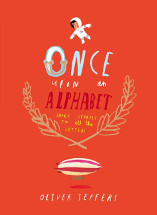
Once upon an alphabet by Oliver Jeffers
HarperCollins, 2014. ISBN 9780007514274
(Age: Pre-school - Yr 6) 'If words make up stories and letters make
up words, then stories are made up of letters. In this menagerie we
have stories, made of words, made for all the letters.' And that's
just what this fabulous book by Oliver Jeffers is all about. He has
taken the concept of a picture book and viewed it through a new
lens. Instead of the traditional 26 letters accompanied by pictures
of words starting with the letter, there are 26 stories, one for
each letter of the alphabet - each short, succinct, imaginative and
complete. Here's an example. 'Bernard and Bob lived on either side
of a bridge and for years had been battling each other for reasons
neither could remember. One day Bob decided to fix things so Bernard
couldn't bother him anymore, by burning the bridge between them. But
Bob learned an important lesson that day. He needed the bridge to
get back.' Characters like Owl and Octopus appear and reappear
throughout the stories adding continuity especially as Z returns us
to Edward the astronaut's problem of the first page! The
cartoon-like illustrations that are Jeffers' trademark are more
about illustrating the story than emphasising the sound of the
letter, another departure from the more traditional format of an
alphabet book and the whole has a wonderful mix of humour and
quirkiness that it will appeal to all ages. This is so much more
than an alphabet book to entertain littlies, although it does that
very well. There is the opportunity to introduce the concept of
alliteration - Danger Delilah is a daredevil who laughs in the face
of Death and dances at the door of Disaster - and explore how it can
be used to add meaning and depth to a story. Students could also be
challenged to create similar short stories - telling a tale in two
or three sentences that still contain a traditional story structure.
(There's a website
devoted to this concept - but select what's appropriate for your
students; and for those who subscribe to the NSW School Magazine
Touchdown, the March 2013 issue contained a how-to.) Every time I
dip into this book I find more to delight me - adults and children
alike will love this one.
Barbara Braxton
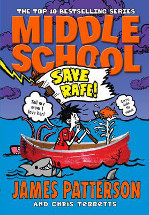
Save Rafe by James Patterson and Chris Tebbetts
Laura Park. Young Arrow, 2014. ISBN 9780099596424
(Age: Yr 4+) It is literally the stuff of nightmares. Rafe
Katchadorian thought he would be going to Airbrook Arts School when
the new school year starts but over the summer vacation it has
closed down and he has to return to Hills Village Middle School -
from where he has already been expelled. Even worse, Vice Principal
Stricker has been promoted to principal and her sister is now the
deputy, and neither of them like Rafe. They have determined that
before he will be readmitted to HVMS he will have to succeed on The
Program, which turns out to be a week-long rugged outdoors camp in
the Colorado Rocky Mountains.
So 4.00am the next morning sees the whole family on the road to Base
Camp, arriving with just two minutes to spare and attracting the
wrath of Sergeant Fish (who is the epitome of the stereotypical
bellowing, tough sergeant-major.) Not an auspicious start. Rafe, as
well as the other seven students who have been assigned to The
Program, discover that this is no ordinary camp and they will have
to work as individuals as well as a team to overcome obstacles
designed to test their resilience, persistence and determination so
they can earn sufficient tags to maintain their place in the
program. The first obstacle is climbing a tower to get the food for
that night's supper.
This is a fast-paced book that has the reader willing Rafe on,
telling him not to quit and hoping that he can see the reasons
behind The Program as clearly. In it Rafe learns a lot about himself
although even when he is required to write a letter to himself about
what he sees his life as being a year from now he has difficulty in
articulating it in words. Drawing is his talent. But you know that
he has internalised much and when he does return to HVMS and
discovers Stricker and Stonecase have yet another hurdle for him, he
will be able to take it on with greater confidence and self-belief.
Whether writing for adults or children, James Patterson crafts a
great story drawing characters that come off the page and compel the
reader to continue reading to find out what happens to them. Like
many troubled kids, Rafe has a backstory of insecurity and
self-doubt that he masks with his troublemaker persona, a kind of
get-them-before-they-get-me attitude that comes to the fore through
his Loozer and Leo comics that he draws because he can't articulate
his feelings. He has little belief in his expectations to succeed
but this is turned around in this book as he is driven by his desire
not to disappoint his mother.
Lavishly illustrated with graphics that are an integral part of the
events and Rafe's story, this could almost be considered a graphic
novel so it will appeal to those boys who are reluctant readers.
This is the 6th in this series that has captured the imaginations of
boys in that Yr 4+ audience who are starting to be more independent,
see girls as a likeable species, and are starting to feel the
awkwardness of adolescence. It is the series to be seen reading!
Barbara Braxton