Penguin Random House, 2017. ISBN 9780143783886
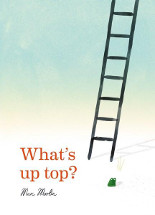
(Ages: 4-7) Questions, Rhyme, Imagination. Questions, questions,
questions. There is one on every page. And none of them are
answered. Even the endpapers are covered in question marks. What's
Up Top? the front cover asks, the writing leading our eye up the
ladder, its end invisible. A small green frog sits, apparently also
pondering the question. The reader is given many possible answers,
each more elaborate and creative than the last, but no definitive
one. From 'Is it a hat?' to 'The string of a kite on a meteorite
that's attached to a whale . . . while a sloth eating soup
parachutes through a hoop for a group of iguanas in purple
pyjamas?', the reader is taken on a journey of infinite possibility.
We see the narrator at the end. He's a penguin. He can't tell us the
answer: 'I don't climb up ladders . . . I'm no good with heights!'
he says.
This will be great as a creative writing prompt. It could also be
used when introducing and discussing the use of question marks. It
is, however, just a fun read aloud rhyme that holds us in suspense
then lets us enter the imaginative realm ourselves. What IS up top
is kind of unimportant and probably boring. As the book says 'It's
probably a bird . . . or maybe just sky?'. The truth is never going
to be as interesting as what we can imagine.
Nicole Nelson
Opposite Land by Charlotte Rose Hamlyn
Random House Australia, 2017. ISBN 9780143780816
(Age: 8-12) Recommended. Themes: Friendship; Graphic Novels;
Opposites; Fantasy; Humour. Written by Charlotte Rose Hamlyn (a
former Adelaide girl, who has worked as a screenwriter for many
children's cartoons, as well as presenting a TV Art program for
children), this is a graphic novel with incredibly quirky characters
and plot direction. The central character - a girl called Steve -
has had a disastrous day at her new school when she makes a mistake
in choosing who to befriend. When she debriefs to her mother at the
end of the school day an unpleasant day spirals into an argument.
(Dare I suggest it - they have opposite views!) An opposite book
written by her grandfather is shared, and it draws Steve to the
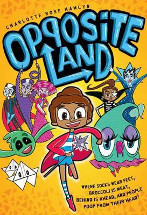
eponymous Opposite Land where 'socks wear feet, broccoli is meat,
behind is ahead, and people poop from their head!' Steve proceeds to
save the un-saveable from the Emperor Never, and learn some
important truths along the way.
Hamlyn's illustrations are exceptionally quirky, and the humour is
quite clever as the 'opposites' interact with Steve and the reader
in confusing ways. Younger readers will like the odd drawings, and
slightly older readers will appreciate the 'clever' interpretation
of an 'opposite world'.
Although graphic novels are not my personal favourites, I can see
the place for this book for a cartoon-loving reader.
Recommended for ages 8-12 years.
Carolyn Hull
The scared book by Debra Tidball
Ill. by Kim Siew. Hachette Australia, 2017. ISBN 9780734417503
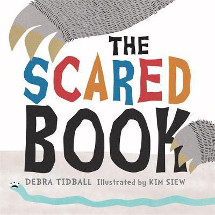
(Age: 3-6) Interactive book, Fear. "Hello! Thank you for reading me.
I hope I'm not a scary story" says the first page. But then, uh oh,
there are monsters. "I can't tell you the rest of this story because
. . . I'm scared!" says the book. Then follows descriptors of how it
feels to be scared: a tingle in the spine, goose bumps, giant
butterflies and monsters, not to mention the smell that they leave.
The book asks the reader to help by scratching away the tingles,
rubbing away the goose bumps, blowing away the butterflies and then
helping it to relax by following a spiral with their finger. This is
a clever publication because it provides a visual representation of
fear and gives simple and practical ways for children to deal with
it. It also normalises the bodily feelings associated with the
emotion. Touching or manipulating parts of the body and breathing
are all ways of helping to alleviate stress and children can
practice using these within the context of helping the book overcome
its fear. The monsters are not threatening looking (they are almost
cute) so children will not become scared themselves.
This is a fun book that provides effective methods and a useful
vocabulary for children to talk about and overcome their fear. It
also reassures children that fear is normal, that everyone has
different things they are scared of and that it is okay to ask for
help.
Nicole Nelson
Jigsaw of fire and stars by Yaba Badoe
Zephyr, 2017. ISBN 9781786697981
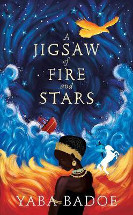
When a boatload of African refugees is rammed and sunk by people
smugglers, Sante's family set her adrift on the sea in a chest
containing all their wealth, in the hope that she will survive.
Discovered by Mama Rose and raised as her own alongside two other
foundlings Cat and Cobra, Sante grows up in a small Gypsy community,
travelling throughout Europe and performing circus tricks for a
living.
The youths possess unusual talents. Sante sees the terrible demise
of her family in dreams, can sometimes read the thoughts of people
and communicates with Triss, an eagle which protects her and does
her bidding. Cobra has an affinity with snakes and can charm them to
behave as he pleases whilst Cat is an unerring knife thrower.
Sante's family and friends are used to constantly moving to escape
the attention of authorities who often chase and harass them. When
they realise that the appearance of suspicious men is somehow
connected to Sante's dead relatives, their instinct is to remove
themselves and disappear, rather than engaging the help of police
whom they naturally distrust.
The arrival of the mysterious Scarlett, a young girl of similar age
who is clearly traumatised, prompts Sante, Cat and Cobra to remain
and assist her against the wishes of their elders. The trio
discovers a sinister people smuggling network where adolescents are
sold into sexual slavery and they become embroiled in a dangerous
and nasty situation.
In order to survive and to attempt to bring the criminals to
justice, Sante, Cat and Cobra summon all of their powers, both
physical and magical as they navigate a confusing maelstrom of
events.
The theme of sex trafficking seems out of place in a story which
appears to be written for early teens, however nothing explicit is
depicted. The writing style, language and plot developments may not
appeal to older readers and the topic seems worthy of a more
sophisticated presentation in my view.
Rob Welsh
Free as a cloud by Bai Bing
Ill. by Yu Rong. Starfish Bay Publishing, 2017. ISBN 9781760360351
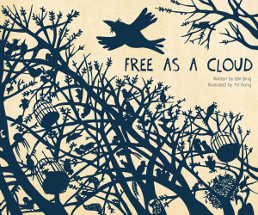
(Age: 4-6) Free as a cloud is a distinctive picture book,
with bold black two dimensional cut-outs dominating the pages,
interspersed with soft pencil sketches showing Sweetie the myna
bird's experiences in the city. The story told from Sweetie's point
of view, describes her thoughts on captivity and freedom. On her
flight over a Chinese city, she observes a happy friendly family and
she decides to join them. Sweetie loves their kind ways, she has a
comfortable cage, great food and a caring home. She is taken on bike
rides through the town, eats sweet juicy fruit, but something makes
her unhappy. Sweetie suffers from melancholy and loses her desire to
sing. 'I don't want to be a sad bird trapped in a cage.'
When the family realises their much-loved pet is sad, they try to
help her, and all their friends come over with their pets for a
wonderful party. Sweetie's family finally realises she needs to
return to her jungle home, filled with colourful flowers. As the
jungle animals watch, she flies happily into the sky greeting the
clouds, joyfully singing to the other birds. Free as a Cloud has a simple straightforward text, which
sometimes sounds a little formal. The illustrations lift the story,
so much action and activity, represented by the characters'
silhouettes in the foreground with colourful vignettes of everyday
life adding depth to the bold illustrations. With the themes of
captivity and freedom, this picture book is suited to readers from
4-6.
Rhyllis Bignell
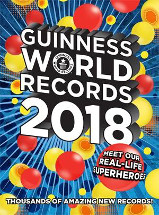
Guinness World Records 2018 by Guinness World Records
Guinness World Records, 2017. ISBN 9781910561713
(Age: 7+) Highly recommended. The Guinness World Records
series needs no introduction and Guinness World Records 2018
continues with the production of a fascinating, exceptionally well
produced and interesting book. The amazing records that it contains
will keep a reader interested for hours and it is fun to dip in and
out of the book to see what incredible feats have been achieved.
There are '45,000 claims researched, 3,000 new and updated records
published, 1,000 photographs sourced, 60 exclusive photoshoots
attended', so there are an enormous number of records to dazzle the
reader.
For those who want to know specific information, there is a Contents
page which has twelve sections, including Earth, Animals,
Superhumans, Adventures, Sci-Tech and Engineering and Sports. An
index highlights main entries in bold and is quite comprehensive.
Eye-catching full-colour photos accompany the entries, which are
written in short crisp language.
A special feature chapter in the 2018 edition is the section on
superheroes, which chronicles the rise of the superhero in popular
culture. There is also a new feature that celebrates absolutes such
as the longest, tallest, fastest and heaviest and it is possible to
download free
posters with these records on them from the World Guinness
records site.
This volume will have readers squabbling over who can read it and is
one that can be shared as well. Adults will also find themselves
entertained by the amazing feats recorded and some people will have
a look at what is necessary to make a record.
Pat Pledger
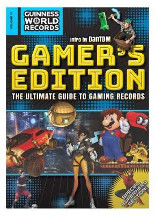
Guinness World Records 2018 Gamer's edition: The ultimate guide to gaming records by Guinness World Records
Guinness World Records, 2017. ISBN 9781910561737
(Age: 7+) Recommended. With an introduction by DanTDM who has the
most viewed Minecraft channel on YouTube (nearly 10 billion views),
The 11th edition of The ultimate guide to gaming records is
a must for any gaming fan and is certain to thrill those children
who are engrossed with games in their screen time. This edition
contains records about favourite games including Mario, Pokemon Go
and Minecraft as well as information about gaming heroes and
videogames.
The colourful Contents page which is divided into sections that
include Fantasy, Viral glitches, Sci-fi, Legends, Superheroes, Real
world, Sports and Fighting, makes an easy entry into the book for
those who can skim read to find their favourite game. Then there are
instructions to the reader on how to become a record-breaker, as
well as an index at the back which once again is helpful for readers
wanting to find out specific information. There is a special section
on Superheroes, with a brief history of superhero games, then
sections on Spider-Man, a Marvel and DC round-up, records about
Batman and Lego superheroes.
The records themselves make for amazing reading (the oldest
videogames YouTuber is Shirley Curry aged 81 years) and the
well-produced book, enticing information and the colourful
photographs will make it a hit in the library and at home.
Pat Pledger
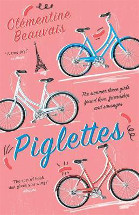
Piglettes by Clementine Beauvais
Pushkin Press, 2017. ISBN 9781782691204
(Age: 14+) Highly recommended. This superb YA novel deals with some
pretty gritty issues like bullying (cyber and real life), self
image, identity and family relationships and is one of the most
wickedly funny books you'll read all year.
Mireille, Astrid and Hakima are three girls at the same school and
recently voted as the first three place-winners in a Facebook 'Pig
Pageant' for the ugliest girls by their schoolmates. This event was
initiated by Mireille's erstwhile childhood friend Malo, who is one
of the most odious youths ever. Since they both started high school
Malo has made it his mission in life to humiliate Mireille at every
turn.
While the girls are all pretty crushed by this horrible bullying,
they are not going to let it get the better of them and form a
friendship that will fly them forever. Each has a particular reason
for their proposed plan to cycle to Paris for the huge Bastille Day
celebrations; Mireille, wants to confront her biological father, now
married to the President, Astrid wants to meet her idols Indochine
and Hakima wants to berate the commanding officer about to be awarded
the Legion of Honour for the debacle that resulted in her brother
Kader losing both his legs in battle.
Overcoming the opposition of parents, the girls set off on what must
be the craziest road trip ever with Kader in his super wheel chair
as their chaperone. Along the way they garner the respect and
adulation of thousands via newspapers and social media and in real
life.
Told through Mireille's witty and philosophical voice, the reader is
alongside the girls for the entire trip which is joyful, uplifting
and totally hilarious.
Proving themselves as true Mighty Girls the trio triumph over the
online bullies and even horrid Malo shows some indications of
redemption, especially when the reason for his nastiness is
revealed. Each girl learns valuable lessons about herself
particularly when they finally attain their goals and find that
something has changed about their motivations.
Definitely worthy of its achievement of winning France's biggest
award for YA/teen fiction I highly recommend this to you for your
girls from around 14 years upwards.
Sue Warren
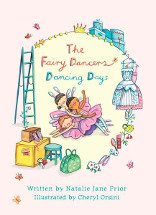
The fairy dancers: Dancing days by Natalie Jane Prior
Ill. by Cheryl Orsini. ABC Books, 2017. ISBN 9780733335648
(Age: 5-7) Recommended. Ballet dancers. Friendship. Ballet. Natalie
Jane Prior's delightful picture book The fairy dancers: Dancing
days contains three enjoyable stories about friendship,
sleepovers, dance concerts and Christmas celebrations. These are
easy to read and fun to share, just right for young dancers
beginning to read chapter books.
In 'The fairy sleepover', after a rainy summer holidays, Emma's
garden has become a lake. Her friends Mia and Grace spend time
outdoors, discovering 'spider webs starred with raindrops, a shiny
chrysalis and a wing from a fairy's chariot'. The girls have missed
their dance lessons and their dance teacher who has been on holidays
too. After they dance around a fairy ring of bright toadstools, Miss
Ashleigh surprises them and invites them for a fun sleepover.
'Robots and fairies' introduces the boys' dance troupe, dressed as
robots they wait to perform. Unfortunately, the fairy dancers and
the robots get into an altercation backstage and costumes end up
ripped and torn. Miss Ashleigh steps in to restore the situation and
help sort everything out.
Miss Ashleigh takes Emma, Mia and Grace into town to see the lights
in 'The Fairy Christmas'. When Grace leaves her doll Emily in the
taxi, their caring teacher tries to cheer her up. Dancing around the
Christmas tree and looking at the Nativity scene helps Grace feel
better. After a visit with Santa, then a dance with the jolly old
fellow, followed by a surprise for Grace, makes this a great evening
out in the end.
Cheryl Orsini's detailed pastel watercolour and gouache
illustrations add excitement and sparkle to the story. Her fluid
lines, hidden details and soft pastel colours show the delightful
characters dancing across the pages complimenting Prior's gentle
descriptive text. This author and illustrator have built a strong
collaborative partnership working together on more than twelve
books. This is apparent in the second enjoyable picture book The
fairy dancers: Dancing days that is a celebration of dancing,
fun and friendship.
Rhyllis Bignell
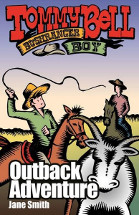
Outback adventure by Jane Smith
Tommy Bell Bushranger Boy book 4. Big Sky Publishing, 2017.
ISBN 9781925520842
(Age: 7-9) Recommended. Bushrangers. Australian history.
Time travel. Author Jane Smith continues to weave fact and fiction
together in her Tommy Bell Bushranger Boy series. Henry
'Harry' Readford was a cattle rustler whose gang stole a thousand
head of cattle from a Queensland station in the late 1800s and took
them across country to the Adelaide auctions. He was a horse thief
as well; his exploits used to develop the character Captain
Starlight in the novel Robbery under Arms.
Young Tommy Bell is off for the school holidays with his friend
Martin on the family's Bowen Downs Station in central Queensland. No
one knows Tommy's time-travelling secrets, not even his best friend.
Tommy's loyal horse Combo joins them and the boys enjoy exploring
the countryside on horseback. When Martin discovers a pair of dusty
boots hidden in a small rocky cavern, Tommy realises that they have
a special ability. Both boys are off on a time-travelling adventure
as soon as Martin tries them on and Tommy puts on his cabbage-tree
hat. On horseback, they ride into the middle of nowhere and meet up
with some scruffy looking men droving a large herd of cattle across
country. Henry 'Harry' Readford their leader welcomes the boys and
invites them along for the long ride, sleeping under the stars and
sharing meals around the campfire. There are plenty of adventures,
long days riding, lost in the bush and a chance meeting with a
helpful Aboriginal man. They become suspicious of Harry's dealings
with the townsfolk in Arcoona, as his stories keep changing and so
does his name. Tommy realises that they are helping rustler Henry
Readford and his gang steal a thousand head of cattle from the
McKenzie's Bowen Station. After a week, they are ready to escape
from the dangerous situation so Martin removes his stinky boots and
Tommy takes off his sweaty hat. Back in the present, the boys
research the life of Henry Readford and discover he changed his ways
later in his life, becoming a property owner.
These junior novels are an excellent resource; they support the Year
5 History Curriculum and provide understanding of the historical
era, making them an easy to use research tool - comparing and
contrasting daily life, transport and the motives behind the
bushrangers' actions.
Rhyllis Bignell
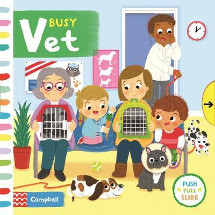
Busy vet illustrated by Louise Forshaw
Busy books. Pan Macmillan, 2017. ISBN 9781509828746
(Age: 2-4) Vets. Board book, Interactive book, Rhyme. This is one of
the Busy book series (comprising more than 20 titles) that
includes Busy
cafe, Busy park, Busy baking, and Busy fire
station. Each book contains push, pull and slide tabs and is
composed of very sturdy board pages. The tabs and pull-outs are
equally robust. Each page contains lots of detail, thereby providing
opportunities for children to ask questions, make observations and
discuss what they notice. As such, it is perfect for inquisitive
toddlers. There are also simple questions directed at the reader
(e.g. 'How many carrots can you count?'). The text is very short,
each page giving a brief rhyme about the vet as she treats each
animal (e.g. 'Poor kitty with a broken bone, you'll soon be fixed
and going home'). Each page shows a different aspect of the job of a
vet (examining injured animals, giving injections, doing x-rays) and
the spaces within a clinic (waiting room, animal cages, examination
room). The text relates directly to what happens within the
interactive push/pull/slide tabs. The scenes are very realistic and
contemporary, containing all the things you see in a vet surgery
including scales, computers and x-ray machines. Little animal lovers
will adore this, especially those who have pets at home and are
curious about what happens at the vets.
Nicole Nelson
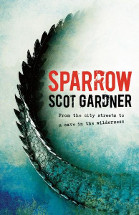
Sparrow by Scot Gardner
Allen and Unwin, 2017. ISBN 9781760294472
(Age: 12+) Highly recommended. Survival, Juvenile detention, Darwin,
Kimberley. Nicknamed Sparrow by the people on the Darwin waterfront
cafes he has befriended, the mute twelve year old gets leftover food
and a few coins after setting up chairs and helping pack them away
at the end of the day. Then he goes back to his sleeping bag atop
some toilets in the shopping centre. Sometimes he drifts back to his
aunty's house but his brother makes this difficult. His brother and
his friends are ghost boys, addicted to sniffing paint, their lips
revealing a moustache of colour. Sparrow tries to stay away from
them, their empty eyes reinforcing the fact that this is a path he
does not want to take. But Sparrow's friend Elsa, a backpacker ends
up in hospital, beaten after they went to the outdoor cinema
together, and he has a good idea of who did this to the girl. But it
is Sparrow who is sentenced to detention.
Gardner packs his stories so tightly that every word has an
importance, each paragraph is dense with fact and background, but so
easily incorporated into the story that the reader is almost unaware
of what they are picking up.
Gardner's exposes the seemier layers of Darwin as he talks of
homelessness, paint sniffing, drug dependence, drug dealing and
children whose lives are outside the law, living on the streets. The
impact of these children's lives on the reader is far more decisive
than any news report or stack of statistics; we are there,
scrambling with Sparrow as he finds things in the rubbish bin that
will be useful, avoiding his drug affected brother, then at hospital
with his dying mother.
Most of the background we hear of through flashbacks as Sparrow must
use all his survival skills to live on crocodile infested beaches in
the Kimberley. Now a sixteen year old in Juvenile Detention, he is
part of a boot camp along the coast, but things go awry and he jumps
from the burning boat and swims for the coast where he must find
shelter, water and food. A man who befriended him in Darwin taught
him to swim and this skill holds him in good stead in the Kimberley
but once on land he must avoid the snakes and crocodiles, mosquitos
and pigs while remaining vigilant for the constant search for water.
He wrestles with his past and the reasons he is in detention, but
when he finds another footprint, things change.
A breathless survival story Sparrow is a gripping read. Survival
stories like Hatchet (Gary Paulsen) are a constant must read
and often used as a class text, and this modern story set firmly in
Australia, will make a remarkable read for students as a class set,
literature circle or borrowed from the library. Sparrow's story is
infectious, readers will be drawn in by the boy's story, working
with him to survive, scrambling from the dangers that lurk in the
mangroves, and marveling at the story he is finally able to tell.
And with the recent expose of Northern Territory's juvenile justice
system, this story has come at a time when the treatment of young
offenders is being reconsidered. This is a must read.
Fran Knight
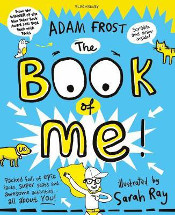
The book of me! by Adam Frost
Ill. by Sarah Ray. Bloomsbury, 2017. ISBN 9781408876817
(Age: 7-10) Recommended as a 'gift book'. Themes: Identity; Facts;
Humour; Interactive Book. The Book of Me is an example of an
interactive book - where the reader gets to fill in details about
themselves, draw their own cartoons, find out some interesting and
quirky facts, laugh at Dad jokes and answer questions and
consequently make their own book. It is illustrated in a style that
lovers of Diary of a Wimpy Kid would be familiar with - a
humourous naive cartoon style. This is not really a book for a
library collection, but it would make a wonderful gift for a 7-10
year old about to embark on a holiday where they might need an
activity pack or to give to child recuperating after an operation.
Written for a UK audience, there are the occasional pages that might
miss the mark for an Australian child. However the Australian facts
on the upside-down page for the 'Land Down under' will cause a
smile.
Give this book with a pencil or coloured pens and it would make a
quirky humourous gift.
Carolyn Hull
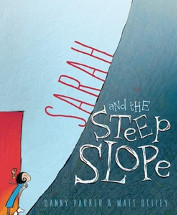
Sarah and the Steep Slope by Danny Parker and Matt Ottley
Little Hare, 2017. ISBN 9781742974675
When Sarah opened her door one morning she was confronted by it. A
steep slope. Blocking out the sun and casting a shadow across
everything. Rising in front her like an insurmountable and
impenetrable barrier. And so it proved to be.
Prodding and pushing didn't move it, surprising it didn't shake it
and trying to sneak around it was hopeless. And when she tried to
climb it, even with her climbing shoes, she got halfway and then
slid all the way back down. How was she going to see her friends?
Nothing worked - even ignoring it didn't make it go away and neither
did the help of the slope doctor so he left clutching a lot of notes
for Sarah's friends and going out the door to a flat, sunlit
landscape. Next day her friends visited her and they didn't see the
steep slope either. They stayed and played all day long. And the
next day . . .
This is a sophisticated picture book for older readers who will
appreciate its symbolism as Sarah tries to negotiate the steep slope
that is only visible to her. Younger readers who are still at a very
literal stage of development may not understand that the slope
exists only in Sarah's mind and that it is a representation of a
problem that she perceives to have no solution.
If used in a class situation, students may make suggestions about
the slope that is facing Sarah and be willing to share the "slopes"
they have had to navigate - physical, academic, mental and emotional
- and how they found their way, while others with slopes in front of
them still may draw comfort and even hope that they are not alone
and that there is a pathway they can follow. We are all faced with
"slopes' as we live and learn - some steeper than others but without
them there is no progress in life - and part of the success of
climbing them lies in being able to acknowledge and analyse the
issue, break it into small steps, develop strategies to tackle each
step, understand that others are willing and able to help and it is
no shame to ask them, believe success is possible and engage in
positive self-talk.
This is a story about the power of friendship, of having the courage
to take the next step forward, of being resilient and acknowledging
we are part of a village that we can seek support from and that
there is always help and hope. The absence of Sarah's family in her
solution and her reaching out to a doctor rather than a parent
suggest that sometimes the issue is within the family or it is not
something the child feels comfortable talking about with a family
member for a range of reasons, giving the reader the approval that
it is okay to seek advice and assistance beyond the traditional
helpers used as they have grown up without feeling guilty that they
have betrayed anyone or hurt their feelings.
Apart from the concepts of symbolism, similes and metaphors and all
that technical English language stuff, this is an important book in
the mindfulness collection as we finally start to acknowledge the
mental health issues for even the youngest children and help them
develop the strategies and skills that will enable and empower them.
Those are the important lessons teachers, and I use the word in its
broadest sense, teach.
Barbara Braxton
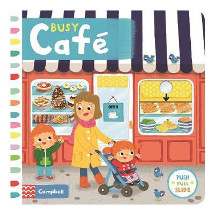
Busy cafe by Louise Forshaw
Busy series. Pan Macmillan, 2017. ISBN 9781509828739
(Age: 0-4) Recommended. Busy cafe is one of nine board books
in the Busy series by Campbell Books, and in my opinion is
fantastic! This little book captured the imagination of my 3 year
old and was the starting point of lots of interesting conversations
about our daily life and how the cafe world works. The book has push
and pull tabs and a spin mechanism that shows the changes in the
cafe; whole food to cut up or eaten foods, full to empty cups; and
were a hit!
The illustrations by Louise Forshaw are bright and enticing, and the
speech bubbles have great questions that also allowed us to do some
counting, searching of the page and discussing favourite foods. The
words follow a simple rhyme which was mastered by the 3rd reading
and also assist to teach children the process of ordering, paying
for and collecting food in this scenario.
The other books in the series include Busy bookshop, Busy
farm and Busy vet and I feel that they would be good
resources to help teach children learn about places and people in
our community while enjoying a fun interactive story. Target
audience: Up to 4 years.
Lauren Fountain