Text Publishing, 2019. ISBN: 9781925603910.
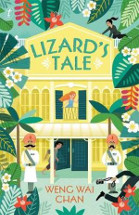
(Age: 9-13) Highly recommended. Themes: Adventure, Singapore -
History, Spies, Stealing, Secrecy. A fabulous adventure story, Lizard's
tale brings to life the Singapore of 1940, on the brink of
war. Desperate to make some money for rent and food, 12 year old
orphan Lizard steals a mysterious box from an English man staying in
Raffles Hotel. Inside is a strange book and dangerous people are
after it. His friend Lili is hiding secrets and his Uncle Archie has
disappeared. He finds himself embroiled in the dangers of espionage.
Who can he trust?
I enjoyed this action packed spy story immensely. Lizard and Lili
are courageous and resilient children who are prepared to take risks
for what they believe in. Their friends are equally brave and
daring. The smells and sights of Singapore are vividly described and
it is easy to imagine the opulence of Raffles Hotel and its wealthy
British occupants, as well as the streets and homes of the everyday
inhabitants of Singapore.
Middle grade readers are sure to enjoy the sights and sounds of Asia
as they follow Lizard and Lili's escapades, while evading the
Japanese spies. The humour and exciting encounters in Lizard's
tale would also make it a great class read aloud. I can
imagine a class wanting to try curry puffs after hearing this story,
and desiring to know more about Singapore of the 1940s and today. It
would also make a very effective literature circle or class text.
There is a glossary of words (Cantonese, Mandarin, Malay, Japanese,
Hindi and Hokkien) at the back that truly shows the multicultural
nature of Singapore and the author's note sets it firmly in its
historical context. Teacher's
notes are available.
Pat Pledger
Bear out there by Jacob Grant
Bloomsbury, 2019. ISBN: 9781526607416.
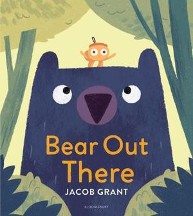
(Age: 4+) Highly recommended. Themes: Friendship, Difference. Bear
just loves being at home, where he can spend the day cleaning his
house and then sit in an easy arm chair reading a book and having a
nice cup of tea. His friend, Spider, on the other hand, loves the
outdoors. He makes kites and needs to go out into the wind to fly
them. But one day his kite is lost. He asks Bear to help him find
the kite. Bear is not sure, he tells Spider that although he wants
to help him find his kite, he does not like the forest. He does not
like the dirty ground or the prickly plants and pesky bugs, but he
still goes with Spider on his quest. The forest with its noise does
not appeal to Bear and when it starts to rain he is even less happy.
He determines that he will go back home to his easy chair and cup of
tea, but seeing Spider's dejected look, decides that he will keep
looking. When the sun comes out he finds the kite in the tree and
all is well. Bear goes back home to his warm bath, easy chair and
cup of tea, while Spider flies his kite, outside with Bear looking
on. The two friends could not be more different: readers will see
that being a bear and a spider are two quite different animals, and
not only are they different in what they are, but also in their
habits and what they like to do. But friendship overcomes their
difference.
This charming tale, following on from the equally engrossing Bear's
scare (2018) when the fastidious Bear finds a cobweb in his
house, is accompanied by bold brightly coloured illustrations, pared
back to the basics, but with enough difference to ensure readers
will hunt out the detail as they turn to each new page with a
different layout from the one before.
Fran Knight
The great toy rescue by Yvette Poshoglian
Illus. by Phil Judd. Puppy Diary 1. Scholastic, 2019, ISBN:
9781760662936.
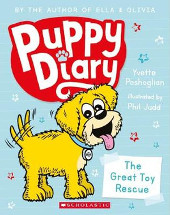
(Age: 6-8) Themes: Dogs, Diaries. Yvette Poshoglian author of the
popular Ella and Olivia books introduces us to Archie a fun-loving
puppy in her new Puppy Diary series. Drawing inspiration
from her own puppy Archie and his antics and activities she writes The
Great Toy Rescue from the dog's point of view. No mention of
how he actually writes, records or captures his thoughts is given!
Archie is a schnoodle, a schnauzer poodle mix, and he has five very
important jobs, waking his Mum, protecting her from the vacuum,
licking up leftovers, barking at the postman and keeping the
apartment cat free. His pawfect morning includes gobbling his food
and practicing downward dog yoga stretches. Chosen from a litter of
puppies when he was ten weeks old was so exciting.
A new adventure begins when his Mum drops him off at Pup's
Playground Doggy Daycare. First Archie is a little anxious at
meeting the other dogs. Oscar the circus pug is a rolling ball of
energy. Information cards introduce each one, Tiny is a Great Dane
who enjoys digging and Yip and Yap are playful Maltese terriers.
Archie enjoys playing with his new friends, until Felix the large
ginger tabby appears on top of the next-door fence. When each of the
dogs discover their special toys are missing, it is time to
investigate.
Yvette Poshoglian adds fun and excitement, she appreciates the dogs'
reactions to pigeons in the park, dog walking and their love of
treats. Phil Judd's entertaining black and white illustrations bring
a warmth and liveliness to Archie and his dog friends. Bold letters,
easy to read text, notes and cards stuck into the diary make this an
engaging junior novel. The Great Toy Rescue is just right
for early fluent readers from ages six to eight.
Rhyllis Bignell
Vincent and the Grandest Hotel on Earth by Lisa Nicol
Puffin Books, 2019. ISBN: 9781760890681.
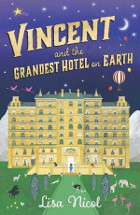
(Age: 9-13) Highly recommended. Themes: Hotels, Hopes and dreams,
Friendship, Family, Fantasy. Vincent is the epitome of ordinary and
yet his ordinary life is transformed in a moment the first time he
uses his late Grandfather's shoe-shine equipment and then is offered
a job that goes beyond his wildest dreams. The Grandest Hotel on
Earth opens up possibilities, friendship opportunities and reveals
all sorts of solutions to the problems and concerns of the Hotel's
patrons, and perhaps even Vincent's problems too. The hope it offers
to Vincent is of a reprieve from his own family concerns. Since the
arrival of his younger brother their world has been battered with
the distress of a child with tantrum-wielding, egg-eating and
non-verbal chaos, and the whole family is weighted with the burden.
The Hotel itself is anything but ordinary. The rooms are magical in
the way they meet the needs of those who stay (reminiscent of the
worlds of Disneyland and The magic faraway tree, and the rooms are
never the same for each visitor) and the staff are equally
restorative in their approach, as is the theme-park-like experience.
It is indeed the Grandest Hotel! The wonders of the experience go
beyond ordinary, but Vincent may have created a problem by being too
curious and a friendship may be at risk.
This book is delightful, with magical moments and human restoration,
and the development of the wonderful young boy, Vincent, and his
growing friendship with the young girl left in charge of her
family's Hotel. This book explores the transformation of ordinary
into extraordinary and reveals some wonderful quirky characters and
experiences. The hint of a 'co-writer' mentioned in the early part
of the book, is a nod to the inspiration for the author Lisa Nicol
and his input is revealed in a Post-word at the end of the book.
This book is funny in a subtle, understated way, but there is also a
poignant reminder that not all of life is easy. The Hotel, though,
seems to have a solution, and reading this book will be uplifting
and rewarding for young readers and they too will want to stay at
The Grandest Hotel on Earth. Teacher's
notes are available.
Carolyn Hull
Turning point by Michael Veitch
Hachette, 2019. ISBN: 9780733640551.
(Age: Senior secondary - Adult) Recommended. Non-fiction. Michael
Veitch has thoroughly researched the background to the battle for
Milne Bay in 1942, a momentous battle in New Guinea, and the first
land defeat of the powerful Japanese forces as they advanced towards
Australia. Veitch asserts that it was at Milne Bay that the myth of
Japanese invincibility was smashed forever. Australian infantry and
air force, and American engineers and anti-aircraft gunners worked
together in the most horrendous of conditions - mud, rain,
mosquitoes and disease, not to mention the impenetrable jungle, all
made life unbearable for the soldiers. The Allies had set up air
strips, rolling out new steel matting for runways, only to
continually battle mud that seeped up through holes in the matting
to create a slippery mud sluice that plastered the aircraft.
Nevertheless Milne Bay became a base for the Kittyhawks providing
essential firepower and cover for the men on the ground.
Veitch includes the stories of the many larger than life
personalities, Australians from all walks of life, who fought
heroically and determinedly to prevent the advance of the Japanese.
We also learn about 'silent Cyril', Major General Cyril Clowes, the
calm and cautious strategic thinker determined not to make useless
sacrifice of men, who ultimately led a successful campaign, but
received little recognition in later years.
Milne Bay was also the scene of Japanese war crimes, the mutilation
and killing of prisoners and helpless Papuan natives, leading to a
hardening of attitude of the Australians towards their enemy.
In many ways a significant event in the history of Australia's
participation in World War II, this book brings to life the people
and the formidable situations they endured - making it a commendable
resource for students of the history of the war in the Pacific, as
well as an engrossing read for the general reader.
Helen Eddy
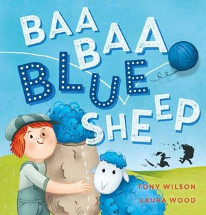
Baa baa blue sheep by Tony Wilson
Illus. by Laura Wood. Scholastic, 2019. ISBN: 9781760666446.
(Age: 4+) Recommended. Themes: Counting, Colours, Sheep. Before the
pages are opened all readers will have the nursery rhyme, Baa
baa black sheep, running through their heads. And this funny
turn on the well known rhyme will have children reading along,
smiles on their faces as they recognise the different hues used for
the wool, and the clever rhymes used by the writer. And reading the
story they will notice the repetition of the refrain, the colours
used and the numbers counting back from nine to three.
Two people are arguing over the bags of wool. A well dressed master
pipes up that he wants all the nine bags of blue wool, because he is
'a blue kind of guy'. But the dame also wants the bags, and in the
end they fight over them only to see the bags of wool roll into a
ditch. Next comes the purple wool. The dame wants the eight bags but
the master disagrees so they fight and the purple wool is torn
apart. Then the red wool is fought over, and the yellow and the
green, until finally the little boy who lived down the lane puts a
halt to the proceedings and they work out a compromise.
I loved the way this rhyme uses the original Baa baa black sheep,
and readers will recognise elements of the original nursery rhyme as
they read this.
Recognition of rhyming words, prediction of words that rhyme,
laughing along with the reading out loud, a shoo-in to talk about
nursery rhymes that are well known and perhaps even some attempts at
turning a well known rhyme around, will all emanate from this cute
tale.
The digital illustrations cleverly reflect what is happening in the
text, and readers will love searching out the parallels between this
tale and the original Baa baa black sheep.
The endpapers with their balls of differently coloured wool will
initiate some talk about wool, sheep and knitting and perhaps
encourage some classes to try knitting or any wool crafts for
themselves.
Fran Knight
Movie time! by Anh Do
Illus. by Dan McGuiness. Hot Dog 6. Scholastic, 2019, ISBN:
9781742997872.
(Age: 6-8) Themes: Films, Play, Movie making, Friends. Hot Dog and
his best friends, Kev the cat and Lizzie the lizard, return for
another fun adventure in Movie time! They love playing cops
and robbers especially when Kev's loot bag is filled with muffins.
After the game, they grab an icecream and notice some special
posters, 'Actors Wanted - a Hero Ninja, a Brave Ballerina and a
Volcano Monster' with try-outs soon and free food as an incentive.
The new movie called 'The Volcano Monster' sounds thrilling,
Hotdog thinks he's perfect for the ninja (with a little practice),
Kev wishes to star as the ballerina (lots of practice needed) and
Lizzie wants to be the volcano monster (she's afraid of heights,
though).
With only a week until the auditions, the friends need to practise
their skills and train really hard, if they want to stand out from
the others keen to be in the movie. What great friends they are,
encouraging, guiding, helping and creating challenges to hone their
skills. Hot Dog's ninja chopping skills create a perfectly sliced
fruit platter, although leaping over a wobbly line of tree trunks
with spiky porcupine obstacles proves a little tricky. Kev looks
gorgeous in his tutu, but his spins and leaps need finesse. Hot
Dog's especially helpful adding a layer of rubber to Lizzie's shoes
at each training session to help her overcome her fear.
At the auditions, the friends try their best and are given special
roles, which come in very handy when the real volcano erupts!
Books in Anh Do's Hot Dog series are jam-packed with humour,
slap-stick comedy, cheesy jokes and loads of fun. He focuses on
friendship, teamwork and caring for others, while creative and
imaginative play is encouraged. Some of the animals' actions need to
come with a word of caution, especially the volcano rescue and
dealing with the lava and flying rocks.
Dan McGuiness continues to capture the humour, fun and crazy actions
of the characters. The brussel sprout icecream, Lizzie's unusual
practice volcano and the spiky porcupines add excitement. Red is the
predominant colour, making the illustrations stand out, bold key
words, and differing text styles and sizes make this another easy to
read story for readers from six and great for hi-lo readers as well.
Rhyllis Bignell
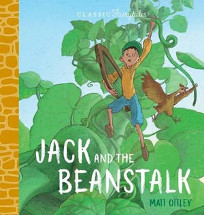
Jack and the beanstalk by Matt Ottley
Scholastic, 2019. ISBN: 9781760660581.
(Age: all) Highly recommended. Themes: Classic tales, Fairytale,
Giants. The classic tale of Jack and the beanstalk has been retold
and illustrated by award winning author/illustrator Matt Ottley. The
first page shows an impoverished family, thin and ragged, with a
poor cow so starved that its ribs are obvious, having to make a
decision about their most precious possession. From there the
illustrations cover the pages as they tell the tale of Jack and his
cow going to the market. Children will sympathise with the decision
that has to be made, wondering what they would do in Jack's place.
Along the way to town, Jack is waylaid by an old man who exchanges
three magical beans for the cow. Jack's mother is incensed and
throws the beans out of the window, sending him to bed. But the
beans are magical and a beanstalk grows up into the sky. Climbing
the beanstalk, Jack finds he is in the giant's grip and must escape
doing so with the giant's magic singing harp and golden egg laying
hen.
A well known fairytale, Jack and the beanstalk has been revisited
many times since it first appeared as The story of Jack
Spriggins and the enchanted bean in 1734. The story was
published in 1807 as the The History of Jack and the beanstalk,
and then Joseph Jacobs included the most well known version in his English
Fairy Tales in 1890.
A story of a poor boy winning against a huge giant will always win
friends as readers pit themselves against the giant, willing Jack to
succeed and return home with something good for his mother. His poor
family is enriched by the fabulous hen and can enjoy the music
played by the harp. The giant is a nasty giant, eating Englishmen so
deserves to fall from the beanstalk. His refrain will cheer the
hearts of the readers as they practise the small poem, repeating it
as the giant comes into the story.
Ottley portrays his characters with a great deal of humour. I love
the images in the giant's house of necessity looming over the tiny
Jack, the giants' feet and hands, large, gnarled and lumpy coming
out at the reader. Readers will love looking at the detail included
by Ottley, the shadows, the cow's eyes and eyelashes, the castle,
the giantess' thongs, the bones under the table and the bright green
endpapers, and ask for the story to be read again.
Fran Knight
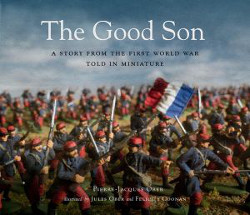
The Good Son by Pierre-Jacques Ober
Illus. by Jules Ober and Felicity Coonan. Candlewick Studio, 2019.
ISBN: 9781536204827.
(Age: Upper primary +) Highly recommended. Themes: War, Patriotism,
military history, toy soldiers. A story from the First World War
told in miniature as the sub-title suggests this beautiful
picture book re-creates realistic scenes from the First World War
using miniature soldiers. Also it tells the story of the little
soldiers in the Great War, caught up in a conflict where they joined
as patriots, to make their families proud but as the war progressed
it became clear they were pawns in a larger game. The monochrome
images of the war torn countryside and the narrative ribbon stating
the bleak facts about WW1 bring us to young Pierre, locked up in a
barn. What unfolds is his story from when the world had colour, with
emphasis on the red white and blue of the French flag. He joined up
to stop the Germans, and marched through the beautiful countryside
dreaming of glory but when they finally saw battle 'we won . . . it
was terrible.' Pierre has a friend, Gilbert, who stands by him
throughout. When the Colonel comes and tells Pierre he will be shot
for desertion it is Gilbert who brings him food and companionship.
His commanding officer is sympathetic but tells Pierre morale is low
so he is to be made an example of to deter others from walking away.
Pierre's crime? To slip away for three days to be with his mother
over Christmas. He writes a letter to his mother recounting an
incident where he was commended for bravery he felt he didn't earn,
whereas he is to be shot for desertion for wanting to spend two days
with his mother. He promises to wear the socks she gave him 'Maman
those were the best two days of the war.' Gilbert comes before dawn
bringing food and comfort and he talks of a younger brother killed
in the first week of the war. Gilbert promises to deliver the letter
to Pierre's mother.
In a note from the author we learn that the idea of using WW1
figurines to create a series of images was originally a gift for his
father's 80th birthday and the centenary of the start of WW1. The
project 'developed into an homage to all the men who fulfilled their
patriotic duty unprepared for the horror unleashed upon them'.
A highly recommended but harrowing story that would make an
excellent history teaching aid for upper primary or middle school
students, younger students might need to read this with a
grandparent or adult.
Sue Speck
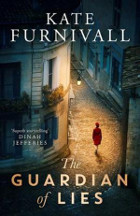
The guardian of lies by Kate Furnivall
Simon and Schuster, 2019. ISBN: 9781471172328.
(Age: 16+) Historical fiction. Furnivall's novel is set in 1950s
France during the Cold War. American air bases are being established
around the country to protect Europe from the growing threat of the
Soviet Union. France is divided between those who view the American
presence as a necessary protection against the reach of Communism,
and those who resent American capitalism and the development of
nuclear weapons.
Wanting to follow in the path of her elder brother Andre, Eloise had
applied to become a secret agent with both the French Intelligence
Service and the American CIA but following rejection by both, she
embarks on detective work in an agency run by Clarisse Favre.
Eloise's detective skills are turned to her personal life after her
faulty decisions see her brother crippled in a car smash and she
learns that her father has sold part of their precious family
property to the American air base in the south. The burning
questions are: Who tried to kill her brother? And why would her
father part with the land that he loves?
Returning to her home in the Camargue, Eloise is drawn into a
tangled web where it becomes hard to work out who can be trusted and
who is an enemy. Someone is leaking top secret information about the
American secret weapons to Soviet Intelligence, the MGB. And someone
is determined to stop Eloise from finding out what is going on.
Caught in the lies and deception, there seems to be only one person
she can turn to - her childhood friend Leon Roussell, now the local
police officer, but how much can she tell him without endangering
members of her family?
Eloise is a strong determined woman, extremely resourceful and well
trained by her brother to consider the evidence . . . and then to
also consider the impossible. But as she gradually uncovers the
secrets, she knows that she herself is drawing closer and closer to
danger.
Readers will find themselves carried along with the fast moving
plot, wanting to know who is the spy and who the counter-spy, but
also ultimately which world view one should trust.
Helen Eddy
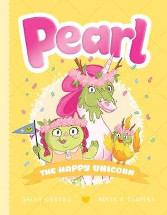
The happy unicorn by Sally Odgers and Adele K Thomas
Pearl book 4. Scholastic, 2019. ISBN: 9781760664275.
(Age: 6-8) Themes: Unicorns, Magic, Ogres. Pretty in pink, Sally
Odgers continues her delightful magical series in The Happy
Unicorn. With bright colourful pages, borders and magical
words, this is another easy to read and share story, just right for
young unicorn fans.
Sometimes Pearl has problems with her magic, instead of stopping the
rain, it may turn pink or even create a towel that helps for a short
while. Tweet the Firebird and Olive the Ogre enjoy the pink rain, it
makes them happy. Olive's busing practising her loudest roars for
the upcoming Ogrefest. Pearl and Tweet want to attend, and with a
little help from Olive and Granny Ogma's ogre-lotion mixed from mud
and leaves, they are disguised as ogres.
Pearl's talent is flicking her tail and stomping her hooves, while
Tweet the Firebird can compete in the fire lighting competition with
the flick of her tail. The Ogrefest is loads of fun; ogres from all
over the valley gather to sing, roar and share piles of snacks. Each
day is filled with laughter and fun, contests, activities and plenty
of eating. Pearl wishes she could use her magic to help her friend
Olive win, but that's not allowed, until the gobble-uns invade the
festival. When their stinky magic fills the air, Pearl's had enough,
she stamps and stomps, swishes her tail and down comes the magic
pink rain which washes the gobble-uns clean and clears the air. What
a wonderful outcome and a special conclusion to a difficult
situation!
Sally Odgers continues to explore the themes of problem solving,
valuing friends and believing in yourself. Adele K Thomas' fun,
pink, grey and black pictures showcase both Pearl's magical world
and add sparkle to the enchanting story. The Happy Unicorn
is just right for readers venturing into early chapter stories.
Rhyllis Bignell
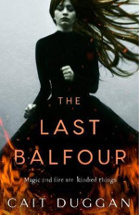
The last Balfour by Cait Duggan
Harper Collins 2019. ISBN: 9781460757017.
(Age: 12+) Highly recommended. Cait Duggan's first novel follows the
witch hunt phenomenon of 19th century Scotland. With rich imagery
and a cast of interesting characters, this novel is a welcome escape
from reality. Incorporating spells and songs from historical texts
as well as charms and pagan traditions, Duggan pays homage to the
healers of old and those who were persecuted in the Scottish witch
trials.
Iona is only fourteen when her aunt Grizzle is convicted of being a
witch and burned at the stake. Her powers have not yet come in yet
her sister is unconcerned with the danger they are both facing.
Blinded by her love for her husband, Gregor, Ishbel refuses to act
until it's too late. Under her aunt's instructions, Iona must set
off through the forest for Edinburgh with little more than her wits
and a family jewel. With a witch-finder in hot pursuit she must let
go of all that is dear to her, even the neighbour's boy, Daziel, who
has returned from his studies to help her. Making new friends along
the way, Iona must come into her magic and gather all of her courage
in order to survive. But will that be enough?
The novel explores Iona and Ishbel's strenuous relationship
following Ishbel's marriage and subsequent infatuation with someone
her sister cannot stand. Dealing with issues of trust, secrecy,
betrayal, and the power of intent, The last Balfour tells us
to be careful who to trust and why.
Highly recommended to young people twelve and up, particularly those
interested in Scottish history, witchcraft, and the supernatural. Teacher's
notes are available.
Kayla Gaskell
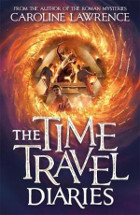
The time travel diaries by Caroline Lawrence
Time Travel Diaries book 1. Piccadilly Press, 2019, ISBN:
9781848128002.
(Age: 10+) Recommended. Themes: Time travel, Boys, Roman Britain.
'There are three rules of time travel, a naked entry and exit, only
drink don't eat and keep interactions to a minimum!' Billionaire
inventor Solomon Daisy needs a willing subject to travel back to
Roman Britain and find the blue-eyed girl with the ivory knife. Only
pre-adolescent children without piercings or fillings can enter the
portal and twelve-year old Alex Papas fits the criteria. He loves
Latin Club and can speak the language too, it's like Greek which he
speaks with his grandma who cares for him, as well.
Alex weighs up the consequences and considers the benefits of the
million pounds reward, four million extra, if he finds the blue-eyed
girl. (Daisy's fascination is borderline obsessive.) Alex uses his
wits, prior knowledge of Londinium to navigate out of the dark
Temple of Mithra into the streets. Chased by a mad woman, traversing
the Thames in a coracle, stealing a knife, sleeping beside a warm
kiln, losing Dinu, the first day and night is problematic for Alex.
At the marketplace, he uses the tune of 'Greensleeves' and his
schoolboy Latin to inform the crowd of his goal.
Fortuitously, Lollia the knife-carrying girl finds Alex. She is
pretty but rather spoilt and treats her slave girl, Plecta, badly.
There's a budding romance that develops when Dinu reappears, as he
falls for Plecta. Do the boys return unscathed to modern day London?
How does Alex ensure the safety of the girls as well?
Carolyn Lawrence's rich background knowledge of Roman life, the
nitty-gritty, sights, smells and sounds, make this a thrilling
novel. She includes 'Ten Things You Didn't Know About Roman London'
to ensure the readers understand the differences between the
realities and representations glamorised in Hollywood movies. The
time travel diaries is a fast-paced junior novel perfect for
sharing with classes studying Ancient Roman history.
Rhyllis Bignell
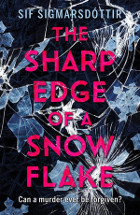
The sharp edge of a snowflake by Sif Sigmarsdottir
Hachette, 2019. ISBN: 9781444935301.
(Age: 15+) Recommended. Themes: Nordic mystery, Thriller, Iceland,
Murder, Social media, Sexual abuse. Lovers of Nordic noir and
mysteries will be thrilled to pick up this gripping thriller set in
the snowy cold of Iceland. Hannah has been sent to live with her
father, a man she barely knows after the death of her mother. She is
to work as a trainee journalist at her father's paper. On the way
from the airport she witnesses the body of a man who has been
murdered and becomes embroiled in finding out what has happened.
Meanwhile Imogen Collins is also coming to Iceland. She is a social
media influencer and works for a company that manipulates sales. She
is also haunted by the man she calls the Beast. Hannah and Imogen
meet and secrets start to spill out as the action speeds up.
This book was very hard to put down. It ticks all the boxes on many
levels - the mystery of the murder is quite riveting, and is central
to the story, but the background of both Hannah and Imogen give the
story depth and interest. What has happened to Imogen in her past?
Will Hannah inherit the mental problems that plagued her mother?
Both young women are feisty characters that readers will identify
with, while the manipulative aspects of social media are thoroughly
explored and Hannah's comments on Instagram are amusing and
relevant.
This is a really engrossing mystery with psychological overtones and
is sure to appeal not only to teens but to adult mystery readers as
well. And the unexpected cliff-hanger at the end suggests that
readers may see more of Hannah's investigative powers in the future.
Pat Pledger
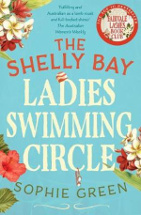
The Shelly Bay Ladies Swimming Circle by Sophie Green
Hachette, 2019. ISBN: 9780733641169.
(Age: Adolescent - Adult) This delightful novel plunges us into the
lives of four women at different stages in their lives. Meeting at
one of Sydney's beaches for a daily swim, named as Shelly Beach in
the novel, the four women discover a lifting of the spirit,
supported as they are by the growing understanding, interest and
care of the others. The issues that the women face are very much at
the heart of coping with the changing world of today, and, even more
so, of recognizing the challenge of the roles that each plays.
While on the surface this may appear to be a 'light read', Green's
gentle persuasive tone lures us into the lives of these women and we
are caught up in their growing friendship and daily lives. While
Green explores the complications that the four women have in their
lives, she also draws characters who are able to change, developing
greater strengths to face their challenges. Each discovers that the
caring support of others enables them to face their lives with a
more positive stance and stronger determination to complete what
they have begun. Focussing on each one's issue in the individual
chapters, Green draws us into the increasingly important shared
times swimming in the beautiful, deep waters of the bay, and what
that offers each woman. We realise that, for the women, this
recurrent meeting enables a deeper exploration of the complexities
of their lives, and we begin to see the strength of the circle that
can support them.
Leanne, a nurse, offers support and care to patients but is
alienated from her family. Swimming with the others, she experiences
the 'magic' of the sea. Marie lives alone, surviving on the age
pension. She finds the friendship of the others and the freedom of
the water exhilarating. Elaine moved to Sydney from England with her
Australian husband, a doctor who works long hours, and has begun to
use alcohol while spending much time alone. Theresa is married with
two young boys, her husband having left her. Her mother,
delightfully spirited and supportive, helps in the home while
keeping her own 'room' in the garden shed.
Ultimately this story is a lesson to all of us in these busy worlds
that we inhabit, that giving and receiving kindness, friendship and
support can bring about change in our lives, especially in our level
of well-being. This is a book for both adults and adolescents who
are curious as to the decisions they might make as adults. Indeed,
it is probably a woman's book, but would be a salutary lesson for
all genders as the modern world is shown to present difficulties,
intruding and sometimes alienating us from what matters in life.
Elizabeth Bondar