Senior Editor: Beth Patch. Australian Edition. Dorling Kindersley,
2019. ISBN: 9780143795001.
(Age: 6-8) Recommended. Themes: Mathematics, Arithmetic, Counting.
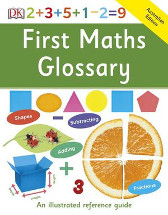
Dorling Kindersley have again produced a beautiful and
well-presented book with an explanation of very simple mathematical
concepts. The clarity of information and the presentation make this
a suitable book for young students up to Year 2 at school or could
be used to support students who are a little older if they have
missed the 'basics' or are young ESL students. The topics covered
begin with counting, then number operations, and also includes,
time, measurement and representation of data. Everything is defined
using a 'concrete' illustration and is exceptionally clear with one
to two sentence descriptions.
This would make a good library addition or a great book to have
within a classroom.
Carolyn Hull
Graveyard shift in Ghost Town by Michael Pryor
Ghost Town book 2. Allen and Unwin, 2019. ISBN:
9781760523930.
(Age: 13+) Highly recommended. Themes: Ghosts. Humour. Melbourne,
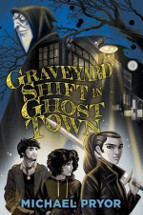
Diversity. Wow! What a great sequel to Gap
year in Ghost Town. Pryor brings back Anton Marin and Rani
Cross, ghost fighters extraordinary, with their researcher friend
Bec, in another exciting and funny adventure as an extreme ghost
plague takes over the city.
Written in the first person by Anton, the reader is faced with
humorous narration and lots of funny asides as Anton relates how he
is feeling about the dangers of ghost fighting and his
self-professed goal of becoming more mature. Rani and Bec's romance
continues and while Anton sometimes feels left out, the three manage
to stay good friends.
There is action galore as well as Anton and Rani take on the plague
of ghost thugs that have taken over Melbourne (Australian readers
will love the descriptions of the sights and alleyways of this
city). There are so many ghosts to fight, not just the lingerers
that Anton knows so well, but moaners, weepers and thugs. When
Anton's Aunt Tanja makes an unexpected appearance, after many years
of being lost, in the warehouse where people are being tortured,
there are many questions raised about the nature of the ghost plague
and what to do about it. Bec's research skills come to the fore and
Anton and Rani must excel in fighting.
People who loved the first book will delight in the snappy prose and
character development in Graveyard Shift in Ghost Town and
will look forward to the next in this highly entertaining series.
Pat Pledger
Now that's a hat! by Heath McKenzie
Scholastic, 2019. ISBN: 9781760664022.
(Age: 4+) Highly recommended. Themes: Hats, Shopping, Choice,
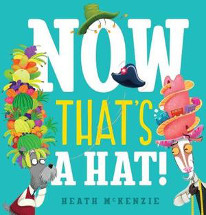
humour. Walking into a hat shop, the happy dog tells the uppity goat
shop assistant that he is looking for an everyday sort of hat,
something he can wear in all seasons. From there readers will laugh
out loud as the assistant shows the customer an array of hats, each
worse or more showy than the last, while each of the lines forms a
rhyme which is sure to intrigue and delight as the reader predicts
the possible word that will rhyme with the line before.
From tall hats and short hats, long hats and upside down hats, dotty
hats and potty hats, to the more outrageous boot hats and loaf of
bread hats, to hats that are too Roman or too Dutch, many many are
simply too much.
The hapless customer becomes very frustrated with the assistant, now
trying out everything he can jam on the customer's head, surrounded
by the rejected hats on the floor around them.
Even passers by look through the window at the mayhem, as the two
become more and more agitated with each other.
McKenzie's wonderful digital illustrations will have all readers
watching each page with interest as they spy the different hats
being tried and rejected, the looks on the faces becoming more and
more disgruntled and the floor even more littered with a variety of
hats.
The text and images play together across each page, no one page the
same as the one before, as the two tussle trying to buy and sell a
hat.
I can imagine many readers building their own hats after reading
McKenzie's story and copying the hats shown in the book. Fun for all
and the twist in the tale will bring tears of laughter and
recognition to any reader, young and old.
Fran Knight
A boy called Bob becomes an AFL Footballer by Bob Murphy and Tony Wilson
Illus. by Phillip Marsden. Piccolo Nero, 2019. ISBN: 9781760641429.
(Age: 8-11) Themes: AFL Football, Bob Murphy, Western Bulldogs
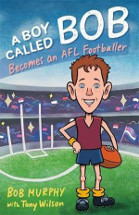
Football Club, Families. A Boy called Bob Becomes an AFL
Footballer is a laugh-out loud, footy-filled novel that
reveals the highs and lows, hard work and dedication need to be an
elite footballer. Bob shares openly and honestly about his family:
his mum was a nun and his dad a priest. They fell in love, were
married, became teachers and raised three children including Robbie
the youngest. Sock footy, tree climbing and visiting his many
cousins made his childhood fun. The school oval was a rectangle and
covered in gravel, the team sure was tough!
Each chapter heading gives a fun explanation of what's to come. In
chapter 5 Bob meets his future partner Justine Quigley at the high
school swimming carnival. Bob dreamed of being an AFL player; he
trained hard, loved the smell of new Sherrin footballs and had his
family's support. Two dozen relatives and friends watched the AFL
draft pick when eighteen-year-old Bob was chosen for the Western
Bulldogs team.
His first year was one of highs and lows: free gear, his photo on
footy cards, and pain from the hard training, overcoming shyness and
feeling judged were difficult. Bob shares from the heart, the
elation of scoring a goal in the final seconds and the tough times
when the coach is challenging them to do better, spraying Bob in the
front row with spit. There are triumphs and tragedies when Bob
injures his knee twice, tons of footy tips and plenty of on field
action.
Tony Wilson author of the The Selwood Boys and Bob Murphy
have co-authored a rousing junior novel, written in an easy to read,
fun style just right for sports and AFL fans. Phillip Marsden's
cartoons add humour as well. Bob's knee is totally twisted around on
the stretcher! Share A Boy called Bob Becomes an AFL Footballer
with a middle primary class and they'll love the asides, the family
support and learn about the hard work and dedication needed to be at
the top of any sport.
Rhyllis Bignell
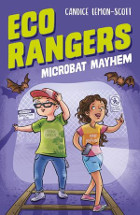
Microbat Mayhem by Candace Lemon-Scott
Illus. by Aska. Eco Rangers book 2. New Frontier Publishing,
2019, ISBN: 9781925594829.
(Age: 7-9) Themes: Wildlife Conservation, Bats, Animal Rescue,
Amusement Parks. The Eco Rangers, Ebony and Jay are best friends who
are passionate about animal rescue and rehabilitation. They love
working closely with Doctor Bat and Doctor Tan, vets at the local
conservation centre who guide them in their animal care.
As a reward for their pelican rescue, they receive annual passes to
the Super World Theme Park. Ebony's take charge attitude sees the
duo ignoring the 'Do Not enter' sign at the old rollercoaster to
save two baby microbats in the rubble. With the help from the vets,
the Eco Rangers take the babies home to care for them. Risking
danger, they return to soon to be demolished Wild Jungle Ride to
discover a colony of microbats living inside.
They come up against a formidable opponent, Ms Pitts manager of the
theme park, who wants the old ride knocked down quickly. At the
hardware store where the friends are buying materials to make bat
boxes, they overhear her discussion with the security guard who's
purchasing baits, traps and poisons to wipe out the colony. The
manager has broken her promise to hold off on the demolition for
three weeks to allow the Eco Rangers to move the microbat colony
safely. The tension and drama build as Ebony and Jay are forced into
difficult actions to save the animals.
Author and wildlife lover, Candice Lemon-Scott's fast-paced
narrative champions caring for our wildlife. With themes of
friendship, animal rescue and rehabilitation and caring for our
environment, Microbat Mayhem is an exciting read for middle
primary students. The Eco Rangers series supports the Year 4
Science curriculum where learners describe relationships that assist
the survival of animals and sequence their life cycles.
Rhyllis Bignell
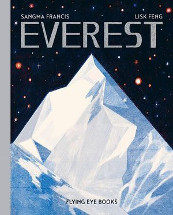
Everest by Sangma Francis
Illus. by Lisk Feng. Flying Eye Books, 2018. ISBN: 9781911171430.
(Age: All) Highly recommended. Themes: Mount Everest, Mountains,
Environment, Climbing. Everything you ned to know about the
magnificent Mount Everest is told within the covers of this highly
readable book. Aimed at mid to upper primary, as an older adult, I
found it riveting, using the contents pages to go back and glean
further bits of information, following the references given to find
out more and reading the glossary enthusiastically. I missed having
an index. From its start 300 million years ago when the huge land
mass, Pangaea was formed, to 50 million years ago when the Eurasian
and Asian continents pushed against each other to form the Himalayan
Mountains, the history of Mount Everest makes fascinating reading.
Supported with lots of diagrams, illustrations and maps, the book is
informative and highly illustrated.
Chapters on the mountain's environment includes facts about the
flora and fauna, and this then goes on to what lures climbers to try
to climb the mountain. Readers will find lots of stories of the
attempts to climb Everest plus a short story about the first
climbers who made it, and a fascinating double page about inventions
that have been made for climbers on this mountain. The trail taken
by most of the climbers is detailed, followed by several pages
looking at the mess they leave behind, now a problem which other
people have to clean up.
For people like me who wanted to know about deaths on Everest see here
for the story of the 200 plus bodies left on the mountain. The
mountain's part within the two religions of Buddhism and Hinduism is
outlined as is the part played by the Sherpa, a Buddhist group of
people who live in the Khumbu Valley and have led many expeditions
to the mountain because of their extraordinary skills at surviving
all that happens there. A double page is devoted to the Story of
Shambhal, while the myth of the Yeti is also discussed.
All in all a fascinating and informative read, one the holds
interest with its stories and illustrations. I can imagine many mid
to upper primary people poring over it.
Fran Knight
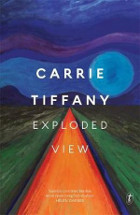
Exploded View by Carrie Tiffany
Text Publishing, 2019. ISBN: 9781925773415.
(Age: Adult - Senior secondary) Highly recommended. Themes: Abuse,
Motor cars - Maintenance and repairs, Mechanics, Adolescent girls,
Domestic violence. What a tense, unforgettable novel this is,
difficult to read because of its subject matter but impossible not
to return to, to listen to the voice of the young girl narrating her
story and to wonder what the outcome could be. Father man moves in
with the mother of a young girl and her brother. He runs an
unlicensed mechanic's workshop on their property and is violent and
abusive. The only way the girl can resist him is by sabotaging the
cars that he is working on and by not speaking for 60 days.
Tiffany's prose is sparse and formatted in a very unusual way -
short paragraphs that allude to the Holden workshop manual that she
has taken from the workshop. It is a short novel, just 192 pages
long, but big in its impact. Descriptions of the road trip that the
family takes over thousands of kilometres for just three days at the
seaside, take up much of the book and the insights that the unnamed
girl makes are breathtaking in their poignancy. The girl doesn't
name what is happening to her as such, short sentences tell the
story and the reader journeys with her, not only on the road trip,
but on her forbidden trips to the tip at night, and her dangerous
drives in the cars that father man is repairing. She dreams of a
softer relationship with the young man at the petrol station, but
knows that father man has tainted that forever.
Tiffany's fine writing gives the reader a heartbreaking story of
trauma, what it means to be female and the coming of age of a young
girl. Book
club notes are available from the publisher, and an extended,
insightful review
is available from Sydney Review of Books.
Pat Pledger
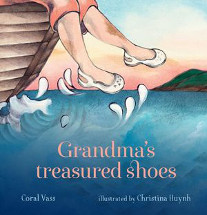
Grandma's treasured shoes by Coral Vass
Illus. by Christina Huynh. NLA Publishing, 2019. ISBN:
9780642279354.
Recommended. Grandma has lots of shoes: out and about shoes, splash
in the rain shoes, walk in the park shoes, dancing shoes and fun
shoes, but her favourites are her old shoes, worn and torn from a
land far away. So begins this lovely tale of movement, of people
migrating, of leaving their own land for somewhere quite different,
often because their country is not at peace. Grandma's shoes were
her only shoes when she lived as a child in Vietnam: they were for
walking and going to school, for playing and working, for everyday.
But one night she and her family had to flee, and her shoes became
scared shoes, fearful shoes, shoes to escape in. They became salty
shoes as they crossed the seas, free shoes as they arrived in a new
land, Australia. Here she was given a new pair of shoes: shiny,
clean for school, and she found that there were different shoes for
all sorts of occasions. All the shoes she was given account for
little compared to her old and warn shoes, wrapped in tissue paper
in a box, kept on a high shelf, reminding her of where she came from
and how these were her escaping shoes to find a place of safety.
The beautiful words flow through the book, offering a different view
of the adage, walk a mile in my shoes, taking readers with them as
the words unfold, each adjective creating a word image of how
Grandma was feeling. So the simple 'trembling shoes', tells the
reader exactly how she was feeling when the family boarded a boat
bound for Australia.
Not usually a word associated with shoes, the combination of the two
words creates an empathy amongst the readers for the child wearing
them. The poetic word images used throughout the text display the
range of emotions felt by people fleeing their own country.
The lovely illustrations too, create a story of the escape: the
shoes are the boats they leave on, the shoes dip into the water as
the girl flees with her family, her shoes land on the wharf, only to
be given another pair of shoes, ones to replace her old ones. But
her old shoes are irreplaceable, and have a place in the hearts of
the family, now settled in Australia. At the end of the book several
pages are devoted to the tale of the Vietnamese refugees who came by
boat in the 1970's receiving a warm welcome by the government of the
day and our citizens, a stark contrast to the detention centres now
in place. But their arrival forced Australia to rethink its
migration policies. A book to recall the past, to contrast with
today's events, a book to tug at the heart strings, to give readers
the opportunity to discuss migration and refugees, to see that
Australia is a land of migrants, a part of our heritage. Teacher's
notes are available here
and here.
The authors gives some background here.
Fran Knight
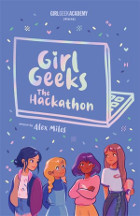
Girl Geeks 1: The Hackathon by Alex Miles
Penguin, 2019. ISBN: 9780143795056.
(Age: 9-12) Themes: Friendship, Computer programming. What would the
Internet look like if more women were building it? Alex Miles in
collaboration with the Australian Girl Geek Academy present an
exciting new series Girl Geeks. Their first novel The
Hackathon encourages engagement with technology, getting your
inner geek on! This series is written for girls from eight to twelve
with coding, computing and creativity at the core.
Hamsa loves arriving at school early, setting out her friends'
places in the classroom. She's finally fitted in with a group of
girls at school. When new girl Niki, recently returned from the USA,
arrives, Hamsa is torn between her old and new friendships. School
is exciting - they have a special Making Room where they work with
the latest technology. When Ms Atlas announces a super group
activity The Hackathon, Hamsa is worried, she doesn't know anything
about coding and she's in a different group to her old friends. The
setting up of the groups, their roles and the projects is explained
in a very detailed manner, with plenty of computing terminology.
Hamsa, Nikki, Eve and Maggie communicate via message feeds, sharing
their project ideas, planning and development, uploading files and
images. At new girl Niki's house, they have a peanut butter and
jelly/jam taste-testing and brainstorming party. When Hamsa
unfortunately shares their group's PlasTICK! pitch to her friend
Zoe, she's shocked to find their idea is stolen. Can Hamsa and her
new friends step up, refocus and present in front of her mum and
three other industry professionals?
Alex Miles explores themes of loyalty, friendship, school and family
life in The Hackathon. The Girl Geeks series is
written to encourage girls to learn and embrace technology, The Girl
Geek Academy aims to teach one million women by 2025.
Rhyllis Bignell
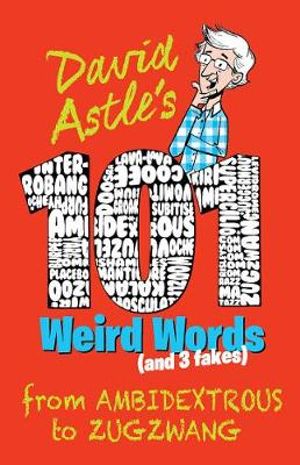
David Astle's 101 weird words (and 3 fakes) by David Astle
Allen and Unwin, 2019. ISBN: 9781760633660.
(Age: 9+) Recommended. Themes: Humour, Words, Definitions. I enjoyed
looking up words like 'Manticore' and 'Rambunctious' and 'Illeism'
and 'Humblebrag', delving into the precise and easily understood
definitions given by David Astle, of SBS's 'Letters and Numbers'
fame. He also has written books about words, speaks on radio about
words and makes puzzles for newspapers. All to do with his love of
words.
And we are lucky that he has published a book of some of his
favourite words, and to confuse the reader he has included three
fake words to trick us. Starting with 'ambidextrous' and finishing
with 'zugzwang', words like 'kvetch' and 'lambent' and 'paraph' will
stump even the most hardened of word watchers. And they don't even
get a red underlining in Word!
Kids will be amused, teachers will have fun throwing in the
occasional word, class quizzes will be recharged using this little
book. I loved simply reading random pages, and I'm sure others will
too.
Illustrations by Paul Tippett add to the humorous writing, and the
word facts and mysteries will keep readers happy.
One of my favourites is 'pareidolia'. I always wanted to know the
term for the faces seen on the moon or on a piece of toast, and here
is just that word. And its a real word, no red line. David tells us
that it comes from the Greek meaning wrong-image, and a girl in
Miami thought she saw Jesus on her toast and sold it for $28,000 on
ebay. With facts like these, the book is a treat.
Fran Knight
Castle Hill Rebellion by Chrissie Michaels
My Australian Story. Scholastic, 2019. ISBN: 9781742991863.
(Age: 10+) Highly recommended. Themes: Australia - History, Sydney
Town, Convicts, Castle Hill, Rebellion. An engrossing recreation of
events surrounding the little known rebellion at Castle Hill in the
convict colony of New South Wales in 1804 is presented in this
highly readable novel, another in the popular, long running series,
My Australian Story. This ill fated rebellion is
reinvigorated in this story as Joe becomes part of the plot hatched
by political prisoners sent to Australia after the Irish rebellions,
to overthrow the British colonial power and return to Ireland to
rejoin their friends aiming for an Ireland free of British rule.
A convict boy, Joe works as a shepherd serving out his sentence,
dreaming of his life after being released. But he becomes embroiled
in a plot to rise against the loathsome garrison and despite his
better instincts becomes part of the plot by a number of transported
Irish rebels including one who has befriended him.
Joe's diary reveals the conditions under which they all live and
work, the voyage out to Australia, the vast distances and the mix of
convicts in Sydney Town. His friends, Kitt and Pat are also very
young, and each is serving out a sentence that defies the
imagination. Pat is part of the team cutting blocks of sandstone for
new buildings at Parammatta, while Kitt has been adopted by former
convicts now farming their own small patch of land.
Readers in upper primary years will find the adventure of the Castle
Hill rebellion absolutely engrossing, depicting a part of
Australia's history usually given scant coverage. Historical notes
at the end reveals more of the people, places and events in the
story, and other useful resources
can be found on the National Museum of Australia website.
A most enjoyable addition to the series about a little known event
in Australia's history.
Fran Knight
The Queen's resistance by Rebecca Ross
The Queen's Rising book 2. HarperCollins Children's Books,
2019. ISBN: 9780008246013.
(Age: 13+) Recommended. Themes: Fantasy, Coming of age,
Conspiracies, Betrayals, Dissent. I loved The
Queen's rising and its sequel is equally as riveting. Brienna
and Cartier, now known as Aodhan Morgane, must take up new roles and
responsibilities as Queen Isolde takes on the reins of ruling
Maevana, and metes out punishment to the Lannons, the family that
had ruled so unjustly. The Queen's resistance is different to many fantasy sequels
in that it concentrates on the difficulties of restoring justice to
the land and the problems that a new ruler faces after overthrowing
a tyrant. The great moral dilemma of whether all the Lannons should
be executed for treason (even the children) is one that is faced by
the Queen and her entourage and raises tricky questions of whether
everyone should be judged on their bloodlines and whether children
have been forced to act in evil ways by their parents. There are
scenes of dark dungeons and it is not difficult to imagine the
torture that has occurred in the cells deep underground.
Brienna faces the challenge of fitting into the MacQuinn household
when there are whispers about her background. She must prove herself
worthy of the MacQuinns and of her Queen's trust. Cartier too faces
difficult times especially as he has taken an orphan boy, Tomas,
under his wing and put his trust in him. Brienna and Aodhan's
feelings continue to bloom although having time to spend together is
almost impossible with Brienna's duties to the Queen and Cartier's
rebuilding of his estate.
The story is told in alternating chapters from the point of view of
Brienna and Cartier and the reader will find the action described
engrossing and the tasks that face them often seem herculean. The
notion of the traditional family is questioned as Brienna is taken
in by the MacQuinns and Cartier is prepared to look after a homeless
boy.
Even though the first book, The Queen's rising, could easily
be read as a stand-alone and will be enjoyed by fantasy lovers, The
Queen's resistance makes a fascinating and engrossing sequel.
Pat Pledger
I don't want to be small by Laura Ellen Anderson
Bloomsbury 2019. ISBN: 9781408894064.
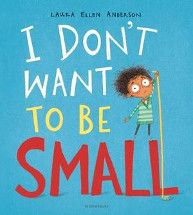
(Age: 4+) Recommended. Themes: Size, Difference, Body image. With the word
'small' in large letters on the front cover and a small boy
measuring himself with a frazzled look on his face, children picking
up this book will know it's about a boy who is displeased about his
size.
In rhyming lines, the boy tells us of his problem, being so small
that his friends forget him, or that he is not allowed to go on the
bigger rides at the fair. He is so cross that he throws his bear up
into the air and it becomes stuck on a higher branch of the tree.
Now he is really cross that he is short, because no matter what he
does, he cannot reach his bear. He tries a long stick and stands on
a box. He ties his socks together to make a rope, even eats all his
greens and then gets into a flower to to see if he can grow quickly
like a plant. But nothing works.
A taller girl comes by and offers to help get the teddy out of the
tree, but even she is not tall enough. They have an idea, and the
boy gets onto her shoulders with just enough reach to get the bear.
Together they have solved the problem and worked out how he can be
taller. A story promoting satisfaction with what you are, of loving
who and what you are, will be a great discussion starter in schools,
where body image is often talked of. A charming tale too of
supporting each other, of two people able to solve a problem
together, will also initiate discussion. The funny illustrations,
like those in her first book, I
don't want curly hair (2017) will cause readers to laugh
out loud while reading.
Fran Knight
Good girl, bad girl by Michael Robotham
Cyrus Haven book 1. Hachette Australia, 2019. ISBN:
9780733638053.
(Age: 16+) Recommended. Themes: Mystery, Thriller, Murder, Child
abuse, Forensic psychologists, Truth. A riveting psychological
thriller, Good girl, bad girl will keep the reader engrossed for all
405 pages of secrets, lies, murder and investigation. Two plots
intertwine with twists and surprises, keeping the reader guessing to
the end. A little girl has been found in a secret room.
Unidentified, she will give no name or age and is put into care. She
is given a name Evie Cormac and when she wants to be declared an
adult, Cyrus Haven is brought in to access whether she should go
free. Does she have the ability to tell if someone is lying?
Meanwhile, Cyrus is also involved in the case of the murder of Jodie
Sheehan, a champion figure skater, who appears to be popular and
open. As the investigation continues secrets begin to emerge and
danger stalks both Cyrus and Evie.
Robotham is a master at writing suspense novels with enough
surprises for even the most experienced mystery aficionado who is
kept asking questions about both Evie and Jodie's murder right until
the end of the book. His characters are fascinating. Cyrus has had
an awful experience in his childhood and Evie's dark experiences as
a child link them together, and the reader will be fascinated,
continually wondering why she is silent about the reason for being
in the secret room. Lenny, the detective in charge of Jodie's
murder, is also a character that the reader will want to see more of
in future books.
It is easy to see why Robotham is a bestselling author. His complex
and clever narratives flow quickly, his characters are flawed and
dark and the suspense is incredible. Readers will be happy to see
future books starring Cyrus Haven and may hope to see Evie and Lenny
as well.
Pat Pledger
Shoelaces are impossible by Ed Allen and Nathaniel Eckstrom
Scholastic, 2018 ISBN: 9781760154950.
(Age: 4+) Recommended. Themes: Procedures, Caterpillars, Shoelaces,
Instructions. Caterpillar really wants to be able to tie his
shoelaces. And understandably, as there are so many pairs of shoes on
his numerous legs. He can do all sorts of things really well. He can
count, walk a tightrope, fly a kite and play the drums, but all he
really wants to do in the world is tap dance, and he cannot possibly
do that when all of his shoelaces are untied.
His friend Rabbit offers to help. He keeps saying that all he needs
to do is practise and keep practising as he shows Caterpillar the
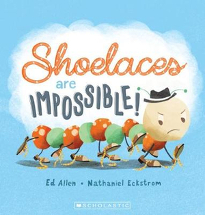
procedure of how to tie his shoelaces. The routine is told simply
and shown in Eckstrom's funny illustrations, enabling a child to
follow the instructions with a smile on their face. The looks on
Caterpillar's face as he tries each of the instructions will
encourage a child to follow his attempts.
Caterpillar is at first disgruntled with his lack of success but
with Rabbit's encouragement keeps practising until he gets it right.
This is a neat little story, told simply to encourage children to
attempt to tie their own shoelaces. With funny illustrations any
child would be delighted to try to tie their own, prompted by
Caterpillar.
Fran Knight