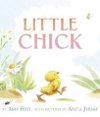
Ill. By Anita Jeram. Walker, 2009. ISBN 9781406316414
(Ages 3-6) Three short stories about Little Chick make up this
beautifully illustrated picture book. Little Chick longs to be able to
make her carrot grow and her kite to fly. She wants to touch her star
in the sky and put it in her pocket. But with the help of Old-Auntie,
she realises that while she cannot always immediately do what she
wants, there are things to be thankful for in the present. She is a
good and patient gardener, she can skip very nicely and she is a good
stretcher.
Amy Hest has created two lovely characters in a warm and loving
relationship. Little Chick is enthusiastic and wants to try out the
impossible. Old-Auntie is a wonderful adult, always able to think of
positive things and able to reassure Little Chick about her ability to
do things.
Anita Jeram's soft muted watercolours highlight this loving connection
and make the story come alive. A picture of Old-Auntie putting her wing
over Little Chick and protecting her in a blanket of love is very
memorable as is Little Chick dragging along a leaf for a kite.
The print is large and clear and each story can be read by itself or as
an interconnected whole. This would be a good read aloud for young
children and would especially show the importance that caregivers can
have in children's lives. It also examines the fact that sometimes
people fail at what they want to achieve, but they learn important
lessons on the way.
Pat Pledger
Sting by Raymond Huber
Walker Books, 2009. ISBN 9781921150890
(Ages 7-10) Ziggy is a little bee who just doesn't fit in. He is
called Oddbee by the other bees in the hive because he likes to explore
and do different things. He goes on a quest to find out why he doesn't
fit in with the other bees. He has many adventures on the way to
discovering who he really is and why being different can sometimes be a
real help in times of danger.
Sting is told in the first person, from Ziggy's perspective. Huber
takes the reader on a wonderful journey told through the eyes of the
little bee. It is full of danger for Ziggy, who has to answer many
questions about why bees are being trained to sniff out explosives and
where the black cloud of killer bees has come from. On the way many
fascinating snippets of information about bees are described and the
reader becomes very aware of the complex life they lead.
All of the characters seemed real and alive to me. Huber has managed to
give his little bees separate and engaging personalities. I
particularly liked the way the author used names for the bees starting
with Z - Ziggy, Zabel, Queen Zenova and so on. This alliteration and
the fast paced action would make the story fun to read aloud.
There are many themes in this book that could be explored through
discussion and lessons. It has a strong message of tolerance for
difference and an anti-war thread is evident throughout the plot.
There is a good glossary at the end with information about bees and the
fact that they are dying out throughout the world. Sting would fit into
a classroom activity about insects, conservation and understanding of
diversity. Classroom ideas can be found here.
Pat Pledger
The hunger games by Suzanne Collins
Scholastic, 2009. ISBN 9781407109084.
(Ages 13+) It is the near future. Panem, once known as North America,
is controlled by a dictator who manipulates reality TV to control the
population. It is divided into 12 Districts and is run from the
Capitol. Each year 2 teenagers from each district are chosen by
compulsory lottery to participate in the Hunger Games. All must fight
to the death, but the winner will never be hungry again. When her
little sister is chosen, Katniss Everdeen takes her place and together
with Peeta Mellark, the baker's son, they are taken to the Arena
knowing they will probably be killed.
Katniss is a survivor. She has been looking after her mother and sister
ever since her father died. With the help of Gale, an 18 year old young
man, she has left the confines of her village and ventures out into the
wilds to gather food for the family and to barter for other
necessities. Faced with the Hunger Games, she puts all her knowledge
about the wild into use. She thinks her way through the game, just
barely keeping ahead of the monster wasps, werewolves and the rest of
the teenage pack. She is a strong and gutsy heroine and the reader
cheers on her efforts to stay alive.
The story is full of non-stop action and violence and the suspense
keeps the reader glued to the page. Collins has created a dystopian
world that is well developed and realistic enough to pull the reader
in. Her vivid writing made the terror and anguish that the teens go
though in the Games come alive for me, almost as if I was actually
watching it on TV. Indeed, for people used to reality TV, The Hunger
Games show feels quite familiar.
All Collins' characters are well drawn and engaging and their
development is clear and deftly handled. The touch of romance between
Katniss and Peeta and Katniss's feelings for Gale make for an appealing
love triangle which teenage girls will enjoy. Readers will want to read
the sequel to see what happens.
This is one of the most exciting books I have read this year, a
compulsive survival book with a frightening dystopian society driving
the action.
Pat Pledger
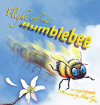
Flight of the bumblebee by Hazel Edwards
Ill. By Mini Goss. CD
narrated by Antonia Kidman. New Frontier, 2009.
(Ages 5-8) The first in the Music Box series, Flight of the
bumblebee
is a clever combination of a story and a piece of classical music.
Bumble is a little honeybee who has no sense of direction. He bumps
into branches and misses petals when he should be collecting pollen. It
is not until the kind Drone gets him to fly to Flight of the
bumblebee,
a piece of music about a king and a bee-prince, that he able to find
his way.
This is a captivating story by Hazel Edwards, with amusing
illustrations by Min Goss. The story will stand-alone if read by a
teacher, but the addition of the wonderful background music by the
composer Nikolai Rimsky-Korsakov in Antonia Kidman's narration makes it
something very special indeed. The music is such a fine piece and will
be a wonderful introduction to classical works for young children.
There is a section about the composer and the origins of the music at
the back of the book.
A useful addition to the library or for classroom use this story can be
read aloud by the teacher or the students can listen to the CD. In the
classroom it will be a boon for teachers wanting to give students a
taste of classical music or are looking for literature to use when
teaching a unit on insects. Teacher's
notes are also available.
Pat Pledger
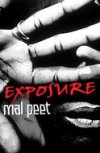
Exposure by Mal Peet
Walker Books, 2008.
(Ages 14+) Highly recommended. Set in South America and featuring Paul
Faustino, a football reporter, Exposure follows the books Keeper
and
Penalty. This can be read a stand-alone novel. The central story
is
loosely based on Othello: the characters get their names from
the play
and the book is divided into 5 acts. A star footballer, Othello, meets
a beautiful pop singer Desmerelda at a celebrity party. They fall in
love and quickly marry much to the delight of the media. But Othello
has a deadly enemy, his jealous agent Diego, who plots his downfall.
Alongside this plot are several linked stories examining celebrity,
racism, poverty and the politics of the country. The main subplot
revolves around three street kids. Bush is a hardworking orphan who
looks after his sister Bianca and friend Felicia and who earns a little
money by running messages for Faustino and other journalists in the
press building.
A complex, challenging book, I read this over several weeks, as I
allowed the parts of the interwoven stories to seep into my brain.
Knowing Othello, I expected that there would be tragedy at the end and
dreaded coming to that final stage. Ultimately the conclusion fitted
well into the 21st century and what constitutes misfortune in the eyes
of the media today.
The story of the street kids was the one that kept me engrossed. Here
too I knew that there would be tragedy. Peet's description of the
poverty that the children lived in was heart rending and anyone who
reads this book will come away with a greater understanding of just
what it is like to be homeless.
Peet's main characters, Othello and Desmerelda, have a thinly disguised
resemblance to David and Victoria Beckham and I found it fascinating to
watch how the media portrayed the pair. The cost of celebrity was made
very clear. Faustino's beliefs gradually changed as he grew to know
Bush and his companions and the other characters are finely drawn.
A review can't do justice to such a formidable book. I believe it would
be an excellent choice for a class study. (Teacher's
notes are available). It would provide much engrossing discussion
about celebrities, poverty and class structures as well as being a
fascinating modern comparison to the original Othello.
Pat Pledger
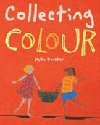
Collecting colour by Kylie Dunstan
Lothian, 2008. ISBN 9780734410221
(All ages) Highly recommended. Shortlisted by the Children's Book
Council, Collecting colour is a beautiful picture book that describes
the art of weaving with pandanus leaves. Rose goes on a trip with her
Aboriginal friend Olive into the bush. Olive's mother and her Aunty
show them how to collect pandanus and find the berries and roots that
will make the dyes to colour them. They have a wonderful day, gathering
leaves and colour, and having a picnic near the river. They throw in
their handlines and catch a barramundi that they bake in coals for tea.
When they get back home, they learn how to prepare the leaves and roots
and finally they get a chance to weave a mat by themselves. Collecting colour, a memorable story of how traditional baskets and
mats are made, is told from the viewpoint of a small white girl. The
text takes the reader through the whole process, clearly showing the
complexity of the materials and the expertise that is needed to produce
a work of art. What makes this picture book so outstanding is the use
of beautiful vibrant colour and bold figures. Dunstan colours her pages
with vivid reds and oranges and all the shades of green and the figures
of all the characters look so warm and happy.
Reading this book made me want to go out and purchase a lovely piece of
art made from pandanus leaves.
Pat Pledger
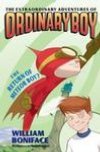
The extraordinary adventures of Ordinary Boy series by William Boniface
Title 1: The Hero Revealed. HarperTrophy,
New York, 2007. ISBN 780060774660 Title 2: The Return
of Meteor Boy. HarperTrophy,
New York, 2009. ISBN 780060774691 Ill. by Stephen Gilpin
(Ages 9-12) These are graphic novels in reverse - action packed
adventure stories of 'superheroes' in prose, sprinkled with
clever illustrations. However, these are heroes with a difference
- they have many and varied creative powers, eg Halogen Boy, whose
glowing ability depends on his sipping of apple juice; Plasma Girl, who
can transform into a jellylike substance; Stench, notable for clearing
the room with his gas, and Tadpole who can stick his tongue out twenty
feet. They form the Junior Leaguers from Superopolis, along with
Ordinary Boy, who has no powers, except lots of smarts.
In the first book, the Junior Leaguers hunt for a missing collector
card and become entangled with Professor Brain Drain, who can empty a
mind by touching a head with his finger, and his adversaries, the
League Of Ultimate Goodness, led by the super superhero Amazing
Indestructo. The evil Professor plans to drown Superopolis in collector
cards. There are a twists and turns and cliff-hangers aplenty as the
Junior Leaguers face one amazing scenario after another. There are
shades of the real manipulative world of marketing when Tycoon reveals
his plans and students learn the economics of supply and demand via
card collecting. They learn that superheroes can have feet of clay and
everyone has a contribution to make.
In the second book in the series, Ordinary Boy travels back 25 years to
save Superopolis from destruction by a meteor, and learns what happened
to the mysterious, vanished superhero, Meteor Boy. Even more wierd and
wonderful characters are encountered along the way and there are
surprises at every turn.
The readers who enjoyed the Captain Underpants series will enjoy this
creative, humourous and entertaining series - there are three so far.
If read by, or to, parents the adults and children alike will enjoy the
creative powers, as I did, and all will enjoy trying to solve the
mysteries. A very 21st century band of Enid Blyton sleuths!
If children need
to read plenty in order to gain fluency and sophistication to graduate
to more demanding books, then this is the stuff to give them at this
age. The vocabulary will extend but not frustrate them. A must
for all primary school libraries!
Kevyna Gardner
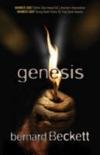
Genesis by Bernard Beckett
(Age 13+) A remarkable science fiction story of life in the future, Genesis will have more thoughtful readers talking and thinking about the implications of the story long after it has been read. Anax, a young woman with potential, has been groomed by a tutor, Pericles to sit the exams for The Academy. She has long studied the life of Adam Forde, a revolutionary long dead, and has prepared herself for the examination by learning many of his tracts, and developing holograms which show aspects of his life, particularly his debates with an android, Art. The exam is a six hour discussion where Anax is expected to tell the three examiners all she knows, what she thinks and field unexpected questions. Throughout her presentation, it becomes clear that society has undergone a radical change, and that the present population lives on an island, surrounded by a sea wall, built to keep out other people, and a defense system which allows no breaches of the rules. While she speaks about this regime, the reader will call into question some of the recent changes within our society, the increasing xenophobia of many nations, the military buildup of some and the increasing suspicion of governments. I found the story brim full of ideas which could be pursued within a classroom, not least of which calls into question what it means to be human. Fran Knight
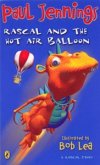
Rascal and the hot air balloon by Paul Jennings and Bob Lea
Puffin,
2009. ISBN 9780143502425.
(Age 5-7) Any book by Paul Jennings is sure to delight his young
readers and Rascal and the hot air balloon is no exception.
Rascal is a
little dragon who loves to chase things especially things that fly like
aeroplanes, helicopters and hot air balloons. Ben thinks it's too
dangerous for Rascal to be chasing planes so Dad tells him to tie him
up. When a hot air balloon gets into trouble Rascal knows that he has
go to its rescue.
Ben Lea's big, bold illustrations are a combination of fantastic
dragons and real life cars and planes and amusing details engage the
reader. There are such amusing expressions on the faces of Rascals and
his companions. The pictures match the text and will give clues to the
beginning reader, who will want to go on and pursue other Rascal books.
With its easy, large text and entertaining illustrations this book is a
pleasure to read. The humourous twist at the end is an added bonus.
Pat Pledger
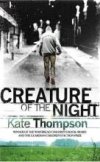
Creature of the night by Kate Thompson
Bodley Head, 2008.
(Age 13+) Highly recommended. In this Bistro Award Honour book, Kate
Thompson takes the reader on a journey through a desolate picture of
reality for 14 year old Bobby in 21st century Ireland while adding a
mystical touch of danger from the Little People. Bobby's mother takes
him away from Dublin, where he has gotten into a gang of boys who
delight in drinking, taking drugs, stealing cars and racing them in the
suburbs. She hopes for a new start for him as well as for herself and
her endless debts.
Bobby hates the country. He loathes the run down cottage that the
family is living in and he doesn't want to reform at all. Offered some
work from the Dooley family next door, he discovers that he can cope
with that and learns that he has a flair for fixing mechanical. However
the lure of the city life still entices him and he keeps trying to get
back.
Meanwhile Dennis, his little brother, is convinced that he has made a
new friend of a tiny woman who comes through the dog flap at night and
talks to him. Bobby himself thinks that he has seen her turn into a
badger and disappear down a hole. There is also the mystery of what
happened to Lars, the former tenant of the cottage. His belongings are
stuffed into a cupboard under the stairs and his Skoda is parked
outside.Was there also a murder of a child in the cottage years ago?
Written in the first person, Bobby's voice is utterly convincing.
Thompson pulls the reader into his life, describing how he loves the
gang in Dublin and hates the way his young ineffectual mother is
treating him. She juggles this reality with the parallel stories of
Celtic superstition and Lars' disappearance in a very believable way.
The character development is quite striking as Bobby gradually learns
things about himself and family that he hadn't understood before. A
very touching moment is his realisation that his mother had him when
she was 14. The Dooley family provides a warm contrast to his feckless
family and the boys in Dublin.
Beautifully crafted and spilling over with emotion, this is a wonderful
read that dragged me in from the first chapter.
Pat Pledger
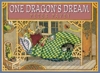
One dragon's dream by Peter Pavey
Walker Books, 2009 (c1978) ISBN 9781921150746
(All ages) Highly recommended. It is wonderful that this fabulous
Picture Book of the Year has been reprinted. It is such a treat: a
counting book with intricate pictures that just beg to be examined
again and again. It revolves around the dreams of a dragon who sleeps
in a beautifully carved bed and has a tabby cat in attendance. His
bedroom is full of wonderful objects: a suit of armour holding a broom
for a lance, a bird's cage with a clock in it and a rocking horse with
a mouse sitting on it; plus many other amazing details. As the counting
progresses, the reader must find the correct number of objects that the
story refers to. For example it is a lot of fun to find the 4th elusive
frog in the picture for 4, or the six stern storks for 6. The counting
story and the pictures that illustrate it are complex and really
stimulate the imagination.
This would be wonderful present for grandchildren, a fascinating book
for primary schools and an outstanding example of a picture book for
secondary schools.
Pat Pledger
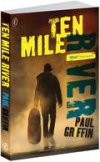
Ten mile river by Paul Griffin
Text, 2009
(Age 14+) Recommended. 14 year old Ray and Jose are best friends. Jose
is good looking with a talent for wise cracking; Ray is large, strong
and very intelligent. Finding the juvenile detention centre not to
their taste, they go on the run from the authorities. They decide to
hole up in an abandoned shack near Ten Mile River. They furnish it with
a stolen TV, Cable TV and other stolen goods and keep body and soul
together by stealing cars. When they meet Trini, they both fall in love
with her and she tries to get them to join the mainstream society.
The powerful narration pulled me into this gritty urban tale as soon as
I started it. I became totally involved in the story of the boys' lives
and was horrified with how they lived. Clever dialogue brought alive
the boys' beliefs and Jose's mispronunciations often had me laughing at
the same time that I wanted to cry because of his lack of schooling.
I emphasised with Ray's dilemma about staying on the run. He is smarter
than Jose and can see the hopelessness of their plight, but cannot seem
to break away from his bonds of loyalty to the other boy. Often going
along with Jose and making idiotic decisions, it seems as if he will
never be able to use his formidable intelligence and will always give
way to the other boy.
Griffin gives the reader an alternative view to the many books that are
written about teens with angst, but who usually have comfortable home
lives, with at least one parent caring for them. It is a searing novel
about street kids staying alive in New York.
I can imagine that this book would have strong appeal to reluctant boy
readers or those who are disenchanted with school. It could possibly be
a useful novel to use in class. Because of the strong language, though,
it would need to be read thoroughly by the teacher before
using it as a class set.
Pat Pledger
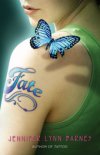
Fate by Jennifer Lynn Barnes
Random House, 2009. ISBN 9761741663044
(Age 13+) In this sequel to Tattoo, Bailey Morgan looks and acts
like a normal teenager during the day, but at night she is the third Fate, weaving
what happens to life. Every evening she travels to Nexus where she works
with two Sidhe ancestors on making the fabric of life. Then she meets
the rest of the Sidhe and her whole life changes as she becomes
entangled in a complex and dangerous web that the Otherworld is
spinning. Meanwhile in her normal life, she is facing her graduation
and wondering how she will cope without her friends and where she will
be travelling in the future.
The book is written in the first person and I loved Bailey's voice as
she recounts what is happening to her and what she is feeling. She is a
strong girl who is faced with many choices, and Barnes vividly brings
to life her dilemmas and her fear that she will lose her human friends.
The beautiful Sidhe and Greek gods and goddesses that make up the
Otherworld are fascinating in their quest for power. The subtle hints
of humour throughout the book add an extra dimension and there are
enough crushes on interesting boys to keep romance alive.
This book can be read as a stand alone as I did but I'm sure that
having read the first book would give more insight into Bailey's world.
It is well written and entertaining and is sure to gain a following by
girls who like books with strong heroines with mystical powers.
Pat Pledger
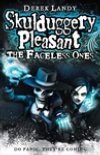
Skulduggery Pleasant: The faceless ones by Derek Landy
HarperCollins, 2009.
(Ages 10+) The Faceless Ones, the third title in the series of
Skulduggery
Pleasant books, is best read sequentially as the story line and myriad
of characters could otherwise prove confusing. In book one, until she
meets an extremely well dressed skeleton named Skulduggery, Stephanie
(aka Valkyrie) is a relatively ordinary teenager. Life soon changes
from the mundane, once she and Skulduggery pair up to fight the many
magical and evil forces revealed throughout the course of the books.
Landy has created an assortment of fascinating characters from the
strong, manipulative females such as China Sorrows and the Sea Hag to
Fletcher Renn, the last Teleporter in existence. He also adds a liberal
sprinkling of evil characters such as the Faceless Ones. By the third
book, Valkyrie is able to lead a double life thanks to her 'Reflection'
emerging from the mirror to carry out her daily human existence and she
has become a confident, independent young woman, capable of making her
own decisions and better able to protect herself.
This series has become immensely popular, particularly amongst
competent male readers eager to read novels containing humour, fantasy,
violence and gore. With the opening line, 'The dead man was in the
living room, face down on the floor beside the coffee table,' Landy
creates the hook for the reader to go on and devour the novel. With the
amount of trailers and internet advertising for the film, the audience
for these books will only increase, especially with Landy having
already
set the scene for a thrilling sequel.
Jo Schenkel
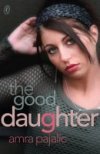
The good daughter by Amra Pajalic
Text, 2009 ISBN 9781921520334
(Age 14-16) Sabiha has become conscious of having Bosnian background
since her
grandfather's arrival in Australia. Before that, she and her mother
were somewhat alienated from the community, due to her mother's single
status and unconventional lifestyle.
Sammie, as she prefers to be called, rebels against the newly imposed
constraints of her community while her mother strives for acceptance
and a husband. Sammie has her own problems as she tries to maintain her
friendship with her best friend from a previous school, as well as
gaining acceptance in her new one.
Throughout the novel, Sammy grows in sensitivity in her insight into
herself and others; we too gain insight into her mother's struggles
with personal relationships, exacerbated by her bi-polar condition, as
well as the struggle to be accepted by a community of Bosnian refugees,
themselves in search of a new identity.
While the explicit explanations of Bosnian customs and history tend to
pall in the initial chapters, the story engages your attention when it
deals with relationship and friendship issues. The clash of cultures is
central to these relationships but at times we feel as if we are being
given a lecture instead of discovering these insights implicitly.
Especially interesting, however, is the way we see these migrants
adopting more traditional religious and cultural beliefs than they held
when in Bosnia.
One concern with the novel is the treatment of homosexuality. It is a
little disappointing that Brian, who is initially sniggered at and
called 'gay' because he is well groomed and well dressed, is, in fact,
homosexual, reinforcing stereotypes.
Overall, however, it is an engaging read that young people of 14-16
should enjoy.
Gwenda Steiner