Pfeffer, Susan. Marion Lloyd Books, 2008. ISBN 9781407106229.
(Age 13+) A companion novel to Life as we knew it, this novel
can be
read as a stand-alone. A meteor has struck the moon, changing the
earth's
climate drastically and bringing disastrous tsunamis and flooding.This
is the compelling story of what it is
like to
survive in New York where the tube stations have been flooded, shops
looted and
the
Yankee Stadium filled with the bodies of the dead. Alex Morales and his
two
young sisters, Briana and Julie, find themselves alone in the city.
Their
father had been in Puerto Rico for a funeral when the disaster struck
and their
mother called away to help in a hospital. Nothing has been heard of
either of
them since the first early reports of the tragedy. Alex, who
has
come from a strict Catholic family, is left to look after his two
sisters
without the support of any adults.
While the protagonists face many of the same
disasters,
intermittent electricity, food shortages, grey dust and a flu epidemic,
the
urban setting brings a different set of problems to be faced. The
Church gives some spiritual and
physical
support like lunch at the schools, but it is Alex who takes on the
difficult
role of head of the household and keeps his family together.
This is a survival story, but highlights the
plight of the
poor. Although Alex is very bright and a leader at school, it is the
boys who
have rich and influential families who are able to leave the devastated
city.
Alex and Julie queue up for food in dangerous lines, the girls can't
walk
around unprotected and it is difficult to see how they can survive.
Alex faces
the moral dilemma of stealing from the dead to keep the family alive.
The
reader sees the young siblings grow from self-centred adolescents to
brave and
caring young adults. Perhaps one of the most challenging aspects of the
story
is the author's exploration of faith in testing times.
This is a compelling read. While it didn't grab me
as
powerfully as Life as we knew it,
probably because I was prepared for the effects of the disaster, the
themes that are explored,
including religion, morality, class structure and family, are certainly
thought
provoking.
Pat Pledger ,
Grandpa baby by Margaret Wild.
Ill. by Deborah
Niland.
Penguin/Viking, 2009. ISBN 9780670071746.
(Age 2-7) Recommended. Grandpa looks after Georgie
while Mum
and dad are working. They make sand
castles,
read stories and plant flowers. One morning Georgie decides that she is
going
to be big and that Grandpa can be the baby. Off to the park they go,
with
Georgie holding onto Grandpa Baby's hand and giving him instructions on
how to
play.
This is a classic 'switch' story where the child gets to imagine what
it is
like to be in an adult's shoes. Georgie makes a great adult, looking
after
Grandpa Baby when he hurts himself and refusing to allow him to swing
too high.
She works out strategies to get him home
when he is tired and puts him to bed for a rest. She also has a
wonderful
imagination and decides on a fabulous dress-up game for the following
day.
Delightfully illustrated by Deborah Niland, the little chimps come
alive in
gorgeous colour. Their facial expressions are really expressive of
their moods.
Observant readers will notice what happens to the dummy, and will be
engrossed
in the little domestic details that illustrate the story.
I loved this book. It left me with a smile on my face and would make a
lovely
read aloud with pictures for young children to gloat over.
Pat Pledger
Burn this book edited by Toni Morrison
Harpercollins, 2009.
ISBN 9780061774003.
(Age 15+) Burn this book is a
collection of essays edited by Toni Morrison on the power of writers
and
writing. The collection has been sponsored by the PEN association, an
organization that since 1921 has worked for the rights of all to
communicate
freely. The essays are by well known authors including John Updike,
Toni
Morrison herself, Nadine Gordimer, Orphan Pamuk, Paul Auster and
others, and
deal with the reasons for writing as well as the transformative power
of the
written word. The writers' attitudes are at times influenced by their
culture;
those from the 'free' world, John Updike, for example, tend to be more
skeptical about the influence of writers than those living under
repressive
regimes. All generally agree that good writing is not overtly
political; it
cannot preach or proselytize, support or undermine a government.
Rather, it is
a testament to the strength and dignity of the individual, the power of
the
imagination and the importance of freedom of expression. A strength of
this
collection is the variety of responses to the topic; Updike's essay
explores
his own methodology, David Grossman from Israel writes of the power of
his
writing to heal personal grief, Francine Prose, an American academic
and
critic, writes an entertaining piece about connections and 'unknowing',
and Ed
Park uses the banning of I am the Cheese by Robert Cormier as
the
springboard
for a creative riff on censorship. The collection would be suitable for
senior
students.
Jenny Hamilton
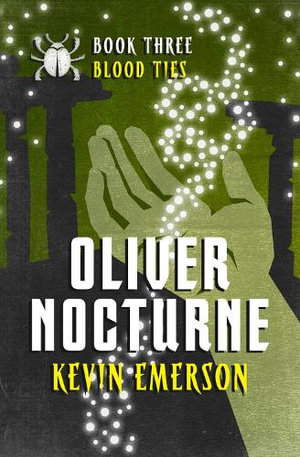
Oliver Nocturne: Blood Ties by Kevin Emerson
Sitting in the principal's office with his parents on the last day of school, Oliver is not pleased to hear his teacher give him a load of extra maths work to do over the summer holidays before he goes to high school in the fall. They are all off to Morosia, the underworld vampire city where some of his relatives live, and he cannot get there soon enough. Meanwhile he visits his friends, Dean and Emalie, and they are on a quest to find Selene, who may be able to help them find out about Emalie's mother, who has disappeared. A trawl through all the spirits and wraiths surrounding vampire lore, Oliver Nocturne is a series about Oliver and his life as a vampire, and what is expected of him in the future. Bringing in all the stories at once is a bit overwhelming, and the number of characters sometimes confusing, and some of the stories within the novel are quite scary. I was often reminded of The Munsters (the 70's TV show) as the story shows the vampires at home, going about their daily routines, and there will be an audience for this series with the predominance of vampires stories being published of late, but I think there are better books around to spend the limited library budget on. Fran Knight
Short Stuff by Mark Stevens
Louis
Braille Audio, 2009.ISBN 978174212.
4CD's, lasting 4 hours
Working
Title Press, 2008
Mark
Stevens' short stories are brought hilariously to life by the clear,
funny
voice of Don Bridges. I loved the coach in the first story, with
reminiscences
of Michael Caine coming through. The reader gives each story a
different ring
through making it memorable and inviting the listeners to stay for the
whole
CD.
In
the first story, Henson longs to be a professional soccer player, and
his time
with the local soccer team is just his training time on the way to
fulfilling
his dream. Often his coach has to interrupt his dreams about his
prowess. But
on the Saturday that his team is about to win the local cup, his team
taking on
the Carver Hill mob, he wakes to a cloud hanging over his house. A few
metres
above his head, the cloud has a message and he feels impelled to ring
the phone
number emblazoned thereon. The Indian accent on the end of the phone
line tells
him to meet him outside his front door, and when he opens it he finds
Finnias.
From then on the laughs come thick and fast, as Fininas calls another
person to
log the incident with Geraldine the cloud.
Don
Bridges' wonderful voice takes on the young Henson, the amiable
Finnias, Amos
the coach, various friends and family, beautifully. He modulates his
voice to
enable all listeners to hear the difference between the different
people and
the passages linking the conversations. His voice contains an undertone
of
humour which suits the style of the text, and his clear voice allows
the
listener to hear every word. As a filler in a classroom, as a start to
the day,
a lunchtime activity, or to borrow and take home to listen, for parents
taking
the kids on a trip, whatever the need, audio books like this are
invaluable.
Fran
Knight
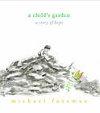
A child's garden by Michael Foreman
Walker Books,
2009.
ISBN 9781406312072.
(All ages) Highly recommended. Michael
Foreman has written another stunning book with a message of peace that
tugs at
the heart strings. A little boy lives in a barren, war torn area behind
a tall
barbed wire fence. One day he finds a tiny green shoot and waters and
nurtures
it until it grows to cover the fence. Birds and butterflies find it and
the
area becomes a place of beauty and a playground for children. Then one
day the
soldiers come along and destroy it. The boy is heartbroken, but hope
arrives
when a little girl on the other side of the fence finds some shoots and
waters
them.
Foreman's illustrations bring to life the bleakness of war. With black
and
white pencil drawings he shows the desolate landscape with its ruins,
buildings
piled high with rubble and ragged shelters. As the boy's little shoot
grows, he
adds colour to show the beauty of plants and the birds and butterflies
that
collect there and the happiness of the children who have a lovely
garden to
play in. When the shoots grow on both sides of the fence and the
landscape is
transformed, the illustrations are all in colour to show the sharing of
peace.
Foreman's message is overt. He gives the reader hope that the seeds of
peace
can be planted deep and will one day flourish in a place where there is
no
fence and people can live peacefully together. This would be a
wonderful book
to use with all age groups to look at the effects of war and oppression
and how
resilient the human spirit can be.
Pat Pledger
Siggy and Amber by Doug MacLeod
Puffin, 2009. ISBN 9780143304388.
(Age 13+) Recommended. Siggy wants to meet
a girl who he hopes will
be 'smart and amazing.And funny and
probably not blonde.' At a dance at the Samsara Youth Club, he meets
Amber, who
may be the girl of his dreams. However he vomits on her
shoes and
he decides that the only way he might get to know her after that fiasco
is to
take her ghost hunting. He has seen something strange at Tallis Point
and wants
to investigate.
The book is peopled with a wide array of unusual characters all of whom
add to
the fun of the story. There is Siggy's friend Fergus who leads a double
life as
Highland Dancing Man, a sister who makes sculptures out of bits of
shrapnel, a
shop owner who sells vampire costumes and finally Amber who lives with
her two
mums and who has goldfish. Add to that witty dialogue that is
side-splitting
and you have a book that is sure to appeal to everyone who picks it up.
If you are after a humorous book for your library then this would make
a
delightful addition. It would also be a great read aloud and would be
sure to
engage reluctant readers.
Pat Pledger
Child 44 by Tom Rob Smith
Pocket Books, 2009. ISBN 9781847391599.
(Age 15+) Recommended. One of the best mystery thrillers that I have
read in a
long time, Child 44 took me on a roller coaster ride to
Stalinist
Russia, where
children are being killed and mutilated by a serial killer. The Soviet
system
refuses to acknowledge that there is such a crime in its perfect
society, and
the deaths are blamed on deviants, homosexuals or intellectually
disabled people.
One detective, Leo Demidov, called to cover up the death of one of his
men's
children, gradually begins to realise that there is more than one child
brutally killed and decides to atone for all the innocent victims that
he
himself has arrested. This leads to demotion and exile
from
his home.
What makes this story so engrossing is the combination of a good murder
mystery
with an in depth look at what it was like to live in Stalinist Russia.
The
emotions of the main characters play a leading role and Leo's feelings
about
his work in the secret police and his marriage are explored in detail.
Fear
pervades the society and Smith tackles the impact that fear has. Child
44 was on
the Man
Booker Prize long list, deservedly so - this is a well written, well
researched
and riveting thriller not to be missed.
Pat Pledger
Don't breathe a word by Marianne Musgrove
Random
House, 2009.
(Age 8-12) Recommended. Mackenzie and Tahlia have been bought up by
their
grandfather
- Pirate (because of his sunken chest!) however one day they arrive
home from
school to find that grandpa had had a fall and couldn't remember
entirely how
he came to be where they found him. Realising the seriousness of what
has
occurred but also fearing for a change in their circumstances if they
allow
people to find out about grandpa they agree to keep grandpa's fall a
secret
between themselves. This would be fine if Tahlia didn't continually
have to go
off to dancing class and Mackenzie wasn't left alone to cope with
grandpa's
strange behaviour. Eventually grandpa puts himself in extreme danger
and the
girls have no choice but to allow grandpa the help he needs.
This
is an excellent novel dealing with dementia and the effect it has on
those
involved. It sensitively portrays the deterioration of the sufferer and
the
increasing concerns of those around them.
This
is the third novel written by South Australian author Marianne
Musgrove, with
The Worry Tree and Lucy the Good
preceding this title.
Tracy
Glover
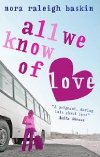
All we know of love by Nora Raleigh Baskin
Walker
Books, 2009. ISBN 9781406315516.
(Ages 14+) Recommended. By observing the quotes at the
beginning of each
chapter,
the reader hears Natalie's story whilst enjoying the plethora of ideas
that
famous people have about the different types of love and the emotional
responses individuals have to 'love'.
Natalie's Mother has been gone for four years, four months and
fifteen
days and Natalie blames herself. Her Mother was in mid sentence and
Natalie
wanted chocolate cookies not the oatmeal cookies and wasn't really
listening.
Natalie is on her way from
Stamford to Florida by bus to ask her Mother about her unfinished
sentence
involving love. She encounters a variety
of people who influence her and share their views on 'love'. Natalie
learns to hear other people's views
on life and love and through the stories they tell. She is learning to
believe in herself and as
she says on page 192: 'I have to forgive myself for something I had
nothing to
do with. And second, I have to pay
attention to the here and now.'
Natalie
is beginning to accept what she can't change and enjoy the people
who
love her. She's growing up.
Sue Nosworthy
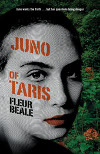
Juno of Taris by Fleur Beale
Random House, 2009. ISBN 9781741662979.
Recommended. Growing up in a
community where strict rules restrict the behaviour, clothing and ideas
of the
population causes some angst amongst the teenagers. Shaving their hair
every
month incites several to rebel against this draconian law, in place to
make
sure everyone is equal. But the reason for enforced equality is at the
heart of
this wonderful dystopian novel, where a population is sheltered under a
dome
over an island in the South Pacific. For their own survival, global
warming
having decimated the rest of the world, this group of people has
developed a
strict code by which they live.
With every aspect
of life regulated on the basis that it is necessary for survival, the
younger
members seek answers to their questions, resulting in an undermining of
the
order which rules their lives. The ideas of public good, social
experimentation, future of society, environmental damage and the
people's right to know are all explored in this powerful tome.
Beale's character are presented sympathetically, even the ones in power
are
understandable, as they strive to retain the cohesion of the group.
Chapters
are short and the plot moves quickly. The wonderful addition of inserts
shows
the reader what the general community is feeling adding to the tension
building
up between Juno and her friends and those in charge. The need to know
what is
Outside causes change and grief.
This is a
blindingly good read, bringing in all aspects of dystopian fiction,
adding to
the range of fiction now available for our students to read. It would
make a
stunning class text with a class willing to let themselves go into this
world
created so ably by Beale, and see the possible futures for Juno and her
community as well as themselves.
Fran Knight
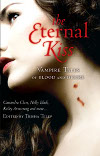
The eternal kiss. Vampire tales of blood and desire. Ed. by Trisha Telep
Random House, 2009. ISBN 9781864719413.
(Age 14+) Thirteen vampire
stories by some of the leading authors in this genre are sure to be a
crowd
pleaser with those who enjoy their stories with blood and fangs.
Certainly not of the girl falls
in love with a vampire variety, this
collection of short stories contains some very well written and quite
compulsive stories by authors like Cassandra Clare, Kelley Armstrong,
Holly
Black, Cecil Castellucci and Rachel Caine. One tale that stood out for
me was
Cassandra Clare's Other boys, which has a terrifying twist when
Jennifer
decides that she will go out the boy who says he is a vampire. Wet
teeth, the
short story by Cecil Castellucci, leaves a very nasty aftertaste as
does All
Hallows by Rachel Caine.
For readers who are looking for
more authors in the vampire genre, these short stories will introduce
them to
many more authors that they may like to try. An author biography
section at the
back of the book contains a brief introduction to each of the authors
and a
description of some of their books. I was already a fan of Holly Black
and
Cassandra Clare but I have decided to try other books by Melissa de la
Cruz whose
story Shelter Island about Dylan Ward inspired me to get one of
her
Blue Blood
series. The thirteenth step by Libba Bray will thrill readers
and
totally
surprise them with an unexpected ending.
Her book, A great and terrible beauty, has been on my list to
find for
some time and I will certainly read it now after such a compelling
short story.
Pat Pledger
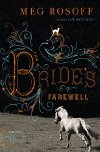
The bride's farewell by Meg Rosoff
Penguin, 2009.
ISBN
9780141383941.
(Ages 13+) Highly recommended. A book that is exceptionally difficult
to put
down, The bride's farewell is an engrossing story about Pell
Ridley,
who
escapes from her poverty stricken home on the day of her wedding.
Determined
not to be like her mother, downtrodden and bearing children
continuously, she
takes her horse Jack and sets off to find a better life, believing that
her
sister Louisa will marry Birdie in her place and all will be well at
home. Her
little step brother Bean follows her, and together they travel to the
horse
fair at Salisbury to see if work can be found. Encounters with a
mysterious
gypsy woman and her brood of children, John Kirby a kindly groom and
Dogman a
poacher bring adventure and danger.
The English countryside and its people, perhaps on
the cusp
of the Industrial Revolution, although that is never stated, are
vividly brought
to life as Pell goes on her quest for a better life. The suspicion from
the
villagers that Pell meets wherever she travels, the
poaching that keeps body and soul together
and the terrible fate of those in the workhouse, all paint a heart
wrenching
picture of the desperate poverty of the times. Rosoff has done her
research
well, and the grinding misery of the workhouse at Andover is described
in such an
understated way that it made me go and research what it really was
like.
Pell is a determined heroine, stubborn about what
she wants
and loyal to her family. When Bean disappears with her horse Jack, she
doggedly
set out to find him. She is distraught about the consequences of her
departure
from her family. On discovering that her younger sisters have been sent
to the
workhouse, she rescues them as well.
Pell is good with animals and the way that Rosoff
describes
the horses and dogs in this book, will have animal lovers continuing
for more.
An unconventional romance blossoms in a very low key way, but the
reader is
always aware that it is Pell's strength of character, her beliefs in
her own
ability and her courage and loyalty that are the key elements of this
wonderful
story.
Pat Pledger
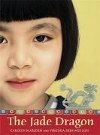
The Jade Dragon by Carolyn Marsden
Candlewick
Press, 2009. ISBN 978076364063.
(Ages 8+ )When Ginny sees another girl in her school
who looks just like her, she is amazed to find the new girl sees
herself as
American. She knows no Chinese language, does not eat Chinese food, and
scoffs
at some of the things Ginny and her family hold dear. But Ginny wants
her to be
her special friend and does all she can to attract her attention. When
Stephanie asks if she can take home Ginny's jade dragon, then Ginny
relents,
knowing that this little animal is her special animal, made only for
her.
This gentle story of friendship and wanting a
friend, will endear all readers, as they sympathise with Ginny doing
all she
can to have a friend. But to do this Ginny must deny her Chinese
heritage, and
fall in line with the selfish Stephanie. Both girls learn something
about
themselves throughout this book as they come to some understanding of
their
heritage and the pulls of living in another country. The parents play
an interesting background
role, as the American parents of the adopted Stephanie bring her up in
an
American household, yet encourage her to build relationship with Ginny
and her
family, and her Chinese heritage, while Ginny is brought up in a
Chinese
household and encouraged to hold dear Chinese customs and her
background, but
equally do well in the new culture. It's the dichotomy of many second
generation
children of migrant families, that tearing from one's background, and
it's
brought truthfully to life in this little novel.
Fran
Knight
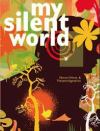
My silent world by Nette Hilton and Vincent Agostino
Lothian Books, 2009. ISBN
9780734410375.
(All ages) Recommended. A deaf girl has a
rich inner life. She knows
music and feels it 'in the rush and thud' on her chest. She
can see the birds in the park and feel the 'thrust of the waves'. She
knows about everything, but she is afraid of the
unseen monster that fits in her ear - a cochlear implant,
but she is brave and knows that she will learn
sound too.
What a demanding but outstanding story this is. I needed to read it
aloud first
before I quietly concentrated on the beautiful text, initially
disregarding the
illustrations as I worked out what the story was telling me. Reading
the free
verse carefully I discovered the rhythm of
the words and ideas. I found Agostino's very
busy, bright illustrations, dominated by the figure of the little girl,
and the
different colours of the text, to be a distraction on the first read,
but very
compelling as an extension of the story on further examination.
This story will give readers an understanding of the richness of the
world that
deaf children can inhabit and could lead to some interesting
discussions about
how it could be better or different not to be able to hear. It gives a
wonderful sense of all the feelings and experiences that being deaf can
bring
and how it must be difficult to get used to all the noise that
surrounds us
today. It deserves a place in every library.
Pat Pledger