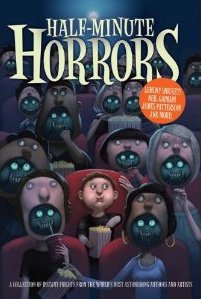
HarperCollins, 2009. (Ages 10+) Recommended. Subtitled Very small stories, very big
scares, this is a collection of terrifying short stories that can
be
read silently or out loud in half a minute. It is a quality collection
of dozens of chilling stories written by outstanding international
authors like Neil Gaiman, Lemony Snicket, Jerry Spinelli, Kenneth Opel,
James Patterson, Jenny Nimmo, Margaret Atwood, Melissa Marr and Libba
Bray.
Ideal for teachers to use on school camps or as a fun end of the day
activity, this collection could also be used as a starter for
encouraging creative writing of a horror story. The stories will also
have immediate appeal to reluctant readers as most take up only a page
or two. There are also illustrated stories that are equally haunting
and quite challenging.
Pat Pledger
Charlie Bone and the Red Knight by Jenny Nimmo
Random
House, 2009. ISBN 9781741664386.
(Ages
8 and up) Recommended. In this eighth and final book of the Charlie
Bone
series, we find Charlie still missing his parents, the Pets' Cafe
closed, and
Billy trapped in Badlock. To make matters worse, it seems that the
Bloors are
becoming more of a threat, as they recruit stronger and more dangerous
allies
in their race to find the box which holds the secret to the Bloors'
power. Charlie's parents
are in danger, and he no longer knows who he can trust. Then a
mysterious Red
Knight appears, and Charlie must discover if he is really there to help
him.
With a huge cast of characters, readers may find themselves needing to
refer
back to the family tree at the start of the book, but all the
characters are
intriguing and have their own role to play. A very satisfying end to
the series.
Donella
Reed
Scream Street: Skull of the Skeleton by Tommy Donbavand
Walker
Books, 2009. ISBN 9781406314281.
(Ages
8 and up) Recommended. The fifth book in the Scream Street
series finds
werewolf Luke Watson searching for another of the relics which will
help his
family escape back to their old lives. It's Halloween, and the arrival
of a new
celebrity resident is causing a stir. Eddie aka the Headless Horseman,
makes a
grand entrance, causing mummies and skeletons alike to swoon. That is,
until
his head disappears. Meanwhile Luke, Cleo and Resus must fight a demon
created
by Sir Otto before his parents, and indeed the whole of Scream Street
are
destroyed.
This book, while part of a series, is also successful as a
stand-alone read, as the characters are reintroduced and motives
explained
clearly. With witty writing, an abundance of bad taste, and a
fast-moving plot,
this is sure to entertain.
Donella
Reed
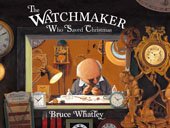
The Watchmaker who saved Christmas by Bruce Whatley
Random House, 2006 (reprinted 2009)ISBN: 9781864719567.
Ages 5 and up. Highly recommended. Three days
before Christmas, the Watchmaker, an old style craftsman, is visited by
a
bearded
gentleman with silvery-white hair and beard. On the back of the watch
he leaves
to be repaired are the initials S.C. Instead of the usual internal
workings,
the Watchmaker finds a myriad of unusual and delicate parts which he
sets about
straightening and cleaning. When he is unable to find a suitable piece
to
replace a broken wheel, his young friend Peter supplies him with a part
from
his hearing aid. This enables the Watchmaker to complete his repair in
readiness for the elderly gentleman's return. The Old Man's arrival and
the retrieval
of his special time piece lead to the journey of a lifetime for the
craftsman.
Whatley has the
happy knack of combining his simply written texts with detailed,
realistic and appealing
illustrations. His depiction of the shop and the old clocks brings back
memories of a bygone era. This story of friendship, persistence,
kindness and
generosity is told without appearing to be sickly sweet.
Peter, despite his hearing impairment, is happy
and positive, willing to help the cause by giving and sharing and
expecting
nothing in return. A delightful story, this could be enjoyed by
children and
adults alike.
Jo
Schenkel, Pilgrim School
Poles apart: Life at the ends of the Earth by Dr Mark Norman
black
dog books, 2010. ISBN 9781742031354.
(Ages: Primary) Highly recommended. What a wonderful, idea! And
beautifully executed. One of my pet
ggrrrs
is that people mix up the animals, habitat and bird life of each of our
polar regions, and here is a book which sets out plainly and seemingly
simply, exactly what lives where.With succinct and precise
words, Dr
Mark Norman elucidates what each polar region is like. The North Pole
is ice on sea, with the sea floor four kilometres below, whereas the
Antarctica is land with three kilometres of solid ice above it. On the
next page we are told what sort of flora exists in each region, then to
the animals, the pages that will interest most kids.
Each double page spread has the North Pole information and pictures at
the top, with the South Pole information and pictures at the bottom.
Between each is small globe reiterating where the Polar Regions lie in
relation to each other. No one reading this book will have any excuse
to mix up the two! A clever device which works well is the simple
turning of the book around to fit all this information together.
I was amazed at the differences between the two regions, the tundra of
the north and the moss of the south, the flowers and insects in the
north and the 'walks' in the south! Each double page spread held me
captivated, learning new information and recalling things learnt years
ago but long forgotten. The last double page tells the reader of the
affects of global warming, and exhorts them to play their part in
helping reduce the impact by planting trees, recycling and so on. A
number of web sites is given for more information, and the book is
wells served with a succinct glossary and useful index.
This like Dr Mark Norman's other books (The octopuses' garden: The
Secret World under the Sea; The Penguin Book: Birds in suits;
The
Antarctica Book: Living in the freezer; The Shark Book: Fish
with
attitude and The Great Barrier Reef Book: Solar Powered)
will attract
attention from those who give out awards, and more importantly from its
target audience, the kids. Dr Norman is senior curator at Museum
Victoria.
Fran Knight
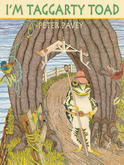
I'm Taggarty Toad by Peter Pavey
Walker Books, 2010. ISBN 9781921529481.
Picture book, ages 3-6. One of my children's favourite stories, when
first published in 1980, this one will be revisited with mirth and
gusto by another generation of families and classes. The drawings have
lost none of their freshness, the intricate cross hatching testament to
the time it took Peter Pavey to do the illustrations, and probably why
he didn't stay in that profession! The clever and bold Taggarty has an
array of adventures, taking on fearful pirates, loathsome dragons and
even the sun in his quest to show that he is braver than most. Children
will delight in the intricate drawings, running their fingers over each
page in search of the variety of animals and objects almost hidden from
view. The last few pages invite the reader to add their own
swashbuckling adventure, and come home at last with the little worse
for wear toad. Themes of taking risks and being adventurous are at the
base of this picture book and so could be used with some success with
smaller children.
The last two pages of the book give an interesting essay from editor,
Myra Lee, outlining the reason this book was chosen to republish and
then an enlightening piece by Peter Pavey about writing and
illustrating this book. Both add an extra layer to the reading and
enjoyment of this book.
Fran Knight
The Phoenix Files: Contact by Chris Morphew
Book 2, Hardie, Grant Egmont, 2010. ISBN 9781921502408
(Age 11+) Those who have read the first in this series, Arrival, know
the trio
of teenager Luke Hunter and his friends Jordan and Peter are the only
that can stop the destruction of the human race. There are only 100
days until all civilization beyond the remote Australian town of
Phoenix is destroyed by something called Tabitha. Contact takes up the story where Arrival left off, with
88 days to
go at the beginning and 70 at the end. The trio's fearless
investigation and a few lucky coincidences enable them to learn what
Tabitha is and where the secret operational centre of the sinister
Shackleton Corporation is.
Tension arises between the two boys over who will win the brave
Jordan's affections. Parents behave strangely and the school principal
is revealed as a malevolent character. The sleuthing leads to a nail
biting climax where the heros narrowly escape death in order to appear,
one presumes, in the next four books in the series. They succeed and
survive, of course, despite incredible odds against them.
As in Arrival, Contact is written in an easy to read,
mostly dialogue
style with the teenagers being smart and funny. The evil Shackleton
emerges as a traditional ruthless comic book, sci fi baddie bent on
world power for an as yet undefined reason. Whilst there are tense
moments and grisly events in this page turner some may find the pace
too slow as the teenagers figure what to do next.
However, once hooked, both genders of middle school age will no doubt
eagerly await book 3.
Kevyna Gardner
Headgames by Casey Lever
Random House, 2010. ISBN 9781741663532.
(13+) When Steven sees a note handed to Avery, the girl he loves
passionately, he strives to read it, spying out something about a game.
Desperate to be involved with her in any way he can, he asks about the
game, plunging himself and his closest friend, Samoan Tala, into a
minefield of secrets, half truths and desperation.
Truth and dare seems innocuous enough on the surface, but Tala sees
that this can be too revealing, too confronting, and may lead them in
unexpected directions. He tries to stop Steven from joining the group,
consisting of Avery, her current boyfriend from the wrong side of town,
Connor, and his recalcitrant half sister, Jude, but joins himself to
protect Steven. The first night of the game sees Avery humiliating
Steven by speaking truthfully to the question of how she feels about
him. The stage is set.
One night, while at Avery's house, Avery spikes Tala's drink and unused
to alcohol, he quickly becomes drunk, saying too much, smashing
furniture after falling, and then collapsing into a deep sleep. Connor
leaves, devastated by Avery's revelation that she is only using him,
and Steven, impulsively heads after him. He feels some sympathy with
this surly, looming year 11 boy and so the two spend a while talking,
learning things about the other that they did not know before.
Connor admits that he was using the game to find out how Avery really
feels about him, and now that he knows, the game is over. But Steven
wants more. He knows the power base has changed. Avery and Connor no
longer control the game, so he and Tala talk everyone into going on.
This is a mistake.
Tala is cornered into revealing that he thinks he is gay, and
devastated by his own admission, runs out on the group. Connor, pressed
again by Avery, reveals that he pushes drugs for his brother, under
considerable duress. Steven tries to reason with him, encouraging him
to see a way out, and later in a more open frankness with his father,
reveals that Connor is behaving criminally. Late one night, Jude rings
Steven, asking for help.
Casey Lever has written a very readable story of the relationships
between different groups in a school. Each person in the group brings
their own hang ups, secrets and problems from home, revealing little to
their peers, but the game brings these out, forcing the group to have
some say about their friends' behaviours. It is their friendship which
encourages them to make changes in their lives. Steven speaks more
openly to his father, Connor tries to stop his involvement with his
brother, Tala attempts to work out his feelings, Jude makes an attempt
to open up, tempering her churlish exterior and Avery reveals she is
not what they all thought. The unexpected friendship between this group
of five disparate people is enticing and will easily absorb younger
secondary readers.
Fran Knight
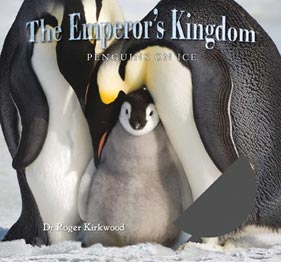
The Emperor's kingdom: Penguins on ice by Dr Roger Kirkwood
Black Dog Books, 2010. ISBN 9781742031262.
This book contains simple text, set out according to the months of the
year, and describes the stages of the penguin's development. The clear
and appealing photographs are presented as double page spreads with
additional smaller photographs inserted on each. It would appear that
January is an uneventful month in the life of the penguin as it is
omitted totally in both the text and table of contents. Having three
double pages devoted to them, however, June and July are obviously
months of great change and importance. Perhaps this is one downfall of
the book as it limits its use as a support in teaching young children
about the calendar, leaving the sole focus on the fascinating birds.
The accompanying DVD is brief with sound effects but no narration, yet
could prove useful to young children as it does provide a menu to
enable a small snippet to be viewed easily by students. Sadly, this
book is too late for student use for the International Polar Year as it
would have made a useful addition to the collection for younger
students and emergent readers. The more in depth information in the
fact file ensures greater usefulness with middle primary students as
well.
Jo Schenkel, Pilgrim School
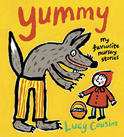
Yummy by Lucy Cousins
Walker Books 2009. ISBN 9781406316216
Highly recommended. What a wonderful book filled with some of the most
popular fairy stories: Little Red Riding Hood, The Three Billy Goats
Gruff, The Enormous Turnip, Henny Penny, Goldilocks and the Three
Bears, The Little Red Hen, The Three Little Pigs, and The Musicians of
Bremen. Each story is told in sparse language but with the essential
features of the tale left intact. The resulting 121 pages is a
wonderful book which could be used when reading aloud to a group of
children or for the individual to avidly examine.
I was thrilled to read through these familiar tales and to find that
what had enthralled me as a child still remained in the story. The
sound of the trip trap of the billy goats over the bridge is emphasised
in bold print in the story and their clever manipulation of the troll
is cleverly described. The third little pig, with a hugely
smug look on his face, says, 'bye-bye wolf' as he falls into a pot of
boiling water. None of these will scare the young reader or listener
too much as Cousins' language and humorous drawing style is so child
friendly.
The illustrations are typically Cousins' style: thick black strokes
outlining the figures, filled in with vivid colours, with having
vibrant greens, blues and yellow backgrounds. The expressions on the
faces of Cousins characters are a riot and the humour will appeal to a
young audience.
Winner of the Publishers Weekly Best Children's Books of 2009, this is
a title not to be missed.
Pat Pledger
Deadline by Chris Crutcher
Greenwillow, 2009. ISBN 9780060850913.
(Age 14+) Recommended. Imagine if, when you went to the doctor for a
normal checkup, you were told that you had terminal cancer. That is
what happens to 18 year old Ben Wolf, who knows that this will be his
last year at school. He decides he won't tell anyone his secret and
refuses treatment. He resolves to go after everything that he has
dreamt about in the short time that he has left. That includes dating a
beautiful girl, getting onto the football team and baiting his Civics
teacher about his conservative viewpoint of history.
As well as facing a terminal illness, Ben has to come to grips with the
effects his death will have on his mother, who is suffers from
depression and often hides out in her room for days at a time. He is
the one who usually helps her out. And he realises that he is not the
only one to harbour a terrifying secret. When he gets to know Dallas
Suzuki, the girl he has dreamt about, he discovers that she is
concealing things too as is the lonely drunk, Rudy, whom he befriends.
They trust him with what has happened in their lives and Ben is faced
with the dilemma of whether he should let the people he loves know
about his cancer.
Crutcher tackles some big themes in Deadline: death, mental
illness,
child abuse, trust, suicide and the manipulation of history, but they
are woven into a engrossing story that is difficult to put down.
Equally engrossing is Ben's try-out for the football team and the way
he and his brother Cody work together to win. I was fascinated by Ben's
arguments about racism and American History with Mr Lambeer his
teacher.
Crutcher has struck just the right note with this story, which could
have been a tearjerker, but instead is thought provoking with lots of
humour interspersed to keep the reader going. It was one of the ALA
Best Books for 2008 and certainly deserves this accolade.
Pat Pledger
The Seer of Shadows by Avi
HarperCollins, 2009. ISBN 9780060000172.
(Age 9-12) Recommended. Horace Carpentine is a young boy who works as
an apprentice to Enoch Middleditch, a society photographer. His
father, who believes in science and rational thought and considers 'all
superstition bunkum', has brought Horace up to be skeptical of the
supernatural. However Horace's beliefs are challenged when the wealthy
Mrs. Frederick Von Macht orders a photo of a portrait of her dead
daughter, Eleanora, and strange things begin to happen. When Horace's
employer decides to sell her more pictures by tricking her about a
ghost image in the first photograph, the spirit escapes the photographs.
Through his friendship with Pegg, the servant girl, Horace learns the
truth about what happened to Eleanora and finds to his dismay that the
photos that he takes of the dead girl's portrait and grave in
Green-Wood Cemetry take on a life of their own. Told in the narrative
voice of Horace, Avi, a Newbery Award winner, brings together a
fascinating background about photography and its processes and life in
New York in the 1880's.
I found this to be a compelling ghost story, with believable
characters and a terrifying ghost bent on revenge. The ending is scary
enough to thrill readers who enjoy a good horror story set in a
believable world.
Well written, suspenseful and memorable, this story lingers in the
mind. There is an interesting and informative Extras section at the
back of the book which contains information about A day in the life of
Avi the history of photography and Fun and spooky Green-Wood Cemetry
facts which add to the reader's knowledge of the period.
Pat Pledger
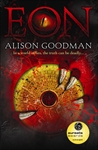
Eon by Alison Goodman
HarperCollins, 2009. ISBN 9780732290115.
(Ages 13+) Fantasy. First published in 2008 with the title, The
Two Pearls of Wisdom, Eon
will be snapped up by fans of fantasy sagas as they delve into the life
of Eona, as she trains to be a Dragoneye, the most powerful of lords
within this ancient Chinese kingdom, able to control wind and water.
Women are forbidden to train for this high station, but she has kept
her sexuality hidden for most of her life, and to become the next
Dragoneye is her avowed aim.
While training she is unwittingly involved in a life and death struggle
for the throne of this kingdom, and is asked to be the representative
of the current emperor, to fight against his enemies to the death. Her
supporters, some of whom know her secret, go to great lengths to find
information about her combatants, just as her combatants delve into her
abilities and styles of fighting.
This is a page turner, a breathless account of survival against
overwhelming odds, made all the more pertinent because she is also
hiding her sex. Shortlisted for many awards, and winning the
prestigious Aurelius Award in 2009, Eon is the first in what I
hope is
a trilogy.
Fran Knight
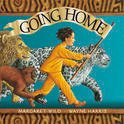
Going home by Margaret Wild
Walker books, 2009. ISBN 9781921529047.
Picture book, ages 3-6. Walker Books is republishing a few of the best
of classic Australian picture books. Several by Margaret Wild, and
Peter Pavey have come across my desk, with several others worth a
mention. Going Home is a lovely read for very early readers or for
reading aloud. I can imagine a child who is worried about being away
from home getting a great deal of satisfaction from this story of a boy
in hospital, being comforted by the animals in the posters around him.
As in Where the Wild Things are, the boy in this story is taken out of
himself as he travels the lands with the animals at night. When he
comes to leave the hospital and go home with his parents he tells the
children left behind his secret. Full of life and colour, Going Home
will be part of a teacher's bookshelf of books about animals as well as
the themes of comfort and home, imagination and family. First published
in 1993, it has a relevance which transcends time.
The illustrations by Wayne Harris carry the story further, by giving a
gorgeous background to the places Hugo goes with the animals. At the
end of the book are three pieces of writing, one by Albert Allun saying
what a pleasure it is to see this book republished, another by Margaret
Wild telling us the reasons behind writing the story and the third by
Wayne Harris, giving his thoughts when first reading the story, and so
underlining the reasons the illustration are so redolent of a child in
hospital. All three extend the story further for the reader and give
extra oomph to the lucky teacher or parent reading it aloud.
Fran Knight
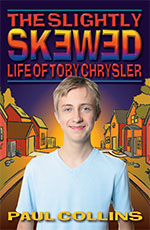
The slightly skewed life of Toby Chrysler by Paul Collins
Celepene Press, 2009. ISBN 9780975074244.
(Age 9-12) 'Slightly skewed life' is somewhat of an understatement for
Toby Chrysler, aka Milo, who lurches from improbable crisis to
improbable crisis in a non stop whirlwind of events. From supposedly
murdering his vastly obese neighbour to hiding a friend in his
cellar in order to flush out their parents who have run off together,
Milo takes it all fairly imperturbably in his stride, even though he is
out on bail for most of the story. But, hey, why let reality get in the
way of a good story? This yarn is wittily told and keeps up a cracking
pace, so it's easy to just go with it. Milo is fond of a good proverb,
care of his best friend and adviser, Fluke, but has a delightful way of
misquoting them so they are even more apt, eg, 'When at first you don't
succeed, cry, cry again.'(p52). The correct proverbs are listed at the
back so this makes the book a good one for parents to read aloud and
share with their middle to upper primary school child. Milo and friends
have plenty of courage and resourcefulness in their quest to find the
two missing parents and it all hurtles towards an even more surprising
ending. Some ends are not neatly tied up but it doesn't seem to matter
in this fun read.
Kevyna Gardner.