Hey Jack! series. Hardie Grant Egmont, 2012. ISBN: 9781742971278.
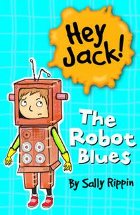
Recommended for ages 5+. The very creative Jack has made his own
costume to attend the birthday party of a friend from soccer. Up
until the time for his departure arrives, he is excited and happy.
Last minute nerves, however, leave Jack feeling 'wobbly'. Not only
does he become nervous about his home made costume, he is aware that
he won't know anyone else at the party. His mother jollies him
along, using robot voices to encourage him. As they sit in the car
and watch some of the other guests arrive, Jack is very aware that
he will be different - the only child in a costume which is not store
bought. Will he survive the festivities or go home feeling even more
embarrassed?
Rippin cleverly achieves in this series, for boys, much the same as
she does for girls in her Billie B Brown books. She takes a
situation to which all children can relate, and considers the
characters' emotions, actions and possible outcomes. Her messages to
children are positive and filled with encouragement. With the large
typeface and spacing and a multitude of illustrations, this title
would be accessible to many emergent readers as well as lending
itself to be used as a read aloud text in a classroom situation. It
would be a great starting point when discussing creativity, the
different talents which children may have, accepting others and
overcoming personal fears.
Jo Schenkel
Bananas in my Ears by Michael Rosen
Walker Books, 2011. ISBN 978 1 4063 3455 6.
(Age: 10+) Poems to make you smile! Michael Rosen takes everyday
events and highlights the funny side through his poetry. I would
recommend this for independent readers aged 10+ to ensure full
comprehension but parents and their children would enjoy reading
them together.
Rosen's poems have been in circulation since the 1980's and this new
publication ensures children today are also able to enjoy his work.
The illustrator, Quentin Blake, has illustrated many of his own
books as well as other author's and brings his trade mark drawings
to each poem. Many of the poems are like stories, exploring everyday
themes such as going to the beach, what happens when we wait for
breakfast and what happens when we wait at the doctor's. The
poems aren't traditional rhyming poems but read like a story, using
speech between characters to tell the story.
Kylie Kempster
Snake by Kate Jennings
Black Inc, 2011. ISBN: 9781863955256.
Highly recommended. This is a beautifully written story about a rather ugly situation. It concerns the post-war marriage and lives of Irene, from Sydney's North Shore, and Rex, a stolid but decent farmer, from the backblocks of NSW. Although a dependable provider and family man, Rex's biggest crime is that he is unimaginative and boring, to his wife anyway, and he pays a terrible consequence for this. The story proceeds through a series of vignettes, with cryptic and intriguing titles such as 'I wish you bluebirds', and 'In accents most forlorn'. It is told with wry humour and understatement, but builds up a devastating picture of a marriage gone sour. Inventive similes abound, for example 'Such a dull mean ordinary existence - she chewed on the injustice of it like a dog on a piece of hide', or 'Girlie read books like a caterpillar eating its way through the leaves on a tree'. Although the story is very bleak, I found myself uplifted by the strong sense of place and brilliant, assured writing, remarkable in a first novel. Peter J Helman
What would Jesus drive by Paul Clark
Ill. by Graham Preston. Wombat Books 2012. ISBN 9781921633713.
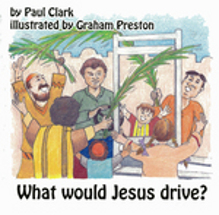
(Age: Young primary) If Jesus lived in modern times what kind of car
would he drive into Jerusalem? A variety of cars gather in the
church parking lot on Psalm Sunday and debate this question. Each
suggestion tells the reader something about Jesus.
This is a short and simple book with entertaining illustrations
aimed at young, primary children. It will serve as a useful teaching
aid for discussion in the class room or Sunday school.
Tina Cain
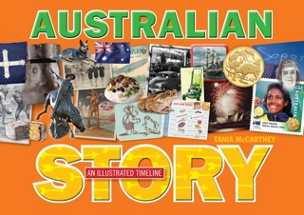
Australian story: an illustrated timeline by Tania McCartney
National Library of Australia, 2011. ISBN 9780642277459. Available
from National
Library Bookstore.
(All ages) Highly recommended. A visual feast, Australian story
is just what its title claims: an illustrated timeline of events
that have been significant in Australia's history. Starting from a
time when there was nothing and continuing from when earth is
created, the book travels through to 2010, where it leaves the
reader gazing at a blue sky page and being asked, 'Where will we go
next?'
Aimed mainly at primary school students the bite size snippets of
information and accompanying illustration will entice children into
finding out more about particular events, or discussing events that
happened during their parents' and grandparents' lives. However,
older students studying a particular decade in history will find
that the timeline will give them succinct information about major
events that happened in Australia during that time and which are
accompanied by photographs and illustrations. An example of this is
the 1960-1969 decade, where both social, historical and scientific
events are highlighted, some of which include: 1962: All indigenous
Australians are given the right to vote; 1964: The Beatles tour
Australia; 1965-1973: Australian soldiers fight in the Vietnam War;
1966: some 200 Indigenous people protest against poor working
conditions in the Gurindji Walk Off; 1966: TV news reports are
received via satellite; 1967: Prime Minister Harold Holt disappears
during a morning swim. This book will be a rewarding read for people
who are seriously interested in well researched, past events or
those who just like flicking through looking at intriguing fragments
of our history. For example when opening up a random page I found
out that Vegemite was first produced in Australia in 1923. As an
adult, I found it fascinating to look through the decades during the time that I
have been alive and find events that I could remember and others
that had passed me by.
Tania McCartney's text is concise and very interesting to read. The
accompanying pictures and captions are also fascinating and provide
a wealth of information. There is a Captions section at the back of
the book, which provides information about the source of the
pictures, photos etc and could be used as a lesson in the use of
primary sources. The production team has done a wonderful job in the
arrangement of this book.
The book will also prove invaluable for teachers when introducing
topics in the Australian national curriculum. Tania has provided
teaching notes for Key
Stage 1 and Key stage
2 during her blog tour. Scroll down the pages for these. Australian Story is a must for all libraries and a great
addition for a family to peruse.
Pat Pledger
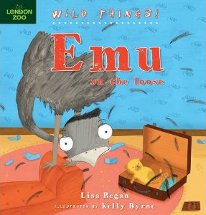
Wild Things! series by Lisa Regan
Bloomsbury Publishing, 2011.
Emu on the loose. ISBN 9781408142479.
Giraffe on a sleepover. ISBN 9781408142462.
(Ages: 3-6) Highly recommended. Wild things! is a series of four
books written by Lisa Regan, and charmingly illustrated by Kelly
Byrne. Sales proceeds support the Zoological Society of London in
their charitable care of wild animals around the world. Emu on the loose, and Giraffe on a sleepover are the
first two lively and colorful books in this series where emus and
giraffes are unquestionably the topics of conversation.
The Wild things! books have been written to a formula in a buoyant
and entertaining manner; and while Emu on the loose, and Giraffe
on a sleepover both mimic storybook telling, and some
Australian readers may not understand the references to miles, these
books absolutely provide the small child with loads of facts about
emus and giraffes. The page layout and graphics are clear and
energetic and for little ones with inquiring minds, each book
includes a glossary.
The books begin with the emu and giraffe ringing a doorbell and
waiting to be invited inside. Children will laugh at the emu in the
bath, and the long giraffe peeping in the window, and they will
groan when the giraffe visits the bathroom. Both animals have been
creatively brought to life through Kelly Byrne's cheerful artistry.
Beautifully told and illustrated, and exquisitely bound, these two
books are a delight to read and would be especially suitable for
resource centre and classroom use at kindergarten or pre-school
level. I recommend them most highly.
Colleen Tuovinen
Left neglected by Lisa Genova
Simon and Schuster, 2012.
(Age: Adult) Recommended. Compellingly told, this story, as we read
in the prologue, is about a 'traumatic smack to the head'.
After a brief prologue, we are plunged into the frenetic life of
Sarah Nickerson, a super-high-achiever, a woman who appears to have
everything in place: important, well-paid job; large family house;
good, loving (equally high-achieving) husband; and three much loved
children. With one mishap, albeit one that springs from
something simple, but which we all know is absolutely risky, her
world collapses.
Interestingly, Lisa Genova does not present Sarah as initially
appealing, and it is impossible not to feel exhausted as she unfolds
her story of fully-timetabled days, where she dashes from one
important task to another. We feel somewhat unnerved by her
apparent, if somewhat cliched, racing headlong to disaster. Yet her
incisively detailed story, told in the present tense, in spare
prose, is so seductive that it is almost impossible to put the book
down. It would be hard to not be captivated by her narrative
of deep personal struggle, trying to come to terms with her puzzling
condition, of her early resistance and refusal to adapt, and by her
grudging acceptance that she has to live every day in an entirely
new way, mentally and physically.
Forced to come to terms with her 'left neglected' mind, Sarah has to
let go of her old life as she can be no longer the performer, whose
children were expected to fit into her rigid timetable, who
timetabled her demanding work schedule into her day, and her
relationship with her husband into clearly defined blocks, for
talking, eating, relaxing and loving. Acceptance does not
happen without the help of others, and we are led through a
beguiling story of the arrival back into her life of her mother, of
hospital staff who challenge her to respond positively to her new
world, of her understanding of the real needs of her children and
husband. As Genova subtly alters her protagonist's view of
life and disability, she constructs a new, gentler woman, who not
only finds her soul, but who also finds a way to choose to live
differently.
An adult book and it is outstanding.
Elizabeth Bondar
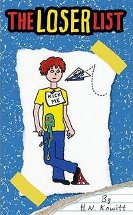
The loser list by H. N. Kowitt
Scholastic Press, 2011. ISBN 978-0-545-24004-8.
(Age: 8-12) Nobody wants to be on the loser list, the infamous list
written on the wall in the girl's toilets. Seventh grade Danny Shine
is mortified when school bully Chantal decides to add his name. He
feels he cannot slip further down the school 'food chain' and
decides to remove his name from the wall. This is when his life
starts to fall apart. Danny becomes alienated from his best friend
Jasper, who is happy to be called a geek, and gets involved with the
bad boys of the school, 'The Skulls'.
Danny's obsession is reading, drawing, trading and buying comics. It
is his skill in drawing tattoos that stop him from being beaten up
by the school bullies who eventually involve him in shop lifting.
Danny must decide how to deal with all of the challenges and
problems his new life as a delinquent creates as well as coping with
his big crush on Asia O'Neill.
There are many similarities with Diary of a Wimpy Kid. The
diary handwritten format peppered with comic style line drawings
will appeal to Wimpy readers.
H.(Holly) N. Kowitt is an American writer. It is interesting that
some female writers who aim their books strongly towards boys, do
not identify themselves as male or female by using only first name
initials. The Tom Gates books by L. (Liz) Pichon are another
example of the non gender specific author name. Tom Gates
books are also a great read for "Wimpy' fans. The Loser List will appeal to 8 to 12 year olds, boys in
particular. A book trailer is available here.
Jane Moore
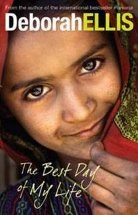
The best day of my life by Deborah Ellis
Allen and Unwin, 2012. ISBN 97874237 914 2.
(Ages: 11+) Recommended. Leprosy. When Valli learns that her aunt
and uncle are not her relatives but someone to whom money was paid
to take her in, she decides to leave. Their life is dependent upon
the town's coal mine, the children collecting pieces that have
fallen along the roadside to make a pittance to give to the family
for food. Hearing they are not related she climbs aboard one of the
trucks leaving the town. In turn the driver finds her ad takes her
to a place he knows where young girls are wanted, but when they wash
her and realise that she cannot feel the burns on her feet, they
toss her out and she must fend for herself. Valli has leprosy and
Deborah Ellis is again at her knowledgable best in relating an
engrossing story which also informs and educates.
Surviving on the streets in Kolkata means sleeping where she can,
begging a few pence for food, and stealing or borrowing what she
needs. A doctor meets her and seeing the state of her feet takes her
to her hospital where she can receive treatment. But once Valli
notices the others with stumpy fingers and pieces of their noses
gone, she runs off. When she comes to a decision to accept the
disease, she returns, finding that she can be cured.
At the end of the book is a sound glossary giving the readers the
meanings of some of the Indian words used, and the author's note
acquaints the readers with the facts of this disease, still much
prevalent in poorer areas of the world where the germ can spread
more easily because of overcrowding and poor diet. Ellis' work
always brings a dignity to the children she talks about, whether
they be in Pakistan, Bolivia or Afghanistan, and the story will
ensure that the book is read and read again.
Fran Knight
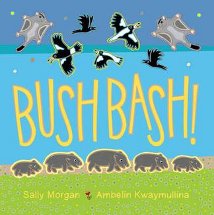
Bush bash! by Sally Morgan and Ambelin Kwaymullina
Little Hare, 2012. ISBN: 9781921714771.
Recommended for ages 5+. When dingo dashes by, looking very excited,
the other animals become intrigued and question where he is headed.
As numbats, flying frogs, bilbies, crows, wombats, gliders, sea
snakes, magpies and lizards ask where he is going, he finally issues
them with an invitation to follow him. The surprise ending is
eventually revealed and we see why he has been so excited and in
such a hurry.
With a simple repetitive style of text, the focus of the reader can
easily be placed on the vibrantly coloured, stylised pictures.
Patterning is used in the background and the bush is depicted in
such a way as to make it interesting and exciting. Dingo leaves
prints in the sand which can be easily followed by the animals and
also by the reader. Although at first glance this would appear to be
just a simple counting book which uses Australian birds and animals,
it has another more important layer. The reader is also encouraged
to look closely at the illustrations to find both aboriginal
artifacts and introduced species.
In the classroom, this could provide scaffolding on which the
students could write their own stories based on Australian animals.
More importantly, it could also be used to discuss endangered and
introduced species which impact on our environment.
Jo Schenkel
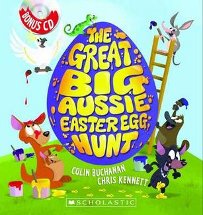
The great big Aussie Easter egg hunt by Colin Buchanan
Ill. by Chris Kennett. Scholastic, 2012.
Easter time in Australia sees all the animals racing across the land
to find their Easter eggs. In rhyming lines, we have the kangaroos
scratching around Uluru with the gecko, and hooting with bandicoot
at Kakadu, while the eagle spreads eggs from high at Alice Springs.
All the iconic places around Australia are included, along with many
well known animals, so that teachers could use the book as a fun
read, using a map of Australia to pinpoint each landmark mentioned,
introducing a class to the many places they may have heard of but
are not sure where they are. The list of animals too, is a useful
tool again for the classroom, with animals not all would know, but
the range gives a neat introduction to a few lessons about
Australian animals.
The accompanying CD could be used in the classroom to sing along
with, pointing out the places on the map as the song is sung, or
small groups may like to learn it to present the map and the places
to the class. The spirited illustrations by Chris Kennett could be
used as a base for the classes' own drawings of Australian animals,
or be copied to do a show and tell of animals for recognition
purposes.
In this Year of
Reading, this book is a fine adjunct to the many books already
listed on their website about journeys around Australia to match the
Alison Lester book, Are we there yet?. And this could be
added to Buchanan's other books along a familiar theme, Fair
dinkum Aussie Christmas, Fair dinkum Aussie Easter and
Santa's Aussie mix-up.
Fran Knight
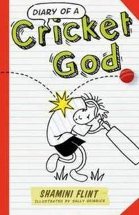
Diary of a cricket god by Shamini Flint
Illus. by Sally Heinrich. Allen and Unwin, 2012. ISBN 9781742378268.
No this is not about Shane Warne or Ricky Ponting! This is the Diary
of 9 year old Marcus Atkinson, son of a marketing guru and Self Help
book author, as he struggles to fulfil his father's hope of him
having a 'Future in Sport'. Whilst his father believes 'Talent is in
the Mind', Marcus wishes it was in his hand and feet. Still
embarrassed by his efforts playing soccer, recorded in Diary of
a Soccer Star, Marcus reluctantly joins the cricket team.
Continually spurred on by his father's mottos, Marcus persists at
training and finally playing despite his and the coaches better
judgement. The rules and language of cricket are introduced in with
humour and wit as Marcus struggles to learn to bat and bowl. The
line drawings which accompany the text add to the fun and make for a
highly readable story as Marcus finally hits the ball and manages to
find a way to win.
This will be a very popular book with the budding cricket god who
has a chance to understand the game without making embarrassing
blunders like Marcus. The popular diary format and comic
illustrations will also appeal to reluctant readers as well as those
who are fans of the Wimpy Kid and Big Nate books. A
must for the Primary Library.
Sue Keane
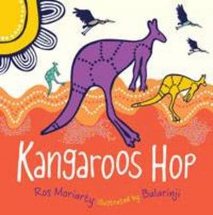
Kangaroos hop by Ros Moriarty
Ill. by Balarinji. Allen and Unwin, 2012. ISBN 9781742379159.
(Ages: 2+) Highly recommended. Includes Yanyuwa language
translation. Picture book. Kangaroos hop is a colourful and contemporary picture book,
with vibrant illustrations and animals which seem to hop, swoop and
dance from the pages.
Throughout the story, the reader meets all manner of native
creatures, who romp through the book in a colourful and cheerful
melee, on their journey down to the river bank. They soon stop short
and turn quiet when they see which creature is waiting for them
there!
The simple and predictable text is accessible to younger readers
because it scaffolds the language by building up the story piece by
piece, using cumulative patterns. The layout makes pointing out key
punctuation features easy, and phonemic structure of the verbs
provides many 'teachable moments' within the book. The addition of
the Yanyuwa language translation at the rear of the book gives the
reader access to an additional cultural element, and is accompanied
by a map, indicating where Yanyuwa is spoken.
The bright illustrations and clear print make this the ideal book
for beginning readers to connect with, with plenty of opportunities
for educators and parents alike to interact with the text both
during reading (which animal do you think we'll see next? Can you
remember who was in the group? There was the kangaroo first, then
the birds . . . ) and afterwards (Can you hop like
a kangaroo? Can you shuffle like an echidna?)
The blurb of the book states that it 'celebrates animals, verbs, and
the brilliant art of the Balarinji design studio' and it certainly
doesn't disappoint. This book would be an ideal addition to any
Indigenous picture book collection, both in school and public
libraries, and comes highly recommended.
Freya Lucas
Sydney Harbour bridge by Vashti Farrer
Scholastic, 2012. ISBN 978 174169 953 1.
Part of the My Australian Story series, Sydney Harbour Bridge tells
the story of the construction of the bridge from the beginning of
1931 until its opening in 1932. The story is told in the form
of letters and diary entries by Billy Thompson and Alice
Carson. Billy comes from a working class area and Alice, a
middle class area, both within sight of the bridge. The story
conveys a real sense of the effects of the Depression on the people
of Sydney in particular and Australia in general. It give a
graphic account of how hard life was for people as well as a look at
the politics of the day especially in the form of Jack Lang, the
colourful and controversial Premier of NSW.
As the story progresses it gives a real insight into the background
of the bridge and how it was constructed as well as the impact that
it had both positive and negative.It shows that people were
evicted from their homes often with little or no compensation at a
time when it was becoming increasingly difficult for ordinary people
to make ends meet.
The author has used alternating diary entries from Billy and Alice
to good effect. As well as the history mentioned earlier the
reader can identify with Billy and Alice and see the effect that the
Depression has on them, their family and friends. The
historical notes at the end help pull everything together and put
things into an historical perspective. I am sure that it would
encourage some readers to undertake further reading and research
into this part of Australia's history.
David Rayner
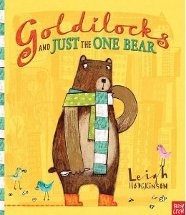
Goldilocks and just the one bear by Leigh Hodgkinson
Noisy Crow, 2012. ISBN 978 0 85763 043 8.
(All ages) Recommended. Picture books. Humour. When the bear becomes
lost in the confusing city, he takes refuge in a hotel, finding
himself in a room which feels very comfortable, unlike the scary
city downstairs. He feels hungry and finds several things to try
before eating the rather dry toast. Then he needs a sit down and
looking around the room finds a number of things that are not quite
right until deciding to sit in the bean bag, with rather disastrous
results. Needing a comfy bed, he ventures into the bedrooms to find
one that is just right, and goes to sleep.
To his amazement he is woken by very loud shouting and finds that a
family has returned, looking through the damage the bear has done,
emulating the story of Goldilocks and the three bears. A very neat
and funny solution offers itself to make the ending simply
tickety-boo.
Readers will laugh out loud as they follow the bear's antics in
finding himself a safe and quiet place to sleep. Large and small
children will find much humour in the background as they read the
story, and will search for the differences between the text and what
is happening on the pages. Watch out particularly for the signs in
the street and the similarities and differences between this story
and that of Goldilocks, as well as the language used, stretching the
readers' vocabulary. This is a happy ever after story that will
thrill its readers, whether read aloud or by themselves, it is well
worth delving into again and again.
Fran Knight