Templar, 2011. ISBN 9781848772182.
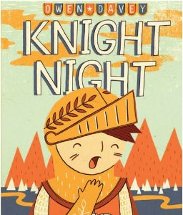
(Age: 3+) Going to bed each night can be a routine experience. You
go down the hallway, climb the stairs, have a bath, brush your
teeth, say goodnight to your dog and go to your room. You tidy away
your things, climb into bed and turn out the lights. But it can also
be an adventure, especially if you are a knight! In this very
engaging picture book, going to bed becomes a series of amazing
adventures, particularly if you are a little boy with a big
imagination.
A great storybook to share and talk about 'what if . . ' that helps
little ones start to see things from another's perspective. It could
also help them start to develop a sense of time passing as they
investigate the pictures and begin to build a great vocabulary of
things medieval. I can imagine a brilliant class mural evolving out
of this. It also lends itself to some maths sequencing activities as
bedtime routines are examined and compared and vocabulary such as
before, after, next between is developed, as well as a introduction
to telling the time. Rich in many respects, Knight Night is
recommended for those from 3+.
Barbara Braxton
The Extinction Gambit by Michael Pryor
The extraordinaires 1. Random House Australia, 2011. ISBN
9781864718201.
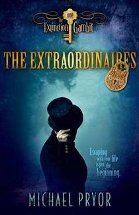
Highly recommended. The Extraordinaires is another clever and
entertaining novel by Michael Pryor, full of wit, adventure and edge
of the seat thrills. True to its name, this book is peopled with
extraordinary characters: from our brave, wolfish hero Kingsley, to
his strong and courageous albino companion, Evadne. The villains in
this novel are equally engaging, be they the troll-like, Damona or
the slippery, wheeler and dealer, Soames. Even an author, Rudyard
Kipling, makes an appearance.
The novel opens in 1908 in a small theatre where Kingsley is to make
his debut as a magician. But when his wolfish nature turns his magic
show into bedlam, Evadne decides to rescue him as her 'project'
little knowing that danger is lurking around the corner, quite
literally. Not only do the police think our beloved hero is guilty
of a dastardly crime, but also, there are dark creatures living in
dark places who want Kingsley for themselves, or at least, they want
his brain! And it seems they will stop at nothing to achieve their
ends.
Befitting a story that opens and closes in a theatre, this novel
often reads like a wonderfully old-fashioned melodrama with all the
fun and adventure that one would expect on a panto stage. The
humorous repartee between Kingsley and Evadne is also reminiscent of
such pantos and is sure to delight readers as they inwardly cheer on
their heroes' fight to stay one step ahead of the chase. However,
Pryor cleverly imbues his villains with more depth than might be
expected from the standard melodrama so the reader also cares about
the outcomes of their misadventures.
All in all, this is a delightful romp of a story, which is only to
be expected from the author of the brilliant series,The Laws of
Magic. It is especially exciting to know that this isn't just
a stand-alone adventure but the first in another series. Readers
will be eagerly anticipating the next book set in extraordinary
times and about extraordinary characters.
Deborah Marshall
Our nest is best! by Penny Olsen with Penny O'Hara
National Library of Australia, 2012. ISBN 9780642277374.
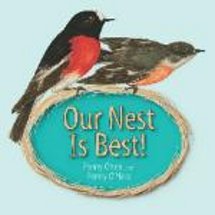
(Age: Pre-School - 7) Recommended. The National Library of Australia
aims 'to interpret and highlight the Library's collection' and it
certainly does this in its book for young readers, Our nest is
best. The beautiful illustrations by Neville Henry Cayley
(1853-1903), Ebenezer Edward Gostelow (1866-1944), and Betty Temple
Watts (1901-1992), all artists from the past who have made
magnificent illustrations of birds found in Australia, are featured
in this lovely little story. Ruby and Rocky Robin are searching for
the best nest for them to build. In their quest they look at the
nests of magpies, owls, fairy-wrens, emus, kookaburras,
reed-warblers, and grebes and decide that their nest is best,
although all the other nests are just right for the birds that build
them.
The text by Penny Olsen, with Penny O'Hara, is charming and should
appeal to young children who are just being introduced to Australian
birds. The nests that the two little robins look at are exquisite
coloured drawings, usually showing how the nest is constructed, but
also has pictures of the baby birds, often with their mouths wide
open to receive food from their parent. The drawings from the three
different artists are incorporated into the book and don't look as
if they are separate plates. At the end of the book, the reader is
given instructions on how to access them in the National Library of Australia
collection. You need to go to Catalogue in Websites A-Z. This is a
fabulous way to look at primary sources for young children.
This will be a wonderful way for children and their adult carers to
learn about Australian birds, their appearance, nests and habitat,
gathered together in an appealing book.
Pat Pledger
Good Morning Mr. Pancakes by Chris McKimmie
Allen and Unwin, 2011. ISBN 978 1 74237 719
3.
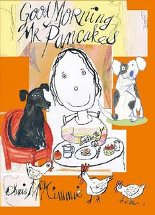
(Age: 5-8) Bee is excited to be going on a holiday. Then she
realizes that there are many things to do before she can leave for
her holiday.
Bee is the central character who lists important jobs to do before
going on holiday. Pets need housing and looking after while
she is gone and certain loved items need to stay home. She
realizes that she can't take everything with her. Bee likes
the idea of getting out of routine such as no ballet classes to go
to and no homework for a week! Bee is so excited that her
imagination takes over as she dreams of what wonderful and exciting
things she'll do.
Bee knows that her holiday will end and that she will have to go
back to her routine of dance classes and school.
A lovely and imaginative picture book with colourful illustrations
that 5-8 year olds will enjoy reading.
Janet Cassidy
The unbeatable boys' book: How to be the ultimate champion by Huw Davies
Ill. by Simon Ecob. Scholastic, 2012. ISBN 9781741699135.
(Age: 8 -12) Huw Davies, often with humour, gives hints to boys
about how to become the ultimate champion at all types of sports,
ranging from cricket to orienteering. With headings like How to make
a penalty, How to ride in a rodeo, How to cross the finish line, How
to throw a ball, and How to train like a champion, there is plenty
to intrigue young readers.
There are also funny entries that will grab the reader's attention.
Who wouldn't like to learn what elephant polo is and how to win at
it, or learn about camel racing? There are pertinent chapters as
well, for example, the one on how to choose a sport. I had fun
flicking through the book and reading the different entries and I am
sure that boys will enjoy it as much as I did. In addition the
advice that is given in point form is also sensible and often
spiced with humour. Illustrations add a touch of humour as
well.
There is plenty here for all types of boys to enjoy, and it will
particularly interest reluctant readers.
Pat Pledger
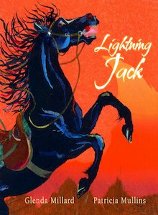
Lightning Jack by Glenda Millard and Patricia Mullins
Scholastic, 2012. ISBN 9781741693911.
(Age: 4+) Highly recommended. From the moment that Sam Tully sees
the stallion, black as midnight, in the muster at the park, he is
determined to ride him. Together he and Lightning Jack stop a mob of
steers from stampeding down the mountainside and elude a grazier who
offers 500 steers for the horse. Like Pegasus, the horse rises into
the sky :
'Horse of the gods, diviner's horse.
The horse called Lightning Jack.'
More adventures follow as they evade Ned Kelly who wants a horse as
fast as Lightning Jack and then they race against the legendary but
ghostly Phar Lap.
Millard has written a wonderful poem that will remain in the minds
of all who hear it. She has taken different aspects of horses from
folklore and legend and made them into one huge adventure for the
imaginative Sam. Written in the style of The man from Snowy
River, this story begs to be read out loud so that the listener can
gain the movement and flight of the horse and the dreams of Sam
Tully.
Patricia Mullins has captured the beauty and the movement of the
black stallion as it gallops with the herd, dares Sam to ride him
and then changes into a wonderful creature of mythical proportions.
Finally the reader sees him as a carousel horse. The black of the
stallion stands out against the beautiful yellows, greens and blues
of the landscape and sky.
The combination of the beautiful collages and drawings and a
wonderful verse story make this is an outstanding picture book,
which is not to be missed.
Pat Pledger
Fated by Sarah Alderson
Fated Book 1. Simon and Schuster, 2012. ISBN 9780857074348.
(Age: 14+) Thriller. Paranormal. Lucas Gray is half-human,
half-Shadow Warrior, and belongs to the Brotherhood, a gang of
assassins who are out to kill the last purebred Hunter. 17 year old
Evie Tremain is a waitress, and is astounded to find out that she is
a demon slayer and has been targeted by the Brotherhood. She is
intrigued by Lucas, not realising that he has been sent to kill her.
Both Lucas and Evie are bound together by fate, but will they be
able to survive the intrigue that has been going on for a thousand
years?
I decided I had to read this book as I had enjoyed Hunting Lila
by Alderson so much. This has more paranormal aspects that Hunting
Lila but all the hallmarks of Sarah Alderson's writing: fast
action, characters that you really want to see succeed against all
odds, and a growing romance between two unlikely people.
The action is non-stop. The shapeshifters, vampires and mixen
creatures have amazing powers and their deadly feats highlight the
skills that Evie develops as a demon slayer. She becomes a fast and
canny fighter and the suspense about whether Lucas will kill her or
protect her builds up throughout the book.
As a reader, I became involved in Evie as a character, in
particular. She was strong and feisty and able to think for herself.
Secondary characters, including some adults, added depth to the
story and no doubt some of their stories will be enlarged in later
books in the series. And of course, an ill-fated romance, and the
question about whether it can survive, adds extra spice to the
story.
Teen girls in particular will enjoy this story and will no doubt
want to read the next in the series, as I will.
Pat Pledger
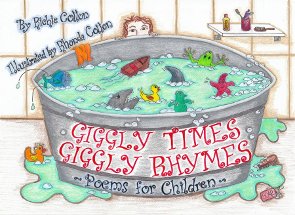
Giggly times, giggly rhymes : Poems for children by Richie Cotton
Billy's Books, 2009. ISBN 978 0 646 52230 2.
(Age: 8+) Australian poet Richie Cotton has captured everyday themes
and characters in quirky, rhyming poetry. From the wiggly worm to
the astronaut, children will find a topic they enjoy and maybe even
a new one. Independent readers aged 8+ will enjoy the rhyme and
rhythm but children of all ages will enjoy hearing the poems -
especially the one about spiders biting bottoms! The colourful
illustrations compliment each poem, opening up a child's imagination
and giving a better understanding of each text.
These poems would be a great tool for the classroom and helping
children's comprehension before using them as a model for their own
writing.
Kylie Kempster
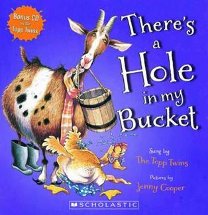
There's a hole in my bucket sung by The Topp Twins (singers)
Ill. by Jenny Cooper. Scholastic, New Zealand ISBN 9781775430469.
Henry the goat has a hole in his bucket. When he tells Liza
the duck she tells him to fix it, but unclever Henry cannot.
There's a problem with every solution Liza offers. This is a
retelling of the classic song that little people love to sing, but
instead of the dirge I've listened to hundreds of times over the
years, this one is brought to life by the hilarious illustrations of
Jenny Cooper. Not for this Liza the dutiful role of the
patient partner - this one gets cranky and frustrated. Henry's
face when she suggests that he cut the straw with an axe is
wonderful and Liza's frustration is clearly apparent. The
final picture has to express the feelings of many a mother and a
teacher at various times.
The edge that this book has over other versions (apart from the
accompanying CD) is that it is perfect for early reading
activities. Apart from the repetitive text that encourages the
children to join in, the pictures provide an opportunity to help the
children consider how Liza is feeling and start to develop both
empathy and expression. It's also an opportunity to introduce
them to new vocabulary like 'frustrated' and to expand their
lexicon with synonyms for 'mad' and 'angry'.
Miss Just-Started-Kindy was thrilled that she could read it by
herself very quickly but my greatest delight was watching Grandad
being coerced into the role of Henry, while she could have won an
Oscar for her portrayal of Liza.
Share this book with your youngest students and you will hear the
song being sung (and acted) in the playground for days.
Barbara Braxton
The book thief by Markus Zusak (audio book)
Vision Australia, Melbourne, 2010. ISBN 978 1 86482 596 1. 14 1/2
hours (11 Cd's). Read by Denis Olsen. PanMacmillan, Sydney, 2005.
(Ages: 14+) Highly recommended. As Death takes the boy's soul, he
notices the dead child's sister, Liesel, the girl who later becomes
the book thief, and Death is destined to see her several more times
before he comes for her years later. It is 1939 and his business is
booming. Liesel is being taken to a foster home, one where she
learns to read through the teaching of her beloved foster father,
the accordion player, Hans Hubermann, and learns love from the next
door neighbour Rudy Steiner and her taciturn foster mother, the
wardrobe of a woman, Rosa Hubermann.
World War Two sees the best and the worst of deeds and people, as
Death narrates his journey around Liesel Meminger during those
frightful years.
Her first theft of a book occurs at her brother's funeral, when one
of the gravediggers drops his handbook. She seizes it and teaches
herself some words from it. She steals another from the Mayor's
wife's library and saves one from a book burning, all the while
learning to read at night with Papa and then reading aloud to those
who huddle in the shelter during bombing raids. And Max, the Jew who
the family hides in their cellar, writes stories for her to read.
This is a story sewn with many layers and complications as we hear
stories behind stories, people's lives filled out with involvements
and intricacies which tie them all together and keep them apart. The
reality of living in Nazi Germany is brilliantly evoked. But the
emphasis on books and the power of words is at its base, as Leisel
collects her books and keeps safe those written by Max. When she
writes her own story it is Death who finds the book in the street
after their houses have been bombed and all but Leisel killed, and
he takes it with him, reading it over the years until finally he
comes for her.
It is a perfect story, symmetrical in its overall theme, that Death
is haunted by humans, haunted by their power to be good and bad at
the same time, to wreak the worst and best deeds upon each other, to
survive all the horrors known to mankind.
And all the while Denis Olsen's beautiful voice carries the story
further. His modulation is perfect, his pitch exquisite, his
rendering of the different voices, a joy to hear, particularly that
reflecting the sardonic wit of the character of Death.
Fran Knight
The Shiny Guys by Doug MacLeod
Penguin, 2012. ISBN 9780143565307.
(Age: 15+) Highly recommended. Fifteen year old Colin Lapsley
is visited by the shiny guys, strange creatures that he can see out
of the corner of his eye. Colin is convinced that they want him to
pay for the terrible thing that he has done. His frantic parents
have him admitted to Ward 44 where he befriends Mango who has an
attachment disorder (he 'grabs people from behind and holds on') and
Anthea, who is anorexic.
The book begins: 'This story is set in 1985. Psychiatric wards are
different today.' MacLeod has written a tour de force about mental
illness, leavening it with his outstanding ability to write humorous
one liners. Colin is a wonderful character who uses jokes to cover
up his thoughts about the serious stuff that is happening around
him. At the same time he is a caring boy who looks after Mango and
ensures that Anthea, as a new patient, fits into the complex social
structure of Ward 44. As a reader I became engrossed in the lives of
these three patients, sympathising with them about their
relationships with their parents and revelling in their strengths
and generosity. MacLeod's device of having some chapters written in
Mango's almost illiterate hand, and question and answers from Anthea
and her doctor add to the reader's understanding of the three main
characters and give some relief from Colin's predicament.
MacLeod also builds up a strong thread of suspense that left me
wondering just what had happened to Colin's sister, Briony, who was
lost on a bushwalk, and how he was involved. Small hints are dropped
throughout the book and these kept me reading avidly. The reason for
Mango's attachment disorder is also a theme that is puzzling.
Most of all though, it is the serious theme of mental illness that
captured my interest. I found myself waking up in the middle of the
night thinking about ECT (Electroconvulsive therapy), and then
spending time looking at websites that discussed its medical
background and effectiveness.
Although at times this novel is very dark, MacLeod leaves the reader
with a ray of hope that a person with a mental illness can, with the
help of caring friends, and medical intervention, fight through
depression and better understand their feelings. Background to the
novel can be found on his blog.
Pat Pledger
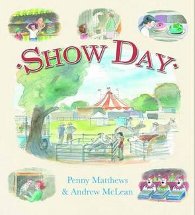
Show day by Penny Matthews
Ill. by Andrew McLean. Omnibus, 2012. ISBN 978 1 86291 689 0.
Highly recommended. Picture book. When the day of the show arrives,
every member of Lil's family is represented, each having submitted
something for judging. Dad has made marmalade, Lil has helped her
mother with a beautiful birthday cake, Henry has his pet guinea pig,
Bart, entered in the Best Pet competition, and the family rooster,
the grumpy Albert has been entered in the Poultry Section. Lil is up
early the morning of the big day to prepare her cow, Goldie. She
must wash her down, drying her off with old towels, ready to be
judged at the show, and Lil is convinced that Goldie will win a
prize.
The beguiling water colour illustrations by Andrew McLean show us a
family working together for the big day. I love the double
page illustration of the family setting off, with the sun's rays
just shading the sky before it appears, the car packed to the top of
the roof rack with their entries, the cow in the trailer behind, the
family smiling and eagerly looking forward to their big day out. The
country show is lovingly portrayed, full of life and colour,
movement and sounds.
As each of their entrants is judged, we hear that not all win, some
come second, some do not rate at all, while Dad, coming last in the
wood chopping event, gets a loud cheer of encouragement from the
audience. The day is not about winning or losing, but being
involved, participating as a family, being with friends and having a
good time. The little twist at the end rounds off a delightful
story, well told and enticingly illustrated.
Fran Knight
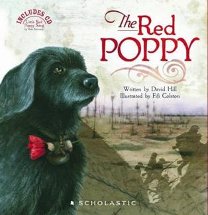
The red poppy by David Hill
Ill. by Fifj Colston. Scholastic, 2012. ISBN 978 1 86943 998 9.
Picture book, ANZAC. Waiting for the whistle that will send them
over the top of the trenches and for some, their deaths, Jim,
recalls writing to his mother and sister the night before. Of course
he has told them nothing of the coming battle, of his fears, or his
life in the trenches. He like many others talks about things his
family will want to hear, and keeps his fears to himself.
Published with a CD containing the song on which this book is based,
this beautifully produced book will serve well on ANZAC Day and at
any time World War One is under discussion in the classroom. The
stunning illustrations are done in chalk and pencil, using
photographs of the time. With edges of almost torn paper the
impression of being taken from a photo frame, or being ephemeral, is
given to the reader. The illustrations are haunting and realistic,
emotional and sparing no pain as we see men shot and surviving in
shell holes between the trenches.
The red poppy taken by the dog as a signal, gets Jim and the German
he befriends, rescued, adding another layer of meaning to the story,
that of friendship between adversaries. The dog too will be
remembered by students as they recall that animals are often used in
wartime in a variety of roles.
Fran Knight
Wildcat Fireflies by Amber Kizer
Fenestra Book 2. Random House, 2011. ISBN 9781742751306.
(Age: 15+) Recommended for those who enjoy paranormal stories. This
is the second in the series, Fenesetra and follows Meridian,
where Meridian has discovered that she is a Fenestra, a half human,
half angel who communicates with the dying and helps them transition
to the afterlife. After the death of her aunt, she and Tens, her
protector, Tens, have journeyed to Indiana to try and find another
Fenestra, who they can feel in the area. Juliet, a caring teen,
works tirelessly with other orphans, in an old people's home, doing
her best to shield everyone from the cruel actions of the women in
charge. Meridian and Tens are in a race to rescue Juliet from a life
of horror, controlled by the evil Aternocti.
Kizer has excelled herself with descriptions, that felt as if they
came out of a Dickens novel, of the life that Juliet leads in
the Dunklebarger Rehabilitation Center, the home for the dying
elderly and the foster children. I become very involved in Juliet's
story and her struggle to protect the children in her charge and to
help the dying. I ached with her when Kirian left the home and
didn't contact her, and dreaded the things that could happen to her
if Meridian and Tens didn't reach her in time. The book is told both
by Meridian and Juliet in different chapters and this works very
well at keeping up the suspense and giving the reader information
about what is happening.
Readers who enjoyed the first book, Meridian, will be happy to
follow the growing relationship between Meridian and Tens, her soul
mate. Other characters introduced in the book are well rounded and
interesting, including Rumi, a little boy in the home, and
adults in the town, who help sort out problems.
The setting, too, adds to the complexity of the book. The town is so
well described that I could see it in my mind's eye and the author's
knowledge of Indiana, festivals and countryside is evident. The
story of the fireflies that rise from the Wildcat River is also
fascinating. Wildcat fireflies has depth of character and description,
with plenty of action and suspense thrown in, and is sure to thrill
its readers. In the information at the back of the book, it states
that there will be two more books in the series, and I am sure that
there will be a following for them.
Pat Pledger
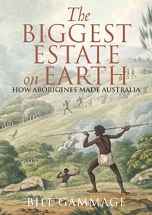
The biggest estate on earth: How Aborigines made Australia by Bill Gammage
Allen and Unwin, 2011. ISBN 9781742377483.
(Age 15+) Highly recommended. 'To the people of 1788, whose landcare
is unmatched, and who showed what it is to be Australian.' 'The
people of 1788' are the Aborigines and the dedication is by
Professor Bill Gammage. His thesis is that the Australian landscape
as it was first viewed by Europeans was made by humans not by
nature.
The biggest estate on earth begins our journey of discovery by
looking at the landscape through the eyes of the European newcomers.
Why did they comment so often on the 'parks' and 'lawns' that met
their gaze? Why did their paintings show vistas of grassland where
now there are forests or thick scrub? Why did they report that
indigenous people deliberately set fire to the countryside?
According to the author, the newcomers did not recognise that the
land in which they had arrived was as closely managed as the one
they had left. The continent was a mosaic of inherited lands whose
traditional owners conserved precious water supplies, and used
controlled burning to prevent bushfires and create favourable
conditions for the plants and animals they wanted to harvest. A
belated appreciation of the value and complexity of sustainable
Aboriginal land management practices is now emerging. This
remarkable book may facilitate that process.
The writing style is precise and accessible and the organisation of
material assists both ease of understanding and the development of
the argument. However, the author knows that some people will
disagree with his conclusions. He has responded by revealing his
argument slowly through a wealth of documentary and pictorial
evidence, drawn from meticulous observation and scholarship.
Detailed descriptions are based on an evident love of Australian
plants, influenced perhaps by his botanist father.
Reading The biggest estate on earth requires patience but
the rewards are great. They include an insight into a vast store of
knowledge, now diminished but not entirely lost, and an
understanding of how this knowledge has been incorporated into
religious beliefs, culture and daily life.
Elizabeth Bor