Allen and Unwin, 2010. ISBN 9781742371443
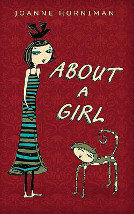
(Age: 14+) Highly recommended. Relationships, Same sex
relationships, Love, Depression. You know that feeling you have when
you come across a book so well written that you want to read it
again - straightaway? Well this is one of those, so I was very
surprised to turn to the publication page and see that it was first
published in 2010. How did I miss it?
Anna's father has left the family without warning, moving in with
his much younger lover, a girl to whom Anna is physically attracted.
This combined with the instability at home as her abandoned mother
tries to rebuild her life with her two daughters, reduces Anna's
belief in herself.
And then something happens which further undermines her confidence,
causing her to suffer a serious bout of depression. She drops out of
uni and finds a job in a bookshop in Lismore. Here she begins to get
her life back on some sort of even keel, and despite not looking for
love, finds it in Flynn. The story of their relationship is achingly
real, tender and all encompassing, as Anna slowly reveals her past
to her lover. But Flynn also keeps herself close, so much so that
Anna can never be sure that she will still be there, and when she
invites her to move in with her in her small apartment, Flynn is
forced to reveal her secret.
The girls share their lives, the stray cat that insists on sleeping
on Anna's bed when Flynn is there, the teapot called Lavinia, the
sharing of bathers when they go to the beach, the meeting of Anna's
mother and disabled sister when they visit. And when they split,
Anna is more certain, more sure that life holds meaning and a
future.
This is a wonderful story of two girls, their shared love and what
happens when love is gone and set against a background familiar to
many readers.
Fran Knight
Editor's note: This is still in print.
Shortlisted, 2011 Prime Minister's Literary Awards, Young adult
fiction
Shortlisted, 2011 Children's Book Council of Australia Book of the
Year - Older Readers
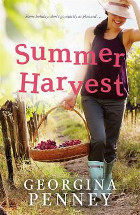
Summer harvest by Georgina Penney
Penguin Books Australia, 2016. ISBN 9780143797081
(Age: Adult) Romance. Illness. Beth Poole is a dog trainer, whose
life has been turned upside down after a life threatening illness
and the desertion of her husband. Her grandmother, obsessed with
Australian soaps, sends her off on a holiday to Australia, but it is
not to the east coast of her TV shows, rather it is to Western
Australia. Beth decides to make the most of it and books an extended
holiday at Margaret River, hoping to rest but the Hardy clan make it
difficult for her to retreat and Clayton Hardy is the most
interesting of all. Can she overcome the doubts that her past
experiences have given her and learn to trust and love again?
This was a romantic story that flowed beautifully and was easy to
read. Beth's dilemma arising from her past illness grabbed at the
heartstrings as she gradually regained her self-confidence, started
to wear attractive clothes and broke her self-imposed isolation by
making new friends. Clayton Hardy is also an engaging character, who
has hidden depths and fears that he too has to overcome before he
finds his true love. Penney sensitively delves into the ways that
people cope with serious illness and how buried grief can affect
relationships.
The setting of Margaret River, the beach, the wineries with their
delicious sounding wines, the food and moments set in the vineyards
under the moon, brought back memories of a lovely holiday spent
there. Penney's description of the area will certainly give readers
who have never visited the area a desire to do so.
This is an engaging romance that is sure to entertain with its
romance and family bickering, and its underlying serious theme will
also engage the emotions. It reads well as a stand-alone, and people
who enjoyed it will be pleased to know that Penney's previous book,
Fly in Fly out, also features the Hardy family.
Pat Pledger
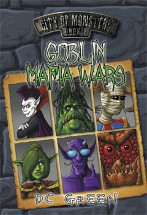
Goblin mafia wars by DC Green
Ford St Publishing, 2016. ISBN 9781925272208
(Age: 12+) You would think that as a royal hume dude your life would
be one of complete luxury not to mention stressfree. Think again! PT
(Prince Thomas of Monstro City) and his Dead Gang friends are
embroiled even deeper in nasty situations and deadly - or is that
undeadly? - circumstances; their quest to find the eggs of the last
dragon, Kalthazar, as well as trying to avert complete goblin civil
war and annihilation of all other species, thwarting the evil plans
of the horrendous Dr Franken, removing the usurper Prince Robbie and
just a few other issues.
Following the toxic altercation at Fire
Mountain with the goblins' attack and Kalthazar's limping
escape to the Isle of Giants, the Gang minus friend Zorg begin a
trek which first of all sees them navigating through the Dead Zone.
Yowsers! This is one extremely bogus territory where even monsters
like the Dead Gang are in very real danger of being exterminated
not least of all by their erstwhile compadre Scarab, the
super-strong mummy gal. She's kind of ticked off about Zorg and
decides that PT in particular is totes responsible.
Surviving this and then a very unnerving train ride back to Monstro
City, the Dead Gang faces yet more monstrous mayhem. While PT
manages to conduct some very delicate negotiations and some highly
skilful bluffing with the rival goblin factions (think Sopranos
style goblins!), his plans are sabotaged by the appearance of a
chocolate popcorn gobbling older/younger idiot savant (without the
savant) brother Prince Robbie. Rumour has it he has been
cryogenically preserved by famous Dr Franken for the past ten years
and not in fact stolen by the Vampire Queen. Looks like vampiric
Stoker is not PT's brother after all... or is he?
And just what is Dr Franken's dastardly involvement with the goblin
factions and the mentally deranged Prince Robbie? How did he get
that dragon egg? And what the web is with all those freaky arms?
Trapped in small cages in the evil doctor's 'hospital' things look
grim for this grimmest - and often grimiest - of gangs, with no
apparent hope of escape. Spoiler alert - yet they do along with an
about-to-hatch dragon egg!
DC Green has provided readers with another rip-snorter yarn about
these highly idiosyncratic monster teens who have their own methods
of solving problems. Their combined abilities and wacky take on
situations along with their staunch support of each other prove more
than a match for their adversaries. High humour rating and all the
excitement of fast-paced action will prove yet again to be a winner
with readers from around 12 and up. If you missed the first volume
you MUST go and get it! Can't wait for the next instalment - write
faster DC! *
Oh and PS completely buzzed about that quote on the back cover!!
Sue Warren
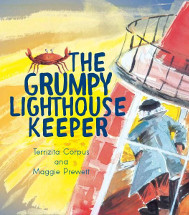
The grumpy lighthouse keeper by Territzita Corpus
Ill. by Maggie Prewett. Magabala Books, 2016. ISBN 9781925360189
(Age: 3+) Highly recommended. Humour. Lighthouse. Beach. Broome. Sea
creatures. When the lighthouse keeper goes out to check that his
light is still shining brightly on a cold blustery night, several
animals crawl from the beach and into his warm snugly bed. As each
comes from the beach, the same format on each page is used,
encouraging children to predict the words that will follow as
another animal appears. Cassius the crab, Trev the turtle, Jacob the
jellyfish, Olena the octopus and Bruce the bluebone take their place
inside the lighthouse keeper's cottage.
The bright, vivid illustrations show the readers each of the animals
and will encourage the readers to try their own skills at
representing these sea creatures.
When the lighthouse keeper returns of course, readers again will
predict his possible response, laughing merrily at his insistence
that the animals leave his bed, then finding it too damp to now
sleep in himself. A solution is found however, although readers will
know that he has missed out on his comfortable bed on such a cold
night.
Readers will laugh out aloud at the antics of the animals, knowing
that a bed is probably the last place they would want to be but
seeing the humour in these creatures taking shelter. All the while
students are reminded of the sorts of sea creatures to be found in
Broome and the history of a local historical spot. I loved it.
Fran Knight
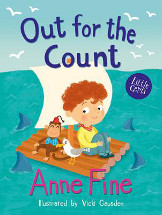
Out for the count by Anne Fine
Ill. by Vicki Gausden. Barrington Stoke, 2016. ISBN 9781781125076
(Age: Emerging readers) Like many children, Hugo would really like a
pet - in his case, a gerbil. He raises the issue again with his dad
just as he is finishing the repainting of Hugo's room. Even though
his father acknowledges that Hugo would probably look after it very
well, he is not a fan of keeping things in cages and so the answer
continues to be 'no'. However, there may be a compromise. Hugo works
out that the gerbil would only be in the cage for seven hours during
the time he is at school, so his father suggests that Hugo
experiences that by staying alone in his now empty room for the same
time.
Hugo accepts the challenge and at midday with just the newspaper
already spread on the floor, a snack, three chosen toys (a ghost
puppet, a bucket of bricks and a monkey on a stick) and his watch, he
enters the room to stay alone for seven hours. And even though he
also has what gerbils don't - an imagination - the time creeps by so
slowly it seems like it stands still. Will Hugo last the seven
hours?
This is an entertaining short story for emerging readers written
some time ago but repackaged for the Little gems series which is
deliberately designed to support students with dyslexia. The font is
'dyslexia-friendly' helping those who confuse letter shapes to see
them more clearly and spaced to minimise confusion; the pages are
tinted and the paper thicker so illustrations are not 'shadowed' on
previous pages; the stories short but engaging; and the book is just
right for small hands to hold and read alone. Plots are linear and
the language and its structure less complex than in other stories
for a similar age group. 'This process was developed by dyslexia and
speech and language experts in response to research and feedback
from thousands of readers on hundreds of Barrington
Stoke manuscripts over the years.'
Dyslexic or not, Out for the count is entertaining, witty
and wise and will spark lots of conversations about people's need to
confine animals to cages and the 'rightness' of this.
Barbara Braxton
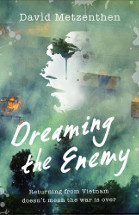
Dreaming the enemy by David Metzenthen
Allen and Unwin, 2016. ISBN 9781760112257
In what appears to be based on the Battle of Coral which took place
during the Vietnam War, Johnny Shoebridge, a conscripted Australian
infantryman endures unspeakable terror defending a 'Firebase' of
artillery and mortars. The Firebases enabled significant targets
such as supply routes to be shelled and also offered support to
infantry if powerful enemy forces were contacted.
When hordes of North Vietnamese soldiers and Vietcong guerrillas
attack a newly positioned and inadequately prepared Firebase on the
first night after it was set up, Johnny and his mates Barry and Lex
must fight desperately in their infantry units which were placed to
defend the guns.
I liked this story for many reasons, not least because the
reader is transported to a place where the gut wrenching fear is
almost palpable and the crescendo of explosions and screams is
overwhelming. Most important however, is the fact that this is
achieved without any glorification of war.
The story is told in a series of flashbacks in civilian life when
Johnny is trying to adjust to being an ordinary person after
returning from military service. The flashbacks not only recount the
experiences of Johnny and his mates but he also displays an acute
awareness of the service and suffering of the enemy in his dreams
about a wounded and traumatised soldier 'Khan'.
In trying to connect with people, Johnny has no control over the
memories and dreams which flood his waking moments, to a point where
at times he loses track of what is real. The theme of mateship is
omni-present in Australian war literature and the concept of
soldiers having a far greater fear of letting their mates down than
dying themselves is clearly very real. Metzenthen has created an
authentic story which I feel would meet with approval from those who
served, on the grounds that the detail is accurate, the humour is
realistic and there is a profound respect for the soldiers from both
sides which is unwavering even when pointing to the insanity of the
war itself.
The author emphasises that what the Australian, New Zealand and
American service men endured was so immense and significant that it
was literally life changing, often permanently and all too often
being terribly destructive in terms of physical and psychological
injury. Without insulting these individuals in any way however, the
author questions this terrible suffering against the outcome of the
war. Metzenthen also reveals the war and post-conflict experience of
the North Vietnamese people, who saw only that their country was
invaded. The unequal nature of warfare between lightly armed
guerrillas and the almost unbelievable might of Western firepower is
considered with great sensitivity. The reader is left with the sense
that after all the civilian and military deaths, all the injuries
and the unspeakable destruction and poisoning of the environment,
the outcome was pretty much the same as it would have been if the
war had not been waged.
Rob Welsh
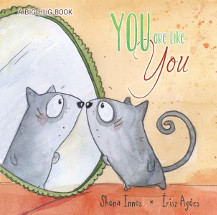
Big hug books by Shona Innes
Ill. by Irisz Agocs. Five Mile Press, 2016. Worries are like clouds. ISBN 9781760400729 You are like you. ISBN 9781760400712
(Age: 4+) Mental health. Depression. Identity. Two more in the
series, Big hug books gives us a book about worrying and one
about identity. As with the others in the series, they aim to give
teachers and parents a starting point of discussion with a class or
children at home. Simply told, they are all obvious in their themes,
and clear about their aim. A page of information about how to use
the books appears at the end of each story. Worries are like clouds tells the reader that many days are
happy, filled with laughter and are carefree, while others are dark
and gloomy and sometimes they would prefer to stay in bed with the
bedclothes over their head. The gentle text tells the reader that
this is normal, that everyone has good and bad days, happy and sad
days, bright sunny days and days with clouds. It goes on to tell the
reader that there are ways to overcome these gloomy days and then a
number of pages are devoted to outlining strategies to deal with a
cloudy day. These would make a great discussion point in the
classroom. You are like you takes the same approach as the others in the
series, with half of the pages devoted to positive images of what
make you, you. Then a number of pages give the negatives sides of
life, people may annoy you, you may feel out of sorts, and so on,
and the author then gives strategies to overcome the negatives.
Again this provides a starter for discussion amongst children, in
the classroom or at home with a simple direct text and accompanying
illustrations.
Fran Knight
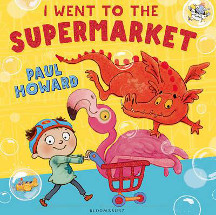
I went to the supermarket by Paul Howard
Bloomsbury, 2016. ISBN 9781408844700
(Ages: 3-6) This book is based on the popular memory game of the
same name (I went to the supermarket and I bought... ) and shows
a young boy and girl competing to remember everything they add to
the shopping list. However, they don't buy chocolate, chips and
chicken at the supermarket... they buy dancing aliens,
fire-breathing dragons and fearsome Granny pirates. As happens in
the real-life game, someone forgets an item and the game comes to an
end (in this case with a mountain of jelly going SPLAT!).
The sparkly, fantastical cover featuring a boy with underpants on
his head pushing a flamingo and a dragon in a shopping trolley will
draw children in. The larger-than-life, crazy illustrations inside,
packed with characters, colour and interesting and varied fonts,
will keep them engaged. This will stimulate the imagination of young
children, many of whom will love reading along and trying to
remember everything on the shopping list. It might even become a
favourite game for them to play themselves.
Nicole Nelson
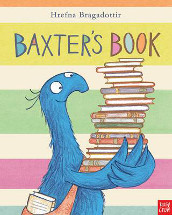
Baxter's book by Hrefna Bragadottir
Nosy Crow, 2016. ISBN 9780857635211
(Age: Preschool - Yr 2) Baxter adores books. Books about scary
wolves, brave lions, cuddly bears, cute little rabbits. He loves
stories so much his greatest wish is to be in a one too. As he comes
out of the bookstore laden with new purchases he spots a sign for an
audition to be in a storybook. This is his dream come true! He is SO
excited but when he joins the very long line of characters waiting
to show their talents, he realises all have been in storybooks
before - except him. But he is convinced of his talents - he can
sing, dance, act and do gymnastics - so goes forth undaunted onto
the stage as the first performer. Imagine his disappointment when
the judges dismiss him because they just don't know what he is. He's
not a scary wolf, a brave lion, a cuddly bear, a cute rabbit or even
a hungry crocodile and when he tries to be like them, he fails. Why
is being himself not enough?
This debut picture book from Icelandic author Hrefna Bragadottir is
quite charming with its lovable main character (who is a totally
original concept) who is prepared to follow his dream but finds
himself not accepted because he's different and doesn't fit the
stereotype of a storybook character. As a story in itself, with soft
pastel pictures that take the edge off his rejection, it is a
stand-alone but there is greater depth here than just a single read
because it raises all sorts of questions about stereotypes - are
wolves always scary and rabbits always cute? - as well as being true
to oneself, tolerating difference and all those other relationship
issues young children encounter when they step into the bigger world
of preschool or big school for the first time. Venturing into the
unknown always raises some questions of self-doubt and when things
don't go as anticipated there can be all sorts of ramifications. The
heart-warming ending to the story will bring reassurance and
recognition and Baxter will never be an oddity again! Young readers
will delight in identifying the characters they know like the three
little pigs, but there's also scope to investigate other stories
that feature the creatures - perhaps make lists and displays to
inspire wider reading - and compare and contrast each character with
the stereotype. Character analysis in preschool!!! For those a
little older it could lead to discussions about preconceptions and
misconceptions we have about people and start to break down some of
the barriers that are already in place even at this age. Baxter's book is a perfect example of children learning about life
through literature and why we need to keep sharing such wonderful
stories.
Barbara Braxton
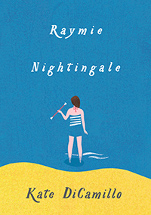
Raymie Nightingale by Kate DiCamillo
Candlewick Press, 2016. ISBN 9780763681173
(Age: 9-12) Recommended. Family breakdown. Friendship. Meaning of
life. Loss. Kate DiCamillo is renowned as a two-time Newbery
Medallist, as author of the Tale of Desperaux and Flora
and Ulysses. In this, her latest book, she uses the
inspiration of her own childhood memories to tell the enigmatic tale
of Raymie Clarke who believes that if she wins the 'Little Miss
Central Florida Tire competition' she might be able to entice her
father back home (he has left town with a dental hygienist and is
currently out of her life completely). With childish logic, she
needs to add baton twirling and good deeds to her 'resume' for her
competition entry, and meets two other girls who are also entangled
in pursuit or sabotage of the Little Miss Central Florida Tire
title. The challenges of friendship, and understanding the world
around her and the wisdom of adults come to the fore as she grapples
with life, loss and the big questions of existence. Keeping life's
batons twirling can be very difficult. There are some curious adults
within her circle of contacts, and her new friends are also
extremely unique.
This is a quirky tale that highlights that children can sometimes
feel that they need to solve the problems of their world or are
unaware of the consequences of their choices; problems that from an
adult or psychological perspective should never be borne by a child.
It is a simply written tale, and the naivete of the children and
their responses to poverty, marriage breakdowns, death and their own
difficult circumstances are dealt with in a gently humorous way that
makes the story entertaining and accessible for a young reader.
Carolyn Hull
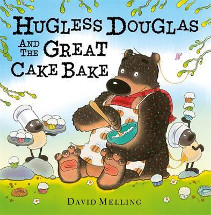
Hugless Douglas and the great cake bake by David Melling
Hugless Douglas series. Hodder, 2016. ISBN 9781444919882
(Age: 5+) Recommended. Cooking. Humour. The series of Hugless
Dougless books has created a large fan base, and this, the
fifth in the stories about the bear, will be well received. Douglas
is big warm and friendly, staring out at the reader as he involves
himself in one adventure after another, adventures which all readers
will recognise.
With a nod to the many cooking shows on our small screen, this time
Douglas follows the trail of honey to find a group of sheep
collecting the ingredients they need to make honey cakes. The black
faced sheep don his apron for him, and pass down all the food they
have collected, as he offers to be involved as well. The process for
making the cakes is followed in the story and the mixture eventually
made, with admonishments about not eating the mixture before it is
cooked.
But as the group stands in line with their plates waiting for the
cakes to be taken from the oven, a food fight beaks out and Douglas
is so involved that he misses the cakes. When he realises what has
happened they have all been eaten. Still hungry he must eat the
rejects, the carrot and nuts, but finds them to his liking, even
though they are not topped with honey.
This is an easily absorbed story of cooking cakes, of the process
involved, of the etiquette of cooking and eating what has been
cooked, of waiting your turn, and of the idea that vegetables and
nuts can be as good as cake.
Fun filled illustrations will drag the readers' eyes along the
pages, following the antics of the black faced sheep and Douglas.
Fran Knight
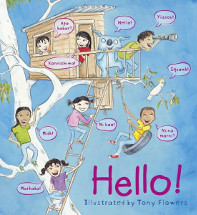
Hello! by Tony Flowers
NLA Publishing, 2016. ISBN 9780642278876
Look at your school population. Are all the children native English
speakers? Or is there a mix of languages almost as diverse as the
children themselves? In my Collection Policy for the school I was
recently working in, under the heading Purpose and Role of the
Collection I included the clause 'provide a wide range of materials
on all levels of difficulty, with a diversity of appeal and the
presentation of different points of view including those that
reflect the lives of students in relation to their culture,
ethnicity, language, religion and beliefs, community and family
structure, sexual orientation and any other consideration' and this
new publication from the National Library of Australia fits the
language aspect of this perfectly.
Superbly illustrated in cartoon style by Tony Flowers and presented
in a clear uncomplicated layout, we meet twelve Australian children,
each of whom speaks a different language including Kala Lagaw Ya
from Badu Island in the Torres Strait; Kaurna from Tarntanya in
Adelaide; and Murrinhpatha from Wadeye in the Northern Territory as
well as the more common languages of Italian, Thai, Korean, Greek,
Vietnamese, Japanese, Indonesian, and Chinese. Even the Lebanese
version of Arabic is included and there is a pronunciation guide at
the back of the book to assist the reader but which has been
dovetailed to meet needs rather than being a linguistic reference.
Each child has two double spreads so as well as introducing the
reader to the word for 'hello' in each language, each then shares a
little of their life including favourite foods, special days,
costumes, musical instruments, games and activities and how to count
to ten and each of these is then highlighted at the back of the book
with photos available in the NLA.
As much as the children I was working with last year loved to
practise and share their new skills in English, their faces always
lit up when they discovered a resource written in their own language
or which was about their own country. They were so happy to see
something familiar amongst the unfamiliar and loved to show it to
their friends and then take it home to share with their families. So
this wonderful resource is sure to strike a chord with so many of
those in our care. Apart from the familiarity it also demonstrates
that we acknowledge and value their origins by having resources for
them available. Seeing yourself in a book is such an affirmation of
who you are.
There are so many opportunities within the Australian Curriculum and
within the calendar to investigate and celebrate the origins of the
children in our classes that this book could be in use all year.
There are comprehensive teaching
notes which include how to make some of the items featured by
the children; but I can envisage it being a pivotal text for
this year's Book Week theme - Australia: Story Country. Make it
model for the children to tell their story by producing a poster and
display for the library to be hung in honour of their country's
national day. This was one of the most popular displays that
attracted so much interest from parents and teachers as much as from
the students. They really valued the recognition.
Barbara Braxton
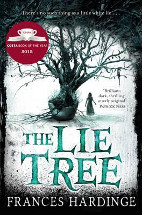
The Lie Tree by Frances Hardinge
Macmillan, 2015. ISBN 9781447264101
(Age: 13+) Highly recommended. Mystery. Lies. Truth. Fantasy. Costa
Book Award for Children's Book (2015), Carnegie Medal Nominee
(2016), Costa Book of the Year (2015), YA Book Prize Nominee (2016).
When Faith's father is found dead at the bottom of a cliff, she is
determined to find out what has happened to him. Her mother and
uncle drag his body into the orchard, and Faith refuses to believe
that he has committed suicide. She reads his journals and finds
references to the Lie Tree that he has hidden in a cave, a tree that
feeds off lies and reveals hidden truths when lies are fed to it.
She begins to spread lies across the island and the truth begins to
appear.
Dark and demanding, this is not a book that can be read in one
sitting. Rather, it is one to savour over a period of time, think
about and return to when ideas have begun to meld into
understanding. Perhaps one of the most interesting themes of the
book is its well-researched background about Victorian science and
the gathering of fossils, the role of women in Victorian times and
Victorian funeral customs, including taking photos of the dead. The
reader is drawn into the lives of Faith and her mother, both
constrained by attitudes to women of the time. Faith desperately
wants to study natural science and to be recognised by her father,
but that is not something that is acceptable for girls living in
that time, while her mother is forced to act as the helpless lady,
needing a man's protection, to get any stability for her family. The
final chapter is a wonderful summary of the difficulties that Faith
will face, but the effect that her efforts could have on 'some later
girl'.
The idea of a Lie Tree is a compelling one, and the reader is
dragged along into the consequences and nastiness that result from
the lies that Faith feeds the tree in her efforts to find who has
murdered her father. She not only lies, but attempts to
scientifically and rationally analyse the physical and dream
evidence that she finds in order to work out the mystery. She is
helped along by Clay, whose photography skills not only let the
reader know about funeral customs, but also help to uncover the
truth.
Hardinge has an original voice and mature and intelligent readers
will find much to savour in The lie tree.
Pat Pledger
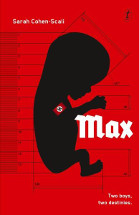
Max by Sarah Cohen-Scali
Text, 2016. ISBN 9781922182852
(Age: 16+) Recommended. This book, first published in France, has
won awards in Europe. It is well researched and covers a period in
history marked with cruelty and evil.
Max is a product of the 'Lebensborn' (Fountains of Youth) program.
This program was designed to produce perfect blonde, blue-eyed
members of the Aryan race to regenerate the Reich. His story spans
the years 1936 to 1945 and begins with Max in utero.
Max brings to life the ideals, thoughts and motivations of the
Hitler Youth. He explains the atrocities and evil practices with a
complacency and coldness that is at once confronting, brutal and
illuminating.
At regular intervals the author calls to the attention of the reader
the age of the narrator (foetus, 3 months old, or one year old).
This at times interferes with the flow of the reading, jarring the
reader, as the writing is infused with well researched historical
information and adult perspectives.
The book is confronting as it portrays the complacency of some
caught up in the holocaust, their moral choices and the battle waged
by good over evil. The themes of friendship and identity are
explored through the unlikely relationship that develops between Max
and Lukas (a Polish boy). There is an adult insight into the moral
dilemmas faced by everyday people as they grappled with a situation
that was tumbling out of their control. There is a poignant section
at the end of the book where Max is oblivious to an opportunity for
love and redemption that will have adults reaching for the tissues.
Linda Guthrie
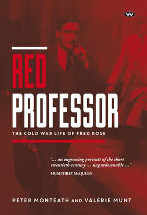
Red Professor: The Cold War life of Fred Rose by Peter Monteath and Valerie Munt
Wakefield Press, 2015. ISBN 9781743053720
(Age: 14+) Recommended. This book is written by historians based at
Flinders University in South Australia. The work is extensively
researched and leans heavily on the numerous primary sources that
document the life of this relatively unknown player in Australia's
history.
Fred Rose is a little like Forest Gump in that he seems to have
popped up in a range of important times in history during his
lifetime. The writing gives the reader the impression that Fred Rose
is very impressed by his own importance. It may be this that lead
Colonel Spry of ASIO to identify him as a Soviet spy who went by the
code name 'Professor'.
Fred's life spans several continents and encompasses work as an
anthropologist on Groote Eylandt, a meteorologist, an academic in
Canberra and East Berlin, a champion of the rights of Australia's
indigenous people and a father informing on his children to Stasi
handlers. He is portrayed as a flawed human being who made
interesting decisions that charted a life that has ultimately left
more questions than answers. Would his life have been more positive
and more productive had he made different decisions? Perhaps so.
The historical information is a real treat for those interested in
more about those heady times during the Cold War and the Petrov
Affair. Though brimming with historical facts (including diaries and
archival material), this book is easy to read. The referencing style
is cumbersome for those readers interested in identifying the source
of information or quotations and this at times disrupts the reading.
This work is well suited as a resource for the Research Project and
History students.
Linda Guthrie