Picador, 2016. ISBN 9781743534908
(Age: 16+) Highly recommended.
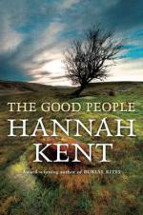
This is the second book from Hannah Kent, whose award winning first
novel 'Burial rites' received great acclaim. That novel, based on a
true story, was set in the cold bleak environment of northern
Iceland in 1829 and told the story of Agnes Magnusdottir condemned
to death for murder. This latest book 'The good people' is about
another 'dark happening in a cold place' and is set in 1825 in
south-west Ireland at a time of poverty and hunger and fearful
superstition. Kent immerses us completely in the hard frugal lives
of the people trying to eke out a living with potatoes and the milk
from the cows when available, living in windowless cabins under
thatch rooves with dirt floors and soot stained walls from the
hearth fire.
We are drawn into the lives of three women gathered around a strange
child - they are Nora, the distraught widow left to struggle on her own with
the care of her grandchild; Mary, the young girl who has left a home
with too many mouths to feed, taking on chores with Nora for the
sake of food and shelter; and Nance, the mysterious old woman at the
edge of the village, she who consorts with the 'good people', the
fairies who wreck havoc with people's lives.
Nance knows the special herbs and cures. People furtively seek out
her help with their troubles, careful to avoid the anger of the
disapproving local priest. But when one misfortune follows another,
and there are signs that the fairies have been about, fear and
distrust leads to rumours about her. Is there an evil spirit amongst
them, is it the child, or is it Nance, or are all three women
involved in something bad?
The world of Nora, Mary and Nance and the surrounding villagers is
very real. Kent has thoroughly researched every detail, and she
brings it all alive - the austere lives, the dirt, the smells, the
struggles and fears, the bitterness and spite, even the language of
the time. The book held me to the very end - it is an intriguing
story that leaves us, like the villagers, with still a few questions
lingering in the mind.
Helen Eddy
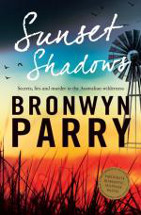
Sunset shadows by Bronwyn Parry
Goodabri bk. 3. Hachette Australia, 2016. ISBN 9780733633317
(Age: 15+) Recommended for fans of romantic suspense. This is the
third book in the Goodabri series, following Dead heat
and Storm
clouds, but could be read as a stand-alone although as
with all series, some background is given in the previous books.
Steve Fraser and Tess Ballard, both police officers, save the lives
of 50 cult members but put their careers on the line when it appears
that one of them may have killed the cult leader. One of the cult
members is Steve's sister who has two children, and he finds himself
having to deal with long buried family issues while trying to
protect them. Tess, too, is hiding secrets from her past and has to
confront the feelings and the danger that she is facing because of
the cult.
Readers will enjoy the vivid descriptions of the Australian bush and
the small country towns of northern New South Wales, as Parry brings
to life what it is like to live in outback Australia. Her
descriptions of cult life and the effect that it has on its members,
even when they have managed to escape the confines of that system,
are quite harrowing and bring a depth to the story that elevates it
above the average romantic suspense story. There is much tension and
excitement as the pair trail the cult leaders and drug dealers
through the bush.
Readers who have read the first two in the series will be happy to
follow the story of Steve Fraser and the unexpected conclusion to
his troubles, and Tess is a gritty heroine, whose determination to
overcome her past is engaging.
Bronwyn Parry has won awards for her romantic suspense stories and Sunset
shadows will not disappoint her fans.
Pat Pledger
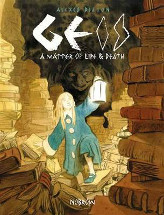
Geis: A matter of life and death by Alexis Deacon
Walker Books Australia, 2016. ISBN 9781910620038
(Age: Upper primary + ) Highly recommended. Geis: (genitive singular geise,
nominative plural geasa)
1. a solemn
injunction , especially of a magical kind, the infringement of
which led to misfortune or even death
2. a tabu , spell or prohibition
This is going to tick a lot of boxes for quite a number of your
readers. Firstly, it is yet another sumptuous graphic novel I have
had the pleasure of receiving recently. Secondly, it is supernatural
AND historical AND fantasy. Finally, it is the first in a trilogy so
readers who love the continuation of a saga will really go for it.
The matriarch chief/ruler of an island lies dying and has no natural
heir. She summons her strongest magic ever. One of you I will spare. For the rest I claim you all! Your
hearts will beat to feed my magic, your bodies will be shells for
my puppets and my slaves, your minds will be shattered and broken.
Fifty souls are called in the night for a contest that will
determine the one worthy of taking her place. This is a trial like
no other and begins the first task.
This is another first novel and I predict the start of an amazing
career for Alexis who graduated in 2001 from the University of
Brighton with a first class Honours in Illustration.
Definitely a name to watch - this is highly recommended for readers
from Upper Primary onwards.
Sue Warren
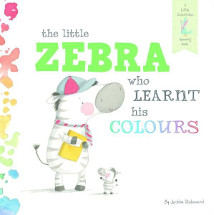
The little zebra who learnt his colours by Jedda Robaard
Five Mile Press, 2016. ISBN 9781760402860
(Age: 3+) Recommended. Early learning. Colours. Flowers. Lift the
flap book. A large board book to teach younger readers their colours
with humour is presented in this new release from Five Mile Press.
Zebra loves to paint, so adorned with his painting easel, smock in
the form of a perky scarf and paints, he sets out to paint his
garden. He paints red poppies, blue forget-me-nots, yellow
buttercups, pink tulips, and finds a strange green vine to climb.
Then he paints some white water lilies, purple lavender and orange
marigolds until his final painting is a mass of colour, delighting
all who survey it.
Each page is illustrated in soft water colours showing Zebra at his
task, repeating the colour to be learnt and the flowers that reflect
this colour.
Zebra's painting skills invite the young reader to look more closely
at what is being shown, and they will soon identify the colours and
flowers on each page, lifting the flaps on some of the pages to see
what is underneath.
This makes an easily understood introduction for younger readers to
learn their colours.
Fran Knight
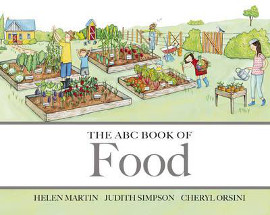
The ABC book of food by Helen Martin and Judith Simpson
Ill. by Cheryl Orsini. ABC Books, 2016. ISBN 9780733334269
Just as cars and trains and boats and planes need fuel to keep them
going, so do our bodies. But while vehicles need only one sort of
fuel, our bodies operate best on a variety of foods from a variety
of sources so that all its myriad parts can operate with maximum
efficiency. Many young children, particularly those who live in the
cities, go to the supermarket with their parents and carers and see
their food being bought but they don't often realise how it has got
to be on the shelves in the first place.
This story-in-rhyme helps to explain the process and the journey
from paddock to plate of some of the more common foods the children
eat. Starting with breakfast where eggs and milk are tracked,
different staples for each meal are investigated in a series of
clear vignettes that helps the very young child understand the
connection between what they eat and where it comes from.
Using familiar scenes such as the breakfast table, a picnic and a
family dinner there are many foods on display and while only a
couple are featured in the explanations, there is plenty of scope to
consider where others might come from. If the bananas start on
plants, what other foods in the pictures might come from plants?
Would they have a similar journey? What about the cupcakes or the
sausages?
There is also a page devoted to the common foods that some people
cannot eat which makes food intolerances more 'mainstream' and
perhaps better understood.
This book is an opportunity to start children thinking about
what they eat, what the best choices might be, sorting them into
food groups, identifying and graphing not only their favourites but
also mapping what they eat each day and maybe changing the
proportions if their pie graph is a bit skewed. It might even be the
beginning of the child's desire to produce their own food either in
a home or school garden as well as introducing plant life cycles and the
notion of seasonal produce. Even sharing recipes and following
instructions to make them could be a popular activity - all adding
to their understanding and interpretation of information.
This is the latest in this series of excellent titles which helps
our very young children begin to understand the world around them as
well as helping them understand the differences between fiction and
non fiction.
Barbara Braxton
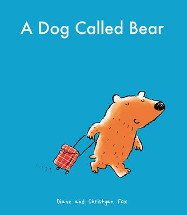
A dog called Bear by Diane and Christyan Fox
Faber, 2016. ISBN 9780571329434
Lucy has always wanted a dog and has read all the books about them
and saved her pocket money to buy all the stuff that a dog needs.
And so she begins her search... not at a pet shop but in her
neighbourhood. First she encounters a frog who pleads his case but
he does not meet Lucy's requirements. Neither does the fox. But Bear
seems to and because it's late and she's tired, she decides he will
be fine.
It's an unlikely partnership but it works until Bear did what bears
do in winter - hibernate. Lucy was not pleased. She not only wanted
a full-time dog but also one that lived up to her expectations, not
one that was messy, dug a lot and and ate so much porridge. Bear
wasn't happy either - carrying sticks, repeatedly fetching a ball
and being woken up were not his ideals. And so he runs away...
This is a charming story about what it means to have a pet and what
our expectations of them are. It would be ideal for starting a
discussion with very young children about the sorts of creatures
that make a suitable pet and what is required to take care of them -
it's more than lots of cuddles and snuggles.
One for the little ones in our lives.
Barbara Braxton
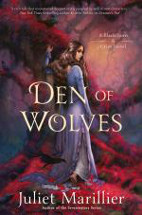
Den of wolves by Juliet Marillier
A Blackthorn and Grim novel. Macmillan, 2016. ISBN
9781743535738
(Age: 15+) Highly recommended. Fantasy. Another stunning read from
Juliet Marillier is sure to delight fans and new readers alike.
Blackthorn has been asked to help Lady Flidais look after a young
woman, Cara, who has been sent to her by her father. Meanwhile Grim
has been given the task of working with Bardan, a wild strange man,
to rebuild a heartwood house deep in the forest belonging to Cara's
father. Both soon realise that all is not well. Blackthorn's past
begins to catch up with her when her old enemy Mathuin attacks the
holdings of Lady Flidais' parents and it is difficult for her to
remember that she has taken a vow to seek no vengeance. Grim is
troubled by the way that Bardan is treated and suspects that there
are many secrets being kept at Wolf Glen. Grim and Blackthorn both
have to make a heart wrenching choice: to stand together or to fight
their battles alone. And what they decide could really influence the
fate and happiness of the young woman, Cara.
Told in alternating chapters by Blackthorn and Grim, each story
builds up suspense as a sense of doom spreads. For Grim, there is
mystery surrounding Bardan's background and where he has been hidden
for many years. It is strange that Cara is sent away so soon after
his arrival at Wolf Glen, and the reader is left wondering about the
significance of the heartwood house, which is made of different
woods in a certain order. Blackthorn finds that she misses Grim's
patience and solid support when he is away, but knows that both have
responsibilities that must be fulfilled. The reader hopes that
Blackthorn can keep her bond but it is obviously so very difficult
for her to do that as she wrestles with stopping the evil Mathuin or
helping Cara and Grim.
With her trade mark mix of fairy tale and historical fantasy,
Marillier brings to a very satisfying conclusion the dilemmas that
both Blackthorn and Grim face. Their complex relationship also
grows in a rewarding and fulfilling way and the reader is left
feeling content with the series, but hopeful that they will solve
more mysteries together in the future.
This was an outstanding story and I hope that there will be more
Blackthorn and Grim adventures in further books.
Pat Pledger
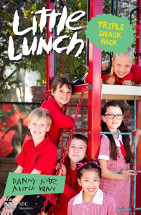
Little lunch: Triple snack pack by Danny Katz
Ill. by Mitch Vane. Little lunch series. Black Dog Books,
2016. ISBN 9781925381276
(Age: 7+) Highly recommended. Humour. Schools. Three stories are
combined in one volume in this offering from Katz, the stories of
the fifteen interval in the school's morning session making
wonderful reading for the newly independent reader. His stories are
always recognisable, they concern things that all kids can relate
to, their backgrounds and the interplay between students are something most
readers will have experienced. The familiarity of the tree in the
school yard evoking different responses from several groups of kids
is given full reign in the first story 'The old climbing tree', where
some children love the old tree, talking of things they have done
with it over the years, while one student in particular wants it
knocked down because it forms a hazard. How will the two opposing
points of view be resolved?
The second is just as engrossing as the twins leave school without
anyone knowing why. The corridor outside class 6E becomes a whodunit
as the kids try to work out what has happened to their friends,
using the flimsiest of details to form the most exciting of stories,
revealing how gossip begins.
And the third, 'The relationship', will intrigue and surprise
the readers as the group so well known now from the television
series is in turmoil as a grade six girl asks Rory out.
The stories are short and with funny illustrations, larger print and
some words emphasised with a different font, all adding to an easy
to read snack pack of tales to absorb.
Fran Knight
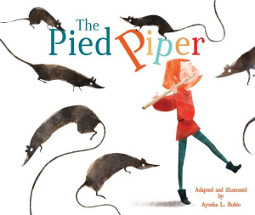
The pied piper, adapted and illustrated by Ayesha L Rubio
Five Mile Press, 2016. ISBN 9781760400477
(Age: 4+) Fairy tale. Pied Piper. Responsibility. Rats.
Reconciliation. Cautionary Tale. A quite different telling of the
story of the Pied Piper is told with stunning watercolour
illustrations. Rats have taken over the town of Hamelin and the
Piper, hearing of their plight, offers to help. The Mayor is so
enthralled that he offers him three sacks of gold. The Piper plays
his pipe and the rats follow him out of the city, but when the Piper
returns to take his reward, the Mayor refuses him. He discusses the
problem with the rats, who are by now his new friends, and they
return to the town and let the children know of the Mayor's
duplicity. The children decide to leave the town and not return
until the debt is paid. The parents finding their children's beds
empty, demand the Mayor leave, and go to the vaults to find the
money to pay the piper. Another twist to the usual story adds a
level of reconciliation to the already loved cautionary tale of
paying your debts. I love the humorous impressions of the town and
the rats, and the Mayor looks so oily!
Fran Knight
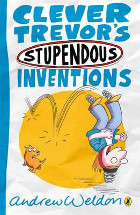
Clever Trevor's stupendous inventions by Andrew Weldon
Puffin, 2016. ISBN 9780143309154
Clever Trevor's name is not really Trevor. It's Stuart. But nothing
rhymes with 'Stuart' and because he is so clever - he invented and
built the Rabbit Brain Booster out of his dad's old computer and a
car battery - his friends have renamed him Trevor. But for all his
cleverness Trevor was still failing at school, especially this year
with Mr Schmedric. Nothing Trevor submitted for his assignments met
Mr Schmedric's expectations - but then Mr Schmedric was one of those
teachers who thought there was only one way to do anything. He won't
accept Trevor's inventions as acceptable solutions for assignments
and bullies him mercilessly. He is the epitome of a nightmare
teacher - and thankfully one that no student will ever meet.
So you can imagine Trevor's shock when he discovers that Mr
Schmedric is not only confiscating his projects but he was selling
them... and making a lot of money, which he makes sure Trevor
knows about. So Trevor and his friends hatch a plot to get their own
back, but Mr Schmedric is smarter than they give him credit for.
When he threatens to make Stuart repeat his class next year, they
have to come up with a new plan...
This is another very funny book-length cartoon from the talented
Andrew Weldon. We first met Clever Trevor as a friend of Steven, in
The Kid with the amazing head, and now he comes into his own.
It is an engaging tale which brings up all sorts of issues about the
ethical use of information and ideas as well as the concept of
power. Can authority be misused? Is it possible for the underdog to
win? Can brains overcome brawn?
Younger readers, particularly the boys and those who are reluctant
readers, will enjoy this story in its very accessible format and
will be eagerly awaiting a new adventure from this talented creator.
And in the meantime they can use the makerspace to create their own
great invention!
Barbara Braxton
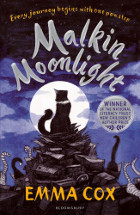
Malkin Moonlight by Emma Cox
Bloomsbury, 2016. ISBN 9781408870846
(Age: 9+) Highly recommended. I actually finished reading this a
couple of weeks ago and the writing of this review has taken so long
because this is so different and so charming I have found it
difficult to find the right words. I could just say it's an animal
adventure story but it is so much more than that. It really puts me
in mind of such titles as Watership Down or even Mrs
Frisby and the rats of NIMH. Rarely does one read an animal
story which truly projects the protagonists as completely sentient
thinking creatures.
A small kitten loses one of his nine lives when he narrowly escapes
drowning along with the rest of his litter. Little does he know but
he is destined to become a hero. The Moon recognises this and
blesses him with her naming of him 'Malkin Moonlight'. This small
feline with a huge and magnificent tail has an acute sense for the
distress of those in need and quickly loses another life in the
first of many rescues.
On his third life, he is rescued in turn by a Domestic named Roux.
Together these two form an unbreakable bond and fall in love. Roux
chooses to abandon the comforts of domestic living and runs away
with Malkin. As they search for a new home they come across a
recycling centre populated by cats who are divided into two warring
camps: those on the 'good' side of the centre where they have
accommodated themselves comfortably and are cared for by the
workers; and those who lurk on the toxic dump site over 'the wall'.
Only Malkin can unite these two factions and create a peace that
will last forever. The adventures and dramas along the way are
gripping and tense but the love, respect and true compassion of this
singular cat and his friends are a remarkable lesson for all
readers.
This first novel is destined to become a modern classic in my
opinion.
Highly recommended for readers from around 9 years up.
Sue Warren
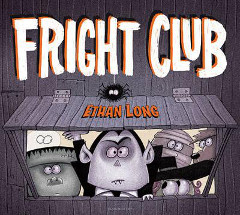
Fright Club by Ethan Long
Bloomsbury, 2016. ISBN 9781681190433
This is one of the cutest board books I've seen for ages. Forget
about sweet and pretty - this one is just in time for Halloween and
a fun story for little people.
The local Fright Club led by Vladimir the vampire is busily
practising their 'ghoulish faces, scary moves, chilling sounds' in
their clubhouse when there comes a knock at the door. A sweet fluffy
bunny asks if she can join the club and is promptly rejected. The
monsters continue with their very amateurish spookiness and there is
another knock at the door. This time the cute bunny is accompanied
by her foxy lawyer citing discrimination about being excluded and
pretty soon all the woodland creatures are picketing the Fright
Club. Of course eventually the monsters have to give in and let them
all join - and who knew? Those little animals can be quite scary
when they want to be!
This is just great fun with a load of good devices to talk about if
you did want to share it with older ones; speech bubbles,
onomatopoeia etc but basically it is a just a hoot for Halloween.
Check out the trailer
online.
Sue Warren
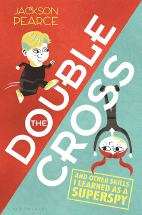
The double cross and other skills I learned as a SUPERSPY by Jackson Pearce
Bloomsbury, 2016. ISBN 9781619634145
(Age: 8-12) Recommended. Smart, intelligent twelve-year-old Hale
Jordan lives with his secret agent parents and younger sister
Kennedy at the SRS Sub Rosa Society, an underground academy for
superspies. Hale struggles to pass the physical test to become a
junior agent, unfortunately his classmates call him Hale the Whale.
When his parents disappear during Operation Groundcover and the
leaders at SRS are unwilling to save them an unlikely hero emerges.
Hale uses all the spy techniques he has learnt to break into the
offices of the League, their rival agency.
Of course, the daring deeds of a young agent like Hale take him into
dangerous situations that require skill and ingenuity. There are
spies and double agents, counterplots and risky missions. When he
secretly opens the SRS files, he discovers that his parents have been
listed as eliminated on sight. The young agent befriends Ben, an
inventor, and his sister Beatrix, a computer whiz from the League
and they work together to foil the SRS plot to kidnap talented kids
and turn them into secret agents.
Pearce's protagonist Hale rises above the bullying from his
classmates and he uses his knowledge and abilities to overcome
difficult situations. The supporting characters are likeable as
well, there's Ben's with his timely and clever inventions, Kennedy's
cheerleading team help with a risky escape and Beatrix's valuable
computer skills. Jackson Pearce's The double cross is an
appealing novel, a funny, action-packed novel that is suitable for
confident readers who enjoy spy stories.
Rhyllis Bignell
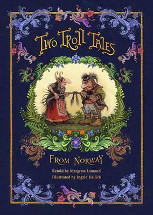
Two troll tales from Norway retold by Margrete Lamond
Ill. by Ingrid Kallick. Christmas Press, 2016. ISBN 9780994234056
(Age: 6+) Norway. Myths and legends. Cautionary tales. Trolls. Two
troll stories from Norway are retold in this offering from Christmas
Press. Trolls are mischievous beings, not to be trusted and cause a
great deal of harm, so people must be on their guard, especially if
they can see them.
The first story, 'The little old lady from around the bend',
offers us a cautionary tale. The old woman in her youth promises to
help a frog should he need it, but he turns out to be a troll and
she is asked to come to his house to help his wife in labour. He
promises riches but she is not allowed to use it, or talk about it.
When the troll baby is born she is told to put salve on its eyes
which she does, applying some to one of her eyes as well. This
allows her to see the troll steal from the village shop and once the
troll realises this, the woman is struck blind in that eye and her
riches disappear. Never trust a troll.
The second story, 'The golden ball of yarn', has a similar
thread of trust and deception. A woodfeller retrieves a ball of
yarn which has rolled near his feet. Despite thinking the girl may
be a troll, a huldra, he gives it to her. She leads him into a
golden place but when he wakes his friends tell him he has not moved
all night. When his wife brings his lunch in the meadows, he is
suspicious knowing that sometimes a huldra replaces a wife, luring
men away. He notices she has a tail and chops it off, so sending her
away. He and his wife then take a ship to somewhere the huldra
cannot find them.
Both stories offer an alternative myth to those usually read in
class. They tell of a different culture and certainly an unusual set
of nasty beings. These could be compared with other cautionary tales
in other cultures.
As these are stories about trolls, I was surprised that the
decorative cover of this handsomely designed book did not reflect
something more of the creatures inside.
That aside it will find a place in a library which offers myths and
legends as a study.
Fran Knight
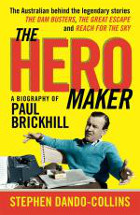
The hero maker: A biography of Paul Brickhill by Stephen Dando-Collins
Penguin Random House, 2016. ISBN 9780857988126
(Age: Secondary) Subtitled: 'the Australian behind the legendary
stories The dam busters, The great escape and Reach
for the sky'. As the daughter of a Lancaster wireless
operator/air gunner growing up in the Sydney suburbs one of my
favourite spots in our house was in front of our fireplace which had
built-in bookshelves on either side. My father was a voracious
reader and Paul Brickhill's books were among his favourites. I had
also consumed them all by the time I was 12 and returned to them
many times over the years. Now those same copies reside on my own
bookshelf.
Having been raised on such a steady diet of Brickhill and knowing
that my father had (at some stage) been acquainted with him (who
knows where?), it would be reasonable to expect that I might have
had some knowledge of the man's life. The only thing I've ever known
was that he was a journalist.
Thanks to this wonderful biography, which I have also devoured as
greedily as I did the man's books, I now have a much greater
awareness of this hugely successful writer and his often troubled
life.
Because I urge you to read this for yourself (I could almost
impatiently stamp my foot and say 'you must'!) there is no need for
much detail regarding the content. Dando-Collins takes us on the
full journey of Brickhill's life including some background history
regarding his family's involvement with newspapers. He describes the
young Paul's childhood on the North Shore of Sydney and his meeting
with a solitary unkempt boy of similar age named Peter Finch who
became a lifelong friend. An uninspired school experience led to
some unfulfilling jobs until Brickhill gained a foothold in the
newspaper business which was his heritage, rising quickly through
the ranks from copyboy to journalist. Despite enjoying some
accolades for his work Paul felt in need of a new challenge and
adventure and decided to realise his childhood dream of flying by
joining the RAAF (despite initial disdain of enlisting). Before too
long he was a fully-fledged Spitfire pilot and on combat missions
but was shot down near Tunis narrowly escaping death as he abandoned
his 'kite' and was captured by Italians who of course promptly
handed him over to the Germans. There followed a long stint in
Stalag 3 which Paul was later to make famous - or infamous - as the
setting for The great escape (RIP The Fifty). Although an integral
member of the X Organisation Brickhill was not among the escapees
and at the close of war was force marched across Germany with other
POWs along with retreating German troops and refugees. Returning to
civilian life after the trauma and privations of POW existence was
not easy for many survivors, Paul among them, but his determination
to tell the story of the great escape and honour his comrades drove
him to complete his first 'escape' book. Almost ten years later,
with other escape books, The dam busters and (what I still regard
as) his 'tour de force' Reach for the sky, the biography of Douglas
Bader, Brickhill was celebrated around the world for both books and
screen adaptations as well as journalistic pieces.
The rigours of the war were not the stuff of easy and calm futures
and Paul's tempestuous and tumultuous marriage to young model Margot
eventually collapsed into catastrophe. This is a no kid gloves account
of Brickhill's personal life. His unpredictable moods and tempers
(including striking his wife on a number of occasions), the
depression, mental illness, heavy drinking and reclusiveness are all
revealed. When his marriage finally faltered it seemed that so did
Paul's creativity and though he 'worked' on several projects over
the next two decades, he more or less lived rather like a hermit in
his small top floor unit in Balmoral, Sydney, without ever
publishing again.
Some critics have dismissed Brickhill's work as being too
'journalistic' but I will say I have never enjoyed reading
newspapers and the like, but I love reading Brickhill. If their
comments refer to the fact that he employs his skills of
journalistic details and observation, yes he does. But he also has a
deft touch for laconic humour and the ability to weave facts into a
cracking yarn. For me the absolute joy of this book was that
Dando-Collin's literary style appears to echo the very essence of
the subject's own work and at times I could 'hear' Brickhill's voice
telling his own story in his own words.
I am so grateful to Random House Australia for allowing me the
privilege of reading and reviewing this volume. I am also grateful
to Stephen Dando-Collins who has breathed life again into one of the
integral storytellers in my life. How fitting in 2016, the 100th
anniversary of his birth and 25th anniversary of his death that Paul
Brickhill's skill and story can be brought to a new generation of
readers and this tribute which is a testament to his global acclaim
is both perfect and poignant.
If you have secondary students who are keen on biographies I suggest
this would be a valuable addition to your collection but above all,
as an Australian reader, I highly recommend it to you to celebrate
the life of one of our most widely recognised writers.
Sue Warren