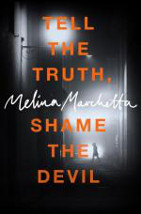
Tell the truth, shame the devil by Melina Marchetta
Viking, 2016. ISBN 9780670079100
(Age: 15+) Highly recommended. Mystery. Marchetta's outstanding
ability as an author stands out in this engrossing and at times,
heart wrenching story. Chief Inspector Bish Ortley has been
suspended from the London Met, and still grieving from the death of
his son and the divorce from his wife. Drinking heavily hasn't
helped, and then he finds out that his daughter on a student trip to
France has been on a bus that was bombed. Desperate to find out what
has happened, Bish races across the Channel and although his
daughter Bee is safe, it turns out that Violette LeBrac, the
granddaughter of a man who bombed a London supermarket, was on
board. Bish had been involved in the arrest of her mother, Noor
LeBrac. As he begins to investigate the bombing, Violette and
another boy, Eddie disappear, and Bish begins to uncover the truth
about what had happened in the past.
Bish is a compelling character who immediately gains the sympathy of
the reader as he tries to cope with his ex-wife's pregnancy and new
husband and a cantankerous teenage daughter while traumatised by his
son's drowning. He has the knack of being able to get people to
confide in him and gradually as he talks to the teens from the bus
and their parents, a picture of what has happened begins to emerge.
His investigative skills are put to the test as he navigates through
a foreign language (French) and the social media that the students
on the bus have used to communicate what has happened. The teens'
different characters come alive on the page, with all the angst,
that comes with coping with hormones and difficult family
backgrounds. Violette is particularly compelling as she confronts
what has happened in the past and Bee's efforts to come to grips
with her brother's death and parents' divorce provide a deeper
background to the reader coming to understand Bish.
The multicultural nature of Europe provides the setting for the
novel. The racism that faces anyone who has a Middle Eastern
background and the treatment that the LeBrac family has been given
is an integral part of the story and is so realistic as to what is
happening in our modern society. Marchetta's writing makes the
reader ponder what tolerance and justice, right and wrong, is all
about as Bish follows the trail of Violetta and Eddie, while
overturning what had been considered the truth in the past.
An outstanding crime novel, Tell the truth, shame the devil
will appeal to adults, but is sure to resonate with older teens as
well.
Pat Pledger
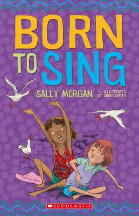
Born to sing by Sally Morgan
Ill. by Craig Smith. Omnibus (Scholastic) 21015. ISBN 9781742991511
(Age: 5+) Highly recommended. Aboriginal themes. Family. Music.
Whales. Maddie loves to sing. She makes up her own songs and sings
everywhere. One of her songs is about the whales that swim near the
coast north of Perth. One day her family announces that the boys and
Dad will go to Tasmania, while Maddie, her mum and Gran will go
north to see the whales. They are to take the caravan that mum
bought at a garage sale, and Maddie is a little dismayed that it may
not survive its ten hour journey. They pack the car and the van and
set off driving the first five hours easily and stopping overnight
at a caravan park. The next day it is not the van that breaks down,
but the car, and they wait along the side of the road for someone to
stop and help them. The older man who stops and cleans their spark
plugs gives them his son's business card. He takes tourists out to
see the whales but warns the women that the boats this year are
mainly booked. Mum is distraught, she feels she has let Maddie down,
but when they get to Denham, Maddie makes friends with a girl
swimming with her, and when they come out of the water, they find
that her grandfather is the man who stopped on the road. All ends
happily when he takes them on their own trip out to see the whales.
A gentle story about families and their holiday, Morgan also
includes conservation themes, along with a reminder that we all need
to support one another.
Fran Knight
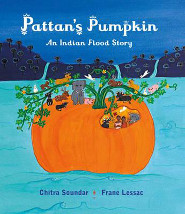
Pattan's pumpkin: an Indian flood story by Chitra Soundar
Ill. by Frane Lessac. Otter-Barry Books (Little Orchard) 2016. ISBN
9781910959442
(Age: 5+) Recommended. Flood stories. Myths and legends. India. Many
cultures have a myth about a great flood destroying part of their
world, and this Indian story will be a wonderful addition to a
library's store of myths and legends, begging to be read and
compared with other stories in other cultures.
Pattan an Indian farmer tends his crops in his valley with his wife,
Kannie and their children. He finds a small plant with large yellow
flowers and takes it home. Here it grows one enormous pumpkin, so
large that it overshadows everything in the vicinity. One day it
begins to rain and does not stop. As the water rises, Pattan and
Kanni fill sacks with grain and rice to be taken to higher ground,
and he dives into the enormous pumpkin and scoops out the flesh. The
animals follow him into the pumpkin and when the pumpkin is cut from
the stalk, it rolls down into the river, with everyone safe inside.
Kanni sings to keep them calm, and when they find the pumpkin has
stopped, they look out to find they are in a lovely valley and the
rain has stopped. They then build their houses and plant their crops
and their families have been there ever since.
This makes a wonderful story of surviving the rain, of keeping your
family together, or thanking your forebears for what they achieved,
all startlingly illustrated by Frane Lessac. Readers will not be
able to take their eyes off her vibrant drawings reflecting the
Indian background and the plants and animals of that region.
Fran Knight
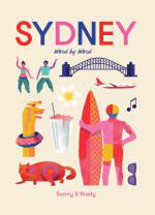
Sydney: word by word by Sonny and Biddy
Little Hare, 2016. ISBN 9781760125523
(Age: All) Recommended. Cities. Sydney. Lifestyle. Sonny Day and
Biddy Maroney work in Sydney and have created an almost wordless
picture book which celebrates the sounds, tastes and look of their
capital city for readers of all ages. Many well known iconic
structures are illustrated interspersed with some less familiar, but
all sparkling with vibrancy in this view of Sydney filled with
people involved in a variety of things. We see people at work and at
breakfast, commuting to work, surfing, playing the guitar, running,
drinking coffee, cycling and at the beach. There is a busker, a gay
pride flag, a Chinese festival, the Zoo, the Bridge and the Opera
House, and a queue.
Each page has just one word and the illustration will evoke many
more from the reader.
In the centre of the book, for example, is a page called Alley, and
the illustrations shows an alley with many cats lurking, looking out
at the reader or just scurrying away, partly hidden by an array of
pot plants.
I love the illustrations which are reminiscent of 1930's film and
travel posters with their Art Deco screen printed look, bold blocks
of colour, white borders and understated and restricted colour
range. This book will encourage discussions about what a city has to
offer, and why cities are built. But more than that readers of all
ages will be delighted with a view of Sydney that is sparkling and
effervescent, all encompassing and enlightening, encouraging them to
open their eyes to what is around them.
Fran Knight
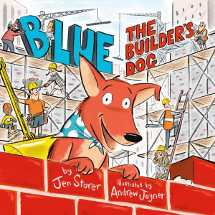
Blue the builder's dog by Jen Storer
Ill. by Andrew Joyner. Penguin, 2016. ISBN 9780670077809
Blue is a builder's dog - an ordinary builder's dog that can be
found on almost any building site in this country. He rides in the
ute to work, guards the tools, greets the subbies and signs the
concrete slabs. (Oops!) He samples sausage rolls at smoko, cleans up
the lunchtime pies and pasties and does all the things a builder's
dog is supposed to do. He is mates with the whole team.
But Blue does not have a hard hat, he is not allowed up high (even
though he liked to go there) and the Big Boss does not take his
advice. He is also not allowed to sleep in the house with the
builder. He is consigned to the shed - which is NO place for a
Working Dog of his stature and importance - and this makes him cranky.
All he wants is his own kennel - not even a flash one, just one
with a hidey-hole for old bones, a swinging door with his name and
maybe a periscope. So he decides to build his own and quits the
building team. Instead of going to work, he stays home to build his
own kennel. The result is not quite like the plan he had in his head
and probably wouldn't meet the Big Boss's standards, but
nevertheless it is a grand home worthy of a Working Dog. That night
he snuggles in happily content and unconcerned that the builder has
gone out. Until a huge storm comes...
Jen Storer and Andrew Joyner have created a funny but touching story
that will appeal to readers of all ages. Everyone will recognise
Blue (some may even know him) and empathise with his need to have a
place of his own. They will laugh at his building skills but be sad
as he huddles on the doormat in the rain waiting for the builder to
come home. And they will delight in the ending which so clearly
demonstrates how important it is to be part of a team. They might
even like to try their hand at designing the perfect kennel for Blue
and maybe even build it if you have a makerspace.
It is an uplifting story that needs to be read just for the fun of
it with the perfect pictures emphasizing the quality of the text.
Andrew Joyner has drawn the iconic Blue and captured the
personalities and conditions on the building site with great detail
and humour so well while Jen Storer has taken a situation that is
played out across Australia everywhere every day and turned it into
an engaging tale that is just delightful. One of those true picture
books where the marriage between text and illustration is so
synergistic that it touches something within and becomes a
read-it-again-and-again favourite.
Barbara Braxton
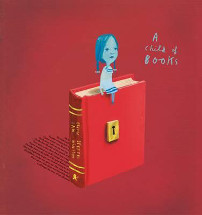
A child of books by Oliver Jeffers
Ill. by Sam Winston. Walker Books, 2016. ISBN 9781406358315
(Age: All) Highly recommended. Books. Classic stories. Every few
years a book comes along which extols the virtues of books and
reading, told in a way which initiates discussion and sharing,
illustrated so beautifully that everyone reading it will look at
the drawings more closely, stopping on each page to breathe in the
images presented. Children and adults alike will read and discuss
this book, taking time to share their reminiscences of books read
long ago or just yesterday, sharing their ideas on what makes a
classic, importuning others to read books they have read and
enjoyed.
Each page has text from a recognised classic story: Alice in
Wonderland, Treasure Island, The secret garden,
Gulliver's travels, Swiss family Robinson, Snow
White and Blood Red, Kidnapped are amongst the forty
or so mentioned. Each endpaper lists all these books, and will make
a wonderful list to begin thinking about what you would add, or discussing
with others what they might have put on the endpaper, or with a
class, brainstorming the sorts of books they would like to see
there. It is all down to personal experience with books, and many
will add a whole range of others they see as classics, and what
discussions will be had as a result!
The girl asks the boy to join her as she sails on a sea of words and
books, taking him on her voyage of the imagination, climbing
mountains, finding treasure in a cave, losing themselves in a
forest, escaping monsters, flying to the stars. All it takes is
imagination, and books hold the key offering this experience to all.
The stunning illustrations parallel the stories reflected by the
text, with mountains or seas of words holding the pair as they have
their adventure. Or the cave is made from a rockfall of words while
the forest overleaf is full of what seem like trees but are really
old fashioned books standing erect. The way Winston has used words
to illustrate the text will have readers turning the book every
which way to discover which book's lines have been used to create
the image. Even the houses on the last four pages turn into a shelf
of books. Just wonderful. This will be a treat for anyone who reads
it, the text and illustrations are beacons, leading to hours of
contemplation and discussion.
Fran Knight
Eleanor, Elizabeth by Libby Gleeson
Ill. by Beattie Alvarez. Second Look, 2016. ISBN 9780994234070.
(Age: 11+) Highly recommended.
This is a new edition of the novel published in 1984, Libby
Gleeson's first novel and Highly Commended in the 1985 Children's
Book Council of Australia awards. Her 2016 introduction explains
that it drew on her experience as a 10 year old moving to a new town
and having to come to terms with a new school, new friends, and a
new culture.
Eleanor is not happy when her family moves from the cool Tablelands
to the hot dry country plains, leaving behind close friends, and
starting a new school with a teacher that likes to crack the ruler
and Danny the bully out to get her in the schoolyard. So it is a relief to
escape into the derelict old family schoolhouse on their property
and then even more interesting when she discovers her grandmother’s
diary hidden in a tea chest. What she reads there leads her to
explore further the unknown areas up the creek and across the
fields. But exploring with her brothers and their friend leads them
all into great danger.
Gleeson's writing weaves together the different worlds of country
life, the children's games and conversations, Eleanor's private
thoughts and fears, and the diary entries of the nineteenth century.
Readers will readily identify with Eleanor's loneliness, her
curiosity and her sense of adventure, and follow along with her as
dramatic circumstances force her to assume a role of great bravery
and courage. The story still holds strong today and this new edition
with line drawing illustrations by Beattie Alvarez should be a
popular read in any school library.
Helen Eddy
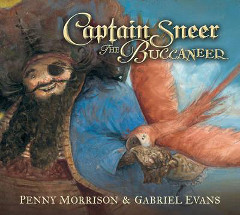
Captain Sneer the buccaneer by Penny Morrison
Ill. by Gabriel Evans. Walker Books, 2016. ISBN 9781922179609
(Age: 4+) Recommended. Verse. Pirates. Humour. Captain Sneer is very
assured of his own importance as leader of a gang of pirates on
board his ship The Golden Isle. But he is somewhat scared of
his stomach during storms and needs to retire to his hammock. In
search of the treasure he loses his map, runs out of water and food,
and is besieged by another pirate ship, but all is not lost for when
they land on an island they find a cave and in that cave is what he
is searching for. Another laugh out loud moment.
Each stanza ends with the children predicting the next word and
there will be much laughter when the word given over the page is not
what is expected.
The pencil, watercolour and gouache illustrations invite readers to
look more closely at what is on the page depicting the pirate and
his cronies. Readers will love searching out all the 'piratey'
icons, and storm around the ghostly looking pirate ship looking at
all the rigging and below decks paraphernalia, their clothing and
armaments. Talk like a pirate day
is celebrated every year on 19 September, and this book is a
wonderful addition to the range of books and stories available. It
will keep readers very much amused with the pirate goings on and the
captain who is not what he seems.
Fran Knight
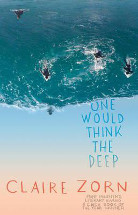
One would think the deep by Claire Zorn
University of Queensland Press, 2016. ISBN 9780702253942
(Age: 15+) Recommended. Grief. Surfing. Family relations. Another
hard hitting novel from Zorn is sure to appeal to fans. It's 1997
and 17 year old Sam is trying to come to grips with the sudden death
of his mother from an aneurysm while he was dancing with her. Left
bereft, he goes to live with his Aunt Lorraine and cousins Shane and
Minty, who he hasn't seen for years. His family had fallen apart
years before and he and his mother had been alone relying on each
other. When he arrives in the small coastal town of Archer Point Sam
begins to follow Minty around, learning to surf and trying to drown
out the snapshots of disaster that he carries in his head.
With masterful and lyrical writing, Zorn brings to life the
character of Sam, on one hand sensitive and intelligent, on the
other angry and aggressive. His grief is overwhelming and his
attempts to cope will resonate with readers, as he tries to navigate
through a new life. He makes some bad decisions, deciding not to go
to school, drinking, fighting and letting down new friends and
ultimately has to decide whether to sink or swim. His feelings for
Gretchen are beautifully portrayed, with all the angst and longing
that the teenage years bring.
Family relations play an important role in the book and the theme of
belonging is all important. Sam can't work out why his family had
stopped meeting years ago and the author keeps the reader wondering
about this as they are slowly revealed throughout the story. Ruby,
Minty's friend, has to decide whether she will pursue her racial
roots and find her indigenous family. Her story is an engrossing sub
plot as she is as talented as Minty at surfing, but believes that
getting an education and going to university is more important than
trying to win surfing events. Minty too is an engaging character,
whom everyone likes, but who is totally absorbed with surfing the
waves.
Music plays an important role in the book. Jeff Buckley is Sam's
favourite singer and a playlist at the back of the book will
draw the reader into the music culture of 1997.
Some big themes are tackled in this book - family violence, racism,
sexism, anger and grief - and all are treated in a complex
multi-levelled way. This would be a great literature circle book or
class text.
Pat Pledger
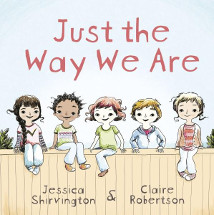
Just the way we are by Jessica Shirvington
Ill. by Claire Robertson. ABC Books, 2016. ISBN 9780733331640
(Age: 4+) Families. Difference. Shirvington presents the young
reader with an array of different families. Each is introduced on a
one double page spread, those who make up the family described and
shown in the illustrations, then the family is presented doing
something together on the next double page. The second double page
always ends with the refrain of the title 'Just the way we are',
underlining the similarities and differences between each family,
but also showing that each is just a family like any other.
The first family has a mum and dad with one child, and they all live
together with the girl's grandfather, so the girl is able to do some
amazing things with her grandfather while her parents are at work.
The next shows a family with one child and two dads, followed by a
family which lives in two houses, then a foster family where the
child no longer calls the guardians by their names, but Mum and Dad,
while the last family is a single parent family. Each shows the
family doing things a family does together no matter how it is made
up, and the illustrations underscore the basic needs of the child
being met within the family: love, care and belonging.
Early readers will enjoy reading of all the different sorts of
families and recognise that each is different but also the same.
Fran Knight
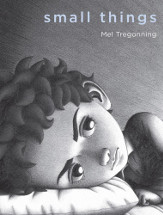
Small things by Mel Tregonning
Allen and Unwin, 2016. ISBN 9781742379791
(Age: all) Highly recommended. Mental Health, Suicide, Loneliness,
Graphic novel. A child stares out from the front cover, large eyed,
on the edge of tears, alone in his bed. Readers will wonder about
the child and turn the pages uncovering the stunning black and white
illustrations in this wordless graphic novel. Each set of
illustrations propels the idea of the child's aloneness, even in the
midst of people. In class there is no room for him, he is an extra
person, isolated and excluded. No one chooses him when a game is
played, and he eats lunch alone. With his confidence undermined he
receives a C for class work, others receive an A or a B. At home his
sister, a violin player is the only person to listen. She offers
some comfort but she too is not holding herself together very well.
Each child has their own worry monsters.
Tregonning depicts the loneliness and increasing mental ill heath of
the child through her illustrations with small pieces of the child
falling away as he walks or sits in class. He is becoming less of
himself as small things fall from his body, with cracks appearing on
his arms and face - just like his sister's. Each is unwell, ably
depicted through the disturbing illustrations reiterating the
feeling of being worthless and alone.
Even in a crowd he has pieces falling from him, and while in bed
images swirl around him filling his head and disturbing his sleep.
He talks again to his sister, and the anxious feelings diminish, so
he talks to his parents, and sleep comes. Finally when in a crowd he
sees that many others are just like him, and he is able to hold out
his hand to another.
This is an amazing book, full of ideas about mental ill health,
showing how the child feels, but also offering some ways to deal
with the anxiety.
The whole is made breathtakingly resonant when reading about Mel
Tregonning who began this book nine years ago, and took her own life
in 2014. Her family found the incomplete manuscript and with the aid
of Shaun Tan, the work was completed as a memorial to their talented
daughter and sister.
On the simplest level, younger children reading this book will see
that many people have worries and concerns: they are not alone, and
they can reach out to others for help. Mental ill health while not a
common theme in children's books, has a growing presence. The recent
issue of The Literature Base (August 2016) has an article about
Mental Health in children's literature in which I pulled together a
number of recent children's books with that theme as part of the
story.
This book quantifies the anguish and lack of confidence felt by
people in this position, the monsters which besiege them are always
there but with help can be kept at bay. And this makes it a valuable
tool to have in the classroom where one in five is likely to be
suffering from some form of mental ill health.
Fran Knight
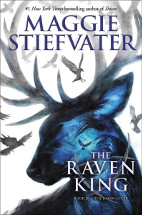
The Raven King by Maggie Stiefvater
The Raven Cycle bk 4. Scholastic Press, 2016. ISBN
9780545424981
(Age: 15+) Highly recommended. The fabulous Raven Cycle
comes to a very satisfying conclusion in The Raven King.
Gansey's quest to find Glendower, the ancient Welsh king is
overshadowed by the fear that he will die, and probably from a kiss
that Blue Sargent gives him. The other Raven boys, Ronan, Adam and
Noah have all been drawn into his quest, and each has to find a path
through the magical dreams, tall forests of Cabeswater, predictions
from the women in 300 Fox Way and an assortment of villains out to
grasp the magic power that comes along the ley line.
Stiefvater manages to juggle numerous plot lines and many characters
in this novel with her masterful writing. Chapters begin with the
phrase ("Depending on where you began the story, it was about . . .
") and this gives a different perspective to where the story is
going and more information about the key players. The introduction
of Henry, as a new and trusted friend who plays an important part in
defining what happens to Gansey is handled brilliantly as is the
strange and frightening power of the demon who is trying to unmake
them all.
This is not an easy read, but it is a fascinating one that is very
difficult to put down. Fans of the fantasy genre will love it and I
wish I had the time to start at the beginning again and read through
all four books in this complex, imaginative and unpredictable
series.
Pat Pledger
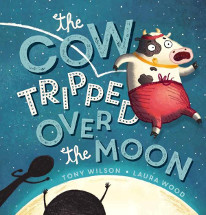
The cow tripped over the moon by Tony Wilson and Laura Wood
Scholastic Press, 2015. ISBN 9781743623534 Hey diddle diddle
You all know the riddle
A cow jumps over the moon.
It happened, all right,
On a crisp, cloudless night
On the second-last Friday in June.
But it didn't happen on the first attempt, or the second or even the
third. As the cow, the cat, the fiddle, the dog, the dish and the
spoon sat and watched the moan soar gracefully over the barn on
which they are sitting they decide to make the traditional rhyme
come true. But what they don't say in the songs from that day Is the
cow didn't jump it first time. It seems a moon clearance takes great
perseverance. . . . And that is the underlying theme of this superb
story from Tony Wilson and perfectly illustrated by Laura Wood.
The cow's first attempt was at 9.17 pm when with little preparation
or assistance, the cow made her first leap and fell flat on her
face! 'She never did make it to space'. She'd tripped over the
little dog Rover! But she was not to be deterred. Using all sorts of
techniques including pole-vaulting and a trampoline, she tried and
tried again with the help of her friends who were as determined as
she was that she would succeed. Even taking a wrong turn and feeling
the burn of the sun just made her more determined. Until on her
seventh attempt just as day was dawning and the moon was
disappearing . . .
It is no wonder that this was an Honour Book in the Early
Childhood category of the CBCA Children's Book of the Year
Awards. As a standalone story about perseverance, resilience and
friendship it is a masterpiece for offering children the hope and
encouragement to keep trying and trying until they get all these new
things they have to learn and achieve sorted. By using a familiar
rhyme that the age group will relate to rather than an anonymous
character for whom there is no connection and its familiar rhythm
Wilson has engaged them straight away and right from the get-go they
are willing the cow to succeed. They will even offer suggestions
about how the friends can support the cow or what they would do to
help, helping them to put themselves in the shoes of others and
build empathy, respect and a feeling of responsibility to help, But
the real story behind the story is its dedication to the author's
son Jack who suffers from cerebral palsy, the most common physical
disability affecting childhood.
'Cerebral palsy (CP) is an umbrella term that refers to a group of
disorders affecting a person's ability to move. It is a permanent
life-long condition, but generally does not worsen over time. It is
due to damage to the developing brain either during pregnancy or
shortly after birth. Cerebral palsy affects people in different ways
and can affect body movement, muscle control, muscle coordination,
muscle tone, reflex, posture and balance.' Steptember, 2016.
Every 15 hours an Australian child is born with cerebral palsy -
that's one in every 500 births. Tony Wilson's child Jack is one of
those ones and on his blog
he talks about Jack's daily struggle to do something as seemingly
simple and everyday as putting a piece of pasta in his mouth. It's
about his goal of being able to walk 100 steps in a day over three
sessions while nearly 70 000 people (including me, my son and my
granddaughter) are endeavouring to do 10 000 steps a day to raise
fund to help with treatment and equipment. You can meet Tony and
Jack here.
But it's also about children like Ollie
a little boy I met at the school I was teaching at last year; it's
about Jayden whom I taught years ago and who is now representing
Australia at the Paralympics in Rio; and it's about all the other 34
000 Australians living with the condition and the 17 000 000
worldwide. And with no known cure that's a lot of people for whom
living a normal life is about as possible as the cow jumping over
the moon. There are many teaching resources to support The Cow
Jumped Over the Moon available via an Internet search but if
you want to learn more go to the Cerebral
Palsy Alliance and if you want to help donate to Steptember . Our team
is called The Waddlers but any donation to the cause is welcome.
Tony Wilson and Laura Wood - it's an honour to review this book. I
hope its spread the message about all the Jacks there are and builds
awareness and raises funds.
Barbara Braxton
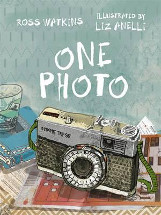
One photo by Ross Watkins
Ill. by Liz Anelli. Penguin, 2016. ISBN 9780670077977
(Age: 7+) Highly recommended. Dementia. Family. Mental illness. When
Dad comes home with a camera, one of those old cameras that takes
film which needs to be developed, the family, Mum and their son,
watch on. He seems to be taking photos of things which have no
inherent interest. There are no people in them, they are of things
and places around the house. Photos of his study, of the table at
breakfast time, his coffee cup, the clothesline, the bus shelter. He
takes roll after roll of film to the developer in the city, bringing
the photos home to stick on the window.
The boy and his mum ask him why he doesn't take photos of them, but
he doesn't answer.
They find that he has put things in the cupboard that shouldn't be
there, and puts the hammer in the fridge, so the reader begins to
understand that this man is showing signs of dementia.
More photos appear, until one day he comes home without the camera.
Then he is no longer there. The family receives a parcel in the post
with his camera in it and one undeveloped film. On getting it
developed they see what he was trying to show them, the family he
wants them to remember.
This poignant tale of a family coping with dementia will resonate
with many children in the class or at home. They may have an older
relative with signs that this disease is taking its toll, or may
have seen it in someone younger, the book showing that there is no
age barrier to this disease.
The illustrations are wonderful, showing the family in their house
and all the things which will remind them of their missing father
and husband. All around the house are things which he used and the
photos of things important to him alongside the photo of him with
his family.
There is a growing number of books with this theme for classes and
children to begin discussions about this disease: Newspaper
hats (Phil Cummings) Forgetting
Foster (Dianne Touchell) Wilfred Gordon McDonald
Partridge (Mem Fox) to name a few.
This wonderfully emotive book about one family and the coping
measures undertaken by the father will resonate with some children
and educate others about this disease.
Liz Anelli's wonderful illustrations give the reader a different
view of the family and its worries. The first endpaper shows the
family in its beginnings, Dad's childhood, meeting Mum, marriage and
children, while the last endpaper shows the things he photographed
in the home, his very personal collection of things he thought would
remind them of him. Time passes as shown in the roof top view of the
house and garden, the tree in leaf at the start and later, when he
is not there, it is bare. And I love the page when he has gone: the
afternoon shadows creeping over the furniture with the photos
displayed on top, across the carpet. I could have cried. Anelli's
beautiful, touching illustrations augment this poignant story of one
family's grief.
Fran Knight
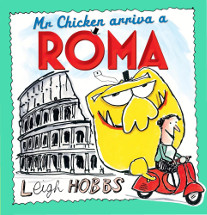
Mr Chicken arriva a Roma by Leigh Hobbs
Allen & Unwin, 2016. ISBN 9781925266771
(Age: 4+) Highly recommended. Travel. Rome. Tourism. After his
successful trips to Paris and London, Mr Chicken now heads for Rome.
As a child he had always been interested in Ancient Rome, and now
learning the language from his beginner's book of Italian, means to
see as much as he can. He has written a list of the sights he wishes
to see, including the Colosseum, the Vatican, the Forum and the
Spanish Steps, and he also wishes to meet some real Romans. On the
first endpaper is his list alongside many images of the places he
wishes to see and a list of words he has learnt. For readers the
first endpaper introduces them to Rome before Mr Chicken takes to
the air.
Business Class suits him with its superior food and greater leg
room, although his neighbour still looks uncomfortable. Landing he
is met by his guide, Federica, who takes him to her Vespa to tour the
city. His day in Rome is eventful as he sees all the sights he has
dreamed about as a child, but then when Federica leaves him at the
Mouth of Truth he falls into a deep sleep and dreams that he is back
in Ancient Rome. Here he finds his face on all the coins, and
statues of him are placed around the city, but when he lands in the
Colosseum, facing a ferocious lion, they both run from the other.
Federica returns, waking him and taking him for his big surprise,
dinner with her family. He gets to meet some real Romans just
as he dreamed.
Throughout the story Mr Chicken tastes a range of food, particularly
gelato and pasta and readers will laugh out loud at his efforts to
steal other people's icecream.
The wonderfully funny illustrations of Mr Chicken on the Vespa, and
stealing a lick of others' gelato, will enthrall younger readers.
And they will learn a few Italian words along the way.
Fran Knight