Bloomsbury, 2016. ISBN 9781408869048
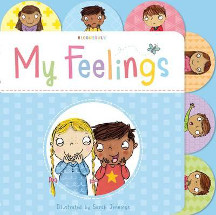
(Ages: 4-6) Board book, emotions. This is about how to cope with and
talk about emotions. It requires children to have a grasp on
labelling and recognising their emotions already as it does little
to identify what they are or what they look like. Rather than
telling the reader what it looks like to be worried or scared, shy
or happy, it gives practical suggestions for dealing with the
feeling ('When you feel scared . . . Run away fast. Say 'I'm
scared!''; 'When you feel happy . . . Whistle and sing!, Say
hello').
Young children often have difficulty dealing with emotions, even
positive ones, so this is a fantastic way to give them practical
outlets. The pictures clearly illustrate the suggestions, giving
children visual as well as verbal cues. This is a great book for
parents to read through in its entirety, but also to pull out during
emotional times to help young children find a way to deal with a
specific emotion. It is appropriately short, and the bright
illustrations and tab cutouts will keep young children engaged.
Nicole Nelson
On the river by Roland Harvey
Allen and Unwin, 2016. ISBN 9781760112455
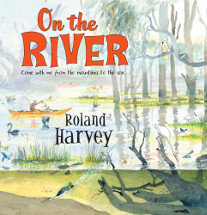
(Age: 8-80) Highly recommended. Roland Harvey's books celebrate the
Australian landscape and lifestyle from the Top End, to the city and
the bush. In his new picture book On the River the unique
watercolour and ink illustrations combine with his simple text,
poems, letters and informative descriptions to showcase the many
facets of the Murray-Darling Basin.
Roland the adventurer sets out with his pelican companion and
navigates the river system from high in the Snowy Mountains down to
the Murray Mouth. Each double page spread is visually engaging, with
so many things to investigate those small humourous scenes - that
display Harvey's unique insight into everyday life. He shows his
love for sports, recreation, fishing and family fun drawn from
childhood trips and family holidays along the river. There is
something for the whole family to spot, from lost bathers, extreme
ironing, the dangers of shooting the rapids, water-skiing etiquette,
quizzical animals - the migrating Bogong moth's backpack, to trout
fishing tips and riverboat carnivals.
From the detailed maps of the Murray-Darling Basin in the endpapers,
Harvey engages his audience with the many facets of river life;
historically from the aboriginal connections to place, the
exploration, settlement, the timeline of transportation and the
farming, fruit, cotton to the current issues of water entitlement
and usage. The geographical features are painted in natural tones,
using bird's eye views, cutaways and panoramas to show the different
environments, with the array of flora and fauna and the recreational
uses of this Murray-Darling Basin.
This is an excellent resource for Humanities teachers, in Years 3, 5
and 7 there is a focus on the Murray River for History and
Geography. Roland Harvey's letter from Murray to Darling succinctly
sums up the steps needed to improve river health and increase the
water flow.
Teacher notes and downloadable activities are available.
Rhyllis Bignell
The swap by Jan Ormerod
Ill. by Andrew Joyner. Little Hare, 2016. ISBN 9781760128760
(Age: 3+) Highly recommended. Board book. Sibling rivalry, Humour,
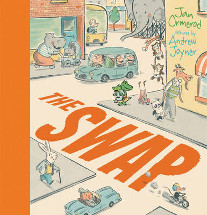
Family, Picture book. Despite Mama Crocodile's best efforts at
increasing daughter Caroline's interest in her new baby brother, she
fails at each fence post. Giving a long sentence of similes which
expound his virtues, Caroline can only respond that he smells. Mum
alludes to his lovely scaly skin and sharp claws, but Caroline can
only see how much room he takes up on her mother's lap. She decides
that she should swap him, and goes to the baby shop where she is
able to exchange the baby for something new. Each time she does
this, the differences between her baby brother and the animal she
choses, stand out. Taking a panda, she is embarrassed when he begins
to eat the cane furniture at the cafe, and the elephant she takes
hops into the town fountain breaking it. Each time she realises that
perhaps her baby brother is not as bad as she thinks, and so learns
a lesson that will be obvious to all readers. Illustrated with
wonderfully lively drawings of the array of animals that live in the
town will delight the readers who will see far more each time they
venture inside. I love the main street with its different shops and
shop windows with flats on top displaying a variety of styles, I was
intrigued with the details within the shops the girl entered and
loved the picture of Mama Crocodile and her two offspring on the
last page, displaying all the love and affection that exists between
the three, and no child will miss the humour of how Caroline learns
to love her brother while Mama is shopping. The production of the
book with its strong library binding makes it a pleasure to hold and
open. A wholly entertaining experience, made all the more poignant
by Jan Ormerod's death earlier this year.
This is a board book version of the paperback published in 2013.
Fran Knight
The loneliness of distant beings by Kate Ling
Hodder and Stoughton, 2016. ISBN 9781510200166
(Age: 14+) Highly recommended. Multi-generational space exploration
leaves no room for love. With a eugenical system in place to provide
mission security, the people of Ventura live a life of structure and
control. They are carriers for the next generation and the
generation after, who may discover a life-supporting planet.
As part the third generation of a seven hundred year round trip, the
children of Ventura are responsible with continuing to produce
optimal offspring for the completion of the mission. On her
graduation, Seren's worst dream is realised when she learns that her
life partner will be Ezra, Captain Kat's more arrogant son. Seren's
discomfort and reluctance for the partnership is attributed to
hereditary mental illness, and so she finds herself with even less
decision-making power than ever before. As the son of Captain Kat,
Ezra, and his future bride, must share in her limelight - any wrong
doing open for public scrutiny. As if things couldn't be worse for
Seren and her precarious mental state, she meets Domenigo, one of
the fish-boys in production. Just a year age gap, the two are drawn
to one another and things quickly heat up. Facing a future of
persecution on discovery, Seren knows she must make the right
decision. She must marry her life partner. But can she after she has
experienced the pure love of Domenigo?
Having thoroughly enjoyed this novel, I would highly recommend it
for teenagers fourteen and up. While primarily a sci-fi romance, the
novel's focus is on Seren's feeling of powerlessness in the face of
societal expectations, and the disadvantages of eugenic systems.
Kayla Gaskell, 20
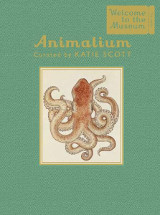
Animalium by Katie Scott and Jenny Broom
Five Mile Press, 2016. ISBN 9781760404307
(Age: 8+) Museums, Evolution. A museum to visit any time you like is
presented in this comfortably hand sized compendium of plants and
animals from around the world.
First published in Britain by Big Picture Press, the books that I
have read (Historium, Botanicum and Animalium)
are part of a series of non fiction books, entreating young readers
to look more closely at the plants and animals presented. Their
website tells us 'Big Picture Press is a new list of highly
illustrated books launched in September 2013, publishing as an
imprint of the Templar Company Limited (UK and Australia) and
Candlewick Press (US and Canada). We believe that books should be
visually intelligent, surprising, and accessible to readers of all
ages, abilities, and nationalities.'
And they have certainly striven to achieve that aim. Historium
(2015) is a highly illustrated and fascinating offering of
historical objects found in the British Museum. Animalium is another in the same milieu, offering incredibly
detailed illustrations of plants and animals across the world. The
large version of this book was chosen as the Sunday Times Children's
Book of the Year in 2014. Opening any page offers a plate of
illustrations on one side with information and a guide to the
illustrations on the verso.
Most pages are animals of the European, Asian and African continents
with a few showing animals our students would know, although the
galah may elicit a few laughs.
Presented in evolutionary order, the first pages deal with Porifera
or sponges, which developed some 540 million years ago, followed by
the Cephalopods and Fish leading up to the Primates and Hooved
Animals. Each page offers highly sophisticated illustrations by
Katie Scott, reminiscent of woodblock prints used in such books in
the past. On the other page, details are given about these animals
and plants, and interspersed with these pages are those detailing
habitats like Woodland, Mangroves and Rainforest. I can imagine some
children encouraged to dip in and out of this book, and see it more
of a library tome to be used by a class. A fascinating read.
Fran Knight
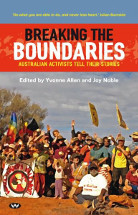
Breaking the boundaries edited by Yvonne Allen and Joy Noble
Wakefield Press, 2016. ISBN 9781743054185
(Age: 12+) Highly recommended. Non-fiction. If you browse the
contents of this collection of personal stories by activists
standing up for what they believe in, you are sure to find at least
one that will draw you in. For me it was 'An Indigenous prime
minister in our lifetime' by Andrew Penfold. It is so inspiring,
particularly at the time of the Don Dale detention horrors, to read
of the real successes that the Australian Indigenous Education
Foundation is having in empowering Aboriginal children to strive for
a brighter future. This is the kind of program that should be fully
supported and expanded throughout the country.
After reading that story, I went on to select others that I
recognised, such as Julian Burnside's 'The reluctant activist', and
Debra McCulloch's 'The business of sex work', then moved onto
unfamiliar writers, and ended up picking up the book from time to
time to read another story, until I'd read them all. There is a wide
variety of issues that have inspired the activists in this book,
issues of environment, human rights, gender, health and disease,
disabilities, euthanasia; there is sure to be something that will
draw the attention of everyone.
There are two stories by primary school students. Maddison Day
writes about educating fellow school students in Aboriginal culture
and history, and Mackenzie Francis-Brown went from holding Biggest
Morning Teas for the Cancer Council to running a healthy eating
campaign. Both provide inspirational examples for other school
students to follow, a stimulus for them to find their own interests
and develop a meaningful project.
The stories are all very short and easy to read. It is such a
marvellous collection - it is so uplifting to read what individuals
by perseverance and hard work have managed to achieve. I recommend
it to anyone feeling a bit depressed by current world events; it is
a great reminder that there are many good and dedicated people
working for the betterment of others, and who are continuing in that
life work.
Helen Eddy
Dreaming the enemy by David Metzenthen
Allen and Unwin, 2016. ISBN 9781760112257
(Age: 17+) Recommended. Good books are not always read for
entertainment. This book is nuanced and brilliantly crafted, but it
takes the reader into uncomfortable places and leaves you staggering
and in pain as you experience the aftermath of the Vietnam War. This
was not an enjoyable journey for the central character and survivor
Johnny Shoebridge, who struggles with PTSD. His tenuous grip on the
world is fraught with the painful dreams of conflict and the
memories of the shared experience with his war buddies. He carries
with him the ghosts of the traumatic experience and they claw at his
stability, leaving him reeling and wounded. Metzenthen has allowed
us also to experience the storyline from the perspective of the
North Vietnamese soldier, as Johnny weaves the story of his enemy
into his own nightmarish existence. The power of this dual
perspective of the Vietnam War and its impacts on the human
survivors - the 'feathers in the wind' tossed to the elements, is
visceral in opening up the tragedy of the Vietnam War for the
veterans who cannot escape the emotional storm that they carry with
them. Metzenthen has subtly and gently revealed the staggering
difficulty of returning to normality, particularly when strangers
(including World War II veterans) were quick to judge and malign the
returned servicemen without understanding their journey.
The writer's craft here is worthy of a recommendation. Metzenthen
has skilfully woven time twists and the different perspectives from
both sides of the conflict, as well as the psychological and
emotional torture of the PTSD sufferer as he attempts to find
'normal'. The empathy that he induces in the reader is powerful, but
it does require maturity in order to deal with the horrors of war
and the torment of the young man who carries the dreams and hopes of
his fallen buddies with him, as well as his own changed view of
self. I found this book emotionally difficult to read - it gave me
opportunity for understanding, but the pain of the central
character, and the immersion into war was devastating and extremely
distressing. Do not place this into the hands of a young reader
without assessing their ability to deal with the hard issues of war.
And although this gives perspective for ex-Servicemen's experience
across the years, it is also an insight into mental health issues.
(Note: some readers will also be confronted by the uncensored
language choices of the Aussie soldier in the midst of
life-threatening circumstances.)
Carolyn Hull
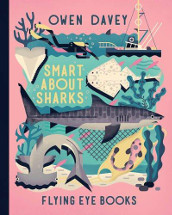
Smart about sharks by Owen Davey
Flying Eye Books, 2016. ISBN 9781909263918
(Age: 5+) Highly recommended. Sharks. Non fiction. A finely detailed
and fascinating look at sharks around the world is offered in this
enthralling hard cover book. Like the diver on the front cover we
are invited to dive down and look at what lurks in the waters
beneath. And no one will be disappointed. I can imagine readers,
particularly boys, poring over the information, the detailed
illustrations and comparisons to educate and then trick each other
with their vastly enhanced knowledge.
Sharks are fish and there are over five hundred different species of
shark. And many of these are detailed on the pages before us. Each
double page with its punning title, offers a different field of
information, along with a host of interesting diagrams. One that
fascinated me is entitled, 'Congratulations, it's a shark',
concerning the offspring of these creatures. The shark has three
methods of birth, I read, one is live birth, the second is eggs and
the third is eggs inside the mother which hatch, the baby shark
eating the rest of the yolk and sometimes its siblings to survive.
Wow! readers, like me, will be entranced. Another page, entiscale,
shows the various sharks drawn in relation to each other. The whale
shark stretches across the whole page, while others are so small
only their name gives their position away. And another, 'A bite
to eat', of course shows us the teeth sharks are known for.
Their rows of teeth can be replaced and one shark may get through
thirty thousand teeth in its lifetime. Each page has a host of
information and facts, and will keep the readers entertained for a
long time. The illustrations beg to be perused with close attention
and will not disappoint the most urbane of readers.
The book is rounded off with an index which points readers to pages
with specific sharks, using both their common and scientific names.
I loved this so much that I will now seek out Davey's other book, Mad
about monkeys.
Fran Knight
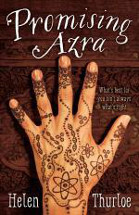
Promising Azra by Helen Thurloe
Allen and Unwin, 2016. ISBN 9781760113278
(Age: Middle - Senior Secondary) Recommended. Forced child
marriages. Cultural awareness. Chemistry. Pakistani culture in
Australia. Azra is a happy, bright student who excels at Chemistry
and is studying for her HSC exams. She and her family live in
Sydney, arriving about four years earlier from Pakistan, sponsored
by her uncle and aunt who also employ her mother and control many
aspects of the family's lives. The family adhere to strict religious
and cultural practices that take priority over all else. Azra is
expected to look after Soraya, her 5 year old sister, and to cook
for the family when she gets home from school. Her older brother
Rashid has few restrictions, he has lost his license, often doesn't
come home at night and does nothing to help around the house. When
Azra has the opportunity to take part in a national chemistry
competition she is not allowed to attend, partly because of a
cultural event but also due to concerns about her associating with
boys. It becomes increasingly apparent that the family intends soon
to arrange her marriage to an older relative of the family back in
Pakistan. This is not uncommon in Azra's cultural group and girls
she knows respond differently, from excitedly planning every aspect
of the wedding to running away to a state refuge to avoid it,
abandoning family and community. By clever negotiation and
determination Azra manages to attend the science competition and
becomes even more certain that she wants to complete her education
before marriage. Her story becomes gripping as we learn the
consequences of her decisions and where she finds support.
The author researched the issue of forced marriage in Australia and
her intention with this book 'was to give a voice to girls who can't
perceive, or properly articulate, the options they might have around
choosing a life partner.' (Author's note.) The story does this in a
sensitive and engaging way including snippets of interesting
chemistry, including the chapter headings which use chemical terms
to mirror the action. Recommended reading for middle to senior
school girls and teachers looking for insight into the issues.
Recommended for more information in Australia is My blue sky website.
Sue Speck
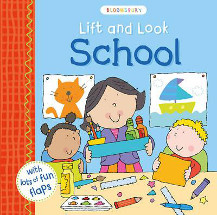
Lift and look school ill. by Simon Abbott
Bloomsbury, 2016. ISBN 9781408864012
(Age: Preschool) Highly recommended. Do you have little ones eagerly
anticipating starting school? If so, this is a perfect gift
especially as it has 'lift the flaps' which we all know are always
such a delight!
Very simple text, a sweet board book format and gorgeously vibrant
and extremely cute illustrations, this will surely be a winner with
any little people from around 3 to 5 years.
Find out what the children are playing, how they get to school,
where they go on a school trip and what they do in their classroom.
Others in this series include: Dinosaurs, Space and
Garden.
This will be perfect for our early childhood centre as our little
people countdown till starting Prep in 2017!
Highly recommended for small humans - pop it into a Santa sack for
your favourite teeny!!
Sue Warren
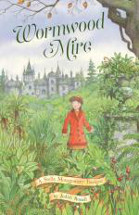
Wormwood Mire: A Stella Montgomery Intrigue by Judith Rossell
ABC Books, 2016. ISBN 9780733333019
Warning: This review will be chockers with fulsome praise and
expressions of delight.
From the point I took this book from its package two days ago I was
in love with it.
We know that you can indeed judge a book by its cover often and
looking at the beautiful artwork of this novel and stroking its
textured surface was like holding a plush box of chocolates and
greedily anticipating the contents.
And I was not disappointed. A gorgeously bound book with wonderful
creamy pages, full page illustrations, embellishments and font all
in a forest green this just oozes style and superiority.
After Stella's first adventure (Withering-by-Sea)
the nasty Aunts are icily furious and ponder what to do with such an
unsuitable child. They grasp the opportunity to send her to the old
family home where their cousin is going to have his two (also
motherless) children taught by a governess (hah! Expense-free
solution) and so Stella is packed off to Wormwood Mire, a decaying
mansion set in huge overgrown grounds. Her initial trepidation is
relieved when she meets Strideforth and Hortense, her two cousins,
both of whom are quirky in their own ways. She is further reassured
by Miss Araminter the governess who is at the very least eccentric
but extremely kind and sensitive.
Before she departed the gloomy house of Aunts Stella had
discovered an old photograph which she has identified as being of
her mother at Wormwood Mire with two babies in an old-fashioned pram
- two babies? Did she once have a sister or twin? She is determined
to solve the mystery of this while she is in the crumbling family
ruin. But Wormwood Mire holds many secrets. The children's ancestor
Wilberforce Montgomery who built the house was a traveller and
collector of the curious and bizarre; objects, plants and animals.
And there is something all the villagers are terrified by but won't
talk about. What is it and will the children be able to discover the
menace - and survive it?
What a sensational read this is! The narrative flows perfectly from
eddy to whirlpool to backwater and the reader is carried along
effortlessly. For me it would have been a one sitting read had I not
had to get up early the next morning. As it was I had to save the
last few chapters but quickly polished them off, savouring every
word. Stella is indomitable - a Mighty Girl in every sense - she has
courage and intelligence and empathy. There is also the mysterious
power she possesses. She is a perfect foil for Strideforth, the
essential scientific mind (at times with less than perfect success)
and strange wild little Hortense, who is more often than not like
the little creatures she adopts. I cannot recommend this highly
enough - of course, those who loved Judith's Withering-by-Sea
will be eager to get their hands on it - but for those who have not
yet been introduced to Stella and her hidden otherworldly talent, it
will also be a joy to read.
Sue Warren
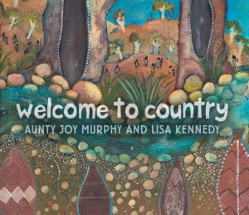
Welcome to country by Aunty Joy Murphy
Ill. by Lisa Kennedy. Black Dog Books, 2106. ISBN 9781922244871
(Age: 5+) Highly recommended. The Australian
Curriculum 'highlights the special connection to Country/Place
by Aboriginal and Torres Strait Islander Peoples and celebrates the
unique belief systems that connect people physically and spiritually
to Country/Place.' Welcome to Country written by Aunty Joy Murphy a senior
Wurundjeri elder of the Kulin alliance and illustrated by Indigenous
artist Lisa Kennedy gives insight and understanding into the meaning
of connectivity to the place and land. This ceremonial greeting is
spoken at the opening of ceremonies, events, school functions and
gives permission for visitors to enter traditional lands. As the
wedge tail eagle rises from the campfires and soars into the night
sky the Wurundjeri greeting is spoken. The dark earthy tones bring
the landscape to life, tree-lined meandering rivers, the ancestors'
spirits presence and families wrapped in possum skin coats. Each
double page spread explains the history, customs and symbols, the
Wurun the River White Gum and the Djeri grub and Bunjil the spirit
eagle who created all things natural. Aunty Joy Murphy explains the
importance of only taking from the land what you can give back and
asks for respect of the spirit ancestors.
The concluding welcome pages are most wonderfully painted. The city
of Melbourne rises in the background as the Wurundjeri People
dressed in traditional and modern day clothes stand by the banks of
the Yarra. Fish swim in the flowing blue waters and bright spring
flowers line the foreground. There is a layered look to Kennedy's
artwork, with her depth of colours and fluid lines she brings the
modern and ancient times to life. Welcome To Country is an important narrative for teachers in
schools and kindergartens and for families to share. Teachers'
notes are available.
Rhyllis Bignell
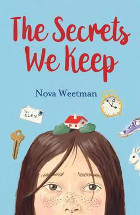
The secrets we keep by Nova Weetman
UQP, 2016. ISBN 9780702254215
(Age: 11+) Recommended. This is a sad, but sweet, poignant journey
into loss and heartache. Clem has lost everything and her life has
spun into the world of 'Nothing will ever be the same again'; her
family and her 'normal' have been torn apart. She has watched her
home burn to the ground, and has only her considerate and gracious
father to lean on in the aftermath and in her grief. A change of
home and school while they wait to see if the insurance company will
pay out their claim leaves Clem with the inner turmoil of extreme
change and the loss of all that she has known. A secret shared at
her new school creates opportunities for friendship, but with it
comes immediate regret at opening up the wounds of her life. And
then everything starts to become more and more painful. Running fast
is all that gives her escape, but even this is marred by the secret
that she has shared. Pain and torment swirl around her as she tries
to fit into the changed world of life after the fire.
This is gently written, and allows difficult issues to be discussed
and friendship to be explored in a way that young readers can
connect with. But there are sad moments amidst the narrative, and
although Clem has support in her grief, she must also be personally
responsible for her passage through this journey. Readers will
appreciate this as a story of self-discovery and not a handbook for
dealing with grief issues. Although the text of this book could
easily by managed by a young capable reader, the content is best
left to an upper Primary reader. The content could be quite
distressing, but Weetman manages to offer some light moments and
glimmers of hope.
Carolyn Hull
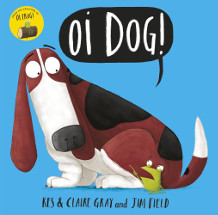
Oi dog! by Kes and Clare Gray and Jim Field
Hodder, 2016. ISBN 9781444919585
(Age: 4+) Recommended. Dogs, Verse, Word play. After the successful
Oi frog!, this trio has written another picture book
concerning a dog sitting on a frog. Frog is not too pleased so
offers alternatives to the dog sitting on a frog. He thinks the dog
should be sitting on a log, and wants change to occur. Dog is a
little perplexed and so asks what bears will sit on. Bears sit on
stairs is the response, and children will laugh out loud as they
predict what that word might be. Each time a new animals is spoken
of, readers will respond quickly with a rhyming word, adding to the
fun of the story. Crickets, moths, slugs, leopards, cheetahs and
pigs, boars, gnus, whales, kittens, dragons and puppies are amongst
the array of animals presented for the readers' amusement, and
combined with the natty illustrations, splashing colour and vibrancy
across the pages, the whole is a snortingly good tale to keep
children amused and engaged.
The huge list of animals and what they will sit upon is repeated at
the end of the book, with the dog then asking the one questions
still to be asked, where will frog sit? This is a funny interactive
book designed to keep readers' interest to the last page, following
on from their successful Oi Frog! (2015)
Fran Knight
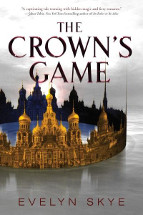
The Crown's game by Evelyn Skye
Balzer and Bray, 2016. ISBN 9780062560605
Highly recommended. Similar in nature to Erin Morginstien's The
Night Circus, The Crown's Game follows a competition
between two enchanters in which only one may survive. I would highly
recommend to anyone interested in fantasy or historic fiction.
Vika has been raised to become the Imperial Enchanter, her entire
life has been devoted to that goal. But little does she know there
is another enchanter who has also been raised not only to become the
Imperial Enchanter, but to win the Crown's Game. The borders are
under threat and there is a whisper about a rebellion, Yuliana, the
Tsar's daughter, convinces the Tsar that the time is ripe for a new
Imperial Enchanter and entreats him to start the Crown's Game to
protect her brother, the Tsaravitch. Pasha, the Tsaravitch, is soft
and unlike his father the Tsar. He defies the royal pomp and as a
result his best friend is an orphan, Nikolai. But Nikolai is more
than just an orphan - he has been brought up an enchanter, and
thrust unwillingly into a game where he must kill or be killed.
Things only grow more intense as a love triangle emerges between
Vika and the two boys and they are all forced to think on who must
die. There is no way out of this game.
Set in imperial Russia during the years 1801-1825, the story focuses
on Alexander I and his Tsarina Elizabeth's two fictional children
Pasha and Yuliana. By adding layers of mysticism, Skye produces a
wonderfully rich fantasy filled with magic, drama, and Russian
curses.
Kayla Gaskell (University student)