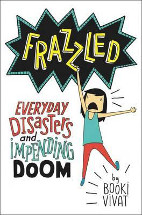
Frazzled: Everyday disasters and impending doom by Booki Vivat
HarperCollins, 2016. ISBN 9780062663665
(Age: 9-12) Recommended. Themes: Confidence, Brothers and Sisters,
School Life, Emotions. Booki Vivat's debut novel Frazzled
introduces the emotion-charged writings and drawings of Abbie Wu, a
Chinese-American girl about to journey into the great unknown -
Pointdexter Middle School. Abbie suffers from middle child syndrome,
Peter her older brother is good at everything and he has all the
trophies to prove it. Sweet six-year-old Clara is her confident
little sister, a wonderful artist who is all ready to start
kindergarten. Then there is Abbie whose anxiety is overwhelming her
life; she believes 'nothing good ever happens in the Middles.' Even
her mother brushes off her daughter's concerns, busy with being a
single parent she does not really understand Abbie's anxieties.
Even her best friends are looking forward to middle school: actress
Maxine is excited to join the drama elective and Logan is excited to
hone his skills as part of the computer gaming and programming
group. Abbie however is so concerned with her lack of talents - she
is uncoordinated, prone to stage fright, tone-deaf and
technologically confused, she believes that everything is hopeless.
Abbie's hopes and dreams of delicious school cafeteria lunches are
crushed. While the eighth graders enjoy tasty meals, the rest of the
school lines up to receive standard soggy vegetables and bland
mystery meat meals. Without an elective choice, Abbie joins all the
loners and troublemakers in study hall. Here, Abbie finally
discovers her special abilities.
Vivat's fun pencil and ink illustrations perfectly display Abbie's
emotional lows and highs. They are complimented by the expressive
text sizes and styles ranging from bold and vibrant to tiny-labelled
diagrams. The contrast of black and white explodes off the pages,
especially when Abby pictures her school life as a gigantic black
hole.
Booki Vivat's enjoyable novel develops well-being themes including
self-esteem, growing in confidence, discovering your own talents and
finding your own place in the world around you.
Rhyllis Bignell
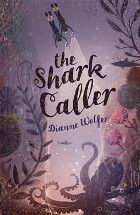
The shark caller by Dianne Wolfer
Random House, 2016. ISBN 9780143780557
(Age: 11+) Highly recommended, Sharks, Papua New Guinea, Mythology,
Westernisation. Fourteen year old Izzie is on her way back to her
island near Papua New Guinea with her twin brother's ashes to be
scattered in the lagoon near their family business, the Sea Star
Resort. She longs to see her home again, but is dismayed when she
sees her old school closed, the resort looking a little worse for
wear, the rainforest on a nearby island cut down. The scar left by
logging has meant that tourists are less evident, the community now
cannot afford a teacher and the kids must board each week at a
nearby school, returning on the weekends. Later that evening she
overhears the men talking about the sharks. The community's life is
bound with the sharks. The men can call them and Izzie finds out
that her brother was the last of the shark callers.
Her father from Broome is wrapped up with his new life and his
family's pearl industry and Izzie has had little to do with him
since her parents separated. Noah, her islander cousin tells her of
the stories around the shark callers, letting her know that they are
relying on her to do what her brother would have done, diving into a
deep cave to bring back an artifact which will ensure the islanders
will be able to catch more sharks, and secure the long term
viability of the reef which surrounds their home. Izzie is torn. He
parents had taken them away because of the myth of the shark caller,
but now back, she is being besieged with the idea that she and only
she can ensure the island's survival.
Noah trains her in the skills needed to get into the cave to fetch
the piece of obsidian so needed for the community's survival, and so
follows a breath taking account of Izzie's dive, where some things
are solved but questions are left lingering.
It is wonderful to see a story set in one of our near neighbours,
full of the sights and sounds of that nation, their beliefs and
customs woven into the story, with a glossary at the end to acquaint
readers with their language. The problems of this nation seem to
replicate problems worldwide: logging of rainforest, reliance on
tourist dollars, the drain of the younger people and stress on the
fishing industry. A marvellous read for middle school people.
Fran Knight
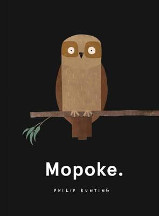
Mopoke by Philip Bunting
Omnibus Books, 2017. ISBN 9781742991658
(Age: 3+) Highly recommended. Reading aloud, Australian animals,
Humour, Word play. The opening line, This is a mopoke.
states baldly what the book is about, showing the reader that there
will be no excess of words and introducing a complimentary pared
down colour palette for the illustrations. Readers will be
enthralled and immediately begin to wonder what story lies inside.
Turning the page children will laugh out loud as the author plays
with the bird's name. He becomes a highpoke, then a lopoke, a
poshpoke and a poorpoke, each new word encouraging the reader to
tease out its meaning. On each page the mopoke stares out at the
reader from his branch set (usually) in the middle of the page,
inviting the reader to notice his plumage, large round eyes, clawed
feet, the time setting and his environment. And a small paragraph is
given on the publication page giving further details about this
Australian bird.
Mopokes love peace and quiet but as the tale unfolds, he is beset
with morepokes, ones that play with a yo yo, ones that play tricks,
some that wear a moustache or an affro, some that wash and find they
can't do anything with their hair, until crossly he disappears to
make a nopoke. Readers will love the simplicity of the humour and
laugh out loud when it is read to them, or take it away to read for
themselves. I love the blocks of colour, reminiscent of stencils or
block prints, simply placed on each page, only the mopoke's eyes
betraying what he feels about all the interruptions.
A funny read aloud, the story introduces the idea that some like to
be alone, and shows what one Australian animal is all about.
Fran Knight
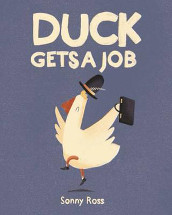
Duck gets a job by Sonny Ross
Five Mile Press, 2017. ISBN 9781760405359
(Age: 4+) Highly recommended. Work, Following your dream, Humour.
When Duck realises that he needs to get a job, he looks at his
friends, all of whom have jobs in the city. They love their
spreadsheets and encourage him to apply for a job like theirs. So he
follows their lead and applies for a job and getting an interview
must decide how he will look. After several swaps, he puts on a hat
and takes a briefcase with him, opting for the professional look.
Following advice from his friends, he gets the job and begins his
work in the city. But he finds the work boring and falls asleep and
so decides to quit.
He thinks hard about what he should do. He has always loved art and
done well with his art work, so he puts his work into a portfolio
and applies for a different job. The interviewer hires him and so he
has work which he loves, and he never falls asleep.
This delightful story based firmly on the author's own experiences,
will have younger children loving hearing it read aloud, or read
themselves, absorbing the message of following your dreams, of not
being influenced by others. The tale will be a wonderful springboard
for children to share ideas about their own likes, dreams, abilities
and futures. I love the illustrations, with humour for kids to find
and laugh about, offering differing visions of city life, showing an
obvious delineation between the job that Duck hates and the one he
loves. The colours reflect Duck's mood and the duck motif is
repeated in the glorious endpapers. With deceptively simple but
beguiling text I loved working out just how the author had achieved
his aims through the text and his illustrations.
Fran Knight
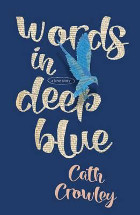
Words in deep blue by Cath Crowley
Pan Macmillan, 2016. ISBN 9781742612386
(Age: Adolescent - Adult) Recommended. This delightful novel is
about the joy of writing, of love, of families, of the angst and joy
of adolescence, of stories and of the place of books in today's
world. Situating her story in a country town, Cath Crowley centres
her story on one family who own a bookshop, who are passionate about
books and reading, and who live above the shop. The struggle to
survive as booksellers in today's world, is at the heart of the
narrative, particularly given the threat to books, and by inference,
to reading, that is potent in the novel.
The quirky and charming aspect of this shop is that many people
write notes to loved ones, to friends, to those who are no longer
living, or just to anyone who might, one day, find the note. Some
write back, their reply encouraging friendship or relationships, and
others just read the notes. The simple love of reading, of the
welcoming of readers who come into the shop just to read the notes,
is at the core of the novel. We know from the start that the
bookshop's role in the town is threatened, and we are caught up in
the underlying note of sadness - that with the demise of the shop,
their lives will change drastically.
Crowley captivates her readers, inviting us into the intimate world
of people's thoughts and relationships through the letters, the
little love stories, the stories of those who part, and the stories
of deep friendship, of loss and of recovery. Crowley has included
some thought-provoking little messages at the start of each chapter,
and these reflect the emotions and lives of the characters. The
letter-narrative is told in the first person from a number of
note-writers, while the narrative itself is told by various
characters, of different ages, told in the first person. Somehow,
once we get to recognize who is speaking, this quirky structure
works and we begin to understand the characters in their sometimes
confessional, sometimes angry, sometimes puzzled narratives. Despite
the presence of change and of incipient loss, the feeling of
possibility is potent, as we are caught up in the small worlds of
the adolescents and the adults who live, for a brief time, in this
quirky story. It is suitable for both adolescent readers and adults
who are happy to read about life as experienced by adolescents, with
all its angst, joy and potency.
Liz Bondar
Editor's note: This is a CBCA Notable for older readers, on longlist
for the Inky Award.
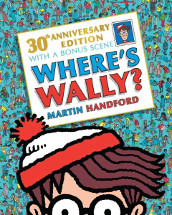
Where's Wally by Martin Handford
30th Anniversary edition. Walker Books, 2017. ISBN 9781406375695
(Age: 5+) Highly recommended. Wow - 30 years ago Where's Wally
first appeared and the book has lost none of its appeal over the
years. When it arrived on my desk I immediately spent quite some
time going through and finding the picture of Wally on different
pages as he travelled around the world. I was thrilled when I did
find him, but needless to say I had a few pages that completely
baffled me and even returning again couldn't find the little figure
with the red striped jumper and hat.
After the initial browse I went back and read the new letter from
Handford to his fans and discovered some more things that the reader
could search for, including the tail of Woof, making the book even
more enjoyable. As the search goes on, there are lots of fascinating
and humorous little figures, details and scenes which are so
enjoyable that hours could be spent perusing the pages.
This is a wonderful book to give children as a gift and it will also
keeping the family occupied for hours. In the library make sure that
no one marks where Wally is and spoils the fun!
Pat Pledger
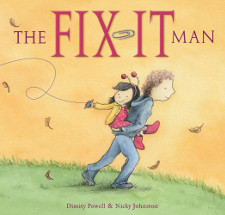
The fix-it man by Dimity Powell and Nicky Johnston
EK Books, 2017. ISBN 9781925335347
Dads can fix anything - that's what dads do. Kites, kennels, teapots
- whatever is needed. He can even cobble together a rug made of
rainbows and old hugs for mum - but he can't fix mum. Not even with
his special peach and honey brew. Even the doctors and lots of rest
can't fix mum. Not even all the love in the world. And no matter how
hard they try, little girls can't mend broken hearts - not hers, not
dad's and not Tiger's. Well, not with sticky tape or glue or needle
and thread. But dad has one more special thing up his sleeve and
together they start to mend.
This is a poignant story of loss and one that will resonate with
many children who have lost a parent or other loved one. With its
gentle text and soft palette, even though it is sad, it is not gloomy
because the love between this family oozes from the page and from
that, the hope is tangible. And the threads that bind the family are
stronger and more enduring than nails, glue, sticky-tape or any
other kind of man-made adhesive or fastening.
Grief is a natural part of life and while we might like to protect
our children from it, nevertheless it happens and we often struggle
helping them to cope with their loss. This book allows conversations
to start and explores the way it is an emotion that we each express
and deal with in our own way. Dad's lap is cosy and warm but his
face is crumpled and wet; pieces spill out from Tiger's heart and
little girls try to do what they can to paper over the cracks - but
they are too wide. But together...
Whether shared as a 1:1 or as a class, it offers children the
opportunity to talk about losses in their life and to learn that
they are not alone in feeling lonely, lost, scared and even betrayed
but there is love and it does get easier.
Barbara Braxton
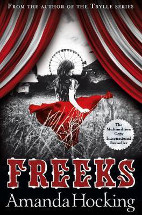
Freeks by Amanda Hocking
Pan Macmillan, 2017. ISBN 9781509807659
(Age: 15+) Freeks by Amanda Hocking is an exciting and fast
paced novel about a young girl called Mara and her life in a
travelling circus alongside her mother and friends. Set in 1987,
Mara's colourful travelling companions are desperate to find their
next short stop as they scrounge for their livelihood going from
town to town and looking to attract large crowds. Their main appeal
to the public is their one-of-a-kind circus performances which
includes fire dancers, tigers, magic tricks, a house of horrors, the
sideshow, a Ferris wheel and more. But these are not the ordinary
attractions of just any circus, half of the population whom live
with the travelling show have abilities that breach the border
between the natural and supernatural. On their way to their next
stop (like it or not for Mara and company), many members of the
troop get bad feelings about the upcoming town which put many at
unease, and these feelings worsen when one of their own wanders from
the camp for longer than her usual spells of absence. It's up to
Mara to interpret the signs shown to her and take care with the
inhabitants of the town, and find if the town brings out more in
Mara than she first anticipated. Freeks is a captivating story that indulges its readers to
the engaging internal dialogue of Mara which helps add to the
mystery and thrill of the story as we interpret the events that
unfold both through our own eyes as well as hers. This novel is
better suited for an older teenage audience due to both adult and
violent themes. Overall, Freeks is an exciting read that is
refreshing and leaves the reader looking for more fantastic writing
by Amanda Hocking.
Sarah Filkin (University student)
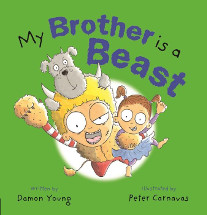
My brother is a beast by Damon Young
Ill. by Peter Carnavas. UQP, 2017. ISBN 9780702259579
(age: 4+) Highly recommended. Siblings, Family, Rhyming story, Read
aloud. From the creators of My sister is a superhero, comes
an equally funny sequel, where her brother is a beast. In a series
of eight line stanzas, the first three double lines tell of what
other brothers do: Some brothers scrub with sponges
to clean glue from dirty doors',
each set of six lines ending with the refrain, 'But my brother is a beast . . . '
The repetition is infectious and the repeated last two lines will
have kids in gales of laughter, working out what the rhyme will be,
following the antics of the beastie brother.
Each page is filled with colour and laughter, movement and music as
the brothers show their skills at playing drums, or the bassoon, or
harp, or clean the stables, or make a table, or row a canoe. But
towards the end of the story, the children are tiring out as the
brothers sleep in a hammock, or laze in an armchair, while the beast
of a brother makes a cave of sheets for his sister to sleep in.
Carnavas' watercolour and ink illustrations suit the mood of the
story beautifully as he repeats the round eyed children motif, and
children will watch out for the array of animals he includes on each
page. Children will love to read this book aloud, reading along with
the older reader, predicting rhymes for themselves. The book lends
itself to making up lines using the model given in the book, and
drawing the children in different situations, using Carnavas'
drawings as a template. I can imagine lots of brainstorming of
lines, 'Some brothers . . . ' and 'But my brother . . . ',
encouraging younger readers to learn about rhyme, rhythm and metre
at an early age.
Fran Knight
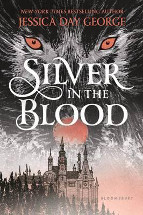
Silver in the blood by Jessica Day George
Bloomsbury, 2016. ISBN 9781681190242
(Age; 13+) Recommended. In the peak of youthful society of 1890's
New York, two young cousins, Lou and Darcia, are at their social
prime with constant attention turned on them as they are the mixed
blood of a wealthy New York family and an ancient Romanian line.
With vague warning, both girls are caught up in a whirlwind trip to
finally engage with their Romanian relatives and connect to their
ancient heritage. The trip is long and with it, more questions and
strange situations appear and are discussed in letters and journal
entries from both girls. Once in her home country, Darcia is
frustrated by her Aunt Kate's sudden change in personality; what
could make someone go from being like a mother, to a prison guard.
Darcia demands to find out what is the real reason they were
suddenly brought back to Romania and why everyone she knows and
loves is starting to act incredibly strange. By the end, neither
girl will ever be the same again.
Jessica Day George writes Silver in the Blood in such a way
that captures the reader's attention and really makes the 1890's in
America, Paris and Romania burst with life, painting a very
relatable and realistic scene for her characters to interact. With
reference to another well-known novel from the time, Silver in
the Blood is exciting for readers of fantasy and mystery. This
novel is recommended for an teenage audience (13+) due to themes of
violence and romance. A fantastic read that leaves readers hoping
for more stories about the two cousins, Darcia and Lou.
Sarah Filkin (University student)
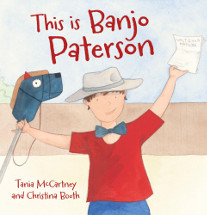
This is Banjo Paterson by Tania McCartney
Ill. by Christina Booth. NLA Publishing, 2017. ISBN 9780642278982
(Ages: 4-8) Highly recommended. Tania McCartney and Christina
Booth's beautifully crafted picture book celebrates one of
Australia's most iconic legends, Andrew 'Banjo' Paterson.
The descriptive narrative focuses on his rural upbringing and the
people who influenced his life's journey. Young Barty as he was
known enjoyed his bush childhood, helping on the farm, riding his
horse Banjo to school, watching polo matches and horse shows. He
enjoyed listening to Jerry the Rhymer's tales about his bush life.
His grandma loved poetry as well and she shared her love of language
and rhyme with her grandson, whilst he boarded at her Sydney home.
His teenage years were filled with school, sports, and his creative
writing as well. This picture book tells of these special people in
his life and the influences and events that moulded his life and
developed his journalism career. He also worked in the legal field,
as a farmer, vet, jockey and most famously as a writer. Tania
includes special moments, the inspiration for 'Waltzing Matilda',
his marriage and his children. The story ends with the beginning
stanzas of 'The man from Snowy River'.
What sets this book apart from other biographies written for younger
children, are the beautiful watercolour illustrations by Christina
Booth. Here is a duality of storyline pictured visually, each
vignette shows today's children dressed in summer clothes acting out
the scenes. There is backyard cricket, Barty with a bush hat riding
his hobbyhorse and sharing picnics under the clothesline with family
and friends. Speech bubbles add to the commentary, rhymes,
statements and exclamations, as well as witty thoughts by his dog
who just wants a walk or to play catch.
Sharing these with a class, with a young audience at kindergarten or
preschool is a wonderful experience, opening up conversations about
life, changes, growing up and people who are important in their
lives. Even the scenes of leaving for war and the time when Paterson
went missing in France during World War 1 are sensitively
illustrated.
Tania McCartney has included a description of Banjo
Paterson's life in a newspaper format - 'The Snowy River Times'.
Photos, copies of original illustrations and the music to 'Waltzing
Matilda' provide additional information. This factual material
and additional poetry are a great beginning for research topics.
Dressing up and acting the scenes, making a wooden and bark hut,
singing along to 'Waltzing Matilda' and unpacking the text are all
wonderful learning opportunities. This is Banjo Paterson is an
exciting collaboration by McCartney and Booth, perfect for sharing
at home and in an education environment.
Rhyllis Bignell
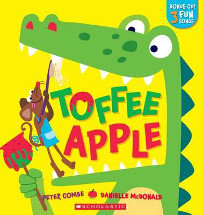
Toffee apple by Peter Combe
Ill. by Danielle McDonald. Contains CD. Scholastic, 2017. ISBN
9781760275082
(Ages: 2+) Recommended. Peter Combe's 'Toffee apple' album won the
1988 ARIA Music Award for Best Children's Album after its release to
great success in 1987. Generations of Aussie parents and
grandparents who enjoyed singing along to Combe's songs as children,
can now share them with their young family members. This fun picture
book includes three songs - 'Toffee apple', 'Newspaper mama' and
'Err yuck!'
Danielle McDonald's bold digital illustrations fill each page with
colourful scenes and an array of comical animals in humourous
scenes. 'Don't forget to clean your teeth' sings the mouse as it
brushes a crocodile's molars. Imagine the surprising situations that
unfold as the newspaper is delivered to a penguin's igloo, a panda's
bamboo hut and a magpie's tree house! The text changes style, size,
colour, some is highlighted, and the position changes from page to
page to encourage the development of reading skills and engagement
with the lyrics.
Peter Combe's songs are fun to share with families and classes. Toffee
apple joins these previously published favourites, Wash
your face in orange juice and Juicy,
juicy green grass.
Rhyllis Bignell
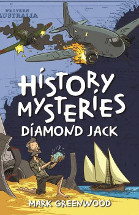
Diamond Jack by Mark Greenwood
History mysteries bk. 1. Puffin Books, 2017. ISBN
9780143309260
March 1942 - the Japanese have reached Indonesia and there is a
constant stream of flights shuttling refugees from Java to the safe
haven of Broome on the northwest coast of Western Australia.
Russian flying ace Captain Smirnoff is piloting one of the last
planes to leave Bandung Airport, an old DC3 stripped back to the
bare minimum to allow for as many passengers as possible including
five Dutch pilots, a trainee flight engineer, a mother and her 18
month old son.
Just as they are about to take off an official jumps on board and
hands Smirnoff a package, telling him to "Take great care of this.
Someone from the bank will collect it when you land."
Unfortunately for Smirnoff, his crew and his passengers, the
Japanese have switched their target to Broome and just an hour from
their destination they are shot down. Despite injuries and
continuing Japanese fire, Smirnoff manages to bring the plane down
on the edge of the beach.
What happened next - the survival and rescue of the passengers; the
finding and the contents of the mysterious package and the enigmatic
man who became known as Diamond Jack are the centre of this
intriguing true tale that still remains unanswered 75 years on.
Should he have done what he did? Is 'finders keepers' really the
rule to live by?
Rudyard Kipling once said, "If history were taught in the form of
stories, it would never be forgotten" and in this new series from
self-confessed history-hunter Mark Greenwood there are stories told
that would otherwise have been forgotten, if they were ever widely
known in the first place. Short, engaging reads written in short
chapters, large font and liberally illustrated they are not only
perfect for the young reader moving on to independent reading but
also those who may not have yet unlocked the key. Greenwood writes
an introduction that personalises the story as though he is talking
directly to the reader, drawing them into this tale that is about to
unfold and then, the tale told, he talks about the sources he has
drawn on and provides a lot of extra information so not only is the
story authenticated but there is scope for further discovery.
Something special to add to the collection and promote an interest
in times past in a way seldom done. Australia - a country full of
stories!
Barbara Braxton
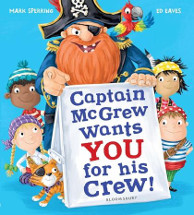
Captain McGrew wants you for his crew! by Mark Sperring
Ill. by Ed Eaves. Bloomsbury, 2017. ISBN 9781408871034
(Ages: 3-7) Captain McGrew's in need of a crew to assist him with
hoisting the sails, digging for treasure, 'splooshing' down the poop
deck and even squeezing lemons for his lemonade. With his bushy red
beard, eye patch, parrot on his shoulder and his four teeth, he is
an awesome character. Even his ginger tabby cat has a matching
patch. What adventures await his four child crew?
Author Mark Sperring's amusing rollicking rhymes are great to read
aloud, filled with pirate vernacular and direct questioning speech.
Each page demands a response; children will enjoy engaging with the
story and predicting the rhyming words.
'Are you good with a spade? Do you complain if you're hot? Can you
dig for long hours while others CANNOT?'
Ed Eaves brings Captain McGrew and his young crew to life, with a
broad range of emotive facial expressions, as they complete their
duties. Colourful settings of the sea, sand and aboard ship are
amusing; look for the cat licking the dishes and cleaning the hull
in a snorkel and mask. Captain McGrew wants you for his crew is an entertaining
picture book, filled with all the delights of a pirate's life.
Rhyllis Bignell
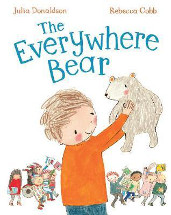
The everywhere bear by Julia Donaldson
Ill. by Rebecca Cobb. Macmillan, 2017. ISBN 9781447280736
(Age: 4+) Highly recommended. Bears, Loss, Adventure. When the
everywhere Bear falls from a child's backpack on the way back to
school after being taken home for the night, his adventures begin.
Readers will love the Bear, and his class, Class One and their
teacher, Mrs McAllister, who allows each child to take home Bear
after school.
But readers will be dismayed when he falls into the street to be run
over by a line marking machine, and then fall into a street drain.
His yellow stripe standing out, he is then flushed out to sea.
Readers will follow his adventure keenly, wanting to know whether he
makes it home again, concerned that he might not make it. But of
course he does. He takes a most circuitous route, floating in the
sea, being picked up in a fishing net by a trawler, sold on the
jetty to a woman fish and chip shop owner. Once she deems him
inedible, he is tossed out of her window onto a garbage truck.
Transported to the tip, all seems lost until a somewhat short
sighted seagull picks him up thinking he is a fish. The gull drops
him to the ground where he is rescued by a woman called Bethany on
her way to work. And where does she work? At the library of course,
where Class One is about to begin their day. All is resolved, a
cycle has taken place which will intrigue younger readers, and Bear
is back to where he started.
This absolutely charming tale is told in rhyming stanzas and I can
imagine many children being able to recite sections of it soon after
it is read.
Julia Donaldson also wrote the hugely popular Gruffalo and
Rebecca Cobb has illustrated several of her recent books and in this
one has created a soft edged pictorial style most suited to the
story of the lost Bear. And the range of transport used in the
endpapers adds another level of understanding to the story of the
lost bear, asking readers to recognise which forms of transport Bear
used.
Fran Knight