Epic fail tales series. Scholastic, 2017. ISBN 9781743811696
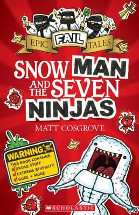
(Age: 7+) Recommended. Matt Cosgrove's hilarious series Epic
fail tales are twisted classic fairy stories, reminiscent of
Roald Dahl's Revolting rhymes and the Fractured fairy
tales cartoons.
Being at home during the school holidays is boring, so the narrator
borrows and reads his sister's 'Snow White' storybook. He
alters the text by adding cut and pasted words, totally changes the
characters, includes witty asides and comments in speech bubbles and
invents humorous situations to make a crazy new story Snow Man
and the Seven Ninjas.
Just before Miss Bacon dies performing her juggling chainsaw act at
a talent show, she wishes for 'a monster made of snow with eyes as
red as blood, and muscles as big as the butt of a pig.' The little
monster magically appears and wins first prize. Hooked on the fame
of winning, little Snow Man exercised and grew stronger and
stronger, and he even developed a marvellous six-pack. Across town,
super dude checks in with his magic mirror, unfortunately. He calls
for the stunt man's help, promising him fifty dollars and a Chinese
take-away if he can slay the Snow Man. The super dude also threatens
the stunt man's pet goldfish and various methods of disposal are
illustrated - super cannon bowl or super kitty snack.
The stunt man's knife throwing act becomes quite confronting, as he
tries many ways to kill off the Snow Man; after the knives, lemon
juice in the eyes, he aims a Brussels sprout filled slingshot at him.
When Snow Man escapes to the home of the Seven Ninjas a new level of
craziness happens. He becomes their slave, someone to insult, as well
as rehearsing for his stage comeback.
Cosgrove's narrative uses silly rhymes, sarcastic dialogue, snappy
puns, with the amusing overwritten text; this radically changes the
original storyline. This is a laugh out loud story for younger
readers and for those familiar with the original, an out of the
ordinary fun fairy tale. His cartoons are funny and gross; they
often have layered levels of meaning.
As part of Middle Primary English lessons, students could develop
their own fractured fairy tales after reading Dahl's narrative poems
and Cosgrove's Epic fail tales.
Rhyllis Bignell
Olivia's voice by Mike Lucas
Ill. by Jennifer Harrison. MidnightSun Publishing, 2017. ISBN
9781925227192
(Age: 5+) Recommended. Deafness. Disability. Sometimes books can be
used to press home a point and these rarely work, but now and again
a book is published that makes the readers aware of one person's
disability with panache. This is no inclusivity driven tome, but
rather a look at one girl and her particular way of dealing with her
deafness.
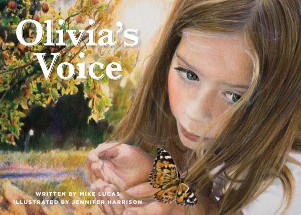
With photographic realism, the pictures created are full of colour
and life, inviting the reader to share Olivia's day.
When she gets up in the morning she loves looking at the beauty
around her: the trees outside her window, the butterfly passing by.
She notices the colour of the things on the table, she loves the
warmth of her mother's face against hers, and then she is off to
school with her friends, watching the shapes made by their mouths,
joining with them clapping their hands. At school the teacher calls
the roll, looking at Olivia as she calls her name. Olivia loves
words and numbers and draws with the others in her class. But music
is her favourite lesson and the children all know which instrument
Olivia will go for.
A story full of life, love and covering all five senses, the fact
that Olivia is deaf does not matter, she joins in with all
activities both at home and school with enthusiasm and verve, shared
by her family and school friends.
This is a charming look at one girl's day, concentrating on all the
senses, it will be a great starting point for young readers learning
about the senses they use everyday, how important they all are in
shaping the world around them, and how the loss of one of those
senses can be compensated with love and support.
Fran Knight
Lucy's book by Natalie Jane Prior
Ill. by Cheryl Orsini. Lothian, 2017. ISBN 9780734416605
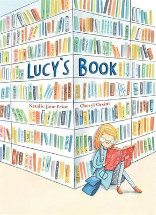
(Age: 4+) Recommended. Library. Books. Sharing. When Lucy finds a
book that really appeals to her she takes it with her everywhere,
reading it at home, in her bedroom, while she has a bath, in bed, in
church, sharing it with her siblings and friends. When she returns
it the following week, her friends race to fetch it from the returns
trolley. The following Saturday Lucy borrows it again after her
friend returns it, first shaking the crumbs from inside the pages.
She extends the book so her ballet friend can read it and returning
it finds it is borrowed by the tardy McGarrigle family. They share
it all around their family and of course are late returning it. Lucy
is anxious, her family is setting out for their holiday and she
wants to take the book with her. Adventure after adventure happens
to Lucy and her book, everyone she knows reading it until it is
taken from the shelves, worn out with use. Lucy is dismayed and no
one can find her a copy, until one day the library has a book sale.
A charming story of the power of just one book, the story will
resonate with many readers as the book is passed around many hands,
each person enjoying it as much as the rest.
Fran Knight
Our fathers cleared the bush: Remembering Eyre Peninsula by Jill Roe
Wakefield Press, 2016. ISBN 9781743054291
(Age: 14+) Local history. The resonating title of 'Our fathers
cleared the bush' conjured up for me issues of theft of Aboriginal
land. Jill Roe's book however does not dwell very long on the
Aboriginal experience, giving it only a chapter towards the end; she
reveals the violent frontier and the Elliston massacre. Over all,
her book is more a mix of historical research and personal memories
of the generations of men and their families who settled across Eyre
Peninsula, South Australia, with chapters on country life, water as
a vital resource, the school bus and the isolated one teacher
schools, farming, agricultural shows, Church and community. Roe's
grandparents were early settlers, and Roe herself was born at Tumby
Bay in 1940, so she is able to draw on childhood memories which add
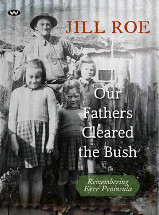
interest and authenticity to the research. The book, illustrated
with black and white photographs, is a valuable record of country
life in South Australia in the 1940's, 50's, 60's and onwards.
Helen Eddy
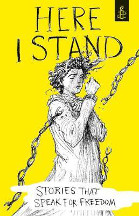
Here I stand: Stories that speak for freedom edited by Amnesty International UK
Walker Books, 2016. ISBN 9781406358384
(Age: 12+) Recommended. This hard cover collection of short stories
and poems edited by Amnesty International is not what I first
expected. The focus is not so much on political issues and human
rights so much as the commonly encountered issues of bullying,
abuse, self-identity, LGBT rights, exploitation, loneliness, and
similar issues experienced by many young people. The authors are 25
leading writers and illustrators inspired by the Universal
Declaration of Human Rights, writers such as Neil Gaiman, John
Boyne, Tony Birch, Sita Brahmachasi, Kevin Brooks and others. They
are simple stories that quickly draw you in and create a connection,
leaving you afterwards with much food for further thought. As author
Bali Rai writes, 'My story is designed to make you think about what
makes us human. I hope that it does.' And all of the stories do make
you reflect on humanity.
The last story in the book is different, and is more political.
'Speaking out for freedom' is an interview with Chelsea Manning, an
intelligence analyst imprisoned for 35 years for revealing what she
had learnt about 'the secret reality of the way the Iraq War was
being fought'. To this day she believes what she did was the right
thing to do, and although she was very afraid she felt she had to
take a stand and speak out.
This is the message of the book as a whole - making a stand for our
common humanity, whether it is regarding the bullied child in
school, the victim of racism or the child being abused. We have to
care about rights and freedoms and speak up for them when they are
under attack. In his introduction to the collection, human rights
lawyer Jules Carey urges us all to care, question, and act.
Teachers' notes Using
fiction to explore human rights are available.
Helen Eddy
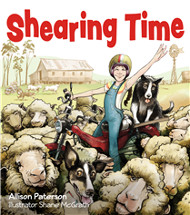
Shearing time by Allison Paterson
Ill. by Shane McGrath. Big
Sky Publishing, 2016. ISBN 97819235520095
(age: 5+) Warmly recommended. Sheep shearing, Station life, Sheep,
Australian rural life. Told by the daughter of the sheep station,
this homage to the bush will entertain and inform those who read it.
All the elements of shearing time on a station are shown: rounding
up the sheep with the motorbikes, herding them into the yard,
shearers cleaning their combs, finally shearing, sorting the
fleeces, and dinner time for the workers then going back to work.
Each element is shown in some detail, enabling the people who do not
have access to how a farm is run, to see it all very clearly. The
vibrant illustrations serve the text well, making sure younger
readers will empathise with the young girl on her motorbike, doing
chores around the farm that they think that adults usually do. She
will be seen as someone their age doing extraordinary things.
Readers will be able to see the sort of life lived on a station by
other people, and given a glimpse of life beyond the cities and
towns. One image shows the life years before when horses and wagons
were used to haul the fleeces to the market, giving the reader a
hint of times long past.
A page at the end of the book gives a glossary of sorts, with
information about shearing time and sheep dogs,a s well as a list of
words used int he text with their meanings. All in all this book is
a worthy contribution to a library's miscellany of books about
Australia, books about other people's lives an of course, about an
almost iconic part of Australian rural life - shearing.
Fran Knight
Heartless by Marissa Meyer
Pan Macmillan, 2016. ISBN 9781925479478
(Age: 13+) Recommended. A tale that is a must read for anyone who
enjoyed Alice in Wonderland and fairy tale retellings,
Meyer, the New York Times bestselling author of The Lunar
Chronicles, has given a unique backstory to the woman who was
the Queen of Hearts. Catherine Pinkerton is a talented baker and
even though she is desired by the unmarried King of Hearts, all she
wants to do is to open a baker's shop with her best friend. However
her mother is determined that she will be the next queen and having
a daughter who owns a bakery is not what she wants. Then Cath meets
Jest, the handsome court jester and the two begin to fall in love,
but fate intervenes . . .
Readers will become engrossed in the setting of the strange fantasy
world that Meyer has created, while identifying with the normality
of Cath making delicious cakes and dreaming of opening her own shop.
Catherine feels no attraction for the King of Hearts and doesn't
want to be the Queen of Hearts, instead falling for Jest a most
unsuitable man in the eyes of her mother. Readers will be swept away
by the conflict that Cath faces, that of being a dutiful daughter
and obeying her mother, while wanting completely different things
for herself.
The idea behind the story is very clever, the writing is lyrical,
Catherine's dreams and desires are very relatable and the ending
will leave readers breathless. This is sure to appeal to people who
enjoyed The lunar chronicles, and those who like books by
Robin McKinley, Zoe Marriot and Frances Hardinge.
Pat Pledger
Old growth by John Kinsella
Transit Lounge, 2017. ISBN 9780994395788
(Age: 15+) Highly recommended. Evocative, intense, and shocking at
times, John Kinsella, in this collection of short stories, takes
this medium into its absolute best. His constructed worlds seem
utterly real, reflecting life as it is today, in the big city, in
small towns and in the Australian countryside. Within the style of
this medium, he plunges us, seemingly, directly into the real lives
of the characters in his little vignettes of the modern world.
In this world, peopled by Indigenous Australians, people who have
lived here for generations, and people who are newer arrivals, we
are immediately aware of the struggle to survive, to make good
lives, or to repair their lives. For some this is not simple, and
for many the relationships are damaged, seemingly beyond repair. We
hear, in the language that is always apt, the language of children
and of adults, the vernacular, the formal communication and the
country accent, each reflecting the small worlds that he creates.
Kinsella does not let us off lightly in this collection. Depicting
sometimes raw, painful, hurtful, shattering, unsettling
relationships and events, Kinsella plunges us into the worlds that
he creates to reflect the issues that face us all today and to
depict just how difficult it is to make sense of the challenges that
this world places before us. We read about the boy who digs a
tunnel, living mostly in his own small world and seemingly
unobserved. Kinsella challenges us to spend time in his sometimes
brutal worlds, or the worlds of slow speech, 'Okay darl' says Beth
while a robber is asking her to open the till in the hotel! We slow
down with this character, who is unfazed by the situation. Kinsella
evokes memories, joy, humour and some element of the tough reality
of modern life in his imaginative reconstruction of today's
Australia.
Despite the darkness of his world at times, he evokes joy and
delight in the reader, and this is at the heart of his
storytelling, that quality of shared history, of connectedness, and
it is in his human reaction to relationships that he presents a
salve for the bruised souls whose lives he has placed, raw, blunt
and sometimes horrifying, before us. Kinsella's vivid worlds, his
characterization, and his absolutely delightful, lucid prose are a
gift to modern readers.
Liz Bondar
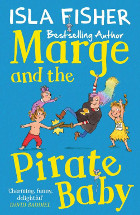
Marge and the pirate baby by Isla Fisher
Ill. by Eglantine Ceulemans. Piccadilly Press, 2017. ISBN
9781848125933
(Age: 6-8) Recommended. Swashbuckling pirates and a mischievous baby
cousin add to the fun and excitement of Isla Fisher's second junior
novel Marge and the pirate baby. Marvellous Marge is a
babysitter extraordinaire, no taller than 'seven packets of
biscuits', with rainbow-dyed hair and a multitude of magical stories
about her past child minding adventures. With Mum taking Auntie
Sally out for her birthday, Marge returns to look after Jemima and
Jakey as well as little cousin Zara.
Marge has previously worked on board a pirate ship 'The Poison
Curse' for Captain Not-So-Jolly-Roger. Marge informs the
children that pirates love babies more than treasure. With
cottonwool beards and pirate jewellery made from buttons, Marge and
the children make costumes and enjoy turning Zara's pram into a
pirate ship. Even though they leave a mess all over the house and
backyard everyone enjoys the pirate activities with Marge. A little
magic happens when the adults arrive home and everything is tidy.
In 'Marge and the stolen treasure' the second story, Marge
arrives on a very hot day to take Jemima and Jakey off to the local
pool. With her rainbow hair hidden under a bathing cap, a pink
dressing gown and gold sandals, she is ready to take charge. Jake's
red wagon is loaded up with a big vase of lemonade and toy
dinosaurs. Marge informs him that sunscreen scares away tigers and
lions, so he slathers it on. Her marvellous tales of animal antics
and inventive songs accompany their walk. Many adventures await the
explorers at the pool, as they conquer their fears and outsmart baby
Zara.
'Marge and the wacky wedding' is another humourous tale, filled
with ring bearers, chocolate fountains and contrary children. Of
course, colourful Marge and her unique rules turn Uncle Desmond and
Annie's wedding into a marvellous day.
Eglantine Ceulemans' line drawings bring Marge to life with her
crazy hair, creative costumes and her unique style of childminding.
They complement Isla Fisher's amusing tales with her outrageously
imaginative and engaging protagonist whose witty dialogue and
amazing stories of her menagerie of pets and pirate life are
enchanting. This is a brilliant read aloud story for junior primary
classes and to share at home; children will love Marge's distinctive
style of caring for Jake, Jemima and Zara.
Rhyllis Bignell
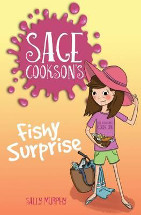
Sage Cookson's fishy surprise by Sally Murphy
Ill. by Celeste Hulme. Sage Cookson series. New Frontier
Publishing, 2017. ISBN 9781925059755
(Age: 7-9) Recommended. In Fishy surprise Sage's best
friend, Lucy is accompanying the family and television crew to
picturesque Crystal Bay. Sage Cookson's parents are stars of a
special series 'The Cookson's Cook on'. They travel to beautiful
locations around Australia and create beautiful dishes from locally
sourced food. Ten-year-old Sage loves to travel with her parents;
she enjoys experiencing so many wonderful locations, tasting
different foods and there is always a mystery to solve along the
way. While Mum and Dad are filming with the owner of Australia's
best fish and chip shop, Sage and Lucy are caught up in a stinky
problem.
When Sheila the cooking show's location scout takes the girls to
Picturesque Cove, they are overcome with the awful smell of rotting
fish and the sight of hundreds of fish carcasses scattered along the
shore. Who is responsible, maybe the person hiding in the rocks? She
looks similar to the evil chocolatier who had previously kidnapped
Sage in order to win a local cooking contest.
In this easy to read junior novel, Sally Murphy's characters are
relatable, she celebrates friendship, combines plenty of fun and
adventure with a dash of mystery. There is even a recipe for
delicious fish and chips included. The Sage Cookson series
books are a delicious addition to the range of spy, princess and fairy
books currently popular with young girls.
Rhyllis Bignell
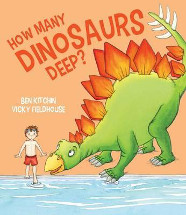
How many dinosaurs deep? by Ben Kitchin and Vicky Fieldhouse
New Frontier Publishing, 2017. ISBN 9781925059731
(Age: 4+) Warmly recommended. Dinosaurs. Fear. Anxiety. Jim is quite
happy in the baby pool, but the time has come to move into the
middle pool. Mum helps him by telling him that the water would
hardly touch a stegosaurus' knee. Jim is amazed and keeps on asking
Mum questions about other water receptacles: the fishbowl, the bath,
the big pool, the water at the end of the jetty, the river near
uncle's shack, the water in the big blue lake, and finally she gives
him the dimensions of the Pacific Ocean. Each time he asks about one
water source, she responds with a dinosaur and its measurements,
allowing the child to see how big one thing is by comparing it with
the other.
Readers will learn about a variety of differing dinosaurs and their
size as well as learning to compare them with something they know.
With his fears allayed, Jim is able to jump into the pool, knowing
that it only comes up to a stegosaurus' knee.
At the end of the book is a double page with information about the
eight dinosaurs mentioned, which will thrill the hearts of all those
early and middle primary readers who cannot get enough books about
dinosaurs.
Fran Knight
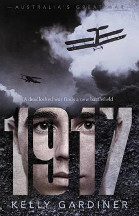
1917 by Kelly Gardiner
Australia's Great War series bk 4. Scholastic, 2017. ISBN
9781743622506
(Age:12+) Recommended. The fourth in Australia's Great War series
and published on the 100th anniversary of 1917, this novel concerns
Alex, a young airman making reconnaissance flights over the trenches
in Belgium.
I really like this series because these novels tell plausible
stories based on historical fact, using authentic characters who
reflect the real people revealed in the letters and documents
researched for the story. Gardiner continues the style, creating a
solid, captivating story which educates young Australians and allows
them to feel proud of those who served, without ever glorifying war.
Alex and his comrades are heroes, but they are very much afraid of
dying horribly in the ghastly war which seems without end. Flying
above the trenches and photographing everything in detail for
military analysis, the airmen observe the hellish conditions endured
by the infantry even though they return to relatively clean, safe
and warm billets upon landing. Their lot is no safer however as the
life expectancy of airmen was measured in days as they fell prey to
the enemy fighters flown by the likes of the famous Manfred von
Richthofen (Red Baron), and the anti-aircraft fire from the ground.
Sadly, a great many of their number also perished in flying
accidents, either in training or during active service on the front.
The narrative is carried along via letters between Alex and his
sister Maggie but this is balanced by descriptive passages in the
author's voice. Alex's family are pacifists who actively protest
Australia's continued participation in the war and particularly the
campaign by Prime Minister Billy Hughes to introduce conscription.
The family's aversion to the war places them in a vexing position
when Alex enlists for service, yet they of course share the same
fear for his safety experienced by every other family of soldiers,
sailors and airmen of the time.
The novel presents the Australian homefront very well. Civilians are
jaded and completely fed up with the war and suffer from shortages
and restrictions. Most of all, the population is sick of the endless
call for men to serve the war machine which kills so many and
returns the rest broken in body and spirit.
Content is not too gruesome for younger readers and I recommend the
novel for twelve years and over.
Rob Welsh
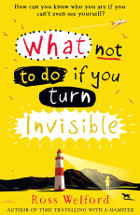
What not to do if you turn Invisible by Ross Welford
HarperCollins, 2016. ISBN 9780008156350
(Age: 10+) Highly recommended. Genres: Fiction, Comedy, Magic. There
are many reasons to love this funny, playful, yet emotional book.
Some may know the author of this book through another of his
creations; Time Travelling with a Hamster. This book
undeniably conforms to its reputation. Its light and adventurous
themes didn't fail to entertain me, as much as it would a middle
grader, or for that matter - an adult. The reader follows a girl who
has 'horrendous' zits, and who just wanted a way to cure them. With
a sunbed and a mixture of untested medicines to cure her acne, she
may have found the secret to invisibility (You'll have to read it to
believe it). You cannot help but love the protagonist, Ethel, as she
develops in many ways through the book.
Ethel has come from a rocky past and lives with her Grandmother in
London. She is bullied for her excessive amounts of acne and deals
with many matters in her search for identity. She makes close
friends with a boy named Elliot, which is a testament to her
personality. Only through this cautionary tale, does she uncover a
mystery and discover her enlightened self.
I became consumed in the predicaments that you can imagine follow a
girl who can become invisible. I was constantly torn between anxious
suspense and guilty cries of laughter. The journey of the Ethel was
very fast paced, but the author didn't fail to carry me through each
scene and surround me with all of his heart-warming characters. The
character development was definitely a dominating feature, and
overall sold the story to me. The ending wrapped the story up
perfectly, without being too heavy, or conversely unstated.
The character of Ethel has certainly earned a place in my heart. I
would recommend this book to anyone from ages 10 to 100. You can
only benefit from enjoying this tale.
Ethan Russell (Student)
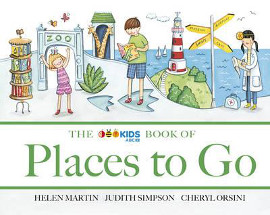
The ABC book of places to go by Helen Martin and Judith Simpson
Ill. by Cheryl Orsini. ABC Books, 2017. ISBN 9780733334283
(Age: 3-6) Recommended. The new addition to the ABC picture book
non-fiction series explores all the places families love, from the
backyard, library, to faraway lands. There are 'all kinds of
different places, some you know and some are new.'
Helen Martin and Judith Simpson's easy to read verses use familiar
words, alliteration and animal sounds as the text flows up and down
or follows the curves of paths travelled. The story is fun to read
aloud, and to share as a family, discussing each scene, the
different ages, lifestyles and situations presented.
Cheryl Orsini's lively scenes are bright and colourful, while
different characters, from young to old and family groups, make the
story visually appealing. The scenes are presented from different
viewpoints, above the action - bird's eye views, the medical
centre's open walls, the close-ups and picture maps. The ABC Book of Places to Go is an excellent resource for
Foundation Geography, where students learn about familiar places and
build connections to them.
Rhyllis Bignell
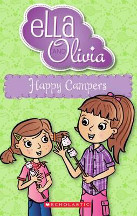
Happy Campers by Yvette Poshoglian
Ill. by Danielle McDonald. Ella and Olivia series, bk 18. Scholastic
Australia. 2017. ISBN 9781760157210
(Age: 5-7) Recommended. Ella and Olivia are sisters and best
friends. Ella is seven years old and Olivia is five-and-a-half years
old, they live with their mum, dad, and little brother Max. The
girls are very excited about their big summer camping trip. They are
sharing their fun holiday with their identical twin cousins, their
aunty and uncle, even Bob the puppy is included.
When the family car is packed to overflowing with the tent, bags,
camping gear, fishing rods and the totem tennis equipment, Dad
realises they need a bigger vehicle. Luckily, Nanna and Grandad have
a kombi van big enough for the family and all the gear.
After a long drive, Ella and Olivia help set up the tent and unload
the van then it is time to play with Josh and Charlie. Climbing tall
trees, sausage sizzles, toasting marshmallows, playing jokes and fun
games of totem tennis make this a great start to the holiday.
The Ella and Olivia series are written specifically for
young readers who are beginning to read enjoy simple plots and
relatable characters. The extremely large font and line drawings
support the transition from picture book to beginning novel. This is
the eighteenth book in this popular series.
Rhyllis Bignell