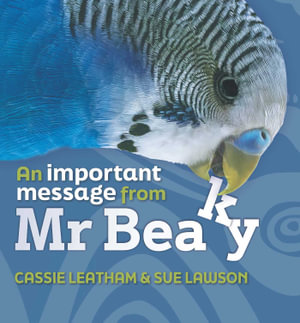
YouTube and social media star, Mr Beaky the budgerigar, is now in print. This clever cheeky blue budgie has been taught the Taungurung language of his First Nations parent and has important messages to share with young readers. This beautifully presented book with gorgeous photos of Mr Beaky, begins with an introduction in Taungurung, Wumindjeka Daungwurrung Biik “Hello Welcome to Taungurung Country.” The following page shows a map of where Mr Beaky’s home is on Taungurung Country in the state of Victoria.
There are several important messages throughout the story, one being that First Nation Peoples in Australia do not all look the same just like all the different coloured budgerigars in Australia but what is important is their murrup, “soul and spirit.” Mr Beaky himself is a blue budgie unlike those in the wild that are green and yellow, but he knows where he belongs and that it is to his Country. From Mr Beaky, the reader learns about the Aboriginal people being the world’s longest continuing civilisation and that importantly, all people must care and show gilbruk “respect” for Elders and Country.
The opportunity to learn about Aboriginal language and culture through the eyes of Mr Beaky, is a perfect starting point for children and adults in understanding, acceptance and Reconciliation. A wonderful book for every school and public library.
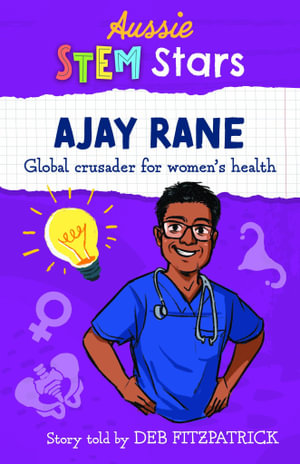
From very humble and impoverished beginnings, the story of Professor Ajay Rane OAM is one of incredible sacrifice and the belief that education has the power to change lives.
Ajay’s father Murli, lived in a small Indian village where poor cotton farmers from the lowest caste worked hard to save enough money to send one child from the village to secondary school. That one child was Murli, who was given this quite incredible opportunity and studied hard to become a doctor. He travelled to England where he did further training and eventually returned with his family to India to set up a hospital in the community from which he came. Murli’s focus was on women’s health, in particular supporting those women who suffered serious and debilitating complications from childbirth. Ajay who grew up helping his father in the surgery and operating theatre, eventually went on to study many aspects of medicine both in India and overseas. Ajay and his wife Paula, also a doctor, finally settled in Townsville Australia in 1996. Like his father Murli, Ajay was primarily concerned with women’s and children’s health and strove to provide better care. From the early 2000’s Ajay began travelling back to India to work with, and train medical staff to help neglected women as well as provide medical equipment to hospitals and support an orphanage.
This book is really the story of two doctors, Murli and Ajay, and the difference they have made to the world through one act of kindness and foresight in a little Indian village so many years ago. A perfect addition to this wonderful collection of Aussie STEM Stars books.
Themes STEM, India, Caste System, Medicine, Women’s Health.
Kathryn Beilby
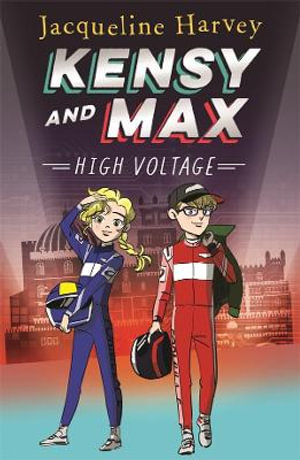
High voltage by Kensy and Max 8. Jacqueline Harvey
Kensy and her twin brother Max, and their family head to Portugal for a holiday. Kensy’s family have a secret, they are agents for Pharos, a secret company. Their grandmother Cordelia is the head of the agency and she is adamant that while they are on holiday, they are not to investigate anything. It is a family holiday and nothing else.
Before heading on holiday Max, Kensy their dad and Fitz need to retrieve Max’s notebook that was left at the house of Magoo MacGregor. They have a close shave but manage to recover the notebook. The holiday starts off being relaxing, but as it goes on different members of the family end up looking into strange things that seem to be occurring in relation to Wolf Racing. Kensy and Max witness a kidnapping, they then spend some time trying to work out why the person was kidnapped and where they were taken. They manage to locate where she is being held and with help from their mother who is a retired agent manage to free her and ensure that the people who are trying to sabotage Wolf Racing don’t succeed with their plan.
This is a fun book with several twists that all come together in the end. The code at the start of each chapter adds to the enjoyment of this book.
I highly recommend this book.
Themes Investigations, Motor racing, Portugal.
Karen Colliver
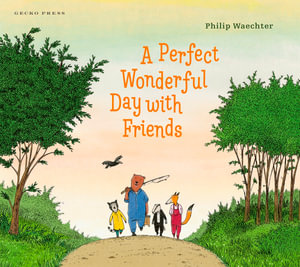
A perfect wonderful day with friends by Philip Waechter
This is a warm hearted picture book about the outdoor adventures of a group of friends on a perfect sunny, summer's day. One quest leads to another, then that quest leads on again and so on until the whole community of friends is involved. Raccoon wants to bake a cake because he is bored, but finds he has no eggs. He goes to see Fox who needs a ladder to fix a leak in the roof. Together they seek out Badger who lives in the most extraordinary house, all clutter. but he also needs help solving a crossword puzzle so they all set off to find Bear. Along the way they meet Crow who joins their adventure. They find Bear fishing unsuccessfully at the river and debate about what she should use to catch the fish. All of the friends jump into the river and have a swim, lying in the sun to dry off afterwards. The five friends are having the best day out: fishing, swimming, picnicking and finally home to bake the cake, but find they must cook two cakes because bears have such big appetites.
The wonderfully funny look at a group of friends finding things to do without really trying is sure to appeal as they meander their way through meadows, pick blackberries, debate about the best way to catch a fish and finally come home to make a cake.
All the memories of a perfect summer’s day during childhood are here, meeting friends, doing nothing but being with each other. The illustrations stand out and children will love picking out the details, while the repetition of language and musical text make an irresistible read aloud begging children to join in.
I loved picking out the differences in the landscape from what we see in Australia, and children will delight in seeing the world from a different perspective.
Philip Waechter was born in Germany. A freelance graphic designer and illustrator in Frankfurt he is known for his beautifully classic illustration style. In 1999 Philip and Moni Port co-founded the community studio LABOR. This books is translated from the German edition by Melody Shaw.
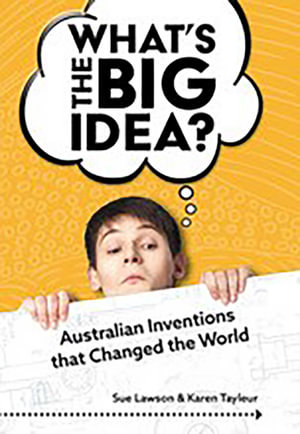
Two great advantages of the wonderful non-fiction being currently published is that it covers a diverse range of topics and provides something to interest everyone, both young and old. The new release, What’s the Big Idea? written by Sue Lawson and Karen Tayleur, is one such book. The authors have collaborated and collected material on an array of Australian inventions in the following areas: Medicine, Technology, Communication, Sport, Agriculture, Tools, Home & Food, Great Ideas, Charity Events & Services.
The information is presented in a large hardback format with glossy pages and clear photographs of inventions, and inventors where possible. Each invention is clearly labelled, has its own position on the page and the text is easily accessible for all ages. The book has clever endpapers, contents page, introduction, glossary and index. The welcome addition of a Timeline begins with Firestick Farming used 60,000 years ago to manage Country with the final invention being a Mobile Laundry Van for the Homeless in 2015.
For those currently watching the Commonwealth Games, two of the sport inventions will be of interest. A popular theory is that Yorta Yorta runner Bobby McDonald is credited with the crouch start for sprints in 1887, and in 1928 the Speedo brand was created for a one-piece racer-back costume.
This book will be a wonderful resource for all libraries whether home, school or classroom. It contains so many familiar and unfamiliar inventions from those of First Nations people through to the present day.
Kathryn Beilby
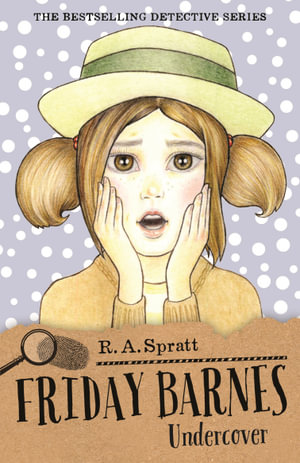
Friday Barnes Undercover by R.A.Spratt
Penguin, 2022. ISBN: 9781761043659. Recommended.
Friday Barnes finds herself surrounded by mystery. She heads to Norway to help Binky, her best friend’s brother who is facing court martial after possibly being attacked by a polar bear. Along the way there are other mysteries that pop up that need Friday’s attention. People seem to gravitate to Friday when they have a problem that needs to be solved, and Friday does her best to logically analyse the problem and get to the bottom of it. In the process of helping Binky Friday discovers that there is more going on than she first thought. In the end all of the mysteries come together, and Friday survives a real polar bear to help solve the case.
This is a fun book, if you have enjoyed any other Friday Barnes books you will enjoy this one.
Hezekiah Johnson is in his senior year at Cedar Regional High in Poconos, Pennsylvania. He is popular at school and is hoping to win a sports scholarship to his dad’s old college. Kai’s parents died nine years ago, he has regular therapy sessions with a youth social worker Dr Reuben and he lives with his Aunt and Uncle. From being sad and anxious, easily lashing out in anger, he has been able to turn his life around through hard work and sport. His best friend is Jamal and he has had a string of girlfriends, searching for the ideal loving relationship he believes his parents had. Zyla Matthews, petite, quiet also 17, attends St Catherines and lives with her needy and unreliable mother, maths whiz younger sister and Aunt Ida. Zyla is passionate about fashion and wants to win a scholarship to a Paris fashion college so has no time for relationships, spending every spare minute working on her portfolio. She doesn’t want to waste time focussing on disappointing relationships like her mother and Aunt Ida do. Her best friend Beatrice is from a rich family and they have a strong and supportive friendship. Kai and Zyla both have summer jobs at a local amusement park and when Kai’s toxic girlfriend gets him into trouble at work they find themselves attending the same amusement booth and become unlikely friends. After bonding over an incident with an aggressive customer the two start a relationship. Idealistic Kai falls head over heels for Zyla while she can’t quite believe she is succumbing to his charms and is wary about being just another conquest. As they navigate the pressures of school, family and their career aspirations with their differing ideas about what love is and how their relationship might endure the inevitable obstacles and doubts it becomes apparent that being in love is not in itself enough.
The timeline switches backwards and forwards between the start of their relationship the previous summer and the Seniors’ day trip in May and the point of view alternates between the two main characters and, later in the book, from others. The characters are well developed and the friendships and other relationships are well imagined, especially Kai’s therapist, an excellent advocacy for mental health support. But this is essentially a story about all consuming teenage love, not a mystery and it doesn’t pretend to have all the answers. I would have liked more detail about the main characters’ career aspirations. We learn that Zyla’s portfolio theme was “something to do with the beauty and versatility of Black women and how that played into fashion” on page 47 but after that there is not much and we learn nothing about Kai’s scholarship pathway. The plot is a bit thin and over the nearly 500 pages it ebbs and flows with some irritating repetitive parts but it will appeal to readers of Kristina Forest’s other young adult romances.
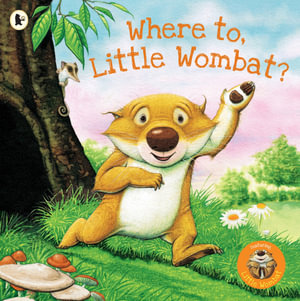
While mum cleans out the burrow, Little Wombat thinks about a different sort of home. He is sick of living in a burrow and Mum sends hm off to find somewhere new. He tries to climb up the tree and join Koala, but does not have the claws to climb and ends up back on the ground. He tries to join Frog on his lily pad but ends up in the pond. He sees Mole and Mole invites him in but wombats are much bigger than moles.
He looks at the turtle and the ants under a rock, but each time the place is simply not suitable for him. Finally the ants tell him of a nice comfortable nest nearby. He goes to try it out, snuggling down with some very large eggs already there. Children will laugh uproariously as the owner of the nest comes home to see Little Wombat off.
Little Wombat scurries back home to his nice clean burrow and mum tells him to invite all of his friends around for a sleepover.
A lovely story of being satisfied with what you have, of the grass on the other side of the fence not always being greener, of envy and wanting what someone else has, will delight all readers as they recognise the forces that make us all sometimes dissatisfied with our lot. Little Wombat is sure there is another home somewhere better than the one he has. In going on his trip, he realises that his home is the best, it is suited for his needs, while other homes require different characteristics which he does not have. Readers will love seeing how each home suits the occupant, and call out when Little Wombat tries out another home, only to find that he does not fit in some way. Readers will easily spot the way a home fits certain animals, building up their knowledge of Australian animals and their habitats. Watercolour illustrations ensure children recognise the environment each animal lives in, while the human characteristics blend well with the attributes that each animal presents.
First published in 2006, this adds to the array of books which present an issue to be discussed in class or at home.
Themes Envy, Compassion, Australian animals.
Fran Knight
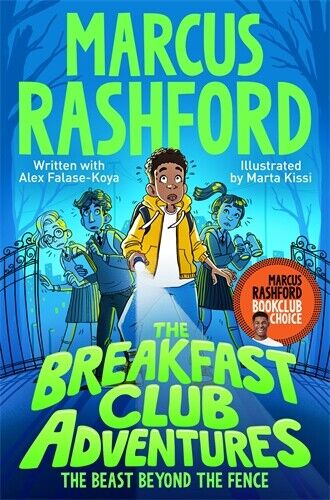
The Breakfast Club Adventures by Marcus Rashford with Alex Falase-Koya
Marcus Rashford is a football star who plays for Manchester United and England. He is passionate about eradicating child food-poverty and increasing children's literacy and access to books. This novel has been released as part of Marcus Rashford's Book Club - a program in collaboration with Macmillan Children's Books, where Rashford chooses two books a year that are made accessible to under-privileged and vulnerable children aged 8-12 across the UK. This is the first book in the Book Club to have been co-written by Rashford himself.
The story starts at breakfast club. Breakfast club is the supervised time before school where children are provided with something to eat along with the time to finish homework, catch up with friends or just relax before the school day starts. This is the perfect opportunity for kids to make new friends .. or start solving mysteries!
Twelve year old Marcus has lost his prized football over the school fence. He is resigned to never seeing it again until he receives a curious invitation to join the Breakfast Club Investigators (BCI).
This kicks off (pun intended!) a whirlwind of adventure and mystery, while testing boundaries and exploring friendships. Marcus gets to know the other members of the BCI, expanding and challenging his pre-conceived ideas of them being just 'the new girl', 'the popular girl' and 'the arty loner'. He learns they have all lost things and they all need help.
Their investigations challenge the BCI to face fears, think creatively and work together. There's a sub-plot regarding Marcus's relationship with his cousin and, after a falling out with the BCI, she helps him sort out his feelings by offering wisdom from a slightly older perspective.
This book is very appealing to middle grade readers - it centres on the relationships and issues they face in real life, and has a variety of diverse characters as well as engaging fonts and illustrations. The mysteries are all neatly solved in the end (including a few surprise twists) and the heart-warming lessons learnt are delivered with fun.
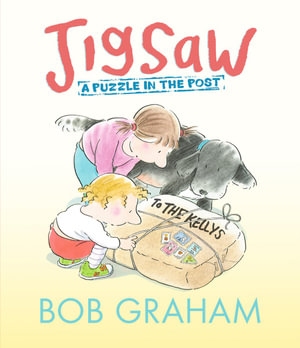
The Kelly family on the front cover is opening a large parcel. Mum, Kitty and their dog are all intrigued, as is the reader. The parcel is covered with stamps and an anonymous note inside wishes them luck. Dad and the girls unpack the jigsaw revealing the pieces for an African sunrise and they set to it. Dad sets his watch for late Autumn and they complete the edges by Winter. The girls play outside in Spring and Summer, while Dad works on. With Autumn coming closer they sort out all the colours, but they realise that the hippo’s shorts are missing. The missing jigsaw piece becomes a quest as they rack their brains for what may have happened to it. Mum recalls a piece that may have fallen to the floor and may have been swept into the bin. So the family goes to the rubbish centre. Here they are faced with a mountain of paper rubbish: old letters, notes, photographs and shopping lists to train tickets and newspapers from long ago. Every now and again a breeze lifts them all from the ground and settles them back down again, making their task even harder. The task seems overwhelming. They sadly go back home their hopes faded, where the missing piece falls from Dad’s shoe. The jigsaw is finished. Has it been luck or determination that has found the missing piece? Whatever has happened, the sun now comes up ‘out of Africa';. Kitty decides to write a thank you letter to the unknown sender and another problem needs to be solved by the family.
This book radiates love and family, hope and determination which will warm the hearts of younger readers who will view their own families with the same care and attention.
Graham infuses his characters with a universal humanity. Mum, Dad, the children and the dog could be any of us. His families are always inspiring as they work together on a problem, promoting hope, radiating love and a togetherness we all aspire to emulate.
His distinctive pen and watercolour illustrations create a world we look into, looking from above or below, each piece of the picture has a meaning and resonance with the readers, eager for the details shown on each page. Sometimes the page has a simple drawing on it, with no words or detail, sometimes an image covers both pages, sometimes there are several panels, but whatever the page offers, it is worth a second look and often readers will ask questions. How many teachers or parents will need to discuss a jigsaw, or postage or stamps or writing a letter, a post box, or recycling? Issues rise out of his work with a quiet insistence, the background to his stories often promising discussions on a different level. Activities are available in Walker Books Storytime kit.
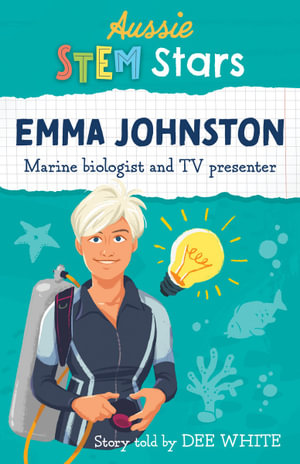
Emma Johnston’s story begins with her idyllic childhood and the wonderful experiences she and her family were able to take part in. From sailing, swimming and snorkelling to living in places such as Japan and France, Emma was fortunate to be given the opportunities to challenge and nurture her curious mind. Emma also loved Maths and Science at school but felt strongly that girls had to struggle to be recognised in these subjects. She fought hard to gain a standing in the Science field and her journey is one of overcoming multiple challenges and fighting for gender equality.
Once Emma has finished her secondary schooling she was still unsure of her pathway. Her results guaranteed that she could choose any university course she wanted but she always felt that she wanted to be a Science Journalist due to her belief that reporting deeply about all things Science related especially environmental issues was the way to arouse people’s interest. This did not quite go to plan and Emma instead focused on Marine Ecology. She is passionate about investigating the underwater world and finding solutions to the damage occurring in places such as Antarctica, Sydney Harbour and the Great Barrier Reef, due to climate change and pollution. Emma’s leadership and ongoing research has been valuable to both others in this field and the general public. She has also presented on television in Foxtel/BBC TV series ‘Coast Australia’.
Emma Johnston was made an Officer of the Order of Australia (AO) in 2018 for “distinguished service to higher education, particularly to marine ecology and ecotoxicology, as an academic, researcher and administrator, and to scientific institutes”. Her story is one of great resilience and perseverance and is a worthy of inclusion in the Aussie STEM Stars series.
The highly descriptive writing of author Dee White will allow the reader to be drawn into Emma’s story and become a part of her journey. A very enjoyable and informative read, and an important addition to a school or public library.
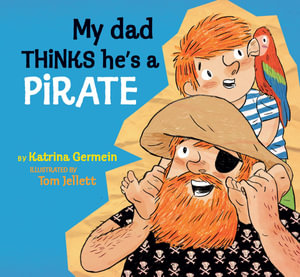
Another book in the My Dad thinks series (My dad thinks he's funny and My dad thinks he's super funny) will delight fans as this time Dad thinks he is a pirate. The family are off to the beach and Dad can’t resist his corny jokes. Wordplays and jokes like ‘Here’s our ship. I bought it on sail’’ and ‘The sea is so friendly. It always waves’ are strewn throughout the narrative with the refrain, ‘My dad thinks he’s a pirate’ popping up at the end of each double page spread.
It is fun to read aloud, and children who are independent readers will appreciate the play on words, sure to bring giggles as well as some groans. It is easy to relate to the story as many readers will know a relative or friend who delights in the sorts of jokes and wordplay that is found in the My dad thinks books.
The illustrations of dad with his ginger beard, shirt with skull and cross bones on it, and hairy legs are hilarious, and the pictures add another dimension of humour to the jokes.
My review copy came complete with a black eye patch, and I know my son and grandson are going to have great fun with this book. It is sure to leave the reader happy and will be a hit with its audience. A great gift for Dad for Father’s Day or for a laugh anytime.
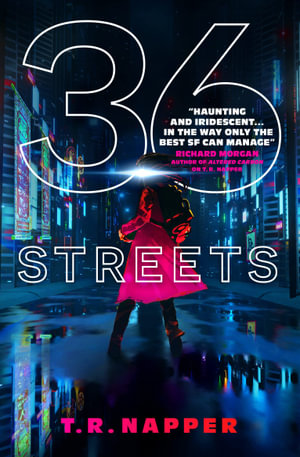
Cyberpunk is a form of science fiction that features high tech and futuristic themes along with dystopia and a dark underworld. An example of an early film in the genre is Ridley Scott’s ‘Blade Runner’. In interviews T. J. Napper refers to that film as a strong influence on his writing. 36 streets is set in a future Chinese-occupied Vietnam. Lin Thi Vu has been honed by her gangster uncle Bao to become a formidable fighting force sent out on assassin missions. In a new assignment, she becomes involved in a conspiracy built around a video game, Fat Victory, an immersive simulation of the American/Vietnam war that meshes the virtual with personal memory.
The novel is gritty with dramatic action scenes that see Lin brutally crushed, yet rise again and again, determined to defeat the forces ranged against her and take her revenge. It is a world of danger, deception, illusion and violence, and the costs to Lin are formidable.
The scenes set in the old world ‘36 streets’ of Hanoi are vivid; the underside of the city is alive, and reflects the in-depth knowledge Napper gained whilst working as an aid worker in Southeast Asia. This grounding provides authenticity to the virtual world of the future that the author creates. It is a mix of old Hanoi and the cyber world of video games, a world of super strength combatants, illusion and deceptive manipulation. However, this book, because of its violence, is not for all readers.
University of Queensland Press, 2022. ISBN: 9780702263255. (Age:4+) Recommended.
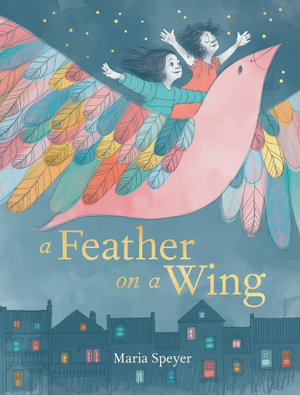
A little girl feels alone in the dark, so her sister tells her stories that transport her to other places and show her that she is part of something very much bigger and never alone. Just as each feather is part of a wing and that wing makes birds fly, so she is part of something. She is a flower in the dairy chain, a drop of rain in a shower, a letter in the alphabet and so they can tell each other a whole host of stories.
Each comparison will entreat younger readers to see themselves as part of something much larger than themselves, opening up a wider horizon, a vista of where they fit in the universe. They will see a drop in a shower, a flower in a daisy chain, a stitch in a scarf, inviting them to make up a line for themselves. They could be a grain of sand on the beach, or a cloud in the sky, the possibilities are endless and children will love making up new lines for this story.
Each metaphor adds a line saying why that comparison is made. So the stone set in a bridge makes the bridge strong, and a stitch in the scarf keeps us warm.
The sleepless child is comforted knowing she is part of something bigger, happy to see how she fits in with the wider world, that she is not alone.
Children will love following the lines of the story seeing it add another layer of togetherness, showing us that we are all feathers and when we work together we fly. The illustrations suit the story, adding a magical quality as the muted colours replicate evening when the child cannot sleep. The sisters go on a magical journey, an adventure through the night, seeing the things spoken of in the text. A loving, caring relationship is shown as the older girl shows the younger sibling the glories of being part of something bigger than themselves.
At the end of the book can be found the music and the words set as a lullaby for children to sing. Teacher's notes are available.
Themes Sleep, Togetherness, Night time, Companionship, Friendship, Support, Sisters.
Fran Knight
Gaia goddess of Earth by Imogen and Isabel Greenberg
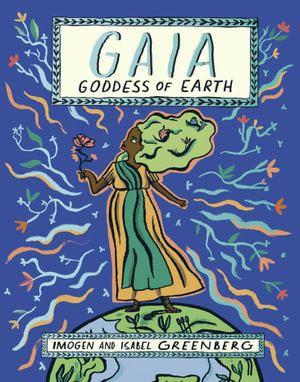
Gaia Goddess of Earth is an entertaining and enjoyable read. Written in very much a feminist mode, this complex and detailed story of Gaia, the Greek Goddess of the Earth, is simplified and told with both humour and serious intent. Gaia created the Earth in all its beauty, free from danger and trouble. However, her husband Ouranos, her son Cronus, and grandson Zeus all had other ideas. Their incredible greed and all-encompassing need for power meant that the Earth was subjected to famine, flood, war and destruction. Familial wars were fought between parent and child, siblings versus siblings with the mere mortals being caught up in the turmoil. It was a devastating time for Gaia. There is hope though, and Gaia does eventually achieve the peace she so deserves for her precious Earth. There is also a story within a story in this tale: the Earth needs to be no longer misused but cared for by all people. After all Gaia created only one Earth.
The gorgeous cover and stunning illustrations will appeal to all readers. The graphic novel-style format is a clever way to introduce children to ancient myths and legends and will be a popular read in a school or public library.
Themes Greek Goddesses, Graphic Novel Format, Myths & Legends, Ancient Gods, Environmental Issues.