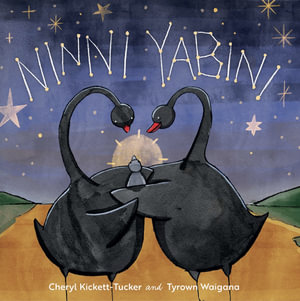
When Mother and Father swan rebuild their nest, they are so engrossed in their task that they do not see the baby swan is missing. A storm has washed their home away and they must build a new nest. Their beloved offspring, named Ninni Yabini after the evening star, wanders away, following a willy-wagtail, and finds herself alone and scared.
The beginning of the story evokes its setting, a place near the river, amongst reeds which they use to build their nest along with river grasses and sticks. While the story develops we learn of the tasks each of the swans does in daily life and the things they collect to make their nest.
When Yabini wanders off, her dad, Maali calls in vain. Yabini spies the evening star, her namesake and feels comforted, following its lead. As she stumbles over logs and runs through puddles, the little star gets brighter and brighter as she nears home.
A happy reunion follows although not without dad telling his cygnet not to follow the willy-wagtail ever again. But all is peaceful as the little family snuggles together to sleep that night, happy and content.
The story models a strong family relationship with the parents kissing and cuddling their child, strengthening the bonds that tie them together.
The illustrations support this theme admirably, from the spectacular front cover showing the baby being held in the parents’ wings to the back cover with the lost very unhappy cygnet being led by the evening star. The strikingly modern illustrations are different from what is usually expected complementing an Indigenous story and will encourage readers to look more closely at the art wok of a range of books.
Written in Noongar and English, and illustrated with wonderful striking artwork, this book celebrates family and home, while at the end is a list of the six Noongar seasons. The use of Noongar language throughout the book encourages children to try out the language for themselves, and an easy place to start is to learn the names of the six seasons.
Author, Cheryl Kickett-Tucker belongs to three areas of the Noongar people – Wadjuk (Swan River), Balladong (Wheatbelt) and Yued (Moora) and her stories reflect the inspiration of her family’s experiences in the bush. For more information about Cheryl and her books see here.
The illustrator, Tyrown Waigana is a Wardandi Noongar (south-west cape country) and Ait Koedhal (Torres Strait Islander) multi-disciplinary artist and graphic designer. An interview with Tyrown can be found here. Teacher's notes are available.
Themes Aboriginal themes, Aboriginal stories, Western Australia, Family, Belonging, Home.
Fran Knight
Flipper and Finnegan by Sophie Cunningham. Illus. by Anil Tortop
Albert Street Books, 2022. ISBN: 9781761180071. (Age:4-8)
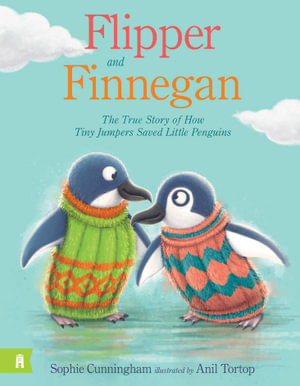
Flipper and Finnegan are are Little Penguins enjoying a glorious life on Phillip Island. They love their special place in the world alongside other wildlife such as seals, bandicoots and Cape Barren Geese. Their days are filled with fish hunting in the clear blue ocean and at night they waddle up the beach to their cosy burrow. When an oil spills covers most of their colony in oil the ranges at the Wildlife Centre know that the penguins are in grave danger. Oily feathers mean the penguins can't keep warm and if they try to preen themselves to remove it the oil will make them sick. Inventive thinking and lots of help from knitters all over the world results in the penguins being put in tiny woollen jumpers until they can be properly cleaned.
There is a small paragraph at the end of the story about the true history behind the tale of Flipper and Finnegan and what we can do to help Little Penguins. There are a few penguin facts scattered within the story and the illustrations and text give a wonderful sense of place (both of Australia and Phillip Island itself). Anil Tortop's illustrations use light to great effect and her animals are cute and cuddly. This is a heartwarming story about what can be achieved when we come together for a cause but is also a reminder of the damage human activity is having on the world around us. While great for younger children this presents the view that after the penguins have been cleaned up they are returned back to a perfect world. This may be a bit simplistic and miss out on teaching points for older children (however it could also be a useful springboard for discussing these issues). A second true story title by this same author and illustrator is titled Tippy and Jellybean: The True Story of a Brave Koala Who Saved her Baby from a Bushfire.
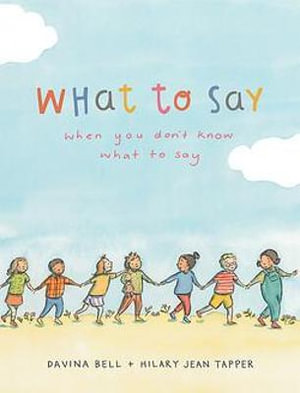
With beautifully appropriate soft edged illustrations by Hilary Jean Tapper, the phrases on each page point to words that need to be said to defuse a situation which many children and adults come across. The words point to a kindness, an emotion felt by the speaker, comforting the other person in a situation we can all recognise.
So at home, a child has drawn on the wall, and owns up with ‘I did it’. Many people will see this event, sometimes more often that they wish, but the simple owning up defuses a situation which could cause distress. At home too, a child may feel left out and the simple question, ‘Want to join in?’ makes that person feel part of the group and be thankful that the questioner is so kind. Similarly when at school, one child has wet themselves and the other reassures her that ‘happens to everyone sometimes’, so reaching out to an embarrassed child, offering comfort. In other situations: talking to a person in hospital or an older family member possibly in a nursing home, or needing help in class, all sorts of situations are described by the illustrations and given apt phrases to respond with. Readers will eagerly say what has happened to them in a similar situation and the reader will be able to encourage a response that is appropriate and kind, offering comfort and support.
Very much a book to produce if people in the class are being unkind or showing signs of being unable to resolve a situation, this book has wide educative uses both at home, and in the classroom.
The beautiful illustrations beg to be interpreted and discussed, leading on to revealing emotions and feelings. These emotions will then lead to solutions and the text gives the best solution: kind words, kindly offered as the speaker feels sympathy for the person involved.
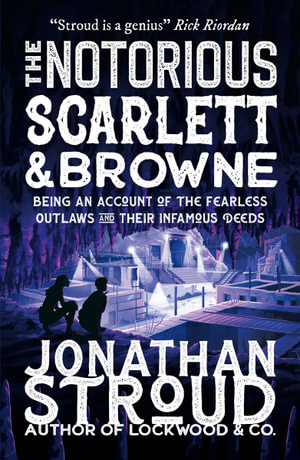
Stroud returns with another adventure featuring the audacious and notorious Scarlett and Browne. This time they have evaded their enemies in the wilds of Mercia and Northumbria, while conducting some exciting heists. Using Scarlett’s planning skills and shooting ability and Browne’s ability to read minds, the pair have been successful until they are faced with a dangerous adversary while trying to pull off a near impossible mission.
There is all the excitement, snarky asides, and humour, wrapped up in a fast-paced plot and beautiful writing that one expects from an author of the calibre of Stroud. In The notorious Scarlett and Browne, Stroud takes his adventure story a step further and gives the reader some solid and often heart-breaking background about his two protagonists. Browne is afraid of his powers and often fails to use them when needed, while Scarlett’s path into being an outlaw is explored in depth. The pair grow closer to understanding each other, and the delightful Joe and Ettie from the first book, appear again.
There is a map at the beginning of the book that shows the paths that the outlaws take and is a useful reference for readers who are not British. The descriptions of the Faith Houses and the Brothers of the Hand that have grown up in response to the threat of the Tainted are frightening and easy to imagine happening in a dystopian world. An execution scene is vividly described as a stage-managed event and had me on the edge of my seat in fear. Albert’s observations about the plight of children as slave labour and the poverty and hunger also added a dimension to the story.
A film based on the first book, The outlaws Scarlett and Browne, is being planned. Meanwhile fans are sure to be thrilled to read this sequel. I look forward to any future books in this series and fans might like to read Stroud’s Lockwood and Co. series while they wait.
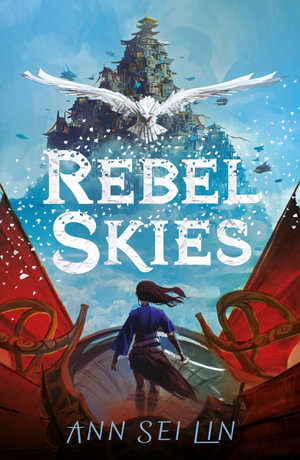
Living as a servant in the immobile sky castle, Midori, Kurara keeps to herself and only her best friend, Haru, knows that she can manipulate paper to become animals, stars, basically anything. They live a quiet life serving throughout Midori, then a Crafter finds her – Crafters are those that control paper, and Kurara is one of them. Escaping the Midori, she joins an airship whose main purpose is chasing and destroying rouge Shikigami, giant monsters made out of paper. Learning how to become a proper Crafter, Kurara travels with the crew across Mikoshima and faces a whole new world full of adventure and intrigue.
Told from multiple perspectives throughout the story, Rebel Skies is about young Kurara learning more about the world and more about herself. Set in a world full of skyships, flying cities and paper spirits, this book feels like a Japanese anime with action, adventure, humour and cultural aspects including clothing, character names and weaponry. At the start of the book, there is a map showing land cities and sky cities, as well as a few illustrations to assist readers in understanding the world that the author has built. This fantasy novel is the first in a new series of the same name, and readers will find the book is evenly paced with a nice steady flow of story. With a wide variety of characters, those reading the book will find some characters relatable and others annoying, which gives a nice depth to the story. Fans of Studio Ghibli anime will enjoy the book, as would fans of manga.
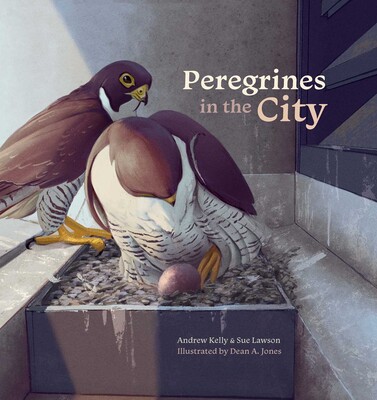
This enthralling story of a pair of peregrine falcons nesting in Collins Street in Melbourne will touch the hearts of all readers, young and old as they see wild animals surviving in the harsh city environment. New words will be learnt, facts about these birds given while a story of the life cycle of these animals will be eagerly absorbed.
It begins with two falcons nesting on a ledge high above Collins Street. The male falcon, the tiercel lands next to the female and hands over his catch, a pigeon which he caught on the wing using his incredible speed, talons and dexterity to grab the prey. The female eagerly pulls apart the flesh and eats. She later lays four eggs in the gravel scrape. These are rolled around under her making sure each stays warm and the tiercel keeps bringing in food he has caught, while at times he takes over the nest duties while she hunts.
After six weeks they begin to hatch, and three small fluffy balls are in the scrape while the fourth egg is rolled to the back. Called eyases, the chicks grow steadily on the diet the tiercel brings in. During the day the pair take turns hunting and keeping them safe, while at night the male watches while the female sits on the chicks. Hunting is lessened as the chicks grow, their fluffy feathers replaced by darker stronger ones. They practise walking up and down the ledge preparing for the day they will leave. Their parents are watchful but bring in less food, forcing the chicks to take to the air. They leave behind the scrape, the fourth egg and feathers and bones regurgitated after their meals.
The precise text brings the life story of these animals to life, introducing words readers may not know, but encouraging them in their use. The story is intertwined with information, told in such a way that it is absorbed without hesitation. It is simply fascinating, telling of how animals survive in what is considered a hostile environment, encouraging children to look out for the peregrine, the largest and strongest of the falcons. Children will scan the skies over their cities to watch for these birds.
At the end of the book is a page of information which adds to the facts already given, along with an outline history about the falcons in Collins Street.
The illustrations are magnificent, drawing the eye in to look closely at their feathers, talons, beaks and plumage. The background of the ledge with its spill of feathers and dung adds a note of admiration for these animals, making the most of a strange, hostile environment for their nest. The almost photographic images will make students gasp as they turn the pages. The picture of the diving tiercel, the city at night, the pair at the scrape, the chicks hatching … all are simply wonderful, giving the reader a very intimate view of the family of falcons. The claustrophobic ledge, the protection of the parents as they watch over their chicks, the final leap to flight, are all given an extra emotional pull through the detailed, close up illustrations. Jones’ obsession with the way pictures tell a story shines through as he depicts falcons here and penguins (2021).
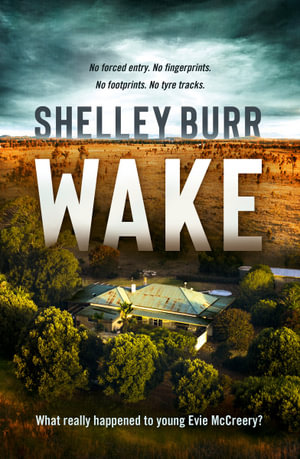
When they were nine years old, Mina McCreery’s twin sister Evelyn vanished overnight from the bedroom they shared. For Mina that meant an immediate change and “everything about her life was public property” - even now, nineteen years later.
An unsolved crime with a million-dollar reward draws a lot of attention, including from private investigator Lane Holland who needs that money. And as Lane’s cold-case investigation progresses we learn more about the complicated pasts of both Mina’s family and Lane himself.
We also learn about the various ways different people deal with trauma, and we get disturbing insights into the ghoulish delight some take in whipping up suspicion and spreading ‘fake news’ online.
Crime fiction is not my preferred genre but this book drew me in immediately. I loved that the outback setting is almost a character itself – the fictional small town in NSW is described in vivid detail, giving this novel an unmistakable Australian flavour. And along with Mina and Lane a host of other likeable and believable characters are richly drawn, including Mina’s best friend Alanna, and Senior Sargeant Emily Starrett of the local police in the next town over.
The layers in this story are revealed slowly, with unexpected turns throughout. Several times I thought I’d figured out where it was going next, only to find myself gasp aloud at the newest revelation. Readers under 16 may be disturbed by some details in this book, including the mentions of child abduction and harm.
The story wraps up in a satisfying way with the overall message that it’s never too late to speak up or for the truth to be revealed.
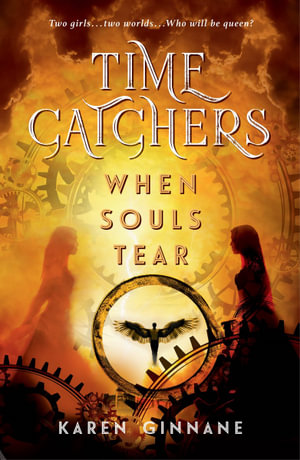
When Souls Tear is the second novel in the young adult fantasy series, Time Catchers, by Australian children’s author, Karen Ginnane. At the end of the first book in the series, When Days Tilt, we left Ava, Jack and their friends at a crossroads. Ava is back in Victorian London while Jack has returned to his blacksmith apprenticeship in the mirror city of Donlon. Jack is suffering the after effects of a torn soul and is having increasing trouble hiding his symptoms. Ava is feeling lost and confused as she tries to determine the best way to fulfil the task left to her by her late mother: to destroy the time snatchers once and for all.
Like its predecessor, When Souls Tear is narrated by both Ava and Jack in alternating chapters. Both protagonists reach a point when they must make a momentous decision. For Jack, is he willing to travel down a dangerous path to find a cure for his debilitating illness? For Ava, how much is she willing to trust new and former foes in her quest to rid both worlds of the evil of time stealing?
When Souls Tear is an enjoyable sequel that will satisfy fans of the first book. However, it is unfortunate that the author’s issues with pacing have continued into this novel. Events seem to either rush past at breakneck speed or take more time than should be necessary. While When Souls Tear is a definite improvement on When Days Tilt, Ginnane still has a way to go in creating a consistent structure for her stories.
Themes Fantasy, Historical, Steampunk, Family, Friends, Time, Adventure, Victorian London.
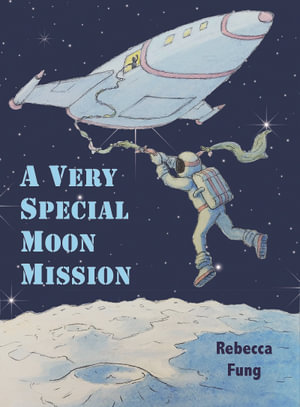
A Very Special Moon Mission is a newly released early middle grade story that will appeal to those children who are fascinated with space and enjoy reading short stories. Best friends Phoebe and Elliot, who are space fanatics and desperate to be astronauts, sneak out of their homes and visit a nearby Space Station to find out as much as they can. They are followed there by Julia, a quiet, unpopular classmate whom Phoebe is not happy to see. The three children are welcomed enthusiastically by the person in charge who generously allows them to wander around the station. They meet the three female astronauts in training and decide to try on their space suits. They wander around and discover the rocket, The Obsession, which they climb aboard and accidently send off into space. They are enjoying their adventure but discover the computer system has a mind of its own! It tips Phoebe out of the door hatch onto the moon and then shoots off deeper into space. Julia is able to reprogram the computer system and they fly back to rescue Phoebe in a very clever way. Once back safely at the Space Station they realise that no one knew they were missing and due to their secret journey, a worrying and complex problem is solved.
Themes Friends, Astronauts, Space Travel, Moon Landing, Adventure, Humour.
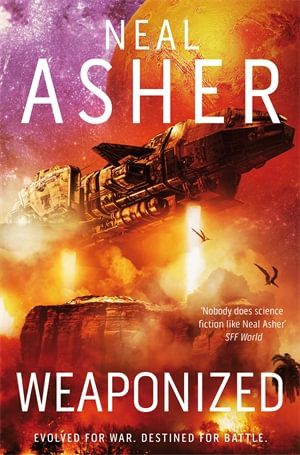
Weaponized is fundamentally a book about evolution – but not as we know it. Set in the distant future on a newly colonised planet, we witness the rapid and violent evolution of humans as they struggle to acclimatise themselves to an increasingly hostile world.
Ursula is the leader of the new colony on Threpsis, a planet with enough similarities to Earth to make it viable for humans – just. She and her fellow pioneers are determined to escape the artificial intelligence that controls much of human society, spread across hundreds of worlds throughout space. They have decided to live as “humanly” as possible, without the aids that AI provides them. While the colonists have the technology to adapt to a strange world full of carnivorous plants and poisonous insects, they are not prepared for the raptors – vicious and destructive predators who may just be more intelligent than they are.
Set against the backdrop of an intergalactic war with an alien race, Ursula and her fellow colonists find themselves fighting a war on two fronts. With dwindling resources and firepower, they decide that their only choice is to weaponise the best assets they have left: themselves. To survive, they might have to become like those they fear.
Weaponized is an extremely fast-paced action narrative. The reader is carried along with the colonists as they fight for their lives in almost every scene. The battles are vicious and, as the narrative progresses, more gruesome. There is very graphic violence and fight scenes.
The non-linear narrative does become frustrating at times as the reader has to continually adjust back into the plot of the current timeline, as the author works to blend past and present to round out Ursula as a character. Some of these chapters feel unnecessary to the plot and detract from the urgency and action of the main narrative. Nevertheless, Weaponized is an enjoyable read, particularly for fans of hard science fiction.
Themes Science Fiction, Action, Space, Aliens, War, Artificial Intelligence.
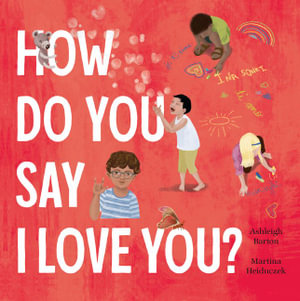
The four lined rhyming stanzas, concisely underscore the love between family members and friends the world over, paralleled and augmented by the illustrations which reflect the diversity and scope of the world’s children.
No matter who we are or where we live, no matter the circumstances or environment, we all say 'I love you', in different ways but the meaning is the same no matter where we are.
We have children often going to school saying 'I love you' as they leave the house, or children returning to the classroom after play saying 'I love you' to their friends, or a child lying at home, too ill for school, saying 'I love you' to her mother, or children waiting for the school bus after farewelling their parents with the words, 'I love you'. A whole array of situations is given, each having the child say 'I love you' to someone else. And the verses tell us more than the three word phrase, often the verse gives us information about the child or its family, their environment or home.
And the words themselves are given in the language the child speaks, linked to the name of the child in the verse.
Readers will love learning 'I love you' in thirteen different languages, from French and Italian to Tongan and Central African. Each child’s name too will be a word that is tried and tested in that language.
The illustrations reflect the country of the verse and the phrase 'I love you', giving readers a chance to spy out things which typify that country. The bold colourful illustrations will draw children’s eyes to seek out the detail which reflects the place the child lives.
I loved the French page, a cold wintry day waits for the child as she comes home on the bus, to be met by her grandparents and taken the rest of the way. The French buildings and street furniture are instantly recognisable.
A wonderful book with which to introduce the term 'I love you' in many languages and encourage children to see outside their classroom, as well as showing them that those three words beg to be shared with their families and friends.
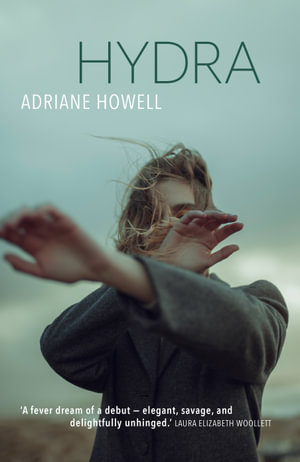
This is a different kind of mystery story. Anja is at a loss, her mother has just died, her husband has left her, and she has just lost her job as an antiques assessor. And in a spontaneous moment she has spent her inheritance money on an old shack on an isolated patch of land set in a nature reserve next to a naval base. She is completely alone, with limited phone coverage and no wifi, and it is not long before she becomes aware of a presence outside in the dark. For a woman alone, the menace will always be men, men from the base, ready for a laugh at her expense, or a lone driver up her driveway ready to abuse her. She resorts to locked doors and sleeping with a knife under her pillow.
Interleaved with Anja’s story are redacted documents from a 1980’s military inquiry into strange happenings at the base, of possible cadet pranks and of mutilation of animals. Myths have sprung up about what happened there, myths that linger on in the memory of the locals. Perhaps the danger is something other worldly.
For the reader the mystery is complicated by a sense of the unreliability of the narrator. Anja tells us of the events that led to her dismissal but the detail is missing. Did she purposely smash valuable china, and injure an old lady in order to grab a priceless antique? Is she really a victim of malicious conniving by a manipulative colleague, or is Anja herself the paranoid stalker? Many of her actions, and her words, seem to be those of some-one close to the edge. The kindly local market administrator, Gemima, recognises her as a ‘possum’s broke its tail’.
Hydra is an intriguing exploration of death, grief and loss, and the unravelling of the mind, as Anja struggles to come to grips with her situation, and questions all her relationships. I read this book once, and then had to read it all over again: there is so much to explore in this novel. Whilst there are all the elements of a mystery novel, much of it is also very funny, particularly the dialogue where Anja tries to disrupt the euphemisms around death. The ending reaffirms women’s friendship and support, and is maniacal but also positive and affirming.
I would recommend this book for readers who have enjoyed the different perspectives offered in novels by Mark Brandi, e.g. The rip or The others.
Text Publishing, 2022. ISBN: 9781922458872. (Age:Upper primary) Recommended.
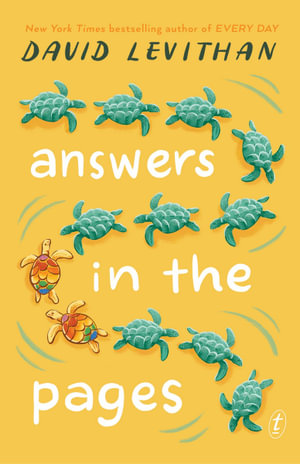
A longstanding habit of mine, is to read the author’s acknowledgements and any notes before I start a new book. Reading these in Levithan’s Answers in the Pages, set the context for this highly engaging upper primary story, giving a very brief, but personal account of the queer novels, authors and supporters who have preceded and encouraged him.
Answers is a deceptively simple story in three strands that sympathetically teases out the issues of book banning, specifically ‘gay’ books, standing up for what you believe, working out what this actually is, and dealing constructively with conflict and differing opinions, particularly those of people who love and care for you.
Donovan’s fifth-grade teacher has assigned a class book that soon causes division across the small town, as parents debate whether the two characters are gay, and whether the book is therefore suitable reading for their children.
Rick and Oliver, ‘The Adventurers’, the two main characters in this book-within-a book, plunge into unbelievably extreme exploits, including wrestling alligators, escaping wild bears and defeating an evil mastermind.
In seemingly unrelated chapters, Roberto and Gideon become partners in a book project, and over time realise they want to be much more to each other.
It might take a while to get into the rhythm of switching between stories in each chapter, and personally, I found the Adventurers story too over-the-top to be enjoyable, but younger readers would probably enjoy the absurdity of it.
However, a few cleverly dropped clues hint at the final twist that ties together the three stories in a heart-warming finale, and demonstrates Levithan’s mastery.
Levithan’s characters are multifaceted and well-drawn, and he exposes their flaws and opinions without judgement or being heavy handed, even though he is addressing issues which would be real and relevant to many readers, like homophobia and parents who act inappropriately, but from a place of love and concern.
It is refreshing to have such a sweet, fun story incorporate contemporary issues, and add to the list of books that queer young readers can find themselves in/identify with. Teacher's notes are available.
Themes Book banning, Coming out.
Margaret Crohn
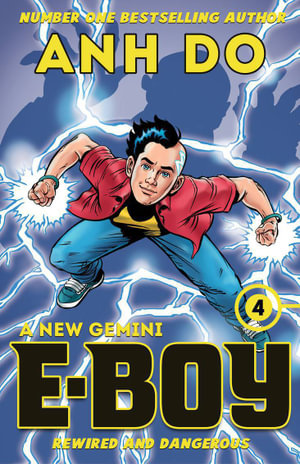
A new Gemini by Anh Do
E-Boy 4. Allen & Unwin, 2022. ISBN: 9781760879037. (Age:10+) Recommended.
In the exciting first chapter, Gemini has control of the small plane Ethan and Penny are piloting and all is looking bleak for the main characters. However, some frantic manoeuvring by Ethan through storm clouds has Gemini tossed off the plane and the link between Gemini and Ethan is finally broken. Penny convinces Ethan to land the plane and search for Gemini as she feels the connection between Ethan and Gemini is worth repairing. Ethan grudgingly agrees but knows it will not be easy. They rescue Gemini who is no longer functioning and fly to Professor Jackie Moore who is renowned for her brilliance in combining robotics and people. She does not have all the tools to successfully fix Gemini and they decide to travel back to Titus but must do it with false passports. Evil Agent Ferris is tracking Gemini and knows the three are back. What follows is a complicated cat and mouse game with Ethan, Gemini and Penny Cook outwitting Agent Ferris and his team for long enough so that Penny can attempt to fix Gemini but is their luck about to end? Agent Ferris is ready to activate Aquarius, his new secret weapon. And what a weapon Aquarius is. Gemini and E-Boy may not be a match for this massive robot. Plus, there is another dastardly well-kept secret that is to be uncovered.
Fans of this series will be enthralled with this latest release. Full of action and a fast-moving story. Book 5 will be out soon.
Themes Robots, Androids, Good vs Evil, Fighting, Technology, Trust, Danger.
Kathryn Beilby
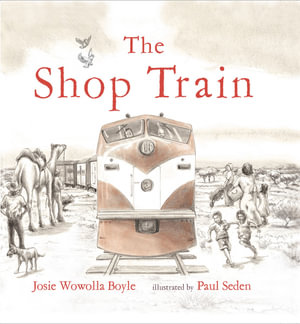
The shop train by Josie Wowolla Boyle. Illus. by Paul Seden
In this loving memorial to times past, Josie recalls travelling to the train to get supplies and the mayhem caused when the bags split on the way home. Her recollections of times with her family, using the Shop Train as their supplier brings back many images of the part these trains played in many Australians’ lives. That this service ceased to run in 1996 is astonishing. And may beg the question of what happens now when goods are needed by people living along the train line.
The East West train line running from Port Augusta to Kalgoorlie and back supplied not only the railway men and their families but all those people who lived in remote communities along the way. Josie recalls the things they bought, the different sections of the train, catering for all sorts of needs, the excitement of the people when one was due, the hearing of its whistle in the heat, the interplay of the driver and the children. Josie tells the story from the perspective of Rosie a young excited child, driving with her mother through the remote and harsh Wonghi country to meet the train. The rough dirt road gives a hint of what might happen on the way back.
Aboard the train, Rosie’s mother buys groceries in brown paper bags while Rosie watches the mail being thrown off the train into the ute, and where the green groceries and vegetables are bought. Alongside is a hairdresser, a butcher's shop and clothing store. Each section is busy with customers.
A tribute to times past, The shop train will encourage readers to think about change and the way of life now no longer seen. This new book by Josie Boyle is a warmhearted and loving testament to her work as well as her family and the life they lived in this remote landscape. And is a fitting memorial to Josie who died in 2020.
Seden’s illustrations, done mainly in septa with an occasional splash of colour, are majestic in detailing the remoteness of their lives, but also the richness of their knowledge using both Indigenous and European resources to solve a problem.
Seden includes details which readers will relish: the occasional animal in the background, the array of vehicles, the detail of the train, the number and types of carriages, the vastness of the horizon. All will be intrigued and many readers will spend time deliberating over the particulars in the lives of these children.
And they may try out a wooden yardy dish for themselves to see if they can separate the tea leaves from the rice, or the flour from the sugar as Rosie’s mother does. Descriptions of the land on which they live give a blunt look at the harshness of these people’s lives, punctuated by trips to the Shop train. Teacher's notes are available.