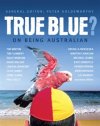
True Blue? On being Australian by Peter Goldsworthy
Allen and Unwin
(All ages) What an introduction to the range of peoples that make up
Australia today, Goldsworthy has drawn together excerpts from books,
speeches, newspaper articles as well as poems and short stories to show
us what it means to be an Australian. Ranging from David Malouf to
Michael Leunig and John Clarke to High McKay, the pieces included here
will engender some debate. Produced by Allen and Unwin with the support
of the Curriculum Corporation, Australia Day Committee and the
Australian Government Department of Education, Science and Training,
the book has the feel of a text for schools, but is enjoyable reading
for a range of interests.
Many of the stories are unforgettable, as people struggle on with their
lives, despite all adversity. One of the most endearing is that of Hieu
Van Le, now the Lieutenant Governor of South Australia. His first sight
of Australia escaping from Vietnam in 1975 is one that will live with
the reader for all time, and is in sharp contrast to the 'welcome'
dealt out decades later to people in a similar plight escaping from the
Middle East. This one is a stand out for me, but all add to the vast
range of people that make up Australia, and give it its broadness.
For students in the classroom, that favourite topic, What it means to
be Australian, will be well served with a class set of this book.
Students will be able to dip in to read authors they have heard of and
many they have not seen before, and argue with their class mates about
what is an Australian, what should have been included or not included,
what best describes us. Some may notice the lack of children's voices
or the dearth of women's voices, some may question the Anglo Saxon
predominance, some may want a greater representation from expatriate
Australians, but all will bring their own views and values to the book,
adding space for discussion and debate. Students will be invited by an
astute teacher to put together their own list of what could be included
in such a book, sending them to a wider reading and selection of
Australian writing, and photos and films will be watched to tease out
other quotes and mythologies.
Fran Knight
Sunny side up by Marion Roberts
Allen and Unwin, 2008 (Age 11-14) This book has Sunny, the optimistic but introverted daughter of a naturopath, giving the readers a warts and all account of her life. She and her best friend, Claud run a pizza delivery service on Friday nights, Sunny's mum is about to have her boyfriend, Carl move in, along with his two obnoxious kids and a cat, Sunny's dog, Willow is a bum sniffer and on it goes, a litany of stories all set to collide in an amazingly funny way.
In between, Sunny's tangent monitor rings, as she not only describes what is happening but goes off in different directions, many of which have little to do with the plot but all add a different dimension to the girl's character. All in all, a very funny read for upper primary and lower secondary readers, happy to be diverted with a clever and humorous story, written with charm and alacrity. Fran Knight
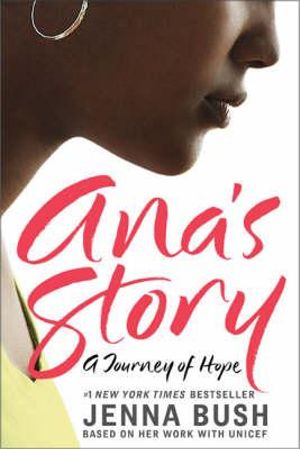
Ana's story by Jenna Bush
HarperCollins, 2008.
(Age 12+) The subtitle, A journey of hope, of this colourfully produced book tells it all, then when you read it is by Jenna Bush based on her work with UNICEF, you know that you are in for a sentimental story of the life of one of the girls Jenna Bush met when working in Africa with AIDS affected children. Although it is sentimental and openly aimed at gaining the readers' sympathies, it does give a lot of information about AIDS and AIDS in Africa and the lives of some of the people affected by this disease and the political pulls which affect their progress.
Ana was born with AIDS, passed on by her mother who died within a few years. Her story is one of courage as she develops strategies to live with the disease and its consequences. When students have read novels like Chandra's secrets by Allan Stratton or The heaven shop by Deborah Ellis, then they have been well informed about the disease and the prejudice which meets people so affected. This book will add to their knowledge. Some of it is mawkishly written, and purple prose abounds, but I know lots of girls will find it absolutely charming. And the photos are stunning, showing life worlds apart from our students. A portion of the proceeds from the sale of the book go to UNICEF and there is a website that students can access. Fran Knight
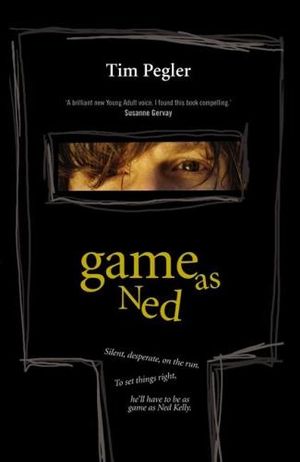
Game as Ned by Tim Pegler
Angus and Robertson, 2007 ISBN978073238576 0
(Age 13+) When Tim tries to speak, his body clams up, his head pounds
and he feels sick: so he doesn't. Left in grade 6 for 3 years meant he
saw a lot of the inside of the library, sent there because of his
failure to respond in the classroom. And here he learns about
Australia's bushrangers, Ned Kelly in particular. With a father killed
in Vietnam, and a runaway mum, he lives with his grandfather, a man who
refuses to allow his autistic grandson to be experimented on with drugs
and therapy.
Working at a sheltered workshop, he meets Erin, employed to be the cook
and general dogsbody. She has problems of her own, but sensing a
kindred soul, she teams up with Ned, chattering away to him, while he
remains silent. But the town bullies intervene and put pressure on both
these young people, and Erin and Ned must stand and fight.
A wholly absorbing read which took me back to the 1970's, with its
setting of a small country town, where girls were sluts and boys'
behaviour ignored. Passing mentions of the Vietnam War and Skyhooks
added to the backdrop. The treatment of both protagonists will evoke a
strong reaction from the readers, and they will be gripped by the final
few chapters, as Ned tries to relive his hero's and namesake's actions.
Fran Knight
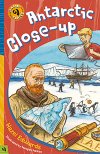
Antarctic close-up by Hazel Edwards
National Museum of Australia
Press, 2007 (Making
Tracks)
(Age 8+) Hazel Edwards visited Antarctica in 2001, and since then has
written several enlightening books about that continent. For the
series, Making Tracks, she
has written a short story involving one boy's adventure, peering into
the past through a telescope he finds at his father's auctions rooms,
once owned by the explorer John Close. He links the telescope to an old
video camera, and watches the crew as they live and survive in the
Antarctic.
Readers will learn a great deal of information about how these early
explorers survived as well as holding their breath when the smallest
things happen putting all their lives at risk. Funny stories too are
drawn into the story as the boys watch the men on their video.
But in the end, the telescope is sold at the auction, and the boys
return to their library with gusto to find books and websites which
give them further information about the expedition.
Fran Knight
Note: Discussion questions and other teacher materials can be found on
the Making
tracks site.
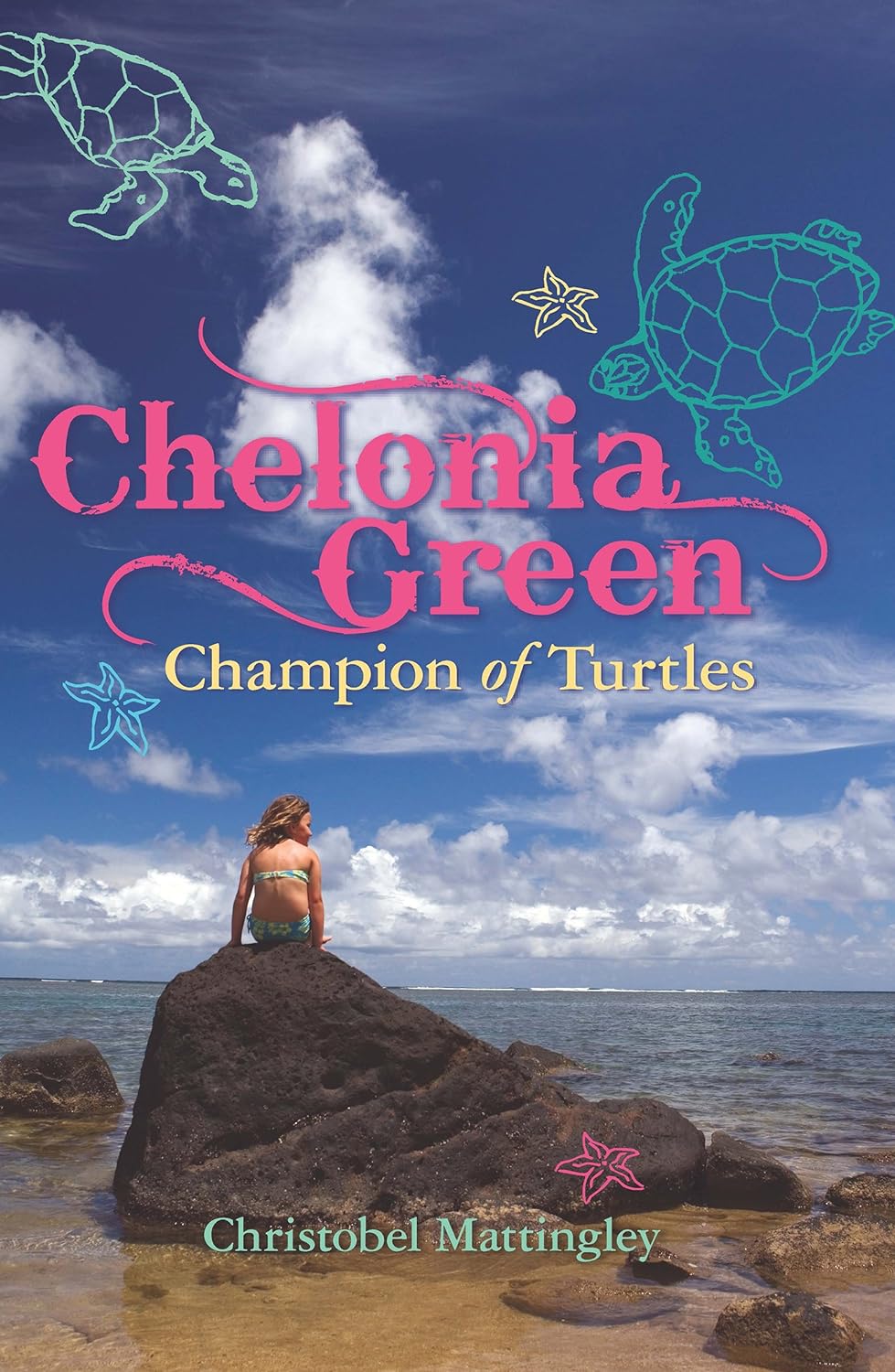
Chelonia Green, champion of turtles by Christobel Mattingly
(Age 8+) This is a breathtaking account of the damage done to the environment by the users of the sea. Chelonia and her family live on an island off the coast of Queensland. Chelonia loves the turtles and sees them as her special friends, but is distraught when one of her favourites, Caretta, turns up dead on the sands. Chelonia and her father unwind the metres of fishing line wound around the turtle's head, and together they begin the arduous job of picking up the rubbish which litters the beaches.
Writing letters to the local yacht club, newspapers and government officials seems to have no response until on one weekend a number of people turn up to help clean up the beaches. A beautifully written story by the admirable Christobel Mattingley, who always writes convincingly about environmental issues, Chelonia Green is a salutary reminder of the damage done to our coastlines and to the animals which live along it. Chelonia Green will be enjoyed by a range of students from beginning readers to upper primary and would work really well, being read aloud. Fran Knight
Monster-Blood Tattoo: Book 1: Foundling by D.M. Cornish
(Ages 11+) When Rossamund leaves his home, Madam Opera's Estimable Marine Society for Foundling Boys and Girls, ready to travel alone to High Vesting where he will begin his apprenticeship as a Lamplighter, he can have little idea of what will befall him. He lives in the Half Continent, where monsters have lived for centuries, ready to trap the unwary, looking in some cases like humans, but often strangely disfigured. Told to meet the captain of the cromster upon the Humour, he is taken aboard by Poundinch whose trade is of a type never spoken of, but Rossamund, coming across crates in the hold that feel warm, realises that he is aboard the wrong boat and is in mortal danger.
Jumping from the boat in the night, he cowers in some shrubbery for cover and is eventually saved by a lady and her driver, and accompanies them on their journey. He realises that she is a fulgar, a monster slayer, and becomes involved in a fight to the death with a group of grinnlings, after she has killed their friend, the ettin. Wounded, the lady Europe becomes dangerously ill, and Rossamund follows her instructions making a draught which will revive her. But the inn in which they are staying does not want such people staying there, so trouble ensues.
Confronted with the phenomenal range of creatures which inhabit this land, from the small Freckle, to the nasty grinnlings and the strange ettin, or humans who are twisted like Poundinch, Rossamund must use his skills learnt at the Society to good use, and not judge those he meets at first sight. The background of this story took eleven years to develop and it shows. Not one word is out of place; all the creatures have histories and descriptions which are finely crafted to meld with the others. Each has a position in the story. Lovers of fantasy will gobble up this book, feeling at one with the courageous Rossamund as he finds his way in life, cheering with him as he overcomes the most appalling of difficulties, and shedding a tear when things happen which are out of his control. Coming across people with tattoos made up of the blood of the monster they have killed, gives the reader a frisson of excitement, as Rossamund and the reader foresee where the story may be going.
Students aged 11-14 will love this highly original fantasy, the first in a trilogy called Monster-Blood Tattoo. Fran Knight
Volcano by June Colbert
Lothian, 2007 ISBN 978073440852 5 (Age 11+) A book that starts off detailing the gross ways to die as a result of a volcanic eruption is a winner, capturing the imagination of any reader from the first words. When Sara introduces herself and her family, the workers with AusDAR, the group which travels the world hotspots, testing, then warning local inhabitants about possible volcanic eruptions, and tells the reader about how they are universally hated whenever they come to town, then we know we are in for a rollicking journey. Sara and the other teenagers traveling with their specialist parents are sent to an international school in their latest hotspot, a small volcano in Columbia, but here the other students are from well off mining engineers' and mine managers' families, and so are very resentful of Sara and her friends whose parents are imposing restrictions on the mining activity and insisting on extensive safety gear. A dare between the two groups results in the richer kids camping overnight on the mountain and when it begins to show signs of an eruption, then a daring plan is hatched to rescue them before the lava flows. An exciting survival story which gives a whole new series of words for the astute reader, Volcano is an easy to read book for the middle school. Fran Knight
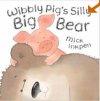
Wibbly Pig's silly big bear by Mick Inkpen
Hodder Children's, 2007
(Age 2-5) This is an endearing story with beautiful illustrations from
Mick Inkpen . Wibbly Pig's friend is a big bear who cannot eat his peas
with a spoon or brush his teeth or comb his hair but Wibbly Pig loves
him anyway.
A short entertaining picture book, the engaging illustrations will
appeal.The story will reinforce the idea for young children that it
doesn't matter how skilful or clever you are, someone will still love
you. Bear is enthusiastic and loving and this is what counts.
Young children are sure to love Wibbly Pig and adults who read this
aloud will be left feeling happy and satisfied with this story.
Pat Pledger
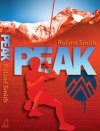
Peak by Roland Smith
Allen and Unwin, 2007 (Age 11-15) Peak, named by his father, a mountaineer, is climbing. His face freezes on the wall of ice and while he is working out how to unstick his face without tearing his skin, a helicopter zooms in, telling him to catch hold of the rope. The opening sequence is stunning, as it tells the reader many of the quirky things about climbing, and showcases some of the dangers. But all is not what you think, Peak is actually doing something very illegal, he is climbing a skyscraper in New York.
Once down, he is immediately taken to a Juvenile Detention Centre and appears in court the next day. He is shocked by the anger of those around him until he is told that a boy died trying to copy his style of climbing buildings. As a result the judge is gong to send him back to the centre until he is 18, but his father appears on the scene, offering to take him out of the controversy, back to the Himalayas where he works. And so Peak is set to climb Mt Everest. Peak's self absorbed father is not interested in helping his son, but wants him to be the youngest person ever to climb the mountain, thus ensuring the survival of his flagging business.
I thought I would be bored by this story, but it took me in. The American style of writing, of telling you about what people are feeling, and having a lot of asides in parentheses, annoys me intensely, but the story was so involving that I quickly learnt to ignore these idiosyncrasies. I am still at a loss to understand in any way why people want to risk their lives climbing Everest, but along the way I learnt a whole lot of information about climbing, the risks involved and about the Chinese occupation of Tibet. The last few chapters particularly held me totally, as the boys found bodies of failed climbers along the last part of their ascent, while working through for themselves their motives in doing the climb. Boys particularly will enjoy this rather long read (246p) and there is a web site where they can learn more about the author. Fran Knight
The night of the burning by Linda Press Wulf
Bloomsbury, 2007 (Age 11+) Set in Poland at the end of World War One, The night of the burning tells, from a child's perspective, the horrors of being in a small village, surrounded by war. They see the soldiers coming to take men for the war, returning the narrator's uncle only when he is near death, no longer of any use. They see typhoid take many villagers, and know the hunger that gnaws at their bodies. It is a gripping story, based on the memories of stories told in South Africa, the place of safety where many hundreds of Jewish orphans came in the 1920's.
Devorah and her sister see their parents die, and living with their aunt, are saved by her at the night of the burning, August, 1920, when the Cossacks, drunk and eager to kill, mow down the Jews in the villages in the area. The girls are found the next morning under their aunt's body, by a neighbour, who sends them to an orphanage at Pinsk. Here they are chosen by a benefactor from South Africa, Isaac Ochberg, in Poland to take 200 Jewish orphans back with him. It is an amazing story of courage and luck as the two girls survive and find their way to life in South Africa, where they are adopted by two quite different families. The Ochberg orphans' stories are kept alive in this sometimes sentimental book, but it will be a fascinating insight for those who have only known peace. Fran Knight
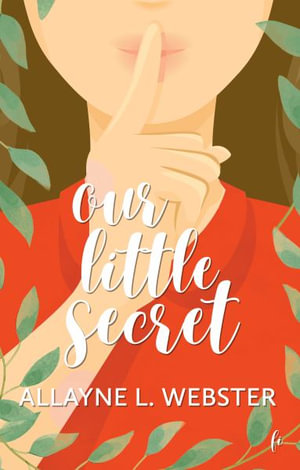
Our little secret by Allayne Webster
Recommended.
The story of the grooming and eventual rape of young teenager, Edwina, is shocking and salutary. Shocking because the scenes detailing her rape are graphic with nothing left to the imagination, and because everyone who reads this book will be able to see just how easy it is to seduce a young girl. Salutary because it gives the readers a valuable insight into the minds of such people. So it should be read as widely as possible.
Edwina is just noticing boys, and is flattered by the attention she receives from 25 year old Tom, who works with her father. He often calls at the house, talking to, then tickling, then finally kissing Edwina, before taking her out of the town in his car. He hurts her but insists that 'our little secret' is just that, and continues to abuse her. When the suicide of a girl in the town who has been raped alerts teachers to the fact that Edwina has changed, one of them talks to her, drawing her story out until she admits that something has happened.
This book deservedly will cause a stir, some parents will not like its graphic nature, and some will not like it because it talks about such a subject candidly. But it will alert girls and parents to the predatory nature of some men and how their children can be groomed to accept their advances. So have it in your library. Some may like to attach a senior fiction label, some may have it for parents, some may keep it on a restricted shelf, but have it available because kids will ask for it, their network is much faster than ours. Fran Knight
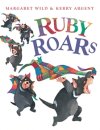
Ruby roars by Margaret Wild and Kerry Argent
Allen
& Unwin, 2007. ISBN 9781741146134
(2+) This delightful story by award winning author and artist is
perfect for reading aloud. Ruby is a little Tasmanian devil who loves
making scary noises. She shouts 'Screekle!', 'scrunch!' and 'scrrr!' at
the animals near her but fails to scare them. What is she to do? Then
she gets an idea and is 'ready to rip and roar' with a plan to scare
her parents…
The alliteration of the text and the great animal noises will ensure
that young children will want to read along, roaring out the sounds
with Ruby. Adults will enjoy reading it out loud. Fascinating
illustrations by Kerry Argent ensure that the reader comes back to look
at Ruby's facial expressions and to follow her adventures with the
animals around her.
Having the threatened Tasmanian devil as the main character is a bonus
as teachers will be able to use this wonderful picture book in units
about Australian animals and endangered species. Part of the royalties
for the book go to the Save the Tasmanian Devil Appeal at
http://www.tassiedevil.com.au
This book is a keeper.
Pat Pledger
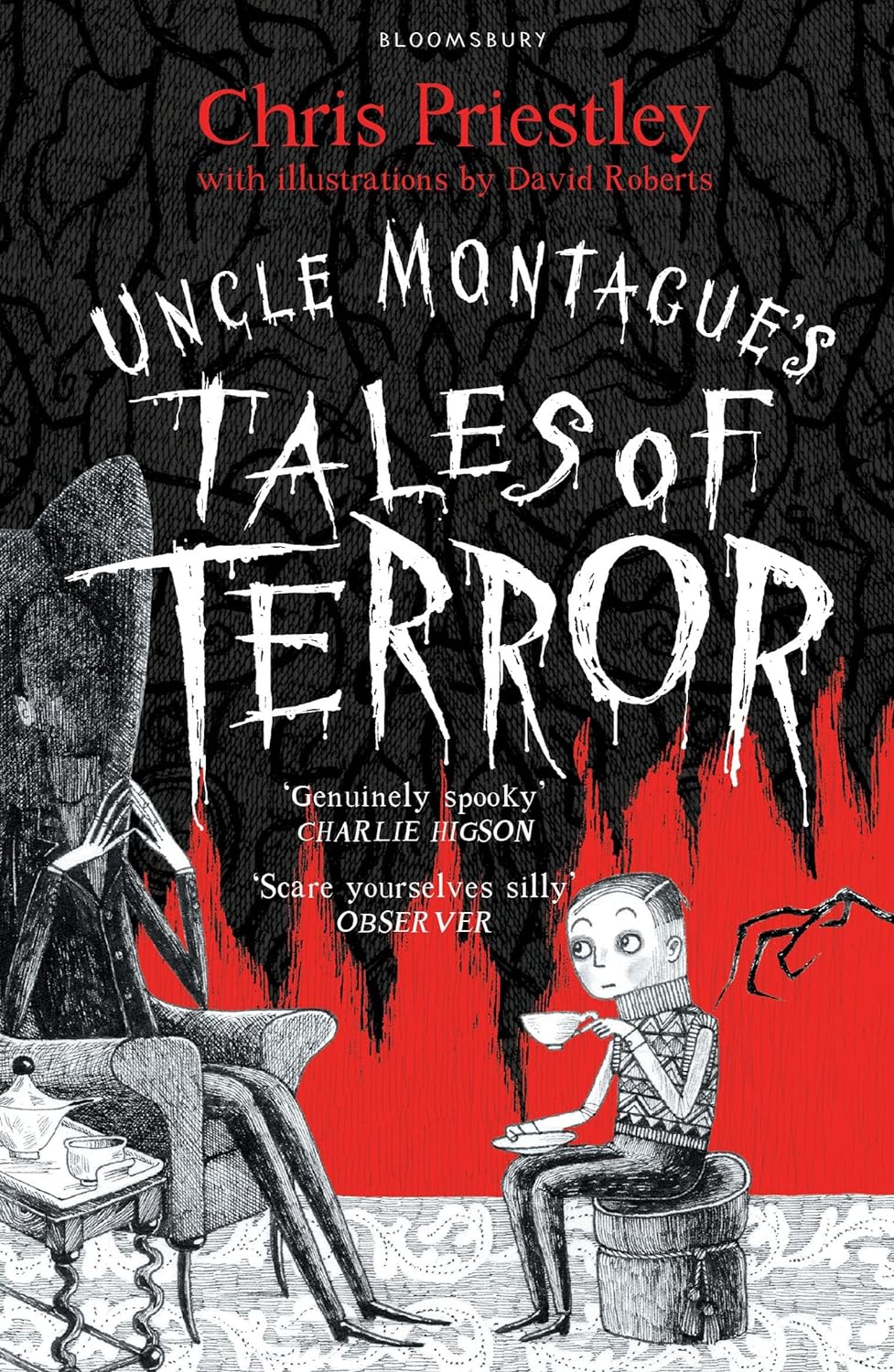
Uncle Montague's tales of terror by Chris Priestley
Bloomsbury, 2007
(10+) This book of short stories loosely bound together by Edgar's
visit to his uncle Montague, will set teeth chattering, as Edgar
realises that some of the stories must be true, and must be set close
by in the woods surrounding his uncle's house. Several of the stories
are vaguely familiar, but told so well, with sinister overtones and
matchless descriptions, that they are truly creepy.
When Harriet meets a young girl in the hallway next to a door which
doesn't normally open, she follows her new friend, but to her chagrin,
for the child is from the doll's house, and the door, one which takes
Harriet away. The Un-door is at once familiar but very spooky with its
hints of supernatural intent. Many of the stories come together at the
end, as Edgar leaves his uncle's house, wanting desperately to return
to the normalcy and calm of his parents, but what he meets in the woods
terrifies him even more.
Fran Knight
In the city by Roland Harvey
Allen
&Unwin, 2007. ISBN 9781741144130
(Ages 5+) This book is highly recommended for the joy it gives its
readers as they follow Frankie, Henry and Penny through the city on
their holiday. Harvey takes us to many fascinating places including the
city sewers, a museum where Ned Kelly's iron underpants are displayed,
the market with its stinky fish, an aquarium, and a zoo. At the same
time he shows the amazing diversity of life in the city through his
amazing pictures.
By showing the city through the three children's eyes, Harvey is able
to give a variety of opinions and interests that will appeal to
different children. Frankie is obsessed with the aquarium and fish
life, Henry's wry observations and humour are very enjoyable and
Penny's checklist of zoo animals and collection of a baby taipan are
delightful.
Harvey's witty and humourous prose and the enthralling illustrations
will have both young and older readers returning again and again to
pour over the intricate pictures and find new things on each page. The
production of the book is great, with fascinating end papers and a
double page spread for each person's observations of their visit and a
lovely dedication to the author's mother.
This is a wonderful book to have near comfortable seats in the library,
where readers can pick it up and find funny and fascinating new things
each time they look. It is sure to bring children back into the library
on repeat visits.
Pat Pledger