Allen and Unwin, 2008.
ISBN 978174175519 0
(Ages: 14+) When Alice returns to her grandmother's house in
Warrnambool and takes a job in Mullaney's law office during her break
from university, she finds that her cousin, Jonty, the one originally
charged with her mother's murder, is also back in town, working at the
local restaurant, Thistles. She is keen to avoid him and the memories
his presence evokes, but one Saturday night while returning from a
concert, Jonty and Tom Mullaney are both at her grandmother's house,
asking for help.
Without realising it, the reader is drawn into the cosseted world of
this small rural city in Victoria, relishing the coming clash between
the three protagonists. Each has kept back information from the police
during the murder investigation, each is suspicious of the other, and
cousins, Jonty and Alice, are resentful and wary because of their
grandmother's will which leaves the insecure and lonely girl, the whole
estate.
Stringently, details about the relationship between the murdered woman,
and the two boys, school mates from a long way back are revealed. Jonty
and Tom were in year 12 with Lillian, a mature aged student, when their
paths crossed and the older woman invited the two boys back to her
home. Her murder created a great deal of gossip and innuendo about the
relationship between the three, and Jonty's arrest came as no surprise
to the town. His time spent in remand for the crime, curtailed
his friendship with Tom, and now, Tom's guilt at not supporting his
friend has resurfaced.
Because the protagonists are much younger than those usually found in a
crime story, the whole feel of this novel is very different from those
thick tomes encountered in Dymocks, and middle secondary students will
be enthralled with the story and its characters as it moves towards the
conclusion. Family life is revealed in its many guises, and as a class
set, this book will engender much discussion.
Fran Knight
Open for business by Moya Simons
Walker Books, 2008. ISBN 9781921150302
(Age: 10+) The first in a series called The Walk Right In Detective
Agency sees Bernice and David setting up a detective agency which sorts
out loads of local problems. David is addicted to lsit making and so
his lists dot the pages as he takes notes about peoples' activities,
lists what he needs to buy at the shop, and makes notes about their
investigations. Armed with a spiral notebook, he and Bernice question
and look, using their wits to find answers to the crimes committed.
A funny series, this will appeal to upper primary school readers, who
want something based firmly in the reality of their lives, with being
told to clean up their rooms, being told off about table manners,
having to go and visit grandma, and so on. The crimes being solved are
not major things, but incidental crimes happening in their
neighbourhood.
Simons has hit upon a winning series of stories, and kids will delight
in finding answers along with David and Bernice.
Fran Knight
The Mysterious Benedict Society by Trenton Lee Stewart
Chicken House, 2008.
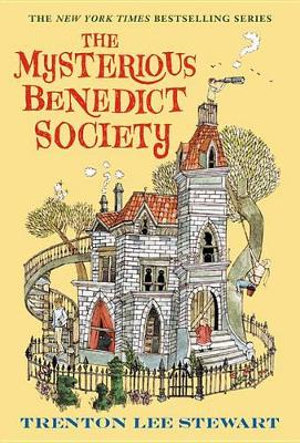
Ages: 9+ Recommended. Fans of Lemony Snicket are bound to enjoy
this
light hearted, rip roaring adventure based on the dastardly Mr
Curtain's wicked plan to brain wash the entire population and take over
the world. The story starts with an advert placed in the
newspaper requesting gifted children with special talents to perform a
series of tests. Reynie Muldoon, resident of Stonewall Orphanage is
encouraged by his beloved mentor to take part. Along the way he meets
three other children, also parentless. All four pass a series of
bizarre exams and are chosen by the mysterious Mr Benedict to
infiltrate the Learning Institute for the Very Enlightened (LIVE) to
defeat the evil Mr Curtain.
This is a cinematic story, reminiscent of Roald Dahl, with plenty of
breathtaking action and larger than life characters. Neatly placed in
all the action are some thought provoking messages such as: 'the only
way to get rid of fears is to confront them', and 'to be a leader means
being lonely and having enemies who despise you'!
One of the reasons this story works so well is that our heroes and
heroines are flawed and human. Although highly intelligent Sticky
Worthington has more neuroses than a medical text book, Kate is brave,
indomitable - and knows it. Reynie lacks self belief and worries
endlessly, and Constance Contraire lives up to her name by being
awkward and irritable. The children bicker and fall out, but ultimately
they use their individual strengths (very appropriate in our climate of
multiple intelligences) to defeat the wicked Mr Curtain.
Just how Kate stumbles on her father, how Reynie finds the happiness of
a family of his own and how we discover Constance Contraire's perfect
excuse for being so lazy and irritable are pulled together in a superb
and satisfying ending that ties up all the knots.
At nearly five hundred pages this is a novel for able readers, ready
for a challenge. They will be richly rewarded with an action packed
story which neatly balances slap stick humour with moments of high
octane excitement. There are heroes they can relate to and a villainous
megalomaniac who deserves every boo and hiss yelled at him!
Claire Larson
Murderer's thumb by Beth Montgomery
Text Publishing, 2008 ISBN
978192136148 8
(Ages: 12+) Hiding from a violent father, Adam and his mother rent a
small house on a farming property. Whole working with the farm hand,
Loody, Adam discovers a body in the silage pit. Buoyed up by his
grandfather's reputation as a consummate detective, Adam takes up this
role with enthusiasm, unearthing clues around the farm as he follows
the trail left by one of the missing girls, a Goth heavily involved
with palmistry called Lina. The local policeman is not to be trusted,
and Adam's school friends are suspicious of him. His eye trauma makes
him stand out and he is ever distrustful when meeting new people.
An absorbing thriller, Montgomery gives us plenty of clues and red
herrings in this isolated farming community, as Adam delves into the
circumstances of the disappearance of the girls, six years before.
Behind the investigation we see families at their worst. Adam and his
mother snipe at each other, mum taking refuge in terrible pottery,
while the farm where the daughter, Emma, disappeared has a mother in a
cloud of anti-depressants and grief, her husband's gruff demeanor
hiding his own sorrow.
Beautifully developed, the community is very real, hiding behind its
inability to respond to the disappearance of the two girls and looking
for easy answers. Each of the minor characters has a background which
is tangible and extensive, adding to the readers' absorption in the
tale. It seems to resolve itself a little too quickly, but the story is
fascinating and holds the reader to the end.
Fran Knight
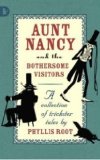
Aunt Nancy and the bothersome visitors by Phyllis Root
Walker Books, 2008.
(Ages 7+) Highly Recommended. Aunt Nancy is an intelligent, quick
thinking, resourceful lady who uses
all her cunning to defeat a series of unwelcome visitors. Each story
sees the arrival of one of these bothersome creatures - Old Man
Trouble, Cousin Lazybones, Old Woeful and Mister Death. These stories
are near to perfection, narrated with accomplished simplicity in a
lyrical language that makes you feel the rhythm right down to the tips
of your toes.
Aunt Nancy and the Bothersome Visitors is one of Walker Books
'Racing
Reads' for confident readers, but in my opinion the stories are best
read aloud, preferably with a Deep South American accent! Knowing my
own limitations I passed them on to one of our drama specialists who
read a couple of the stories to Year 3. The children were mesmerised.
Some of the language is quite difficult with the idiom and expression
of a different place and era - probably South America during slavery
times, but you soak up the atmosphere and message even if some of the
expressions are unfamiliar. The stories certainly have the air of
parables and the richness of the language and rhythm is reminiscent of
the Afican American Spirituals. You can imagine these stories being
accompanied
by plenty of hand clapping and foot tapping. As an introduction to the
traditional stories of other cultures they are just perfect.
David Parkins' illustrations also deserve a mention. The simple black
and white line drawings complement the style of the story telling and
the year 3 children were captivated - poring over the illustrations and
re-reading the stories for themselves.
Claire Larson
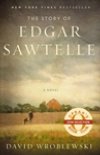
The story of Edgar Sawtelle by David Wroblewski
Fourth Estate, 2008.
ISBN 9780007265022
(Age Senior to adult). This most unusual thriller, nearly 600 pages
long, has psychic elements combined with murder, arson and dog
breeding. With touches of Shakespeare's Hamlet, the story resolves
itself in much the same way, bodies littering the pages at the end of
the novel.
Edgar Sawtelle is the third generation of a Wisconsin family which
breeds a dog now called Sawtelles. Born mute but able to hear, Edgar
was their last chance to have a child. This self contained family;
Trudy, the mother who does much of the training, and her husband Gar,
who keeps the records, and sells the dogs retaining contact with the
buyers, work with his brother Claude. Edgar learns to train with signs,
dogs having to watch him all the time, which people recognise as a
feature of these animals. The dogs are trained and kept until they are
12-18 months old before they are sold. Grandfather and father have kept
meticulous records of breeding lines, along with photographs and
information about where the dogs have gone. One dog called Almondine,
is Edgar's constant companion.
The vet is the only regular contact they have. Their lives change when
Gar dies. Edgar finds him and alone on the farm, cannot summon help.
When Edgar and Trudy try and run the place on their own, Trudy gets
pneumonia, so Claude comes to help, Edgar 's world comes to an end when
Claude and Trudy begin a relationship and Claude moves in. Edgar
decides several times that he will kill Claude and one day when he
thinks Claude is coming up the stairs in the barn he makes a move and
the vet falls to his death. Edgar runs away taking 3 of the dogs with
him.
Surviving by raiding cabins on the lakes, he comes to a farm run by
Henry; a loner who takes Edgar and the dogs in after one of the dogs is
injured. Edgar comes to believe that his father's death was not
natural, and decides he must go home. No one is there, so he leaves a
note, setting in train an amazing climax with all the characters
involved in a life and death struggle.
This story about making decisions is not your usual tale. Defying any
attempt to categorise it, the novel involves a mystery, yet tinged with
psychic moments where the future is foretold makes reading about this
family tense and unsettling. Based firmly on the relationships between
family members, the decisions people make in their lives is shown to
have far reaching ramifications. The well trained dogs seem to parallel
the decisions made by members of the family, and in the end, the
animals make the decision to leave and take charge of their own lives.
Mark Knight
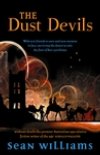
The dust devils by Sean Williams
Angus and Robertson, 2008.
(Ages 11+) Recommended. The second in the Broken Land series, The
dust
devils continues the story of Ros, a young desert traveller, in his
quest to release Adi, whose spirit has become detached from her body.
Following her disembodied voice and trying to catch up with her
people's caravan, Ros crosses the dry desolate landscape, where dangers
lurk from sand bandits and the wicked Bee Witch.
Williams is a wonderful story teller. He has created a harsh, wild
setting that is a perfect background for his story of survival against
the odds. The reader can clearly picture the desolate countryside and
vicariously experience the difficulty of staying alive in a desert. The
Weird, a strange and awful place from which travellers rarely return,
is a wonderful invention.
This novel is peopled with believable characters, both good and bad.
Ros
grows in power and self belief. The sand bandit chief is terrifying and
Adi's forlorn voice is haunting.
A short section at the beginning of the novel giving a basic background
to the first novel is a useful device to remind the reader of what
happened in the first of the series, The changeling. However it
would
be beneficial to both enjoyment and understanding to read the books in
the correct order.
This is quality fantasy that left me waiting for the final in the
series.
Pat Pledger
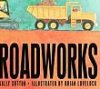
Roadworks by Sally Sutton
Ill. by Brian Lovelock. Walker, 2008. ISBN
9781921150166.
(Ages 3-7) Recommended. A vibrantly coloured book, which describes how
a road gets built, Roadworks is full of bright images of all the work
that has to be done to construct a new highway. There are images of the
surveyors, the bulldozers, lorries, dump trucks, graders, rollers, line
markers, sign makers, and verge gardeners, all complete with pictures
of the people who do the work.
The text is lots of fun, with its repetition and rhymes. Young children
are likely to especially enjoy the alliteration in all the words that
make noises and relish reading along with the story. All readers will
gain a more thorough knowledge of the complexity of building a road and
the different roles of the workers. A useful fact page with
illustrations of the various pieces of machinery and a description of
what each does appears at the back.
The illustrations are bold and very colourful and complement the text.
I especially liked the multicultural nature of the workers and the
gender balance.
This is a book that will lend itself to being read aloud, and the road
building theme will be very useful for a unit of work on transport or
machinery.
Pat Pledger
Guyaholic by Carolyn Mackler
Walker Books, 2008. ISBN 9781406312164
(Age 15+) When V (short for Valentine) is hit in the head with a hockey
puck and falls into the arms of Sam Almond, life begins to change for
her. She has been left to live with her grandparents by a mother who
has a commitment phobia. V is also afraid of making a commitment and
falling in love, so she bounces from one boy to another. Sam is
different to the other boys she has dated, and V must make up her mind
what she really wants.
This is a sequel to Vegan, Virgin, Valentine, but can be read
as a
stand-alone. Mackler has written a funny, touching, coming of age story
about a girl who must come to terms with what a relationship means, not
only with Sam but with her mother. When V embarks on a road trip across
America to see her mother, she uncovers truths about herself and the
meaning of love on the way.
This is an entertaining read. It has enough humour, engaging characters
and interesting story line to keep the reader engrossed, while sending
a subtle message about the nature of love and self discovery.
Pat Pledger
Ratwhiskers and me by Lorraine Marwood
Walker Books, 2008. ISBN 9781
92115039 5
(Ages: 10+) When Boy is taken by the men as a cook at their tent
site, he feels safer than he has for a while. Meeting Pigtail gives him
a friend, but the men warn him off, he is told not to talk to the
Chinese miners. It is Bendigo during the early days of the Gold Rushes
in Victoria in the middle of the nineteenth century. Using the
technique of the verse novel, Marwood gives us a look at the gold
field, with its rough single minded characters, the resentment towards
the Chinese diggers, the deaths from all sorts of disease and the ugly
disposal of the bodies.
Boy is soon exposed as a girl, in flight from the murder of her family
during one of the many fires which ravaged the camp sites in Victoria.
Nina has recollections of the fire which killed her parents and sister,
but cannot piece together what really happened. When she must leave her
loyal dog, Ratwhiskers, tied in a cave lest he give her away, she is
taken by the evil Ellery and tortured to tell what she knows. An easily
read adventure on the goldfields is sure to please upper primary
students.
Fran Knight
The graveyard book by Neil Gaiman Ill. by Chris Riddell.
Bloomsbury,
2008.
(Ages 10+) Recommended. Nobody Owens, Bod for short, has evaded a
murderer when he was a baby. The evil Jack has killed all his family
members, and the ghosts who reside in the local graveyard have rescued
him. Brought up by the kindly ghosts of Mr and Mrs Owens, and mentored
by Silas, Bod is taught many things and faces many dangers and
adventures. The Sleer who guards an ancient treasure wants him to be
Guardian; evil ghouls try to entice him away and the man Jack is still
pursuing him.
This is a story for all ages. Each chapter is almost a short story and
very readable. Gaiman builds up lots of tension and fear with his
imagery and descriptions of the adventures that Bod has. The opening is
very frightening with the tale of Jack creeping through the house and
murdering the family.
Gaiman is a master of characterisation. Each of the people in this
novel is so well drawn that they will stay in the memory long after the
book has been put down. The reader follows the life of Bod from a
toddler to teenager, watching him grow and mature and never losing the
inquiring mind and curiosity that saved him as a baby. The Owens couple
is warm and friendly and Silas, dark and wise, is a wonderful teacher
for a young boy. Minor characters like Liza from the potter's field and
the Lady on the Grey are fully rounded. Chris Riddell's illustrations
are a perfect accompaniment to the text and enhance the reader's
perception of the characters and the setting.
The many themes that permeate this book will appeal to different ages.
Younger readers will be drawn to the portrayal of family, while Bod's
coming of age story and decision to make it on his own will engross
older
readers. Everyone will be enthralled by the Danse Macabre scene and the
horrors of the ghouls.
Pat Pledger
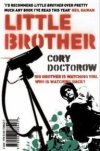
Little brother by Cory Doctorow
Tom Doherty, 2008.
(Age 13+) Recommended. A book that kept me thinking about the issues
that it raises long after I finished it, Little Brother will be a treat
for teenagers who are into political issues, computers and maths.
Marcus, 17 years old, smart and computer savvy, believes he knows how
to get around any system, until one day he and his friends are caught
up in the aftermath of a terrorist attack on San Francisco. Arrested by
the Department of Homeland Security the friends are taken to a secret
prison and interrogated for days. When Marcus is released from the
place they call Gito-by-the-Bay, he finds that he is living in a police
state and Darryl, one of his friends who was arrested with him, has
disappeared. What can one teenager do?
This is a fast paced adventure story with lots of information about
hacking which I skimmed over but is sure to be fascinating for younger
readers. What I really admired about this book is the way Doctorow
expands his ideas about a police state, the rights of the individual,
privacy and freedom of speech. The whole story line insists a teenager
can take action to improve things and can do it now. Sometimes the
story gets a bit didactic, but the reader will forgive that as Marcus'
journey to overcome injustice progresses.
This is a great discussion book and one that will get kids thinking. Is
it ever OK to torture people? Should the rights of individuals to
privacy be kept in times of terrorism? How should technology be used?
Can teenagers make a difference? This story can be download for free at
http://craphound.com/littlebrother/download/ but it's a must-have addition
to the library or class collection in its book format.
Pat Pledger
Little Brother by Cory Doctorow
Harper, 2008
(Age 13-16) Marcus and his friends are dedicated gamers and hackers but
they are
not terrorists. They are loyal to the values of the US constitution, so
loyal that they take on the Department of Homeland Security when it
overreacts to a terrorist bridge attack in San Francisco by arresting
and torturing anyone in the area. By setting up illegal but secure Xnet
connections the gamers mobilise support amongst the young using the
slogan 'Don't trust anyone under 25'. The reactions to torture are
believable and the physicality of the torture and confinement contrast
with the details of the cyberspace underworld/otherworld created by the
gamers. There is little character development and the plot,
including a first love affair, is predictable. However, there are
lots of technical details that may be interesting and the action is
fast-paced. The dilemma of the balance between the need for safety and
a corresponding loss of rights is explored hypothetically in the
classroom and in reality in the streets. Recommended for Years 9-11.
Jenny Hamilton
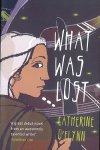
What was lost by Catherine O'Flynn
Tindal Street Press 2007
(Age 16+) Highly Recommended. If you're looking for something to tempt
A-Level students into wider reading this could be just the book. I
bought it on the strength of Jonathan Coe's on cover recommendation and
I'm so glad I did. Catherine O'Flynn's novel, winner of Costa's First
Novel prize, is both a highly readable detective story and a biting
attack on our consumer obsessed society. I can certainly foresee a
lively debate among students asked to discuss the parallels between
Orwell's 1984 and What Was Lost.
Moving between the past and the present, What Was Lost focuses
on the
1984 disappearance of ten year old Kate Meaney. Twenty years on her toy
monkey is discovered at the Green Oaks shopping centre and the mystery
of her disappearance is finally about to be solved.
This is a novel brimming with flawed characters - Green Oaks security
guard, Kurt is haunted by a choice he made as a teenager with
consequences that still reverberate twenty years on. Lisa, hapless
manager of a record shop, is trapped in a miserable relationship and a
job she hates. Adrian, accused of being linked to Kate's disappearance,
is rootless and drifting. Teresa, Kate's erratic and dangerous friend,
is fighting against the society that has failed her; and then there is
Kate, fragile, brave and determined to be the best private detective
since Philip Marlowe.
However, this novel is far more than the sum of its characters. O'Flynn
has much to say on the creeping sickness of a society obsessed with the
consumer dream; a society where shopping centres are the venue for
Sunday worship and where retail mania is played out among shop workers'
passive aggression. In Green Oaks you can glide along marbled atriums
oblivious to what goes on behind the scenes - the twilight zone of
service tunnels, stockrooms where minor battles rage and security
cameras that are watched by guards who can see the rats as well as the
people. In Green Oaks you are under the surveillance of a thousand
cameras, surrounded by hordes of people and yet still experience the
desolation of feeling entirely alone.
O'Flynn explores many themes - isolation, loneliness, loss and
ultimately redemption. Occasional flashes of humour are on the manic
side of funny, but this is primarily a haunting novel, probing and
unsettling, that stays with you long after you've finished it.
Claire Larson
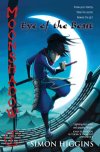
Moonshadow: Eye of the beast by Simon Higgins
Random House Australia, 2008. ISBN 9781741662832
(Ages 11-15) Moonshadow is the story of a young apprentice, Moon, who
has trained by a secret brotherhood, the Grey Light Order, and
who is sent on a mission to the Silver Wolf's lair.
Equipped with special powers such as being able to see through the eyes
of animals and possessing advanced sword skills, he carries the fate of
Imperial Japan. He meets a mysterious, beautiful girl - friend or foe?
The year 10 student I gave this book to wrote:
'The way that Simon Higgins encapsulates the aura and majesty of
the world that the tale is set in is truly remarkable. The way he also
blended in magic, superstition, and science is also deserving of
credit. My favourite part of the story is when Moonshadow meets the
deathless, with the climatic battle between the foes bringing the story
to a suitable end. The most interesting thing would probably be the way
that the story is told from different perspectives. It is full of
action, mystery, romance and drama. I would give this book 9/10 and
rate it highly to any other young readers.'
Suitable for Year 6 to 10 students.
Kevyna Gardner and Luke Davenport
Balaklava High School