Allen and Unwin,
2009. ISBN 978174175716 3
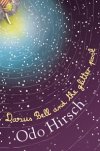
(Ages 9+) The Bell family has lived at Bell House for 5 generations and each generation
pays for their establishment with a gift to the town. This
time, however, the family has no money to buy an important gift. Their
funds have been eaten away.The house has a
gardener who plants fruit and vegetable where lawns once were, a
builder who conducts his business from his house over the garage, doing
odd jobs around the house in return and a cook, married to the
gardener, supplying local shops with her baking. Darius has known no
other life, and so it is all normal to him, but he feels the
expectation of a gift tremendously.
After an earthquake shatters the little house in the woods where Darius
and his friends play, he finds a cave, full of fabulous glittering
stones. Excited that he may have found the answer to his father's
problem, he investigates further, only to be dismayed that the stones
are worthless. But he finds that the cave has value in its beauty and
sets about trying to make it a place to visit, a gift to the town.
A thrilling story of Darius' family's dilemma, it twists and turns as
Darius tries to find a solution. Upper primary readers will love the
chapter when Darius' father, offering a wheelbarrow of home grown
vegetables to the council as the gift, is humiliated by the self
serving mayor, but in talking about manners and humility, trumps the
man soundly. A story of words and their use, nowhere is this more
evident than in the lawyer's office, where the words of the will are
studied. Hirsch makes us believe that all that glitters is not
gold.
Fran Knight
The cat who liked rain by Henning Mankell
Andersen Press, 2008.
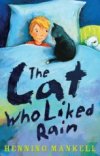
(Ages 6+) This engaging short novel can be read on so many different
levels. For an adult it is a portrait of loss and resilience. For a
young child it is the story of Lukas who is given a cat for his seventh
birthday and has not realised until now how it feels to fall in love.
Lukas christens his black cat Night and decides to teach him how to
hiss at his annoying big brother Markus. Lukas falls into a pattern of
playing with his cat and looking after its every need until disaster
strikes and Night disappears.
Better known for his gripping and dour adult thrillers, this is a new
side to Mankell, and he explores Lukas's shock and grief at Night's
disappearance with humour and tenderness. He certainly knows children
and every young child will be able to relate to Lukas's struggle to
come to terms with the first real loss he has ever experienced in his
young life.
There are no easy answers or cosy reunions in this story. But Lukas is
helped by his father who paints an imaginative picture of Night's
possible whereabouts. Translated from the Swedish, the language is
occasionally clumsy, but this is an endearing tale of family life which
does not shy away from the realities of sibling rivalry, anxious,
overtired parents and a little boy on a mission to find his lost cat.
An excellent story that will help young children understand and cope
with grief and loss.
Claire Larson
A rose for the ANZAC boys by Jackie French
Harper Collins.
Louis Braille Audio, 2008. Read by Caroline Craig, 6 CD's, 7 hours
Ages 12+
Jackie French's award winning story of the significance of ANZAC Day to
generations of people is brought to life by Caroline Craig's calm and
involving voice. She readily takes on the voices of a range of people
presented in the story: the young girls in France, Midge, Ethel and
Anne, Lachlan as he walks with his grandfather to the memorial in their
small town, the wounded soldiers returning from the front, Tim's voice
as Midge reads his letter. Each dissimilar group of people is
differentiated by small changes in Caroline's voice, without making the
differences too obvious or resorting to stereotypes. Her tone and pace
are perfect for the story and it seems to take a lot less time than 7
hours.
The girls in their school in England are well aware that war is at
hand. They have brothers and friends fighting in France, have heard of
the privation they are enduring. Midge's aunt writes to her and the
letters convey much of the devastation that is Gallipoli. Through these
letters French is able to give the readers an amazing amount of
information and detail which otherwise would have seemed imposed. Her
aunt's last letter, and the fact that Midge's brother Tim is listed as
missing, galvanises Midge and her friends to do something positive for
the war effort.
The girls are well aware that they have little power, their lives
regimented and contained in this early twentieth century society. The
information French gives, as with all her historical novels, is subtly
included. We learn that VADs are not allowed to go overseas until they
are 23, the science teacher at school spent 2 years at Oxford, but of
course, was not allowed to sit the exams, that the girls are not able
to learn to drive. But these three girls decide to do something.
Their efforts land them in France giving refreshment to the wounded
brought through by train from the front. In this way, French is able to
both give a rattling good story, and give middles school students a
sound message about World War One, showing its significance to
Australians and New Zealanders. A beautifully read story which will
grab the readers.
Fran Knight
Dream Land: One girl's struggle to find her true home by Lily Hyde
Walker Books, 2008.
ISBN 9781406307658
(Age: 10+ ) Recommended. Dedicated to the Crimean Tatars,
this fascinating piece of little known history is an amazing struggle
of one family's return to their home after fifty years in exile by
Joseph Stalin during WW2. They were resettled in Central Asia and
Siberia. After perestroika, the laws were relaxed and many Tatars
returned to Crimea to reclaim their land and build again. This is
the heart rendering struggle of Safinar's family. Along with
Grandfather, her mother and brother Lutfi, Safinar has come back to
Crimea where her father had earlier returned hoping to have a home
ready for them. But the struggle to build on their former land is
fraught with difficulties both from the local bureaucracy and the
Russians who now live there.
While Safi's grandfather tells the treasured stories of their heritage,
the reader learns of the present struggle to rebuild not only their
homes but also their lives, in a land they now share with others.
Safi is an engaging, curious child who like the characters in
Parvana, Secrets in the
Fire and The heaven shop, shows an amazing resilience in
harsh and
challenging times. The glossary is a useful addition.
Unlikely to be read from the shelf, the book depicts cultural diversity
in a very readable, warm and enlightening way. It needs teacher and
teacher-librarian promotion.
Sue Nosworthy
Hunting elephants by James Roy
Woolshed Press, 2008. ISBN 978174166326.
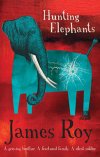
(Age 12+) Forced to attend his uncle's wedding, Harry is scathing of
the man he
has rarely seen. He had been going to a friend's party. The long drive to his uncle's farm is a strain,
and when the family arrives, they find that mum, even with her knowhow
on the internet, has somehow mistaken the bookings. They must stay with
Uncle Frank. Into this simmering pot, comes the uncle, holding down the
memories and frightening experiences of the Vietnam War, his fourth
wedding already putting extra tension on the already overcrowded home.
Here too, Harry meets his cousin, Trent, a brooding, sulky young man
with an unhealthy interest in guns. Harry sees his uncle retreat to a
dilapidated caravan behind the house and it surprises him that the man
should go there when he has a beautiful ranch style farm house to live
in. His interest takes a turn when approaching the van, he finds the
lock open and he goes inside.
James Ray has an easy flowing style which gathers in the readers,
giving little snippets of information about the family, but leaving the
reader wanting to find out more. His characters are rounded and
believable, everyday people buffeted by things which have happened in
their lives, but coping as best they can. Harry's family has suffered
the death of a son and brother. Each is coping in whatever way they
can, mum wraps herself up in her work, keeping her son's room as it
was, Harry is anguished because he believes that he hastened his
brother's death and dad tries to keep all together. It is a family with
undercurrents of anxiety and overwhelming anguish. Hostilities break
out regularly but are submerged as quickly as they surface, each person
unwilling to have a full discussion about the issue.
The elephant in the room, the issue which is between people and will
cause even more tension when exposed, is there in bucket loads. How
James Ray resolves the story is fascinating and involving, grabbing the
reader until the last line.
Fran Knight
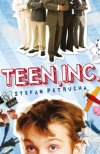
Teen, Inc. by Stefan Petrucha
Bloomsbury, 2008.
ISBN 978074759330 Teen, Inc. by Stefan Petrucha is saved from being glib by the
inclusion
of a range of likeable yet sardonic adolescents balancing accountably
predictable adults.
After NECorp was responsible for the death of his parents, Jaiden Beale
was raised by the monolithic corporation. His 'home' was a thinly
disguised office building, complete with security guards, presentation
rooms, LED screens and an artificial lake. But as teenaged Jaiden
becomes more interested in friends than MySpace screens, he finds this
constant supervision untenable. Teen, Inc. abounds with American teenage corporate symbols (or
product
placement) and at times this book reads like a movie script. With
a head resounding with 'cutthroat corporate strategy guides' and
lawyers who ask his friends to sign responsibility waivers, Jaiden
explodes. In a fast paced series of events, he becomes aware of the
inevitable conspiracy, but the depth of his relationship with his
former captors, especially the dependable pseudo-Mom, Nancy, and
steadfast Ben, the short-order cook, results in a well rounded tale
that will possibly be a film, one day. Ted Bungrin provides an
admirable evil antagonist. And the bumbling CEO (Desmond Hammond 111)
will probably be played by Robin Williams.
Parts of this book allude to ideas beyond my comprehension. I would
like to meet a male 'ninth grader' who has read Brave New World
yet
alone one who understood the politics in 1984. But today's
youth are
well aware of electronic monitoring bracelets, that cell phones can be
used as tracking devices and adolescents can be bribed with R-rated
DVDs. This book won't be chosen as a class text, but will be popular.
Pauline Crawford
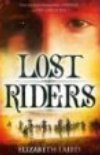
Lost Riders by Elizabeth Laird
Macmillan, 2008,
(Ages 9+) Highly Recommended. Rashid and Shari's poverty
stricken mother decides to allow her sons to travel from their home in
Pakistan to the Gulf to work as companions to rich children. Both
Rashid and Shari are promised a comfortable life as playmates to a
wealthy family. Of course the promises do not materialise and the boys
find themselves in the heat of the Gulf working as jockeys in an Uzba -
a camel farm.
It is one of Laird's strengths that the story of such an alien
environment should grab the reader's attention and suck them straight
into the harsh world of camel racing. Rashid is the lucky one,
separated from his four year old brother; he learns to live in an Uzba
where, although life is harsh, he is treated far better than Shari.
This is a story of contradictions - the rich Camel racers - sheikhs and
entrepreneurs treat their camels far better than they do the young
jockeys who race them. Starved to ensure they remain small,
electrocuted with cattle prods to spur them on, the boys, some as young
as four or five are forced to ride in races where injury is likely and
death not unknown.
Rashid has an uneasy relationship with his fellow jockeys. He relies on
their friendship, but discovers he has a gift for camel racing which
the rich owners want to manipulate to their advantage, placing Rashid
in a league well above the other boys. However, when his young brother
is seriously injured during a race, Rashid needs his friends' help to
rescue him. Based on real events that were taking place as
recently as 2005 this story is a chilling reminder that child
trafficking and slavery are still a reality in some parts of the world.
This is a powerful story full of action and excitement which also
tackles the complexity of human relationships and the struggle to find
happiness and fulfilment in the most unlikely of situations. Great to
read aloud for both upper primary and lower secondary, there will be
plenty to think about and discuss, and I have a hunch we may see Lost
Riders on this year's Carnegie shortlist.
Claire Larson
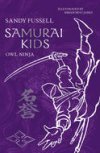
Owl Ninja: Samurai Kids by Sandy Fussell
Ill. by Rhian Nest James. Walker Books, 2008. ISBN 9781921150371
(Age Middle Primary) Recommended. This is the second in the series with
books three and four to follow.An adventure set in Japan with an
unusual makeup of six children (five boys and one girl each one with a
disability) forming the 'Samurai Kids'. The group, affectionately
called 'Little Cockroaches' by their famous samurai teacher, Ki-Yaga,
follow a treacherous path to convince the Emperor to silence the drums
calling the mountain people to pledge allegiance either to the Lord of
the North or the Lord of the South.
Narrated by Niya, the one legged boy whose spirit is the white crane,
the story unfolds with a strong sense of Japanese tradition and
sayings. The group's loyalty to their teacher and each other as
they parry with their swords engages the reader. Humour enriches
the incidents and the enjoyment in overcoming the Dragon Master and his
students is another in the realm of good verus evil. The
illustrations add an interesting layer to the text.
Ideal for encouraging students to read more widely.
Sue Nosworthy
Von Gobstopper's Arcade by Alexandra Adornetto
HarperCollins, NSW, 2009. ISBN 9780732286637
Von Gobstopper's Arcade provides a satisfactory conclusion to the series The Strangest Adventures. Throughout the trilogy, the children Ernest Perriclof and Millipop Klompet battle against their evil enemy, Lord Aldor. This book sees the children excitedly venturing into the new arcade created by the master toymaker, Gustav Von Gobstopper, as part of a school excursion. On their tour, they discover a message left by one of the toys, leading them to remain behind and investigate. They are met and welcomed by the Resistance group, a small band of toys. Milli and Ernest are told of the Botchers, a group of surgeons employed to turn the toys into monstrous creatures due to be unleashed at Christmas, thereby ruining childhood for all of their recipients. Thus resumes the battle of good versus evil.
The cover is reminiscent of David Cornish's hard cover titles in the Monster Blood Tattoo series and the text is somehow akin to Lemony Snicket's Series of Unfortunate Events. Although Drabville is a bit 'other worldly', it is still familiar enough for children to be able to relate to the setting.
Aged only 16, Adornetto writes fluently and descriptively with an intended audience of pre-teens. The only concern could be that the language is somewhat wordy, thereby failing to engage intended readers.
Jo Schenkel
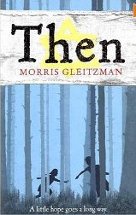
Then by Morris Gleitzman
Puffin, 2008. 13+
Gleitzman began the story of Felix in Once. This sequel sees
Felix and
Zelda, the six year old girl he befriended, continue their desperate
journey into Poland. Felix, aged ten is Jewish, while Zelda is the
orphaned child of Nazi parents. Both are alone, starving and terrified
and see and endure far more than any child should ever have to.
Fortunately they are rescued by Genia, a Polish woman who lives alone
on a small farm. Felix and Zelda befriend the pig and the chickens and
Leopold, Genia's beloved dog. She passes the children off as relatives
whose home and immediate family have been bombed. The children reach an
uneasy contentment, cemented by Genia's kindness and the imaginative
games they play.
However their safety is put at risk by children from the village and
adults too, always on the look out for anyone harbouring Jews. There
can only be one outcome - and throughout the book it is gathering
momentum until it hits the reader with devastating force.
I found this story even more harrowing than The Boy in The Striped
Pyjamas and The Book Thief. There is something about
Gleitzman's
depiction of the brave but naive children, coupled with the
relentless horrors they experience, that is almost too painful to read.
Gleitzman describes how Felix and Zelda stumble across a pit full of
dead Jewish children. Violence and fear are ever present as the Nazis
descend on the farm, taking the pig and chickens and killing the
family's beloved pet dog. But it is the ending that really distressed
me.
As a child I remember the profound effect that certain books had on me.
Sounder by William Armstrong gave me bad dreams for weeks, and
that
was
a walk in the park compared with Then. It is natural for adults to be
protective of children, but how far should we go? One of the strengths
of a book like Gleitzman's is that we can encounter Nazism vicariously,
experiencing it through Felix and Zelda, but how many of us want our
children to be faced with the full Nazi horror? Perhaps we should
proceed with caution, ensuring that this is a book that children share
with adults rather than read alone, so that we can talk about it with
them and absorb some of the horrors that real children just like Felix
and Zelda endured.
Claire Larson
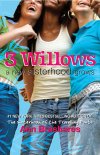
3 Willows: a new sisterhood grows by Ann Brashares
Random House Australia, 2009. ISBN 9781741664096
(Age : 12+) Ann Brashares follows her award winning series of The
sisterhood of the travelling pants with an entirely new sisterhood.
Polly, Jo and Ama became best friends on the first day of third grade,
but as time went by, the friendship fell away. On the last day of
school before their summer holidays, they are reunited for one
afternoon recapturing a glimpse of what they had let fall away. The
summer holidays before they start high school, they find themselves in
very different places. Polly is not a beautiful girl at all, her
mother, who insists on being called Dia, is an individual and artist
and detests models. Polly dreams of becoming a model, and she is
rewarded by a chance to show her wares in New York; a dream come true
or so she thought! Jo knows her parents will separate and wasn't at all
surprised or upset at the announcement, everything had changed after
her brother Finn died. This summer while she is staying at the beach
house, she finds herself a job, a boyfriend and a chance to be accepted
by the 'cool group', everything she had dreamed, or was it? Ama wanted
to follow in her sisters' footsteps and do well in their new country,
so she worked hard at school, she studied hard and was not in the least
athletically inclined - she loved the Library, not lakes and hills!
Then to her horror finds her self stuck in a hiking camp, with no
shampoo or hair straightener and a tent partner from hell, and the
possibility of an 'F' for her first high school grade, the
biggest nightmare ever!
As the story of the girls' summer holiday events unfolds, beneath its
surface we see another story. Each girl travels alone through the
struggles, hurdles, and hardship of the summer. Each one realizes that
the friends they had left behind were the very friends they most
desired. This journey takes the girls back to the strongest roots they
have.
This is a great tale of friendship, love, life, death, struggle pain,
endurance and sticking it out.
Margaret Unsworth
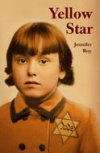
Yellow Star by Jennifer Roy
Frances Lincoln Children's Books, 2009.
ISBN 9781845079086
(Ages 12+) When her aunt Sylvia told her of her childhood in the Jewish
ghetto in Lodz, Poland, Jennifer Roy had to write it down. She toyed
with a non fiction book, and then a fictionalized account in the third
person, finally settling on a verse novel told in the first person. It
is most successful. Told from a child's perspective, the horror is made
more real by the simple way it is told, without embellishment. And it
is Sylvia's story from start to finish, coming from taped interviews
with her aunt, Jennifer Roy has faithfully retold the story of the
270,000 people who became the 800 survivors of this horrific place.
In between the diary like entries, Roy gives us a potted history of the
events for that year, so the reader has a good idea of the progress of
the war and what is happening outside Lodz. What is happening inside
that city is claustrophobic and dehumanizing, as we read of parents
torn from their children, people starving to death, adults made to work
in the factories still active in Lodz.
Sylvia's father was able to protect himself and his family and some of
his siblings, by watching what was going on. The remnant Nazi force,
getting ready to shoot them all, still had to clean up the ghetto, and
so wanted men to stay and clean. The lists they had of these people,
her father noted, were not lists at all, and so he was able to give his
name and that of his wider family to the soldiers and so pass into some
safety.
But at the end, hailed by some of the Russian army, the few left were
overwhelmed that they were rescued by a major, a Jewish major, who when
his planes were bombing the ghetto, noticed the light reflecting from
the yellow stars on their clothes and so stopped the planes, landing
and then coming to search for those he saw. It is a powerful
story, one which will enthrall those readers irrespective of what they
know of the holocaust. This story gives information about what it was
like in one ghetto, and for one family, but gives the story of them all
in bleak and simple words. For those looking at historical fiction, or
diary stories, or stories of the holocaust, then this is a salutary
read for middle school students.
Fran Knight
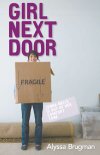
Girl next door by Alyssa Brugman
Random House, 2009. ISBN 978
741663389
(Ages 12+) The family has all the trappings of having made it, a
million dollar house in a cul de sac, the kids at a top private school,
and holidays in Mauritius and Vanuatu, what more could they want? But
it all falls to a shuddering heap when dad leaves, mum loses her job
and the baby she is carrying, Jenna-Belle is escorted from her school
for non payment of fees and the sheriff moves in to evict them from
their house.
What is important becomes clearer as time goes on; living in a caravan
in a bogan area, Jenna-Belle looks more closely at her life. The
boarder, Bryce Cole helps them with their moves but he is a chronic
gambler with problems of his own, and eventually dumps them.
Jenna-Belle's best friend, Declan, who lives next door also offers
support and sympathy, but he seems more interested in furthering his
sexual experiences than helping out Jenna-Belle.
Brugman uses a finely tuned sense of humour to get across the naivety
of Jenna-Belle, so enamoured of the group she mixes with at school, who
slight her at every opportunity. But she takes it because she and her
family think they have made it. Even when sitting in an all night cafe,
drinking the coffee given them by a kindly waiter, the family has not
made an active decision about what to do. It all seems rather like play
acting, and when the story is resolved, a little too quickly and
neatly, the family does not seem to have learnt anything about their
former extravagant life style.
I found Jenna-Belle interesting and entertaining, but was disappointed
with the final wrap up of the story, but middle school readers will lap
it up.
Fran Knight
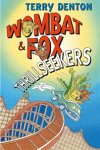
Wombat and fox thrillseekers by Terry Denton
Allen and Unwin, 2009.
ISBN
9781741751314
(Ages: 6-9) The third in the series of short stories about the antics
of friends,
Wombat and Fox, this will thrill those who read it out loud, to
themselves or with someone reading it to them. In the first story, Wild
and Dangerous Deeds, Wombat is given a notebook and pencil for his
birthday. Sick of the usual birthdays, he decides to write up a list of
dangerous deeds to do during the next twelve months. Swimming with
sharks, jumping from a plane, running with scissors and putting his
head
in a bear's jaw are all discussed and are all rejected. The event they
do decide on involves all their friends and turns out to be good fun,
if a little damp.
At the start of this book is a character list showing the readers who
are involved in the story. The drawings are exciting, furious and fast
adding to the enjoyment of the reader. The wild and dangerous deeds
theme is continued through the next two stories and will be loved by
all who read them. Living life on the edge, Wombat and Fox will easily
find a place in school libraries. Middle primary school readers will
not leave it one the shelves.
Fran Knight
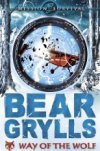
Way of the Wolf by Bear Grylls
Red Fox, 2009.
(Age: 8+) Useful things to know for your next day out : brown bears
only attack if they are hungry, but black bears always attack. If you
are starving and food is in short supply you can always resort to the
half digested contents of a reindeer's stomach. These and other
survival tips will delight young readers of Bear Grylls' Mission
Survival series.
Beck and Tickaani are on their way to the Alaskan town of Anakat with
Beck's Uncle to film a TV documentary about the traditional Anak way of
life. At the same time they hope to draw peoples' attention to the oil
giant Lumos Petroleum's plan to sink an oil well right in the middle of
Anakat.
Unfortunately the whole expedition goes pear shaped when the plane
crashes, the pilot is killed and Uncle Al seriously injured. The two
boys have to trek across the Alaskan tundra in search of help. Facing
up to the dangers of hidden crevasses, hungry bears, freezing rivers
and the lurking threat of wolves, Beck and Tikaani trek through snow
and ice in search of rescue.
It did irritate me that both Beck and Tikaani were 13 going on 28. They
display no uncertainty, anxiety or bad temper - with the situation or
each other. Both are entirely mature, focused and skilful. But that's
just how I would like to have been at 13 - invincible. This is a
punchy, action packed read. Grammar is sometimes clumsy, and
descriptive passages have all the sophistication of GCSE coursework.
It's obvious that Grylls would prefer to get on with the action, and
that's fine because most kids would too. Way of the Wolf will
never win
any literary prizes, but it's a pacy read with plenty of boy appeal.
Sheer escapism and great fun.
Claire Larson