Sometimes Life Sucks: When someone you love dies by Molly Carlile
Allen and Unwin, 2010. ISBN: 978 17742371887.
(Ages 12-16) Like adults, a teenager's reaction of grief when someone
close to them has died can often be diverse. Sometime's Life Sucks
is
not a novel but a series of short stories about different situations
where a teenager might have experienced the death of someone they love.
These stories a supported by tips and advice from the books author who
has drawn upon her experience as a palliative care nurse and
counsellor. The different experiences of grief and death included in
the book include: supporting a friend who is grieving, attending
funeral and experiencing the death of a famous idol, just to list a
few. The contents page at the beginning of the book would encourage
young readers to use the book to reference the type of grief that they
themselves are experiencing. Each story has useful websites, quotes
from other children and a familiar story for each scenario to comfort
readers in knowing that they are not alone in their grief as others
have experienced such grief and life goes on. Justifiably the stories
in this book are not light and can be graphic, most notably the
description of death, but there are many examples of the celebration of
life not just grieving death. Sometimes Life Sucks should be
recommended to school counsellors and sensitively recommended to
teenagers who have experienced grief in their lives.
Adam Fitzgerald
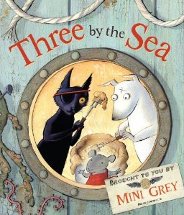
Three by the sea by Mini Grey
Jonathan Cape, 2010. ISBN 978-0224083621.
(Ages 5+) Recommended. Cat, Dog and Mouse live in harmony and
contentment, successfully dividing household duties between them.
However, one day a stranger arrives, a salesman from a mysterious
company called 'The Winds of Change'. The Wolf salesman sets about
sowing the seeds of doubt and discontent in the minds of the three
friends. After all, why does Dog insist on planting bones in the garden
when a few herbs could make everything so much tastier? And must Mouse
always cook with cheese as the sole ingredient? As for Cat, well he
spends more time sleeping than cleaning house.
All of a sudden the three friends are arguing and complaining. Mouse,
in a fit of pique decides to leave home. It is only when his life is in
grave danger that his friends forget their quarrel and with a bit of
teamwork save the day. However, the winds of change have already blown
into this household and some things do indeed change for the better.
Even young children can understand the problems of being stuck in a
rut. When I read this with a Year 3 class there was plenty of talk
about how change can seem scary but often ends up being a good thing.
There was also lots of discussion about the importance of friendship
and tolerance.
I'm a big fan of Mini Grey and this is a delightful story, with plenty
of visual jokes, perfect for sharing and poring over. It allows
children to talk about quite complex and abstract ideas and put a voice
and a name to different feelings. Great fun and thought provoking too,
what more can we ask for?
Claire Larson
Super DC Heroes: Wonder Woman Readers
Raintree, 2010.
Recommended for Middle Primary.
Review of the set:
Being a child of the 80's I recall watching this character on
television, however there are elements to these stories that differ
greatly, I think the character has more depth and there is a greater
link to mythology than I can recall. I am not however a reader of
the traditional comics, so maybe this character is true to the comic
version of the superhero.
As a set of readers, they are quite good. The topic is engaging
and the character of Wonder Woman is strong, fair and wise. Each
book has fact files at the back to fill in the reader a little more
about the new characters and Wonder Woman's tools. There are also
some very good questions and writing prompts that go beyond
comprehension of the story and challenge values and opinions.
Text is at a medium level of understanding, and words that may be of a
slightly higher order are included in a glossary at the back. Nicely
illustrated by Dan Schoening in a fairly true to form comic
style using bold lines and colours.
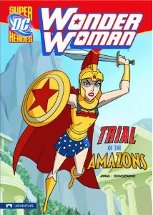
Trial of the Amazons by Michael Dahl and Dan Schoening
ISBN: 978140621363. 55pp.
The first in the series, this reader gives us the background of how
Wonder Woman came to be.
A powerful Amazonian, Wonder Woman is the princess with the ultimate
attitude and skills. Blessed by the Gods and given her magic trio
of the lasso of truth, silver armbands and golden crown, she embarks
upon a series of missions to make the world a better place.
Creature of Chaos by Sarah Hines Stephens and Dan Schoening
ISBN:9781406216349. 55pp.
Devastation has arrived, and it is in the form of a small child. No, I
am not talking about your average two year old, but an evil
character moulded by Cronas-enemy of the Gods. Deva is the
opposite of Wonder Woman, crafted with skills and powers to equal hers,
but on the side of evil.
Wonder Woman needs to fight hard and think fast if she is going to beat
this ball of destruction, can she remember all of her lessons and save
the day? Monster Magic by Louise Simonson and Dan Shoening
ISBN: 9781406216356. 55pp.
A powerful sorceress Circe has come to Washington D.C. to claim back
her special plants taken from her magical island. At the same
time a large number of magical and mythical creatures wreak havoc on
the city. Wonder Woman uses her lasso on the creatures and
discovers a surprising truth. What tools will Wonder Woman
use to restore peace to the city and appease the sorceress?
Attack of the Cheetah by Jane Mason and Dan Schoening
ISBN: 9781406216332. 55pp.
Three beautiful new cheetah cubs bring a new lease of life to the
National Zoo. When their behaviour becomes strange and they go
wild, it is up to Wonder Woman to discover why. Super villain
Cheetah-part woman, part cheetah-is behind the chaos. What is it
she wants, and can Wonder Woman use her super powers to solve the
problem?
Zana Thiele
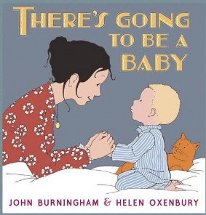
There's going to be a baby by John Burningham and Helen Oxenbury
Walker Books, 2010. ISBN 978-0744549966.
(Age 2-6) Recommended. A beautifully crafted and illustrated tale,
There's going to be a baby, relates the story of a little boy's
attitude to the forthcoming new arrival. Uncertain about the baby
the young child asks all sorts of questions. When is the baby going to
come? What will we call the baby? What will the baby do? The reader
follows the mother and child's progress through the seasons while the
baby develops. They visit a restaurant, an art gallery, a garden, the
zoo, the seaside and the bank. At each location the mother muses that
the new baby might work there when it grows up while the little boy
imagines his own comical version of what the baby might do.
This is an original and sensitive treatment of a child's wonder and
fear about a new sibling. The loving relationships between mother and
child is beautifully depicted as the mother ensures that the little boy
has a wonderful time while she is pregnant, with trips to the zoo and
the seaside.
Helen Oxenbury's delightful illustrations show the extraordinary
flights of fancy that the little boy imagines. These are drawn in a
two-page spread with four panels to a page, reminiscent of a comic, and
coloured in muted watercolours with black outlines. One page
illustrations with bold colours show Mum and the little boy both
growing bigger until the reader sees Grandad and the boy going to the
hospital to see the new baby.
The book layout is also beautiful. The endpapers carry pictures of the
baby working in all the occupations and the paper is sturdy enough for
young fingers to handle over time. The print varies in colour to
distinguish the conversations of the mother and child.
This is a wonderful book to read to children when there is a new baby
on the horizon and would fit beautifully into a theme of family.
Pat Pledger
Wavelength by A. J. Betts
Fremantle Press, Perth 2010. ISBN 978 1921696305.
Highly recommended. At first this seemed like just another in a stream
of books about kids
in year 12 not coping, or coming to grips with themselves, but after a
few pages, it is clear that this is an exceptional read, stunningly
different form many others. Oliver is not coping with year 12. Mum's
business of making muffins, dozens of them, in the early morning,
interrupts his much needed sleep, and when she goes off in her van
making deliveries, it is up to Oliver to make sure his siblings are
ready and off to school. So one morning he explodes. As a result, Mum
packs him off to his father, now at Buselton, a swimming instructor at
a leisure centre. But all is not what he expects. Needing a space apart
to study, his dreams are shattered when his bag is stolen and he loses
his books and calculator. The girl who works at the canteen at the
pool, mocks his distress, and his father, although trying to be
helpful, underwhelms his vision of what his father does for a living.
Oliver thought he had it all mapped out, going to uni next year with
his friends, all taking geology together, but the canteen girl upsets
his views, questions his reasons and generally turns his ideas on their
head. The pool is part of a centre attached to an elderly citizen's
village and so Oliver comes in contact with many groups of older people
in the course of his day. Through them he learns more tolerance and
patience as he copes with the everyday. His father is not doing the
work he expected him to be doing and at first, he, like the canteen
girl, is seen as a failure, but reassessing his views over the week, he
learns to question his own aims with more care. A wonderful read, quite
different from the expected turn of story, this book has a range of
characters not usually seen in adolescent fiction. The older people are
all drawn with care and are never cliched, the father and his
companion are presented truthfully and the girl in the canteen is
questioning and acute in her dealings with the mess that is Oliver.
Fran Knight
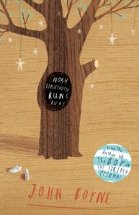
Noah Barleywater runs away by John Boyne
David Fickling Books, 2010.
(Ages 10+) Noah Barleywater leaves home early one morning to embark on
an adventure involving a magical toyshop, an elderly puppet maker, a
talking dachshund and a permanently hungry donkey. Readers will
find themselves swiftly immersed in Boyne's fanciful imaginative world.
The story unfolds gently as we slowly gather the clues for Noah's hasty
departure from his beloved parents. The elderly toyshop owner regales
Noah with stories of his own past and through these parables Noah
begins to realise that he must return home and face up to the tragedy
awaiting him, the death of his terminally ill mother. It is only
towards the end of the story that the old man is revealed as that
famous wooden puppet who longed to become a boy.
Boyne's plot is cleverly constructed and the imaginative devices are in
place to draw readers into the story. However, I feel this is a story
that does not entirely work. For a start it's difficult to decide who
John Boyne is writing for. Some of the Disney-esque features - clocks
that talk and moving floorboards will appeal to younger readers.
However other themes are far more grown up, particularly the regret
experienced by the elderly Pinocchio for missed opportunities and past
mistakes, emotions that youngsters are unlikely to relate to.
The title page describes this as a fairytale and it is certainly
original and imaginative. However, I believe it is a fairytale for
grown ups, those who want the bittersweet luxury of reflecting on their
own sorrows and regrets and those who are trying to come to terms with
their own frailties. Noah Barleywater runs away could become a book that adults will rave
about, but I'm not convinced children will.
Claire Larson
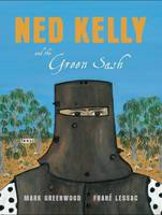
Ned Kelly and the green sash by Mark Greenwood
Ill. by Frane Lessac. Walker Books 2010. ISBN 9781921150876.
(All ages) Highly recommended. In this beautifully illustrated
non-fiction picture book, Greenwood and Lessac bring to life the
notorious bushranger, Ned Kelly, his childhood and the duality of his
character.
The book commences with words written by Kelly in his Condemned Cell,
'I do not pretend that I have led a blameless life, or that one fault
justified another, but the public, judging a case like mine, should
remember that the darkest life may have a bright side, and after the
worst has been said against a man, he may, if he is heard, tell a story
in his own rough way'.
The story then highlights the tale of young Kelly rescuing a drowning
boy and being presented with a green sash for his courage, as well as
examining the poverty of his life and his later crimes.
Greenwood has produced a really thought provoking book. On one hand the
reader finds out about Kelly's bravery and his pride in the green sash
that was a symbol of this. On the other hand the reader sees Kelly's
violent crimes through the inclusion of newspaper articles of the time,
giving the view of the press about bushranger and his gang. Additional
biographical information and facts at the back of the book also ensure
a lively discussion about right and wrong.
Lessac's wonderful illustrations, painted in bold greens, reds and
oranges for the Australian bush, and subdued tones for the goals,
greatly added to my understanding of the times. She brought to life for
me the poverty of the Irish family, struggling to stay alive through
drought, the way that Ned eased into a life of crime and the harassment
by the police.
An outstanding picture book for all ages, this is sure to become a
classic.
Pat Pledger
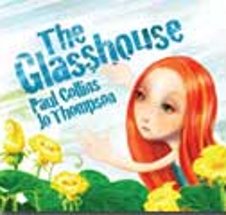
The glasshouse by Paul Collins
Illus. by Jo Thompson. Ford St., 2010. ISBN 978 1921665045.
Picture book. Recommended. Clara lives all alone in a stunning
glasshouse, where she grows
exquisite pumpkins. She tends the seedlings, watching and nursing them
as they grow, knowing that they are the best pumpkins around. They have
no blemishes, are perfectly formed, have a beautiful colour and are
delicious. Buyers come from everywhere to buy her prefect pumpkins. But
one day a boy appears at her door and she follows him outside, only to
be amazed that so many of the other glasshouses are smashed and broken.
Frightened by what she has seen, she now spends her time checking her
glass for cracks, watching for any disturbance to her perfect world.
She makes the buyers take off their shoes, watches them as they mover
around her area until they start to go elsewhere. The boy
reappears and shows Clara one of his pumpkins, one that is not quite so
perfect. It is misshapen, discoloured and spotty, but tastes just as
good as hers. She becomes more insular and worried. Less and less
people come to buy her pumpkins and she loses interest in them, causing
them to become discoloured and not quite perfect.
A beautiful story of accepting things for what they are, of not
expecting everything to be perfect, of acceptance and understanding and
of love, is made spectacular with the exuberant, colour filled
illustrations that glow on every page.
Fran Knight
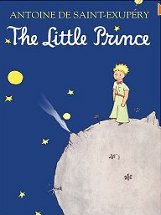
The Little Prince by Antoine de Saint-Exupery
Translated by Richard Howard. Egmont, 2005. ISBN 9781405216340
(Age 7+) Recommended. A new translation by Richard Howard, this edition
uses more contemporary language than previous editions to bring to
modern readers the iconic story of the stranded pilot who finds in the
desert the mystery and enchantment of childhood again. When the pilot,
whose plane has come down, is found by the Little Prince and asked to
draw a sheep, he re-enters the world of children where listening and
understanding, comfort and sharing are values that have been lost by
adults who are confined by rules and restrictions, logic and control,
property and power. As the Little Prince describes his love for his
rose and for the stars, the pilot learns to give, and learns that the
mechanical concerns of life tend to work out when the important matters
of the heart are dealt with first. The story also shows that sorrow is
as much a part of life as laughter, the prince eventually having to
leave. The language in this translation is more natural and logical,
with, for example, 'put away' used rather than 'lay aside', 'crash
landing' rather than 'accident', 'struck by lightning' rather than
'thunderstruck' in the Katherine Woods translation, thus perhaps
bringing a wider contemporary audience to the story. The drawings, the
author's own, add a visual dimension to the story and also link to the
theme of children's special understanding of the world; as a child the
pilot was told to stop drawing, to stop understanding the world
visually; he now has to learn again the act of creating life through
art. This is a book everyone should read several times, and it lends
itself to being read aloud.
Jenny Hamilton
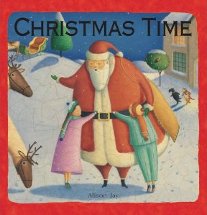
Christmas time by Alison Jay
Hardie Grant Egmont, 2010. ISBN 9781921759130.
(Age: Pre-school) Board book. At first glance this book appears to be a
series of Christmas pictures illustrating the one word that appears on
each page. However the illustrations take the reader through two
children's wonderful adventure with Father Christmas. After creeping
down the stairs, the children, dressed in their pyjamas, hats and
scarves, go outside where they feed Santa's reindeer and meet the
wonderful man himself. Santa whisks them away in his sleigh and they
have a delicious feast at the North Pole.
Alison Jay's picture are a rich portrayal of a traditional Christmas,
with objects like Christmas cake, mistletoe, stockings, reindeer and
snowmen beautifully coloured in rich tones. Children will have fun
discovering what the children are doing as well as following the little
hidden stories that are linked by the pictures. I loved the humour of
the cat and dog who are celebrating their own cosy Christmas while the
children go adventuring and loved finding the snowman in the pictures.
The one word on each page will also help increase a young child's
vocabulary in a fun way.
Pat Pledger
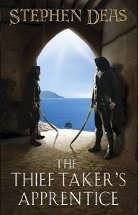
The Thief-Taker's Apprentice by Stephen Deas
Gollancz, 2010. ISBN: 978-0575094475.
(Ages: 14+) The first of a series of possible books by new UK fantasy
author Stephen Deas, The Thief-Taker's Apprentice is set in a
medieval
themed fantasy city called Deephaven. The story follows Berren, an
orphaned teenager who is forced to live as a thief earning money for
his abusive master Hatchet. The story begins quite gruesomely with a
detailed description of the public execution, witnessed by Berren, in
the town's square involving a decapitation of three convicted thieves.
Following the execution Berren seizes upon an opportunity to steal the
Thief-Taker's reward money and in doing so brings himself to attention
to the legendary Syrannis. Rather than turning the brazen thief Berren
into the authorities, Syrannis, a well respected thief-taker, decides
to nurture Berren as his apprentice. With some hesitation but little
choice, Berren moves in with his new master Sy, where he his looked
after and is taught amongst other things manners and writing. Berren is
grateful for these new opportunities but before too long becomes
impatient and desperately wants to be taught sword fighting. As a
result, Berren rebels against his new master and runs away and meets
his acquaintances still working for his former master. This type of
rebellion continues throughout the novel, with Berren learning much
along the journey about making decisions and respecting elders,
especially those who genuinely want to help. The Thief-Taker's
Apprentice is definitely not suited for younger audience or the
squeamish with some graphic depictions of violence. There are elements
of romance with Berren courting his Master's other adopted minor
Lilissa but this relationship is only beginning and serves more as a
plot device. The novel does contain positive messages and meaningful
themes for teenagers about growing-up too fast and wanting to live in
an adult world before they are fully prepared to deal with the full
consequences.
Adam Fitzgerald
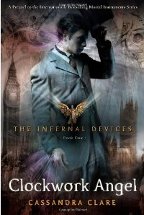
Clockwork angel by Cassandra Clare
The Infernal Devices. Book 1. Walker Books, 2010. ISBN 9781406328813.
(Age 13+) Recommended for lovers of fantasy and romance. Tessa Gray,
only sixteen years old, arrives in England in search of her brother
Nathaniel, who has gone to London seeking his fortune. Nathaniel isn't
waiting for her at Southampton, instead two strange women, Mrs Dark and
Mrs Black, persuade her to enter their carriage after assuring her that
Nathaniel is in London. To her dismay Tess discovers that Victorian
London is a strange and dangerous place, where Shadowhunters stalk
demons and terrifying supernatural creatures are afoot. Can Tessa trust
Will and Jem, two young and handsome Shadowhunters, and why did her
mother have a clockwork angel clutched in her hand as she died?
Although Clockwork angel is a prequel to Clare's The Mortal Instruments
series, it reads very well as a stand-alone. Fans of the latter will
recognise a couple of the people but this series takes the reader into
a very different time period with new and interesting characters.
Victorian London, with its fog, gaslights and shadowy alleys is
fascinating. Vividly described, the 1800's came alive for me as Tessa
struggles with the Downworld and finds sanctuary in the Institute. The
inclusion of Victorian automatons and Tessa's clockwork angel adds rich
detail and suspense.
Tessa is, in many ways, a product of her times, but she is no wimp. She
is fearless in her search of her brother and courageous as she comes to
grips with her new talents. Charlotte Branwell runs the Institute where
Tess takes refuge and she too is a strong young woman, doing a man's
job. Clare's two attractive young Shadowhunters, Will and Jem, are more
that adequate romantic heroes. I empathised with Will's haunted nature
and Jem's cheerful stance about his mysterious illness and am looking
forward to learning more about their backgrounds in future books in the
series. Mrs Dark and Mrs Black live up to their names and the early
scenes when Tess is kept captured in their house are truly terrifying.
I thoroughly enjoyed Clockwork angel and I believe that teenage girls
will enjoy the romance, action and suspense. It has enough twists and
turns to keep the reader going to the end and enough unanswered
questions to ensure that the next book in the series is picked up as
soon as it hits the shelves.
Pat Pledger
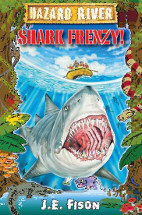
Hazard river series by J.E. Fison
Ford Street, 2010.
Shark frenzy. ISBN 9781921665110.
Snake surprise. ISBN 9781921665127.
(Age 7-10) Recommended. Jack Wilde and his friends are on holidays at
Hazard River and they have lots of exciting adventures. In Shark
frenzy, they discover a shark washed up on the shore of the river.
Its
fins are missing and their search for what has happened to the shark
leads them into dangerous waters. In Snake Surprise, the gang
discovers a
message asking for help in an abandoned houseboat that is inhabited by
a snake. Trying to discover what has happened to the houseboat's owner
leads them on a dangerous quest.
Both these chapter books are exciting reads that I couldn't put down.
The setting at Hazard River will seem to be familiar for many children
who go camping or stay in holiday flats during the long summer
break. Told in the first person by Jack Wilde, the stories are
full of humour, imagination and adventure. Add some sibling rivalry
between Jack and his brother Ben, teasing from his neighbour Lachlan,
and information from Mimi Fairweather, otherwise known as Professor
Bigbrains, and the series is a winner. Fison's message about the
environment and endangered species is handled with a gentle but deft
hand and is sure to appeal to children.
I can see reluctant as well as more advanced readers lapping up this
funny series. Although the story is told from a boy's point of view,
Mimi is a strong enough personality to appeal to girls as well. All in
all, this series is a welcome addition to chapter books for young
readers. There is a website with
a book trailer.
Pat Pledger
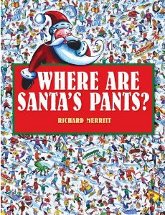
Where are Santa's pants? by Richard Merritt
Little Hare, 2010. ISBN 9781921541506.
(All ages) There is a mountain of fun to be had in this search for
Santa's pants. Merritt has drawn intricate and detailed pictures of the
North Pole, the beach, the village, a department store, a nativity
play, post office, city, farm, ice rink and home, all places where
Santa has lost his pants, each in a different pattern for each picture.
The crowds are out for Christmas and it is not an easy task to find
Santa's pants as well as eight reindeer and a lucky sixpence in each of
the elaborate double spreads.
The virtues of patience and persistence are called for in the search
for Santa's pants. I must admit I was fortunate if I found a reindeer
or two in the highly amusing and complex pictures and was happy to
discover that there were answers at the end!
Those children who adore looking out for Wally in the books by Martin
Handford, will delight in another book where they can put their
observation skills to the test.
Pat Pledger
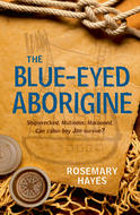
The blue-eyed Aborigine by Rosemary Hayes
Frances Lincoln Children's Books, 2010. ISBN 978 1847800787.
Highly recommended. Suggested for readers 13 plus.
This historical novel gives an excellent account of the wrecking of the
Batavia when she struck a reef on the Abrohols Islands, half way down
the coast of Western Australia in 1629. Related principally from the
perspective of a cabin boy, Jan de Bye, part one of the story deals
with the atrocities which occurred amongst survivors who found
themselves under the command of the insane Jeronimus Corneliusz.
Commander Pelseart and Captain Jacobs had taken the longboat to search
for water but finding themselves a long way North, decided to continue
to Java to arrange rescue for the rest of the survivors. Jacobs and
Corneliusz had previously conspired to mutiny and seize the vessel and
its astonishingly valuable cargo, in order to live a buccaneering life.
In their absence, Corneliusz, an apothecary who had secured himself a
position as senior merchant for the Dutch East Indies Company on the
trading venture to Java, commenced his rule of terror. Murder, torture
and rape was conducted on an horrific scale and any who resisted were
considered traitors and enemies. In this fashion, the boy Jan, finds
himself involved in the sickening exploits, participating in acts
previously unimaginable. Incredibly Pelseart returned from Java within
two months and the mutineers met their fate. Because the rescue vessel
would have been overcrowded with the survivors and prisoners, many of
mutineers were tried and executed on the islands. Because of his age
and the fact that he had been influenced by Corneliusz, Jan's death
sentence was commuted along with that of Wouter Loos, who despite being
a murderer had tried to protect Lucretia Van der Meylen, a noblewoman
passenger. The fate of this pair was to be set adrift in a small boat
with meager supplies when Pelseart took the survivors to Java. The
novel to this point is based on sound historical fact but part two is
pure fiction as the fate of these individuals is unknown. Hayes
presents a wholly plausible narrative of the exploits of Jan and Wouter
(who were probably the first Europeans to land on mainland Australia)
as they seek to survive in this barren region. Hayes portrays
Aboriginal characters in a realistic and sensitive manner and creates
an outcome which is quite possible, maybe probable. Having read many
accounts of this tragic episode, I was impressed by the author's
research and skill in relating history whilst telling a captivating
tale. Necessarily for younger adolescents, many explicit details are
avoided and the violence and degradation are described as moderately as
possible.
Rob Welsh