Random House, 2010. ISBN 978 1 74166382 2.
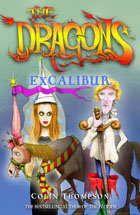
This is the second book in The Dragon series and follows on
from the
first. After a mistaken identity the real King Arthur has taken over
the rule of the Kingdom and optimism spreads throughout Camelot.
However Brat and Blot have other plans. They are not happy about the
way King Arthur is ruling and plot an overthrow. When word reaches the
palace, of Brat and Blot's plans, Morgan le Fey, Sir Lancelot and a
vampire attempt to save the kingdom.
This series is written as a send up of ancient times. The language is
obscure at times and the undertone and setting have limited appeal. The
book has an interesting format with footnotes and illustrations
scattered throughout to make sense of the story.
Tracy Glover
Mimi and the Blue Slave by Catherine Bateson
Woolshed Press, 2010. ISBN: 978 1 86471 994 9
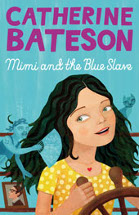
(Ages 9+) Recommended. Mimi is part of a fairly normal, happy family
until her father's death suddenly tears them apart. The story opens two
days before the funeral, when Mimi has been struck down with the flu.
Her mother has the support of her sisters, Ann who is somewhat proper
and judgmental and Marita who is rather more alternative. Mimi must
instead rely on her imaginary pirate friend, Ableth, for guidance and
help. Following the funeral Mimi and her mum leave on a holiday which
is meant to help them both but fails to achieve its purpose. On their
return home, grief affects her mother badly and Mimi buries her own
grief to try and keep the household and the antique business running.
New friendships are forged with Fergus, the boy from the organic fruit
and vegetable shop and various people her parents have long known from
the antique trade and gradually life begins to improve again.
This is a brilliant story of change, grief, friendship, loyalty
throughout the process of dealing with the death of someone close. It
is imbued with warmth and humour as the personalities of the two aunts
balance the serious side of the book. Bateson manages to focus on the
tough issues in such a way as to make them accessible to younger
readers, providing a sense of hope to any who may have had the
misfortune to have experienced such things in their own lives.
Jo Schenkel
6 by Karen Tayleur
Black dog books. ISBN 978 174203155 2.
An amazingly confronting story of six young people in their last year
of school. The voices of the characters seem so realistic and so true,
especially to parents who have been through year twelve! Sarah is
the clever girl but longs to be admired and sought after by Finn, a
first footy team member and very good looking. We hear the
stories of the other five but it is mostly Sarah's story. The little
ditties at the beginning of each chapter are intriguing, encouraging
the reader to find out more.
Year twelve is a roller coaster ride for many students and so each
person's story contributes to the whole. It's the usual scenario
of who loves whom and how does this work and if it doesn't, then how
devastating life becomes! What is so compelling about this year
twelve drama is that the resolution is unexpected, thankfully! A very
cleverly written story involving death, alcohol and cars. Parents and
teachers sometimes worry about stories for year twelves, but this has
all the elements of a disaster with an intriguing ending for
discussion, and with the characters able to move into the next phase of
their lives and having a little more understanding of the others in
their group.
Well recommended for Middle and Senior Students
Sue Nosworthy
The Song of the Winns by Frances Watts
The Gerander Trilogy, Book. HarperCollins, 2010. ISBN: 978 0 7333 2786
5.
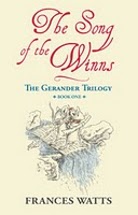
Highly recommended. Since their parents were killed in an accident,
three mice, siblings Alex, Alistair and Alice, have lived with their
Aunt and Uncle. Their 'ordinary' existence ceases when Alistair is
kidnapped. Whilst Alistair finds himself unceremoniously dumped on top
of Tibby Rose in a far off place and develops a friendship with her,
Alex and Alice decide to embark on their own adventure to find and
retrieve their brother.
Tibby and Alistair share an uncommon trait; they are both ginger mice,
a fact which has not been a problem while they have been safe within
the midst of their families. It is, however, this fact that leads them
into dangerous situations and causes them to run away to what they hope
is safety. Both pairs of mice try to understand why they are being
followed and explain the mystery and adventure in which they have found
themselves, as they battle the dilemma of who can be trusted.
As the first book in this trilogy, The Song of the Winns provides new
and interesting characters, setting and a plot with sufficient interest
and excitement to make one wish to continue reading the next book
immediately. It brought to mind Mrs Frisby and the Rats of NIMH, which
I read many years ago, as both series revolve around intelligent
rodents and have the potential to become classic texts. This series has
the capacity to become didactic with regard to war and prejudice due to
race and colour but hopefully will not overshadow the entertaining
nature of the tale of friendship, courage and adventure.
Jo Schenkel
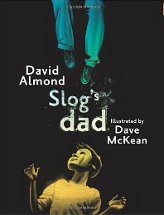
Slog's Dad by David Almond
Illustrated by Dave McKean. Walker Books, 2010. ISBN 978 1 4063 22903.
Highly recommended. This is one of those rare books that will give you
goose bumps as you read, a book that makes you weep quietly to yourself
- a book that you read knowing that you are in the hands of a skilled
writer. Slog's dad has died. First he had a black spot on his toe, so
his foot was amputated, and then his leg and sitting in front of his
house he joked with passers by. But then another spot appeared on his
remaining leg. But when that leg was removed as well, he became quiet.
The years of smoking and working on the rubbish trucks came to an end.
He no longer joked with passers by, but kept to his room, with his wife
waiting upon him. But he promised Slog that he would come back in the
spring. The illustrations reiterate the story of the man losing his
legs, showing a boy playing with a paper cut out of a man, taking one
leg and then the other from the paper.
So when Slog sees a man in the park, he is ecstatic. Hus friend, Dave
is not so sure, and butts in offering alternative explanations for this
man, asking him questions that only Slog's dad would know how to
answer. But despite this, Slog is convinced that he has seen his dad
once again, and so says goodbye.
A bare story with few words, but what words! Each one resonates with
meaning and empathy for the boy who has lost his father. In between the
words are pages of incredible illustrations, designed, as with the
words, to grasp at your throat, pulling the reader into the story of
the boy accepting his father's death.
Fran Knight
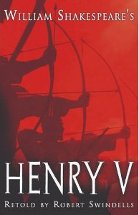
Henry V by William Shakespeare, retold by Robert Swindells
A and C Black, 2010. ISBN 978 1 40812398 6.
A retelling of Shakespeare's Henry V in 94 pages makes the play more
accessible to a wider audience. All of the main characters are there,
Henry V, Bedford, Gloucester, Archbishop of Canterbury as well as the
French king and his entourage, and even the lower orders, Pistol, a
dying Falstaff and Num. The play opens with Henry V deciding with his
advisers that their only option is to go to war with France. Act
2 sees the army in France, and the dialogue between the lower orders,
Num Pistol and Bardolph easily parallels the lives of some of Henry's
men. Act three sees the two armies the night before the Battle of
Agincourt and we see Henry V strolling incognito amongst his men,
gauging what they are feeling and encouraging their participation. Act
four details the awful battle and statistics are given towards the end
of this act to underscore the impressive defeat of the French army. Act
five sees the mopping up of the campaign, and Henry V returning to
France to marry the French king's sister, Katherine.
Those reading the original will be well served by reading this
shortened modern retelling. A list of characters at the start of the
play will aid the readers, and each act is prefaced by one of the
important speeches from the play. Comments by Swindells at the end
reiterate the power of Shakespeare's language in this play, and he
quotes two of the major speeches which will resonate with many.
This amazing adaptation is one of the series, Shakespeare Today,
published
by A and C Black.
Fran Knight
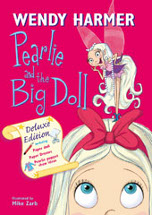
Pearlie and the Big Doll by Wendy Harmer
Random House, 2010. (Deluxe edition). ISBN: 978 1864718218.
When cleaning the park one evening, Pearlie the Park Fairy discovers a
lost doll which has been left behind by a visitor. Because the Dolly
seems so sad to have lost her Little Girl, Pearlie enlists the help of
all the park animals to give a wonderful concert to try and make Dolly
happy. As the show occurs with the boot scooting Duck Family, Silky and
Sulky the trapeze artist spiders, four acrobatic frogs, Brush and Sugar
the singing possums, the rats, Scrag and Mr Flea, Dolly stops crying
and begins to enjoy the performance.
Aimed at beginner readers, this series is perfectly targeted at young
girls. The hot pink endpapers, glimmering cover and stylised art work,
in addition to the paper doll which can be dressed in several different
outfits, should make this a very appealing read and activity book for
such an audience. During the concert, the rats, who have 'brushed their
fur and cleaned their teeth', present some 'I say, I say' jokes and
provide the type of humour bound to appeal to the young reader, showing
that Harmer knows her audience well. Given that Pearlie has now been
taken on by Nickelodeon as an animated cartoon series, the books will
undoubtedly continue to gain even further popularity.
Jo Schenkel, Pilgrim School
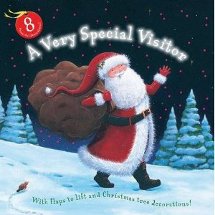
A very special visitor by Rebecca Geelings
Ill. by Karen Sapp. Egmont, 2010. ISBN 9781405256193.
(Age 2-4) In this book about the magic of Christmas, there is a journey
through many things that make Christmas special. Snow has covered
everything, a church bell chimes and happy people sing carols. But best
of all there is a very special visitor to delight everyone.
This board book contains flaps to lift which young children will enjoy.
The flaps are cleverly hidden among the illustrations by Karen Sapp,
and may provide a fascinating challenge for toddlers when they first
listen to the book The last two pages have flaps containing Christmas
tree decorations, which are lifted out of the book to place on the
Christmas tree. I think that could be a very enjoyable Christmas
activity for parent and child.
Pat Pledger
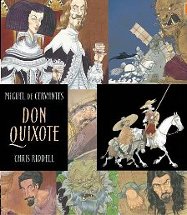
Miguel de Cervantes Don Quixote retold by Martin Jenkins
Ill. by Chris Riddell. Walker Books 2010. ISBN 9781406324303.
(Age 11+) When we remark that someone is 'tilting at windmills'
and behaving in a 'quixotic' fashion, we are harking back to one of the
most influential stories ever told - Don Quixote. The central
character, a retired Spanish gentleman living in La Mancha, becomes so
obsessed with old-fashioned tales of chivalry that he decides to live
out his dream of becoming a knight who performs brave deeds. Wearing a
home-made suit of armour and riding on his bony horse, Rocinante, he
sets out on his quest. His fantasy is so complete that he mistakes bad
food for good, an inn for a castle and windmills for giants. Quixote's
'Squire', the trusty and realistic Sancho Panza, is a perfect foil for
his deluded master.
Cervantes lived in an era when the certainties of mediaeval life were
being replaced by a spirit of enquiry. The hero's journey into fantasy
then return to reality is regarded as the forerunner of the modern
novel which traces a character's emotional
development.
Chris Riddell's animated, cartoon-like pictures reveal the
idiosyncrasies of a passing parade of characters. Pen and ink drawings,
wrapped around text boxes, are interspersed with occasional full-page
colour illustrations which make the old hero and his companion look
both noble and ridiculous.
Curiously, while the illustrator has written an introduction to the
work, the author has not. This is an opportunity missed. Young readers
might welcome an overview of early 17th century Spanish culture and a
glossary to explain terms like 'Basque' and 'Moor'. Occasional lapses
in syntax prevent the story from flowing smoothly but the retelling is
largely successful.
Martin Jenkins won the Kate Greenaway Medal for his retelling of
Gulliver's travels. His adaptation of Don Quixote is a
worthy attempt,
attractively presented, to bring another classic within the reach of a
younger audience.
Elizabeth Bor
I am Number Four by Pittacus Lore
Penguin Books, 2010. ISBN 9780143205135.
(Ages 13 +) I am Number Four is an entertaining book about an
alien teenager from the planet Lorien, unoriginally given the ordinary
name of John Smith. He has been living on earth since fleeing his home
planet when he was four years old with nine other children. Three of
the other children have already been hunted down and murdered by the
Mogadorians, aliens from the planet that invaded and conquered
Lorian. John and his guardian (or Cepan) Henri have
continued to flee the detection and suspicion of people on earth and
the Mogadorians by continuously moving from town to town, changing
identities each time. However, when John and Henry arrive in the small
town of Paradise, Ohio, John meets a girl and becomes more
determined to stay, even if this means a head on encounter with
Mogadorians who he knows want to kill him next. John's arrival in the
new town also coincides with the arrival of his Legacies, these are
special powers inherited from his Lorien parents. In this respect, I
am
Number
Four is a 'coming of age' story where the central teenage
character develops into adulthood taking control of his destiny with
his new powers and freedoms and as a result the themes of this book
parallel the lives of many teenage readers. There are also comparisons
that could be made to the classic Romeo and Juliet love
tragedy,
although they are not strong. Whilst there is some minor depictions of
violence and occasional course words this is fairly low level. A
renewed interest in this book is likely to be generated with this quick
release of the film version in early 2011 (refer to the film's official
website at http://findnumberfour.com/).
I
suspect that this was the
book's original intent given the speed in which the film version has
been released.
Adam Fitzgerald
Careless by Deborah Robertson
Read by Jane Nolan. First published by Pan Macmillan Australia, 2006.
Unabridged audio edition, Louis Braille Audio 2006. 8CDs.
ISBN 978 0 7320 32418. Careless is not an easy book to deal with, it canvasses the whole
spectrum of grief and at times the characters' despair is contagious.
Children are murdered, a life partner dies and those left behind must
learn to live in the world bereft of their loved ones. Eight year old
Pearl's is the most tragic story; with a depressive and needy mother,
Pearl has had to assume responsibility for her younger brother Riley.
She is the sole survivor when a car is driven through their playgroup
and her journey back to being able to contemplate a future where bad
things don't happen is a long one. Her story and those of others
experiencing loss come together through a proposed memorial. Ultimately
the hurt characters start to slowly heal and the scars of their
experience are more enduring memorials to the dead than any sculpture.
The structure of the novel, shifting between multiple narratives, means
the listener can 'lose the thread' and the precise, short sentences
mean the reading has a staccato feel to it. However the
Australian voice and observations of the minutiae of interactions work
together to create an authentic view of how we all care, or are
careless of one another in difficult times. Anyone who has experienced
loss will find this story quite moving.
Sue Speck
Elliot Allagash by Simon Rich
Serpent's Tail. ISBN 978 1846687549.
(Ages: 14+) When Elliot comes into his life, things change totally.
Seymour is inept, a butt of jokes and taunts by the others, derided for
his lack of interest in sport, he is bullied and left out. Elliot is a
strange, geeky boy, expelled from every school he has ever been to, and
so his very wealthy father has placed him in this school on the lower
north side of New York, the bottom rung in private education. Seymour's
parents despair of him ever fitting in until Elliot comes into their
son's life. Elliot's interest is in manipulation, he goes to great
lengths to change people's opinions of Seymour, employing his
bodyguard, James to do the most devious things to ensure Seymour fits
in, preparing him for class president.
Stories told to Seymour by Elliot and his father, Terry, underline the
immoral activity that both involve themselves in, having no thought to
whoever they tread on in their schemes to gain power. To Elliot,
raising Seymour's status in school is a game, Seymour is a pawn to be
moved around, the others beneath his contempt. Seymour becomes seduced
by Elliot's wealth and ability to manipulate until, in his final year
at school, he meets Ashley, the girl Elliot manipulated out of becoming
class president many years before. It is only now that Seymour can see
what Elliot has done.
A laugh out loud story, the two main characters reflect different sides
of the coin. Elliot, all powerful and needing power to survive,
manipulates Seymour mercilessly, making him the most popular boy in
school, successful and confident, but alone with only Elliot as a
friend. Seymour's days are ruled by Elliot until he meets Ashley, a
broken and wounded young woman. He now sees the results of Elliot's
game and decides he wants no more of it. A rather unsettling read of
power and friendship, the moral vacuum in which Elliot lives will
initiate much thought and discussion.
Fran Knight
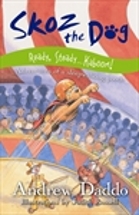
Skoz the dog: Ready steady. Kaboom! by Andrew Daddo
ABC Books, 2010. ISBN 978 0733327810.
Junior fiction. Skoz the dog has a problem, he sleepwalks, and this
time he finds himself at a circus where all sorts of mayhem erupts as
he is mistaken for the trained circus dog. Starting with being shot
from a cannon, then finding himself leaping through hoops of fire,
before being dressed in a tutu and placed on a horse, Skoz goes from
one action thrill to the next. He is absolutely befuddled by it all,
and wants a nice snooze. But when the snakes come out and there is talk
of him being placed in the tiger's cage, he runs in fear of his life,
and is suddenly scooped up by the trapeze artist, who loudly declares
to the audience that this trick will be done without the net. The
hapless Skoz is limp in his arms, but does the trick with aplomb,
causing the audience to cheer so loudly that the trapeze artist
announces that the trick will be repeated, but his time, blindfolded.
Skoz runs for his life, and is luckily found by his owner, Fergus, on
his way home from the circus.
A funny look at all the things kids will see at the circus, but through
the eyes of a dog who is involved with many of the tricks, this little
book will delight its readers. The illustrations by Judith Russell
underline what Skoz is feeling as he is scooped up by one and all, and
the looks upon his face are delightful. A very funny blend of words and
pictures will endear this book to its readers. This is the third in the
series about Skoz.
Fran Knight
Three Favourites by Odo Hirsch
Allen and Unwin, 2010. ISBN 978 1 74237 472 7
Odo Hirsch writes stories for children and this book has three in one -
Antonio S and The Mystery of Theodore Guzman, Hazel Green
and Amelia
Dee and the Peacock Lamp. It is highly recommended for independent
readers, with easy to read text and descriptive language that helps a
child picture the amazing adventures the children get up to in each
story.
While it will be easily read by older students, younger children would
also enjoy it when read to them by parents, teachers or carers. This
book is a great way to get older children to reader larger books, which
can overwhelm a lot of children. With this book, they can read a story
(in any order) and put it down to be continued later.
The themes of these stories are all centred around children and involve
magic, imagination, mystery and being yourself - great ways to capture
a child's attention as well as send messages to be yourself.
Kylie Kempster
Maestro by Peter Goldsworthy
Read by Paul English. First published by Angus and Robinson, 1989.
Unabridged. Louis Braille Audio edition 2003. ISBN 07320 27551. 5 hours, 5
CDs.
15 year old Paul Crabbe arrives in Darwin from the south in 1967. His
parents find him an old Viennese piano teacher to train their talented
son in the hope he will become a concert pianist. Paul loves Darwin,
its lushness mirrors his growing physical and emotional maturity but
his relationship with his strict and demanding teacher, Eduard Keller,
is complex. Determined to prove his ability yet angry that nothing he
does is ever good enough, Paul, with the callous confidence of youth,
sets out to find out what terrible secrets are hidden in Keller's past.
Looking back on that time the adult Paul realises the significance of
those years and the key role his teacher played in his life.
Paul English reads with a light touch, sensitive to the wry humour
Goldsworthy slips into the text. There is a tense moment where the
author declares he will not try and capture the Viennese accent of the
piano teacher but the accent ascribed to him is both necessary and
consistently applied.
This much studied text takes on a freshness and immediacy as an audio
book and would make an excellent introduction or revision for senior
students or adults.
Sue Speck