Bloomsbury, 2011. ISBN 978 0 8027 2357 4.
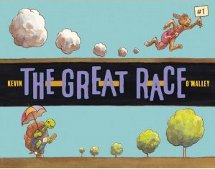
(Ages 4+) Picture book. Humour. The race between the tortoise and
the hare is given a new treatment in this funny parody of the
original fable. The hare in this tale is a strutting sports star,
beloved by the multitudes, receiving adulation wherever he goes.
Sporting sunglasses, he wears the latest clothing, and tells
everyone that he is the greatest. The tortoise can only try his
best, doing exercises to increase his abilities and fitness, but
practicing running by trotting to the pastry shop. When the big day
comes, humour abounds as the snail beats the tortoise in his run
along the road, and they both watch the hare in the foreground. But
near the end, something happens which will cause gales of laughter
from the young audience.
Humour is reflected in the charming illustrations. The hare is
always surrounded by his loving fans, and each page showing Hare is
full of animals, looking adoringly at their beloved, while each page
showing the tortoise is quite bare, the tortoise is the central
image, with few friends, a snail being his only companion. But the
tortoise wins, and the readers will laugh out loud at the way he
wins, and find humour in the situation the two animals find
themselves in. A gentle story of doing your best, of the vacuousness
of fandom, the story will engender much discussion about the
readers' favourite sports star and the hollowness of fame. And of
course, an astute teacher will use this story to compare it with the
original fable, The tortoise and the hare.
Fran Knight
Wood angel by Erin Bow
Chicken House, 2011. ISBN: 978-1-906427-60-3
(Age: 13+) Highly recommended. Alone in the world with only her cat
Taggle for company, Kate makes 'lucky' wooden charms to sell. But
her unusual gift marks her out in a place where witches are still
burned.
When Kate's village falls on a bad time known as the 'Skara Rok' she
is accused of practising dark magic. Scared for her life Kate turns
to a stranger. But he has a plan more dangerous than Kate could have
ever have dreamed of. It's up to Kate to carve good out of evil.The
main character plain Kate is a teenage girl who faces a lot of
problems during the novel. Kate's two main problems are dealing with
the death of her father and everyone around her and losing her
shadow to a stranger. She goes and joins a group of people known as
the Roamers. She stays with them throughout the story and makes many
new friends. During the novel Kate faces many added dangers and
problems while trying to get her Shadow back from the stranger. Will
Kate get her shadow back from the stranger before he harms everyone?
I like this book because it is told from Kate's perspective and the
way that the Erin Bow brought it all together. It makes me feel as
if I am in the story with all the characters. I also like the book
because of the adventure, poetry and family themes in the novel.
Wood Angel is a highly engaging novel and Erin has written a
beautifully crafted novel. I would love to find other novel written
by Erin Bow as she is a stunning author. I would highly recommend
this novel to others who are in to the fantasy genre.
Emily Madden (Student, Yr 9)
Pirate X by Sherryl Clark
UQP, 2011. ISBN 978 0 7022 3889 5.
(Ages 10+) Highly recommended. Adventure. Jumping onto the foredeck
of a sailing ship Blackbeard appears, cutlass and guns ready, black
hair wildly alive with red ribbons, and in his flowing majestic
black bear, live fuses are fizzing. Will is astounded. Only a few
days before he was on the run from a shop owner in London, from whom
he had stolen some rolls, and when he fell, hitting his head, he
woke up three centuries before, and taken on board a pirate ship.
Here he learns to keep his head down and his thoughts private. He is
befriended by Major Steele Bonnet, the captain of the ship, but
something is obviously wrong. Blackbeard runs the ship, Revenge,
while the Major often remains in his cabin, alternately being a man
of iron, and then a drunk.
Life on board a ship in 1717 is harsh and cruel, with the crew
working long hours to keep the vessel afloat and seaworthy, given
rotten meat and weevily food to survive on. Will craves for broccoli
and butter, and when the ship stops at a Caribbean island, he gorges
on fresh pineapple. Not only must Will learn to use the cutlass and
pistol, the ropes of the ship,but he must also watch his back as he
has earnt the enmity of one of the ship's bullies who has vowed to
kill him.
Pirate life is brutal and bloody and we sees the full scope of what
life must have been like aboard these ships. Clark's research is
monumental, the setting so realistic its impossible to separate fact
from fiction. The background to the story, meticulously researched
is mind boggling as we descend into the bowels of the ship, haul
water or or gunpowder, throw bodies and badly wounded over board, or
bombard Charle Town. Clark was entranced with the story of Major
Steele bonnet, and in researching him, a failure as a pirate, wrote
this book. It is sure to capture a wide and appreciative audience,
adding reality to the fantasy of the Pirates of the Caribbean series
of films.
Fran Knight
Where there's smoke by John Heffernan
Omnibus, 2010. ISBN978 1 86291 866 5.
(Ages 10+) Recommended. Fire. Stunned by the sound of a motorbike,
during one hot afternoon at school, recalling his father's abuse and
the reason he ad his mother have left home, Luke is surprised into
answering his teacher in less than respectful way and so is sent to
the principal. But he runs off to the one person who he knows will
understand the anger that is inside him, his family's friend and
saviour, Tiny. He offers to stay at their place until the threat of
the man's return is over, much to their relief. But Luke must still
contend with the bully at school, and placate his friend, Sarah, who
has told him in every way she can, not to fight. But fighting seems
to him the only way he can throw off bullies and it is to this that
he resorts every time he is threatened.
Meanwhile, small fires are building up in the summer's heat, and
people look to the hills around Edenville, shading their eyes from
the glare of the sun, to check where the fires are. Nina and Luke
too, look out, not for the fire, but for Nina's ex-husband, a man
she knows has found them yet again, carrying through this threat
never to leave them alone.
Two strong themes are presented in this easy to read, fast paced
story of fire, with the threat of fire ever present just as the
lingering threat of Nina's ex-husband is always there. Both threats
come to a climax and readers will avidly read to the end, learning
about the reality of bushfires in rural Australia and much about
fire safety. Without being didactic, Heffernan creates a situation
where readers will learn about the recent Victorian bushfires
through the impact of such a fire on a small hills community.
Fran Knight
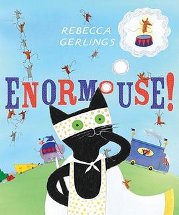
Enormouse! by Rebecca Gerlings
Egmont, 2011. ISBN 978 1 4052 4832 7.
(Ages 5+) Picture book. When a kitten with big ideas falls
from
his window and falls into the caravan, a part of a circus driving
through the town, the animals work hard to include him in their act.
But he doesn't quite make the grade. One evening, he has a big idea,
and so sets up a tent with cheese as the attraction and lures
hundreds
of mice into his domain.
The next day his act is a sellout, as he puts all the mice together,
making one big animal which he trains like a lion tamer. Doing
tricks
and like no other act, he is very successful, and has sell out shows
all over the world, showing that just one big idea can be most
fruitful
in someone's life.
The illustrations which accompany the text are wonderful, ranging
from
the pastel colours when the kitten is falling from the building, up
to
bold bright colours when he has achieved success. Readers will love
the
little jokes hidden on each page of pictures, and seek them out as
they
read.
Fran Knight
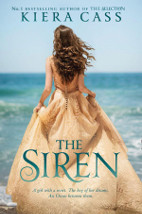
Siren by Tricia Rayburn
Penguin, 2011. ISBN 9780143204497 (Age: 12+) Vanessa Sands is on a holiday with her family in Winter
Harbour when her sister tragically leaps to her death off some local
cliffs. Everyone claims it is either suicide or a horrible accident,
but Vanessa thinks otherwise, and begins searching for the real
reason to her beloved sister's passing. But she also has another
problem. Since her sister's death in the ocean, more bodies have
been washing up on the shore, all of them men, grinning from ear to
ear . . .
Can Vanessa face who she truly is?
This book appears interesting, original, and exciting at a first
glance, but once the first-chapter threshold is passed, the true
nature is revealed.
This book does manage to be original in some ways, mainly because
the idea of a modern day 'siren' is not really that common in
novels, yet. It's an interesting concept, and this book could have
been really interesting, but unfortunately the engaging storyline is
let down by poor character structure and development, frustrating
dialogue, and bland description, each of which I will now talk about
in turn.
The characters are two-dimensional, and they're hard to imagine as
real people, because they don't talk like it seems they should. This
is also a part of the dialogue problem. Overall, it's not half-bad,
but there is very little sustained conflict throughout the novel,
and every twist or problem is explained (conveniently) by a
character. The description is a fair problem also, as not much time
is taken to describe scenes and characters, and this lets down the
plot a little. Overall, this makes the book quite boring to read.
This is a very mild romance/mystery novel. Resist the siren's call
for this one, and spend your money on something better.
Rebecca Adams (Student)
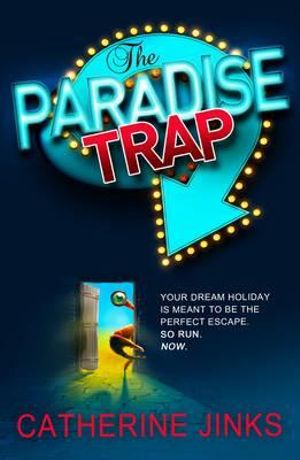
The Paradise trap by Catherine Jinks
Allen and Unwin, 2011. ISBN 9781742375
(Age: 10-14) Recommended. Fantasy. When his Mum decides to go back to
Diamond Beach for a holiday, Marcus is not so sure. He is quite
happy playing his computer games and doesn't trust the happy
memories that his mother has about the seaside town. When he
discovers a hidden cellar under the old smelly caravan that his
mother has bought, he is dragged into a series of fantasy holidays
with his new friends the Huckstepps. But how do you get back home if
your fantasy won't let you go?
Catherine Jinks, a favourite author of mine, is a masterly writer
who can be relied on to come up with the unexpected. Who would
expect to find an entrance into a fantasy world under an old
caravan? The intertwining of Greek mythology with the adventures
that the two families have is ingenious and is sure to get kids
looking up stories about sirens and Odyssey. There is plenty of
action and suspense and everyone has to use their ingenuity and work
together as a team to find a way out of the labyrinth of the fantasy
holidays.
Marcus is a most appealing hero, and is supported by the in-depth
characterisation of everyone around him. It is unusual to find whole
families involved in the fantasy world but Jinks takes along Marcus
and his Mum, and all the Huckstepp family on a wild ride to get out
of their dream holidays and home to safety. By the end of the story
I felt as if I knew each member really well, with all their
strengths and foibles.
How many of us have had a holiday that doesn't live up to
expectations or the ideal destination is smaller and meaner than our
childhood memories? Jinks explores the meaning of expectation,
feelings of being let down and disappointment in the context of
thrills and spills in a fantasy world.
This is a thoroughly enjoyable story that I read in one sitting. It
is one that everyone could consume for the action while more
thoughtful readers could explore the complex imagery and ideas that
Jinks provides in this exciting and unique story.
Pat Pledger
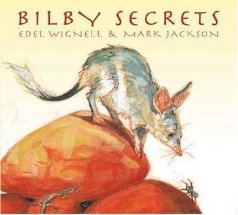
Bilby secrets by Edel Wignell and Mark Jackson
Walker Books, 2011. ISBN 978 1 921529 32 0.
(Ages 5+) Highly recommended. Picture book. The hostile environment
of the Australian desert is captured in words and illustrations in
this superior picture book, telling both a story and giving factual
information about the rare Australian mammal, the bilby. The front
endpaper introduces the reader to the bilby, an endangered mammal,
living in very remote areas of Western Australia, and although
rarely, if ever, seen in the wild, is beginning to replace the
rabbit as the animal of choice at Easter.
The story begins with the female bilby finding her burrow to wait
for the birth of her baby. The next few pages tell us of the
development of the baby bilby, how it grows and survives, eventually
coming out of the pouch to remain in the burrow while mother hunts.
Mother then goes off foraging for feed, storing it in her cheeks to
return to the young bilby. When it is ready to leave the nest it
goes out into the night, mindful of the dangers present, an owl, a
fox, a snake. The story follows the routines of their lives, while
elsewhere on each page is information about the bilby. The story
itself has no unecessary words, each sentence tells the reader
something about the bilby and its survival, about the environment in
which it lives, while the information, given in a different font,
presents it in more factual terms.
This wonderful story of the bilby makes an entrancing tale to tell
younger readers and an informative text for older readers. The words
are evocative and precise, while the illustrations, giving a
sweeping view of the little space the bilby occupies are majestic.
While this is a beautiful story to read to a class, it is also an
information book with an index at the back for student use. it will
make a wonderful beginning text in a classroom where students are
being introduced to information books, indexes and research.
Creative non-fiction at its best.
Fran Knight
Speaking of tangents
An interview with A.J. Betts by Fran Knight
Tangent: Trigonometric function that is equal to the ratio of the
sides (other than the hypotenuse) opposite and adjacent to an angle
in a right triangle.
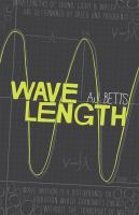
A.J. Betts, author of Wavelength and Shutterspeed,
two adolescent novels published by Perth's Fremantle Press, loves
muffins, but the idea for her latest novel, Wavelength came
unexpectedly from a bad experience with her favourite treat. Venting
her outrage on her trusty lap top for an hour or so, gave her the
idea for Oliver's mother, a hard pressed single mum, furiously
making muffins from some god forsaken hour in the morning to create
an income for the family. Oliver, a demented year 12 student, is
slavishly following his peer group in obsessing about his exams, all
to get a particular university entrance score. The two forces are
bound to clash, and they do so with spectacular results.
This stream of consciousness approach worked exceptionally well with
Wavelength, but it was quite the opposite with Amanda's first
book, Shutterspeed. She took a text book approach with this
story, making up character profiles, plotting a course of action for
the tale, developing lines of plot. Both approaches worked well,
making the development of characters a line I wanted to pursue when
interviewing A. J. Betts recently. But tangents kept getting in the
way.
Part of Wavelength is set, most satisfyingly in a retirement
village. An idea fraught with danger, I thought, because it lends
itself to the observation of the elderly as a homgeneous group,
displaying characteristics bounded by their ages. But in Amanda's
hands, no such cliche is obvious. Each person has a delineated
personality, each can be viewed as a separate entity with their own
story. One is based on Amanda's grandfather, another of a woman with
dementia she met in a shopping centre, another through observations
of older people in an aquarobics class.
But what about those chapter headings? I hesitated to ask.
The Wavelength chapter headings, mysteriously offering the
reader a brief tangental look into long forgotten physics lessons or
things still being committed to memory, reflect the nature of the
emotional regime Oliver is experiencing at the time - as well as
Amanda's recent interest in science. Interestingly the chapter
headings were about rocks, with the book divided into three
sections, Igneous, Metamorphic and Sedentary, the chapter headings
reflecting the rocks of those eras, ranging from the very hard to
the more malleable and softer rocks at the end, when Oliver has at
last realised just what he wants to do. Amanda adores metaphors!
A teacher with the Western Australian Education Department in the
Hospital School, Amanda loves the variety of work this offers. But
writing was always her aim, so much so that when she drove to Perth
in 2004, from her then home in Brisbane, she made herself a promise
that she would stay in Perth until she had a novel published. Now
with two published and another manuscript (entered for the Vogel
Award in 2010 because that was the last year she fitted the
criteria) receiving encouragement to develop the story further, she
has some decisions to make.
But writing full time means earning money from other sources, so she
is investigating further the possibilities of school visits.
Mentorships from societies such as the May Gibbs Children's
Literature Trust means that time can be spent unhindered for a
little while, taking time out just for writing and collecting
stories. And Fremantle Press with its editor, have been solid in
their support of Amanda and her work.
Amanda is excited that her novel, Wavelength, has been
shortlisted for the Western Australian Premier's Award, where she is
one amongst a group of authors whose names are far more well known.
Not surprisingly, Amanda has found that people have questioned
whether she would be better off living in the eastern states. And
this is another question with which she will need to grapple.
Another tangent which takes her away from writing.
With a list of the best cafes in the city to visit, Cibos, Brown
Dog, Nanos, as well as places in Croydon and North Adelaide, from
friends suggestions and her own googling, Amanda is well attuned to
Adelaide life for the four weeks she is here for her Fellowship.
Cafes are wonderful places to write, so you may see a young woman in
bike lycra, tapping away on her lap top, listening into
conversations, watching for a diversion to give her more material
for her writing.
Tangent: Adjective
(of a line or plane) touching, but not intersecting, a curve or
curved surface.
Fran Knight
Warambi by Aleesah Darlison
Ill. by Andrew Plant. Working Title Press, 2011. ISBN 978
1921504 28 0.
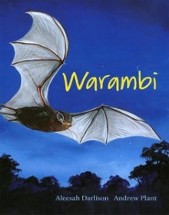
(All ages) Picture book. The birth of the bent-wing bat in its dark
cave, means that it attaches itself to its mother for drinking and
sleeping while enfolded in her warm wings. The little bat stays like
this for some time, but when mum flies out looking for insects, the
pup must crowd together with the other babies, keeping warm until
their mothers return. Eventually the pups too go outside, learning
to collect the insects for themselves, with their mothers to teach
them. So life goes on, but one day, big machinery pulls apart the
cave in which these bats live, causing the pup to fly off into the
night sky, alone. Warambi takes refuge in the pocket of a coat, hung
outside a farmhouse, and there she stays, warm and protected until
found by the farmer. He then takes her out into the farmland and
lets her go.
The stunning blue pages will draw the reader in to the life cycle of
a bent-wing bat, following the story of Warambi, based on a true
story of this little bat's survival. Much will be learnt from the
story itself, the way a bat lives, its initial dependence on its
mother, its learning to survive alone, and then of course, the
effects of the relentless push by suburbia into its habitat.
Students will be able to use this book as an entry into talk of
conservation and habitat destruction, of sustainability and of
course, about an Australian mammal, the bent-wing bat. The end
papers are full of information about the bent-wing bats, which will
thrill younger readers, looking for more facts after reading the
story. An appropriate read for the Year of the Bat (2011).
Fran Knight
A Pocketful of Eyes by Lili Wilkinson
Allen And Unwin, 2011. ISBN 9781742376196.
(Age 13+) Recommended.
Blurb from cover:
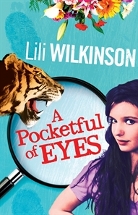
'Bee is in her element volunteering in the taxidermy department at
the Museum of Natural History - but her summer job turns out to be
full of surprises: A dead body in the Red Rotunda. A mysterious
Museum benefactor. A large stuffed tiger in the catacombs. A
handsome boy with a fascination for unusual animal mating habits.
And a pocket full of glass eyes. Can Bee sift through the clues and
discover if her colleague committed suicide or if there's a murderer
in their midst?'
Bee doesn't believe that her boss, Gus, committed suicide. She's
convinced that it was murder and, like the heroines in the books
that she has loved, (Trixie Belden and those in books by Janet
Evanovich and Agatha Christie) she is determined to find out what
happened. With the gorgeous Toby by her side, Bee starts
investigating and she takes the reader on a thrilling ride as she
plunges from one suspect to another. This all happens in the Museum
of Natural History as Bee works on bringing animals back to life
with glass eyes and tiny stitches. I really enjoyed learning the
intricate procedures of taxidermy as Bee sorted through alibis and
red herrings.
I really admire the way that Lili Wilkinson is able to write
fabulous stories in different genres. In A pocketful of eyes
her prose is funny and her characters are quirky, especially Bee's
mother who loves playing games on her playstation, and who has a
boyfriend whose nickname is Celestial Badger. Although there are
many clues spread throughout the story I still didn't manage to work
out who dunnit! What a contrast this mystery is to the beautiful
poignancy of the historical book, Angel fish, the story of
the Children's Crusade. Both are so satisfying in the depth of their
characterisation and setting.
This is a very funny story that will please both girls and boys who
enjoy a mystery with a very slight dash of romance thrown in. It
would also be an excellent introduction to the mystery genre and is
certainly a must for the library shelves.
Pat Pledger
The Bridge by Jane Higgins
The Text Publishing Company, 2011. ISBN 9781921758331.
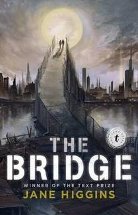
(Ages 13+) Nik has always wanted to join the ISIS, but the problem
is that it's not that simple. You can't just join; they have to pick
you. The ISIS are the brains behind the army on the Cityside,
fighting the war against the Hostiles on the Southside on the other
side of the river. When the day finally comes, the day Nik has
waited for his whole life, they don't pick him. Nik is desperate for
answers, the ISIS pick the smartest people in the school usually and
Nik is one of the smartest people in his year. Then the school gets
bombed and so much is lost in the attack. Nik losses his best friend
Lou. Lou's sister Fyffe and brother Sol are devastated by the loss
of their brother and Fyffe, Sol, Jono, Dash and Nik also lose their
friend Bella. The city has become unsafe, the Hostiles have taken
the bridges and now control who goes in and out of the city. As a
group they decide to leave the city to take Fyffe and Sol home, but
it all goes wrong when Sol is taken by the Hostiles so to save him
Nik, along with Fyffe, leave Dash and Jono behind and go across the
bridge.
This book is amazing. I just could not put it down. I had to keep
reading. The book just pulls you in and makes you want to keep
reading. I would highly recommend this book, it has adventure and
danger and it truly shows you how far friends and family will go for
each other.
Tahlia Kennewell (Student)
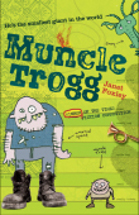
Muncle Trogg by Janet Foxley
Illustrated by Steven Wells. Scholastic 2011 ISBN 978 1 906427 03 0
(Ages 10+) Humour, Warmly recommended. Muncle, son of the Trogg
family, giants who live in top of Mount Grumble, is picked on
mercilessly because of his size. He's about to leave school, after
the compulsory five years, but is no bigger than a Smalling, the
creatures that live outside the mountain, the enemies of the giants.
His brother, Gritt, is normal size and is desperate to join the
Titan Gang at school, run by the school's nastiest bully, Titan.
On a school excursion to the Palace, Muncle meets the Wise Man, who
gives Muncle some Smalling clothes to try on. He shows the class one
of the treasures of their museum, a book, which contains magic from
the Smallings, but as no one can read and write in this kingdom, it
is useless. But the Wise Man has an idea after dressing Muncle, and
takes him away for lunch. So begins an extraordinary adventure for
Muncle. He goes in disguise to the Smalling land and there helps a
dragon return to Mount Grumble, learning to fly the creature on his
return. Everyone is impressed with the adventures of Muncle, so new
things await him at the Palace.
A fun book which will appeal to middle primary people looking for
something a little unusual.
Fran Knight
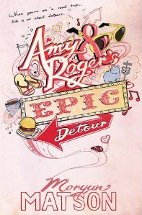
Amy & Roger's Epic Detour by Morgan Matson
Simon and Schuster, 2011. ISBN 9780857072689.
(Age 15+) Recommended as a light read. Amy Curry's life is a mess.
Her father has been killed in an accident and her brother is in
rehab. Her mother has decided to move from California to Connecticut
to make a fresh start and has left her behind in their old home.
When Amy's mother decides that she has to have her car, she
organises that Roger, the son of a friend, will join Amy on a road
trip to bring the car to her. Amy is not too happy about this
but as their epic journey progresses and she gets to know Roger, she
begins to feel alive again.
Told in the first person narrative by Amy, the reader is taken on a
fascinating tour of the US. I held my breath as she and Roger
journeyed along Highway 50, the loneliest highway in the US and
wondered if they would meet a twister in Colorado. I am now
determined to visit Yosemite National Park and eat a Hot Brown and
Derby pie at the Brown Hotel in Louisville, Kentucky. The
narrative is interspersed with scrapbook pages of maps, drawings,
postcards, playlists and receipts showing what they ate and spent on
hotels as well as snippets of information about each state, its
motto and size. It's sure to inspire girls to try a road trip for
themselves.
The journey that Amy takes to regain her life is just as engrossing
to read as the road trip. She starts off completely wrecked,
uninterested in anything, fearful and afraid to look anyone in the
eye. She hasn't grieved properly for her father, and she feels that
her mother and brother blame her for his death. As she and Roger get
to know each other and she meets others on her trip she gradually
begins to come to terms with everything. Roger, too, has his
problems and uses the road trip to work out his feelings about the
way that his girlfriend Hadley had dumped him. The people they meet
on the way are awesome: Bronwyn gives Amy a new set of clothes so
she can't camouflage herself anymore, Leonard makes her Princess Amy
in his video game, Walcott gets her to open up and Lucien makes her
a topiary owl.
I laughed and cried as I read this book. It's sad, uplifting but
ultimately lots of fun to travel across the US with Amy and Roger on
their epic detour.
Pat Pledger
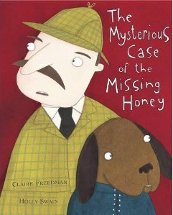
The mysterious case of the missing honey by Claire Freedman and Holly Swain
Guillane Children's Books, 2011. ISBN 978 1862337862.
(Ages 6+) Warmly recommended. Picture book. When Inspector
Clueless picks up the phone call from Mr Bear,one busy Monday
morning, he can have no idea that this theft will keep he and his
trusty companion, Sniff-It-Out, busy for the rest of the week. The
crime, two jars of stolen honey seems an open and shut case, with
the sleuths on the crime scene looking for clues immediately. They
go through their files back at the station, and are on the trail of
two notorious thieves very quickly. But the next night two more jars
of honey are empty, and the pair is baffled. Both f the crooks they
had under watch were not the thieves, so the following night, they
stay on watch at the bear's house. A funny story incorporating lots
of words used in crime stories and television shows, the book is fun
to read and would be an ideal opener for a unit on law and order or
when talking about the police in the classroom.
The list of suspects will engender discussion around puns and use of
words to create images, as phrase such as Beak the Sneak, and
Stretch Giraffe are used as the names of some of the suspects.
Clueless and Sniff-It-Out will cause lots of laughter from the
readers as they follow their antics in trying to find the thief. The
illustrations are priceless with their little hidden motifs
capturing the readers' attention. I love Sniff-It-Out's uniform, the
carrot cake at the party, the house of Fingers the Frog. All
delightful and inviting.
Fran Knight